International Journal of Advances in Management and Economics
Available online at:
www.managementjournal.info
RESEARCH ARTICLE
Samuel Carvalho De Benedicto et. al. | Jan.- Feb. 2019 | Vol.8| Issue 1 |80-94 80
Strategic Management Under the Optics of Organizational
Socioenvironmental Performance
Candido Ferreira Silva Filho
1, Samuel Carvalho De Benedicto
1*,
Samanta
Bellao Peixoto
1, Cibele Roberta Sugahara
1Pontifícia universidade católica de campinas. Rod. Dom pedro i, km 136 – parque das universidades. Cep13086-900 campinas/sp-brasil.
*Corresponding Author:[email protected]
Abstract: The objective of this study is to discuss the importance and applicability of the strategic management in organizations in the construction of competitive advantages and their relationship with social and environmental responsibility. The purpose is to present the strategic performance as essential to the responsibility and socio-environmental performance, regardless of the size of the organization. As empirical evidence, an exploratory study with a qualitative approach was carried out using the 2016 and 2017 sustainability reports of honda, a multinational company present in south america for 45 years, that develops actions that exemplify and explain how promising it can be a model of strategic management in connection with socio-environmental responsibility. The honda s/a analysis allows us to conclude that the construction of an organization's competitive advantage is directly linked to the strategic vision of the high management, which must be aligned with the economic, social and environmental dimensions. In the company studied, the strategic actions taken to contemplate the tripod of sustainability promoted the reconfiguration of activities, generating changes at all levels of the organization: operational, tactical and strategic. The results obtained by the company involve: cost reduction, positive image, social commitment and environmental preservation.
Keywords:Strategic management; Competitive advantage; Socio-environmental sustainability.
Article Received: 30 Oct. 2018 Revised: 18 Nov. 2018 Accepted: 10 Dec. 2018
Introduction
The business world, influenced by the globalization and the incessant search for prominence in the current market, keeps changing. In this way, organizations increasingly face the need to reformulate their strategies in order to guarantee the company's competitiveness and profitability [1].
It is known that one of the great challenges of today's managers is to make strategic decisions that allow the companies to achieve the desired success, while mitigating the impact that such actions would cause to the environment and, consequently, to humanity. However, the strategic management applied intelligently and focused on ensuring social and environmental responsibility should be among the topics to be prioritized by the organization.
In general, in their trajectory, companies must adopt innumerable strategies, which define and are defined by the environment, technology and the structure of them.
Thus, the management of these strategies must be viewed in a holistic perspective by the organization, which will make it possible to analyze and understand management, and formulate and implement strategies. This knowledge aims at promoting the evaluation of the company in the present and in the future, as well as providing information for decision making, which is increasingly gaining visibility when managed in favor of the society and the environment [2].
When a company sets goals and seeks to achieve them, it has clearly defined why it exists, what it does, and where it wants to go [3]. The scarcity of resources, the degradation of the environment and the emission of polluting gases make up the present scenario of the great productive centers.
Samuel Carvalho De Benedicto et. al. | Jan.-Feb. 2019 | Vol.8| Issue 1 |80-94 81
without the longing for earnings corrupting the obligation and importance of considering sustainability as one of its great pillars to obtain success.
Regardless of their size or nature, every organization deals with a multitude of audiences that interfere positively or negatively in their lives. However, even today, referring to the management models seen as a reference, considering the importance of guaranteeing the company's socio-environmental responsibility, its application, in most cases, is seen as applicable only in large corporations. However, it is important to note that small businesses may be the big companies of the future.
Therefore, the awareness of the preciousness and care with how the environment must be treated must be part of the essence of the organization since its inception. In this way, it becomes evident that conscious attitudes will bring better gains for the future and greater credibility for the present [4]. Currently, knowledge about the planning and valuation of establishing strategies and appropriate goals to sustainability is fundamental for any company present in the market.
It can be said that the awareness about the subject has been widely discussed by large companies that seek to understand and improve their performance regarding sustainable actions, which are certainly excellent tools to reduce costs, generate good results and collaborate with the reduction of environmental impacts caused by the lack of environmental performance of products and business activities.
The relevance of deepening the theme is given to the fact that sustainability must be seen as a great ally for the companies to guarantee their strategic vision for the future, because from this understanding, the negative impacts generated by actions that do not value corporate sustainability are easily evidenced.
Therefore, the management that is not aware of the analysis of such impacts in a holistic way, may reverse its current profit in significant losses as a future result. Notably, creating strategies is fundamental and, coupled with a management that focuses on socio-environmental responsibility, can be seen as a result-generating tool.
However, the tendency is to mitigate large future losses through sustainability-focused management.
Therefore, this study aims to promote the understanding and the great relationship between strategic management and sustainability, in order to indicate the solution to the following question: is it possible to relate the economic success of a company to the fact that it enhances its mitigation of the impact that their actions would cause to the environment?
This study has as general objective to discuss about the importance and applicability of the strategic management in the organizations in the construction of competitive advantages and its relations with the socioenvironmental responsibility. The study aims at analyzing the relevance of the implementation of strategic management oriented towards sustainability and broaden the view of managers on the subject.
The purpose is to present the strategic performance as essential to the responsibility and socio-environmental performance, regardless of the size of the organization. The model aims to generate the necessary changes so that it has the capacity to make decisions that seek economic success, without losing the focus on its responsibility towards the environment and the human being, as well as assessing and containing the negative impacts on social and environmental development.
The work is justified due to the exigency of the current market, of the great technological advances and of the competition, themes correlated to the necessity to guarantee the survival of the organization through the management of the strategies. However, this issue is directly related to a problem that involves the great carelessness practiced in the world, in general, when it is related to the need to generate results to the importance of acting with sustainability and rigor with respect to the socio-environmental responsibility of organizations.
Samuel Carvalho De Benedicto et. al. | Jan.-Feb. 2019 | Vol.8| Issue 1 |80-94 82
Strategy and its Aspects
The origin of the word strategy comes from the Greek “strategos”, which means the art or science of being a general. Initially, strategy had a relation with the the military art of planning and executing movements and operations of troops, ships and/or airplanes to defeat enemies. Or the art of applying available means or exploring favorable conditions for specific purposes [5]. However, as time goes on, the term is now used in the business environment, as a managerial ability [6].
The strategy is a way of directing the company to the use of the resources that it possesses and the direction of a path to follow, facing the different objectives [6]. It is linked to the decision making within an organization, in order to define goals and objectives that will contribute to the desired results. Michael Porter presents concepts about strategy and competitive advantage, where it is possible to analyze the issues comprehensively and directly related to the events of today's world. According to the author, the essence of the formulation of competitive strategy involves relating a company to its environment.
This relationship must be made from a macro-environmental perspective, which considers the economic, socio-cultural, demographic, political and technological forces. Although the environment is broad and encompasses all these forces, since they are external and reach the company as a whole, mechanisms and skills must be created to deal with them [7].
As for the environments to which companies are inserted, one of the elements that make up strategic management is the external environment. The external environment of a company is divided into three main areas: general environment, industry and competition [8]. Given that, about the general environment, the authors state that it is composed of the elements of broader scope in society that influence the sector of related companies.
Thus, in order to be able to control the information necessary for the companies, it is needed to gather the data and information for the understanding of each segment and its implications so that the appropriate strategies can be selected and employed.
The degree of the competitors in an industry depends on five basic forces [...]. Together these forces determine the ultimate profit potential in the industry, which is measured in terms of long-term return on invested capital.
So, each organization will have different forces influencing it, whether they are intense or not. Hence, the potential for profit differs from one firm to another as these forces differ. The five competitive forces are: the entry of new competitors, the threat of substitutes, the bargaining power of buyers, the bargaining power of suppliers and the rivalry between existing competitors [7].
All five competitive forces together determine the intensity of competition in an industry as well as profitability, with the most strength or forces predominating and becoming crucial from the point of view of strategy formulation [7].
As for the basic structure of a company, it is reflected in the strength of the forces. Short-term factors must be distinguished so that profitability and competition are affected only on a transient basis. Knowing that the focus in the structural analysis of a company lies in the identification of its basic characteristics, rooted in its economy and technology, these characteristics shape the arena in which the competitive strategy must be established.
Regarding the actions that refer to the knowledge of the competitive forces, the author affirms that the companies will each have particular strengths and weaknesses when dealing with the structure of the industry, and this can change and it really changes gradually over time.
In this way, it can be concluded that knowledge and understanding are essential for the strategy to be formulated. It is clear that the teachings conveyed in the concept of Porter's forces act, however, on the business of the company, and that the assessment of these make all the difference when you want to make room in the current competitive market.
Samuel Carvalho De Benedicto et. al. | Jan.-Feb. 2019 | Vol.8| Issue 1 |80-94 83
However, the author makes clear that such strategies should lead to a behavior that is aligned in social terms, established by ethical standards and public policies [7].
Although many companies use the strategic planning mechanism, many of them have doubts about the method of elaboration and their specific objectives [9]. However, only a small number of companies realize the true strategic planning that allows establishing the direction to be followed by the organization, aiming at a greater degree of interaction with the environment.
This direction includes the scope of action, macro politics, and functional policies, philosophy of action, macro strategy, functional strategies, macro-objectives and functional objectives; while the degree of integration depends on the behavior assumed by the organization with the medium of which it forms part.
However, for the company to stand out in the market, it is necessary that it has a competitive strategy, with the objective of focusing on actions to expand or sustainably maintain its advantages over its competitors. This strategy must come from a detailed knowledge of the structure and the way in which it changes [7].
It is known that the development of the sustainable awareness by companies has been treated with great propriety and seen as a great ally in order to obtain competitive advantages. Although in many companies sustainable performance is directed only at competitive factors, this model of performance, when practiced with awareness of the socio-environmental responsibility of the organization, will lead to the sustainable development [10].
Sustainable Development
The concept of sustainable development was presented by the World Commission on Environment and Development (CMMAD), during the United Nations General Assembly, through the report Our Common Future in 1987 [11]. Such a concept assumes the rational use of the natural resources without developing sustainability risks, that is, growth that produces goods and services, well-being and comfort, without compromising the ability of future generations to meet their own needs [12].
The terms sustainability and sustainable development are often related. The term that involves development is used to represent the expectation that the country guarantees a permanent economic development and expansion and that it remains in that condition over time, which would generate improvement in social indicators, in addition to environmental preservation [13].
Sustainability is defined as the ability to self-sustain. Therefore, it can be considered a sustainable activity as one that can be maintained for an indeterminate period of time, so that it is never exhausted, although there are unforeseen events that may occur during this period. This concept can be broadened by addressing the issue of sustainable society, which represents a society that does not jeopardize natural resources such as air, water, soil and plant and animal life on which life depends [14].
Part of the responsibility for this awareness is due to the consumers, who began to demand more, seeking to select products that have specific characteristics, such as clean production from the environmental point of view [15]. In an in-depth analysis, the implementation of corporate social responsibility, through social and environmental responsibility actions, can be seen as additional costs and that would tend to reduce the remuneration that could be earned by shareholders.
However, the studies show a very different reality, where the actions of social and environmental responsibility generate positive results for companies. According to the author, when developing strategies that meet both parties being shareholders/members and the other employees/community, it requires a debate on the interests of the company and that is why it is interested in carrying out an investigation of an empirical nature to the performance of the company in reconciling social responsibility or corporate sustainability indices and its corporate performance in terms of risk and return [16].
Samuel Carvalho De Benedicto et. al. | Jan.-Feb. 2019 | Vol.8| Issue 1 |80-94 84
Corporations have been pressured by their stakeholders to implement initiatives that are in line with the principles of sustainability.
The theme promotes the reconfiguration of its operational activities and, gradually, has reached the top management of the organizations, ensuring that changes occur at a strategic level, not only at operational levels [18]. Thus, the desired development model is based on clean technologies and renewable energies (and no longer the "chimneys") and requires organizations to keep social and environmental responsibility [19].
Corporate Sustainability
A comprehensive and long-term corporate strategy, aligned with the core business objectives and with its core competencies working to create a positive social change and value for the business, and which is embedded in day-to-day business operations, is what one can call strategic sustainability [19]. Within corporations, three fundamental components for sustainable development are defined: economic growth, protection of the environment and social equality. The breakdown of paradigm occurred in companies that had as sole focus the financial performance, it brought the aforementioned concept with three-dimensional objectives, which gave rise to the term "tripod of sustainability" or Triple Bottom Line. [18].
In this way, the search for corporate sustainability begins, translated through the socio-environmental responsibility of the organizations and their environmental performance in the business activities. Strategic business sustainability cannot be achieved without taking into account the well-known sustainability tripod, which is a tool analyzed by companies and researchers, which seeks to interpret the interactions that come from the external environment and especially to illustrate the importance of a holistic vision of sustainability, which is not limited to mere economic sustainability.
It is worth noting that within the principles of sustainability, social issues cannot be separated from environmental issues. In this way, an ecologically sustainable organization also acts in a socially responsible way, in order to serve the interests of all
stakeholders that affect or are affected by its activities [20].
Social responsibility can be defined as an organization's commitment to society, expressed through acts and attitudes that positively affect it broadly or to a specific community, acting in a proactive and coherent way to its role in society and accountability to it [21]. Social and environmental responsibility, ethics and transparency also presuppose security in the work environment as a question of management quality, ethnic and gender diversity in the composition of the staff as appropriate human resources policies [19].
Management with a focus on sustainable strategies means not only worrying about economic results, but also working towards corporate sustainability, with the efficient use of natural resources, with a view to reducing losses in the production process and maximizing profit, organizational and social objectives, in an integrated and capable way [22].
The image of the organization has become a point of great influence with its stakeholders. The social and environmental transformations that the corporate world has faced indicate a pre-eminent need for community recognition of business transparency actions [23].
Some factors interfere in the fact that organizations are driven to the construction of sustainability, because in addition to the need to socialize the sustainable actions developed in the company, through social balance sheets, sustainability reports and indicators, companies are inserted in an environment with new challenges, which requires ethical posture, cultural values, environmental behavior, cleaner products and increasingly stringent legislation in relation to social and environmental issues [23].
Samuel Carvalho De Benedicto et. al. | Jan.-Feb. 2019 | Vol.8| Issue 1 |80-94 85
environmental performance of the consumers of an industry [20].
Currently, the demand for information and accountability regarding environmental and social practices of the companies, by the interest groups, is constantly increasing. Corporate sustainability is a subject that top management must consider in its strategies. The strategies must be in accordance with the principles of corporate sustainability, which is an individualized process and that each organization must choose its positioning relative to the theme, taking into account its strategy, its values and principles and the market context in which it is [21].
The relationship between improving company performance and sustainability investments is a much discussed theme in organizations beyond the question of the possible benefits generated in the financial result from investments made in the pollution prevention. The combination of environmental technologies (with the objective to minimize the impacts caused to the environment) with new production technologies brings great potential of competitive advantage and superior performance for companies [24].
Global Reporting Initiative (GRI) Sustainability Reports
Sustainability issues have become a part of most companies, so financial metrics alone can not determine business performance or success, companies need to produce reliable, relevant, and appropriate information for the purpose of business decisions and ensure the significant and reliable disclosure of social and environmental metrics [25]. The number of companies that wish to evaluate and report their performance and social, environmental, economic and governance impacts, grows every day.
This trend has already happened for some years and represent the reason for the existence of sustainability reports which is a public document that informs the stakeholder how the organization is facing corporate challenges in sustainability. The report aims to provide quantitative and qualitative information that shows how the company's economic, environmental and social effectiveness was in the reported period [26].
The Global Reporting Initiative (GRI) is the largest initiative related to the standardization of economic, environmental and social disclosures, included in the annual accounts reports. They are the first and most widely adopted global sustainability reporting standards. The Sustainability Reporting Standards is its primary product, made available as a free public good. They have been continuously developed over 20 years and represent the best global practice for reporting on economic, environmental and social issues [27].
GRI-based sustainability reports provide a platform for companies to disclose their initiatives related to the Global Compact, the Millennium Development Goals and the Equator Principles, as well as being fully aligned with the New York Stock Exchange Sustainability Indexes (DJSI) and of London (FTSE4good). In Brazil, it is worth emphasizing the alignment of the GRI reports with several initiatives, such as the BM & FBovespa's Corporate Sustainability Index (ISE).
The GRI Guidelines use as a reference, whenever possible, generally accepted international regulations and standards, among which: Article 15 of the Rio Principles; Universal Declaration of Human Rights of the United Nations and its Protocols; United Nations Convention: International Covenant on Civil and Political Rights; United Nations Convention: International Covenant on Economic, Social and Cultural Rights; Declaration of the International Labor Organization (ILO) on Fundamental Principles and Rights at Work, 1998; Vienna Declaration and Program of Action; ILO Tripartite Declaration on Multinational Enterprises and Social Policy; Organization for Economic Co-operation and Development (OECD) Guidelines for Multinational Enterprises and; Principles of the Global Compact [28].
Samuel Carvalho De Benedicto et. al. | Jan.-Feb. 2019 | Vol.8| Issue 1 |80-94 86
It is an information medium increasingly demanded by society to know the reality of organizations, which further reinforces the importance of incorporating sustainability into business strategies. In addition, ensuring that this information is public raises the levels of credibility and transparency of the organization [28].
On a global scale, of the 250 largest companies, about 93% produce reports. Brazil is the leader in publications in Latin America, with over 60 annual sustainability reports. As we noted in Table 1, a survey conducted by GRI in 2011 showed that disclosure of this document contributes to building a more positive image of the company when it finds sustainability information in reports.
Board 1: Interest in sustainability information
Stakeholder Indication of Interest in Sustainability Information
Investors
Carbon Disclosure Project - 200 investors required disclosure of greenhouse gas emissions. Shareholder deliberations for a more comprehensive report.
Dow Jones Sustainability Index and others have requested information on sustainability. Principles of Ecuador - the main financial actors required the discussion of the socio-environmental
impacts of large projects in developing countries. Regulatory Agencies Many actions required socio-environmental data in annual reports.
Employees One of the main sustainability reporting publics.
NGOs
Publish What You Pay - 200 NGOs around the world have called for transparency in tax and royalties payments.
From 56 global socio-environmental NGOs, 79% considered Sustainability Reports to be "very" or "reasonably" useful.
General public In a survey of 21,000 people, 50% said that having read or heard about a sustainability report improved their impression of the company, led them to buy company products or speak well of the company to others.
Media Many business rankings have socio-environmental criteria.
Source: [29]
Methodology
From the point of view of its nature, this research is applied, by generating practical knowledge aimed at solving specific problems involving local truths and interests [30]. Regarding the problem approach, the research is defined as qualitative, since it does not require the use of statistical methods and techniques [31]. Qualitative research seeks the systematic explanation of facts that occur in the social context, which is usually related to a multiplicity of variables.
It is appropriate when it is sought to study subjectivity, beliefs, values, attitudes, social relations and practices, strategies, management models and changes occurring in the organizational, social, political and economic context [32]. The descriptive data will be analyzed inductively, having its process and significance as main focus of approach [33]. With regard to the objectives, this research is exploratory to the objective of making the problem explicit or to construct hypotheses [34].
An exploratory study is adopted in situations where the object of research is still little known or not studied. In this way, the exploratory study has the greater familiarity with the problem and allows to show it better.
Between other possibilities, the exploratory study involves bibliographical survey and documentary analysis [32]. As for the sources of data collection, the 2016 and 2017 Sustainability Reports of the company Honda were prospected, becoming thus, an exploratory documentary study [32].
The sample was selected in a non-probabilistic or convenience manner [34] taking into account the accessibility of the researcher to the data. In this study, the content analysis was chosen as the technique of data analysis. In recent years, content analysis has been emphasizing qualitative methods and gaining legitimacy. The importance of content analysis for organizational studies is increasing and has evolved because of the concern with scientific rigor and depth of research [35].
Samuel Carvalho De Benedicto et. al. | Jan.-Feb. 2019 | Vol.8| Issue 1 |80-94 87
Honda South America: Management with a Focus on Sustainability
With a view to discussing the relationship between economic success and actions to mitigate environmental impact, we take as a reference the experience of Honda South America, recognized as the only company in the Brazilian automotive sector that is self-sufficient in renewable energy. Honda is a Japanese multinational company that has been present in South America for 45 years, focusing on the manufacture and marketing of automobiles, motorcycles, quadricycles, tricycles, power products and, starting in 2015, began to commercialize executive jets in Brazil.
The brand's motorcycles came to be imported into Brazil in 1971, and five years after Honda's inception in the country, the first factory was inaugurated in the industrial hub of Manaus in 1976. In parallel, the company also expanded its factories to other countries in South America, such as Peru in 1975 and Argentina in 1978. In June 1992, the company's headquarters established its Honda Environmental Statement in order to spell out the company's environmental and safety vision.
The management model is used as the basis for all the units that make up the group. Since the company's business strategy has focused on sustainability since its inception, its corporate structure has an internal department called ESG, which stands for Environment, Social Responsibility and Governance in order to meet the requirements of the market and align with the strategies of the corporation.
Regarding its suppliers, since 2008, Honda Automobiles has taken action to reduce CO2 emissions from suppliers, where the goal is for each supplier to achieve a reduction of 1% of its emissions annually. Companies with more notable initiatives are recognized through the Honda Environmental Award, a renowned award in the current market.
Honda SA (HSA) works together with its headquarter in Japan, and through the application of its product innovation, it seeks, with the help of technology, to achieve the highest levels of reduction of environmental impacts caused by production, administrative and its products, which is why the company stands out for maintaining initiatives that
include the diversification of the energy matrix with the use of renewable sources. After a number of achievements and progressive advances in HSA in the South American continent, since its formation to the present day, in 2014, a new phase began with the inauguration of the company's first wind farm in Brazil, located in the city of Xangri-lá in Rio Grande do Sul.
This project produces enough clean electric power to supply the entire automobile factory and the offices of the city of Sumaré and São Paulo (SP), resulting in at least 8,000 tons of CO2 emitted into the environment. In 2016, Honda South America launched its first Sustainability Report certified by the Global Reporting Initiative (GRI), the world's most widely adopted methodology for reporting on the economic, social and environmental performance of organizations.
In this way, the company and its stakeholders now have a tool that enables the dialogue and implementation of processes for continuous improvement towards sustainable development. In the Honda South America (HSA) 2016 Sustainability Report for the period from April 2015 to March 2016, the company's annual calendar, Issao Mizoguchi, president of the corporation, celebrates its 45 years of operations in Brazil and presents: "We believe that a production with less environmental impact and focused on the respect for the human being is the basis of an important legacy to be left for future generations."
The multinational's vision of sustainable development is remarkable and can be seen in various company actions. As exposed in this report, the organization follows the following principle: we, as one of the members of the society responsible for protecting the global environment will make every effort to contribute to the health of huimans and the preservation of the environment in our planet in each phase of our corporate activities. only in this way we will be able to succeed in the future, not just for our company, but for the whole world.
Samuel Carvalho De Benedicto et. al. | Jan.-Feb. 2019 | Vol.8| Issue 1 |80-94 88
Such concepts are responsible for the conquest of great environmental benefits.
Results
The incorporation of sustainability into the world of business is a global trend and, in this context, Honda in South America carried
out a research with the company's stakeholders (Table 1), in order to build a matrix of material aspects that would make possible the report that represents the management of sustainability of the company in the period of the Sustainability Report of 2016.
Table 1 :Stakeholders involved in Honda’s research
Stakeholder Participation
Clients 38%
Employees 24%
Suppliers 12%
Communities 7%
Media 7%
Government 5%
Concessionaries 4%
Others 3%
Total 100%
Source: Own elaboration based on GRI data.
The research was divided in three stages, being: identification of potentially material themes; prioritization of material themes; and validation by leadership. The topics considered in the analysis were defined through the analysis of sectoral references, such as GRI research, reputational risk tools, material subjects of the sector, according to SASB (Sustainability Accounting Standards Board), and analysis of other companies in
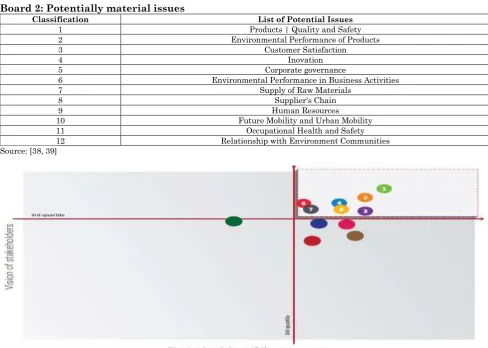
the sector. As for prioritizing the themes, this step took into account the takeholder responses and interviews with 18 Honda executives. The Table 2 lists the potentially material themes obtained with the information survey, while Figure 1 highlights the seven themes considered as fundamental aspects, with the classification characteristic being positioned from the 3rd quartile of the graph.
Board 2: Potentially material issues
Classification List of Potential Issues
1 Products | Quality and Safety
2 Environmental Performance of Products
3 Customer Satisfaction
4 Inovation
5 Corporate governance
6 Environmental Performance in Business Activities
7 Supply of Raw Materials
8 Supplier's Chain
9 Human Resources
10 Future Mobility and Urban Mobility
11 Occupational Health and Safety
12 Relationship with Environment Communities
Source: [38, 39]
Figure 1:Fundamental aspects
Samuel Carvalho De Benedicto et. al. | Jan.-Feb. 2019 | Vol.8| Issue 1 |80-94 89
The research data sets out the strategic vision of the HSA and the stakeholder view, where Quality and Product Safety; Environmental Performance of Products; Customer Satisfaction; Innovation; Corporate governance; Environmental Performance in Business Activities and; Supply of raw materials, are the topics most valued by those interested in the company's business. Based on these data, the main theme defined to represent the fundamental aspects that differentiated the HSA from its competitors was "Equilibrium and the Perenniality of
business". This result is linked to Honda's principle of offering the highest quality products, at a fair price and guaranteeing customer satisfaction, as well as being concerned about issues involving the environmental performance of business activities, where it counts with goals and perspectives aimed at minimizing the environmental impacts of its products and services through the application of eight concepts (Table 3) that guarantee environmental responsibility actions throughout the productive chain.
Board 3: Environmental performance of business activities
Concept Description
Green Factory process, which includes waste management, energy efficiency, rational use of water and reduction of It provides targets and guidelines for the reduction of environmental impacts in the production atmospheric emissions.
Green Logistics It guarantees a constant reduction of the impacts caused in the transport processes of the company's products and parts.
Green Office It seeks the alignment of the offices with the company's guidelines, with actions of recycling, selective collection and rational use of electricity, water and paper.
Green Purchasing It aims to optimize the consumption of electrical energy and resources. In addition to reducing CO2 emissions from the production process of parts and components that supply the factories.
Green Dealer It encourages Honda dealer network to properly allocate 100% of the waste generated in the after sales and customer service.
Green IT It combines state-of-the-art technology and environmental preservation through measures such as optimization and transformation of servers and creation of print centers.
Recycling (3R's) It works on the recyclability from the school of the components of the product to the appropriate disposal at the end of its useful life.
Green Laboratories Develops and implements environmental and energy technologies to improve the performance of Honda engines, reduce atmospheric emissions and develop alternative energy products. Source: [37]
All these concepts seek to ensure that the technological advances exposed in their products and services are linked to socio-environmental responsibility, as well as issues such as the efficient use of resources and the concern with energy and climate change issues are adopted as a basis for environmental management in all units of the Group.
Based on the data presented in the Sustainability Reports for the years 2016 and 2017, it was possible to carry out a survey of the company's socio-environmental performance, since the document was prepared based on the GRI G4 Guidelines. These guidelines are intended to assist rapporteurs in drawing up relevant sustainability reports that include valuable
information on the most important sustainability issues for the organization as well as making the sustainability reporting process a standard practice. GRI periodically reviews these guidelines and the G4 version is the most up-to-date, where the degree of transparency and consistency of useful and reliable information for markets and society is even higher. In the Sustainability Reports, it was possible to evaluate issues related to the importance of sustainability-oriented strategic management practiced by Honda in South America (HSA), composed by the units installed in Brazil, Peru, Chile and Argentina. The groups of information selected for analysis refer to the environmental aspect of the GRI Content Summary of the Reports, as shown in Table 4.
Board 4: GRI Coontent Indicators
Indicator Content
Environmental Aspect
Water
Environmental Evaluation of Suppliers Effluent and Waste
Samuel Carvalho De Benedicto et. al. | Jan.-Feb. 2019 | Vol.8| Issue 1 |80-94 90
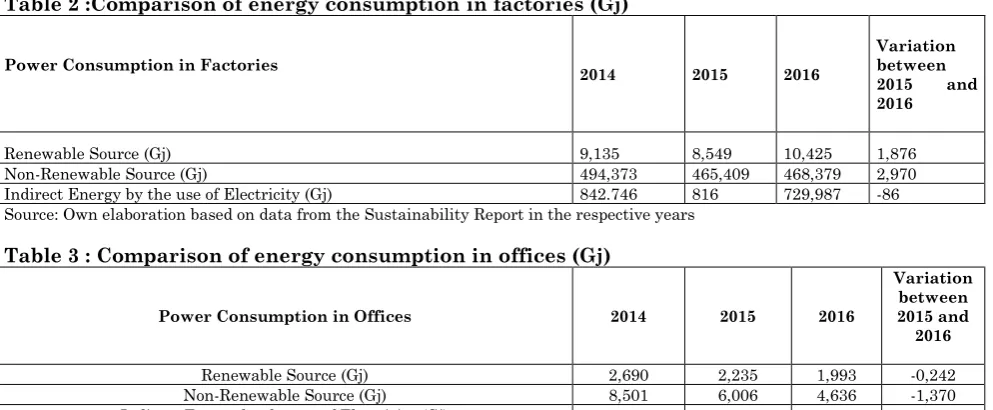
The set of standard information comprised of performance indicators is disseminated from the existing GRI Indicator Protocols for each of the aspects contained in the Guidelines. The aim is to ensure consistency in the interpretation of data. Taken together, the principles aim to demonstrate the existing impacts, allowing the various stakeholders to make decisions. Tables 2, 3 and 4 refer to Honda's energy and water consumption in South America (HSA).
The set of standard information comprised of performance indicators is disseminated from the existing GRI Indicator Protocols for each of the aspects contained in the Guidelines. The aim is to ensure consistency in the interpretation of data. Taken together, the principles aim to demonstrate the existing impacts, allowing the various stakeholders to make decisions. Tables 2, 3 and 4 refer to Honda's energy and water consumption in South America (HSA).
Table 2 :Comparison of energy consumption in factories (Gj)
Power Consumption in Factories
2014 2015 2016
Variation between
2015 and
2016
Renewable Source (Gj) 9,135 8,549 10,425 1,876
Non-Renewable Source (Gj) 494,373 465,409 468,379 2,970
Indirect Energy by the use of Electricity (Gj) 842.746 816 729,987 -86
Source: Own elaboration based on data from the Sustainability Report in the respective years
Table 3 : Comparison of energy consumption in offices (Gj)
Power Consumption in Offices 2014 2015 2016
Variation between 2015 and 2016
Renewable Source (Gj) 2,690 2,235 1,993 -0,242
Non-Renewable Source (Gj) 8,501 6,006 4,636 -1,370
Indirect Energy by the use of Electricity (Gj) 18,406 12,766 11050 11.037
Source: Own elaboration based on data from the Sustainability Report in the respective years
Table 4 :Comparison of water consumption of factories m³
Water withdrawn and acquired from factories 2014 2015 2016
Variation between 2015 and 2016
Municipal network (m³) 186,852 151,315 126,071 -25,244
Underground bodies (m³) 1.167,053 998,244 735,961 -262,283
Reuse water (m³) 946 1,645 1,205 0,440
Source: Own elaboration based on data from the Sustainability Report in the respective years
The negative values presented in the Tables represent the reduction in water and energy consumption between 2015 and 2016. Within the concept of Green Factory, Honda Cars of Brazil (HAB), focused on energy efficiency, adopted a new process in the department of Paint, where motors and burners are partially shut down in unproductive times, which allowed the reduction of 113,566 m³ of natural gas and 710 MWh in electricity consumption per year.
As for the water economy, a scarce natural resource on our planet, in another initiative, the implementation of a rainwater reuse equipment made it possible to reduce 22,400 liters of water in consumption. The HSA waste management and recycling system is constantly improving. Based on the concept
of 3R's, the company works on recyclability from the choice of product components to the appropriate destination at the end of its useful life. The classification of the waste of the company is made through the processes for which they are destined, being measured in tons.
Samuel Carvalho De Benedicto et. al. | Jan.-Feb. 2019 | Vol.8| Issue 1 |80-94 91 Table 5: Solid waste generated and intended - factories - non-hazardous
Disposition 2014 2015 2016
Total - Non-Hazardous 49552 47023 56654
Total - Hazardous 6290 4024 5808
Source: Own elaboration based on data from the Sustainability Report in the respective years
Regarding its suppliers, since 2008, Honda Cars has taken action to reduce CO2 emissions through the supply chain, where the goal is for each supplier to achieve 1% reduction in emissions annually. The results are measured by a system developed by Honda Japan for all units in the world. In addition, since 2014 the company promotes a project with suppliers which visits the development of environmental improvement work where the companies with more
nottified initiatives are recognized through the environmental award of Honda, renomized prize in the current market. The concern to guarantee that the chain of suppliers meets the environmental criteria adopted by HSA may be perceived through the percentage of suppliers contracted on the basis of that preamble (Table 6). The data presented positive growth in the period analyzed, even on small scale.
Table 6 :Total number of active suppliers and contracting percentages
Featured criteria 2015 2016
Total active suppliers (quantity) 255 258
Suppliers contracted based on environmental criteria (%) 50,0 52,5
New contracted suppliers (quantity) 21 19
Source: Own elaboration based on data from the Sustainability Report in the respective years
As stated in the Sustainability Reports, Honda seeks to engage its partners in all brand commitments and recognizes those who work to reduce the environmental impacts of its activities and contribute to the well-being of society. Honda's Vision 2030 in South America includes initiatives aimed at meeting the future demands of society, maintaining its environmental vision and interest in realizing the joy and freedom of mobility and a sustainable society in which people can enjoy life.
In this regard, one of the initiatives aims to work towards a future carbon neutral society. In addition, the company announced in 2011 that it aims to reduce its corporate CO2 emissions by 50% by 2050 compared to 2000 levels. The initiatives taken by HSA together with its supply chain, as well as the aggressive strategic targets adopted by the company in the pursuit of emission reduction, represent the excellent performance of Honda in terms of social and environmental responsibility.
Among the various strategic measures implemented by the Group, used to combine issues involving competitiveness, market positioning, innovation, quality, strategic management and socio-environmental responsibility, the main highlight was the implementation of the first wind farm of Honda Energy in Brazil in 2014, located in
Xangri-Lá (RS). The investment made to implement the Park reaches R$ 107 million reais. The first cycle of operation completed by the project was in the fiscal year of 2015, where power generation reached 71,405 MWh, with a total capacity to supply 100% of the production in the Sumaré (SP) plant, which represented a reduction of 8,007 tons of CO2 in the period covered by the 2016
Sustainability report. In the fiscal year of 2017, the power generation reached 73,391 MWh, 2.9% higher than the previous period. Since its inauguration, 207 thousand MWh of electricity have already been generated, which allowed Honda to stop emitting 18 thousand tons of CO2 in the atmosphere.
Due to the greatness of this project, it is the only one in the sector to obtain the Renewable Energy Certificate granted by ABEEólica (Brazilian Wind Energy Association) and Abragel (Brazilian Association of Clean Energy Generation). In addition, because it is responsible for the generation of renewable energy used in production, the Park puts Honda Cars of Brazil as the only company in the sector with the right to use the "Renewable Energy Seal" in all its automobiles.
Samuel Carvalho De Benedicto et. al. | Jan.-Feb. 2019 | Vol.8| Issue 1 |80-94 92
greenhouse gases in Brazil, while the values of Honda Cars of Brazil are calculated according to the Brazilian Program GHG Protocol, and are verified by third party. Therefore, the emission reductions associated with the Xangri-Lá Wind Farm (RS) are not reflected in the emissions inventory of Honda Cars of Brazil (HAB).
As for motorcycles, in 2015 the company renewed 100% of its models, to meet all the requirements of PROMOT 4 - Air Pollution Control Program for Motorcycles and Similar Vehicles. This program aims to establish fixed and restricted limits to the emission of polluting gases (CO, HC and NOx). In the same year, the HSA reached values close to
half of the fixed limits, going beyond the requirements of the Program. In addition, the motorcycle factory in Manaus (AM) replaced the use of LPG (Liquefied Petroleum Gas) by Natural Gas in its internal processes, which allowed the reduction of more than 2,095 tons of CO2 per year, in addition to other atmospheric pollutants.
Tables 7 and 8 show the amount of CO2 emitted by the company in Tonnes of Equivalent Carbon Dioxide (tCO2e) and present satisfactory values, although it does not consider the highly positive impact caused by the Xangri-Lá (RS) Wind Farm.
Table 7: Greenhouse gas emissions - HAB and HDA plants
GEE Emission 2014 2015 2016 Variation between 2015 and 2016
Direct Emissions from Renewable Sources
1754 1945 1777 -168
Direct Emissions from Non-Renewable Sources 36560 42187 45081 2.894
Indirect Energy by the use of Electricity tCO2e 133516 134043 126249 -7.794
Total (tCO2e) 171830 178175 173107 -5.068
Methodology: GHG Protocol
Source: Own elaboration based on data from the Sustainability Report in the respective years.
Table 8 :Greenhouse Gas Emissions - Factories Argentina and Peru *
GEE Emission 2014 2015 2016 Variation between 2015 and 2016
Direct Emissions from Non-Renewable Sources 2992 1417 4085 2.668
Indirect Energy by the use of Electricity tCO2e 6579 8230 8188 -42
Total (tCO2e) 9571 9647 12273 2.626
*The factory Honda Selva del Peru did not enter the calculations of 2016.
Source: Own elaboration based on data from the Sustainability Report in the respective years.
Conclusion
The study discussed the importance and applicability of the strategic management in organizations in the construction of competitive advantages and their relationship with social and environmental responsibility. The study shows that, currently, many companies are already working with a focus on sustainable strategies, putting in practice the tripod of sustainability.
This means that they are no longer concerned only with economic results. Its focus is on making efficient use of natural resources, promoting the reduction of losses in the productive process and maximizing profit in order to meet organizational and social objectives in an integrated manner. As a sustainability management reference, Honda South America, which since 2016 has launched the Sustainability Report certified
by the Global Reporting Initiative (GRI), has increased the transparency of actions towards sustainable development. Considering the results presented in this study, based on the study and analysis of Honda's socio-environmental performance in South America, recognized as the only company in the national automotive sector that is self-sufficient in renewable energy, it can be said that the environmental performance of an organization is directly linked to the strategic vision of high management, which should be aligned with social and environmental concepts.
Samuel Carvalho De Benedicto et. al. | Jan.-Feb. 2019 | Vol.8| Issue 1 |80-94 93
Finally, the company's initiatives raise the reputation of the brand, which is now recognized for reducing the environmental impacts of its activities and contributing to
the well-being of society. High reputation enables the company to achieve better financial results [38,39].
References
1. Mintzberg H, Ahlstrand B, Lampel J (2010) Safári de Estratégia: um Roteiro pela selva do Planejamento Estratégico. 2. Ed. Porto Alegre, Bookman.
2. Pankaj G (2007) a Estratégia e o Cenário de Negócios: Textos e casos. 2. Ed. Porto Alegre, Bookman.
3. Drucker P (1997) Administração em Organizações sem fins Lucrativos: Princípios e Práticas. São paulo: Pioneira.
4. Caldas MD (2007) Vantagens Competitivas Segundo o Modelo de porter. 2007. 50 f. Trabalho de Conclusão de curso (mba finanças e controladoria) - centro Universitário Newton paiva, belo Horizonte.
5. Ferreira ABH (2006) Mini Dicionário Aurélio. 4ª ED. São Paulo-SP: Nova Fronteira.
6. Ribeiro RV (2012) estratégia empresarial. 1 ed. Curitiba: iesde brasil.
7. Porter ME (2004) estratégia competitiva: técnicas para análise de indústrias e da concorrência. 16 ed. Rio de janeiro: campus.
8. Hitt MA, Ireland RD, Hoskisson RE (2014) administração estratégica. São paulo: pioneira thomson learning.
9. Oliveira LR, Medeiros RM, Terra PB, Quelhas OLG (2012) sustentabilidade: da evolução dos conceitos à implementação como estratégia nas organizações. Production, 22(1): 70-82.
10. Kraemer MEP (2005) gestão ambiental: a busca de estratégias para vantagem competitiva e construção
da imagem corporativa. In
https://www.gestiopolis.com/a-busca-de-estrategias-competitivas-atraves-da-gestao-ambiental. Acessed in 11/03/2017.
11. Souza TCG (2018) relatório de sustentabilidade: proposta de aplicação em uma instituição de ensino superior comunitária à luz da global reporting initiative (gri). (2018) dissertação (mestrado em sustentabilidade) – pontifícia universidade católica de campinas, campinas.
12. Quintiere M (2006) auditoria ambiental. Rio de janeiro: publit.
13. Altenfelfer R (2004) desenvolvimento sustentável. Gazeta mercantil, maio.
14. Araújo G, Bueno MP, Sousa AA, Mendonça PSM (2006) sustentabilidade empresarial: conceito e indicadores. In congresso virtual brasileiro de administração, campo grande: ufms/convibra.
15. Paiva PR (2003) contabilidade ambiental:
evidenciação dos gastos ambientais com
transparência e focada na prevenção. Sao paulo: atlas.
16. Cavalcante LRMT, Bruni AL, Costa FJM (2016) sustentabilidade empresarial e desempenho
corporativo: uma analise do mercado brasileiro de
ações. In
http://www.infinitaweb.com.br/albruni/artigos/a0713_ sustentabilidade.pdf. Acessed in 20/02/2017.
17. Aktas, R, Kayalidere K, Kargin M (2013) corporate sustainability reporting and analysis of sustainability reports In turkey. International journal of economics and finance, 5(3):113-125. 18. Feil AA, Naime RH (2015) mensuração da
sustentabilidade das corporações com selo ise da bm&fbovespa via modelo gse. Revista ambiente contábil, 7(1): 254- 272.
19. Keinert TMM (2007) organizações sustentáveis: utopias e inovações. 1 ed. São paulo: annablume. 20. Coral E (2002) Modelo de planejamento estratégico
para a sustentabilidade empresarial (tese (doutorado em engenharia de produção) – universidade federal de santa catarina, florianópolis.
21. Barbosa PRA (2007) índice de sustentabilidade empresarial da bolsa de valores de são paulo (ise-bovespa). (2007) dissertação (mestrado em administração) – universidade federal do rio de janeiro, rio de janeiro.
22. Andrade JMR, Câmara RPB (2012) mensuração da sustentabilidade empresarial: uma aplicação m hotéis localizados na via costeira da cidade de natal/rn. Revista ambiente contabil, 4(2): 110-131. 23. Corrêa R, Souza MTS, Ribeiro HCM, Ruiz MS (2012)
evolução dos níveis de aplicação de relatórios de sustentabilidade (gri) de empresas do ise/bovespa. Sociedade, contabilidade e gestão, 7(2): 24-40. 24. Gomes Júnior SF, Gomes AR (2010) as vantagens da
sustentabilidade empresarial. Ingepro: inovação, gestão e produção, 2(6): 62-71.
25. World Business Council for Sustainable Development (2018) in https://www.wbcsd.org. Acessed in 22/07/2018.
26. Daub CH (2007) Assessing the Quality of
Sustainability Reporting: an Alternative
Methodological Approach. Journal of cleaner production, 15(1): 75-85.
27. Gri -Global Reporting Initiative (2018) Diretrizes para Relatório de Sustentabilidade. Versão g4. Amsterdã: gri.
28. Oliveira MAS, Campos LMS, Sehnem S, Rossetto AM (2014) Relatórios de Sustentabilidade Segundo a Global Reporting Initiative (gri): uma Análise de Correspondências Entre os Setores Econômicos Brasileiros. Production, 24(2):392-404.
Samuel Carvalho De Benedicto et. al. | Jan.-Feb. 2019 | Vol.8| Issue 1 |80-94 94
30. Roesch SMA (2005) Projetos De Estágio E De Pesquisa EM Administração. 3ª. ED. São Paulo: Atlas.
31. Marconi MA, Lakatos EM (2007) Fundamentos de Metodologia Científica. 4. Ed. São Paulo: Atlas. 32. Gil AC (2008) Como Elaborar Projetos de Pesquisa. 4.
Ed. São Paulo: Atlas.
33. Creswell JW (2014) Research design: Qualitative and Quantitative Approaches. 4th ed. Tousand oaks: Sage Publications.
34. Richardson RJ (2007) Pesquisa Social: Métodos e Técnicas. 3. Ed. São paulo: atlas.
35. Oliveira TMV (2001) Amostragem não Probabilística: Adequação de Situações Para uso e Limitações de Amostras por Conveniência, Julgamento e Quotas. Administração on line, 2(3): 01-10.
36. Mozzato AR, Grzybovski D (2011) análise de conteúdo como técnica de análise de dados qualitativos no campo da administração: potencial e desafios. Revista de administração contemporânea, 15(4): 731-747.
37. Bardin L (2009) análise de conteúdo. Lisboa: edições 70.
38. Honda Brasil (2016) Relatório de Sustentabilidade, São paulo: honda.