CLEAN AND EFFICIENT MICROWAVE ASSISTED SYNTHESIS
OF SOME NEW PYRIMIDINE, PYRAZOLINE AND
ISOXAZOLINE DERIVATIVES FROM
3-(3-NITROPHENYL)-N-PHENYL-PROP-2-ENAMIDE
Urvashi Tiwari
[a], Chetna Ameta
[a], Sanyogita Sharma
[b], Meenakshi Sharma
[c], Arpit Kumar
Pathak
[a], Pinki B. Punjabi
[a]*
Keywords: Microwave irradiation, Chalcones, Isoxazoles, Pyrazoles, Pyrimidines
A rapid and efficient method for the preparation of some new pyrimidine, pyrazoline and isoxazoline derivatives by the reaction of chalcones with hydroxylamine, urea and hydrazine hydrate under microwave exposure has been reported. The products have been isolated, purified and characterized by spectral methods like IR, NMR and mass spectrometry. The antibacterial and antifungal activities of the final products against various bacteria and fungi have also been reported.
*Corresponding Authors
*E-mail: [email protected]
[a] Microwave Chemistry Laboratory, Department of Chemistry, Mohanlal Sukhadia University, Udaipur - 313 001, Rajasthan, India
[b] Department of Chemistry, Pacific Institute of Technology, “Pacific Hills” Pratapnagar Extension, Airport Road, Debari, Udaipur, India
[c] Department of Chemistry, Banasthali Vidyapeeth, Banasthali, Rajasthan, India
Introduction
Increasing globalization and industrialization is causing harm to our ecosystem, which is gradually getting polluted. The implementation of green chemistry and green manufacturing technologies will help to decrease the causes for these climate changes which are dreadedful for environmental and human health challenges that we are facing and feeling now-a-days. Green chemistry techniques are now being used across the world to develop new materials in every field of chemistry. MAOS (Microwave Assisted Organic Synthesis)1 strategies offer feasible
solutions to minimize environmental deterioration as their benefits are manifold: it frequently leads to dramatically reduction in reaction time, higher yields, cleaner reaction profiles and above all, eco-friendliness. This is a technique which gives “yes or no answer” for a particular chemical transformation within 5 to 10 minutes as compared to several hours in conventional protocol in industry and academia.2,3 A heterocyclic compound is one which
possesses a cyclic structure with hetero atoms in the ring in addition to c- atom. Nitrogen and oxygen containing heterocyclic compounds have received considerable attention due to their wide range of pharmacological activities.4-8
As our interest is to synthesize heterocyclic templates capable of bearing some potential pharmacophores which can enhance the inherent biological activity, Therefore
with the installation of biological active heterocyclic units such as isoxazoles, pyrimidines and pyrazoles has been carried out. Pyrimidines are found to be endowed with potential biological activity such as antitumor,9 antiviral,10
anticancer,11 antibacterial,12 antimicrobial13 and many others.
Isoxazoles have been reported to possess bactericidal,14
fungicidal15 and antimicrobialactivity.16 Pyrazoles display a
number of antimicrobial activities like anticancer,17
antidiabetic18 and antidepressant.19 Therefore, it was thought
worthwhile to synthesize these nuclei from 3-(substituted phenyl)-N-phenyl prop-2-enamide, in order to explore the pharmacological activities of these compounds.
Results and Discussion
Acetanilide on condensation with substituted aldehydes in presence of 30% NaOH afforded compound 1A-B, which were used as intermediates for the synthesis of pyrozolines, pyrimidines and isoxazolines following three different pathways. Compounds 1A-B gave characteristics IR bands in the region between 3310-3315 cm-1 for (N-H str.), 3014 –
3018 cm-1 (C-H str., Ar-H), 1660 -1666 cm-1 (C=O str.),
1595 -1605 cm-1 (C=C str.) and 1H NMR signals for
multiplete of nine integrating aromatic protons at (δ) 6.20 -7.40, doublet of C-H vinyl group at (δ) 6.302 -5.20, singlet at (δ) 5.24 – 5.95 for N–H group and signal at (δ) 3.5 for
OCH3. Further, compounds 1A and 1B were confirmed by
the characteristics IR bands at 1540, 1499 cm-1 (NO 2 str.)
and 1218 cm-1 (C-O-C str.).
Chalcones are convenient starting material for the synthesis of pyrozolines, pyrimidines and isoxazolines due to their α, β-unsaturated moiety. The absence of carbonyl stretching frequency in the region of 1665 cm-1 confirms the
formation of products. In the first path way compound 1A
2A-B, 3A-B and 4A-B, respectively. Compound 2A showed characteristic IR absorption bands in the region 2962cm-1
(CH2 str.) and 1683 cm-1 (C=N str.), 1606 & 1415 cm-1 (NO2
str.) and signals at 6.40 ppm (dd, 1H, Hc), 4.54 ppm (dd, 1H,
Ha), 3.48 ppm (dd, 1H, Hb) and 3.24 ppm (s, 2H, CH2) in 1H
NMR spectrum in addition to –NH and aromatic protons, which supports the synthesis of compound 2A and pyrazoline ring.
Similarly other synthesized pyrazoline derivatives commonly gave characteristics IR absorption bands in the region between 2940 -2970 cm-1 for C-H str. of CH
2, 1610
-1690 cm-1 (C =N str.) and signals at (δ) 3.50 -3.20 ppm (dd,
1H, Hb), 4.54 -4.30 ppm (dd,1H,Ha) and 6.42 -6.20 ppm (dd,
1H, Hc) which, further confirmed the formation of
pyrazoline ring in respective compound 3A-B and 4A-B .
In second pathway, isoxazoline derivatives 5A-B have been synthesized by treating compounds 1A-B and hydroxylamine hydrochloride in basic medium. Compound
5A showed absorption bands in the region of 3348 cm-1
(N-H str.), 2931cm-1 (C-H str. CH
2 ) 1638 cm-1(C=N str.), 1450
& 1352 cm-1 (NO
2 str.). 1H NMR signals were found at (δ)
6.8- 7.39 (m, 9H, Ar-H), 6.16 (dd, 1H, Hc), 5.4 (s, 1H, NH),
4.38 (dd, 1H, Ha) and 3.40 (dd, 1H, Hb) confirmed synthesis
of compound 5A. The compound 5B alsoshowed IR band at 1210 cm-1 (C-O-C str.) and NMR signal at (δ) 3.3 singlet of
three integrating protons for OCH3.
In third pathway, reaction of compounds 1A-B with urea and thiourea in acidic medium afforded the corresponding compounds 6A-B and 7A-B bearing pyrimidine ring.
NH CH3
O
+
O
NH
O
R
30% NaOH
MeOH
1 A-B
N N N
CH2CONHNH2
R NH
N N
C
C H2
O Ha Hb
Hc
S S
N NH
N N Ha Hb
Hc
R NH
N O Ha
Hb
Hc R
NH
N
N C
O
Ha Hb
Hc N
N N
CH2
R N
S
SCH2CONHNH2
GAA, EtOH
GAA, EtOH GAA, EtOH
PhNHNH2
2 A-B
3 A-B 4 A-B
NH
NH N
Ha Hb
Hc
O NH
NH N Ha Hb
Hc
S R
R
5 A-B
6 A-B
7 A-B
NH2OH.HCl Urea Thiourea
R = (A) 3-NO2
(B) 4- OCH3 REACTION SCHEME R
Conc. HCl
Table 1. Physical and analytical data of synthesized compounds
Compound Molecular Formula Mol. weight M.P., 0C Yield,
%
Elemental analysis, calculated/(found) %
C H N
1A C15H12N2O3 268 92 70 67.16 (67.06) 4.51 (4.44) 10.4410.36
1B C16H15NO2 253 76 75 75.87(75.79) 5.97(5.90) 5.53(5.45)
2A C23H19N7O3 441 210 68 62.58(62.49) 4.34(4.25) 22.21(22.16)
2B C24H22N6O2 426 228 72 67.59(67.50) 5.20(5.11) 19.71(19.63)
3A C24H19N5O3S2 489 182 78 58.88(58.79) 3.91(3.82) 14.31(14.22)
3B C25H22N4O2S2 474 210 65 63.27(63.18) 4.67(4.58) 11.81(11.73)
4A C21H18N4O2 358 158 77 70.38(70.30) 5.06(5.00) 15.63(15.56)
4B C22H21N3O 343 160 70 76.94(76.85) 6.16(6.09) 12.24(12.14)
5A C15H13N3O3 283 196 75 63.60(63.51) 4.63(4.55) 14.83(14.74)
5B C16H16N2O2 268 206 80 71.62(71.56) 6.01(5.92) 10.44(10.32)
6A C16H14N4O3 310 208 64 61.93(61.84) 4.55(4.42) 18.06(17.93)
6B C17H17N3O2 295 210 69 69.14(69.05) 5.80(5.70) 14.23(14.14)
7A C16H14N4O2S 326 160 71 58.88(58.79) 4.32(4.22) 17.17(17.09)
7B C17H17N3OS 311 156 67 65.57(65.48) 5.50(5.41) 13.49(13.38)
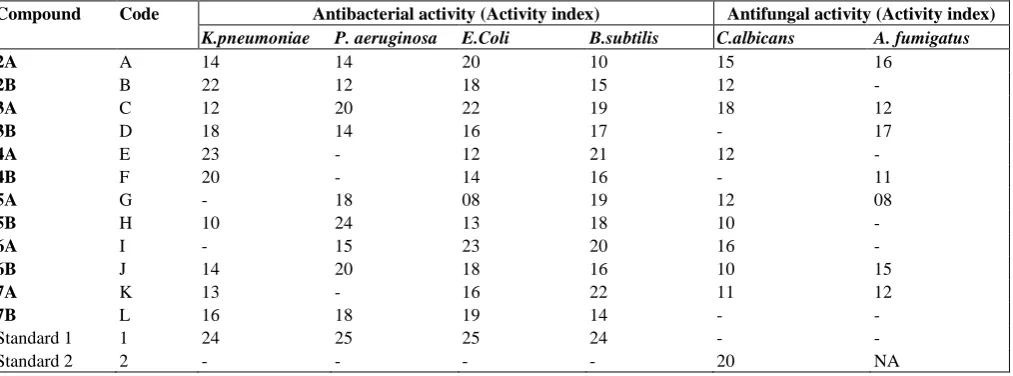
Table 2. Antimicrobial activity of synthesized compounds (500 ppm)
Compound Code Antibacterial activity (Activity index) Antifungal activity (Activity index)
K.pneumoniae P. aeruginosa E.Coli B.subtilis C.albicans A. fumigatus
2A A 14 14 20 10 15 16
2B B 22 12 18 15 12 -
3A C 12 20 22 19 18 12
3B D 18 14 16 17 - 17
4A E 23 - 12 21 12 -
4B F 20 - 14 16 - 11
5A G - 18 08 19 12 08
5B H 10 24 13 18 10 -
6A I - 15 23 20 16 -
6B J 14 20 18 16 10 15
7A K 13 - 16 22 11 12
7B L 16 18 19 14 - -
Standard 1 1 24 25 25 24 - -
Standard 2 2 - - - - 20 NA
Standard: 1 = Ciprofloxacin, 2 = Fluconazole dispersible; NA: Nil activity
Their IR, 1H NMR and mass spectral studies confirmed
the structure of these compounds. 6A-B gave IR bands at 1692 cm-1 (CONH str. ), 1618 cm-1 (C=N str.), 1728 cm-1
(C=O str.) and 1350 & 1487 cm-1 (NO
2 str.) and 1H NMR
signals at (δ) 6.06 (dd, 1H, Hc), 5.30 (s, 1H, NH), 3.30 (dd,
1H, Hb), 4.26 (dd, 1H, Ha) and 5.8 (d, 1H, CONH )
confirmed the synthesis of compound 6A-B and pyrimidine ring. Similarly, compound 7A-B gave some characteristic bands in the region between 3370 – 3380 cm-1 (N-H str.),
1670 -1672 cm-1 (CSNH str.) , 3080 -3090 cm-1 (C –H str.,
Ar- H), 1608 -1612 cm-1 (C=N str.) and 1H NMR signals at
(δ) 6.06 -6.08 (dd, 1H, Hc), 4.20 -4.30 (dd, 1H, Ha), 3.28
-3.32 (dd, 1H, Hb) and 5.0 -5.4 (s, 1H, CSNH) which, further
confirmed the synthesis of compounds 7A-B.
The synthesized compounds have also been characterized by their mass spectral and elemental analysis studies.
Antimicrobial activity
The antimicrobial activity of synthesized compounds has been investigated against four bacterial strains i.e., E. coli, B. subtilis, K. pneumoniae and P. aeruginosa and two fungal
Sabourad dextrose agar media following agar well diffusion method at 500 μg / mL using DMSO as solvent. The zone of inhibition was measured in mm. Standard drugs used were ciprofloxacin (antibacterial) and fluconazole dispersible (antifungal). Compounds 3A, 6A, 7B and 4A,
6A, 7A showed better activity against E.coli and B. subtilis,
respectively. The rest compounds shows moderate to good activity. Compounds 2B, 4A, 4B and 3A, 5B, 6B showed significant activity against K. pneumoniae and P. aeruginosa, respectively.Compounds 3A, 6A showed good activity against C.albicans and all synthesized compounds showed moderate to good activity against A. fumigatus as compared to standard drug, which was active against A. fumigatus.
Experimental Section
General Procedure
eluent and products were detected by iodine vapors. IR spectra (KBr pellets) were recorded on Perkin-Elmer 1800 (FTIR) spectrometer. 1H NMR spectra (DMSO-d
6) were
taken on a Bruker DRX spectrometer (300 MHz FT NMR) using TMS as internal standard and chemical shift were expressed in δ. Mass spectra were taken on a Jeol SX-102/PA-6000 (EI) spectrometer. Elemental analysis was carried out on C, H, N analyzer (Elemental Vario Carlo Alba 1108). The results were found to be in good agreement with the calculated values (± 0.2%).
Synthesis of 1 A and 1B
It is prepared by the reaction of mixture of acetanilide (0.01 mol), aldehydes (0.01mol), aqueous NaOH (30%) in methanol (50 mL). The reaction mixture was stirred for 1hr. Then the reaction mixture was irradiated for 6-8 minutes in MW at 600 W. After completion of reaction, the viscous mass was poured into ice cold water with vigorous stirring and left over night for complete precipitation. The resultant solid was dried and recrystallized from ethanol.
Synthesis of 2A, 2B, 3A, 3B, 4A and 4B
Equimolar amounts of chalcone 1A-B (0.01 mol), substituted hydrazides (0.01 mol) in ethanol (50 mL) were taken in an Erlenmeyer flask and 2-3 mL of glacial acetic acid was added to it. The reaction mixture was mixed thoroughly and irradiated for 6-8 minutes at 720 W with intermitted irradiation for 30 sec. interval. On completion of reaction (as monitored by TLC) resultant mass was poured into ice cold water with vigorous stirring. The solid obtained was filtered, washed with ethanol and recrystallized from ethanol.
Synthesis of 5 A and 5B
It is prepared by reacting purified mixture of chalcone (0.01 mol), hydroxylamine hydrochloride (0.01 mol) and of NaOH (30%) in ethanol (50 mL) under microwave irradiation for 4-6 minutes at 720W. Completion of reaction was monitored by TLC. Excess of solvent was removed by evaporation; obtained mass was poured into ice water with vigorous stirring. It was kept over night. The resultant solid product was filtered, washed and recrystallized from acetone.
Synthesis of 6A, 6B, 7A and 7B
It is prepared by reacting purified mixture of chalcone (1A-B) (0.01 mol), compounds urea or thiourea (0.01 mol) in ethanol (50 mL) and 2-3 drops of conc. HCl. Reaction mass was irradiated for 7-10 minute in microwave at 960 W. Excess of solvent was removed, poured in ice-cold water, filtered, recrystallized from ethanol.
Spectral Data
3-(3- Nitrophenyl)-N-phenyl prop -2-enamide (1A)
IR (KBr, cm-1): 3315 (NH), 3018 (C-H str. Ar-H), 1666
(C=O), 1602 (C=C), 1540, 1499 (NO2); 1H NMR (δ):
6.35-7.40 (m, 9H, Ar), 6.30 (d, 1H, CH vinyl), 5.95 (d, 1H, CH vinyl), 5.26 (s, 1H, NH); Mass (m/z): 268 [M] +.
3-(4-Methoxyphenyl)-N-phenyl prop-2-enamide (1B)
IR (KBr, cm-1): 3311 (NH), 3014 (C-H str., ArH), 1599
(C=O), 1218 (C-O-C); 1H NMR (δ): 6.20-7.30 (m, 9H
Ar-H), 6.10 (d, 1H, CH vinyl), 5.92 (d, 1H, CH vinyl), 5.24 (s, 1H, NH), 3.5 (s, 3H, OCH3); Mass (M/Z): 253 [M] +.
2-(1H-benzotriazol-1-yl)-1-[5-(3-nitrophenyl)-3-(phenyl amino)-4,5-dihydro-1H-pyrazol-1-yl]ethanone (2A)
IR (KBr, cm-1): 3348 (NH), 3022 (C-H str., ArH), 2962
(CH2), 1815 (C=O), 1683 (C=N), 1606, 1415 (NO2); 1HNMR (δ): 6.64-7.96 (m, 13H, Ar), 6.40 (dd, 1H, H
c), 5.33
(s, 1H, NH), 4.54 (dd, 1H, Ha), 3.48 (dd, 1H, Hb), 3.24 (s,
2H, CH2); Mass (m/z): 441[M] +.
2-(1H-benzotriazol-1-yl)-1-[5-(4-methoxyphenyl)-3-(phenylamino)-4,5-dihydro-1H-pyrazol-1-yl]ethanone (2B)
IR (KBr, cm-1): 3345 (NH), 3018 (C-H str., Ar-H), 2954
(CH2), 1812 (C=O), 1678 (C=N), 1225 (C-O-C); 1H NMR
(δ): 6.50-7.86 (m, 13H, Ar), 6.36 (dd, 1H, Ha), 3.46 (dd, 1H,
Hb), 3.22 (s, 2H, CH2), 3.60 (s, 3H,-OCH3); Mass (m/z): 426
[M] +.
2-(1, 3-Benzothiazol-2-yl sulfanyl)-1-[5-(3-nitrophenyl)-3-(phenylamino)-4,5-dihydro-1H-pyrazol-1-yl] ethanone (3A)
IR (KBr, cm-1): 3348 (NH), 3018 (C-H str. Ar-H), 2950
(CH2), 1820 (C=O), 1650 (C=N), 1600, 1410 (NO2); 1H
NMR (δ): 6.65-7.35 (m, 13H, Ar-H), 6.21(dd, 1H, Hc), 5.22
(s, 1H, NH), 4.40 (dd, 1H, Ha), 3.20 (dd, 1H, Hb), 2.78 (t,
1H, Hc), 2.89 (s, 2H, CH2); Mass (m/z): 489 [M] +.
2-(1,3-Benzothiazol-2-yl-sulfanyl)-1-[5-(4-methoxyphe-nyl)-3-(phenylamino)-4,5-dihydro-1H-pyrazol-1-yl]etha- none (3B)
IR (KBr, cm-1): 3344 (NH), 3015 (C-H str., Ar-H), 2946
(CH2), 1816 (C=O), 1647 (C=N), 1220 (C-O-C); 1HNMR
(δ): 6.42-7.98 (m, 13H, Ar-H), 6.15 (dd, 1H, Hc), 5.18 (s, 1H,
NH), 4.32 (dd, 1H, Ha), 3.14 (dd, 1H, Hb), 2.84 (s, 2H, CH2),
3.80 (s, 3H, OCH3); Mass (m/z): 474 [M] +.
5-(3-Nitrophenyl)-N,1-diphenyl-4,5-dihydro-1H-pyrazol-3-amine (4A)
IR (KBr, cm-1): 3351 (NH), 3096(C-H str., Ar-H), 2949
(CH2), 1610 (C=N), 1338, 1487 (NO2); 1HNMR (δ):
6.25-7.40 (m, 14H, Ar-H), 6.34 (dd, 1H, Hc), 5.1 (s, 1H, NH),
4.50 (dd, 1H, Ha), 3.46 (dd, 1H, Hb); Mass (m/z): 358[M] +.
5-(4-Methoxyphenyl)-N,1-diphenyl-4,5-dihydro-1H-pyra-zol-3-amine (4B)
IR (KBr, cm-1): 3350 (NH), 3090(C-H str., Ar-H), 2946
(CH2), 1615 (C=N), 1214 (C-O-C); 1H NMR (δ): 6.30-7.20
(m, 14H, Ar-H), 6.20 (dd, 1H, Hc), 5.5 (s, 1H, NH), 4.40 (dd, 1H, Ha), 3.42 (dd, 1H, Hb), 3.3 (s, 3H, -OCH3); Mass
5-(3-Nitrophenyl)-N-phenyl-4,5-dihydro-1,2-oxazol-3-amine (5A)
IR (KBr, cm-1): 3348 (NH), 3089 (C-H str., Ar-H), 2931
(CH2), 1638 (C=N), 1450, 1352 (NO2); 1HNMR (δ):
6.82-7.39 (m, 9H, Ar), 6.16 (dd, 1H, Hc), 5.4 (s, 1H, NH), 4.38
(dd, 1H, Ha), 3.40 (dd, 1H, Hb); Mass (m/z): 283 [M] +.
5-(4-Methoxyphenyl)-N-phenyl-4,5-dihydro-1,2-oxazol-3-amine (5B)
IR (KBr, cm-1): 3344 (NH), 3080 (C-H str., Ar-H), 2930
(CH2), 1630 (C=N), 1210 ((C-O-C); 1HNMR (δ): 6.95-7.25
(m, 9H, Ar-H), 6.10 (dd, 1H, Hc), 4.9 (s, 1H, NH), 4.30 (dd,
1H, Ha), 3.36 (dd, 1H, Hb), 3.3 (s, 3H, -OCH3); Mass (m/z):
268 [M] +.
6-(3-Nitrophenyl)-4-(phenylamino)-5,6-dihydropyrimidin-2-(1H)-one (6A)
IR (KBr, cm-1): 3380 (NH), 3080 (C-H str., Ar-H), 1692
(CONH), 1618 (C=N), 1350, 1487 (NO2), 1728 (C=O); 1H
NMR (δ): 6.80-7.48 (m, 9H, Ar-H), 6.06 (dd, 1H, Hc) 5.3 (s, 1H, NH), 3.30 (dd, 1H, Hb), 4.26 (dd, 1H, Ha), 5.8 (d, 1H,
CONH); Mass (m/z): 310 [M]+.
6-(4-Methoxyphenyl)-4-(phenylamino)-5,6-dihydropyrimi-din-2-(1H)-one (6B)
IR (KBr, cm-1): 1680 (CONH), 3060 (C-Hstr., Ar-H),
1720 (C=O), 1610 (C=N), 1218 (C-O-C); 1HNMR (δ):
6.60-7.30 (m, 9H, Ar-H), 6.04 (dd, 1H, Hc), 5.1 (S, 1H, NH), 3.28
(dd, 1H, Ha), 4.20 (dd, 1H, Hb), 5.6 (d, 1H, CONH); Mass
(m/z): 295 [M] +.
6-(3-Nitrophenyl)-4-(phenylamino)-5,6-dihydropyrimi-dine-2-(1H)-thione (7A)
IR (KBr, cm-1): 3387 (NH), 3089 (C-H str., Ar-H), 1672
(CSNH), 1612 (C=N), 1389, 1428 (NO2); 1HNMR (δ):
6.28-7.46 (m, 9H, Ar-H), 6.08 (dd, 1H, Hc), 5.1 (s, 1H, NH), 3.32
(dd, 1H, Hb), 4.30 (dd, 1H, Ha), 5.0(d, 1H, CSNH); Mass
(m/z): 326 [M] +.
6-(4-Methoxyphenyl)-4-(phenylamino)-5,6-dihydropyri-midine-2-(1H)-thione (7B)
IR (KBr, cm-1): 1670 (CSNH), 3080 (C-H str., Ar-H),
1608 (C=N), 3378 (NH); 1HNMR (δ): 6.20-7.40 (m, 9H,
Ar-H), 6.06 (dd, 1H, Hc), 5.2 (s, 1H, NH), 4.20 (dd, 1H, Ha),
3.28 (dd, 1H, Hb) 5.4 (s, 1H, CSNH); Mass (m/z): 311 [M] +.
Conclusion
The purpose of the research is the development of new potent bioactive molecules with less toxic, safer and easily available methods. From the literature survey it is evident that Microwave Induced Organic Reaction Enhancement (MORE) chemistry offers a simple, nonconventional technique for the synthesis of wide variety of compounds including biologically important heterocyclic compounds, co-ordination compounds etc.
The results of the antimicrobial screening indicated that
benzene rings attached to the pyrazoline moiety show excellent activity whereas 4-OCH3 substituted benzene rings
attached to the pyrimidine moiety show good activity against K. pneumoniae as compared to other compounds. Compounds containing isoxazole moiety are moderately active against both bacteria and fungi.
Acknowledgement
We are thankful to Prof. Suresh C. Ameta for giving valuable suggestions during the progress of the work and to the Head, Department of Chemistry, M. L. Sukhadia University, Udaipur for providing laboratory facilities. Our thanks are also due to the Director, SAIF, CDRI, Lucknow, India for providing spectral and analytical data and Prof. Kanika Sharma, Head, Biotechnology Department, M. L. Sukhadia University, Udaipur for antimicrobial activity.
Refe
rences
1Crosignani, S., Launay, D., Linclau, B., Bradley, M., Mol. Divers.,
2003, 7, 3.
2Shmidt, M. S., Reverdito, A. M., Kremenchuzky, L., Perillo, I. A.,
Blanco, M. M., Molecules, 2008, 13, 831.
3Martin, B., Sektjic, H., Chassaing, C., Org. Lett., 2003, 5, 1851. 4Chaudhary,A., Sharma, N., Sharma,P., Jasuja,N. D., Sharma,G.,
Joshi,
S. C., Singh, R.V., Rasayan J. Chem.,2000, 1, 648.
5Singh, A. K., Parthsarthy, R., Lohani, M., J. Chem. Pharm. Res.,
2012, 4, 779.
6Malladi, S., Isloora, A. M., Peethambar, S. K., Ganesh, B. M.,
Goud, P. S., Der Pharma Chemica, 2012, 4,43.
7Rao, R. M., Sreeramulu, J., Ravindranath, L. K., Reddy, G. N.,
Hanumanthurayudu, K., Reddy, G. N., Jayaraju, A., Madhusudhan, P., J. Chem. Pharm. Res.,2012, 4, 272.
8Sharshira, E. M., Hamada, N. M. M., Molecules, 2012, 17, 4962. 9Baraldi, P. G., Pavani, M. G., Nunez, M., Brigidi, P., Vitali, B.,
Gambari, R., Romagnoli, R., Bioorg. Med. Chem.,2002, 10, 449.
10Kumar, A., Sinha, S., Chauhan, M. S., Bioorg. Med. Chem.Lett.,
2002, 12, 667.
11Rostom, S. A., Ashour, H. M., Abd, E. L., Razik, H. A., Arch. Pharm.,2009, 5, 299.
12Parekh, A. K., Desai, K. K., Eur. J. Chem.,2005, 2, 109. 13Vaghasta, S. J., Shah, V. H., J. Serb. Chem. Soc., 2007, 72, 109. 14Shah, T. K., Desai, V., J. Serb. Chem. Soc., 2007, 72(5), 443
15Ai-Shihry, S. S., Molbank,2005, M447.
16Bhambi, D., Salvi, V. K., Jat, J. L., Ojha, S., Talesara, G. L., J. Sulfur Chem.,2007, 28, 155.
17Manna, F., Chimenti, F., Fioravanti, R., Bolasco, A., Seecci, D.,
Chimenti, P., Ferlini, C., Scambia, G., Bioorg. Med. Chem. Lett.,2005, 15, 4632.
18Ahn, J. H., Kim, H. M., Jung, S. H., Kang, S. K., Kim, K. R.,
Rhee, S. D., Yang, S. D., Cheon, H. G., Kim S. S., Bioorg. Med. Chem. Lett.,2004, 14, 4461.
19Prasad, Y. R., Rao, A. L., Prasoona, L., Murali, K., Kumar P. R., Bioorg. Med. Chem.Lett., 2005, 15, 5030.