© 2019 by the Serbian Biological Society How to cite this article: Petković B, Stojadinović G, Kesić S, Ristić S, Martać Lj, 357 Podgorac J, Pešić V. Psychomotor activity and body weight gain after exposure
to low ribavirin doses in rats: role of treatment duration Arch Biol Sci. 2019;71(2):357-68.
Psychomotor activity and body weight gain after exposure to low ribavirin doses in rats:
Role of treatment duration
Branka Petković1,*, Gordana Stojadinović1, Srđan Kesić1, Slavica Ristić2, Ljiljana Martać1, Jelena Podgorac1 and
Vesna Pešić1
1Institute for Biological Research “Siniša Stanković”, University of Belgrade, Bulevar despota Stefana 142, 11060 Belgrade,
Serbia
2Galenika a.d., Institute for Research and Development, Pasterova 2, 11000 Belgrade, Serbia
*Corresponding author: [email protected]
Received: February 5, 2019; Revised: March 13, 2019; Accepted: March 22, 2019; Published online: March 25, 2019
Abstract: Clinically-related basic studies on the behavioral effects of ribavirin treatment are still lacking despite its wide use as an antiviral medication. This paper considers the effects of low ribavirin doses (10, 20 and 30 mg/kg/day) on psychomo-tor activity (novelty-induced explorapsychomo-tory behavior, d-amphetamine (AMPH, 1.5 mg/kg, intraperitoneal)-induced mopsychomo-tor activity), and body weight gain in socially undisturbed adult male Wistar rats 24 h after the first, seventh and fourteenth once-a-day injection. Low doses of ribavirin were tested in an attempt to avoid the recognized systemic side effects related to high-dose usage. None of the singly applied ribavirin doses affected exploratory/spontaneous and AMPH-induced motor behavior (locomotion, stereotypy-like and vertical activity), however, body weight gain was significantly lower after treatment with 30 mg/kg of ribavirin. The 7- and 14-day treatments with 10 and 30 mg/kg/day of ribavirin significantly suppressed novelty-induced locomotion and body weight gain; the 14-day treatment with ribavirin at a dose of 30 mg/kg/ day decreased AMPH-induced stereotypy. These findings indicate that repeated application (up to 14 days) of low ribavirin doses results in low novelty-induced locomotion along with reduced weight gain, accentuating the existence of a U-shaped dose-response relationship with a prolonged duration of ribavirin treatment.
Keywords: ribavirin; amphetamine; motor activity; body weight; rats
INTRODUCTION
Ribavirin (Virazole, 1-β-D-ribofuranosyl-1,2,4-triazole-3-carboxamide) is a well-known C-nucleoside analogue that has been investigated as a therapy for numerous viral infections, such are influenza A, B and C, herpes simplex, hepatitis C, hemorrhagic fever, Coxsackie, Lassa, Dengue, Hantaan, West Nile viruses, etc. [1]. It is mainly used for treating chronic hepatitis C vi-rus (HCV) infection, especially in combination with interferon alpha [2]. According to medical reports, in addition to the therapeutic objective, side effects are often associated with standard therapy. Some of these side effects include depression, anxiety, psychosis, cognitive impairment and body weight (BW) loss [3-6]. The exact contributions of each component of combined therapy to the side effects have not been elucidated, but there is a view that they are mainly
related to interferon alpha [7-10]. Adequate expo-sure to ribavirin seems crucial for achieving the best virological response and up to now, anemia has been reported as a frequent dose-dependent limiting side effect of ribavirin use [11].
been elucidated, indicating that the receptor subtype-specific interactions between adenosine and dopamine receptors (A1/D1 and A2A/D2) play an essential role in the modulation of basal ganglia function [17]. At the behavioral level, adenosine receptor agonists inhibit and adenosine receptor antagonists potentiate the motor-activating effects of dopamine agonists [18,19]. In that context, our previous experiments showed that the intraperitoneal (i.p.) injection of ribavirin, acutely applied at doses of 20 and 30 mg/kg, decreased locomotor activity in rats induced by amphetamine (AMPH; 1.5 mg/kg, i.p.) [20]. Considering the well-known fact that nucleus accumbens (NAc) dopamine mediates AMPH-induced rewarding and locomotor stimulating effects [21], these findings accentuated the central effects of i.p. administered ribavirin. Neverthe-less, clinically-related basic studies on the behavioral consequences of chronic ribavirin treatment with respect to the central regulation of motor behavior [19] are still lacking. Importantly, it has been shown that chronic treatment with agents acting at adenos-ine A1 receptors results in behavioral effects that are significantly different from those observed following their acute administration [22-24].
Drugs with psychoactive capacity produce their effects on behavior, affective and sensory perceptual functions because of their ability to bind to specific sites in the CNS (and thereby to modify ongoing neu-ronal processes); regardless of the fact that for a given substance we do not know the specific mechanism(s) of action, behavioral changes in certain experimental paradigms are confirmation that the treatment is act-ing. Therefore, any medication that disrupts the highly interconnected circuits normally serving to process the stream of stimuli detected by our brains from the outside world has the capacity to produce psychomotor changes [25]. It is known that the response to novelty is very complex and that it reflects a desire to explore novelty, novelty-related anxiety and, with regard to the time-dependent profile of the activity, adaptability to the certain environment [26]. New findings indicate that psychomotor activity observation can serve as a potential objective tool capable of monitoring the course of affective states in everyday life [27]. Although it may sound incidental, the dynamics of the psychomotor response to a novel environment should not be under-estimated. In neurologically intact rats, locomotor and vertical activities reflect exploratory activity and are
also used as an index of psychomotor activation after exposure to low doses of psychostimulant drugs [28].
Having in mind that ribavirin is still recognized as an elusive drug [29], and considering all the above-mentioned, it is of particular importance to clarify the neurobehavioral effects of ribavirin application. To improve current knowledge in the field, this study focused on investigating the effect of low ribavirin doses (10, 20 and 30 mg/kg/day, i.p.; single or re-peated once-a-day administration) on novelty-induced [30,31] and AMPH-induced psychomotor activity [21], and on BW gain (as an indicator of energetic intake in the conditions of controlled utilization [5]) in socially undisturbed adult male rats. Common to psychomotor activation and the motivational aspect of food intake is that they are highly dependent on mesolimbic dopaminergic transmission [21,30-32]. Low doses of ribavirin were tested in an attempt to avoid the already recognized side effects related to its usage at high doses [33,34].
MATERIALS AND METHODS
Animals and drugs
Male Wistar 2.5-3.5-month-old rats were used. The animals were maintained in groups of 4-5 rats per cage under standard conditions (23±2°C, 60-70% relative humidity, 12 h light/dark intervals, food and water provided ad libitum). All animal procedures were in compliance with Directive 2010/63/EU on the protection of animals used for experimental and other scientific purposes and were approved by the Ethical Committee for the Use of Laboratory Animals of the Institute for Biological Research “Siniša Stanković”, University of Belgrade, Serbia.
rats (10, 20 and 30 mg/kg/day) corresponded to hu-man daily doses of 1.6, 3.2, and 4.8 mg/kg/day, or to 100, 200 and 300 mg/day, respectively (assumed for a 60 kg human).
Behavioral measurement system and data preparation
The behavior of the animals was monitored in the open field by an automatic device (Columbus Auto-Track System, Version 3.0 A, Columbus Institute, OH, USA) in an isolated room under controlled conditions (described in detail in [20]). Different parameters, including locomotion (distance traveled in cm), stereotypy-like movements (such as sniffing, self-grooming, licking and head waving), and vertical activity or rearing (lifting both forepaws off the floor), were analyzed. The type of activity, characterized by the animal movements, was determined by the user-defined box size (set to 5 beams). The described parameters were defined in accordance with the auto-track system for IBM-PC/ XT/AT version 3.0A (Instruction Manual 0113-005L, 1990).
After registration, the data were prepared bearing in mind that when certain behavioral phenomena occurred only during a particular interval of a long registration period, the usage of long intervals could underestimate the behavior, as intervals during which certain behavioral changes occurred more frequently would be identified. We first read automatically re-corded data at 10-min intervals within a 120-min registration period. Based on these findings, the data were further expressed as the total for three 40-min consecutive periods. Such a methodological approach, which is in accordance with the suggestion that the determination of interval length should not be arbitrary and based on convention but empirically determined for a particular behavioral paradigm [36], allowed for the detection of fundamental behavioral differences during particular intervals as well as an appropriate comparison between groups instead of averaging and mitigating changes. We strongly believe that this is im-portant to note because with such findings as obtained in our study, different methods could be applied for data analysis and conclusions could differ depending on the selected method.
Experimental procedure
Two sets of experiments were performed to address the consequences of ribavirin administration on sponta-neous motor behavior in the novel environment and BW gain (Experiment 1), as well as on AMPH-induced motor activity (Experiment 2) of adult male rats.
In Experiment 1 (a schematic presentation is given in Fig. 1A), 24 adult male rats were used. The cohort was divided into four groups (n=6 per group) and injected once a day with saline (0.9% NaCl; 1 mL/kg; control group) or ribavirin at doses of 10, 20 and 30 mg/kg (i.p.) for 14 days. The body weight was measured every day before the treatment, i.e. between 15.00 and 16.00 h. The animals’ behavior was, in addition to the baseline activity (day 0), repeatedly monitored across the experiment, precisely on days 2 and 8, as well as after termination of the treatment (day 15; Fig. 1A) between 09.00 and 15.00 h. The animals were placed in the open field arena and allowed to freely explore it for 120 min. This experimental procedure allowed us to study the influence of single or repeated exposures to ribavirin on novelty-induced exploratory activity, which is highly regulated by mesolimbic dopaminergic transmission [31].
In Experiment 2 (schematic presentation is given in Fig. 1B), 72 adult male rats were used. The cohort was divided into three sets (24 rats per each). The first, second and third sets of animals were exposed to a single and 7 and 14 treatments, respectively, with saline (0.9% NaCl; 1 mL/kg, i.p.; control group, n=6) or ribavirin at doses of 10, 20 and 30 mg/kg/day (i.p.) (n=6 per dose). The treatment was performed between 15.00 and 16.00 h. The AMPH challenge (1.5 mg/kg, i.p.) was performed on the 2nd day (for the first set of
animals), the 8th day (for the second set of animals),
and on the 15th day (for the third set of animals) of
between 09.00 and 15.00 h. The BW was measured every day before the treatment (between 15.00 and 16.00 h); the data obtained from the third set of animals (duration of the treatment was 14 consecutive days) were, in addition to the data obtained in Experiment 1, used to calculate changes in BW gain (to obtain
the total number of 12 animals per group with regard to this parameter). BW gain was calculated by subtracting the weight of the rat measured at the beginning of the experiment from that measured on the day of behavioral testing.
Statistical analysis
The Kolmogorov-Smirnov test was used to assess the normality of data sets. Some of the data did not have a normal distribu-tion before and even after transformadistribu-tion. Therefore, Steel’s test (a non-parametric version of the Dunnett test; [38]) was used to determine which means differed from the control considering that several au-thors suggested that errors in statistics can be prevented by carrying out direct com-parisons with the control without subjecting the data to analysis of variance (ANOVA), especially when monotonicity between the dose and response is not assumed [39, 40]. Nevertheless, the Kruskal-Wallis ANOVA was performed as well, and the obtained findings are presented in Table 1. The Fried-man ANOVA followed by the Wilcoxon matched-pairs test was used to analyze the timeline of changes in behavior and BW within each group. The accepted level of significance was p<0.05.
RESULTS
Exploratory activity of adult male rats in a novel environment after exposure to different doses of ribavirin – impact of treatment duration
Spontaneous activity of the animals in a novel environment after a single or repeated treatments with different doses of ribavirin is presented in Fig. 2. On day 0, all examined groups of rats showed very similar timeline profiles of locomotion (Fig. 2A, first panel), stereotypy-like movements (Fig. 2B, first panel) and vertical activity (Fig. 2C, first panel), which justified their further use in the experiment. All
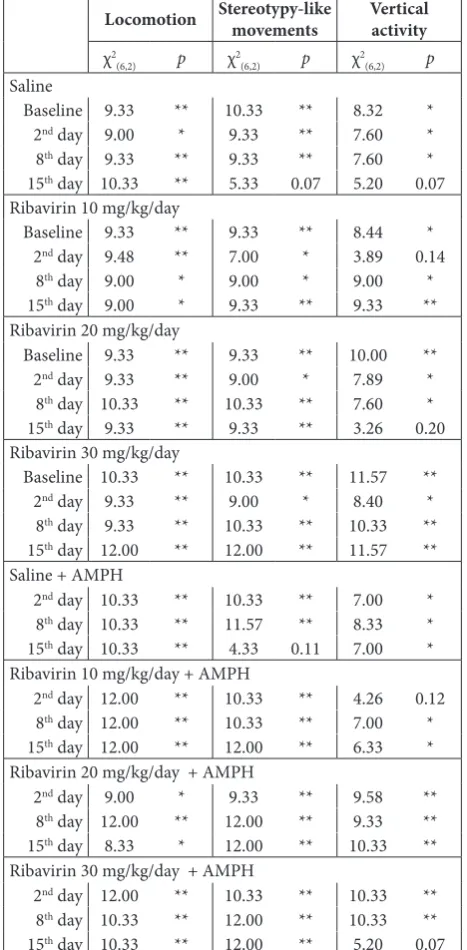
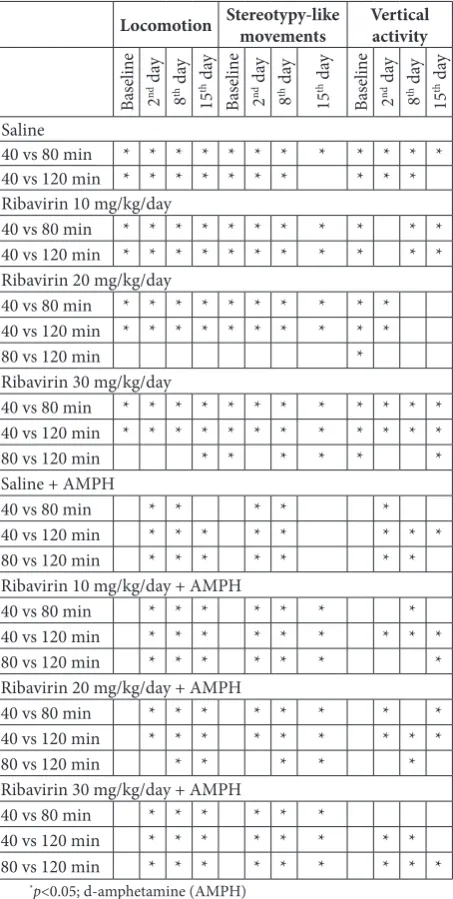
examined motor activities were the highest during the first 40 min of registration and decreased thereafter (results of Friedman ANOVA and Wilcoxon test are given in Tables 2 and 3, respectively).
On day 2 (a day after the first once-a-day i.p. injection of saline or specified doses of ribavirin), no significant changes in novelty-induced exploratory activity were detected in ribavirin groups compared to the control group (Fig. 2A-C, second panels). All groups of animals showed ex-pected decreases in motor activities across the registration period, except animals that were injected ribavirin at a dose of 10 mg/ kg with regard to vertical activity (results of Friedman ANOVA and Wilcoxon test are given in Tables 2 and 3, respectively).
On day 8 (a day after the seventh once-a-day i.p. injection of saline or specified doses of ribavirin), we detected highly similar novelty-induced motor activity in all groups of animals during the first and the last 40 min of registration. During the second 40 min, significant differences appeared in terms of decreased locomotion of animals exposed to 10 and 30 mg/kg/day of riba-virin compared to control/saline-injected animals (Fig. 2A, third panel, *p<0.05, Steel’s test). At the same time interval, decreased stereotypy-like activity of animals exposed
Table 1. Results of Kruskal-Wallis ANOVA
Locomotion Stereotypy-like movements Vertical activity
40 min 80 min 120 min 40 min 80 min 120 min 40 min 80 min 120 min
H(3,24) p H(3,24) p H(3,24) p H(3,24) p H(3,24) p H(3,24) p H(3,24) p H(3,24) p H(3,24) p
SPONTANEOUS MOTOR BEHAVIOR
Baseline 0.08 0.99 0.31 0.96 4.97 0.17 0.67 0.88 1.19 0.76 6.35 0.10 0.27 0.96 2.65 0.45 3.73 0.29 2nd day 2.91 0.41 0.69 0.88 0.88 0.83 4.55 0.21 0.27 0.97 1.45 0.69 3.71 0.29 2.02 0.57 5.19 0.16
8th day 4.38 0.22 7.30 0.06 1.08 0.78 3.55 0.31 7.43 0.06 2.28 0.52 3.02 0.39 7.03 0.07 1.69 0.64
15th day 1.93 0.59 1.04 0.79 8.87 * 2.66 0.45 1.07 0.79 4.01 0.26 1.73 0.63 0.24 0.97 0.97 0.81
AMPH-INDUCED MOTOR BEHAVIOR
2nd day 3.63 0.30 4.03 0.26 1.42 0.70 1.71 0.63 2.46 0.48 0.77 0.86 1.82 0.61 3.01 0.39 1.74 0.63
8th day 1.57 0.67 4.01 0.26 2.26 0.52 1.54 0.67 7.85 * 5.57 0.13 2.19 0.53 0.93 0.82 1.57 0.67
15th day 1.99 0.58 2.81 0.42 0.62 0.89 2.69 0.44 2.65 0.45 8.39 * 1.29 0.73 3.69 0.30 1.21 0.75
*p<0.05; H
(degrees of freedom, number of animals); d-amphetamine (AMPH)
to 10 mg/kg/day of ribavirin (Fig. 2B, third panel, *p<0.05) and decreased vertical activity of animals exposed to 20 mg/kg/day of ribavirin compared to the control (Fig. 2C, third panel, *p<0.05) were also observed. In all groups of animals, Friedman ANOVA revealed a significant decrease in all examined motor activities across registration time (Table 2; post hoc analysis (Wilcoxon test) is given in Table 3).
On day 15 (a day after the fourteenth once-a-day i.p. injection of saline or specified doses of ribavirin), we detected highly similar novelty-induced motor ac-tivity in all groups of animals during the first and the second 40 min of registration. During the third 40 min, significant differences appeared in terms of decreased locomotion of animals exposed to 10 and 30 mg/kg/day of ribavirin compared to the control (Fig. 2A, fourth panel, *p<0.05, Steel’stest), without significant changes in stereotypy-like and vertical activities (Figs. 2B and 2C, respectively, fourth panels). Importantly, Friedman ANOVA revealed non-significant changes in stereotypy-like and vertical activities across the registration time in the control group. In all groups exposed to ribavirin, the pattern of changes in the activities over time was preserved, except in the group exposed to 20 mg/kg/ day regarding vertical activity (results of Friedman ANOVA and Wilcoxon test are given in Tables 2 and 3, respectively). Appropriate findings of Kruskal-Wallis ANOVA regarding the exploratory activity of adult male rats in the novel environment after exposure to different doses of ribavirin are given inTable 1.
D-AMPH-induced motor activity of adult male rats after exposure to different doses of ribavirin – impact of treatment duration
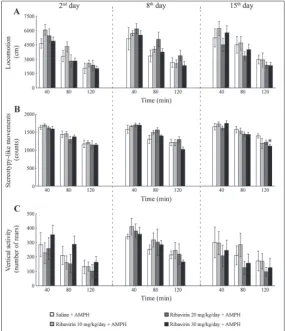
On day 2 (a day after the first once-a-day i.p. injection of saline or specified doses of ribavirin), no signifi-cant changes in AMPH-induced motor activity were detected in ribavirin groups compared to the control group (Figs. 3A-C, first panels). All groups of animals showed expected decreases in motor activities across the registration period, except animals that were in-jected with ribavirin at a dose of 10 mg/kg with regard to vertical activity (results of Friedman ANOVA and Wilcoxon test are given in Tables 2 and 3, respectively).
On day 8 (a day after the seventh once-a-day i.p. injection of saline or specified doses of ribavirin), we recorded slight changes in d-AMPH-induced motor activity during the second 40 min of registration, but they were not statistically significant (Figs. 3A-C, second panels). In all groups of animals, Friedman ANOVA revealed a significant decrease in all examined motor activities across registration time (Table 2; post hoc analysis (Wilcoxon test) is given in Table 3).
On day 15 (a day after the fourteenth once-a-day i.p. injection of saline or specified doses of ribavirin),
Table 2. Results of Friedman ANOVA
Locomotion Stereotypy-like movements Vertical activity
χ2
(6,2) p χ2(6,2) p χ2(6,2) p
Saline
Baseline 9.33 ** 10.33 ** 8.32 *
2nd day 9.00 * 9.33 ** 7.60 *
8th day 9.33 ** 9.33 ** 7.60 *
15th day 10.33 ** 5.33 0.07 5.20 0.07
Ribavirin 10 mg/kg/day
Baseline 9.33 ** 9.33 ** 8.44 *
2nd day 9.48 ** 7.00 * 3.89 0.14
8th day 9.00 * 9.00 * 9.00 *
15th day 9.00 * 9.33 ** 9.33 **
Ribavirin 20 mg/kg/day
Baseline 9.33 ** 9.33 ** 10.00 **
2nd day 9.33 ** 9.00 * 7.89 *
8th day 10.33 ** 10.33 ** 7.60 *
15th day 9.33 ** 9.33 ** 3.26 0.20
Ribavirin 30 mg/kg/day
Baseline 10.33 ** 10.33 ** 11.57 **
2nd day 9.33 ** 9.00 * 8.40 *
8th day 9.33 ** 10.33 ** 10.33 **
15th day 12.00 ** 12.00 ** 11.57 **
Saline + AMPH
2nd day 10.33 ** 10.33 ** 7.00 *
8th day 10.33 ** 11.57 ** 8.33 *
15th day 10.33 ** 4.33 0.11 7.00 *
Ribavirin 10 mg/kg/day + AMPH
2nd day 12.00 ** 10.33 ** 4.26 0.12
8th day 12.00 ** 10.33 ** 7.00 *
15th day 12.00 ** 12.00 ** 6.33 *
Ribavirin 20 mg/kg/day + AMPH
2nd day 9.00 * 9.33 ** 9.58 **
8th day 12.00 ** 12.00 ** 9.33 **
15th day 8.33 * 12.00 ** 10.33 **
Ribavirin 30 mg/kg/day + AMPH
2nd day 12.00 ** 10.33 ** 10.33 **
8th day 10.33 ** 12.00 ** 10.33 **
15th day 10.33 ** 12.00 ** 5.20 0.07
*p<0.05, **p<0.01; χ2
we recorded highly similar AMPH-induced motor activity in all groups of animals except the third 40 min, when significant differences appeared in terms of decreased stereotypy-like activity of animals ex-posed to 30 mg/kg/day of ribavirin, as compared to the saline-injected control (Fig. 3B, third panel, *p<0.05, Steel’stest). Importantly, Friedman ANOVA revealed non-significant changes in stereotypy-like activity across the registration time in the control group. In all groups exposed to ribavirin, the pattern of changes in the activities over the time was preserved, except in the
group exposed to 30 mg/kg/day with regard to vertical activity (results of Friedman ANOVA and Wilcoxon test are given in Tables 2 and 3, respectively).
Appropriate findings of Kruskal-Wallis ANOVA regarding d-AMPH-induced motor activity of adult male rats after exposure to different doses of ribavirin are given inTable 1.
Body weight gain of adult male rats during exposure to different doses of ribavirin – impact of treatment duration
Animals repeatedly injected with ribavirin at doses of 10, 20 and 30 mg/kg/day showed atypical weight gain compared to saline-treated ones (Fig. 4A). Kruskal-Wallis ANOVA revealed a significant impact of riba-virin treatment on BW gain a day after the seventh (H(3.48)=11.13; p<0.05) daily injection, while the in-fluence of the fourteenth daily injection very slightly missed the significance level (H(3.48)=7.37; p=0.06). Importantly, Steel’s test revealed that compared to the weight gain of the control group, this parameter was significantly lower in the group exposed to ribavirin at the dose of 30 mg/kg on day 2, and significantly lower in groups exposed to ribavirin at doses of 10 and 30 mg/kg/day on day 8 and on day 15 (Fig. 4B, *p<0.05). These data revealed that treatment duration was important in assessing the effect of ribavirin on BW.
DISCUSSION
The results of the present study for the first time reveal the effects of single (1 day) or repeated (7- and 14-day) exposures to low ribavirin doses on psychomotor activ-ity and body weight gain (as an indicator of energetic intake under conditions of controlled utilization) in socially undisturbed, group-housed adult male rats. These findings indicate that in rats the administration of ribavirin at low doses (10, 20 and 30 mg/kg/day, corresponding to 100, 200 and 300 mg/day in humans, respectively) can influence certain dopamine-mediated behaviors in a treatment duration-dependent man-ner. Although there was no strict regularity between changes in novelty-induced and AMPH-induced motor activities and BW gain due to repeated application of low ribavirin doses, low novelty-induced locomotion
Table 3. Results of Wilcoxon test
Locomotion Stereotypy-like movements Vertical activity
Ba
sel
ine
2
nd d
ay
8
th d
ay
15
th d
ay
Ba
sel
ine
2
nd d
ay
8
th d
ay
15
th d
ay
Ba
sel
ine
2
nd d
ay
8
th d
ay
15
th d
ay
Saline
40 vs 80 min * * * * * * * * * * * *
40 vs 120 min * * * * * * * * * *
Ribavirin 10 mg/kg/day
40 vs 80 min * * * * * * * * * * *
40 vs 120 min * * * * * * * * * * *
Ribavirin 20 mg/kg/day
40 vs 80 min * * * * * * * * * *
40 vs 120 min * * * * * * * * * *
80 vs 120 min *
Ribavirin 30 mg/kg/day
40 vs 80 min * * * * * * * * * * * *
40 vs 120 min * * * * * * * * * * * *
80 vs 120 min * * * * * *
Saline + AMPH
40 vs 80 min * * * * *
40 vs 120 min * * * * * * * *
80 vs 120 min * * * * * * *
Ribavirin 10 mg/kg/day + AMPH
40 vs 80 min * * * * * * *
40 vs 120 min * * * * * * * * *
80 vs 120 min * * * * * * *
Ribavirin 20 mg/kg/day + AMPH
40 vs 80 min * * * * * * * *
40 vs 120 min * * * * * * * * *
80 vs 120 min * * * * *
Ribavirin 30 mg/kg/day + AMPH
40 vs 80 min * * * * * *
40 vs 120 min * * * * * * * *
80 vs 120 min * * * * * * * * *
was always accompanied by reduced BW. Moreover, a U-shaped dose-response relationship appeared with prolonged duration of ribavirin treatment, as for some of the examined behaviors the dose-response curve was extended to very low ribavirin doses.
Although the undesirable neurobehavioral compli-cations of prolonged ribavirin therapy have been well recognized, an experimental approach that addresses the role of the dose and treatment duration on psy-chomotor functioning has not been undertaken. The ribavirin doses used in the current study are far below those usually used in humans to treat HCV infections
[33]. However, low doses of ribavirin have already proved to be effective after systemic administration in different animal models of human autoimmune diseases [41,42] and viral infections [43], speaking in favor of its therapeutic potential in diseases for which it is not primarily intended. Gener-ally, the consequence of adaptive changes in the number of A1 receptors in the brain due to their long-term stimulation has been described [44, 45].
The extent and timeline profile of riba-virin action primarily depends on its dose, route of administration, treatment dura-tion, BBB permeability, biodistribution and pharmacokinetic properties. Namely, it has been reported that 82% of intramuscularly administered ribavirin at a dose of 10 mg/ kg was excreted in the urine of rats within 24 h [12], while the total radioactivity in the urine of rats treated intravenously with [14C]
ribavirin at a dose of 30 mg/kg included 84% of the initial dose [46]. In the brain of rats, the content of ribavirin reached a peak at 8 h after intramuscular administration of a single dose of 10 mg/kg [12] and was detected in different brain areas (cerebellum, olfactory bulb, cerebral cortex, basal ganglia and hippocampus) 20 min after intravenous or nasal application of the same ribavirin dose [47]. This is supported by the find-ing of a previous study that pretreatment with ribavirin at doses of 20 and 30 mg/ kg significantly decreased hyperlocomo-tor activity induced by AMPH (1.5 mg/kg, i.p.) application 20 min later [20]. Given this data, the lack of an effect of a single ribavirin treatment on spontaneous and AMPH-induced mo-tor behavior 24 h later can be explained by its rapid elimination from the body, and/or by its decreasing concentration in the brain to a level that cannot cause observable behavioral changes.
Importantly, 24 h after 7 i.p. administrations of riba-virin (one per day), dose-specific and opposite changes in novelty-induced and AMPH-induced motor activities were observed, pointing to overall adaptations within the novelty- and AMPH-responsive brain regions due
Fig. 3. The influence of single, 7- and 14-day treatments with ribavirin at low doses (10, 20 and 30 mg/kg/day, i.p.) on d-amphetamine (AMPH)-induced locomo-tion (A), stereotypy-like activity (B) and vertical activity (C) of rats. The AMPH challenge (1.5 mg/kg, i.p.) was performed on the 2nd day (a day after the first
once-a-day i.p. injection), on the 8th day (a day after the seventh once-a-day i.p.
injection) and on the 15th day (a day after the fourteenth once-a-day i.p. injection)
to systemic ribavirin administration. Namely, common to these stimuli is that they are dopamine-mediated [21,30,31]. Our findings indicate that the outcome of the 7-day ribavirin pretreatment depended on the neurochemical peculiarities of the subsequent stimu-lus: AMPH targets the dopamine transporter (DAT) at mesolimbic/mesostriatal dopaminergic terminals [37,48], while novelty-induced motor activity strongly depends on excitatory glutamatergic inputs to the ventral tegmental area (VTA) and consequential elevation of mesolimbic dopaminergic transmission [31]. It has been shown that after exposure to the novel stimulus, the NAc dopamine level remained elevated for the entire 120 min period and was accompanied by increased motor activity [31]. It has also been documented that stimulation of A1 receptor activity in the VTA negatively influenced
motor activation [49]. In light of these findings and considering the data obtained in our study it could be assumed that the 7-day application of ribavirin, which has a moderate affinity for A1 receptors [15], could influence VTA activity regulation. Consequently, the magnitude of VTA stimulation by novelty was lower in animals exposed to (certain) low ribavirin doses as novel stimuli lost the novelty faster in ribavirin-exposed than in the control group. The AMPH-induced motor behavior suggested that DAT-mediated dopamine release from dopaminergic terminals was not affected; however, this finding needs additional examination with other drugs that act through DAT.
All natural rewarding stimuli, including food, act through the activation of midbrain dopaminergic neu-rons, increasing accumbal/striatal levels of dopamine [50-52]. It has been shown that the regulated release of dopamine is important for sustained feeding [53] and that consumption of food is related to dopamine transmission in several regions of the striatum (in the caudate putamen for response to the caloric value of food and regular feeding, in the NAc for the rewarding aspect of feeding [52]). Overactivity of A1 receptors, in addition to locomotor activity decrease, also pro-duces hypophagia [51]. It has also been shown that stimulation of the A1 receptor inhibits ghrelin release from the stomach (colocalization of ghrelin and A1 receptor immunoreactivity in the gastric nerve fibers are observed). Ghrelin is a hormone that crosses the BBB and stimulates dopamine signaling in the NAc [54, 55]. In our experiment, 7 days of ribavirin treatment (10 and 30 mg/kg/day) was, in addition to a decrease in novelty-induced motor activity, accompanied by a slight, but significant reduction in BW gain in treated animals compared to controls. This supports the as-sumption that 7-day ribavirin administration could provoke peculiar changes in the regulation of midbrain dopaminergic system activity, thus influencing/dimin-ishing physiological (novelty-induced motor activity and food-directed behavior), but not the pharmaco-logical (AMPH-induced motor activity) responses that depend on it. We have to accentuate that single housing of animals and direct measurement of food consumption were not performed in our experiment in order to avoid stress reaction and behavioral con-sequences of social isolation [56] that could interfere with the parameters of interest.
A decrease in BW gain accompanied by the nov-elty-provoked decrease in locomotion was detectable after 14 days of ribavirin application. Although the pattern/extent of changes indicates that the effect was decreasing, the U-shaped dose-response relationship was still evident, accentuating the cumulative effects of small ribavirin doses (10 and 30 mg/kg/day). The effect of treatment with 20 mg/kg/day on basal and AMPH-induced motor activities indicated that at this dose ribavirin had an atypical mechanism of action, which was not seen with the tested lower and higher doses. In clinical usage, the dose of 200 mg/day (cor-responding to 20 mg/kg/day in rats) is recommended for renal-impaired HCV patients [33].
Due to the relatively short duration of treatment, we were not able to fully define whether prolonged ribavirin application could minimize the effect of small ribavirin doses on novelty-induced psychomotor activ-ity and BW gain as the consequence of the allostatic process (i.e. the dynamic biobehavioral adaptation in response to external stimulation/treatment; [57]). In that sense, the presence of changes in motor activity after d-AMPH challenge also suggested that physi-ological readjustment caused by a 14-day ribavirin ap-plication tends to be outside the homeostatic range, introducing the system into a state that might require more specific pharmacological stimulation to detect any irregularities in its functioning. Therapeutic appli-cation of ribavirin in real conditions is a multi-month [2] procedure, but in our experimental paradigm this was not appropriate because i.p. treatment is stressful for animals [58]. Thus, the influence of the repeated i.p. injection protocol used in our study should not be neglected, especially considering the fact that in the control group the absence of a time-dependent decrease in stereotypy-like and vertical activities was noticed after the 14-day saline injections, which was not the case in 1-day and 7-day injection protocols. Importantly, in animals exposed to 10 and 30 mg/kg/ day, examination regularity was preserved after the 14 days of ribavirin injections, suggesting a protective role of repeatedly used low ribavirin doses in chronic mild stress-induced responses, which deserves to be additionally examined. Behavior of the group exposed to 20 mg/kg/day of ribavirin was control-like, indicating once again that at this dose, ribavirin has an atypical mechanism of action. The role of A1 adenosine re-ceptors is extensively implicated in defense reactions
and in the brain’s response to stress [59]. Given that ribavirin has affinity for A1 receptors [15], its involve-ment in the aboveinvolve-mentioned stress response seems quite acceptable.
The question that remains unanswered is the nature of motor activity increase induced in the experimental groups by d-AMPH injection compared to the saline injection. Such analysis requires an additional 72 rats, with most likely no impact on the accuracy of other data. Therefore, in our attempt to minimize the number of rats used, we chose to omit these groups. Neverthe-less, the absence of peculiarities in the psychomotor re-sponse to strong/pharmacological stimulation does not mean that fine physiological regulation is undisturbed by prolonged ribavirin treatment. These experiments should be considered and examined in depth in further studies, to provide concrete data on the neurochemical and molecular bases of this phenomenon.
CONCLUSIONS
The findings of this study are a valuable contribution to an understanding of the psychomotor and physiologi-cal response to low ribavirin doses in a rodent model, with reference to treatment duration. Although we did not observe strict regularity between the changes in novelty- and AMPH-induced motor activities and BW gain due to repeated application of low ribavirin doses, low novelty-induced locomotion was always ac-companied by reduced BW gain. The observed effects were discrete, as is appropriate for an agent that has not been primarily assessed as neuroactive, but should not be neglected as they accentuate potential undesirable manifestations of application of low ribavirin doses during the first days and weeks of treatment. By ac-centuating the U-shaped dose-response relationship related to prolonged duration of ribavirin treatment, this study opens up the issue of potential undesirable/ unexpected effects of low ribavirin doses.
Funding: This study was supported by the Ministry of Education, Science, and Technological Development of the Republic of Serbia (Grant Nos. 173027 and 173056).
Author contributions: B.P. and V.P. designed and performed the study, analyzed and interpreted the results, critically revised the manuscript and gave final approval of the manuscript for publica-tion. G.S., S.K., S.R., Lj.M. and J.P. contributed to drafting of the manuscript. G.S. prepared the tables and figures.
Conflict of interest disclosure: The authors declare that they
have no conflict of interest.
REFERENCES
1. Esmat G, El Kassas M, Elbaz T, El Raziky M. Ribavirin and its great potentials in infectious diseases. In: Buskirk J, editor. Ribavirin: biochemistry, clinical applications and potential side effects. New York: Nova Science Publishers Inc; 2013. p. 37-57.
2. Thomas E, Ghany MG, Liang TJ. The application and mecha-nism of action of ribavirin in therapy of hepatitis C. Antivir Chem Chemother. 2012;23(1):1-12.
3. Cattie JE, Letendre SL, Woods SP, Barakat F, Perry W, Cherner M, Umlauf A, Franklin D, Heaton RK, Hassanein T, Grant I; Translational Methamphetamine AIDS Research Center (TMARC) Group. Persistent neurocognitive decline in a clinic sample of hepatitis C virus-infected persons receiving interferon and ribavirin treatment. J Neurovirol. 2014;20(6):561-70.
4. de Knegt RJ, Bezemer G, Van Gool AR, Drenth JP, Hansen BE, Droogleever Fortuyn HA, Weegink CJ, Hengeveld MW, Janssen HL. Randomised clinical trial: escitalopram for the prevention of psychiatric adverse events during treatment with peginterferon-alfa-2a and ribavirin for chronic hepatitis C. Aliment Pharmacol Ther. 2011;34(11-12):1306-17. 5. Fioravante M, Alegre SM, Marin DM, Lorena SL, Pereira TS,
Soares EC. Weight loss and resting energy expenditure in patients with chronic hepatitis C before and during standard treatment. Nutrition. 2012;28(6):630-4.
6. Mahajan S, Avasthi A, Grover S, Chawla YK. Role of base-line depressive symptoms in the development of depressive episode in patients receiving antiviral therapy for hepatitis C infection. J Psychosom Res. 2014;77(2):109-15.
7. Kamei S, Sakai T, Matsuura M, Tanaka N, Kojima T, Arakawa Y, Matsukawa Y, Mizutani T, Oga K, Ohkubo H, Matsumura H, Hirayanagi K. Alterations of quantitative EEG and mini-mental state examination in interferon-alpha-treated hepa-titis C. Eur Neurol. 2002;48(2):102-7.
8. Malaguarnera M, Laurino A, Di Fazio I, Pistone G, Casto-rina M, Guccione N, Rampello L. Neuropsychiatric effects and type of IFN-alpha in chronic hepatitis C. J Interferon Cytokine Res. 2001;21(5):273-8.
9. Schmidt F, Janssen G, Martin G, Lorenz R, Loeschke K, Soyka M, Folwaczny C, Schaefer M. Factors influencing long-term changes in mental health after interferon-alpha treatment of chronic hepatitis C. Aliment Pharmacol Ther. 2009;30(10):1049-59.
10. Seyam MS, Freshwater DA, O’Donnell K, Mutimer DJ. Weight loss during pegylated interferon and ribavirin treat-ment of chronic hepatitis C*. J Viral Hepat. 2005;12(5):531-5.
11. Reddy KR, Nelson DR, Zeuzem S. Ribavirin: current role in the optimal clinical management of chronic hepatitis C. J Hepatol. 2009;50(2):402-11.
12. Ferrara EA, Oishi JS, Wannemacher RW, Jr., Stephen EL. Plasma disappearance, urine excretion, and tissue distribu-tion of ribavirin in rats and rhesus monkeys. Antimicrob Agents Chemother. 1981;19(6):1042-9.
13. Jeulin H, Venard V, Carapito D, Finance C, Kedzierewicz F. Effective ribavirin concentration in mice brain using cyclo-dextrin as a drug carrier: evaluation in a measles encephalitis model. Antiviral Res. 2009;81(3):261-6.
14. Crumpacker C, Bubley G, Lucey D, Hussey S, Connor J. Rib-avirin enters cerebrospinal fluid. Lancet. 1986;2(8497):45-6. 15. Franchetti P, Cappellacci L, Grifantini M, Senatore G,
Mar-tini C, Lucacchini A. Tiazofurin analogues as selective ago-nists of A1 adenosine receptors. Res Commun Mol Pathol Pharmacol. 1995;87(1):103-5.
16. Fastbom J, Pazos A, Palacios JM. The distribution of ade-nosine A1 receptors and 5’-nucleotidase in the brain of some commonly used experimental animals. Neuroscience. 1987;22(3):813-26.
17. Franco R, Ferre S, Agnati L, Torvinen M, Gines S, Hillion J, Casadó V, Lledó P, Zoli M, Lluis C, Fuxe K. Evidence for adenosine/dopamine receptor interactions: indications for heteromerization. Neuropsychopharmacology. 2000;23(4 Suppl):S50-9.
18. Ferre S, Fredholm BB, Morelli M, Popoli P, Fuxe K. Ade-nosine-dopamine receptor-receptor interactions as an inte-grative mechanism in the basal ganglia. Trends Neurosci. 1997;20(10):482-7.
19. Schwienbacher I, Fendt M, Hauber W, Koch M. Dopamine D1 receptors and adenosine A1 receptors in the rat nucleus accumbens regulate motor activity but not prepulse inhibi-tion. Eur J Pharmacol. 2002;444(3):161-9.
20. Janać B, Pešić V, Peković S, Rakić L, Stojiljković M. The time-course of ribavirin-provoked changes of basal and AMPH-induced motor activities in rats. Exp Brain Res. 2005;165(3):402-6.
21. Sellings LH, Clarke PB. Segregation of amphetamine reward and locomotor stimulation between nucleus accumbens medial shell and core. J Neurosci. 2003;23(15):6295-303. 22. Jacobson KA, von Lubitz DK, Daly JW, Fredholm BB.
Adenosine receptor ligands: differences with acute versus chronic treatment. Trends Pharmacol Sci. 1996;17(3):108-13. 23. Kawashimo A, Shimazoe T, Yoshimatsu A, Watanabe S. Repeated adenosine pre-treatment potentiates the acute effect of methamphetamine in rats. Jpn J Pharmacol. 2000;84(1):78-81.
24. Poleszak E, Malec D. Influence of adenosine receptor ago-nists and antagoago-nists on amphetamine-induced stereotypy in rats. Pol J Pharmacol. 2000;52(6):423-9.
25. Calhoon GG, Tye KM. Resolving the neural circuits of anxi-ety. Nat Neurosci. 2015;18(10):1394-404.
26. Hughes RN. Neotic preferences in laboratory rodents: issues, assessment and substrates. Neurosci Biobehav Rev. 2007;31(3):441-64.
patients with bipolar disorder - Continuous heart rate and movement monitoring. Psychiatry Res. 2016;237:166-74. 28. Flagel SB, Robinson TE. Quantifying the psychomotor
activating effects of cocaine in the rat. Behav Pharmacol. 2007;18(4):297-302.
29. Jain MK, Zoellner C. Role of ribavirin in HCV treatment response: now and in the future. Expert Opin Pharmacother. 2010;11(4):673-83.
30. Horvitz JC. Mesolimbocortical and nigrostriatal dopamine responses to salient non-reward events. Neuroscience. 2000;96(4):651-6.
31. Legault M, Wise RA. Novelty-evoked elevations of nucleus accumbens dopamine: dependence on impulse flow from the ventral subiculum and glutamatergic neurotransmission in the ventral tegmental area. Eur J Neurosci. 2001;13(4):819-28. 32. Beccuti G, Pannain S. Sleep and obesity. Curr Opin Clin Nutr
Metab Care. 2011;14(4):402-12.
33. Abenavoli L, Mazza M, Almasio PL. The optimal dose of ribavirin for chronic hepatitis C: From literature evidence to clinical practice: The optimal dose of ribavirin for chronic hepatitis C. Hepat Mon. 2011;11(4):240-6.
34. Gara N, Ghany MG. What the infectious disease physician needs to know about pegylated interferon and ribavirin. Clin Infect Dis. 2013;56(11):1629-36.
35. Nair AB, Jacob S. A simple practice guide for dose con-version between animals and human. J Basic Clin Pharm. 2016;7(2):27-31.
36. Sanson-Fisher RW, Poole AD, Dunn J. An empirical method for determining an appropriate interval length for recording behavior. J Appl Behav Anal. 1980;13(3):493-500.
37. Sulzer D, Sonders MS, Poulsen NW, Galli A. Mechanisms of neurotransmitter release by amphetamines: a review. Prog Neurobiol. 2005;75(6):406-33.
38. Steel RGD. A multiple comparison rank sum test - treat-ments versus control. Biometrics. 1959;15(4):560-72. 39. Hothorn LA. The two-step approach – a significant ANOVA
F-test before Dunnett’s comparisons against a control – is not recommended. Commun Stat Theory Methods. 2016;45(11):3332-43.
40. Hamada C. Statistical analysis for toxicity studies. J Toxicol Pathol. 2018;31(1):15-22.
41. Harvie P, Omar RF, Dusserre N, Lansac N, Desormeaux A, Gourde P, Simard M, Tremblay M, Beauchamp D, Bergeron MG. Ribavirin potentiates the efficacy and toxicity of 2’,3’- dideoxyinosine in the murine acquired immunodeficiency syndrome model. J Pharmacol Exp Ther. 1996;279(2):1009-17. 42. Stojkov D, Lavrnja I, Pekovic S, Dacic S, Bjelobaba I,
Mostar-ica-Stojkovic M, Stosic-Grujicic S, Jovanovic S, Nedeljkovic N, Rakic L, Stojiljkovic M. Therapeutic effects of combined treatment with ribavirin and tiazofurin on experimental auto-immune encephalomyelitis development: clinical and histo-pathological evaluation. J Neurol Sci. 2008;267(1-2):76-85. 43. Safronetz D, Haddock E, Feldmann F, Ebihara H, Feldmann
H. In vitro and in vivo activity of ribavirin against Andes virus infection. PLoS One. 2011;6(8):e23560.
44. Fernandez M, Svenningsson P, Fredholm BB. Adaptive changes in adenosine receptors following long-term treat-ment with the adenosine receptor agonist R-phenylisopropyl adenosine. Life Sci. 1996;58(9):769-76.
45. Roman V, Keijser JN, Luiten PG, Meerlo P. Repetitive stimu-lation of adenosine A1 receptors in vivo: changes in recep-tor numbers, G-proteins and A1 receprecep-tor agonist-induced hypothermia. Brain Res. 2008;1191:69-74.
46. Lin CC, Yeh LT, Luu T, Lourenco D, Lau JY. Pharmaco-kinetics and metabolism of [(14)C]ribavirin in rats and cynomolgus monkeys. Antimicrob Agents Chemother. 2003;47(4):1395-8.
47. Colombo G, Lorenzini L, Zironi E, Galligioni V, Sonvico F, Balducci AG, Pagliuca G, Giuliani A, Calzà L, Scagliarini A. Brain distribution of ribavirin after intranasal administra-tion. Antiviral Res. 2011;92(3):408-14.
48. Jones GH, Robbins TW. Differential effects of mesocortical, mesolimbic, and mesostriatal dopamine depletion on spon-taneous, conditioned, and drug-induced locomotor activity. Pharmacol Biochem Behav. 1992;43(3):887-95.
49. Kaplan GB, Leite-Morris KA, Klufas MA, Fan W. Intra-VTA adenosine A1 receptor activation blocks morphine stimula-tion of motor behavior and cortical and limbic Fos immu-noreactivity. Eur J Pharmacol. 2009;602(2-3):268-76. 50. Berridge KC, Robinson TE. What is the role of dopamine
in reward: hedonic impact, reward learning, or incentive salience? Brain Res Brain Res Rev. 1998;28(3):309-69. 51. Kim DS, Palmiter RD. Adenosine receptor blockade reverses
hypophagia and enhances locomotor activity of dopamine-deficient mice. Proc Natl Acad Sci U S A. 2003;100(3):1346-51.
52. Szczypka MS, Kwok K, Brot MD, Marck BT, Matsumoto AM, Donahue BA, Palmiter RD. Dopamine production in the caudate putamen restores feeding in dopamine-deficient mice. Neuron. 2001;30(3):819-28.
53. Kim DS, Szczypka MS, Palmiter RD. Dopamine-deficient mice are hypersensitive to dopamine receptor agonists. J Neurosci. 2000;20(12):4405-13.
54. Palmiter RD. Is dopamine a physiologically relevant media-tor of feeding behavior? Trends Neurosci. 2007;30(8):375-81. 55. Yang GK, Yip L, Fredholm BB, Kieffer TJ, Kwok YN. Involve-ment of adenosine signaling in controlling the release of ghrelin from the mouse stomach. J Pharmacol Exp Ther. 2011;336(1):77-86.
56. Olsson IAS, Westlund K. More than numbers matter: the effect of social factors on behaviour and welfare of laboratory rodents and non-human primates. Appl Anim Behav Sci. 2007;103(3-4):229-54.
57. Ramsay DS, Woods SC. Clarifying the roles of homeosta-sis and allostahomeosta-sis in physiological regulation. Psychol Rev. 2014;121(2):225-47.
58. Meijer MK, Spruijt BM, van Zutphen LF, Baumans V. Effect of restraint and injection methods on heart rate and body temperature in mice. Lab Anim. 2006;40(4):382-91. 59. Dunwiddie TV, Masino SA. The role and regulation of