665
© 2018 by the Serbian Biological Society How to cite this article: Jovanović M, Srdić-Rajić T, Svirčev E, Jasnić N, Nikolić B, Bojić S, Stević T, Knežević-Vukčević J, Mitić-Ćulafić D. Evaluation of anticancer and antimicrobial activities of the Polygonum maritimum ethanol extract. Arch Biol Sci. 2018;70(4):665-73.
Evaluation of anticancer and antimicrobial activities of the
Polygonum maritimum
ethanol extract
Marina Jovanović1, Tatjana Srdić-Rajić2, Emilija Svirčev3, Nebojša Jasnić1, Biljana Nikolić1, Svetlana Bojić1, Tatjana Stević4, Jelena Knežević-Vukčević1 and Dragana Mitić-Ćulafić1,*
1University of Belgrade – Faculty of Biology, Studentski trg 16, 11000 Belgrade, Serbia
2Institute of Oncology and Radiology, Pasterova 14, 11000 Belgrade, Serbia
3University of Novi Sad – Faculty of Sciences, Department of Chemistry, Biochemistry and Environmental Protection,
Trg Dositeja Obradovića 3, 21000 Novi Sad, Serbia
4Institute for Medicinal Plants Research “Dr Josif Pančić”, Tadeuša Košćuška 1, 11000 Belgrade, Serbia
*Corresponding author: [email protected]
Received: April 23, 2018; Revised: June 6, 2018; Accepted: June 6, 2018; Published online: June 12, 2018
Abstract: Polygonum maritimum is a traditional herbal remedy that produces abundant flavonoid secondary metabolites.
The ethanol extract of P. maritimum aerial parts (POM) was chemically characterized and tested for antimicrobial properties
and cytotoxicity. Results of LC-MS/MS analysis showed high contents of gallic acid, epigallocatechin gallate and catechin, and significant amounts of quercetin-3-O-galactoside and quercetin-3-O-glucoside. Evaluation of the antifungal properties
revealed that POM induced notable growth inhibition of Alternaria alternata (34.3%), Penicillium spp. (30.6%), Fusarium
semitectum (20.2%) and Aspergillus spp. (19.6%). Evaluation of cytotoxicity against human hepatoma HepG2 cells included
monitoring the effects of both POM alone and its combination with cytostatic doxorubicin (Dox). Cell viability, apoptosis
and cell cycle distribution and the expression of antioxidant enzymes (superoxide-dismutases SOD1and SOD2 and catalase)
were determined. A dose-dependent decrease in cell viability was detected, but a remarkably stronger effect was obtained
when POM and Dox were applied in combination as compared to individual treatments. IC50 values were determined to be
393 μg/mL (POM) and 2.24 μg/mL (Dox) in combination, but 1153 μg/mL (POM) and 12.56 μg/mL (Dox) in a single
treat-ment. The value of the Loewe index, determined for IC50,was notably lower than 1 (LI=0.51), clearly indicating synergism
of POM and Dox. Additionally, POM and POM +Dox induced early/late apoptosis and G2/M cell cycle arrest. Furthermore,
POM increased, while Dox decreased the expression levels of SODs and catalase. The obtained results encourage further
examination of the potential use of POM in modern phytotherapy.
Key words:P. maritimum;antifungal effect;synergism with doxorubicin; flow cytometry; antioxidant enzymes
Abbreviations and acronyms:Polygonum maritimum extract (POM); Doxorubicin (Dox); superoxide dismutase 1 (SOD1); superoxide dismutase 2 (SOD2) ; catalase (CAT); liquid chromatography tandem-mass spectrometry (LC-MS/MS); fetal bovine serum (FBS); phosphate buffered saline (PBS); dimethyl sulfoxide (DMSO); 3-(4,5-dimethylthiazol-2-yl)-2,5-di-phenyltetrazolium bromide (MTT); fluorescence-activated cell sorting (FACS); Loewe index (LI); 7-aminoactinomycin D
(7-AAD); nuclear factor erythroid-2 related factor 2 (Nrf2); 25% inhibitory concentration (IC25); 50% inhibitory
concentra-tion (IC50); 75% inhibitory concentration (IC75)
INTRODUCTION
The genus Polygonum belongs to the family Polygo-naceae, one of the dominant families in the flora of most countries, especially in the Northern Hemisphere [1]. Being native to Europe, Asia and Africa, Polygonum
herbs have been used as traditional medicines in many
viewed as potential sources of novel anticancer and antiallergic agents, antiinflammatory drugs, antibiot-ics, insecticides and herbicides. The pharmacological effects of Polygonum spp. include antioxidant, antibac-terial, antifungal, neuroprotective, antidiabetic and antiinflammatory activities [1,5-8]. Furthermore, the species Polygonum maritimum, commonly known as sea knotgrass, has been described for its antioxidant activities [1]. It contains quercetin, quercitrin and catechin, known for their numerous bioactivities [9].
Considering the existence of biodegrading and storage-contaminating fungi in foods, as well as fungal toxicity and potential pathogenicity, there is a constant need for their growth control. Since synthetic sub-stances targeting plant fungal pathogens can produce toxic residues, the preservative activity of herbs and spices has received notable attention [10]. In addition, the resistance of fungi to conventional antimycotics further stimulates the search for natural inhibitors [11].
The use of cytostatics in treating different cancers is burdened with numerous problems, including many side effects and the frequent development of drug resistance in tumor cells [12,13].
Taking into account the abovementioned facts, the aims of this study were to examine the cytotoxic and antifungal properties of the ethanolic extract of
P. maritimum (POM). Its cytotoxicity was assessed in human hepatocarcinoma HepG2 cells and included an evaluation of its effect on antioxidant enzyme expres-sion and its potential to modulate the cell’s response to the common cytostatic doxorubicin (Dox). To the best of our knowledge, none of this has been previ-ously reported. Furthermore, the antifungal effect was examined against Penicillium spp., Alternaria alternata, Aspergillus spp., Fusarium semitectum and
Fusarium oxysporum by monitoring growth inhibition and mycelial decolorization.
MATERIALS AND METHODS Chemicals and reagents
Reference standards of the phenolic compounds and quinic acid were obtained from Sigma-Aldrich Chem (Steinheim, Germany), Fluka Chemie GmbH (Buchs, Switzerland) or from Chromadex (Santa Ana, USA).
HPLC gradient grade methanol was purchased from J. T. Baker (Deventer, The Netherlands), and p.a. formic acid from Merck (Darmstadt, Germany). William’s medium, fetal bovine serum (FBS), penicillin-strep-tomycin mixtures, phosphate buffered saline (PBS), trypsin from porcine pancreas, dimethyl sulfoxide (DMSO), protease inhibitor cocktails, Triton® X-100 and 3-(4,5-dimethylthiazol-2-yl)-2,5-diphenyltetra-zolium bromide (MTT) were purchased from Sigma-Aldrich (Steinheim, Germany). Reagents for apoptosis and cell cycle assays were obtained from Invitrogen Life TechnologiesTM (FITC-AnexinV, Binding puffers 2x, Rnase A Pure LinkTM, Massachusetts, USA), and 7-aminoactinomycin D was provided by PharmingenTM (New Jersey, USA). The Folin-Ciocalteu reagent was obtained from Fisher Scientific (Leicestershire, UK). Doxorubicin (Cas. No. 25316-40-9) was provided by Actavis, S.C. Sindan-Pharma S.R.L. (Buchurest, Romania). Primary and secondary antibodies were purchased from Abcam (Cambridge, UK). All the other chemicals and reagents were obtained from local companies and were molecular biology grade.
Plant material and extract preparation
Aerial parts of POM were collected along the Adriatic coast, in Ulcinj, Montenegro. The voucher specimen was deposited at the Herbarium of the Department of Biology and Ecology, Faculty of Sciences, University of Novi Sad, Serbia (BUNS Herbarium) under the reference number 2-1670. The dried plant material (5-15g) was extracted with 80% ethanol (1g per 10 mL) and filtered. The obtained extract was evaporated to dryness in a vacuum evaporator (<45°C). Raw extract was suspended in water and purified by liquid-liquid extraction with petroleum ether. The petroleum ether layer was washed with methanol and the methanol ex-tract was pooled with the aqueous layer. Subsequently, the extract was evaporated and dissolved in DMSO to a final concentration of 100 mg/mL.
Identification of compounds
In vitro antibacterial activity
The microdilution method was used to assess the anti-bacterial activity of POM (concentration range of 0.039-5 mg/mL) against seven bacterial strains, including Gram-negative bacteria: Escherichia coli (ATCC 8739),
Shigella flexneri (ATCC 9199), Pseudomonas aeruginosa
(ATCC 15442), Salmonella enteritidis (ATCC 13076), and Gram-positive bacteria: Staphylococcus aureus
(ATCC 25923), Listeria monocytogenes (ATCC 19111), and Enterococcus faecalis (ATCC 29212).
In vitro antifungal activity
The antifungal activity of the plant extract was de-termined by the agar plate method [16]. The fungi
Penicillium spp., Alternaria alternata, Aspergillus spp.,
Fusarium semitectum and Fusarium oxysporum were obtained from the Institute of Medicinal Plants Re-search “Dr. Josif Pančić”, Pančevo, Serbia. Micromycetes were maintained on potato dextrose agar (PDA). One hundred µL of the extract with a particular concentra-tion were brushed with a glass sterile stick in the PDA substrate. The POM was tested at a concentration of 1 mg/mL against Penicillium spp., Fusarium oxysporum
and Alternaria alternata, and at a concentration of 5 mg/mL against Fusarium semitectum and Aspergillus
spp. Seven-day-old agar disks (5 mm in diameter) bear-ing the desired fungus growth were transferred to the center of Petri plates with PDA. The fungus cultures were incubated at 25±2°C for 7 days. The experiment was set for up to four replicates and repeated three times. The percentage of mycelial growth inhibition was calculated according to the following formula:
%I=100×(dc×dt)/dc
where I – mycelial growth inhibition in %, dc – myc-elial growth in control in mm, dt – mycmyc-elial growth with POM in mm.
Cell culture
Human hepatocellular carcinoma HepG2 cells (ATCC HB-8065, USA) were grown in William’s medium con-taining 15% FBS, 1% penicillin/streptomycin and 2 mM L-glutamine. The cells were maintained in an incubator at 37ºC with 5.0% CO2 in a humidified atmosphere. The
cells were subcultured at 90% confluence, twice each week, using 0.1% trypsin. Cell viability was determined by the trypan blue dye exclusion method. Cells in the logarithmic growth phase were used in all experiments.
Cytotoxicity assay
The cytotoxic effects of the plant extract and doxoru-bicin, both as single compounds and in mixture, were assessed by a modified MTT assay [17]. Briefly, HepG2 cells were seeded into 96-well plates at a density 2x10⁴ cells/well and incubated overnight at 5% CO2, 37°C. The cells were exposed to a series of two-fold dilutions of test substances and their combinations to obtain concentra-tions ranging from 4-0.125 mg/mL of POM, and from 22.8-0.712 µg/mL of Dox. After incubation for 24 h, the medium containing test substances was displaced with MTT (final concentration 0.5 mg/mL) and incubated for additional 3 h. At the end of the incubation with MTT, the medium was removed, and the formazan crystals were dissolved in DMSO. The optical density was measured at 570 nm using a microplate reading spectrophotometer (Multiskan FC, Thermo Scientific, Shanghai, China). Three independent experiments were conducted, and external wells were excluded.
Analysis of apoptosis by flow cytometry
HepG2 cells (1x10⁶ cells/plate) were cultured with plant extract, POM (0.5 and 1 mg/mL) with and without Dox (2.8 and 5.7 µg/mL) for 24 h. After the treatment, the cells were harvested, washed with PBS, stained with Annexin V_FITC and 7-AAD, and analyzed by fluo-rescence activated cell sorting (FACS) (Calibur Becton Dickinson, Heidelberg, Germany) flow cytometer and Cell Quest computer software, according to the manufacturer’s protocol.
Cell cycle analysis
Western blot analysis
After treatment with the test compounds, the cell lysates were prepared in ice-cold lysis buffer containing 50 mM Tris-HCl, pH 7.5, 150 mM NaCl, 1% Triton X-100 and protease inhibitor cocktail solutions. The protein concentration was determined according to the Lowry method [18] at 750 nm, using bovine serum albumin (BSA) as a standard. Protein expression of CuZn superoxide dismutase (SOD1), Mn superoxide dismutase (SOD2) and catalase (CAT) were determined by Western blot analysis. Cell lysates (20 μg of samples per lane for SOD1 and SOD2 and 50 μg per lane for CAT) were poured on 12% SDS-polyacrylamide gels and transferred overnight to 0.45 mm polyvinylidene difluoride (PVDF) membranes after electrophore-sis. The membranes were blocked in 5% dry non-fat milk in Tris buffered saline containing 0.1% Tween 20 (TBST) for 1.5 h. Anti-SOD1, -SOD2 and -CAT rabbit polyclonal antibodies (1:2000) were used as primary antibodies. Anti-β actin mouse monoclonal antibody (1:1000) was used as a loading control. Horseradish peroxidase-conjugated secondary goat anti-rabbit polyclonal antibodies (for SOD1, SOD2 and CAT, 1:5000) or rabbit anti-mouse polyclonal antibody (for beta-actin, 1:5000) were used as a secondary antibody. The immunoreactive bands were visualized using the enhanced chemiluminescence detection kit (ECLplus, Amersham, Bucks, UK) on a ChemiDoc-It2 detection system (UVP, Jena, Germany). The intensity of signals was evaluated by the ImageJ program. The amount of protein in each lane was normalized to β-actin.
Statistical analysis
To analyze the type of pharmacokinetic interactions of Dox and the extract in combination, the Loewe ad-ditivity model (LI) was used and data from the MTT assay were subjected to statistical analysis with the mixLow package in R-studio [19]. Data from apop-tosis, cell cycle and Western blotting were analyzed by analysis of variance (ANOVA) using GraphPad Prism software. The level of statistical significance was defined as p<0.05. Microsoft Excel software was used to perform the statistical analyses for antifungal experiments.
RESULTS
Identification of compounds
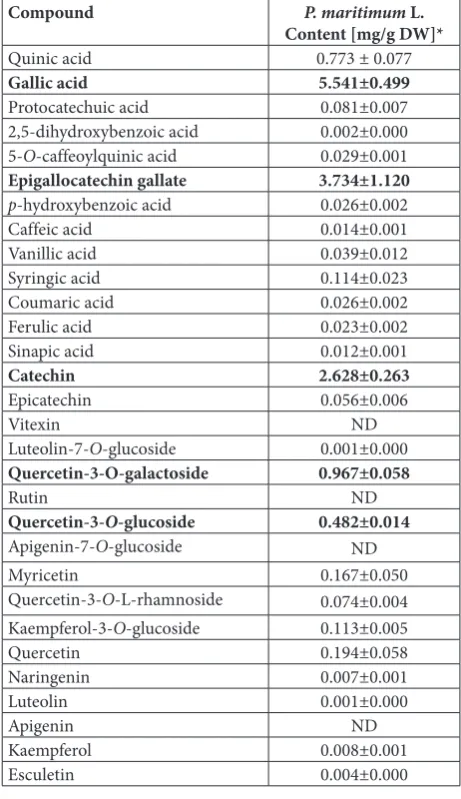
The obtained results showed that the P. maritimum
extract of the aerial parts has a high total phenolic content (483 mg eqv. gallic acid/1g dry extract) but a lower total flavonoid content (1.4 mg eqv. quercetin/1g dry extract). The dominant compounds of the POM
extract could be presented in following order: gallic acid > epigallocatechin gallate > catechin > quercetin-3-O-galactoside > quercetin-3-O-glucoside (Table 1).
Table 1. Results of phenols quantification in the P. maritimum
herbal extract.
Compound P. maritimum L.
Content [mg/g DW]*
Quinic acid 0.773 ± 0.077
Gallic acid 5.541±0.499
Protocatechuic acid 0.081±0.007 2,5-dihydroxybenzoic acid 0.002±0.000 5-O-caffeoylquinic acid 0.029±0.001
Epigallocatechin gallate 3.734±1.120
p-hydroxybenzoic acid 0.026±0.002 Caffeic acid 0.014±0.001 Vanillic acid 0.039±0.012 Syringic acid 0.114±0.023 Coumaric acid 0.026±0.002 Ferulic acid 0.023±0.002 Sinapic acid 0.012±0.001
Catechin 2.628±0.263
Epicatechin 0.056±0.006
Vitexin ND
Luteolin-7-O-glucoside 0.001±0.000
Quercetin-3-O-galactoside 0.967±0.058
Rutin ND
Quercetin-3-O-glucoside 0.482±0.014
Apigenin-7-O-glucoside ND Myricetin 0.167±0.050 Quercetin-3-O-L-rhamnoside 0.074±0.004 Kaempferol-3-O-glucoside 0.113±0.005 Quercetin 0.194±0.058 Naringenin 0.007±0.001 Luteolin 0.001±0.000
Apigenin ND
Kaempferol 0.008±0.001 Еsculetin 0.004±0.000
In vitro antimicrobial activity
Antibacterial screening performed by the microdilu-tion assay against a panel of seven pathogenic strains showed no antibacterial activity (in the given range of concentrations; less than 5 mg/mL). Antifungal activity was evaluated by comparing the growth of mycelia in the presence of POM and in the control sample (untreated). Apart from Fusarium oxysporum,
POM inhibited the growth of all other tested strains. The obtained results showed a notable growth inhibi-tory effect on Alternaria alternata, Penicillium spp.,
Fusarium semitectum and Aspergillus spp., with inhi-bitions determined to be 34.3%, 30.6%, 20.24% and 19.6%, respectively (Table 2). Moreover, depigmenta-tion and morphological changes of the Aspergillus spp. mycelium were additional indications of POM toxicity.
Cytotoxicity assay
The cytotoxic effect of the herbal extract, Dox, and their combinations, evaluated on HepG2 cells, is presented in dose-response curves (Fig.1). The IC25, IC50 and IC75 values were determined from these curves (Table 3). In order to quantify the mode of interaction between the tested substances, the Loewe index (LI) was cal-culated, with LI<1, LI=1, LI>1 indicating synergistic, additive and antagonistic effects, respectively (Fig. 2).
Table 2. Inhibition of mycelium growth after treatment with POM.
Fungi Growth inhibition [%]
Alternaria alternata 34.3
Penicillium spp. 30.6
Fusarium semitectum 20.24
Aspergillus spp. 19.6
Fusarium oxysporum nd*
POM was tested at concentrations of 1 mg/mL against Penicillium spp.,
Fusarium oxysporum and Alternaria alternata and 5 mg/mL against
Fusarium semitectum and Aspergillus spp.
*nd – not detected – inhibition of growth is not detected
Table 3. The cytotoxicity of POM and Dox, either alone or in a binary-drug combination on HepG2 cells.
IC25 of POM IC25 of Dox IC50 of POM IC50 of Dox IC75 of POM IC75 of Dox
P. maritimum 702 1153 1880
Dox 1.30 12.56 138
P. maritimum+Dox 253 1.44 393 2.24 608 3.47
* Values are presented as IC25 IC50 and IC75, in µg/mL, from three independent experiments by the MTT assay. IC25-75-the concentration of sample
required to inhibit cell survival by 25%, 50% and 75%, respectively.
Fig. 1. Inhibition of HepG2 cell viability after treatment with POM, Dox and their combination. The tested concentrations of POM, Dox and their combination are presented as values of natural logarithms (LN values). POM was tested in a concentration range from 4-0.125 mg/mL (that corresponded to the range from 1.386 to -2.079 presented in LN values). Dox was tested in a concentration range from 0.0228-0.0007125 mg/mL (that corresponded to the range from -3.780 to -7.246 presented in LN values).
Fig. 2. Loewe Index values calculated at the IC25, IC50 and IC75 level. Loewe index (LI), interaction index; LI<1 indicates synergism; LI=1 indicates an additive effect; LI>1 indicates antagonism.
(for the IC50 and IC75 values, LIs were determined to be 0.51 and even 0.35, respectively). For example, 50% lethality was obtained with strikingly lower doses in the cotreatment (393 μg/mL of POM and 2.24 μg/mL of Dox), compared to the treatment with POM (1153 μg/mL) or Dox alone (12.56 μg/mL).
Assessment of apoptosis and cell cycle
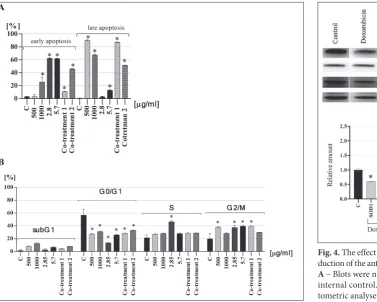
To determine whether the cytotoxicity of POM and its combination with Dox is related to apoptosis induction and if it is mediated by cell cycle arrest, flow cytometry was applied. The POM extract (500 µg/mL), alone and in combination with Dox (2.8 µg/mL), increased the percentage of cells in late apoptosis (89.85% and 87.11%, respectively; Fig. 3A). Nonetheless, the combination of lower concentrations of POM and Dox increased the number of early apoptotic cells. Furthermore, a statisti-cally significant increase in early and late apoptotic cells was observed after the cell treatment with 1000 µg/mL of
POM alone (25.51% and 67.5%, respectively), and in combination with Dox (45.88% and 51.6%, respectively). As expected, Dox increased the number of apoptotic cells as follows: when applied in a lower dose (2.8 µg/mL) only cells in early phase (62.15%) were observed, but when applied in a higher dose (5.7 µg/mL), both early and late phases (61.65% and 12.75%, respectively) were observed. The cell cycle phase distribution after the treatment of cells with POM, Dox and their combinations is presented in Fig. 3B. Lower concentrations of the extract, Dox, and their combination induced cell cycle arrest in G2/M phase, causing a significant decrease in cell number in the G0/ G1 phase. Higher concentrations and their combination did not significantly affect the cell cycle.
Western blot analysis
To examine the effect of POM on the antioxidant en-zymes SOD1, SOD2 and CAT, we employed Western blotting. HepG2 cells were treated either with the Fig. 4. The effect of POM and Dox on the in-duction of the antioxidative defense enzymes.
A – Blots were normalized to β-actin as the internal control. B – Histograms of densi-tometric analyses of SOD1, SOD2 and CAT levels following treatment of HepG2 cells with POM or Dox (POM 0.5 mg/mL, Dox 1.4 µg/mL); C – untreated control * p≤0.05.
Fig. 3. Analysis of apoptosis (A) and cell cycle arrest (B) in HepG2 cells treated with
POM, Dox and their combination. Co-treatment=simultaneously applied POM and Dox (Co-treatment 1=500 µg/mL POM and 2.28 µg/mL Dox; Co-treatment 2=1000 µg/mL
extract (500 µg/mL) or with Dox (1.4 µg/mL). The obtained results showed that Dox decreased the ex-pression of CAT, SOD1 and SOD2, while POM extract significantly increased CAT and SOD1 expression but had no influence on SOD2 (Fig. 4).
DISCUSSION
Many reports have highlighted the potential benefits of using Polygonum species in phytomedicine, revealing the close correlation between their phenolic composition and the pharmacological effects they exhibit, including antioxidant, anticancer and antimicrobial properties. In the course of the examination of the biological activities of POM, its antimicrobial potential was examined first. While no antibacterial activity was found, a notable anti-fungal effect against food-contaminating micromycetes was observed. Absence of an antibacterial potential is contrary to the results of El-Haci et al. [1], who deter-mined an antibacterial activity of P. maritimum extract against some human pathogens. This discrepancy could be attributed to the difference in the process of extraction [20]. On the other hand, the obtained antifungal effect is consistent with literature data showing that extracts of various Polygonum species, such as P. hydropiper, P. aviculare, P. punctatum and P. acuminatum produced fungicidal effects [5,21-24]. In addition, the antimicro-bial activity of gallic acid and catechin, being dominant in POM, was also shown [25].
The cytotoxicity of POM was monitored in human hepatoma HepG2 cells, which have been widely used as an in vitro model for assessing drug effectiveness and toxicity [26]. Since chemosensitizing phytochemicals can be combined with conventional chemotherapeu-tic agents to improve cancer treatment and clinical outcomes, we also monitored the effect of its combi-nations with doxorubicin (Dox). The benefits of this approach include a reduction in the doses of applied chemotherapeutic drugs, which is important in view of the severe toxicity of conventional cytostatics. This can decrease the toxicity without compromising treat-ment efficacy through the induction of more diverse mechanisms of action [27]. Dox-induced toxicity is mediated by reactive oxygen species (ROS) produc-tion and consequently increases lipid peroxidaproduc-tion [28]. Furthermore, the medical application of Dox is limited due to its side effects, mainly hepatotoxicity and
cardiotoxicity, but also due to frequent development of drug resistance in tumor cells [29]. Taking into account that the active principals of POM, including the most dominant flavan-3-ols (catechin and epigallocatechin gallate), flavon-3-ols (quercetin and myricetin deriva-tives) and free gallic acid, possessing an antioxidative potential [25,30], POM could protect against toxicity mediated by Dox-induced ROS, and certainly affect the expression of antioxidative enzymes. In line with this are the results indicating that extracts of P. glabrum
and P. orientale provided hepatoprotective activity in normal hepatocytes in vivo [31,32].
The low cytotoxic effect of POM is in agreement with literature data showing that plant species from the Polygonaceae family have an antiproliferative ef-fect on hepatocarcinoma cells, including Bel-7402 and Hepa 1-6 [33]. Concerning the effect of combinations (POM+Dox), both antagonistic and synergistic inter-actions were obtained. This could be attributed to the dual effect of antioxidants, which induce a prooxi-dative effect at higher concentrations [34]. In light of this, POM at lower tested concentration induced an antioxidant effect and consequently reduced the ROS-mediated toxicity of Dox. On the other hand, with increasing POM concentration, its effect became prooxidative and enhanced Dox toxicity, inducing a remarkable synergistic effect.
Medications based on plants, including Poly-gonum extracts, and conventional cytostatic drugs can influence the metabolism of toxic substances by modulating both nonspecific and specific detoxifying enzymes and by disturbing the balance between ap-optosis, the regulation of cell death and proliferation [37,38]. Herein we monitored the impactof POM and Dox on the modulation of nonspecific detoxifying/ antioxidant enzymes such as SOD1, SOD2 and CAT. The results indicated that POM enhanced, whilst Dox suppressed SOD1 and CAT activities in HepG2 cells. Some studies reported higher expression of SOD en-zymes in hepatocytes after treatment with P. orientale
and P. multiflorum extracts, which is in accordance with our findings [32,39]. The main constituents of
POM, gallic acid and catechin, exert their ability to elevate the hepatic levels of CAT, and therefore may provide protection against the deleterious effects of lipid peroxides and hydrogen peroxide [40]. Moreover, gallic acid and epigallocatechin gallate affect the level of antioxidant enzymes by stimulating Nrf2 protein expression through the Keap1-Nrf2-ARE signaling pathway in HepG2 cells [41]. It is well known that activation of the Nrf2-ARE cellular defense system is an important mechanism for protecting cells against oxidative and xenobiotic stresses [26,41,42].
Considering all the obtained results, the
POM-induced dual protective and cytotoxic effects depended mainly on the applied dose. A similar observation was described by another research group that showed that plant extracts had a protective effect on hepatocytes
in vivo as a result of enhanced antioxidant enzyme activities and the cytotoxic effect obtained through increased apoptosis and alterations of the cell cycle [43].
In conclusion, the Polygonum maritimum extract could be a significant natural source of biologically ac-tive compounds that possess antifungal and cytotoxic properties. It is important to emphasize its ability to potentiate the chemotherapeutic activity of the con-ventional cytostatic doxorubicin. However, further investigation is needed to elucidate the mechanism of action of POM and to examine its application both as a fungicide and adjuvant in chemotherapy.
Acknowledgments: The authors are grateful to Dr. Bojana Žegura, National Institute of Biology, Slovenia, for providing the HepG2 cells for this work. This work was supported by the Ministry of Science of Republic of Serbia, Project No. 172058.
Author contributions: MJ participated in all the experiments, wrote the draft and performed the literature search; TSR con-tributed to the flow cytometric analysis; ES prepared the extract, performed the chemical analysis and reviewed the manuscript; SB performed the statistical analysis and prepared the figures; BN supervised the research project in some parts and formed the final version of manuscript; NJ contributed to the Western blots, TS contributed to the antifungal experiments; JKV critically reviewed the manuscript; DMĆ provided the concept of the study and supervised all phases of the research. All authors read and approved the final manuscript.
Conflicts of interest disclosure: The authors have no conflicts of interest to declare.
REFERENCES
1. El-Haci IA, Bekkara FA, Mazari W, Hassani F, Didi MA. Screening of biological activities of Polygonum mariti-mum L. from Algerian coast. Asian Pac J Trop Biomed. 2013;3(8):611-6.
2. Tunon H, Olavsdotter C, Bohlin L. Evaluation of anti-inflammatory activity of some Swedish medicinal plants. Inhibition of prostaglandin biosynthesis and PAF-induced exocytosis. J Ethnopharmacol. 1995;48(2):61-76.
3. Wang KJ, Zhang YJ, Yang CR. Antioxidant phenolic com-pounds from rhizomes of Polygonum paleaceum. J Ethno-pharmacol. 2005;96(3):483-7.
4. Ravipati AS, Zhang L, Koyyalamudi SR, Jeong SC, Reddy N, Bartlett J, Smith PT, Shanmugam K, Münch G, Wu MJ, Saty-anarayanan M. Antioxidant and anti-inflammatory activi-ties of selected Chinese medicinal plants and their relation with antioxidant content. BMC Complement Altern Med. 2012;12(1):173.
5. Dong X, Fu J, Yin X, Li X, Wang B, Cao S, Zhang J, Zhang H, Zhao Y, Ni J. Pharmacological and other Bioactivities of the Genus Polygonum-A Review. Trop J Pharm Res. 2014;13(10):1749-59.
6. Nkuété AH, Migliolo L, Wabo HK, Tane P, Franco OL. Evaluation of Multiple Functions of Polygonum Genus Com-pounds. European J Med Plants. 2015;6(1):1-16.
7. Rodrigues MJ, Custódio L, Lopes A, Oliveira M, Neng NR, Nogueira JM, Martins A, Rauter AP, Varela J, Bar-reira L. Unlocking the in vitro inflammatory and anti-diabetic potential of Polygonum maritimum L. Pharm Biol. 2017;55(1):1348-57.
8. Rodrigues MJ, Slusarczyk S, Pecio Ł, Matkowski A, Salmas RE, Durdagi S, Pereira C, Varela J, Barreira L, Custódio L. In vitro and in silico approaches to appraise Polygonum mariti-mum L. as a source of innovative products with anti-ageing potential. Ind Crops Prod. 2018;111:391-9.
9. Alía M, Mateos R, Ramos S, Lecumberri E, Bravo L, Goya L. Influence of quercetin and rutin on growth and antioxidant defense system of a human hepatoma cell line (HepG2). Eur J Nutr. 2006;45(1):19-28.
11. Brent KJ, Hollomon DW. Fungicide resistance in crop patho-gens: How can it be managed? 2nd rev. ed. Brussels: Fungi-cide Resistance Action Committee; 2007. 50 p.
12. Ullah MF. Cancer multidrug resistance (MDR): a major impediment to effective chemotherapy. Asian Pac J Cancer Prev. 2008;9(1):1-6.
13. Shields M. Chemotherapeutics. In: Pharmacognosy: Funda-mentals, Applications and Strategies.McCreath SB, Delgoda R, editors. London: Academic Press; 2017. 738 p.
14. Beara IN, Lesjak MM, Jovin ED, Balog KJ, Anačkov GT, Orčić DZ, Mimica-Dukić NM. Plantain (Plantago L.) spe-cies as novel sources of flavonoid antioxidants. J Agric Food Chem. 2009;57(19):9268-73.
15. Orčić D, Francišković M, Bekvalac K, Svirčev E, Beara I, Lesjak M, Mimica-Dukić N. Quantitative determination of plant phenolics in Urtica dioica extracts by high-perfor-mance liquid chromatography coupled with tandem mass spectrometric detection. Food Chem. 2014;143:48-53. 16. Balouiri M, Sadiki M, Ibnsouda SK. Methods for in vitro
evaluating antimicrobial activity: A review. J Pharm Anal. 2016;6(2):71-9.
17. Mosmann T. Rapid colorimetric assay for cellular growth and survival: application to proliferation and cytotoxicity assays. J Immunol Methods. 1983;65(1-2):55-63.
18. Lowry OH, Rosebrough NJ, Farr AL, Randall RJ. Protein measurement with the Folin phenol reagent. J Biol Chem. 1951;193(1):265-75.
19. Boik JC, Narasimhan B. An R package for assessing drug synergism/antagonism. J Stat Softw. 2010;34(6):1-8. 20. Mohapatra DP, Thakur V, Brar SK. Antibacterial efficacy of
raw and processed honey. Biotechnol Res Int. 2011;2011:1-6. 21. Ayaz M, Junaid M, Ullah F, Sadiq A, Ovais M, Ahmad W,
Zeb A. Chemical profiling, antimicrobial and insecticidal evaluations of Polygonum hydropiper L. BMC Complement Altern Med. 2016;16(1):502.
22. Waqas M, Shad AA, Wasila H, Khan EA, Bashir O, Rashid MU, Ahmad I. Antimicrobial activity of Polygonium hydro-piper leaves against plant and human pathogenic fungal and bacterial strains. Pure Appl Biol. 2016;5(4):856-61. 23. Salama HM, Marraiki N. Antimicrobial activity and
phyto-chemical analyses of Polygonum aviculare L. (Polygonaceae), naturally growing in Egypt. Saudi J Biol Sci. 2010;17(1):57-63. 24. Derita MG, Leiva ML, Zacchino SA. Influence of plant part, season of collection and content of the main active constitu-ent, on the antifungal properties of Polygonum acuminatum
Kunth. J Ethnopharmacol. 2009;124(3):377-83.
25. Badhani B, Sharma N, Kakkar R. Gallic acid: a versatile anti-oxidant with promising therapeutic and industrial applica-tions. Rsc Advances. 2015;5(35):27540-57.
26. Yeh CT, Yen GC. Involvement of p38 MAPK and Nrf2 in phenolic acid-induced P-form phenol sulfotransferase expression in human hepatoma HepG 2 cells. Carcinogen-esis. 2005;27(5):1008-17.
27. Pinmai K, Chunlaratthanabhorn S, Ngamkitidechakul C, Soonthornchareon N, Hahnvajanawong C. Synergistic growth inhibitory effects of Phyllanthus emblica and Termi-nalia bellerica extracts with conventional cytotoxic agents: doxorubicin and cisplatin against human hepatocellular carcinoma and lung cancer cells. World J Gastroenterol. 2008;14(10):1491-7.
28. Ichihara S, Yamada Y, Kawai Y, Osawa T, Furuhashi K, Duan Z, Ichihara G. Roles of oxidative stress and Akt signaling in doxorubicin cardiotoxicity. Biochem Biophys Res Commun. 2007;359(1):27-33.
29. Eid SY, El-Readi MZ, Wink M. Synergism of three-drug combinations of sanguinarine and other plant secondary metabolites with digitonin and doxorubicin in multi-drug resistant cancer cells. Phytomedicine. 2012;19(14):1288-97 30. Ow YY, Stupans I. Gallic acid and gallic acid derivatives:
effects on drug metabolizing enzymes. Curr Drug Metab. 2003;4(3):241-8.
31. Raja S, Ramya I. A comprehensive review on Polygonum glabrum. Int J Phytomedicine. 2017; 8(4):457-67.
32. Chiu YJ, Chou SC, Chiu CS, Kao CP, Wu KC, Chen CJ, Tsai JC, Peng WH. Hepatoprotective effect of the ethanol extract of Polygonum orientale on carbon tetrachloride-induced acute liver injury in mice. J Food Drug Anal. 2017;26(1):369-379. 33. Hu B, An HM, Shen KP, Song HY, Deng S. Polygonum
cus-pidatum extract induces anoikis in hepatocarcinoma cells associated with generation of reactive oxygen species and down regulation of focal adhesion kinase. Evid Based Com-plement Alternat Med. 2012; 2012: 607675.
34. Procházková D, Boušová I, Wilhelmová N. Antioxidant and prooxidant properties of flavonoids. Fitoterapia. 2011;82(4):513-23.
35. Shieh DE, Chen YY, Yen MH, Chiang LC, Lin CC. Emo-din-induced apoptosis through p53-dependent pathway in human hepatoma cells. Life Sci. 2004;74(18):2279-90. 36. Lee BH, Huang YY, Wu SC. Hepatoprotective activity of
fresh Polygonum multiflorum against HepG2 hepatocarci-noma cell proliferation. J Food Drug Anal. 2011;19(1):26-32. 37. Wang YY, Li J, Wu ZR, Zhang B, Yang HB, Wang Q, Cai
YC, Liu GX, Li WH, Tang Y. Insights into the molecular mechanisms of Polygonum multiflorum Thunb-induced liver injury: a computational systems toxicology approach. Acta Pharmacologica Sinica. 2017; 38(5):719-32.
38. Altay A, Kartal Dİ, Sadi G, Güray T, Yaprak AE. Modulation of mRNA expression and activities of xenobiotic metaboliz-ing enzymes, CYP1A1, CYP1A2, CYP2E1, GPx and GSTP1 by the Salicornia freitagii extract in HT-29 human colon cancer cells. Arch Biol Sci. 2017;69(3):439-48.
39. Lin L, Ni B, Lin H, Zhang M, Li X, Yin X, Qu C, Ni J. Tra-ditional usages, botany, phytochemistry, pharmacology and toxicology of Polygonum multiflorum Thunb.: a review. J Ethnopharmacol. 2015;15(159):158-83.
40. Yoo KM, Lee CH, Lee H, Moon B, Lee CY. Relative antioxi-dant and cytoprotective activities of common herbs. Food Chem. 2008;106(3):929-36.
41. Han X, Shen T, Lou H. Dietary polyphenols and their bio-logical significance. Int J Mol Sci. 2007;8(9):950-88. 42. Silva IC, Polaquini CR, Regasini LO, Ferreira H, Pavan FR.
Evaluation of cytotoxic, apoptotic, mutagenic, and chemo-preventive activities of semi-synthetic esters of gallic acid. Food Chem Toxicol. 2017;105:300-7.