Proceedings of the
Seventh International Workshop on
Graph Transformation and Visual Modeling Techniques
(GT-VMT 2008)
From Model Transformation to Model Integration based on the
Algebraic Approach to Triple Graph Grammars
Hartmut Ehrig , Karsten Ehrig and Frank Hermann
14 pages
Guest Editors: Claudia Ermel, Reiko Heckel, Juan de Lara
Managing Editors: Tiziana Margaria, Julia Padberg, Gabriele Taentzer
From Model Transformation to Model Integration based on the
Algebraic Approach to Triple Graph Grammars
Hartmut Ehrig1, Karsten Ehrig2and Frank Hermann1
1[ehrig, frank](at)cs.tu-berlin.de
Institut f¨ur Softwaretechnik und Theoretische Informatik Technische Universit¨at Berlin, Germany
Department of Computer Science University of Leicester, United Kingdom
Abstract: Success and efficiency of software and system design fundamentally relies on its models. The more they are based on formal methods the more they can be automatically transformed to execution models and finally to implementation code. This paper presents model transformation and model integration as specific problem within bidirectional model transformation, which has shown to support various purposes, such as analysis, optimization, and code generation.
The main purpose of model integration is to establish correspondence between var-ious models, especially between source and target models. From the analysis point of view, model integration supports correctness checks of syntactical dependencies between different views and models.
The overall concept is based on the algebraic approach to triple graph grammars, which are widely used for model transformation. The main result shows the close relationship between model transformation and model integration. For each model transformation sequence there is a unique model integration sequence and vice versa. This is demonstrated by a quasi-standard example for model transformation between class models and relational data base models.
Keywords:model transformation, model integration, syntactical correctness
1
Introduction
Whenever one can expect benefits out of different modeling languages for the same specific task there is a substantial motivation of combining at least two of the them. For this purpose it is useful to have model transformations between these modeling languages together with suitable analysis and verification techniques. In cases of bidirectional model transformation the support for the modeling process increases, for instance, if results of analysis can be translated backwards to mark the original source of deficiency or defect, respectively.
Triple graph grammars are based on triple rules, which allow to generate integrated modelsG
consisting of a source modelGS, a target modelGT and a connection modelGC together with
correspondences fromGCtoGSandGT. AltogetherGis a triple graphG= (GS←GC→GT).
From each triple ruletrwe are able to derive a source ruletrSand a forward ruletrF, such that
the source rules are generating source models GS and the forward rules allow to transform a
source modelGSinto its corresponding target modelGT leading to a model transformation from
source to target models. On the other hand we can also derive from each triple ruletra target ruletrT and a backward ruletrB, such that the target rules are generating target modelsGT and
backward rules transform target models to source models. The relationship between these for-ward and backfor-ward model transformation sequences was analyzed already in [EEE+07] based on a canonical decomposition and composition result for triple transformations.
In this paper we study the model integration problem: Given a source modelGSand a target
modelGT we want to construct a corresponding integrated modelG= (GS←GC→GT). For
this purpose, we derive from each triple ruletran integration ruletrI, such that the integration
rules allow to define a model integration sequence from(GS,GT)toG. Of course, not each pair
(GS,GT)allows to construct such a model integration sequence. In our main result we
charac-terize existence and construction of model integration sequences sequences from(GS,GT)toG
by model transformation sequences from GS toGT. This main result is based on the
canoni-cal decomposition result mentioned above [EEE+07] and a new decomposition result of triple transformation sequences into source-target- and model integration sequences.
In Section2 we review triple rules and triple graph grammars as introduced in [Sch94] and present as example the triple rules for model transformation and integration between class models and relational data base models. Model transformations based on our paper [EEE+07] are intro-duced in Section3, where we show in addition syntactical correctness of model transformation. The main new part of this paper is model integration presented in Section4including the main results mentioned above and applied to our example. Related and future work are discussed in sections5and6, respectively.
2
Review of Triple Rules and Triple Graph Grammars
Triple graph transformation [Sch94] has been shown to be a promising approach to consistently co-develop two related structures. Bidirectional model transformation can be defined using mod-els consisting of a pair of graphs which are connected via an intermediate correspondence graph together with its embeddings into the source and target graph. In [KS06], K¨onigs and Sch¨urr formalize the basic concepts of triple graph grammars in a set-theoretical way, which was gen-eralized and extended by Ehrig et. el. in [EEE+07] to typed, attributed graphs. In this sec-tion, we shortly review main constructions and relevant results for model integration as given in [EEE+07].
Definition 1(Triple Graph and Triple Graph Morphism) Three graphsSG,CG, andT G, called source, connection, and target graphs, together with two graph morphismssG:CG→SG and tG:CG→T Gform a triple graphG= (SG
sG
←CG→tG T G). Gis calledempty, ifSG,CG, and
A triple graph morphismm= (s,c,t):G→H between two triple graphsG= (SG←sG CG→tG
T G)andH= (SH←sH CH→tH T H)consists of three graph morphismss:SG→SH,c:CG→CH
andt:T G→T Hsuch thats◦sG=sH◦candt◦tG=tH◦c. It is injective, if morphismss,cand tare injective.
Triple graphs Gare typed over a triple graphTG= (TGS←TGC→TGT)by a triple graph
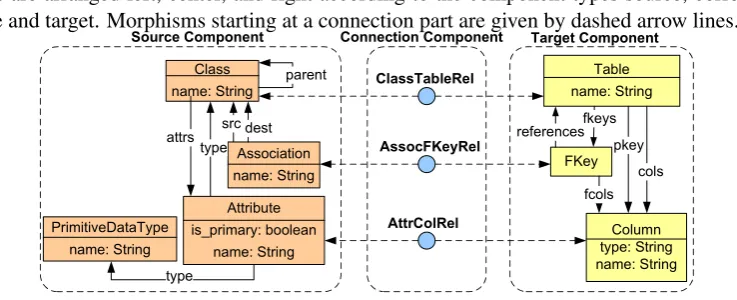
morphismtG:G→TG. Type graph of the example is given in Fig. 1showing the structure of
class diagrams in source component and relational databases in target component. Where classes are connected via associations the corresponding elements in databases are foreign keys. Though, the complete structure of correspondence elements between both types of models is defined via the connection component ofT G. Throughout the example, originating from [EEE+07], ele-ments are arranged left, center, and right according to the component types source, correspon-dence and target. Morphisms starting at a connection part are given by dashed arrow lines.
Class name: String
Table name: String
src
ClassTableRel
Association name: String
PrimitiveDataType name: String
FKey AssocFKeyRel
AttrColRel Column
type: String name: String cols fkeys references dest
fcols pkey
Attribute is_primary: boolean
name: String attrs
Source Component Connection Component Target Component
type
parent
type
Figure 1: Triple type graph forCD2RDBMmodel transformation
A triple rule is used to build up source and target graphs as well as their connection graph, i.e. to build up triple graphs. Structure filtering which deletes parts of triple graphs, is performed by projection operations only, i.e. structure deletion is not done by rule applications. Thus, we can concentrate our investigations on non-deleting triple rules without any restriction.
Definition 2(Triple Ruletrand Triple Transformation Step) Atriple rule tr consists of triple graphs LandR, called left-hand and right-hand sides, and an injective triple graph morphismtr= (s,c,t):L→R.
Given a triple rule tr = (s,c,t):L→R, a triple graph
G and a triple graph morphism m= (sm,cm,tm):L→
G, called triple match m, a triple graph transforma-tion step (TGT-step)G===tr,m⇒ H fromGto a triple graph
H is given by three pushouts (SH,s0,sn), (CH,c0,cn)
and (T H,t0,tn) in category Graph with induced
L = (SL
tr
s
CL sL
o
o
c
tL // T L)
t
R = (SR s CR
R
o
o
tR
/
/T R)
SL
smyyrrr oo CL //
cm~~}} T L
tm||yy G= (SG
tr
s0
CG
o
o //
c0
T G)
t0 SR
sn
y
y oo ~~ CRcn // T R tn
|
|
yy H= (SHoo sH CH t
H
/
/T H)
morphismssH:CH→SH andtH:CH→T H. Morphismn= (sn,cn,tn)is called comatch.
consists of a triple start graphSand a setT Rof triple rules. Given a triple ruletrwe refer by
L(tr)to its left and byR(tr)to its right hand side.
Remark 1 (gluing construction) Each of the pushout objects SH,CH,T H in Def. 2 can be constructed as a gluing construction, e.g. SH =SG+SLSR, where theS-componentsSGofG
andSRofRare glued together viaSL.
:Class {new} name = n
:Table {new} name = n
:ClassTableRel {new}
:Class :Table
:attrs {new} :ClassTableRel
:Attribute {new} name = an primary = true
:PrimitiveDataType {new} name = t
:Column {new} type = t name = an
:AttrColRel {new}
:cols {new}
:type {new}
:Class :Table
:attrs
:ClassTableRel
:Attribute
is_primary = true :Column
:AttrColRel
:cols :pkey {new}
:Class :Table
:parent {new}
:ClassTableRel
:ClassTableRel {new}
:Class {new} name=n
Class2Table(n:String)
SetKey()
PrimaryAttribute2Column(an:String, p:Boolean, t:String) Subclass2Table(n:String)
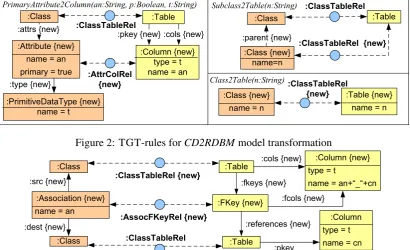
Figure 2: TGT-rules forCD2RDBMmodel transformation
:Class :Table
:ClassTableRel {new}
:Association {new} name = an :src {new}
:Class :dest {new}
:FKey {new}
:Table :AssocFKeyRel {new}
:ClassTableRel
:Column {new} type = t
name = an+“_“+cn :cols {new}
:fcols {new} :fkeys {new}
:references {new} :Column type = t name = cn :pkey
Figure 3: RuleAssociation2ForeignKey(an:String)forCD2RDBMmodel transformation
Examples for triple rules are given in Fig. 2and Fig. 3in short notation. Left and right hand side of a rule are depicted in one triple graph. Elements, which are created by the rule, are labeled with ”new” and all other elements are preserved, meaning they are included in the left and right hand side. Rule ”Class2Table” synchronously creates a class in a class diagram with its corre-sponding table in the relational database. Accordingly the other rules create parts in all com-ponents. For rule ”PrimaryAttribute2Column” there is an analogous rule ”Attribute2Column” for translation of non primary attributes, which does not add the edge ”:pkey” in the database component.
3
Model transformation
L = (SL
tr
s
CL sL
o
o
c
tL // T L)
t
R = (SR s CR
R
o
o
tR
/
/T R)
triple ruletr
(SR
id
CL s◦sL
o
o
c
tL // T L)
t
(SRoo sR CR tR //T R)
forward ruletrF
(SL s
/0
o
o
/
/ /0)
(SRoo /0 // /0)
source ruletrS
For simplicity of notation we sometimes identify source ruletrSwithSL→−s SRand target rule trT withTL→−t TR.
Theses rules can be used to define a model transformation from source graphs to target graphs. Vice versa using backward rules - which are dual to forward rules - it is also possible to define backward transformations from target to source graphs and altogether bidirectional model trans-formations. In [EEE+07] we have shown that there is an equivalence between corresponding forward and backward TGT sequences. This equivalence is based on the canonical decomposi-tion and composidecomposi-tion result (Thm.1) and its dual version for backward transformations.
Definition 3(Match Consistency) Lettr∗S andtrF∗ be sequences of source rulestriS and
for-ward rules triF, which are derived from the same triple rulestrifor i=1, . . . ,n. Let further G00=
tr∗S
=⇒ Gn0= tr∗F
=⇒ Gnn be a TGT-sequence with (miS,niS) being match and comatch of triS
(respectively(mi,ni)fortriF) then match consistency ofG00= tr∗S
=⇒Gn0= tr∗F
=⇒Gnnmeans that the S-component of the matchmiis uniquely determined by the comatchniS(i=1, . . . ,n).
Theorem 1(Canonical Decomposition and Composition Result - Forward Rule Case)
1. Decomposition:For eachTGT-sequence based on triple rules tr∗ (1)G0=tr
∗
=⇒Gnthere is a canonical match consistentTGT-sequence
(2) G0=G00= tr∗S
=⇒ Gn0= tr∗F
=⇒Gnn=Gn based on corresponding source rules tr∗S and for-ward rules tr∗F.
2. Composition:For each match consistent transformation sequence (2) there is a canonical transformation sequence (1).
3. Bijective Correspondence:Composition and Decomposition are inverse to each other.
Proof. See [EEE+07].
Now we want to discuss under which conditions forward transformation sequencesG1=tr ∗ F
=⇒
Gn define a model transformation between suitable source and target languages. In fact we
have different choices: On the one hand we can consider the projectionsV LS = pro jS(V L)
andV LT=pro jT(V L)of the triple graph languageV L={G|/0=⇒∗G via TR}, wherepro jX is a
projection defined by restriction to one of the triple components, i. e.X∈ {S,C,T}. On the other hand we can use the source rulesTRS={trS|tr∈TR}and the target rulesTRT={trT|tr∈TR}
to define the source languageVLS0={GS|/0⇒=∗GSvia TRS} and the target languageVLT0= {GT|/0=⇒∗ GT via TRT}. Since each sequence /0=⇒∗ G via TR can be restricted to a source
VLT ⊆VLT0, but in general no equality. In case of typed graphs the rules inTRare typed over
TGwithTG= (TGS←TGC→TGT)and rules ofTRSandTRT typed over(TGS← /0→ /0)and
(/0← /0→TGT), respectively. Since GS andGT are considered as plain graphs they are typed
overTGSandTGT, respectively.
Given a forward transformation sequenceG1= tr∗F
=⇒Gnwe want to ensure the source component
ofG1corresponds to the target component ofGn, i.e. the transformation sequence defines a a
model transformationMTfromVLS0toVLT0, writtenMT:VLS0VVLT0, where all elements of the source component are translated. Thus given a class diagram as instance of the type graph in Fig.1all corresponding tables, columns and foreign keys of the corresponding data base model shall be created in the same way they could have been synchronously generated by the triple rules ofTR. An example forward transformation is presented in [EEE+07]. SinceGS∈VLS0 is generated byTRS-rules we have a source transformation /0=⇒∗GSviaTRS. In order to be sure that
G1=tr ∗ F
=⇒Gntransforms all parts ofG1, which are generated by /0⇒=∗GS, we require that /0=⇒∗GS
is given by /0=tr ∗ S
=⇒ G1 withG1= (GS← /0→ /0), i.e. projS(G1) =GS based on the same triple
rule sequencetr∗ asG1= tr∗F
=⇒Gn. Finally we require that the TGT-sequence /0= tr∗S
=⇒G1=
trF∗
=⇒Gn
is match consistent, because this implies – by Fact1below – thatGS∈VLS andGT ∈VLT and
that we obtain a model transformationMT:VLSVVLT (see Fact1).
Definition 4(Model Transformation) A model transformation sequence(GS,G1= tr∗F
=⇒Gn,GT)
consists of a source graphGS, a target graphGT, and a source consistent forward TGT-sequence
G1= tr∗F
=⇒GnwithGS=projS(G1)andGT=projT(Gn).
Source consistency ofG1=tr ∗ F
=⇒Gnmeans that there is a source transformation sequence /0= tr∗S
=⇒
G1, such that /0= tr∗S
=⇒G1= trF∗
=⇒Gnis match consistent. A model transformationMT:VLS0VVLT0 is defined by model transformation sequences(GS,G1=
tr∗F
=⇒Gn,GT)withGS∈VLS0andGT ∈ VLT0.
Remark2 A model transformationMT:VLS0VVLT0 is a relational dependency and only in
special cases a function.
This allows to show thatMT:VLS0VVLT0defined above is in factMT:VLSVVLT
Fact1 (Syntactical Correctness of Model TransformationMT) GivenGS∈VLS0andG1= tr∗F
=⇒
Gn source consistent with pro jS(G1) =GS then GT =pro jT(Gn)∈VLT and GS ∈VLS, i.e. MT:VLSVVLT.
Proof. GivenG1=tr ∗ F
=⇒Gn source consistent, we have /0= tr∗S
=⇒G1=tr ∗ F
=⇒Gn match consistent and
hence, by Theorem 1 above with G0 = /0 =tr
∗
4
Model Integration
Given modelsGS∈VLS0andGT∈VLT0the aim of model integration is to construct an integrated modelG∈VL, such thatGrestricted to source and target is equal toGSandGT, respectively, i.e. projSG=GS andprojTG=GT. Thus, given a class diagram and a data base model as instance
of the type graph in Fig. 1 all correspondences between their elements shall be recovered or detected, respectively. Similar to model transformation we can derive rules for model integration based on triple ruletr. The derived rules are source-target ruletrST and integration ruletrIgiven
by
(SL
s
CL sL
o
o
c
tL // T L)
t
(SRoo sRCR tR //T R)
triple ruletr
(SL s
/0
o
o
/
/TL)
t
(SRoo /0 //TR)
source-target ruletrST
(SR
id
CL s◦sL
o
o
c
t◦tL // TR)
id
(SRoo sR CR tR //TR)
integration ruletrI
An example for both kinds of rules is given in Fig. 4for the triple ruleClass2Tablein Fig.2.
:ClassTableRel {new}
:Table
name = n :Class
name = n
(a) integration ruleClass2TableI
:Class{new} name = n
:Table{new} name = n
(b) source-target ruleClass2TableST
Figure 4: Derived rules forClass2Table()
Similar to the canonical decomposition of TGT-sequences G0=tr
∗
=⇒Gn into source and
for-ward transformation sequences we also have a canonical decomposition into source-target and
integration transformation sequences of the form /0=tr ∗ ST
==⇒G0= tr∗I
=⇒Gn. Such a sequence is called S-T-consistent, if theS- andT-component of the comatch oftriST is completely determined by
that of the match oftriIfortr= (tri)i=1...n.
Theorem 2(Canonical Decomposition and Composition Result - Integration Rule Case)
1. Decomposition:For eachTGT-sequence based on triple rules tr∗ (1)G0=tr=⇒∗ Gnthere is a canonical S-T -match consistentTGT-sequence
(2) G0=G00=tr ∗ ST
==⇒Gn0= trI∗
=⇒Gnn=Gn based on corresponding source-target rules tr∗ST and integration rules tr∗I.
2. Composition: For each S-T -match consistent transformation sequence (2) there is a canonical transformation sequence (1).
3. Bijective Correspondence:Composition and Decomposition are inverse to each other.
In the following we give the proof of Theorem2which is based on the Local-Church-Rosser and the Concurrency Theorem for algebraic graph transformations (see [Roz97], [EEPT06]). The proof uses two lemmas, where the proof of the lemmas is given in [EEH08]. In Lemma1 we show that a triple ruletr can be represented as concurrent productiontrST∗EtrI of the
to L(trI), the left hand side of trI. Moreover E-related sequences in the sense of the
Con-currency Theorem correspond exactly to S-T-match-consistent sequences in Theorem 2. In Lemma2we show compatibility ofS-T-match consistency with sequential independence in the sense of the Local-Church-Rosser-Theorem. Using Lemma1we can decompose a single TGT-transformationG0=tr⇒G1into anS-T-match consistent sequenceG0=trST
==⇒G10=trI
=⇒G1and vice versa. Lemma2 allows to decompose TGT-sequences G0=tr
∗
=⇒ Gn into S-T-match consistent
sequencesG0=tr ∗ ST
==⇒Gn0= tr∗I
=⇒Gnand vice versa.
All constructions are done in the categoryTripleGraphTG of typed triple graphs and typed triple graph morphisms, which according to Fact 4.18 in [EEPT06] is an adhesive HLR category. This implies that the Local-Church-Rosser and Concurrency Theorem are valid for triple rules with injective morphisms (see Chapter 5 in [EEPT06]).
Lemma 1 (Concurrent Production tr =trST∗EtrI) Let E =L(trI) with e1 = (id,/0,id) : R(trST)→ E and e2 =id:L(trI)→ E then tr is given by the concurrent production tr = trST∗EtrI. Moreover, there is a bijective correspondence between a transformation G1=
tr,m
==⇒G2
and match-consistent sequences G1= trST,m1,n1
=====⇒H=tr====I,m2,n⇒2 G2, where S−T -match consistency
means that the S− and T−components of the comatch n1 and the match m2 are equal, i.e. n1S=m2Sand n1T =m2T. Construction of concurrent production:
L(trST)
l
trST //
(1)
R(trST)
e1KKKKK%%
K K
K L(trI)
e2
z
z
tttttt t
trI //
(2)
R(trI)
r
L(tr)
d1 //E d2 //R
E−concurrent rule
Lemma 2(Compatibility ofS−T-match consistency with independence)
Given theTGT-sequences on the right with independence in(4)and matches mi,m0i and comatches ni,n0i. Then we have:
G20 tr1 I
m10,n10PP#+
P P P P P P P P P P G00 tr1ST m0,n0 +3G10
tr2ST
m20,n20
3 ; n n n n n nnnnnnn
tr1I m1,n1PP#+
P P P P P P P P P
P G21
tr2I m3,n3 +3G22
G11 tr2ST
m2,n2
3 ; n n n n n nnnnnnn
(1)G00= tr1ST
==⇒G10===tr1⇒I G11S−T -match consistent⇔
(2)G00=tr1ST
==⇒G10=tr2ST
==⇒G20=tr1I
==⇒G21S−T -match consistent and
(3)G11=tr==2ST⇒G21===tr2⇒I G22S−T -match consistent⇔
(4)G10= tr2ST
==⇒G20===tr1⇒I G21===tr2⇒I G22S−T -match consistent
Proof of Theorem2.
1. Decomposition: Given
(1) we obtain (for n =
3) by Leamma 1 a de-composition into triangles
(1),(2),(3), where the corre-sponding transformation se-quences are S − T-match consistent.
G30
(6) tr1I
( J J J J J J G20
(4) tr1I
(
J J JJJ J
tr3STtt6>
t ttt
G31
(5) tr2I
(
J J JJJ J
G10
(1) tr1I
(
J J JJJ J
tr2STtt6>
t ttt
G21
(2) tr2I
(
J J JJJ J
tr3STtt6>
t ttt
G32
(3) tr3I
(
J J JJJ J G00
tr1STtt6>
t ttt
tr1 +3
G0= G11
tr2STtt6>
t ttt
tr2 +3G22 tr3STtt6>
t ttt
In the next step we show that G10 =tr1I
==⇒
G11=tr==2ST⇒G21is sequentially independent leading by the Local Church Rosser The-orem to square (4) sequential indepen-dence in this case means existence of d :
L(tr2ST)→G10withg◦d=m2.
L(tr1I) m1
tr1I//
R(tr1I)
$ $ H H H H H
H L(tr2ST)
m2 z z tttttt / / d r r
f f f f f f f f
f f f f R(tr2ST)
G1 g //G2 //G3
The diagram on the right shows that d = (dS,dC,dT) = (m2S,/0,m2T) satisfies this property.
(1)−(4) leads to the following transformation se-quence G00 =tr1ST
==⇒ G10 =tr2ST
==⇒ G20 =tr1I
==⇒ G21 =tr2I
==⇒
G22= tr3ST
==⇒G32===tr3⇒I G33which is againS−T-match consistent due to shift equivalence of correspond-ing matches in the Local Church Rosser Theorem (see Lemma2). Similar to above we can show that
G21===tr2⇒I G22=tr==3ST⇒G32 are sequentially indepen-dent leading to (5) and in the next step to (6) with correspondingS−T-match consistent sequences.
SL2
dS=m~~~2S
~~~~~
~~~~~~
~ m2S
44 44 44 44 44 44 /0 dC
m2C
44 44 4 44 44 44 44 O O
T L2
dT
m2T
33 33 33 33 33 33 33 G10,S
id //G11,S=G10,S
G10,C g
C / / O O
G11,C
O
O
G10,T
id //G11,T=G10,T
2. Composition:Vice versa, eachS−T-match consistent sequence(2)leads to a canonicalS−
T-match consistent sequence of triangles(1),(2),(3) and later by Lemma1to TGT-sequence
(1). We obtain the triangles by inverse shift equivalence, where subsequence 1 as above isS−T -match consistent. In factS−T-match consistency of(2)together with Lemma2implies that the corresponding sequences are sequentially independent in order to allow inverse shifts according to the Local Church Rosser Theorem. Sequential independence for(6)is shown below
R(tr1ST)
n1
SR1= L(tr3ST)
m3
tr1I//
R(tr3ST)
" " D D D D D D D
D L(tr1I)
SR1
m1I
~ ~ |||||| || / / d s s
h h h h h h
h h h h h h
h R(tr1I)
G10 g1
/
/G20
g2
/
/G30 //G31
ByS−T-match consistency we havem1I,S=g2S◦g1S◦n1S. DefinedS=g1S◦n1S, theng2S◦ dS=g2S◦g1S◦n1S=m1I,Sand similar for theT-component, whiledC=m1I,Cusingg2C=id. 3. Bijective Correspondence: by that of the Local Church Rosser Theorem and Concurrency Theorem.
Given an integration transformation sequenceG0=tr ∗ I
=⇒GnwithprojS(G0) =GS,projT(G0) =
GT andprojC(G0) =/0, we want to make sure that the unrelated pair(GS,GT)∈VLS0×VLT0is transformed into an integrated modelG=Gn with projS(G) =GS,projT(G) =GT. Of course
this is not possible for all pairs(GS,GT)∈VLS0×VLT0, but only for specific pairs. In any case
(GS,GT)∈VLS0×VLT0implies that we have a source-target transformation sequence /0⇒=∗G0 viaTRST ={trST|tr∈TR}. In order to be sure that G0=
tr∗I
=⇒ Gn integrates all parts ofGS and
GT, which are generated by /0⇒=∗G0, we require that /0=⇒∗G0is given by /0= tr∗ST
the same triple rule sequencetr∗asG0=tr ∗ I
=⇒Gn. Moreover, we require that the TGT-sequence
/0=tr ∗ ST
==⇒G0= tr∗I
=⇒GnisS-T-match consistent because this implies - using Theorem2- thatGS∈ VLS,GT ∈VLT andG∈VL(see Theorem2).
Definition 5(Model Integration) A model integration sequence((GS,GT),G0= tr∗I
=⇒Gn,G)
con-sists of a source and a target modelGS andGT, an integrated modelGand a source-target
con-sistent TGT-sequenceG0= trI∗
=⇒GnwithGS=projS(G0)andGT =projT(G0). Source-target consistency ofG0=
tr∗I
=⇒Gn means that there is a source-target transformation
se-quence /0 =tr ∗ ST
==⇒ G0, such that /0 = tr∗ST
==⇒ G0= tr∗I
=⇒Gn is match consistent. A model integration MI:VLS0×VLT0VVL is defined by model integration sequences ((GS,GT),G0=
tr∗I
=⇒ Gn,G)
withGS∈VLS0,GT∈VLT0andG∈VL.
Remark 3 Given model integration sequence ((GS,GT),G0 = tr∗I
=⇒ Gn,G) the corresponding
source-target TGT-sequence /0=tr ∗ ST
==⇒G0 is uniquely determined. The reason is that each
co-match oftriST is completely determined by S- andT-component of the match oftriI, because
of embeddingR(triST)L(triI). Furthermore, each match oftriST is given by uniqueness of
pushout complements along injective morphisms with respect to non-deleting ruletriST and its
comatch. Moreover, the source-target TGT-sequence impliesGS∈V LS0andGT∈V LT0.
Fact2 (Model Integration is syntactically correct) Given model integration sequence((GS,GT), G0=
tr∗I
=⇒Gn,G)thenGn=G∈VLwithprojS(G) =GS∈VLSandprojT(G) =GT ∈VLT.
Proof. G0= tr∗I
=⇒Gnsource-target consistent ⇒ ∃ /0=tr
∗ ST
==⇒G0s.t. /0= tr∗ST
==⇒G0= tr∗I
=⇒GnS-T-match consistent T hm2
⇒ /0=tr ∗
=⇒Gn, i.e.Gn=G∈VL
Finally we want to analyze which pairs(GS,GT)∈VLS×VLT can be integrated. Intuitively
those which are related by the model transformationMT:VLS VVLT in Theorem1. In fact,
model integration sequences can be characterized by unique model transformation sequences.
Theorem 3 (Characterization of Model Integration Sequences) Each model integration se-quence ((GS,GT),G0 =
trI∗
=⇒ Gn,G) corresponds uniquely to a model transformation sequence
(GS,G00= tr∗F
=⇒Gn,GT), where tr∗I and trF∗ are based on the same rule sequence tr∗.
Proof. ((GS,GT),G0= tr∗I
=⇒Gn,G)is model integration sequence de f
⇔ source-target consistent G0 = tr∗I
=⇒ Gn with projS(G0) = projS(Gn) =GS, projC(G0) = /0,
projT(G0) =projT(Gn) =GT andGn=G de f
⇔ /0=tr ∗ ST
==⇒G0=tr ∗ I
=⇒GnS-T-match consistent withprojS(Gn) =GSandprojT(Gn) =GT T hm2
⇔ /0=tr ∗
=⇒GnwithprojS(Gn) =GSandprojT(Gn) =GT T hm1
⇔ /0=tr ∗ S
=⇒G00=tr ∗ F
de f ⇔G00=tr
∗ F
=⇒Gnsource consistent withprojS(G00) =projS(Gn) =GSandprojT(Gn) =GT de f
⇔ (GS,G00= tr∗F
=⇒Gn,GT)is model transformation sequence.
Person Company
custumer_id : int Custumer employee
Figure 5: Source component of Fig.6in concrete syntax Coming back to the example of a model transformation from
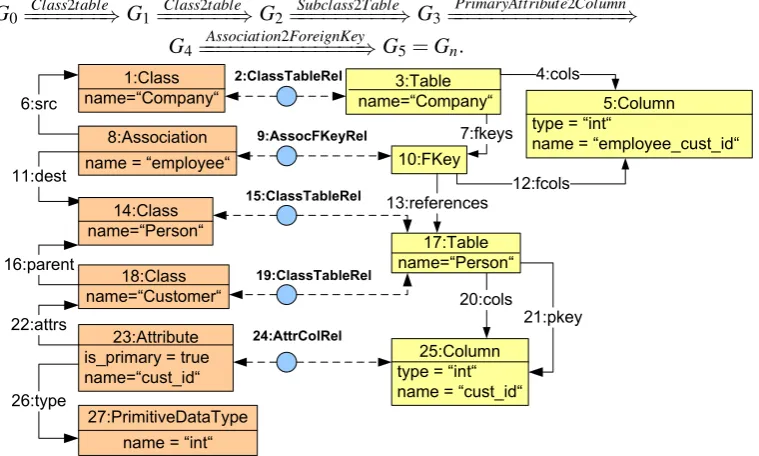
class diagrams to database models the relevance and value of the given theorems can be described from the more practical view. Fig. 6 shows a triple graph, which defines a class dia-gram in its source component, database tables in its target com-ponent and the correspondences in between. Since this model is already fully integrated, it constitutes the resulting graphGof
example model integration sequence((GS,GT),G0= tr∗I
=⇒Gn,G).
The starting point is given byGSas restriction ofGto elements of the class diagram, indicated
by pink, andGT containing the elements of the database part, indicated by yellow colour. Now,
the blue nodes for correspondence as well as the morphisms between connection component to source and target component are created during the integration process. All elements are labeled with a number to specify matches and created objects for each transformation step. The sequence of applied rules is
G0=Class======2table⇒G1=======Class2table⇒G2=========Subclass2Table⇒G3=
PrimaryAttribute2Column
==============⇒
G4=
Association2ForeignKey
=============⇒G5=Gn.
3:Table name=“Company“
10:FKey 7:fkeys 2:ClassTableRel
24:AttrColRel 15:ClassTableRel
9:AssocFKeyRel
19:ClassTableRel
20:cols 6:src
11:dest
16:parent
21:pkey 8:Association
name = “employee“ 1:Class name=“Company“
14:Class name=“Person“
18:Class name=“Customer“
27:PrimitiveDataType name = “int“ 23:Attribute is_primary = true name=“cust_id“
25:Column type = “int“ name = “cust_id“ 22:attrs
26:type
17:Table name=“Person“
5:Column type = “int“
name = “employee_cust_id“ 4:cols
12:fcols 13:references
Figure 6: Example of model integration for model transformationClass2Table
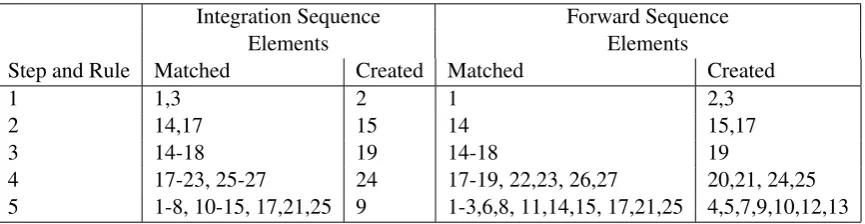
Now, Table 1 shows all matches of this sequence for both cases of Theorem 3 being the
model integration sequence G0=tr ∗ I
=⇒Gn and the forward transformation sequence G00 = tr∗I
=⇒ Gn,
Integration Sequence Forward Sequence
Elements Elements
Step and Rule Matched Created Matched Created
1 1,3 2 1 2,3
2 14,17 15 14 15,17
3 14-18 19 14-18 19
4 17-23, 25-27 24 17-19, 22,23, 26,27 20,21, 24,25
5 1-8, 10-15, 17,21,25 9 1-3,6,8, 11,14,15, 17,21,25 4,5,7,9,10,12,13
Table 1: Steps of example integration sequence
/0=tr ∗ ST
==⇒G0. Therefore, /0= tr∗ST
==⇒G0= tr∗I
=⇒Gnis match consistent. Analogously /0= tr∗S
=⇒G00consists of the specified steps in Table1, where comatches are given by the elements of the match in the
forward transformation sequence implying /0=tr ∗ S
=⇒G00=tr ∗ F
=⇒Gnbeing match consistent. Both
in-tegration and forward transformation sequence can be recaptured by analyzing the other, which corresponds to Theorem3.
5
Related Work
Various approaches for model transformation in general are discussed in [MB03] and [OMG07] using BOTL and QVT respectively. For a taxonomy of model transformation based on graph transformation we refer to [MG06]. Triple Graph Grammars have been proposed by A. Sch¨urr in [Sch94] for the specification of graph transformations. A detailed discussion of concepts, extensions, implementations and applications scenarios is given by E. Kindler and R. Wagner in [KW07]. The main application scenarios in [KW07] are model transformation, model integration and model synchronization. These concepts, however, are discussed only on an informal level using a slightly different concept of triple graphs compared with [Sch94].
In this paper we use the original definition of triple graphs, triple rules, and triple transforma-tions of [Sch94] based on the double pushout approach (see [Roz97], [EEPT06]). In our paper [EEE+07] we have extended the approach of [Sch94] concerning the relationship between
TGT-sequences based on triple rulesG0 tr∗
⇒Gnand match consistent TGT-sequencesG0 trS∗ ⇒Gn0
trF∗ ⇒Gm
based on source and forward rules leading to the canonical Decomposition and Composition Result 1 (Thm1). This allows to characterize information preserving bidirectional model trans-formations in [EEE+07].
In this paper the main technical result is the Canonical Decomposition and Composition Re-sult 2 (Thm 2) using source-target rules trST and integration rules trI instead of trS andtrF.
6
Future Work and Conclusion
Model integration is an adequate technique in system design to work on specific models in dif-ferent languages, in order to establish the correspondences between these models using rules which can be generated automatically. Once model transformation triple rules are defined for translations between the involved languages, integration rules can be derived automatically for maintaining consistency in the overall integrated modelling process.
Main contributions of this paper are suitable requirements for existence of model integration as well as composition and decomposition of source-target and integration transformations to and from triple transformations. Since model integration may be applied at any stage and several times during the modelling process, results of model integrations in previous stages can be used as the starting point for the next incremental step.
All concepts are explained using the well known case study for model transformation between class diagrams and relational data bases. While other model transformation approaches were applied to the same example for translation between source and target language, triple graph grammars additionally show their general power by automatic and constructive derivation of an integration formalism. Therefore, model integration in the presented way can scale up very easily, only bounded by the effort to build up general triple rules for parallel model evolution.
Usability extends when regarding partly connected models, which shall be synchronized as discussed on an informal level in [KW07]. On the basis of model integration rules model syn-chronization can be defined in future work as model integration using inverse source and target rules, standard source and target rules as well as integration rules in a mixed way, such that the resulting model is syntactically correct and completely integrated. Another interesting as-pect for future work is the extension of triple graph rules and corresponding transformation and integration rules by negative application conditions (see [HHT96]), or by more general graph constraints (see [HP05]).
Bibliography
[EEE+07] H. Ehrig, K. Ehrig, C. Ermel, F. Hermann, G. Taentzer. Information Preserving Bidirectional Model Transformations. In Dwyer and Lopes (eds.),Fundamental Ap-proaches to Software Engineering. LNCS 4422, pp. 72–86. Springer, 2007.
http://tfs.cs.tu-berlin.de/publikationen/Papers07/EEE+07.pdf
[EEH08] H. Ehrig, K. Ehrig, F. Hermann (eds.).From Model Transformation to Model Inte-gration based on the Algebraic Approach to Triple Graph Grammars (Long Version). Februrary 2008. published as Technical Report, TU Berlin, No. 2008-3.
[EEPT06] H. Ehrig, K. Ehrig, U. Prange, G. Taentzer.Fundamentals of Algebraic Graph Trans-formation. EATCS Monographs in Theoretical Computer Science. Springer Verlag, 2006.
http://www.springer.com/3-540-31187-4
[HP05] A. Habel, K.-H. Pennemann. Nested Constraints and Application Conditions for High-Level Structures. In Kreowski et al. (eds.), Formal Methods in Software and Systems Modeling. Lecture Notes in Computer Science 3393, pp. 293–308. Springer, 2005.
http://dx.doi.org/10.1007/b106390
[KS06] A. K¨onig, A. Sch¨urr. Tool Integration with Triple Graph Grammars - A Survey. In
Heckel, R. (eds.): Elsevier Science Publ. (pub.), Proceedings of the SegraVis School on Foundations of Visual Modelling Techniques, Vol. 148, Electronic Notes in Theo-retical Computer Science pp. 113-150, Amsterdam. 2006.
http://dx.doi.org/10.1016/j.entcs.2005.12.015
[KW07] E. Kindler, R. Wagner. Triple Graph Grammars: Concepts, Extensions, Imple-mentations, and Application Scenarios. Technical report tr-ri-07-284, Software Engineering Group, Department of Computer Science, University of Paderborn, June 2007.
http://www.uni-paderborn.de/cs/ag-schaefer/Veroeffentlichungen/Quellen/Papers/ 2007/tr-ri-07-284.pdf
[MB03] F. Marschall, P. Braun. Model Transformations for the MDA with BOTL. InProc. of the Workshop on Model Driven Architecture: Foundations and Applications (MDAFA 2003), Enschede, The Netherlands. Pp. 25–36. 2003.
http://citeseer.ist.psu.edu/marschall03model.html
[MG06] T. Mens, P. V. Gorp. A Taxonomy of Model Transformation. InProc. International Workshop on Graph and Model Transformation (GraMoT’05), number 152 in Elec-tronic Notes in Theoretical Computer Science, Tallinn, Estonia, Elsevier Science. 2006.
http://tfs.cs.tu-berlin.de/gramot/Gramot2005/FinalVersions/PDF/MensVanGorp.pdf
[OMG07] OMG. Meta Object Facility (MOF) 2.0 Query/View/Transformation Specification, Final Adopted Specification (07-07-2007). 2007.
http://www.omg.org/docs/ptc/07-07-07.pdf
[Roz97] G. Rozenberg (ed.).Handbook of Graph Grammars and Computing by Graph Trans-formations, Volume 1: Foundations. World Scientific, 1997.
[Sch94] A. Sch¨urr. Specification of Graph Translators with Triple Graph Grammars. In G. Tinhofer, editor, WG94 20th Int. Workshop on Graph-Theoretic Concepts in Com-puter Science, volume 903 of Lecture Notes in ComCom-puter Science, pages 151–163, Springer Verlag, Heidelberg. 1994.