© 2020 by the Serbian Biological Society How to cite this article: Nikolić T, Arok M, Radišić D, Mirč M, Velaja L, Milić D, 13 Ćirović D.Endangered species’ trait responses to environmental variability in
agricultural settings. Arch Biol Sci. 2020;72(1):13-21.
Endangered species’ trait responses to environmental variability in agricultural settings
Tijana Nikolić1,*, Maja Arok2, Dimitrije Radišić2, Marko Mirč3, Lea Velaja1, Dubravka Milić1 and Duško Ćirović4
1University of Novi Sad, Biosense Institute – Research Institute for Information Technologies in Biosystems, Doktora Zorana
Đinđića 1, Novi Sad, Serbia
2University of Novi Sad, Faculty of Sciences, Department of Biology and Ecology, Trg Dositeja Obradovića 3, Novi Sad, Serbia
3Department of Evolutionary Biology, Institute for Biological Research “Siniša Stanković” - National Institute of Republic of
Serbia, University of Belgrade, Bulevar despota Stefana 142, Belgrade, Serbia
4University of Belgrade, Faculty of Biology, Studentski trg 16, Belgrade, Serbia
*Corresponding author: [email protected]
Received: July 15, 2019; Revised: September 2, 2019; Accepted: September 9, 2019; Published online: September 13, 2019
Abstract: Understanding the spatial and temporal effects of variable environmental conditions on demographic character-istics is important in order to stop the decline of endangered-species populations. To capture interactions between a species and its environment, in this work the demographic traits of the European ground squirrel (EGS), Spermophilus citellus,
were modeled as a function of agricultural landscape structure. The habitat suitability index was determined for 20 locali-ties within the study area based on habitat use, management and type. After mapping the habitat patch occupancy in the field, crop cover maps, the average normalized difference vegetation index (NDVI) and automated water extraction index (AWEI) were obtained from satellite images covering the period 2013-2015. This data was used to develop population-level generalized linear models (GLMs) and individual-level conditional mixed-effects models (GLMMs) in R package Ime4, focusing on the key demographic traits of the EGS. The land composition and patch carrying capacity (PCC) are the key determinants of the endangered EGS population size, while system productivity is the main factor influencing individuals’ body condition after monitoring for variations across sampling years and age classes. The proposed landscape structural models show that human activities and abiotic factors shape the demographic rates of the EGS. Thus, to conserve threatened species, an appropriate focus on the spatial adaptation strategies should be employed.
Keywords: normalized difference vegetation index (NDVI); automated water extraction index (AWEI); demographic traits;
Spermophilus citellus; habitat
INTRODUCTION
In agricultural settings, open grassland ecosystems host a significant number of species and have been recognized among the most threatened ecosystems on the planet [1]. The grasslands at the southern edge of the Pannonian Basin (e.g., the region of Vojvodina Province in Serbia) are particularly affected by agri-cultural intensification and land use degradation as a consequence of adverse local and regional agricultural policies [2]. Increased fragmentation has resulted in the isolation of populations of many species and has reduced habitat availability. Furthermore, the effects of interaction of past and current environmental con-ditions with species population traits, such as size,
density and sex structure, or with individual traits such as body mass, length and fitness, can be detected through changes in population demographic rates [3,4].
the species’ range due to adverse changes in land use practices [7]. A 30% overall population decline has been estimated over the last decade, due to which it is listed on the IUCN Red List as Vulnerable [5]. Most populations of the species in Serbia are situated in Vo-jvodina, the northernmost region of Serbia [8,9]. Due to land conversion and infrastructural development, these populations are fragmented and their habitats are surrounded by arable land.
To mitigate these negative effects, in 2010 the In-stitute for Nature Conservation of Vojvodina Province promoted the Regional Eco Network of Habitats [10], comprised of protected areas, eco network elements, corridors and their surroundings. As these elements and their surrounding areas differ in protection status, as well as in temporal, spatial and microclimatic char-acteristics, revision or evaluation of their individual contributions to specific species protection efforts is required. In order to further support regional biodiver-sity, a reassessment of the conservation area networks and a better understanding of the magnitude of their dynamics are especially important since empirical evidence indicates that environmental changes have the potential to alter individual traits and popula-tion dynamics, as well as increase the vulnerability of many species [11-14]. Most of extant studies in this field have focused on the species inhabiting polar or tropical areas, as well as high altitudes. In this work, the impact of a changing environment on a temperate small mammal species was investigated.
To better understand the interaction between the EGS and the environmental conditions character-izing its habitat, the species’ colonies were modeled both at the individual and population levels within the predefined landscape structure. This landscape structure is situated in an agricultural area inside a local ecological corridor in Central Banat (Serbia), recognized and labeled by the Institute for Nature Conservation of Vojvodina Province. In order to re-late the EGS population dynamics to its environment, population-level generalized linear models (GLMs) as well as individual-level conditional mixed-effects model (GLMMs) were developed. Quantifying this relationship should contribute to a better understand-ing of the potential effects of changunderstand-ing environmental conditions on further local population changes.
MATERIALS AND METHODS
Study area
The area covered by the present study included 20 EGS colonies found within the mosaic landscape of semi-natural and semi-natural open grassland areas in Central Banat, and span across Bočar, Novo Miloševo (NM), Novi Bečej (SK), Kumane, Melenci and Elemir (Supple-mentary Fig. S1, Supple(Supple-mentary Table S1). The local corridor comprises a mosaic of steppe grasslands, saline soils/depressions and salt steppe ecosystems [2]. This is a highly important conservation area des-ignated for providing protection to certain groups of species, plant communities and host sites recognized as protected areas, Important Bird Areas (IBA) [15], Important Plant Areas (IPA) [16], Emerald [17] and Ramsar [18] sites [10].
Population data acquisition
To capture the demographic traits of the 20 studied EGS colonies in Central Banat, during the period 2013-2015, the animals were counted annually within 0.25-ha plots [19]. Having an exact area to count the animals in allowed for a high accuracy estimation of the total number of individuals in the habitat patch. As part of this field survey, body weight and length were measured and age and sex determined. To deter-mine the age of individuals, we used morphological characters such as body size and mass as well as molar and premolar wear [20]. The animals from the fourth age class were notably heavier and larger-bodied, with distinguishable marks on their teeth. The body condi-tion coefficient (BCC) was calculated as a regression function of body mass and length [21]. All individuals identified as residing within a particular plot were captured and ere kept in cages until the end of the study day, and were subsequently released in the area where they were caught.
by one colony and the number of individuals at each locality was estimated.
Spatial data
For spatial analysis, a buffer zone with a 1-km radius was applied, outlining each mapped occupied area that represents the maximal dispersal capacity of the species (Supplementary Fig. S1) [22]. Within the delineated area, the average seasonal normalized difference vegeta-tion index (NDVI) and the automated water extracvegeta-tion index (AWEI) sourced from the time series of Landsat 8 satellite images were calculated. To further develop the landscape structure within the specified radius, crop maps were used for each consecutive season from 2013 to 2015. The crop maps were developed using a supervised random forest classification algorithm and data obtained from the time series of satellite im-ages generated by the BioSense Institute [23]. Based on habitat use, management and type, the habitat suitability index (HSI) was developed for each of the 20 localities within the study area (further details on this approach are given in Table S1). For each patch included in the analyses, the patch carrying capacity (PCC) was calculated, designating the relationship between habitat suitability, area and average density (i.e., PCC=patch area×patch suitability×average density in the patch type) [24].
Model calibration and sensitivity analysis
To analyze the relative relationship between land-scape structure (environmental conditions within the buffer zone of 1-km radius) and demographic changes (population size and body condition of indi-viduals), and to account for the year effect, a number of linear regression and linear mixed effect analyses were conducted. Based on the approach presented in [25], population-level GLMs and individual-level conditional mixed effect GLMMs were developed in R package Ime4 [26], R version 3.3.2 to study species demographic traits.
To model the relationship between population size and seasonal changes in landscape structure, a GLM was developed, whereas the GLMM captured the re-lationship between body condition of individuals and seasonal changes in landscape structure. For this
pur-pose, three components of landscape structure were defined: composition, capacity and productivity; and each dependent variable of each category was incor-porated into the population GLM and the individual GLMM. The defined landscape categories are presented in Supplementary Fig. S2, whereby Category 1 denotes the composition and accounts for crop percentage (% crop), grassland percentage (% grassland) and the aver-age area covered by water (AWEI); Category 2 pertains to PCC (suitability×area×density), and Category 3 relates to system productivity (NDVI). The significance of each dependent variable for predicting the variability in population size and body condition was investigated.
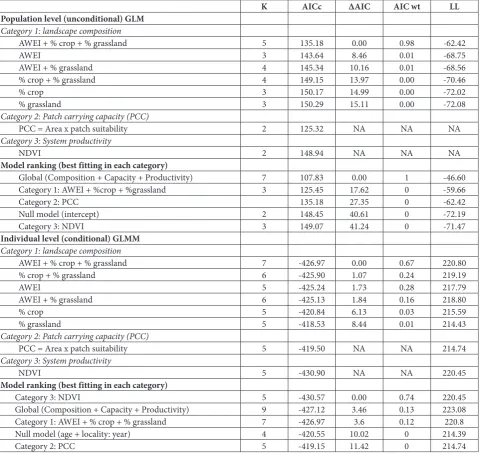
The model pertaining to each category that yielded the best fit to the data was compared to the global model (capturing all variables) as well as the null model. For assessing the body condition changes in the GLMM, crop percentage, grassland percentage, NDVI, AWEI and PCC were included as fixed effects and body condition as the criterion variable (Table 1). Age structure of captured individuals, and local-ity and year were included in the GLMM as random effects. Local population size served as a criterion variable in the GLM (Table 1). The model that yielded the lowest Akaike information criterion corrected for small sample size score (AICc) was chosen as the best candidate and also the variations within the popula-tion or individual models were compared based on the maximum reliability test [27].
RESULTS
Population size and body condition
During the 2013-2015 study period, habitat patches in Central Banat on which European ground squir-rel colonies were identified, differed in composition, capacity (PCC) and productivity, which affected the population size and body condition of the individu-als (Fig. 1).
model and system productivity (Category 3) (Table 1). On the other hand, based on the findings for the body-condition GLMMs, the system productivity model (Category 3) emerged as the most optimal candidate, followed by the global model (Category 1, 2 and 3), which was found to be more significant than the null model and the PCC model (Category 2; Table 1).
Environmental variables
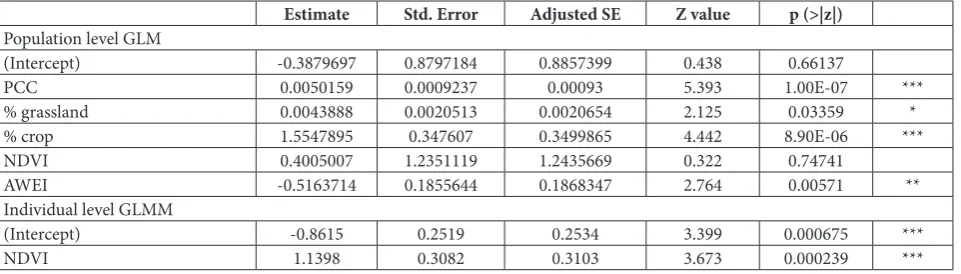
For each colony in the study region, the percentage ratio of grasslands, crops and the average area cov-ered by water during the active season of the EGS were identified as the population size-limiting factors. However, PCC, which depends on patch suitability and the area that the patch population occupies, was also significant. A small positive effect on population size was noted for the increase in grassland percentage and crop percentage, while the increase in PCC had a significant positive impact on population growth. Finally, an increase in the average area covered by water exerted a negative impact on population growth.
For capturing individual differences in body con-dition, system productivity was the most significant variable as it directly related to the average available food quantity during the active season of the species. As expected, within the studied colonies, an increase in productivity had a positive impact on the body condition of the animals in different age classes. Co-efficients of the selected variables for the best fitting models on population and individual levels are pre-sented in Table 2.
DISCUSSION
The findings yielded by the models developed as a part of the present study indicate that land composition and PCC are the main determinants of the population size of endangered EGS. On the other hand, system productivity is positively related to an individual’s body condition after monitoring for variations across sam-pling years and age classes. These results suggest that in agricultural landscape, human-induced conditions (e.g., crop rotation, water impact (irrigation), drainage and general water management or pastoral grazing management), are the main drivers of population-level differences in size, while also indirectly affecting population structure. On the other hand, as environ-mental abiotic factors (e.g., dry season precipitation or temperature) affect system productivity, they drive individual-level differences in body condition and indirectly influence population dynamic.
Species’ presence in a particular area is likely to be impacted by shifting resource availability due to changes in land use and habitat management [28,29]. Spatial and temporal structures, the amount, suitability and connectivity of habitat define the habitat use [30] and species’ responses to changes in spatial gradients reflect local population dynamics and distribution, as well as species’ life history traits [31]. In this work, compositional and structural features at the scale of a local patch and its surroundings were integrated to demonstrate the responses of the EGS in terms of habitat occupancy in a lowland area of Vojvodina. The results indicate that habitat occupancy is related to the observed variance in structural heterogeneity, which is in agreement with the findings given at the local [32] and landscape scales [33]. The present study findings further revealed that not only was the
ence of certain habitat types critical for determining habitat occupancy, but so were the intermediate com-positional heterogeneity and the amount of resources. Other authors have reported that habitat suitability and connectivity increase the probability of successful reproduction and facilitate movement among distinct habitat patches [34,35], which is especially important in highly fragmented agricultural landscapes.
Landscape or habitat heterogeneity and spatial scale have been shown to impact site occupancy for various species or groups of species [36] and were found to be more influential on the persistence of specialist species relative to generalists [37]. Findings yielded by ecological studies in protected lowland areas of Vojvodina (e.g. the Special Nature Reserves Slano Kopovo and Okanj Bara, and Nature Park Rusanda)
Table 1. Results of the multi-model selection based on AICc and log likelihood (LL) values for three categories of models within the population GLM and individual GLMMs.
K AICc ΔAIC AIC wt LL
Population level (unconditional) GLM
Category 1: landscape composition
AWEI + % crop + % grassland 5 135.18 0.00 0.98 -62.42
AWEI 3 143.64 8.46 0.01 -68.75
AWEI + % grassland 4 145.34 10.16 0.01 -68.56
% crop + % grassland 4 149.15 13.97 0.00 -70.46
% crop 3 150.17 14.99 0.00 -72.02
% grassland 3 150.29 15.11 0.00 -72.08
Category 2: Patch carrying capacity (PCC)
PCC = Area x patch suitability 2 125.32 NA NA NA
Category 3: System productivity
NDVI 2 148.94 NA NA NA
Model ranking (best fitting in each category)
Global (Composition + Capacity + Productivity) 7 107.83 0.00 1 -46.60
Category 1: AWEI + %crop + %grassland 3 125.45 17.62 0 -59.66
Category 2: PCC 135.18 27.35 0 -62.42
Null model (intercept) 2 148.45 40.61 0 -72.19
Category 3: NDVI 3 149.07 41.24 0 -71.47
Individual level (conditional) GLMM
Category 1: landscape composition
AWEI + % crop + % grassland 7 -426.97 0.00 0.67 220.80
% crop + % grassland 6 -425.90 1.07 0.24 219.19
AWEI 5 -425.24 1.73 0.28 217.79
AWEI + % grassland 6 -425.13 1.84 0.16 218.80
% crop 5 -420.84 6.13 0.03 215.59
% grassland 5 -418.53 8.44 0.01 214.43
Category 2: Patch carrying capacity (PCC)
PCC = Area x patch suitability 5 -419.50 NA NA 214.74
Category 3: System productivity
NDVI 5 -430.90 NA NA 220.45
Model ranking (best fitting in each category)
Category 3: NDVI 5 -430.57 0.00 0.74 220.45
Global (Composition + Capacity + Productivity) 9 -427.12 3.46 0.13 223.08
Category 1: AWEI + % crop + % grassland 7 -426.97 3.6 0.12 220.8
Null model (age + locality: year) 4 -420.55 10.02 0 214.39
Category 2: PCC 5 -419.15 11.42 0 214.74
[38-40] highlight the importance of spatial structure within agricultural settings where the continuity of open grassland is interrupted. Every component of landscape structure examined in this study should thus be considered as an additional environmental factor limiting population size. The analyses reported in this work indicate that patch carrying capacity, which entails its management practice, and habitat suitability also influence population size. The popula-tion size varies in relapopula-tion to patch capacity because larger and more heterogeneous sites provide a better chance for population survival [41]. On the other hand, ground-dwelling squirrels act as ecosystem engineers contributing to within-patch heterogeneity by moving soil, modifying local plant distributions and creating annual-dominated assemblages [42-44]. Thus, the EGS plays a significant role in maintaining the diver-sity and functionality of steppe and open grassland ecosystems, which are amongst the most vulnerable habitats in Europe.
The EGS is predominantly herbivorous, feeding mainly on typical grassland species such as grasses and legumes [45]. A significant difference in grassland vegetation between dry and wet years and its influence on ground squirrel diet have been demonstrated [46]. In this particular study, the proportion of dicots in the field during a wetter year was greater and the animals favored this group of species to monocots. Such cli-matic effects on food supply are particularly important in spring, just after emergence from hibernation and during the reproductive period. Moreover, results obtained in a study focusing on two sites in Vojvodina showed that the abundance of most grassland plant
species will decline due to the predicted climate change, whereby plants with the highest moisture index will be the most endangered [47]. Therefore, climate change has the potential to alter not only species composition but also system productivity.
High temperatures, but not extreme precipita-tion events, can be well tolerated by the EGS [48,49]. Based on climate prediction models, in the future, the area covered by the present study will be affected by drought and extreme weather conditions [50], thus increasing the possibility of catastrophic events that could, along with altered ecosystem productivity, affect the species’ population survival. Jointly, these findings and forecasts highlight the importance of including reconnection of more suitable habitat environments in future grassland conservation efforts, which should also promote landscape management practices that enable animals to move across landscape unhindered.
The results obtained in the present study demon-strate the importance of evaluating the relationship between species demographic traits and temporal changes in environmental conditions for scaling pop-ulation changes. To ensure poppop-ulation persistence, there is a need to promote both local remnant open grassland and surrounding area conservation. Such comprehensive strategies would enable individuals to use a wider array of microclimate conditions [51]. The body condition and behavioral traits are closely related to the foraging of small mammal species. As increases in temperatures are forecast for the future, which may lead to uncertain food supply, the flex-ibility of species traits and their capacity to adapt to
Table 2. Model coefficients of selected variables for population and individual level top models for European ground squirrel habitat use within the Central Banat landscape structure.
Estimate Std. Error Adjusted SE Z value p (>|z|)
Population level GLM
(Intercept) -0.3879697 0.8797184 0.8857399 0.438 0.66137
PCC 0.0050159 0.0009237 0.00093 5.393 1.00E-07 ***
% grassland 0.0043888 0.0020513 0.0020654 2.125 0.03359 *
% crop 1.5547895 0.347607 0.3499865 4.442 8.90E-06 ***
NDVI 0.4005007 1.2351119 1.2435669 0.322 0.74741
AWEI -0.5163714 0.1855644 0.1868347 2.764 0.00571 **
Individual level GLMM
(Intercept) -0.8615 0.2519 0.2534 3.399 0.000675 ***
NDVI 1.1398 0.3082 0.3103 3.673 0.000239 ***
predicted and enhancing weather/climate changes and consequences related to resource availability remain to be elucidated [7].
In terms of land ownership, the grassland frag-ments containing the colonies are public agricultural land and, therefore, the main task in their conservation is to prevent land use type change of these areas (ur-banization, building or industrialization, forestation or infrastructure development), or management change to other agricultural purposes (plowing or turning into vineyards or orchards). Besides maintaining an appro-priate land use type, our results show that grassland fragments must cover an area large enough so that its carrying capacity can support viable EGS populations. The habitat quality of the specific grassland patch de-pends on grazing/mowing intensity, which should be determined for every patch based on vegetation char-acteristics and productivity. Recent studies [52] have shown that the survival of EGS populations depends to great extent on the landscape characteristics of the area surrounding the colony patches and on enabling (or not) intercolony communication. The appropriate levels of heterogeneity and complexity of the agricul-tural area surrounding the colonies can be achieved by applying specific measures, such as maintaining field margins, fallow land, etc. These findings point to the need for combining local conservation practices with landscape-level management.
Only a small number of EGS colonies in Vojvodina are located inside protected areas [52] where activities (such as agriculture, tourism, etc.) are monitored and directed by the appropriate authority, the Institute for Nature Conservation of Vojvodina Province. On the other hand, most colonies are a part of the regional eco network, whose legal framework should protect these localities from land management change. Ser-bia, as non-European Union member state, is in the prepreparation phase of enforcing agri-environment schemes (AES) that will function under the future Common Agricultural Policy. Nevertheless, the pro-posed local measures promote traditional agricultural practices and local farmers’ knowledge and are, thus in concordance with international legislative.
In summary, the well-documented decline of the EGS population should not be generalized indepen-dently of ongoing changes in weather conditions and
decadal climate prediction. Including demographic traits and behavioral flexibility in analytical models would significantly improve extinction risk assess-ment for the EGS. Even though the trend that has been observed in phenotype changes of mammals as a response to climate change was mostly attributed to their phenotype plasticity, this was not confirmed for ground squirrel species [53]. Therefore, conservation planning and management actions in agricultural land-scape should support ecosystem stability and include spatial adaptation strategies to respond effectively to predicted climate variability.
Funding: This work was financially supported by the Ministry of Education, Science and Technological Development of the Republic of Serbia, Grant III 43002, “Biosensing Technologies and Global System for Long-Term Research and Integrated Management of Ecosystems“, The Rufford Foundation Grant, “Building a better future for European ground squirrel in Serbia”, and the Provincial Secretariat for Science and Technological Development, Grant No. 142-451-2591/2017, “Evaluation of ecological network for more efficient natural protection in AP Vojvodina”.
Acknowledgments: The authors are grateful to Dr. Branko Brkljač and Predrag Lugonja who kindly prepared and provided us with data on crop classification within the study area for the consecu-tive sampling years.
Author contributions: TN, DR, MA, MM and LV participated in collecting data on European ground squirrel populations in the field. TN prepared the database on the European ground squirrel. TN performed the modeling and prepared the results. The inter-pretation of the results was done and approved by all authors. TN, MA and DĆ wrote the manuscript. DĆ and DM supervised the activities and reviewed several drafts of the manuscript.
Conflict of interest disclosure: The authors declare no conflict of interest.
REFERENCES
1. Wolff S, Schrammeijer EA, Schulp CJ, Verburg PH. Meet-ing global land restoration and protection targets: What would the world look like in 2050? Glob Environ Change. 2018;52:259-72.
2. Puzović S, Panjković B, Tucakov M, Stojnić N, Sabadoš K, Stojanović T, Vig L, Marić B, Tešić O, Kiš A, Galamboš L, Pil N, Kicošev V, Stojšić V, Timotić D, Perić R, Bošnjak T, Delić J, Dobretić V, Stanišić J. Upravljanje prirodnom baštinom u Vojvodini. Novi Sad: Sekretarijat za urbanizam, graditeljstvo i zaštitu životne sredine, Pokrajinski zavod za zaštitu prirode. 2015. 156 p. Serbian.
4. Brooks ME, Mugabo M, Rodgers GM, Benton TG, Ozgul A. How well can body size represent effects of the environment on demographic rates? Disentangling correlated explanatory variables. J Anim Ecol. 2016;85(2):318-28.
5. Coroiu C, Kryštufek B, Vohralík, V, Zagorodnyuk, I. Sper-mophilus citellus. In: The IUCN Red List of Threatened Species [Internet]. IUCN; 2008 Jun 30. [cited 2019 Feb 10] Available from: http://dx.doi.org/10.2305/IUCN.UK.2008. RLTS.T20472A9204055.en
6. Janderková J, Matějů J, Schnitzerová P, Petruš J, Sedláček J, Uhlíková J. Soil charatcteristics at Spermophilus citellus localities in the Czech Republic (Rodentia: Sciuridae). Lynx. 2011;42:99-111.
7. Janák M, Marhoul P, Matějů J. Action Plan for the Conserva-tion of the European Ground Squirrel Spermophilus citellus in the European Union [Internet]. European Commission; 2013 [cited 2019 Feb 11]. Available from: https://ec.europa. eu/environment/nature/conservation/species/action_plans/ pdf/EUSAP_EuropeanGround%20Squirrel_Final.pdf 8. Ružić A. Contribution to the knowledge of ecology of the
ground squirrel Citellus citellus L. Proc Inst Ecol Biogeogr. 1950;1:97-140. Serbian.
9. Petrov MB. Mammals of Yugoslavia, insectivores and rodents. Belgrade: Natural history museum of Belgrade. 1992. 186 p.
10. Uredba o ekološkoj mreži. Offic Gazzete Rep Serb. 2010;102/2010p. Serbian.
11. Ozgul A, Childs DZ, Oli MK, Armitage KB, Blumstein DT, Olson LE, Tuljapurkar S, Coulson T. Coupled dynamics of body mass and population growth in response to environ-mental change. Nature. 2010;466(7305):482-7.
12. Walther GR, Post E, Convey P, Menzel A, Parmesan C, Beebee TJ, Fromentin JM, Hoegh-Guldberg O, Bairlein F. Ecological responses to recent climate change. Nature. 2006;416(6879):389-95.
13. Parmesan C. Ecological and evolutionary responses to recent climate change. Annu Rev Ecol Evol Syst. 2006;37:637-69. 14. Toïgo C, Gaillard JM, Van Laere G, Hewison M, Morellet
N. How does environmental variation influence body mass, body size, and body condition? Roe deer as a case study. Ecography. 2006;29(3):301-8.
15. Callaghan D, Heath M, O’Sullivan J, Pritchard D. Important Bird Areas and potential Ramsar Sites in Europe. Wagenin-gen: BirdLife International; 2011. 126 p.
16. Anderson S, Darbyshire I, Halski B. Important Plant Areas. In: Willis KJ, Bachman S, editors. RBG Kew, state of the world’s plants report-2016. London: Royal Botanical Gar-den, Kew; 2016. p. 24-7.
17. Sekulić N, Šinžar-Sekulić J, editors. [Emerald Ecological Network in Serbia]. Beograd: Republika Srbija: Ministarstvo životne sredine i prostornog planiranja, Zavod za zaštitu prirode Srbije; 2010. 100 p. Serbian.
18. Ramsar Convention Secretariat. The Ramsar Convention Manual: a guide to the Convention on Wetlands (Ramsar, Iran, 1971). 6th ed. Gland, Switzerland: Ramsar Convention Secretariat; 2013. 109 p.
19. Katona K, Váczi O, Altbäcker V. Topographic distribu-tion and daily activity of the European ground squirrel
population in Bugacpuszta, Hungary. Acta Theriolog-ica, 2002;47(1):45-54.
20. Ružić A. Određivanje uzrasnih kategorija u populaciji teku-nice Citellus citellus L. Arhiv Biol Nauka. 1966;18:65-70. Serbian.
21. Schulte-Hostedde AI, Zinner B, Millar JS, Hickling GJ. Res-titution of mass–size residuals: validating body condition indices. Ecology. 2005;86(1):155-63.
22. Ramos-Lara N, Koprowski JL, Kryštufek B, Hoffmann IE. Spermophilus citellus (Rodentia: Sciuridae). Mammalian Species. 2014;46(913):71-87.
23. Crnojević V, Lugonja P, Brkljač BN, Brunet B. Classifica-tion of small agricultural fields using combined Landsat-8 and RapidEye imagery: case study of northern Serbia. J Appl Remote Sens. 2014;8(1):083512.
24. Verboom J, Pouwels R. Ecological functioning of ecological networks: a species perspective. In: Jongman RHG, Pungetti G, editors. Ecological networks and greenways; concept, design, implementation. Cambridge: Cambridge University Press; 2004. p. 4-72.
25. Merrick MJ, Koprowski JL. Circuit theory to estimate natal dispersal routes and functional landscape connectivity for an endangered small mammal. Landscape Ecol. 2017; 32:1163-79.
26. Bates D, Maechler M, Bolker B, Walker S. lme4: Linear mixed-effects models using Eigen and S4. R package ver-sion 1.7. J Stat Softw. 2014;1(7):1-23.
27. Burnham KP, Anderson DR. Multimodel inference: under-standing AIC and BIC in model selection. Sociol Methods Res. 2004;33(2):261-304.
28. Fisher JT, Anholt B, Bradbury S, Wheatley M, Volpe JP. Spatial segregation of sympatric marten and fishers: the influence of landscape and species-scapes. Ecography. 2013;36(2):240-8.
29. Sozio G, Mortelliti A. Empirical evaluation of the strength of interspecific competition in shaping small mammal communities in fragmented landscapes. Landscape Ecol. 2016;31(4):775-89.
30. Hodgson JA, Moilanen A, Wintle BA, Thomas CD. Habitat area, quality and connectivity: striking the balance for effi-cient conservation. J Appl Ecol. 2011;48:148-52.
31. Guo Q, Taper M, Schoenberger M, Brandle J. Spatial-tempo-ral population dynamics across species range: from centre to margin. Oikos. 2005;108(1):47-57.
32. Stirnemann I, Mortelliti A, Gibbons P, Lindenmayer DB. Correction: Fine-Scale Habitat Heterogeneity Influences Occupancy in Terrestrial Mammals in a Temperate Region of Australia. PLoS One. 2015;10(10):e0140802.
33. Fischer C, Flohre A, Clement LW, Batáry P, Weisser WW, Tscharntke T, Thies C. Mixed effects of landscape structure and farming practice on bird diversity. Agr Ecosyst Environ. 2011;141(1):119-25.
34. Schooley RL, Branch, LC. Habitat quality of source patches and connectivity in fragmented landscapes. Biodivers Con-serv. 2011;20(8):1611-23.
36. Tews J, Brose U, Grimm V, Tielbörger K, Wichmann MC, Schwager M, Jeltsch F. Animal species diversity driven by habitat heterogeneity/diversity: the importance of keystone structures. J Biogeogr. 2004;31(1):79-92.
37. Ye X, Skidmore AK, Wang T. Within-patch habitat quality determines the resilience of specialist species in fragmented landscapes. Landsc Ecol. 2013;28(1):135-47.
38. Pavkov G, editor. Specijalni rezervat prirode “Slano Kopovo” – predlog za stavljanje pod zaštitu kao prirodnog dobra od izuzetnog značaja. 1999. Novi Sad: Zavod za zaštitu prirode Srbije, Beograd, Odeljenje Novi Sad. 80 p. Serbian. 39. Panjković B, Kovačev N, editors. Specijalni rezervat
prirode “Okanj bara” –predlog za stavljanje pod zaštitu kao zaštićenog područja I kategorije. Novi Sad: Pokrajinski Zavod za zaštitu prirode. 2011. 373p. Serbian.
40. Kicošev V, Tucakov M, Kovačev M. Park prirode “Rusanda” - predlog za stavljanje pod zaštitu kao zaštićenog područja II kategorije. Novi Sad: Pokrajinski Zavod za zaštitu prirode. 2011. 254p. Serbian.
41. Mérő TO, Bocz R, Polyák L, Horváth G, Lengyel S. Local habitat management and landscape‐scale restoration influ-ence small‐mammal communities in grasslands. Anim Con-serv. 2015;18(5):442-50.
42. Seabloom EW, Bjørnstad ON, Bolker BM, Reichman OJ. Spatial signature of environmental heterogeneity, dispersal, and competition in successional grasslands. Ecol Monogr. 2005;75(2):199-214.
43. Barker OE, Derocher AE. Habitat selection by arc-tic ground squirrels (Spermophilus parryii). J Mammal. 2010;91(5):1251-60.
44. Bylo LN, Koper N, Molloy KA. Grazing intensity influences ground squirrel and American badger habitat use in mixed-grass prairies. Rangel Ecol Manag. 2014;67(3):247-54. 45. Győri-Koósz B, Katona K, Altbäcker V. Diet composition of
European Ground Squirrel in grazed or mowed grasslands. Hung Small Game Bull. 2013;11:215-25. Hungarian. 46. Győri-Koósz B. Diet preference of the European ground
squirrel [Spermophilus citellus (Linnaeus, 1766)] in
Hungar-ian natural and seminatural grassland habitats investigation by floristic composition and microhistological faeces analy-sis [dissertation], [Sopron]: Institute of Wildlife Manage-ment and Vertebral Zoology, Faculty of Forestry, University of West Hungary; 2015. 16 p.
47. Čavlović D, Beloica J, Obratov-Petković D, Đurđević V, Košanin O. Simulation of long-term changes in environ-mental factors and grassland composition in three protected areas of Serbia. Tuexenia. 2017;37:431-46.
48. Váczi O. The effects of abiotic environmental factors on spatio-temporal activity pattern of the European ground squirrel (Spermophilus citellus) [dissertation]. [Budapest]: Eötvös Loránd University. 2005. 131 p. Hungarian. 49. Váczi O, Koósz B, Altbäcker V. Modified ambient
tempera-ture perception affects daily activity patterns in the Euro-pean ground squirrel (Spermophilus citellus). J Mammal. 2006;87(1):54-9.
50. Vuković A, Vujadinović M, Rendulić S, Djurdjević V, Ruml M, Babić V, Popović, D. Global warming impact on climate change in Serbia for the period 1961-2100. Thermal Science. 2018;22(6):2267-80.
51. McCain CM, King SR. Body size and activity times mediate mammalian responses to climate change. Glob Chang Biol. 2014;20(6):1760-9.
52. Nikolić T, Radišić D, Ćosić N, Díaz-Delgado R, Milić D, Vujić A, Ćirović D. Landscape heterogeneity effects on key-stone rodent species: agro-ecological zoning for conserva-tion of open grasslands. Biodivers Conserv. 2019;28(12): 3139-58.
53. Boutin, S, Lane, JE. Climate change and mammals: evolu-tionary versus plastic responses. Evol Appl. 2014;7(1):29-41.
Supplementary Material