Available on-line at: www.oapub.org/edu
doi: 10.5281/zenodo.3762671 Volume 6 │ Issue 3 │ 2020
SELF-REPORTED PHYSICAL ACTIVITY, ENJOYMENT AND
WELL-BEING OF GREEK YOUTH BASKETBALL PLAYERS
Charalampos Krommidas1i, Stefanos Perkos2, Ioannis Syrmpas1, Georgios S. Gorozidis1, Omiros Vlahos1, Evangelos Brisimis1, Georgios Loules1 1University of Thessaly,
Trikala, Greece 2Aristotle University of Thessaloniki,
Serres, Greece
Abstract:
Children and adolescents’ regular participation in sports can help them to increase their physical activity (PA) levels and fitness and to adopt healthy behaviors in adulthood. The purpose of this study was to examine the relationship of self-reported PA and enjoyment of youth basketball players with their well-being variables (self-rated health, self-esteem and subjective vitality). Participants were 208 male athletes (Mage: 13.88 ± 1.38 years), members of seven Greek basketball clubs, who voluntarily participated in this research. Data were collected prior to training with several valid and reliable questionnaires measuring PA, self-rated health, subjective vitality and self-esteem (Cronbach’s α = .66 to
.82). The findings suggested that 71.5% of youth basketball players spend 6 to 7 days per week in moderate to vigorous PA (MVPA) and 73.1% of them reported spend 5 to 6 hours
Keywords: moderate to vigorous physical activity, enjoyment, well-being, youth, basketball
1. Introduction
It is well documented that children and adolescents’ regular participation in sports can
help them to increase their levels of PA (e.g., Hebert, Møller, Andersen, & Wedderkopp, 2015; Kokko, Martin, Geidne, Van Hoye et al., 2019; Wickel & Eisenmann, 2007) and fitness (e.g., Ara, Vicente-Rodrıíguez, Jimenez-Ramirez, Dorado, Serrano-Sanchez, &
Calbet, 2004; Hoffman, Kang, Faigenbaum, & Ratamess, 2005). Additionally, youths’
regular participation in sports can reduce childhood obesity (e.g., Ara et al., 2004), to improve their mental health (e.g, Schumacher Dimech & Seiler, 2011; Eime, Young, Harvey, Charity, & Payne, 2013), to help them learn life skills (e.g., Goudas, 2010; Gould & Carson, 2008) and to adopt healthy behaviours in adulthood (e.g., Kjønniksen, Anderssen, & Wold, 2009). On the other hand, participation in competitive sports and
early sports specialization might link with severe injuries (e.g., Cuff, Loud, & O’ Riordan,
2010; Habelt, Hasler, Steinbrück, & Majewski, 2011), doping (e.g., Greydanus & Patel, 2002), eating disorders (e.g., Fietz, Touyz, & Hay, 2014) and alcohol consumption (Lisha & Sussman, 2010). These negative aspects of sports might lead children and adolescents to early drop-out of sports and withdrawal from regular physical activity.
Nowadays, the vast majority of children and adolescents are physically inactive
(Guthold, Stevens, Riley, & Bull, 2020) and do not meet WHO’s PA recommendations “to accumulate at least 60 minutes of MVPA daily” (WHO, 2010; p. 7). Therefore, it is very important to investigate the contribution of sport participation on youths’ PA levels. One
of the most popular team sports between children and adolescents worldwide is basketball (e.g., DiFiori, Güllich, Brenner, Côté, Hainline, Ryan, & Malina, 2018). To our knowledge, there is a small number of studies that have examined so far the contribution
of basketball on youths’ PA levels (e.g., Guagliano, Lonsdale, Kolt, Rosenkratz, & George,
2015; Hebert, Møller, Andersen, & Wedderkopp, 2015). Additionally, few studies have found no significant differences in MVPA between basketball players and non-players (Reich, Rechtik, Miklánková, & Prukner, 2016) or that sports participation does not contribute to meet youth WHO’s PA recommendations (Leek, Carlson, Cain, Henrichon et al., 2011).
Sport-related enjoyment, which is referred to the feeling of pleasure or fun during sports participation (e.g., Scanlan, Carpenter, Lobel, & Simons, 1993), appears to be one of the most important reasons for promoting youths participation in PA and sports (e.g., Fenton, Duda, Appleton, & Barrett, 2017; Karatrantou, Stavrou, Hasioti, Varveri, Krommidas, & Gerodimos, 2019; McCarthy, Jones, & Clark-Carter, 2008) and in basketball (e.g., DiFiori et al., 2018). Moreover, lower levels of enjoyment have been linked to higher rates of sport dropout (Crane & Temple, 2015). Therefore, it is very
our knowledge, no previous study has examined the role of enjoyment in youth
basketball players’ well-being.
Based on the above, the purpose of this study was to examine the relationship of self-reported physical activity (PA) and enjoyment of youth basketball players with their well-being (self-rated health, self-esteem, subjective vitality). The hypotheses that lead
this study are the following: 1) The vast majority of the youth basketball players’ will meet WHO’s recommendations for daily participation in 60 minutes of MVPA, 2) There
will be no significant changes in players’ MVPA between different age groups due to their participation in basketball training, 3) Players’ enjoyment in basketball will
significantly predict their PA levels and well-being.
2. Method
2.1. Participants
Participants were 208 male players (Mage: 13.88 ± 1.38 years, sports experience: 3.16 ± 2.07
years) members of seven Greek basketball clubs, who voluntarily participated in this research.
2.2. Instruments
Participants completed the following questionnaires:
A. Out-of-school Physical Activity
Two items measuring the frequency and the total amount of time (hours) spent in out-of-school moderate to vigorous intensity physical activity (MVPA) was used (Booth, Okely, Chey, & Bauman, 2001). More specifically, participants’ frequency of MVPA was
captured with the following item: “Outside school hours: How often do you usually exercise in your free time, so much that you get out of breath or sweat?”. Their responses were given on a 5-point Likert scale ranged from 1 (Once a month or less) to 5 (Every day). While,
participants’ amount of time spent in MVPA was captured with the following item:
“Outside school hours: How many hours do you usually exercise in your free time, so much that
you get out of breath or sweat?”. Their answers were given on a 6-point Likert scale ranged from 1 (Never) to 6 (About 7 hours per week).
B. Sport-related enjoyment
A subscale of McAuley, Duncan, and Tammen (1989) was used in order to measure children’s enjoyment/ fun in basketball. This scale consisted of 4 items (e.g., “Over the past
3-4 weeks ... I enjoyed the activities in basketball” or “I found basketball interesting”. Players’
C. Self-rated health
An item related to participants’ health status was used based on World Health
Organization and Health Behavior in School-aged Children study (e.g., Currie, Roberts, Morgan, Smith, Settertobulte, Samdal, & Barnekow Rasmunssen, 2004; Richter, Erhart, Vereecken, Zambon, Boyce, & Gabhainn, 2009). The item was: “Would you say your health is…” and the answers were given on a 4-point Likert scale ranged from 1 (My health is poor) to 4 (My health is very good). This item has been widely used in previous studies with children and adolescents in order to examine their health status (e.g., Kokkevi, Stavrou, Kanavou, & Fotiou, 2014; Krommidas et al., 2016).
D. Self-esteem
A short version of the “Physical Self-Description Questionnaire” (Marsh, Martin, & Jackson,
2010) for measuring the general self-esteem of participants was used. The questionnaire consisted of 5 items (e.g., “Over the past 3-4 weeks ... Overall, I had a lot to be proud of” or “Most of thethings I did, I did well”). Participants’ answers were given on a 5-point Likert scale ranged from 1 (Strongly disagree) to 5 (Strongly agree). This scale has been also successfully used in previous studies with youths (e.g., Papaioannou, Appleton, Torregrosa, Jowett et al., 2013).
E. Subjective vitality
A scale measuring participants’ feelings of energy and vitality over the past 3-4 weeks was used (Ryan & Frederick, 1997). The scale consisted of 5 items (e.g., “Over the past 3-4
weeks … I felt I had a lot of energy”). All items were scored on a 5-point Likert scale ranging from 1 (Strongly disagree) to 5 (Strongly agree). This scale has been also widely used in previous studies with young athletes (e.g., Krommidas et al., 2016; Papaioannou et al., 2013).
2.3. Procedure
The study was approved by the Bioethics Committee of the School of Physical Education & Sport Science, University of Thessaly (Ref. Number: 936/ 10/12/2015). A consent form was also signed by the young players, their parents, and their coaches.A researcher from the University of Thessaly prior to a basketball training session, asked the participants to fill in several valid and reliable questionnaires measuring their PA, subjective health, anxiety, subjective vitality and self-esteem. Participants were informed by the researcher that their responses would remain anonymous and that they could withdraw from this study at any time they wished.
2.4. Statistical Analysis
Confirmatory Factor Analysis (CFA) was conducted in order to examine factorial validity for each questionnaire. The method of Maximum Likelihood Estimation was used to estimate the parameters of each model in CFA. The Goodness-of-Fit Indices of chi-square (χ2), Tucker-Lewis Index (TLI), Comparative Fit Index (CFI) and Root Mean Square Error
Then, descriptive statistics (means, standard deviations), Cronbach’s α for measuring scales’ internal consistency reliability (Cronbach, 1951) and correlation
analysis were calculated. One way multivariate analysis of variance (MANOVA) was also
conducted in order to examine the age effect on players’ MVPA (days and hours per
week).
Finally, Structural Equation Modeling (SEM) was used to examine if youths’
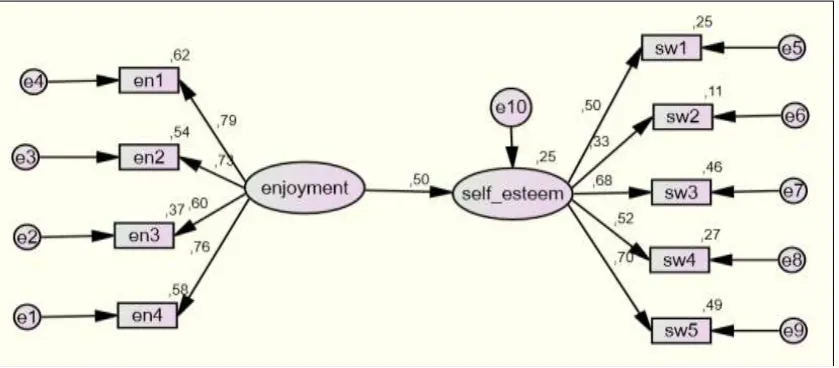
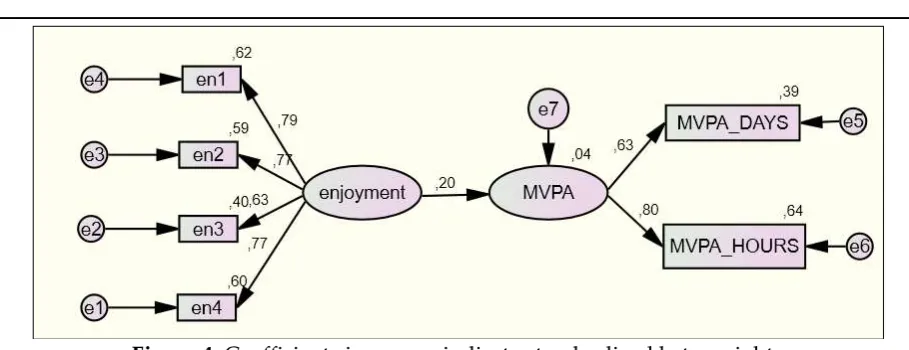
enjoyment in basketball predicts directly their PA levels and well-being variables. Four models were calculated. Across all models, we created one exogenous latent variable,
players’ enjoyment in basketball. Then, for each model we created one endogenous latent variable capturing self-rated health, self-esteem, subjective vitality and MVPA respectively (Figures 1 to 4). Maximum Likelihood Estimation and the Goodness-of-Fit Indices (GFIs) mentioned above for the CFAs were also used here to estimate the parameters of each model.
All the above statistical analyses were conducted by using the PASW Statistics software (IBM; version 18.0 for Windows) and AMOS statistical software (IBM; version 20.0). The level of significance was set at p < .05.
3. Results
3.1. Confirmatory factor analysis
CFA of the Enjoyment scale revealed acceptable goodness-of-fit indices: χ2(2) = 4.81, TLI
= .97, CFI = .99, RMSEA = .08, RMSEA 90% CI = .00 - .18. The factor loadings (4 items) ranged
from .63 to .79. In addition, CFA of the Self-esteem scale revealed acceptable goodness-of-fit indices: χ2(5) = 10.33, TLI = .92, CFI = .96, RMSEA = .07, RMSEA 90% CI = .00 - .14. The
factor loadings (5 items) ranged from .35 to .75. Finally, CFA of the Subjective Vitality scale revealed acceptable goodness-of-fit indices: χ2(4) = 13.52, TLI = .93, CFI = .97, RMSEA
= .11, RMSEA 90% CI = .05 - .18. The factor loadings (5 items) ranged from .58 to .87.
3.2. Descriptive statistics, reliability and correlation analyses
Figure 1: Days per week in Moderate to Vigorous Physical Activity (MVPA; % of players)
Figure 2: Hours per week in Moderate to Vigorous Physical Activity(MVPA; % of players)
Descriptive statistics (means and standard deviations), Cronbach’s alpha for
measuring scales’ internal consistency reliability and correlation analysis are presented
Table 1: Descriptive statistics, reliability and correlation analyses of the examined variables
Variables M ± SD alpha 1 2 3 4 5 6
1. MVPA (Days) 5.97 ± .79 - -
2. MVPA (Hours) 5.08 ± .86 - .50*** -
3. Enjoyment 4.25 ± .74 .82 .12 .15* -
4. Health 3.59 ± .57 - .14* .18* .18* -
5. Self-esteem 3.79 ± .57 .66 .09 .16* .38*** .31*** - 6. Vitality 3.80 ± .71 .81 .22** .26*** .52*** .13 .43*** -
Notes: MVPA = Moderate to Vigorous Physical Activity; M = Mean; SD = Standard Deviation; alpha = Reliability; *** p < .001; ** p < .01; * p < .05
3.3. Age effect on youth players’ MVPA
Then, in order to examine age effect on players’ MVPA, participants were splitted into
three age groups. One-way multivariate analysis of variance (MANOVA) revealed no
significant effect of age on players’ participation in MVPA (Wilks’ λ = .990, F4,406 = .535, p
= .710; Table 2).
Table 2: Descriptive statistics of players’ MVPA between age groups (no significant differences)
Variables Age Group M SD N
MVPA (Days per week) 11 to 12 years old 5.92 .81 39
13 to 14 years old 5.97 .76 96 15 to 16 years old 6.00 .84 72
Total 5.97 .79 207
MVPA (Hours per week) 11 to 12 years old 5.10 .75 39
13 to 14 years old 5.00 .86 97 15 to 16 years old 5.17 .90 72
Total 5.08 .86 208
Notes: M = Means; SD = Standard Deviations; N = Number of participants
3.4. Structural Equation Modelling
GFIs for Models 1, 2, 3 and 4, having enjoyment as an exogenous latent variable, appear in Table 3. Across all models, the effect of sport-related enjoyment on self-rated health, self-esteem and subjective vitality was significant (Figures 1 to 3). On the contrary, the
effect of enjoyment on players’ MVPA was not significant (Figure 4). These findings
imply that sport-related enjoyment had a direct effect on youths’ well-being variables.
Table 3: Goodness-of-fit Indices of Models 1, 2, 3 and 4
Model Endogenous variable χ2 df χ2/df TLI CFI RMSEA
4 Health 17.00 5 3.4 .92 .96 .11
5 Self-esteem 47.39 26 1.82 .93 .95 .07
6 Vitality 65.67 26 2.53 .92 .94 .09
7 MVPA 9.70 8 1.21 .99 .99 .03
Figure 1: Coefficients in arrows indicate standardized beta weights (For Model 1: β = .17, p < .05)
Figure 2: Coefficients in arrows indicate standardized beta weights (For Model 2: β = .50, p < .001)
Figure 4: Coefficients in arrows indicate standardized beta weights (For Model 4: β = .20, p = .10; MVPA = Moderate to Vigorous Physical Activity)
4. Discussion
The purpose of this study was to examine the relationship of self-reported PA and enjoyment of youth basketball players with their well-being (rated health, self-esteem and subjective vitality). A high percentage of youth basketball players (71.5%) reported they are spending 6 to 7 days per week in MVPA. Based on this finding, it can be concluded that the vast majority of youths who participate in basketball training meet
the WHO’s PA recommendations for “at least 60 minutes of MVPA daily” (WHO, 2010; p.
7). This finding is in line with previous studies that found high levels of PA in youths who participate in organized sports (e.g., Hebert et al., 2015; Kokko et al., 2019; Wold, Duda, Balaguer, Smith, et al., 2013).
Findings regarding age effect revealed no significant changes in youths’ PA levels
between different age groups. A rational explanation for this could be their regular participation in basketball training. However, this finding is not aligned with a large
number of studies found that youths’ PA levels are dramatically reduced as they are
growing up (e.g., Biddle, Gorely, & Stensel, 2004; Dumith, Gigante, Domingues, & Kohl, 2011). The findings of the present stressed that basketball training may contribute to
maintaining youths’ PA levels.
Findings from correlation analysis revealed that MVPA and enjoyment were
positively related to youths’ self-reported health, subjective vitality, and self-esteem. On
the contrary, youths’ MVPA (days per week) was not related to their enjoyment. This
result is not aligned with other studies that found a significant relationship between
youths’ PA levels and sport-related enjoyment (e.g., Fenton et al., 2017; Lagestad & Sørensen, 2018). Since enjoyment is one of the most crucial factors for promoting children
different exercises, teaching approaches, and positive feedback. Additionally, the adoption of strategies such as the avoidance of social comparison between youths’ and promotion of personal improvement, the reduction of youths’ sport-related anxiety and
the creation of an “empowering climate” that would emphasize players’ autonomy (to enable them to have “voice and choice” during training), personal improvement and
learning may promote youths’ enjoyment (e.g. Cheon, Reeve, Lee, & Lee, 2015; Duda &
Appleton, 2016; Duda, Quested, Haug, Samdal, et al., 2013; Harwood, Barker, & Anderson, 2015; Smith, Smoll, & Cumming, 2007).
Finally, findings from SEM revealed a direct effect of sport-related enjoyment on
players’ self-rated health, self-esteem, and subjective vitality. Similar findings were also reported by Gagné, Ryan and Bargman (2003) who found that intrinsic motivation, which refers to the fact that one participates in a sport only for the fun or pleasure he/ she feels,
predicted significantly young athletes’ well-being. On the contrary, sport-related
enjoyment was not a significant predictor of players’ PA levels. This result is not in line with previous studies who found that enjoyment has a direct effect or plays a mediating
role on young athletes’ PA levels (e.g., Fenton et al., 2017; Gagne et al., 2003). A rational
explanation for this finding could be that the participants of previous studies belong to different sports (e.g., soccer or female gymnasts vs basketball players) or age groups. The
previous studies used also different methods to capture participants’ PA levels (e.g.,
accelerometers) compared to the present study (self-report measures).
5. Conclusion
Based on the above, it appears that the regular participation of children and adolescents in basketball may contribute to increase or maintain their PA levels, to meet World Health Organization (WHO) recommendations for PA and to improve their quality of life. Particularly, enjoyment during training should be the focus of basketball coaches because
it is linked with their players’ well-being. A limitation of this study might be the self-report measures we used to assess youths’ PA levels. This kind of self-referred
instruments often underestimates or overestimates children and adolescents’ PA levels
mainly due to recall errors (e.g., Biddle, Gorely, Pearson, & Bull, 2011). Future studies it is important to use more reliable and valid methods to capture young basketball players’
PA levels such as accelerometers or pedometers. By using motion sensors, researchers
might be able to compare precisely the contribution of basketball training in youths’ daily
PA. Moreover, future researchers can examine other well-being variables of youth basketball players such as sport-related anxiety or use other well-being scales such as Cantril’s life satisfaction ladder (Cantril, 1965) or the Positive and Negative Affect Scale
(PANAS; Watson, Clark, & Tellegen, 1988) or the Scale of Positive and Negative Experience
Conflict of Interest
The authors declare that there are no conflicts of interest.
About the Authors
Charalampos Krommidas, Ph.D., is with the Dept. of Physical Education & Sport Science, University of Thessaly, Trikala, Greece, e-mail: [email protected]
Stefanos Perkos, Ph.D., is with the Dept. of Physical Education & Sport Science, Aristotle University of Thessaloniki, Serres, Greece, e-mail: [email protected]
Ioannis Syrmpas, PhD, is with the Dept. of Physical Education & Sport Science, University of Thessaly, Trikala, Greece, e-mail: [email protected]
Georgios S. Gorozidis, Ph.D., is with the Dept. of Physical Education & Sport Science, University of Thessaly, Trikala, Greece, e-mail: [email protected]
Omiros Vlahos, Ph.D. student, is with the Dept. of Physical Education & Sport Science, University of Thessaly, Trikala, Greece, e-mail: [email protected]
Evangelos Brisimis, Ph.D. student, is with the Dept. of Physical Education & Sport Science, University of Thessaly, Trikala, Greece, e-mail: [email protected]
Georgios Loules, Ph.D. student, is with the Dept. of Physical Education & Sport Science, University of Thessaly, Trikala, Greece, e-mail: [email protected]
References
Ara, I., Vicente-Rodríguez, G., Jimenez-Ramirez, J., Dorado, C., Serrano-Sanchez, J. A., & Calbet, J. A. L. (2004). Regular participation in sports is associated with enhanced physical fitness and lower fat mass in prepubertal boys. International Journal of Obesity, 28, 1585-1593.
Biddle, S. J. H., Gorely, T., Pearson, N., & Bull, F. C. (2011). An assessment of self-reported physical activity instruments in young people for population surveillance: Project ALPHA. International Journal of Behavioral Nutrition and Physical Activity, 8, 1. DOI: 10.1186/1479-5868-8-1
Biddle, S. J. H., Gorely, T., & Stensel, D. J. (2004). Health-enhancing physical activity and sedentary behaviour in children and adolescents. Journal of Sports Sciences, 22(8), 679-701. DOI: 10.1080/02640410410001712412
Booth, M. L., Okely, A. D., Chey, T., & Bauman, A. (2001). The reliability and validity of the physical activity questions in the WHO health behaviour in schoolchildren (HBSC) survey: a population study. British Journal of Sports Medicine, 35, 263-267. Cantril, H. (1965). The pattern of human concerns. New Brunswick, NJ: Rutgers University
Press.
Cheung, G. W., & Rensvold, R. B. (2002). Evaluating goodness-of-fit indexes for testing measurement invariance. Structural Equation Modeling: A Multidisciplinary Journal, 9, 233-255. DOI: 10.1207/S15328007SEM0902_5
Crane, J., & Temple, V. (2015). A systematic review of dropout from organized sport among children and youth. European Physical Education Review, 21(1), 114-131. DOI: 10.1177/1356336X14555294
Cronbach, L. J. (1951). Statistical power analysis for the behavioral sciences (2nd Eds). New
York: Academic Press.
Cuff, S., Loud, K., & O’ Riordan, M. A. (2010). Overuse injuries in high school athletes.
Clinical Pediatrics, 49(8), 731-736. DOI: 10.1177/0009922810363154
Currie, C., Roberts, C., Morgan, A., Smith, R., Settertobulte, W., Samdal, O., & Barnekow Rasmussen, V. (2004). Young people’s health in context - Health Behaviour in
School-aged Children (HBSC) study: International report from the 2001/02 survey.
Copenhagen: WHO-Europe.
Davis, T. C., Arnold, C., Nandy, I., Bocchini, J. A., Gottlieb, A., George, R. B., & Berkel, H. (1997). Tobacco use among male high school athletes. Journal of Adolescent Health, 21(2), 97-101. DOI: 10.1016/s1054-139x(97)00032-3
Diener, E., Wirtz, D., Tov, W., Kim-Prieto, C., Choi, D.-w., Oishi, S., & Biswas-Diener, R. (2010). New well-being measures: Short scales to assess flourishing and positive and negative feelings. Social Indicators Research, 97(2), 143-156. DOI: 10.1007/s11205-009-9493-y
DiFiori, J. P., Güllich, A., Brenner, J. S., Côté, J., Hainline, B., Ryan, E., & Malina, R. M. (2018). The NBA and youth basketball: Recommendations for promoting a healthy and positive experience. Sports Medicine, 48, 2053-2065. DOI: 10.1007/s40279-018-0950-0
Duda, J. L., & Appleton, P. R. (2016). Empowering and disempowering coaching climates: Conceptualization, measurement considerations, and intervention implications. In M. Raab, P. Wylleman, R. Seiler, A.-M. Elbe, & A. Hatzigeorgiadis (Eds.), Sport and Exercise Psychology Research: From Theory to Practice (p. 373-388). Elsevier Academic Press. DOI: 10.1016/B978-0-12-803634-1.00017-0
Duda, J. L., Quested, E., Haug, E., Samdal, O., Wold, B., Balaguer, I., … Cruz, J. (2013).
Promoting adolescent health through an intervention aimed at improving the
quality of their participation in physical activity (‘PAPA’): background to the
project and main trial protocol. International Journal of Sport and Exercise Psychology, 11(4), 319-327. DOI: 10.1080/1612197X.2013.839413
Dumith, S. C., Gigante, D. P., Domingues, M. R., & Kohl III, H. W. (2011). Physical activity change during adolescence: a systematic review and a pooled analysis.
International Journal of Epidemiology, 40, 685-698. DOI: 10.1093/ije/dyq272
sport. International Journal of Behavioral Nutrition and Physical Activity, 10(98). DOI: 10.1186/1479-5868-10-98
Fenton, S. A. M., Duda, J. L., Appleton, P. R., & Barrett, T. G. (2017). Empowering youth sport environments: Implications for daily moderate-to-vigorous physical activity and adiposity. Journal of Sport and Health Science, 6, 423-433. DOI: 10.1016/j.jshs.2016.03.006
Fietz, M., Touyz, S., & Hay, P. (2014). A risk profile of compulsive exercise in adolescents with an eating disorder: a systematic review. Advances in Eating Disorders: Theory,
Research and Practice, 2(3), 241-263. DOI: 10.1080/21662630.2014.894470
Fraser-Thomas, J., & Côté, J. (2006). Youth sports: Implementing findings and moving forward with re-search. Athletic Insight the Online Journal of Sport Psychology, 8(3), 12-27.
Gagné, M., Ryan, R. M., & Bargman, K. (2003). Autonomy support and need satisfaction in the motivation and well-being of gymnasts. Journal of Applied Sport Psychology, 15, 372-390. DOI: 10.1080/10413200390238031
Goudas, M. (2010). Prologue: A review of life skills teaching in sport and physical education. Hellenic Journal of Psychology, 7, 241-258.
Gould, D., & Carson, S. (2008). Life skills development through sport: current status and future directions. International Review of Sport and Exercise Psychology, 1(1), 58-78. DOI: 10.1080/17509840701834573
Goudas, M., & Hassandra, M. (2006). Greek students’ motives for participation in
physical education. International Journal of Physical Education, XLIII, 85-89.
Greydanus, D. E., & Patel, D. R. (2002). Sports doping in the adolescent athlete: The hope, hype, and hyperbole. The Pediatric Clinics of North America, 49, 829-855. DOI: 10.1016/S0031-3955(02)00021-4
Guagliano, J. M., Lonsdale, C., Kolt, G. S., Rosenkranz, R. R., & George, E. S. (2015).
Increasing girls’ physical activity during a short-term organized youth sport basketball program: A randomized controlled trial. Journal of Science and Medicine
in Sport, 18(4), 412-417. DOI: 10.1016/j.jsams.2015.01.014
Guthold, R., Stevens, G. A., Riley, L. M., & Bull, F. C. (2020). Global trends in insufficient physical activity among adolescents: a pooled analysis of 298 population-based surveys with 1.6 million participants. The Lancet Child & Adolescent Health, 4, 23-35. DOI: 10.1016/S2352-4642(19)30323-2
Habelt, S., Hasler, C. C., Steinbrück, K., & Majewski, M. (2011). Sport injuries in adolescents. Orthopedic Reviews, 3(2), 82-86. DOI: 10.4081/or.2011.e18
Harwood, C. G., Barker, J., & Anderson, R. (2015). Psychosocial development in youth
soccer players: Assessing the effectiveness of the 5C’s intervention program. The Sport Psychologist, 29(4), 319-334.
Hoffman, J. R., Kang, J., Faigenbaum, A. D., & Ratamess, N. A. (2005). Recreational sports participation is associated with enhanced physical fitness in children. Research in
Sports Medicine, 13(2), 149-161. DOI: 10.1080/15438620590956179
Hu, L., & Bentler, P. M. (1999). Cutoff criteria for fit indexes in covariance structure analysis: Conventional criteria versus new alternatives. Structural Equation
Modeling: A Multidisciplinary Journal, 6(1), 1-55. DOI: 10.1080/10705519909540118
Karatrantou, K., Stavrou, V., Hasioti, P., Varveri, D., Krommidas, C., & Gerodimos, V. (2020). An enjoyable school-based swimming training program improves
students’ aquaticity. Acta Paediatrica, 109, 166-174. DOI: 10.1111/apa.14920.
Kjønniksen, L., Anderssen, N., & Wold, B. (2009). Organized youth sport as a predictor of physical activity in adulthood. Scandinavian Journal of Medicine & Science in Sports,19(5), 646-654.
Kokkevi, A., Stavrou, Μ., Kanavou, Ε., & Fotiou, Α. (2014). The repercussions of the economic recession in Greece on adolescents and their families. Innocenti Working Paper No.2014-07, UNICEF Office of Research, Florence.
Kokko, S., Martin, L., Geidne, S., Van Hoye, A., Lane, A., Meganck, J., … Koski, P. (2019).
Does sports club participation contribute to physical activity among children and adolescents? A comparison across six European countries. Scandinavian Journal of
Public Health, 47(8), 851-858. DOI: 10.1177/1403494818786110
Krommidas, C., Galanis, E., Papaioannou, A., Tzioumakis, G., Zourbanos, N., Keramidas, P., & Digelidis, N. (2016). The relationship of Empowering and Disempowering coaching climate with enjoyment and quality of life variables in Greek youth soccer. Inquiries in Sport & Physical Education, 14(2), 19-35.
Lagestad, P., & Sørensen, A. (2018). Longitudinal changes in sports enjoyment among adolescents. Journal of Physical Education and Sport, 18(1), 89-97. DOI: 10.7752/jpes.2018.01011
Leek, D., Carlson, J. A., Cain, K. L., Henrichon, S., Rosenberg, D., Patrick, K., & Sallis, J. F. (2011). Physical activity during youth sports practices. Archives of Pediatrics &
Adolescent Medicine, 165(4), 294-299. DOI: 10.1001/archpediatrics.2010.252
Lisha, N. E., & Sussman, S. (2010). Relationship of high school and college sports participation with alcohol, tobacco, and illicit drug use: A review. Addictive
Behaviors, 35(5), 399-407. DOI: 10.1016/j.addbeh.2009.12.032
Marsh, H. W., Balla, J. R., & Hau, K. T. (Eds.). (1996). An evaluation of incremental fit indexes:
A clarification of mathematical and empirical properties. Mahwah, NJ: Lawrence
Erlbaum.
Marsh, H. W., Martin, A. J., & Jackson, S. (2010). Introducing a short version of the physical self-description questionnaire: New strategies, short-form evaluative criteria, and applications of factor analyses. Journal of Sport & Exercise Psychology, 32, 438-482.
McCarthy, P. J., Jones, M. V., & Clark-Carter, D. (2008). Understanding enjoyment in youth sport: A developmental perspective. Psychology of Sport and Exercise, 9(2), 142-156. DOI: 10.1016/j.psychsport.2007.01.005
Papacharisis, V., & Goudas, M. (2003). Perceptions about exercise and intrinsic
motivation of students’ attending a health-related program. Perceptual and Motor Skills, 97, 689-696.
Papaioannou, A., Appleton, P., Torregrosa, M., Jowett, G., Bosselut, G., Gonzalez, L., …
Zourbanos, N. (2013). Moderate-to-vigorous physical activity and personal well-being in European youth soccer players: Invariance of physical activity, global self-esteem and vitality across 5 countries. International Journal of Sport and Exercise
Psychology, 11, 351-364. DOI: 10.1080/1612197X.2013.830429
Reich, P., Rechtik, Z., Miklánková, L., & Prukner, V. (2016). Comparison of the physical activity in the daily program between youth basketball players and adolescents aged from 16 to 17 years in the Czech Republic. Journal of Education, Health and
Sport, 6(13), 174-173. DOI: 10.5281/zenodo.247109
Richter, M., Erhart, M., Vereecken, C. A., Zambon, A., Boyce, W., & Gabhainn, S. N. (2009). The role of behavioural factors in explaining socio-economic differences in adolescent health: A multilevel study in 33 countries. Social Science & Medicine, 69, 396-403.
Ryan, R. M., & Frederick, C. (1997). On energy, personality, and health: Subjective vitality as a dynamic reflection of well-being. Journal of Personality, 65(3), 529-565.
Scanlan, T. K., Carpenter, P. J., Lobel, M., & Simons, J. P. (1993). Sources of enjoyment for youth sport athletes. Pediatric Exercise Science, 5, 275-285.
Schumacher Dimech, A., & Seiler, R. (2011). Extra-curricular sport participation: A potential buffer against social anxiety symptoms in primary school children.
Psychology of Sport and Exercise, 12, 347-354. DOI: 10.1016/j.psychsport.2011.03.007
Smith, R. E., Smoll, F. L., & Cumming, S. P. (2007). Effects of a Motivational Climate Intervention for Coaches on Young Athletes' Sport Performance Anxiety. Journal of Sport & Exercise Psychology, 29(1), 39-59. DOI: 10.1123/jsep.29.1.39
Smith, R. E., Smoll, F. L., & Schutz, R. W. (1990). Measurement and correlates of sport-specific cognitive and somatic trait anxiety: The Sport Anxiety Scale. Anxiety
Research, 2, 263-280. DOI: 10.1080/08917779008248733
Watson, D., Clark, L. A., & Tellegen, A. (1988). Development and validation of brief measures of positive and negative affect: The PANAS scales. Journal of Personality
and Social Psychology, 54, 1063-1070. DOI: 10.1037/0022-3514.54.6.1063.
Wickel, E. E., & Eisenmann, J. C. (2007). Contribution of youth sport to total daily physical activity among 6- to 12-yr-old boys. Medicine and Science in Sports and Exercise, 39(9), 1493-1500. DOI: 10.1249/mss.0b013e318093f56a
Wold, B., Duda, J. L., Balaguer, I., Smith, O. R. F., Ommundsen, Y., Hall, H. K., …
in a reference sample. International Journal of Sport and Exercise Psychology, 11(4), 328-340. DOI: 10.1080/1612197X.2013.830433
Creative Commons licensing terms