ISSN: 2501 - 1235 ISSN-L: 2501 - 1235 Available on-line at: www.oapub.org/edu
doi: 10.5281/zenodo.3706998 Volume 6 │ Issue 3 │ 2020
MOTOR PERFORMANCES IN RELATION TO PERCEIVED
PHYSICAL SELF-EFFICACY, ENOJOYMENT AND
BMI IN PRIMARY SCHOOL CHILDREN
Dario Colella1i Domenico Monacis1,2
d’Arando Cristina1 1Department of Clinical and Experimental Medicine University of Foggia, Italy 2Department of Humanities,
Cultural Heritage, Education Sciences University of Foggia,
Italy
Abstract:
Physical efficiency is an important health indicator for children and adolescents. The increase in overweight and obesity in childhood is a dangerous determinant of physical fitness development. This study aimed to evaluate and compare motor performances, perceived self-efficacy and enjoyment in relation to BMI in primary school children. The sample consisted of 2,623 children (F: 1,300; M: 1,323) divided into three groups according to gender and BMI differences (Normal-weight vs Over-weight vs Obese). In addition to descriptive statistics (M ± SD), ANOVA 3 (group, normo-weight vs overweight vs obese) was performed x 2 (gender), to highlight differences between groups (p<.05). Physical fitness perceived physical self-efficacy and enjoyment were assessed with motor test (SLJ; 6 MWT; 10x4; MBT) and two self-report questionnaires, i.e. PACES and PPAS_C. Results showed a strong relation between BMI and motor performances, perceived self-efficacy and enjoyment in both males and females. Overweight and obese children showed lower motor performances compared to the Nw group of students (p<.05). Furthermore, the scores of perceived self-efficacy and enjoyment of the Ow-Ob group are lower than those of the Nw group (p<.05). Findings reveals that children perceived self-efficacy and enjoyment are crucial for motor development and promoting active lifestyles.
Keywords: physical fitness; obesity; primary school; self-perception; enjoyment
1. Introduction
Motor activities contribute to the development of motor skills, necessary precursors of correct lifestyles and for participation in sport; various and different motor experiences increase the quantitative and qualitative opportunities to learn further motor skills and develop motor skills, generating a circular process that feeds itself through daily motor activities. Several studies have confirmed the contribution of physical activity to the
physical growth, personal development and the promotion of children’s health.
According to Ortega et al. (2008) physical efficiency is an important health indicator for children and young people, since: (1) the levels of cardiorespiratory efficiency (aerobic / anaerobic endurance) are mainly associated with abdominal adiposity; (2) cardiorespiratory and muscle efficiency are associated with the occurrence of cardiovascular disease risks; (3) the improvement of muscle efficiency (strength) and speed have positive effects on skeletal development; (4) the increase in both cardiorespiratory and muscle efficiency are recommended for children and young people with various diseases to improve the quality of life; (5) improving cardiorespiratory efficiency has positive effects on depression, anxiety, mood and self-esteem and is associated with good school performance.
Unfortunately, the decline in usual physical activity levels also generates a consequent decline in motor performance and related factors. Recently Faigenbaum et al. (2018), highlights that a large percentage of children and adolescents in the world do not reach the 60-minute of moderate to vigorous (MVPA) daily physical activity, with a consequent reduction in the levels of physical efficiency in young developmental age. The triad of physical activity in children (Faigenbaum, 2018), identifies three distinct, but closely related factors: exercise deficit disorders, pediatric dynapenia, motor illiteracy (physical illiteracy). A dangerous circular process is thus generated: subjects with low MVPA levels will be less inclined to participate in motor activities, even free / unstructured, and this determines a lesser suitability for the practice of physical or sports activities that entail the achievement of a state of joy, associated with movement (joy of movement).
This is associated with a progressive reduction in the motor repertoire of motor
skills and the consequent levels of individual coordinative development. Today’s
children are weaker, slower and heavier than their peers of the past, with an increasing tendency to develop physical, psychosocial and cognitive health problems, especially in school age. The proposals from international organizations (WHO, 2018), observed for the practice of habitual physical activities both of a quantitative and qualitative type (how much and how to carry out these activities) also differentiated according to the control band various types of physical activity. In general, WHO can be said to have purchased 150 minutes per week of moderate intensity activity for adults and 60 minutes of moderate to vigorous daily activity for the developmental age (WHO, 2018). Despite
global needs, however, the decline in physical activity levels in recent years doesn’t seem
According to Garrido-Miguel et al. (2019) the prevalence of overweight and obesity combined in European children aged 2 to 13 years changed from 20.6% during 1999 to 2006, to 21.3% during 2011 to 2016. The highest prevalence was in Italy (16.8%) and Malta (14.2%).
School programs that include curricular physical education and extracurricular motor and sports activities, produce positive results on promoting further physical activity outside of school and contribute to increasing the time that children and young people spend actively and reduce the time spent in sedentary habits (Messing, 2019). Not only that, the contexts that emphasize positive experiences (family, school, neighborhood), characterized by fun, variety and wide participation, conducted by qualified teachers, informed parents, can significantly influence the character of these physical activities and increase the probability to realize the potential benefits of participation.
However, integrated interventions in different educational contexts (school, free time, sport) are needed to analyze cause-effect relationships between different factors: socio-environmental determinants related to daily physical activity, reduction of children's physical activity levels, increase in overweight and obesity in developmental age, cognitive and social development (Wright et al., 2016; Cotton et al., 2017; Verjans-Janssen et a., 2018).
The school setting is fundamental for the development of physical fitness and motor learning. Physical education offers many and different opportunities for practicing structured physical activity, promoting the development of motor abilities during childhood and adolescence. Recent findings show that many of these benefits will not necessarily be the result of participation in the activities but the effects could be mediated by the nature of the interactions between students and their teachers, parents and adults of reference to school, in the family in the socio-cultural context (Lonsdale et al., 2013; Bailey, 2006). Faigenbaum et al. (2020) describes the complex system of factors related to participation in active play, exercise and spots activities in children and adolescents, the so-called “F-words” (family, facilitators, facilities, force, fitness, function, fun, felling and
future), underline the relationship among socioecological, physiological and psychological correlates of physical activity.
Therefore, the concept of physical literacy has to be considered in its entirety: it includes the psychomotor, cognitive and affective aspects, as well as the learning processes (Lee et al., 2019).
Fundamental Movement Skills (FMS) play a key role in program of physical literacy, developing physical competences (Edwards et al., 2017). Barnett et al. (2017) consider fitness as a key target for interventions, highlighting the positive associations with FMS self-perception.
The opportunities and environmental conditions for motor activity interact with the biological substrates of growth and maturation, thus determining the repertoire of
children’s motor skills (skills, knowledge and behavior expressed in a specific didactic
context).
Motor experiences take place in various contexts including home, school, neighborhood play area; all this contributes to the development of motor patterns through the variability of practice and to the learning of motor skills which are the essential basis for promoting health in different ways (Lubans et al., 2010; Barnett et al., 2016).
The increase in overweight and obesity in childhood is a dangerous determinant of physical fitness development. Rauner et al (2013) analyzed the relationship between physical activity and overweight and between fitness and overweight highlighting that obesity is inversely related to physical activity. School-based program can improve actual and perceived physical abilities, body image, and PA in overweight and obese children (Morano et al., 2020).
All studies reveal inverse relationships between physical efficiency and overweight. Mediation effects have been noted in the interrelation between body mass index (BMI), fitness and physical activity. Excessive body weight would be the cause or effect of low physical activity and low fitness levels. Cattuzzo et al. (2014) confirmed that: motor skills levels are inversely proportional to body weight (27 of 33 studies), there is a positive association between motor skills and good cardiorespiratory efficiency (12 of 12 studies) and between motor skills and musculoskeletal functions (7 out of 11 studies).
The relationship between motor skills and joint flexibility has not been well defined. The study highlights that the development of motor skills during childhood can directly and indirectly influence the health status linked to physical efficiency and can serve to encourage the development of long-term health-related results in children and adolescents. Unfortunately, studies from several countries warn that a consequence of the reduction in physical activity levels among children and adolescents is the decline in motor performance (Tomkinson & Olds, 2007; Ekelund et al., 2011) which helps to reduce preventive and protective effects of physical activity.
Furthermore, it has been shown that low levels of physical activity and physical efficiency in adolescence are associated with low levels of physical activity and physical efficiency in adulthood, prerequisites for a sedentary life (Huotari et al., 2011).
2. Perceived Self-Efficacy
competence, such as strength, physical fitness, body perception or sport activities (Babic et al., 2014; Bardid et al., 2016).
Physical activity and sport practice engagement are closely related to psychological factors and intrinsic motivation (Sierra-Diaz et al., 2019), in order to organize effective programs to promote active and healthy lifestyle in Physical Education classes.
According to Tietjens et al. (2018), both physical fitness and skills (commonly considered as perceived motor competence) are critical for the development of perceived competence. Motor competence refers to a person’s ability to perform a wide range of
motor skills, including the movement coordination and control underlying a particular motor outcome that are necessary to manage everyday tasks (Robinson et al., 2015).
According to Stodden et al. (2008) the development of motor skill competence is a primary underlying mechanism that promotes engagement in physical activity. Actual motor competence and optimal levels of perceived motor competence seem to play a key role in engaging children and adolescents in physical activity and sports (Estevan, Barnett & Estevan, 2018). A combination of high actual and perceived motor competence is related to higher physical activity and lower weight status (Meester et al., 2016; Colella et al., 2009). Khodaverdi & Stodden (2015) demonstrate the link between physical (actual motor competence and aerobic fitness), behavioural (PA) and psychological development (perceived motor competence) in childhood. Measures related to motor competence, motivation and positive affect work in an integrative manner to produce differences in PA and subsequent health outcomes in children (Cariney et al., 2019).
3. Enjoyment
Perceived self-efficacy and enjoyment are mediation factors for learning motor skills (Lubans et al., 2008). Physical education contributes to the educational process of the child, promotes the learning of motor skills, the development of perceived self-efficacy and enjoyment (Hills et al. 2014). Enjoyment and perceived self-efficacy are strictly related: pleasant and fun experiences during motor activity promote awareness of the practice of motor activities in different contexts and at different ages (Robinson et al., 2015).
Examining growth trajectories of PA and enjoyment, Yli-Piipari et al., (2012) found that adolescents with highest levels of intrinsic motivation and moderate to high levels of extrinsic one, reached highest levels of enjoyment and physical activity.
According to the Motivational Model in PE (Gråstén & Watt, 2017), intrinsic motivation had positive relations with enjoyment, knowledge, and performance, while BMI was negatively linked with relatedness and self-competence.
and obese children showed less positive emotions than normal weight ones (Gil-Madrona et al., 2019).
Even if enjoyment during physical activity is as an essential condition for encouraging sport practice, developing positive effects, and diminishing the negative ones and sedentary behavior in boys and girls (Gil-Madrona et al., 2019; Bai et al., 2017), findings reveals autonomous motivation and enjoyment in PE were not significant predictors of later PA (Timo et al., 2016).
4. Material and Methods
4.1 Aim
The aim of this study is to (a) evaluate and compare motor performance of resistance, strength and speed in relation to the body mass index (BMI) of a sample of children, (b) to examine perceived self-efficacy and enjoyment in relation to the BMI and motor performances.
4.2 Participants
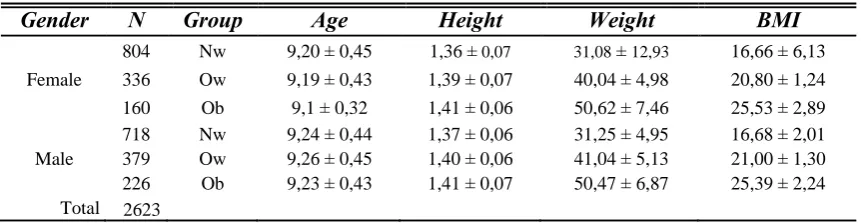
The sample consisted of 2,623 primary school children (F: 1,300; M: 1,323), ranged from 8 to 10 years (Table 1). Children recruited, participated at Sbam! (Health Wellness Food Movement at school), a multicomponent regional project aimed at primary schools in Apulia Region, in the south of Italy. The project has been promoted and financed by the Regional Administration and had provided for the collaboration of the University of Foggia, the CONI (Puglia regional committee) and local health authorities. The program was structured to implement measures to reduce sedentary habits and prevent childhood overweight and obesity, based on (a) correct eating habits promotion , (b) motor skills learning during curricular physical education lessons, (c) develop of active transport through pedibus, (d) recreative sport and socialization through fair play, (e) active lifestyles to reduce sedentary habits and support physical activity during leisure time (Colella, 2014).
4.3 Measures
Participants were divided into three groups according to gender and BMI differences (Normal-weight vs Over-weight vs Obese). Anthropometric data (height and weight)
Table 1. Sample
Gender N Group Age Height Weight BMI
Female
804 Nw 9,20 ± 0,45 1,36 ± 0,07 31,08 ± 12,93 16,66 ± 6,13
336 Ow 9,19 ± 0,43 1,39 ± 0,07 40,04 ± 4,98 20,80 ± 1,24 160 Ob 9,1 ± 0,32 1,41 ± 0,06 50,62 ± 7,46 25,53 ± 2,89
Male
and those relating to motor development and psychological factors (physical self-efficacy and enjoyment) were carried out. According to Cole et al., (2000) participants were divided by gender and group differences: normal-weight (Nw), overweight (Ow) and obese (Ob) children (Cole, 2000).
The following motor tests were assessed (Ruiz et al., 2010): standing long jump (SLJ) and medicine ball throw (MBT) to evaluate strength of the lower and upper limbs, shuttle run 10 × 4 (10 × 4) and 6 min walk test (6 min WT) to evaluate resistance.
Enjoyment during PA practice was assessed using the Physical Activity Enjoyment Scale (PACES), (Carraro, Young, & Robazza, 2008). The 16-item scale is scored on a 5-point Likert scales, with responses ranging from 1 (Disagree a lot) to 5 (Agree a lot). A high score on the positive scale (PACES_P) and a low score on the negative (PACES_N) indicate a high pleasure in physical activity (only PACES_P was considered in this research).
The PSP_C (Physical Self Efficacy Scale for Children) utilizes six items representing strength, speed, and coordinative abilities. The items are structured in response scales having a 1- to 4-point format. Children are required to think of themselves when playing, performing physical education exercises, or when involved in sporting activities. For each item, participants are asked to choose one of the four sentences best representing their personal feelings. Therefore, the total test score can range from 1 to 24. High scores would indicate a high self-perception of physical ability, whereas low scores would reflect a low self-perception.
4.4 Statistical Analysis
Descriptive statistics (M ± SD) and ANOVA 3 (group, normo-weight vs overweight vs obese) were performed x 2 (gender), to highlight the differences between groups. The significance index was set at p <.05. Pearson correlation’s coefficient was carried out for
dependent variables (Physical Self Efficacy and Enjoyment) by sex and BMI categories. Statistical significance was set at p < .05. Data were analyzed using “SPSS-Statistical
Package for the Social Sciences” (ver. 25.0).
5. Results
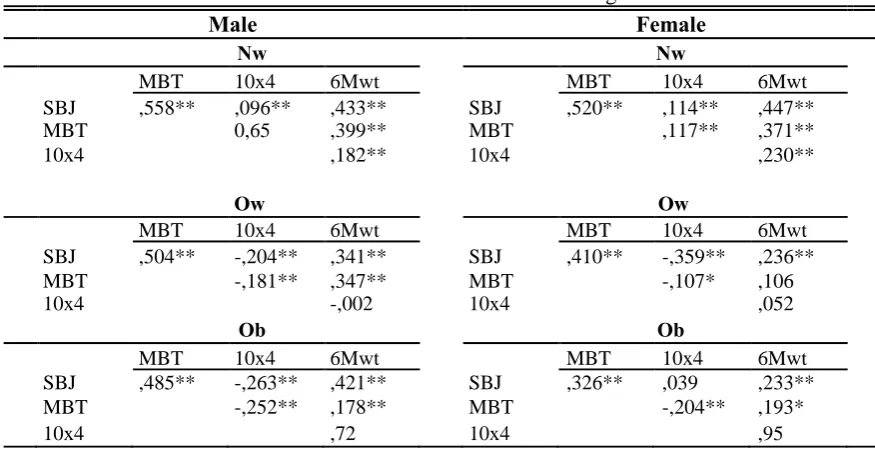
Table 3 indicates bivariate correlations between physical measures, respectively in male and female.
Statistically significant correlations among variables were generally low (r = .09–
.20) to moderate (r = .34–.55). BMI influenced about all measures. Higher positive correlations were carried out between SBJ and MBT both in male and female group; SBJ and MBT were also negatively related to 10x4 in Ow and Ob group (male and female).
*= p<.05; **= p<.001
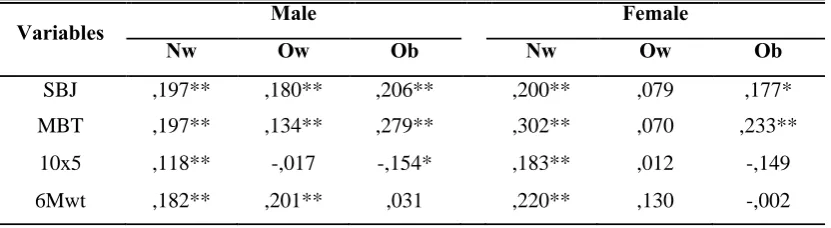
Physical Self Efficacy and Enjoyment (PACES_P) were correlated with above all motor tests (Table 4 and 5). There was a significant indirect effect of psychological correlates on motor abilities and physical performance, related to BMI.
Table.2 Measures
Gender N Group SLJ 10x4 MBT 6mWT PSP_C Paces_P
Female
804 Nw 1,18±0,22 13,80±1,79 4,08±0,95 656,81±118,28 18,33±3,70 40,93±5,64 336 Ow 1,11±0,21 13,99±2,05 4,27±0,98 630,59±98,31 18,30±3,18 40,55±5,77
160 Ob 1,00±0,23 14,63±2,40 4,32±1,11 587,54±121,65 17,71±3,42 39,79±7,26
Male
718 Nw 1,30±0,25 13,06±1,93 4,69±1,09 676,52±129,55 20,04±3,26 40,61±6,99 379 Ow 1,21±0,20 13,54±1,53 5,08±1,12 659,44±108,58 19,45±3,10 41,13±5,60 226 Ob 1,10±0,26 14,24±2,44 5,01±1,42 607,56±130,12 17,96±4,75 38,77±9,96 Total 2623
Table.3 Pearson’s Bivariate Correlations Among Measures
Male Female
Nw Nw
MBT 10x4 6Mwt MBT 10x4 6Mwt
SBJ ,558** ,096** ,433** SBJ ,520** ,114** ,447**
MBT 0,65 ,399** MBT ,117** ,371**
10x4 ,182** 10x4 ,230**
Ow Ow
MBT 10x4 6Mwt MBT 10x4 6Mwt
SBJ ,504** -,204** ,341** SBJ ,410** -,359** ,236**
MBT -,181** ,347** MBT -,107* ,106
10x4 -,002 10x4 ,052
Ob Ob
MBT 10x4 6Mwt MBT 10x4 6Mwt
SBJ ,485** -,263** ,421** SBJ ,326** ,039 ,233**
MBT -,252** ,178** MBT -,204** ,193*
*= p<.05; **= p<.001
*= p<.05; **= p<.001
6. Discussion
Studies highlight and confirm that motor performances of normal weight children is higher than that of overweight and obese peers. Overweight and obese children show lower motor performance than normal weight peers in all tests except in the test of the throwing of the medicine ball (kg2). In addition, there is a decline and a significant difference between the scores of the nw subjects vs. those reported by the ow-obese subjects.
The analysis of the results highlights moderate relationships between SBJ and MBT in all groups, regardless of gender, with higher values in the Normal Weight group. The 6-minutes test is positively correlated with the SBJ and MBT, with higher values in the Nw group (both boys and girls). The results suggest that a higher distance is positively correlated with lower BMI.
Statistical analysis highlights a positive association between MBT and Self Efficacy and enjoyment in the Obese groups, while 10x4 speed test evidences the least correlations with psychological correlates.
This suggests that activities that required rapid body movements, high intensity or endurance activities, are less appreciated and accepted by obese children. No significant statistical correlation was found in the female Ow group.
Robinson et al. (2015) in a recent review underline: (a) a positive relationship between motor competence and physical activity across childhood; (b) a strong
Table. 4 Pearson’s Correlates For Physical Self-Efficacy With Other Variables
Variables Male Female
Nw Ow Ob Nw Ow Ob
SBJ ,265** ,251** ,267** ,266** ,242** ,259**
MBT ,249** ,181** ,339* ,341** ,168** ,255**
10x5 ,085* -,76 -,226** ,099** -,103 -0,75
6Mwt ,194** ,197** ,049 ,218** -,106 -0,99
Table.5 Pearson’s Correlates For PACES_P With Other Variables
Variables Male Female
Nw Ow Ob Nw Ow Ob
SBJ ,197** ,180** ,206** ,200** ,079 ,177*
MBT ,197** ,134** ,279** ,302** ,070 ,233**
10x5 ,118** -,017 -,154* ,183** ,012 -,149
association between motor competence and motor performances (especially in endurance and muscular strength) from childhood to adolescence, and (c) motor competence can be considered a precursor and a consequence of weight status, highlighting an inverse relationship across childhood and adolescence. Vitali et al. (2019) showed that muscular strength scores was positively correlated with BMI, PA levels, and enjoyment.
The studies confirm the research carried out by Deforche et al. (2003) which assessed several factors of physical efficiency and physical activity of boys and girls divided into two groups, obese and non-obese. Obese subjects had lower performance in all tests that required horizontal or vertical elevation of body mass (standing long jump, sit-up, shuttle run) compared to normal weight peers. In contrast, obese subjects showed more handgrip strength. Also in the study carried out by Carvalho Dumith et al. (2010) on a sample of 519 students (ages 7 to 15 years), it emerges that the boys reported higher performances than the girls in all tests (sit-and-reach, standing long jump, pull-up, medicine ball throw, run of 9 minute run test, 20 m speed) except for flexibility and that the group of normal-weight students showed superior performance vs the overweight-obese group in all tests, except in sit-and-rich and in throwing the medicine ball. The endurance test (9 minutes run test) had the strongest association with body weight. Higher values of the body mass index have been associated with the decline in physical efficiency, regardless of age. The results of the study by Joshi et al (2012) on a sample of 7230 students (aged between 5 and 17 years), confirm previous studies regarding motor performance and physical activity levels in relation to BMI. The Fitnessgram protocol was used and, regardless of gender differences, boys in overweight-obese conditions show lower motor performance, compared to normal-weight students, particularly in motor tasks that require the movement of the body horizontally and vertically. In general, participants with a normal body weight have the highest levels of Health Fitness Zone (HFZ), followed by overweight and obese subjects. Gontav & Ruzdija (2014) also showed that adolescents (N = 2228, male and female) with a high body mass index have a lower percentage of muscle mass and obtained lower results in the tests of evaluation of muscle strength, speed and coordination and a low aerobic capacity, compared to normal weight peers. Groups with a high body mass index achieved results similar to the normal weight group only in terms of flexibility and greater in terms of static force.
associations of physical fitness (i.e. cardiorespiratory fitness, muscular strength, and speed/agility) with psychological distress and psychological well-being in overweight/obese pre-adolescent children. Results evidenced that upper-body muscular strength was negatively associated with stress and negative affect; absolute lower-body muscular strength was negatively associated with negative affect. Cardiorespiratory fitness, expressed by the last completed lap, and relative upper-body muscular strength were positively associated with optimism. Finally, absolute upper-body muscular strength was positively associated with self-esteem independently of sex and weight status, and absolute lower-body muscular strength was also positively associated with self-esteem. According to the authors, increased levels of physical fitness, specifically muscular strength, could have significant benefits for overweight/obese children psychological health.
Ultesch et al. (2018) examined children's accuracy of physical self-concept as predictive factor for their future physical activity. Analyses revealed that children who perceive their motor competence more accurately show more future physical activity, and the effect is stronger for underweight and overweight/obese children, related to normal weight children (Utesch et al., 2018). Fu et al. (2019) investigated the relation between physical activity, sedentary behavior and motivation during a 12 weeks classroom-based Active Video Game program. Results evidenced a significant negative trend for sedentary behavior, an important increase in light and vigorous physical activity, step counts and enjoyment. Recent studies demonstrated the potential and additional benefits of regular and structured for children's and adolescents' self-concept and enjoyment, in a way that is favorable and encouraging for promoting their academic achievement (van de Berg et al., 2019; Dapp & Roebers, 2019). Physical activity intervention is associated with increased self-concept and self-worth in children and adolescents. Compared with other setting and environment, school-based and gymnasium-based intervention are strongly associated with increased self-concept (Liu, Wu & Ming, 2015).
Flynn et al. (2018) examined active video games (AVGs) as a tool to improve fitness and attitudes toward physical activity during early adolescence (50% overweight or obese). Participants improved the number of sit-ups and step-ups they completed from pre- to postintervention (p < .05). Participants also increased their self-efficacy, attitude to exercise and perceived social support to physical activity (p < .05).
7. Conclusions
Physical education at school offers all children and young people numerous and fun opportunities to increase their daily and weekly physical activity levels during the school day. In fact, curricular motor activities and periods of recreation offer children regular opportunities for learning and motor development (interdependent relationship) and rich social interactions (Meyer et al., 2013). The quantity and quality of studies on physical activity in developmental age and sedentary behaviors have rapidly increased in recent years but research directions are often followed in an uncoordinated way among scholars.
Grasten & Yli-Piipari (2019) suggests that school-based physical activity programs have to provide all children positive experiences, improving their motivation, and MVPA participation during school days and leisure time.
To reach an international consensus on the priorities of research in the field of physical activity and motor development for the health of children and adolescents, two independent groups of scholars (Delphi procedure) were compared, in order to define a list of research priorities for the next ten years (Gillis et al., 2013).
Among the top three research priorities (out of 29) for the next 10 years, the following were identified:
a) develop effective and sustainable interventions to increase long-term children's physical activity;
b) implement policies to promote environmental change and their influence on the levels of physical activity and the reduction of sedentary behavior in children; c) longitudinal studies on the effects of physical activity on sedentary habits and
health promotion.
The motor evaluation in secondary school allows to acquire data on the quality of teaching, on motor development, indicators of the health conditions of young people and to reconstruct the habits of motor activities carried out during the day or in a week.
8. Recommendations and Methodological Implications
difficulty, duration and intensity, to help increase the quantitative and qualitative levels of physical activity, promoting success and motivation to continue.
The aim is to propose motor tasks through production styles (Mosston & Ashworth, 2008), in particular guided discovery and problem solving and through reproduction, practice and self-verification styles, in order to adapt the executive variants to promote the perception of competence (task successfully performed) and fun. The variation of teaching styles is essential to encourage the personalization of the motor task. Among the essential and indispensable skills of the Physical Education Teacher is the quality of the didactic action through the personalization of the motor task and the educational intervention in the motor and youth sports field.
About the Author(s)
Dario Colella. Full Professor of Methods of Didactics and Motor Activities, Department of Clinical and Experimental Medicine, University of Foggia, Italy.
Domenico Monacis. PhD Student, Department of of Humanities, Cultural Heritage, Education Sciences, University of Foggia, Foggia, Italy.
Cristina d’Arando. Master’s Degree in Preventive and Adapted Physical Activity, University of Foggia, Italy.
References
Babic, M. J., Morgan, P. J., Plotnikoff, R. C., Lonsdale, C., White, R. L., & Lubans, D. R. (2014). Physical activity and physical self-concept in youth: systematic review and meta-analysis. Sports Medicine (Auckland, N.Z.), 44(11), 1589–1601.
https://doi.org/10.1007/s40279-014-0229-z
Bai, Y., Allums-Featherston, K., Saint-Maurice, P. F., Welk, G. J., & Candelaria, N. (2018). Evaluation of Youth Enjoyment Toward Physical Activity and Sedentary Behavior. Pediatric Exercise Science, 30(2).
Bailey, R. (2006). Physical Education and Sport in Schools: A Review of Benefits and Outcomes. Journal of School Health, 76(8), 397–401.
https://doi.org/10.1111/j.1746-1561.2006.00132.x
Bandura, A. (1997). Self-efficacy: The exercise of control. W H Freeman/Times Books/ Henry Holt & Co.
Bardid, F., De Meester, A., Tallir, I., Cardon, G., Lenoir, M., & Haerens, L. (2016). Configurations of actual and perceived motor competence among children: Associations with motivation for sports and global self-worth. Human Movement Science, 50, 1–9. https://doi.org/10.1016/j.humov.2016.09.001
Barnett, L. M., Lubans, D. R., Timperio, A., Salmon, J., & Ridgers, N. D. (2018). What is
the Contribution of Actual Motor Skill, Fitness, and Physical Activity to Children’s
Self-Perception of Motor Competence? Journal of Motor Learning and Development,
Barnett, L. M., Stodden, D., Cohen, K. E., Smith, J. J., Lubans, D. R., Lenoir, M., … Morgan,
P. J. (2016). Fundamental Movement Skills: An Important Focus. Journal of Teaching in Physical Education, 35(3), 219–225. https://doi.org/10.1123/jtpe.2014-0209
Burns, R. D., Fu, Y., & Podlog, L. W. (2017). School-based physical activity interventions and physical activity enjoyment : A meta-analysis. Preventive Medicine,
103(August), 84–90. https://doi.org/10.1016/j.ypmed.2017.08.011
Cairney, J., Dudley, D., Kwan, M., Bulten, R., & Kriellaars, D. (2019). Physical Literacy, Physical Activity and Health: Toward an Evidence-Informed Conceptual Model.
Sports Medicine (Auckland, N.Z.), 49(3), 371–383.
https://doi.org/10.1007/s40279-019-01063-3
Cameron, D. S., Bertenshaw, E. J., & Sheeran, P. (2017). Positive Affect and Physical Activity: Testing Effects on Goal Setting, Activation, Prioritization, and Attainment. Psychology and Health, 33(2), 258–274.
https://doi.org/https://doi.org/10.1080/08870446.2017.1314477
Carraro, A., Christina, M., Robazza, C., & Leuven, K. U. (2008). A contribution to the validation of the physical activity enjoyment scale in an italian sample. Social Behaviour and Personality, 36(7), 911–918.
Carvalho Dumith, S., Ramires, V.V., Alves Souza, M., Souza Moraes, D., Godoy Petry, F., Soldera Oliveira, E., Viana Ramires, S. and Hallal, P.C. (2010). Overweight/Obesity and Physical Fitness Among Children and Adolescents. Journal of Physical Activity and Health, 7, 641-648.
Cattuzzo, M.T., Henrique, Rafael dos Santos, Hervaldo Nicolai Réb Alessandro, Santos de Oliveira Ilana, Melo Bruno Machado, Moura Mariana de Sousa, Cappato de Araújoc Rodrigo, Stodden, D. (2014). Motor competence and health related physical fitness in youth: A systematic review. Journal of Science and Medicine in Sport, 1, 123; No of page 7.
Cole, T. J., Bellizzi, M. C., Flegal, K. M., & Dietz, W. H. (2000). Establishing a standard definition for child overweight and obesity worldwide: international survey. BMJ
(Clinical Research Ed.), 320(7244), 1240–1243.
https://doi.org/10.1136/bmj.320.7244.1240
Colella, D. (2014). Physical Education in Primary School in Italy. The Sbam! Program for the Promotion of Physically Active Lifestyles. In C. Scheuer, B. Antala, M. Holzweg (Ed.), Physical Education: Quality in management and teaching. Berlin: Logos Verlag Berlin GmbH
Colella, D., Morano, M., Bortoli, L., & Robazza, C. A. (2008). Physical Self Efficacy Scale for Children. Social Behavior and Personality: An International Journal, 36, 841-848.
https://doi.org/10.2224/sbp.2008.36.6.841
Colella, D., Morano, M., Robazza, C., & Bortoli, L. (2009). Body image, perceived physical ability, and motor performance in nonoverweight and overweight Italian children.
Perceptual and Motor Skills, 108, 209–218. https://doi.org/10.2466/PMS.108.1.209-218
Cotton, W., Dudley, D., Jackson, K., Winslade, M., & Atkin, J. (2017). Rationale and protocol paper for the Healthy Active Peaceful Playgrounds for Youth (HAPPY) study. BMC Public Health, 17(1), 1–6. https://doi.org/10.1186/s12889-017-4445-y Council of Europe, Committee for the Development of Sport. (1988). Handbook for the
EUROFIT tests of physical fitness. Rome (1993): Edigraf editoriale grafica.
Crocker, P. R. E., Bailey, D. A., Faulkner, R. A., Kowalski, K. C., & Mcgrath, R. (1997). Measuring General Levels of Physical Activity: Preliminary Evidence for the Physical Activity Questionnaire For Older Children. Medicine and Science in Sports and Exercise, 29, 1344–1349.
Dapp, L. C., & Roebers, C. M. (2019). The Mediating Role of Self-Concept between Sports-Related Physical Activity and Mathematical Achievement in Fourth Graders.
International Journal of Environmental Research and Public Health, 16(15).
https://doi.org/10.3390/ijerph16152658
De Meester, A., Stodden, D., Brian, A., True, L., Cardon, G., Tallir, I., & Haerens, L. (2016).
Associations among Elementary School Children’s Actual Motor Competence,
Perceived Motor Competence, Physical Activity and BMI: A Cross-Sectional Study. PloS One, 11(10), e0164600. https://doi.org/10.1371/journal.pone.0164600
Deforche, B. Lefevre, J. De Bourdeaudhuij, I., Hills, AP., Duquet, W., Bouckaert, J. (2003). Physical fitness and physical activity in obese and non-obese Flemish youth.
Obesity Research, 11, 3, 434-441.
Edwards, L. C., Bryant, A. S., Keegan, R. J., Morgan, K., & Jones, A. M. (2017). Definitions, Foundations and Associations of Physical Literacy: A Systematic Review. Sports Medicine (Auckland, N.Z.), 47(1), 113–126. https://doi.org/10.1007/s40279-016-0560-7
Ekelund U., Tomkinson, G.R., Armstrong N. (2011). What proportion of youth are physically active? Measurement issues, levels and recent time trends, British Journal Sports Medicine, 45, 859-865.
Estevan, I., & Barnett, L. M. (2018). Considerations Related to the Definition, Measurement and Analysis of Perceived Motor Competence. Sports Medicine (Auckland, N.Z.), 48(12), 2685–2694. https://doi.org/10.1007/s40279-018-0940-2 Faigenbaum, A. D., Rebullido, T. R., & Chulvi-Medrano, I. (2020). Youth Physical Activity
Is All About the “F-Words.” Strength & Conditioning Journal, Publish Ahead of Print. Retrieved from https://journals.lww.com/nsca-scj/Fulltext/publishahead/Youth_Physical_Activity_Is_All_About_the__F_Words
_.99290.aspx
Faigenbaum, A. D., Rebullido, T. R., Mcdonald, J. P. (2018). Pediatric inactivity triad: a risky PIT. Current Sports Medicine Reports, 17, 2, 45-47.
Flynn, R. M., Staiano, A. E., Beyl, R., Richert, R. A., Wartella, E., & Calvert, S. L. (2018). The Influence of Active Gaming on Cardiorespiratory Fitness in Black and Hispanic Youth. The Journal of School Health, 88(10), 768–775.
Fu, Y., Burns, R. D., Gomes, E., Savignac, A., & Constantino, N. (2019). Trends in Sedentary Behavior, Physical Activity, and Motivation during a Classroom-Based Active Video Game Program. International Journal of Environmental Research and Public Health, 16(16). https://doi.org/10.3390/ijerph16162821
Garrido-Miguel, M., Cavero‐Redondo, I., Alvarez-Bueno, C., Rodriguez-Artalejo, F.,
Moreno, L. A., Ruiz, J. R., … Martinez-Vizcaino, V. (2019). Prevalence and Trends of Overweight and Obesity in European Children From 1999 to 2016: A Systematic Review and Meta-analysis. JAMA Pediatrics, 170(10).
https://doi.org/10.1001/jamapediatrics.2019.2430
Gillis, L., Tomkinson, G., Olds, T., Moreira, C., Christie, C., Nigg, C., … Van Mechelen,
W. (2013). Research priorities for child and adolescent physical activity and sedentary behaviours: an international perspective using a twin-panel Delphi procedure. International Journal of Behavioral Nutrition and Physical Activity, 10(1), 112. https://doi.org/10.1186/1479-5868-10-112
Gontarev, S. & Ruzdija, K. (2014). The relationship between overweight, obesity and physical fitness among eleven and twelve-year-old Macedonian adolescents,
Journal of Physical Education and Sport,14,2, 178-185.
Grasten, A., & Watt, A. (2017). A Motivational Model of Physical Education and Links to Enjoyment, Knowledge, Performance, Total Physical Activity and Body Mass Index. Journal of Sports Science & Medicine, 16(3), 318–327.
Grasten, A., & Yli-Piipari, S. (2019). The Patterns of Moderate to Vigorous Physical Activity and Physical Education Enjoyment Through a 2-Year School-Based Program. The Journal of School Health, 89(2), 88–98.
https://doi.org/10.1111/josh.12717
Hills, A.P., Dengel, D.R., David R. Lubans, D.R. (2014). Supporting Public Health Priorities: Recommendations for Physical Education and Physical Activity Promotion in Schools; Prog Cardiovasc Dis(2014);
http://dx.doi.org/10.1016/j.pcad.2014.09.010
Huotari, P., Nupponen, H., Mikkelsson, L., Laakso, L., & Kujala, U. (2011). Adolescent physical fitness and activity as predictors of adulthood activity. Journal of Sport Sciences, 29, 11, 1135-1141.
Joshi, P., Bryan, C., & Howath, H. (2012). Relationship of body mass index and fitness levels among school children. Journal Strength Conditional Research, 26, 1006-14. Khodaverdi, Z., Bahram, A., Stodden, D., & Kazemnejad, A. (2016). The relationship
between actual motor competence and physical activity in children: mediating roles of perceived motor competence and health-related physical fitness. Journal of Sports Sciences, 34(16), 1523–1529. https://doi.org/10.1080/02640414.2015.1122202 Lee, J., Zhang, T., Lun, T., Chu, A., Zhang, X., Weiller-abels, K. H., & Keller, J. (2019).
Comprehensive School Physical Activity Program and Physical Literacy :
Liu, M., Wu, L., & Ming, Q. (2015). How Does Physical Activity Intervention Improve Self-Esteem and Self-Concept in Children and Adolescents? Evidence from a Meta-Analysis. PloS One, 10(8), e0134804.
https://doi.org/10.1371/journal.pone.0134804
Lonsdale, C., Richard, R., Rosenkranz, L.R., Peralta, A.B., Fahey, P., Lubans, D.R. (2013). A systematic review and meta-analysis of interventions designed to increase moderate-to-vigorous physical activity in school physical education lessons.
Preventive Medicine, 56,6, 152-161.
Lubans, D.R., Foster, C., Biddle, S.J.H. (2008). A review of mediators of behavior in interventions to promote physical activity among children and adolescent.
Preventive medicine, 47, 463-470.
Lubans, D.R., Morgan, P.J., Cliff, D.P., Barnett, L.M., Okely, A.D. (2010). Fundamental Movement Skills in Children and Adolescents. Review of associated health benefits. Sports Medicine, 40,12,1019-1035.
Madrona, P. G., & Cejudo, J. (2019). Impact of the Body Mass Index on Affective Development in Physical sustainability Impact of the Body Mass Index on A ff ective Development in Physical Education. Sustainability, 11(9).
https://doi.org/10.3390/su11092459
Manley, D., Cowan, P., Graff, C., Perlow, M., Rice, P., Richey, P., & Sanchez, Z. (2014). Self-efficacy, physical activity, and aerobic fitness in middle school children: examination of a pedometer intervention program. Journal of Pediatric Nursing,
29(3), 228–237. https://doi.org/10.1016/j.pedn.2013.10.011
Messing, S., Rütten, A., Abu-Omar, K., Ungerer-Röhrich, U., Goodwin, L., Burlacu, I., & Gediga, G. (2019). How Can Physical Activity Be Promoted Among Children and Adolescents? A Systematic Review of Reviews Across Settings. Frontiers in Public
Health . Retrieved from
https://www.frontiersin.org/article/10.3389/fpubh.2019.00055
Meyer, U., Roth R., Zahner L., Gerber M., Puder J. J., Hebestreit H., Kriemler S. (2013). Contribution of physical education to overall physical activity. Scandinavian Journal of Medicine and Science in Sports, 23, 600–606.
Moghaddaszadeh, A., Ahmadi, Y., & Belcastro, A. N. (2017). Children and adolescent physical activity participation and enjoyment during active play. The Journal of Sports Medicine and Physical Fitness, 57(10), 1375–1381.
https://doi.org/10.23736/S0022-4707.16.06732-3
Morano, M., Robazza, C., Rutigliano, I., Bortoli, L., Ruiz, M. C., & Campanozzi, A. (2020). Changes in Physical Activity , Motor Performance , and Psychosocial Determinants of Active Behavior in Children : A Pilot School-Based Obesity Program. Sustainability, 12(3).
Mosston, M., Ashworth, S. (2008). Teaching physical education. First on line edition available at: http://www.spectrumofteachingstyles.org/e-book-download
Nagy, M. R., O’Sullivan, M. P., Block, S. S., Tooley, T. R., Robinson, L. E., Colabianchi, N.,
Healthy Weight and Overweight/Obese Elementary School-Age Children. Journal of Physical Activity & Health, 14(11), 845–851. https://doi.org/10.1123/jpah.2016-0552 Ortega, F.B., Ruiz, J.R., Castillo, M.J., Sjöström, M. (2008). Physical fitness in childhood
and adolescence: a powerful marker of health. International Journal of obesity, 32, 1-11.
Rauner, A., Mess, F., & Woll, A. (2013). The relationship between physical activity, physical fitness and overweight in adolescents: a systematic review of studies published in or after 2000. BMC Pediatrics, 13, 19. https://doi.org/10.1186/1471-2431-13-19
Robinson, L. E., Stodden, D. F., Barnett, L. M., Lopes, V. P., Logan, S. W., Rodrigues, L.
P., & D’Hondt, E. (2015). Motor Competence and its Effect on Positive
Developmental Trajectories of Health. Sports Medicine (Auckland, N.Z.), 45(9), 1273–1284. https://doi.org/10.1007/s40279-015-0351-6
Rodriguez-Ayllon, M., Cadenas-Sanchez, C., Esteban-Cornejo, I., Migueles, J. H.,
Mora-Gonzalez, J., Henriksson, P., … Ortega, F. B. (2018). Physical fitness and psychological health in overweight/obese children: A cross-sectional study from the ActiveBrains project. Journal of Science and Medicine in Sport, 21(2), 179–184.
https://doi.org/10.1016/j.jsams.2017.09.019
Ruiz, J. R., Castro-Pinero, J., Espana-Romero, V., Artero, E. G., Ortega, F. B., Cuenca, M.
M., … Castillo, M. J. (2011). Field-based fitness assessment in young people: the ALPHA health-related fitness test battery for children and adolescents. British Journal of Sports Medicine, 45(6), 518–524. https://doi.org/10.1136/bjsm.2010.075341 Sierra-Diaz, M. J., Gonzalez-Villora, S., Pastor-Vicedo, J. C., & Lopez-Sanchez, G. F. (2019). Can We Motivate Students to Practice Physical Activities and Sports Through Models-Based Practice? A Systematic Review and Meta-Analysis of Psychosocial Factors Related to Physical Education. Frontiers in Psychology. Switzerland. https://doi.org/10.3389/fpsyg.2019.02115
Stodden, D. F., Goodway, J. D., Langendorfer, S. J., Roberton, M. A., Rudisill, M. E., Garcia, C., & Garcia, L. E. (2008). A Developmental Perspective on the Role of Motor Skill Competence in Physical Activity: An Emergent Relationship. Quest,
60(2), 290–306. https://doi.org/10.1080/00336297.2008.10483582
Tietjens, M., Dreiskaemper, D., Utesch, T., Schott, N., Barnett, L. M., & Hinkley, T. (2018). Pictorial Scale of Physical Self-Concept for Younger Children (P-PSC-C): A Feasibility Study. Journal of Motor Learning and Development, 6(s2).
Timo, J., Sami, Y.-P., Anthony, W., & Jarmo, L. (2016). Perceived physical competence towards physical activity, and motivation and enjoyment in physical education as
longitudinal predictors of adolescents’ self-reported physical activity. Journal of
Science and Medicine in Sport, 19(9), 750–754.
https://doi.org/https://doi.org/10.1016/j.jsams.2015.11.003
Utesch, T., Dreiskamper, D., Naul, R., & Geukes, K. (2018). Understanding physical (in-) activity, overweight, and obesity in childhood: Effects of congruence between physical self-concept and motor competence. Scientific Reports, 8(1), 5908.
https://doi.org/10.1038/s41598-018-24139-y
van den Berg, V., Singh, A. S., Komen, A., Hazelebach, C., van Hilvoorde, I., & Chinapaw, M. J. M. (2019). Integrating Juggling with Math Lessons: A Randomized Controlled Trial Assessing Effects of Physically Active Learning on Maths Performance and Enjoyment in Primary School Children. International Journal of
Environmental Research and Public Health, 16(14).
https://doi.org/10.3390/ijerph16142452
Verjans-Janssen, S. R. B., Van Kann, D. H. H., Gerards, S. M. P. L., Vos, S. B., Jansen, M. W. J., & Kremers, S. P. J. (2018). Study protocol of the quasi-experimental
evaluation of “KEIGAAF”: a context-based physical activity and nutrition intervention for primary school children. BMC Public Health, 18(1), 842.
https://doi.org/10.1186/s12889-018-5764-3
Vitali, F., Robazza, C., Bortoli, L., Bertinato, L., Schena, F., & Lanza, M. (2019). Enhancing fitness , enjoyment , and physical self-efficacy in primary school children : a DEDIPAC naturalistic study. PeerJ, 7:e6436. https://doi.org/10.7717/peerj.6436 World Health Organization (2018). Physical activity for health. More active people for a
healthier world: draft global action plan on physical activity 2018-2030.
Wright, C. M., Duquesnay, P. J., Anzman-Frasca, S., Chomitz, V. R., Chui, K., Economos,
C. D., … Sacheck, J. M. (2016). Study protocol: The Fueling Learning through
Exercise (FLEX) study - A randomized controlled trial of the impact of school-based physical activity programs on children’s physical activity, cognitive
function, and academic achievement. BMC Public Health, 16(1), 1–12.
https://doi.org/10.1186/s12889-016-3719-0
Yli-Piipari, S., John Wang, C. K., Jaakkola, T., & Liukkonen, J. (2012). Examining the
Growth Trajectories of Physical Education Students’ Motivation, Enjoyment, and
Physical Activity: A Person-Oriented Approach. Journal of Applied Sport Psychology,
Creative Commons licensing terms