ISSN: 2501 - 1235 ISSN-L: 2501 - 1235 Available on-line at: www.oapub.org/edu
doi: 10.5281/zenodo.3229690 Volume 5 │ Issue 9 │ 2019
EXAMINATION OF MENTAL TOUGHNESS LEVELS OF
DART PLAYERS
Şeyma Öznur Cesuri
İstanbul Gelişim University, Department of Exercise and Sports Sciences,
Turkey
Abstract:
Purpose: The aim of this study was to investigate the mental toughness levels of
athletes interested in the dart sector. Methods: In our study; SMTQ, consisting of 13
items and 3 sub-dimensions were used. The sample group consisted of 53 athletes and personal information form also applied to the participants. Since the data set did not conform to the normal distribution, Mann-Whitney U and Kruskal Wallis H tests were used for nonparametric. Results: At the end of the research; there is no statistically significant difference found in all sub-dimensions of the scale when the level of the mental toughness of the participants is examined according to gender and age group. However, we found that there is a significant difference in confidence sub-dimension also there was no statistically significant difference in the average constancy and control
sub-dimensions of the participants according to the training age groups. Conclusions:
In the study, it was determined that age and gender variables had no effect on mental toughness level in the sport, however, the athletes with 4-5 years of experience in the confidence subscale of the training age had less mental toughness than the other groups. In this respect, we can say that more experienced athletes have more mental toughness levels.
Keywords: mental toughness, dart, sport psychology
1. Introduction
Mental toughness is a term commonly used worldwide by the athletes' community and the media to describe the superior mental traits of a community [1]. Jones et al. [2] defined mental toughness as follows: in a competitive and stressful situation, they can enjoy the pressure, even after challenging situations, self-confidence can protect, performance is able to show performance against the negativities. Having a natural or advanced psychological threshold allows us to cope better with your competitor's
performance (competition, training, lifestyle), under pressure, under control, in a focused, focused, self-confident way.
2. Literature Review
Undisputed mental toughness is one of the most important psychological structures for athletic performance excellence. Whether it's a 10-foot final to win a golf tournament, or a chance to play tennis in two sets to win the match in five sets, it's no doubt that mental toughness is invaluable by sport participants. For example, most elite athletes claim that at least 50% of superior athletic performance is the result of mental or psychological factors that reflect the phenomenon of mental toughness [3]. 83% of the trainees consider mental toughness as the most important psychological characteristics to determine the success of competition [4].
Despite the widespread acceptance of the importance of mental toughness to perfect performance in coaches and scientific communities, only recently researchers have begun to draw a considerable attention to this difficult phenomenon [5]. Mentally resilient athletes tend to be highly competitive, committed, self-motivated, effectively coping, and continuing to concentrate where they are under pressure, to continue when forced and to maintain a high level of faith even after a setback [6]. Sheard [7] points to mental toughness as a mindset behind sportive success. The mental toughness presented as an understanding appears to be open to manipulation through mental skill training.
In darts; it is necessary to decide in a short time, and to concentrate very well. A moment of carelessness in this sport can change the direction of the shot and does not hit the target. In darts competitions that require high levels of motivation and concentration, breaths are held and the final shot is expected to hit the target. Missing a shot takes you to lose the game. The fact that the athletes are mentally comfortable and ready to achieve success in hit sports is a very important factor for achieving concentration and for long term success. Mental toughness is an issue that should be emphasized for dart athletes and coaches in order to prevent performance from being influenced by many factors that affect performance.
The aim of this study was to investigate the mental toughness levels of athletes interested in the dart sector. In addition, it is planned to examine the variables in terms of gender, age, training age and international degrees, which are thought to be effective in the mental toughness levels of the athletes. In this study, it will be examined how the mental toughness levels of athletes engaged in dart sports and how they relate to the determined variables.
3. Material and Methods
3.1. Subjects
16,92±1,80, the average of attachment sub- trol sub-dimension 10,96±1,89 was determined.
Table 1: Descriptive Statistics Table on Numerical Variables
n Mean ss. Min Max
Age 53 19,08 1,66 17 29
Confidence 53 16,92 1,80 11 20
Constancy 53 12,58 2,22 7 16
Control 53 10,96 1,89 7 15
3.2. Methodology
This study aims to determine the mental toughness levels of sportsmen interested in darts. Accordingly, prior to the analysis of the data set, it was tested whether the relevant variables were compatible with the normal distribution to determine the statistical method to be used. At this stage, Kolmogorov-Smirnov and Shapiro-Wilk tests were used. The critical value was p = 0.05. If the p values obtained for the related variables were greater than 0.05, it was accepted that the data fit the normal distribution and in the case of small, the data did not conform to normal distribution. Since the data set did not conform to the normal distribution, Mann-Whitney U and Kruskal Wallis H tests were used for nonparametric methods.
The universe of this study; in 2018, Turkey joined the darts championships (N = 132) constitutes athletes. The sample group consisted of 53 athletes determined by the simple random sampling method, which allowed all employees to enter the sample in an equal and coincidental manner, and that the results of the study were determined quickly and easily [8,9].
The survey method was used as the data collection method for the purpose of the study. Personal information form and mental toughness inventory were applied to the participants. After the participants were informed about the study, participation in the study was carried out voluntarily.
3.3. Sports Mental Toughness Questionnaire
4. Results and Discussion
Table 2: Demographical Characteristic of Participants
Variables n %
Gender Man 34 64,2
Woman 19 35,8
Age Groups 17-19 Age 40 75,5
20 age and over 13 24,5
Training Experience
2-3 Year 7 13,2
3-4 Year 12 22,6
4-5 Year 21 39,6
5-10 Year 13 24,5
Table 1 shows that 64.2% of the participants are male and 35.8% are female. 75.5% of the participants were in the age group of 17-19 and 24.5% were 20 years and older. 13.2% of the participants were 2-3 years, 22.6% 3-4 years, 39.6% 4-5 years and 24.5% were in the 5-10 years training experience group.
Table 4: Examining Mental Toughness Levels of Participants According To Gender Variable
Sub-Dimensions Gender n Mean SD Min Max Mean Rank Z p
Confidence Man 34 16,74 1,90 11 20 25,75 -0,803 0,422 Woman 19 17,26 1,59 15 20 29,24
Constancy Man 34 12,68 1,92 8 16 27,35 -0,225 0,822 Woman 19 12,42 2,73 7 16 26,37
Control Man 34 10,59 1,84 7 14 24,44 -1,643 0,101
Woman 19 11,63 1,83 9 15 31,58
When Table 4 is examined, there is no statistically significant difference in all sub-dimensions of the scale when the level of the mental toughness of the participants is examined (p> 0.05).
Table 5: Comparison of Confidence, Constancy and Control Scores with Mann Whitney U Test According to Age Group
Sub-Dimensions Age n Mean SD Min Max Mean Rank Z p Confidence 17-19 Age 40 17,08 1,97 11 20 28,65 -1,39 0,165
20 Age or Over 13 16,46 1,05 15 18 21,92
Constancy 17-19 Age 40 12,55 2,39 7 16 26,99 -0,011 0,991 20 Age or Over 13 12,69 1,70 10 15 27,04
Control 17-19 Age 40 11,10 1,85 7 15 28,16 -0,979 0,328 20 Age or Over 13 10,54 2,03 7 15 23,42
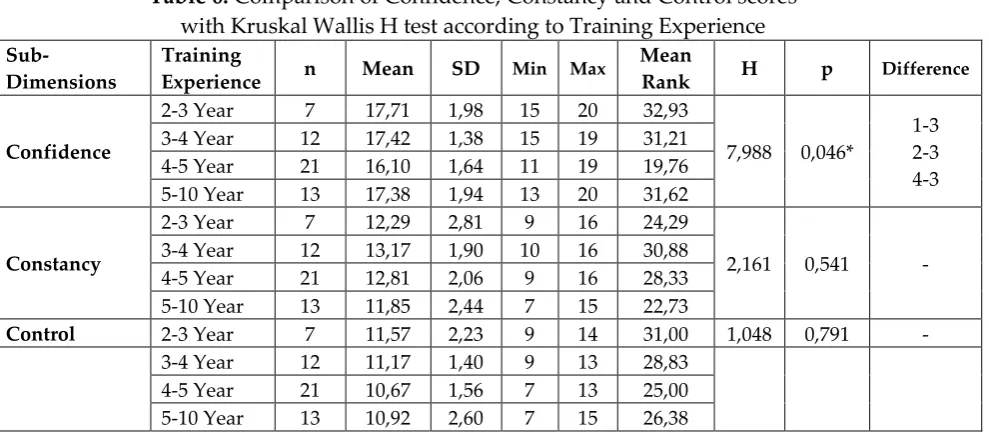
Table 6: Comparison of Confidence, Constancy and Control scores with Kruskal Wallis H test according to Training Experience
Sub-Dimensions
Training
Experience n Mean SD Min Max
Mean
Rank H p Difference
Confidence
2-3 Year 7 17,71 1,98 15 20 32,93
7,988 0,046*
1-3 2-3 4-3 3-4 Year 12 17,42 1,38 15 19 31,21
4-5 Year 21 16,10 1,64 11 19 19,76 5-10 Year 13 17,38 1,94 13 20 31,62
Constancy
2-3 Year 7 12,29 2,81 9 16 24,29
2,161 0,541 - 3-4 Year 12 13,17 1,90 10 16 30,88
4-5 Year 21 12,81 2,06 9 16 28,33 5-10 Year 13 11,85 2,44 7 15 22,73
Control 2-3 Year 7 11,57 2,23 9 14 31,00 1,048 0,791 - 3-4 Year 12 11,17 1,40 9 13 28,83
4-5 Year 21 10,67 1,56 7 13 25,00 5-10 Year 13 10,92 2,60 7 15 26,38
Table 6 shows that there was a statistically significant difference in the mean confidence subscale of the participants according to their training experience (p <0.05). The mean confidence subscale score of the participants in the 4-5-year group (16,10), the average confidence score of the participants in the group of 2-3 Years, 3-4 Years and 5-10 Years (17,71 - 17,42 - 17), 38) is significantly lower. The reason for this is that participants with more than 5-10 years of experience will have more experience and also the groups with 2-3 and 3-4 years of experience will be the difference in the number of people. There was no statistically significant difference in the average constancy and control sub-dimensions of the participants according to the training age groups (p> 0.05).
It was determined that the participants did not show any change according to gender in the sub-dimensions of mental toughness level in sports (p> 0.05). In the literature, Yarayan et al. [12] found no significant difference in the mental toughness level of Confidence, Constancy and Control sub-dimensions of individual branches according to the gender of the participants in their study on the team and individual athletes. A significant difference was found in Constancy sub-dimension of team sports. In a study by Pehlivan [9], it was determined that the level of mental toughness in sports was not significantly different in the mean of Confidence, Constancy and Control sub-dimensions according to gender variable.
The level of the mental toughness of the participants according to their age; There was a significant difference in confidence and control sub-dimension (p <.05). In the sub-dimensions of confidence and control; It is seen that the difference between 18-25 and 26-32 age group. The level of mental toughness in sport; constancy sub-dimension did not change according to age (Table 5). In SMTQ, the highest score of confidence in athletes between the ages of 18-25, the highest score, the highest score in the sub-dimension of constancy to athletes between the ages of 34-41 and the control sub-dimension of the highest score of the athletes in the age range 26-33 is seen to belong to. When the related literature was reviewed, Yardımcı et al. [15] showed that there were differences in control and commitment sub-dimension in the relationship between mental durability level and age variables.
Pehlivan [10] in his study, the mental toughness inventory in fitness, the sub-dimensions of confidence and constancy did not show a significant difference according to the age variable. It was found that there was a significant difference between the control sub-dimension scores of the athletes in terms of the age variable. Connaughton et al. [16] reported that older athletes have a higher level of mental toughness than younger athletes. In a study conducted by Yardımcı et al. [15] showed that the mental toughness of American football athletes in sports has decreased in terms of mental strength scores of 24 and above, 21 - 23 years old and under 20 years of age. Rust [17] found no association between mental toughness and age. Yıldız and Yılmaz [18] in his work on mental toughness and self-efficacy, as stated in the increase in mental toughness have increased.
In another study, there was no significant difference in the level of mental toughness and courage of the wrestlers according to their age [19]. The level of mental toughness in sports according to the training age of the participants; It was determined that the sub-dimensions of confidence, constancy, and control did not change according to the training experience. When we look at the related literature, Miçooğulları et al. [20] found no significant difference in terms of their training age when they examined the mental toughness levels of 15-year-old and 11-15-year-old soccer players.
Nazarudin et al. [21] found that mental toughness levels of individuals with the training experience of 15 years and above were higher than those with less training age in the dimension of confidence of the mental toughness scale.
Güvendi et al. [19] found a significant difference in the constancy dimension of mental toughness scale according to the sports year in favor of those who wrestle between 1 and 5 years. They also found that the average duration of the mental toughness of the players with sports years of 5 years and above was higher than those who made this sport for 6-10 years.
5. Recommendations
Enrichment of the studies conducted in the literature on mental toughness is important in terms of giving more attention and attention to the issue of mental toughness which affects the performance of both athletes and coaches in sport psychology.
6. Conclusion
In the study, it was determined that age and gender variables had no effect on mental toughness level in the sport, however, the athletes with 4-5 years of experience in the confidence subscale of the training age had less mental toughness than the other groups. In this respect, we can say that more experienced athletes have more mental toughness levels. While similar studies are performed, the demographic characteristics of the study may be increased or applied in different sports branches.
References
1. Gucciardi D. F., Gordon S, & Dimmock J. A., 2008. Towards an understanding of
mental toughness in Australian football, Journal of Applied Sport Psychology, 20, 261281. doi.org/10.1080/10413200801998556
2. Jones G., Hanton S., & Connaughton D., 2007. A framework of mental toughness
in the world’s best performers, The Sport Psychologist, 21, 243-264.
https://doi.org/10.1123/tsp.21.2.243
3. Loehr J. E., 1986. Mental toughness training for sports: Achieving athletic
excellence, Lexington, MA: Stephen Greene Press.
4. Gould D., Hodge K., Peterson K., & Petlichkoff L., 1987. Psychological
foundations of coaching: Similarities and differences among intercollegiate wrestling coaches, The Sport Psychologist, 1, 293308. doi.org/10.1123/tsp.1.4.293
5. Gucciardi D. F., Gordon S., & Dimmock J. A., 2009. Advancing mental toughness
research and theory using personal construct psychology. International Review of Sport and Exercise Psychology, 2(1), 54-72. doi: 10.1080/17509840802705938 6. Crust L., & Clough P. J., 2011. Developing mental toughness: From research to
practice, Journal of Sport Psychology in Action, 2(1), 21-32. doi: 10.1080/17509840802705938
7. Sheard M., 2010. Mental toughness: The mindset behind sporting achievement.
London, UK: Routledge.
8. Sheard M., Golby J., & Werch A. V., 2009. Progress toward Construct Validation
of the Sports Mental Toughness Questionnaire (SMTQ), European Journal of Psychological Assessment, 186-193. doi: 10.1027/1015-5759.25.3.186
9. Pehlivan H., 2014. Sports Mental Toughness Questionnaire (SMTQ) of
10.Ural A., & Kılıç İ., 2006. Scientific Research Process and Data Analysis with SPSS. Detay Publishing, Ankara.
11.Yazıcıoğlu Y., Erdoğan S., 2004. SPSS Applied Scientific Research Methods,
Detay Publishing, Ankara.
12.Yarayan E., Yıldız A. B., Gülşen D. B. A., 2018. Examination of Mental Toughness
Levels of Individual and Team Sports Players at Elite Level According to Various
Variables, Journal of International Social Research 11(57). doi:
10.17719/jisr.2018.2509
13.Masum R., 2014. A Mixed Method Analysis of Mental Toughness in Elite and
Sub-Elite Male and Female Tennis Players in Pakistan. Advances in Social Sciences Research Journal, 1,110-122. doi: 10.14738/assrj.16.555
14.Nicholls A. R., Polman R., Levy A., & Backhouse S. H., 2009. Mental Toughness
in Sport: Achievement Level, Gender, Age, Experience and Sport Type Differences, Personality and Individual Differences, 47, 73–75. doi: 10.1016/j.paid.2009.02.006
15.Yardımcı A., Sadık R., & Kardaş N. T., 2017. The Relationship between
Loneliness Levels and Sports Mental Resistance Levels of American Football
Players, Journal of Sport Sciences Researches, 2(2), 79-90. doi:
10.25307/jssr.337838
16.Connaughton D., Wadey R., Hanton S., & Jones G., 2008. The development and
maintenance of mental toughness: Perceptions of elite performers, Journal of Sport Sciences, Vol: 26, 83–95, doi: 10.1080/02640410701310958
17.Crust L., 2009. The relationship between mental toughness and affect intensity.
Personality and Individual Differences, 47(8), 959-963. doi:
10.1016/j.paid.2009.07.023
18.Yıldız A. B., & Yılmaz B., 2017. Determination of Relation Between the Mental Toughness and of The Self-Efficacy Levels of Athletes', International Sports Sciences Congress, 15st-18th November 2017
19.Güvendi B., Türksoy A., Güçlü M., & Konter E., 2018. Examination of the Level
Courage and Mental Toughness of Professional Wrestlers, International Journal
of Sport, Exercise & Training Sciences-Ijsets, 4(2), 70-78. doi:
10.18826/useeabd.424017
20.Miçoogullari B. O., Gümüsdag H., Ödek U., & Beyaz Ö., 2017. Comparative
Study of Sports Mental Toughness between Soccer Officials. Universal Journal of Educational Research, 5(11), 1970-1976. doi: 10.13189/ujer.2017.051113
21.Nazarudin M. N. B., Fauzee O. S. M., Jamalis M., Geok K. S., & Din A., 2009. Coaching leadership styles and athlete satisfaction among Malaysian University Basketball team. Research Journal of international studies, 9(1), 4-11.
Creative Commons licensing terms
Authors will retain the copyright of their published articles agreeing that a Creative Commons Attribution 4.0 International License (CC BY 4.0) terms will be applied to their work. Under the terms of this license, no permission is required from the author(s) or publisher for members of the community to copy, distribute, transmit or adapt the article content, providing a proper, prominent and unambiguous attribution to the authors in a manner that makes clear that the materials are being reused under permission of a Creative Commons License. Views, opinions and conclusions expressed in this research article are views, opinions and conclusions of the author(s). Open Access Publishing Group and European Journal of Physical Education and Sport Science shall not be responsible or answerable for any loss, damage or liability caused in relation to/arising out of conflict of interests, copyright violations and inappropriate or inaccurate use of any kind content related or integrated on the research work. All the published works are meeting the Open Access Publishing requirements and can be freely accessed, shared, modified, distributed and used in educational, commercial and