ARTIGO ORIGINAL
RESUMO
Introdução: As fraturas do fémur proximal representam um problema de saúde pública nas sociedades industrializadas. São escassos os estudos sobre a incidência destas fraturas em Portugal. O objectivo deste estudo foi analisar e interpretar as tendências epidemiológicas das fraturas do fémur proximal, na população idosa em Portugal, no período de 2005 a 2013.
Material e Métodos: Estudo transversal incluindo todos os doentes com idade igual ou superior a 65 anos admitidos por fratura do fémur proximal em hospitais portugueses pertencentes ao serviço nacional de saúde com recurso aos dados do registo nacional da administração central do sistema de saúde.
Resultados: Foram incluídos 101 436 doentes. Observou-se um aumento progressivo no número de internamentos por ano ao longo do período analisado. A idade média à admissão foi de 79,32 (± 12.33) anos apresentando um aumento progressivo e significativo ao longo do período analisado (p < 0,001). Dos doentes, 74.5% eram do sexo feminino (p < 0,001). Apresentavam idade média à admissão significativamente superior, quer globalmente, quer em cada ano em estudo (p < 0,001). A incidência ajustada à idade (≥ 65 anos) foi de 597 fraturas / ano / 100 000 habitantes. Verificou-se um aumento na incidência de fraturas do fémur proximal de 508,49 (2005) para 628,39 fraturas por 100 000 pessoas / ano (2013). No sexo feminino o aumento foi de 616,78 para 762,88 e no masculino de 339,95 para 419,06.
Discussão: Este é o primeiro estudo a avaliar e interpretar as tendências epidemiológicas das fraturas do fémur proximal em doentes admitidos nos hospitais do Serviço Nacional de Saúde em Portugal incluindo apenas indivíduos com idade igual ou superior a 65 anos.
Conclusão: O número absoluto de fraturas do fémur proximal em Portugal mostrou uma tendência de aumento entre 2005 - 2013, afetando uma percentagem significativa da população portuguesa com mais de 65 anos de idade. Tendem a ocorrer mais comummente no sexo feminino e em indivíduos progressivamente mais velhos.
Palavras-chave: Fraturas do Colo Femoral/epidemiologia; Idoso; Osteoporose/complicações; Portugal
Epidemiological Trends of Proximal Femoral Fractures
in the Elderly Population in Portugal
Tendências Epidemiológicas das Fraturas do Fémur
Proximal na População Idosa em Portugal
1. Serviço de Ortopedia e Traumatologia. Centro Hospitalar de São João. Porto. Portugal.
Autor correspondente: João Silva. [email protected]
Recebido: 27 de fevereiro de 2018 - Aceite: 10 de julho de 2018 | Copyright © Ordem dos Médicos 2018
João SILVA1, Daniela LINHARES1, Mariana FERREIRA1, Nélson AMORIM1, Nuno NEVES1, Rui PINTO1 Acta Med Port 2018 Oct;31(10):562-567 ▪ https://doi.org/10.20344/amp.10464
ABSTRACT
Introduction: Proximal femoral fractures are an important public health problem in industrialized societies. There are few studies that evaluate the incidence of this type of fracture in Portugal. The aim of this study was to analyze and interpret epidemiological trends of proximal femoral fractures in the elderly population in Portugal between 2005 and 2013.
Material and Methods: Cross-sectional study including all patients aged 65 years and older admitted due to proximal femoral fractures in Portuguese hospitals belonging to the National Health Service using data from the national registry of the health system central administration.
Results: 101,436 patients were included. There was a progressive increase in the number of hospitalizations per year over the period analyzed. The mean age at admission was 79.32 (± 12.33) years presenting a progressive and significant increase over the analyzed period (p < 0.001). 74.5% of the patients were female (p < 0.001). They had a significantly higher average age at admission, both globally and in each study year (p < 0.001). The age-adjusted incidence (≥ 65 years) was 597 fractures / year / 100,000 inhabitants. There was an increase in the incidence of proximal femoral fractures from 508.49 (2005) to 628.39 fractures per 100,000 person-years (2013). In the female sex the increase was from 616.78 to 762.88 and in the male sex from 339.95 to 419.06.
Discussion: This is the first study to evaluate and interpret the epidemiological trends of proximal femur fractures in patients admitted to the National Health Service in Portugal including only individuals aged 65 years or over.
Conclusion: The global number of proximal femoral fractures in Portugal showed a trend of increase between 2005 - 2013, affecting a significant percentage of the Portuguese population over 65 years of age, especially in females and progressively older individuals.
Keywords: Aged; Femoral Neck Fractures/epidemiology; Osteoporosis/complications; Portugal
INTRODUCTION
Osteoporosis is highly prevalent among the elderly and frequently associated with an increased risk of fracture un-derlying a low-energy trauma injury. The number of osteo-porotic fractures could double by 2040, according to recent studies.1 Proximal femoral fracture (PFF) is one of the most severe consequences of osteoporosis,2 representing a
ma-jor public health concern in industrialised western societies. A 26% one-year mortality rate in elderly patients after hip fracture has been described.3 PFF are associated with an
ARTIGO ORIGINAL PFF occurring in Sweden, Canada and Australia has been
found in other studies.9-11 Few studies on the incidence of this type of fractures have been published in Portugal. In total, 77,083 PFF were registered in Portugal between 2000 and 2008, 77.4% of these affecting female patients.12,13 The 2007 annual PFF incidence rates per region in Portugal have been obtained by Pina et al., with rates per 100,000 ranging between 154.4 and 572.2 in women and 77.4 and 231.5 in men.14
To the best of our knowledge, no studies on the epide-miological trends in PFF in the Portuguese elderly popula-tion have ever been published.
This study aimed at a description and analysis of the epidemiological trends in PFF rates 2005 vs. 2013, affecting patients aged 65 and older admitted to Portuguese public hospitals (Portuguese National Health System - SNS).
MATERIAL AND METHODS
This was a cross-sectional study involving all the tients who were admitted with PFF to SNS hospitals. All pa-tients aged 65 and over admitted to hospital between 2005 to 2013 and presented with femoral neck fracture (820 code of the Portuguese national GDH disease codification data-base) as principal or secondary/additional diagnosis were selected from the Portuguese national record of the Central Administration of the Health System [Administração Cen-tral do Sistema de Saúde (ACSS)]. The classification of diseases was based on the International Classification of Diseases, Clinical Modification (ICD-9-CM) which is used in every SNS hospital. Patients from Azores and Madeira were excluded from the study due to the doubtful reliability of the available records.
Statistical analysis
Data have been described by use of frequency tables and were analysed through Student’s t-test and its non-par-ametric equivalents for continuous variables and the analy-sis of contingency tables and chi-square test for categorical variables. SPSS Statistics (version 21.0) software has been used. The incidence of PFF in our study population was based on data from the 2011 population census.
RESULTS Population
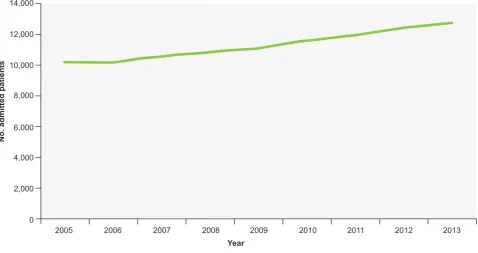
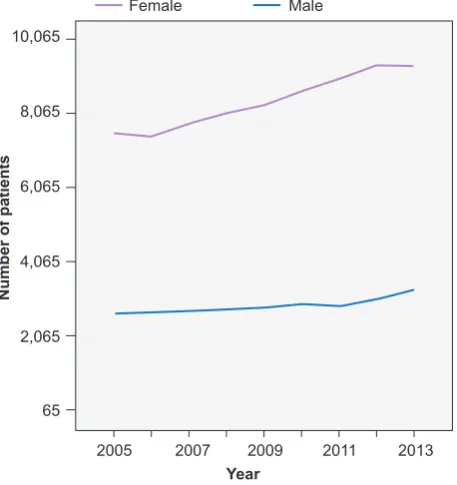
The Portuguese population has increased from 10.36 million in 2001 to 10.56 million in 2011, with an increasing demographic mismatch corresponding to a narrowing at the base of the age pyramid corresponding to the youngest population and a widening at the top, related to the relative increase in the elderly population.15 A decline in the ratio of population aged 0-14 from 16% in 2001 to 15% in 2011 has been found, in opposition to an increase in the ratio of population aged 65 and over from 16% to 19%. An in-crease to 128 in the ageing index has been found in 2011 in the Portuguese population (i.e. 128 elderly per every 100 young people).15 In total, 101,436 patients admitted to all the Portuguese SNS hospitals with PFF between 2005 and 2013 were included in the study. A progressive increase in the number of admissions per year throughout the study time period has been found, from 10,221 patients in 2005 to 12,631 patients in 2013 (Fig. 1). A mean age of 79.32 (± 12.33) years at admission has been found, with a pro-gressive and significant increase (p < 0.001 (Fig. 2) (74.5% female) and an increasing trend in both genders throughout the inclusion period of time (Fig. 3). Female patients pre-sented with a significantly older age at admission, globally
Figure 1 – Number of admitted patients, 2005-2013
Year
No. admitted patients
2005 2006 2007 2008 2009 2010 2011 2012 2013
ARTIGO ORIGINAL
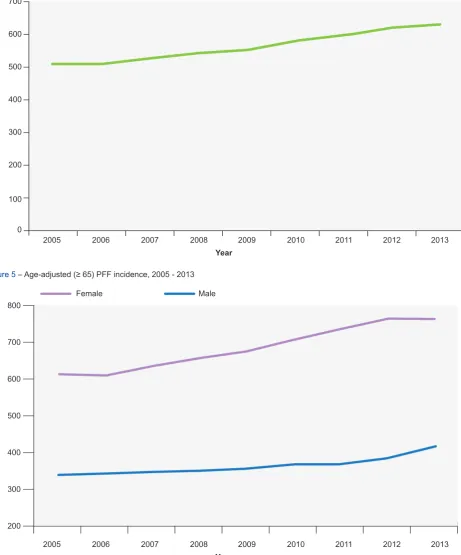
and throughout each study year (p < 0.001). An increasing trend in patient’s mean age at admission on both genders, even though higher in male patients has been found (Fig. 4). An age-adjusted incidence (≥ 65) of 597 fractures / year / 100,000 has been found. An increasing incidence of PFF from 508.49 in 2005 to 628.39 fractures/year/100,000 was found in 2013 (Fig. 5). An increase from 616.78 to 762.88 in female and 339.95 to 419.06 in male patients has been
found (Fig. 6). A mean length of hospital stay of 14.97 days in 2005 and 14.5 days in 2013 has been found. Patients remained in hospital for 14.77 days (± 18.95), on aver-age. A variation in mean length of hospital stay has been found throughout the study period, with no clear trend, even though a declining trend has been found over the most re-cent period in analysis.
Figure 2 – Mean age of admitted patients, 2005-2013
Year
Mean age at admission
(years)
2005 2006 2007 2008 2009 2010 2011 2012 2013
77 78 79 80 81 82
Figure 3 – Number of admitted patients per gender, 2005 - 2013
Year
Number of patients
2005 2007 2009 2011 2013
65 2,065 4,065 6,065 8,065 10,065
Female Male
Figure 4 – Mean age of admitted patients per gender, 2005 - 2013
Year
Age (mean)
2005 2007 2009 2011 2013
65 70 75 80 85
ARTIGO ORIGINAL
Figure 6 – Age-adjusted (≥ 65) and gender-adjusted PFF incidence, 2005 - 2013
Female Male
Year
Incidence of fracture / gender /year / 100,000
2005 2006 2007 2008 2009 2010 2011 2012 2013
200 300 400 500 600 700 800
Figure 5 – Age-adjusted (≥ 65) PFF incidence, 2005 - 2013
Year
Incidence / year / 100,000
2005 2006 2007 2008 2009 2010 2011 2012 2013
0 100 200 300 400 500 600 700
DISCUSSION
This is the first study on the assessment and analysis of the epidemiological trends of PFF in patients admitted to the Portuguese SNS hospitals involving only patients aged 65 and over. With an increasing mean life expectancy and ageing population, PFF currently represents one of the ma-jor issues in geriatric traumatology, corresponding to one of
ARTIGO ORIGINAL patients per year, on average. A progressive increase in the annual number of hospital stays has been found throughout the study period, reflecting an increasing annual average number of fractures.
PFF tend to affect progressively older patients. As pre-viously described in literature, these are also significantly more frequent in female patients.17,18 Different reasons for this susceptibility have been described, including postmen-opausal osteoporosis,17 higher life expectancy when com-pared to male patients and other gender-related genetic factors.19,20 Mean annual PFF rate of 0.55 /1,000 in men and 1.56 / 1,000 in women were found in an English study, cor-responding to a 2.83 female/male ratio.21 In another South Korean study, 70.2% of PFF have occurred in women.22 A
Norwegian study carried out in four hospitals in 2004 and 2005 has found that 71.5% of the patients were female.23 These results are in line with what has been found in the Portuguese population.
In addition, one study from Denmark has shown a sig-nificant increase in the incidence of PFF in both genders24 while in Sweden, a trend reversal towards an increased in-cidence of PFF in women, but not in men, has been found by Löfman et al.9 An increased incidence of PFF in men, a decline trend in women up to the age of 74 and a significant increase in both genders over that age were found in Ger-many, by Icks et al.25 A steady incidence of PFF in men and
a significant decline in the incidence in women has been found In Switzerland by Chevalley et al.26 By contrast, an
increasing trend in the PFF in both genders has been found in Portugal throughout the study period. The differences in the number of admissions per gender may correspond to differences in the age groups that were evaluated as well as to the implementation of osteoporosis prevention and treat-ment programs in elderly women.25,27
A 12.4% increase in age-adjusted incidence (≥ 65) of PFF has been found between 2005 and 2013, mainly due to the ageing population, which has been proved by the data from the last population census.15 Conflicting results regarding trends in PFF incidence have been found in stud-ies published in other countrstud-ies. Therefore, Lönnroos et al.8 in Finland and Icks et al.25 in Germany have found an
in-creasing trend in the incidence of PFF, while Chevalley et al.,26 Chang et al.28 and Jaglal et al.29 have found a declining incidence in Switzerland, Australia and Canada, respec-tively. However, the data from these studies correspond to the global population and not only to elderly patients, which
may explain for the disparity of the results when compared to the group of patients in our study.
This was a multi-centric study, involving all the Portu-guese SNS hospitals and a nine-year inclusion period, al-lowing for the analysis of a high number of patients and reinforcing the validity of the results. The study limitations relate to the fact that this was a cross-sectional study with biases underlying possible miscoding and to the absence of internal and external validity, as well as with the impact of PFF on patients who did not attend public hospitals.
CONCLUSION
PFF have been comprehensively studied due to the demographic changes underlying ageing population. An increasing trend in the absolute number of PFF has been found between 2005 and 2013, affecting a significant per-centage of the Portuguese population aged 65 and over. PFF tend to affect mainly female patients and progres-sively older patients. Further studies need to be focused on the causes underlying PFF and the results should be compared to those found in other countries. Pharmacologi-cal treatment of osteoporosis must be started and new pre-vention strategies aimed at the decline in the incidence of PFF should be implemented. A better understanding on its epidemiology is crucial, allowing for the development and implementation of preventive public policies aimed at this group of patients.
HUMAN AND ANIMAL PROTECTION
The authors declare that the followed procedures were according to regulations established by the Ethics and Clini-cal Research Committee and according to the Helsinki Dec-laration of the World Medical Association.
DATA CONFIDENTIALITY
The authors declare that they have followed the proto-cols of their work centre on the publication of patient data.
CONFLICTS OF INTEREST
The authors declare that there were no conflicts of inter-est in writing this manuscript.
FINANCIAL SUPPORT
The authors declare that there was no financial support in writing this manuscript.
REFERENCES
1. Odén A, McCloskey EV, Kanis JA, Harvey NC, Johansson H. Burden of high fracture probability worldwide: secular increases 2010–2040. Osteoporos Int. 2015;26:2243–8.
2. Laires PA, Perelman J, Consciência JG, Monteiro J, Branco JC. Actualização sobre o impacto epidemiológico e socioeconomic das fracturas da extremidade proximal do femur. Acta Reumatol Port. 2015;40:223-30.
3. Klop C., Welsing PMJ, Cooper C, Harvey NC, Elders PJM, Bijlsma JWJ, Leufkens HGM, De Vries F. Mortality in British hip fracture patients, 2000-2010: A population-based retrospective cohort stud. Bone. 2014;66:171-7.
4. Keene GS, Parker MJ, Pryor GA. Mortality and morbidity after hip fractures. BMJ. 1993;307:1248-50.
5. Marques A, Lourenço Ó, da Silva JA: The burden of osteoporotic hip fractures in Portugal: costs, health related quality of life and mortality. Osteoporos Int. 2015;26:2623-30.
6. Cumming RG, Klineberg R, Katelaris A: Cohort study of risk of institutionalization after hip fracture. Aust N Z J Public Health. 1996;20:579-82.
ARTIGO ORIGINAL
Acta Reumatol Port. 2009;34:475-85.
8. Lönnroos E, Kautianinen H, Karppi P, Huusko T, Hartikainen S, Kiviranta I, Sulkava R. Increased incidence of hip fractures. A population based-study in Finland. Bone. 2006;39:623-7.
9. Löfmann O, Berglund K, Larsson L, Toss G. Changes in hip fracture epidemiology: redistribution between ages, genders and fracture types. Osteoporos Int. 2002;13:18-25.
10. Jaglal SB, Weller I, Mamdani M, Hawker G, Kreder H, Jakkimainen L, Adachi JD. Population trends in BMD testing, treatment, and hip and wrist fracture rates: are the hip fracture projections wrong? J Bone Miner Res. 2005;20:898-905.
11. Chang KP, Center JR, Nguyen TV, Eisman JA. Incidence of hip and other osteoporotic fractures in elderly men and women: Dubbo Osteoporosis Epidemiology Study. J Bone Miner Res. 2004;19:532-6.
12. Alves SM, Castiglione D, Oliveira CM, de Sousa B, Pina MF. Age-period-cohort effects in the incidence of hip fractures: political and economic events are coincident with changes in risk. Osteoporos Int. 2014;25:711-20.
13. Alves SM, Economou T, Oliveira C, Ribeiro AI, Neves N, Goméz-Barrena E, Pina MF. Osteoporotic hip fractures: Bisphosphonates sales and observed turning point in trend. A population-based retrospective study. Bone. 2013;53:430-6.
14. Pina MF, Alves SM, Barbosa M, Barros H. Hip fractures cluster in space: an epidemiological analysis in Portugal. Osteoporos Int. 2008;19:1797-804.
15. Pordata Portugal. Censos 2011 - Resultados Definitivos. Fundação Francisco Manuel dos Santos. [Acedido em 2017 set 20]. Disponível em: http://www.pordata.pt/
16. Vanhaecht K, Sermeus W, Peers J, Lodewijckx C, Deneckere S, Leigheb F, et al. The impact of care pathways for patients with proximal femur fracture: rationale and design of a clusterrandomized controlled trial. BMC Health Serv Res. 2012;12:124.
17. Guarniero R, Oliveira L. Osteoporose: atualização no diagnóstico e princípios básicos para o tratamento. Rev Bras Ortop. 2004;39:477-85. 18. Cummings SR, Melton LJ. Epidemiology and outcomes of osteoporotic
fractures. Lancet. 2002;359:1761–7.
19. Einhorn TA. Bone strength: the bottom line. Calcif Tissue Int. 1992;51:333–9.
20. Villa ML, Nelson L, Nelson D. Race, ethnicity and osteoporosis. In: Marcus R, Feldman D, Kelsey J, eds. Osteoporosis, 2nd ed. San Diego:
Academic Press. 2001:569–84.
21. Wu TY, Jen MH, Garrafa A, Liaw CK, Aylin P, Majeed A. Admission rates and in-hospital mortality for hip fractures in England 1998 to 2009: time trends study. J Public Health. 2011;33:284-91.
22. Kang HY, Yang KH, Kim YN, Moon SH, Choi WJ, Kang DR, et al. Incidence and mortality of hip frac- ture among the elderly population in South Korea: a population-based study using the national health insurance claims data. BMC Public Health. 2010;10:230.
23. Diamantopoulos AP, Hoff M, Skoie M, Hochberg M, Haugeberg G. Short-and long-term mortality in males Short-and females with fragility hip fracture in Norway: a population-based study. Clin Interv Aging. 2013;8:817-23. 24. Giversen IM. Time trends of age-adjusted incidence rates of first hip
fractures: a register-based study among people in Viborg County, Denmark, 1987–1997. Osteoporos Int. 2006;17:552-64.
25. Icks A, Haastert B, Wildner C, Becker C, Meyer G: Trend of hip fracture incidence in Germany 1995–2004: a population based study. Osteoporos Int. 2008;19:1139-45.
26. Chevalley T, Guilley E, Herrmann FR, Hoffmeyer P, Rapin CH, Rizzoli R: Incidence of hip fracture over a 10-year period (1991– 2000): reversal of a secular trend. Bone. 2007;40:1284-9.