Proceedings of the
Eighth International Workshop on
Software Clones
(IWSC 2014)
Active Clones: Source Code Clones at Runtime
Mohammad Asif A. Khan, Chanchal K. Roy and Kevin A. Schneider
18 pages
Guest Editors: Nils G ¨ode, Yoshiki Higo, Rainer Koschke
Managing Editors: Tiziana Margaria, Julia Padberg, Gabriele Taentzer
Active Clones: Source Code Clones at Runtime
Mohammad Asif A. Khan1, Chanchal K. Roy2and Kevin A. Schneider3
1[email protected],http://mdakhan.weebly.com/index.html 2[email protected],http://www.cs.usask.ca/∼croy/
3[email protected],http://www.cs.usask.ca/∼kas/Welcome.html
University of Saskatchewan, Canada
Abstract:Code cloning is a common programming practice, and there have been a considerable amount of research that investigated the implications of code clones on software maintenance using static analysis. However, little has been done to inves-tigate the runtime implications of code cloning. In this paper we invesinves-tigate source code clones at runtime, referring to clones as ‘active clones’ if they are invoked when a software system is in use. For example, if a particular useu of a system results in a clonecbeing invoked, we say that clonecis active with respect to use u. From this definition and given a set of uses{u1,u2, ...}and clones {c1,c2, ...}
we are able to identify the extent clones are active at runtime and analyze active clone resource use (e.g., CPU time) and define and calculate a set of active clone metrics to provide insights into source code cloning implications at runtime. We de-veloped a hybrid static and dynamic analysis technique for detecting and analysing active clones, and conducted an empirical study on five software systems (HSQLDB, JHotDraw, RText, jEdit and UniCentaoPOS) to validate our approach. We found a small portion of clones are active during a typical use of a software system, and that active clones have the potential for guiding a software developer’s code inspection activity during a software maintenance task.
Keywords:clone detection, active clones, dynamic analysis
1
Introduction
Code duplication is a common programming practice. Programmers use code duplication to increase the speed of the software development process by using similar code to implement common functionality. Although cloning is an inexpensive and often productive practice, it introduces complications during software maintenance [JDHW09, KG08]. A code fragment may contain a bug, and when copied elsewhere, the bug is also propagated. As well, a bug may emerge when a clone is used in a new context. Fixing a bug in one clone may require reviewing and perhaps applying a similar fix to its clones. Any inconsistency in making a change to a set of clones may introduce new bugs. For large software systems and depending on the extent of the cloning, such maintenance effort may be expensive. Despite the ongoing debate as to whether code clones are harmful or not [JDHW09,KG08,LW08,Roy09,RC07], it is believed that clones are unavoidable, and not all clones can or should be removed [KG08,KSNM05], which calls for software clone management.
TG12,MLPB13]. In this paper, we also aim to aid towards clone management. However, unlike the previous approaches, we exploit the runtime implications of source code cloning for clone management. In particular, we investigate source code clones at runtime, referring to clones as ‘active clones’ if they are invoked when a software system is in use. For example, if a particular useuof a system results in a clonecbeing invoked, we say that clonec is active with respect to useu. From this definition and given a set of uses{u1,u2, ...}and clones{c1,c2, ...}we are able to identify the extent clones are active at runtime, analyze active clone resource use (e.g., CPU time) and define and calculate a set of active clone metrics. Associated with a particular use u of a system, is an execution trace, which we denote as tu. An execution trace tu is a
sequence of method calls{<1,m1>, <2,m2>, ...}and socodomain(tu) is the set of method
calls invoked during the use (i.e.,codomain(tu) ={m1,m2, ...}). Our focus is on method clones, and so if method clonec∈codomain(tu), thencis an active clone with respect to useu. Execution
traces may be collected in the field, however for our study we used a set of tests to collect execution traces. We consider a test to represent a typical use of a software system by an end-user, or a typical use of a software system by a developer in support of a software development or maintenance task. Software developers often use testing to execute a software system with the intent of locating errors, detecting faults and verifying or validating a system’s qualities and functionality. If a developer runs the system or designs a test suite for the task at hand, they can use our approach to identify active clones related to the tests and consequently to the task at hand.
It is clear that the choice of tests effects the extent active clones are discovered. For example, a test suite may be specifically designed for full coverage and so in such a situation one would expect all clones to be active. Our interest, however, is in tests that correspond to a particular use of the system. For example, tests that are specifically designed to exercise a single feature, requirement or use case scenario. Although a test suite may exercise the entire system, a single test typically is designed to exercise a subset of the system. A clone, then, is active with respect to a use, a set of uses, a set of tests, or a test suite. It is determining the method clones that are active when a single test or a small set of tests are run that we focus on in this paper. As a result, we are interested in addressing the following three research questions:
RQ1: To what extent are clones active during runtime?
RQ2: How active are the active clones?
RQ3: Does active clone identification support software maintenance activities?
To address these questions we developed a hybrid dynamic and static analysis technique for detecting active clones and conducted an empirical study of five open source software systems downloaded from Sourceforge [Sou]. Our study provides insights into the software systems by showing detailed information concerning active clones, their coverage in the codebase, the frequency of their use and resource utilization.
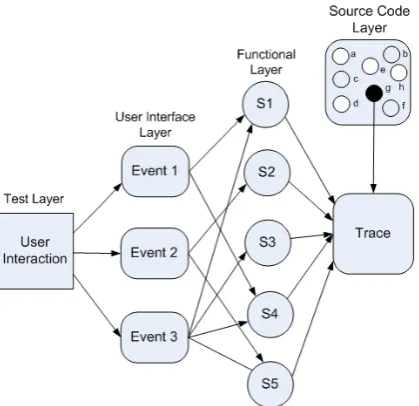
Figure 1: Testing Framework
2
Testing Framework
Each of the systems in our study are interactive systems with graphical user interfaces (GUIs), and so we developed a testing framework Figure1that accommodates tests corresponding to a user interacting with a system. Four layers are identified in the framework: the test layer, the user interface layer, the functional layer and the source code layer. The framework connects user activities defined in test suites and tests to the source code. In a drawing application, creating a rectangle, circle, or triangle may be three individual tests in a single drawing test suite. Mouse actions, keyboard actions, display updates and so on are categorized as user interface (UI) events. Such UI events are provided by the software user interface and are denoted in Figure 1 asEvent i wherei=1,2, ..,n. Each individual event in turn corresponds to sub-programs that handle the event, denoted in Figure1asSi. A sub-program may be executed by more than one tests.
A trace is a sequence of method invocations executed during a particular test. The methods are invoked in response to the user interaction. An execution trace can be further processed to mine meaningful resource information, such as CPU and memory usage. We are also able to segment the execution trace by user interface event to help manage the size and complexity of the trace data.
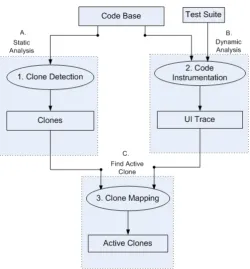
Figure 2: Active Clone Detection Framework
3
Active Clone Detection Framework
Our overall goal is to determine whether software maintenance could be more efficient or effec-tive by identifying the aceffec-tive clones and aceffec-tive clone classes that correspond to a maintenance task by using runtime information. The maintenance effort of a system containing large amounts of code clones may be reduced if test suites specific to the maintenance task can be used to identify just those clones that are relevant.
We developed a hybrid approach, incorporating both static and dynamic analysis techniques. We use dynamic analysis (using aspect-oriented programming to instrument the software) to capture execution trace information and static analysis to capture clone information. To conduct a study a series of steps is required, from obtaining the software to mapping clones to execution traces. For this we designed and developed a framework for the experiment, which is depicted in Figure 2. The framework consists of three major phases: a) static analysis, b) dynamic analysis, and c) finding active clones.
3.1 Static Analysis
We use a static analysis tool, the NiCad clone detector [CR11,RC08], to detect clones in the codebase. NiCad has been shown to be highly accurate with respect to both precision and recall [RC09,RC10] in the detection of copy-and-pasted near-miss clones. We used a dissimilarity threshold of 30% with blind renaming option of identifiers of NiCad.
3.2 Dynamic Analysis
Dynamic analysis [CZD+09] is the technique of analysing the data collected from a running pro-gram. The advantage of using dynamic analysis is that it exposes the system’s actual behaviour. However, the drawback of it is that only a partial picture of a system is revealed and the obtained information is dependent on the inputs used to exercise the system’s functionality. Dynamic analysis is used in a variety of applications such as software testing, performance analysis, and program comprehension via reverse engineering. We are interested in collecting profile informa-tion in the form of execuinforma-tion traces. This can be done by instrumenting the code, monitoring the execution environment, or as is the case in our approach, by dynamically weaving aspects to log runtime information. A challenge is to have an adequate set of tests or recorded user interaction to collect relevant behavioural information.
The first part of our dynamic analysis approach is to instrument the code for collecting the execution traces. We use aspect-oriented programming [KLM+97] and dynamic loading to log method calls. This allows us to generate a sequence of execution traces that will later enable us to identify active clones and their behaviour. To capture the execution traces, the system is run using a test suite corresponding to the activity we wish to analyze. By focusing on a single maintenance task, the test corresponds directly to the user interaction that is being investigated. If the entire system and clone execution frequency analysis is to be performed, a comprehensive test suite with adequate coverage is warranted which is out of the scope of this study.
As part of the code instrumentation step of the dynamic analysis phase, we use an AspectJ [KHH+01] implementation to describe and capture the interface actions that occur in a target application. We have written a tracing aspect that weaves with the program and records when any method in the target application is invoked. The advantage of using an AspectJ implementation is that it does not turn off the just-in-time compiler, and enables access to any component (method, parameter, constructor, etc.) in a software system.
To aid in program comprehension we also segmented the execution trace into meaningful segments called user interface (UI) traces [SS09]. An execution contains UI traces for program initialization, display updates, mouse events and so on which are often pertinent to the tasks at hand. This segmentation process allows a developer to associate the cloning concentration with the semantics of code. In this way, they can also learn in which part of the system cloning happens most often (e.g., UI or business logic code).
3.3 Finding Active Clones
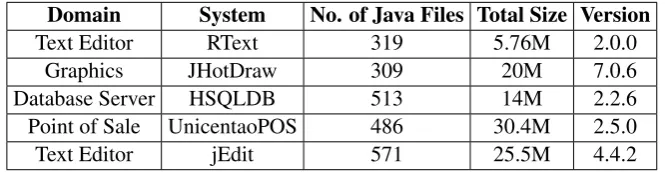
Table 1: Subject Software Systems
Domain System No. of Java Files Total Size Version
Text Editor RText 319 5.76M 2.0.0
Graphics JHotDraw 309 20M 7.0.6
Database Server HSQLDB 513 14M 2.2.6
Point of Sale UnicentaoPOS 486 30.4M 2.5.0
Text Editor jEdit 571 25.5M 4.4.2
record in a trace file consists of the full class name, the class type, the method name, and the parameter types. Second, we obtain all the clones of the subject system detected by the NiCad clone detector (Section3.1). Third, we determine whether the trace related code contains any clones. For clone mapping, we created a script to extract all the method names from the NiCad XML output file. The clones for which we get a match in the trace are called active clones, and then we retrieve the corresponding clone classes to which the active clones belong. These clone classes are treated as active clone classes.
4
Metrics
To explore the nature of traces and the impact of clones for test based execution of a system we use a number of metrics as defined in this section. We use metrics to quantify aspects of both static and dynamic analyses. Some of the metrics we introduce in this paper (e.g., the active clone metrics) and some are adapted from relevant empirical studies [HL05]. We group the metrics into four major categories: system, clone, trace and active clone metrics.
4.1 System Metrics
• LT OTAL: total number of lines of code in a system.
• FT OTAL: total number of files in a system.
• MT OTAL: total number of methods in a system.
4.2 Clone Metrics
• NCLONE: number of clones in a system.
• CC: number of clone classes in a system.
• %MCLONE: percent of methods that contain a clone.
• FCLONE: number of files that contain a clone.
• LCLONE: lines of code that are part of a clone.
• %LCLONE: percent of lines that are part of a clone.
4.3 Trace Metrics
• Np: number of packages invoked in a trace. When a method from a package is invoked the
package is considered to be invoked.
• Nm: number of distinct methods invoked in a trace.
• %FT RACE: Percent of files containing methods invoked in a trace.
4.4 Active Clone Metrics
• NACLONE: number of active clones.
• CCACLONE: number of clone classes that contain at least one active clone.
• %MACLONE: percent of invoked methods that contain at least one active clone.
• FACLONE: number of files that contain at least one active clone.
• %FACLONE=FACLONE/FT OTAL∗100
• LACLONE: lines that are part of an active clone.
• %LACLONE=LACLONE/LT OTAL∗100
5
Study Approach
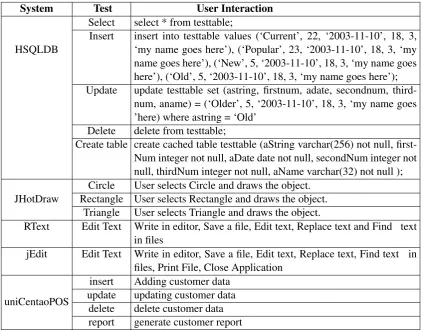
In this section, we provide a brief description of the subject systems being studied, our approach and the tests used. All the tests were run on an Intel(R) Core (TM) i7 CPU @2.93 GHz with 4GB RAM. Tables1and2provide a summary of the systems and the tests that were part of our experiment respectively. To bring variation to our study we considered systems from four dif-ferent domains: text editing, graphics, database management and point of sale. We also selected systems that differed in size, ranging from 5.76M to 30.4M bytes of code.
Table 2: Sample Tests
System Test User Interaction
HSQLDB
Select select * from testtable;
Insert insert into testtable values (‘Current’, 22, ‘2003-11-10’, 18, 3, ‘my name goes here’), (‘Popular’, 23, ‘2003-11-10’, 18, 3, ‘my name goes here’), (‘New’, 5, ‘2003-11-10’, 18, 3, ‘my name goes here’), (‘Old’, 5, ‘2003-11-10’, 18, 3, ‘my name goes here’); Update update testtable set (astring, firstnum, adate, secondnum,
third-num, aname) = (‘Older’, 5, ‘2003-11-10’, 18, 3, ‘my name goes ’here) where astring = ‘Old’
Delete delete from testtable;
Create table create cached table testtable (aString varchar(256) not null, first-Num integer not null, aDate date not null, secondfirst-Num integer not null, thirdNum integer not null, aName varchar(32) not null );
JHotDraw
Circle User selects Circle and draws the object. Rectangle User selects Rectangle and draws the object.
Triangle User selects Triangle and draws the object.
RText Edit Text Write in editor, Save a file, Edit text, Replace text and Find text in files
jEdit Edit Text Write in editor, Save a file, Edit text, Replace text, Find text in files, Print File, Close Application
uniCentaoPOS
insert Adding customer data update updating customer data
delete delete customer data report generate customer report
6
Findings
In this section, we present the results of our experiment identifying active clones in five different subject systems of varying sizes. The research questions are discussed based on the experimental results shown in Tables3to8.
Table 3: Method Clone Metrics
Systems Files Lines of Code CC NCLONEMT OTAL%MCLONE
FT OTALFCLONE%FCLONELT OTALLCLONE%LCLONE
RText 319 81 25.3 95036 3019 3 80 189 3698 5.5
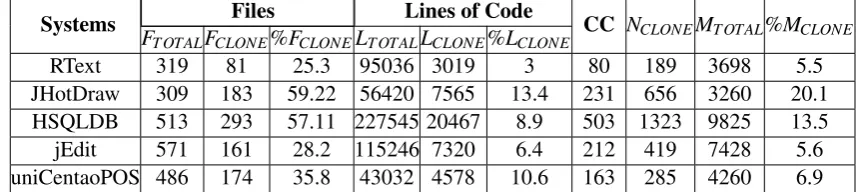
JHotDraw 309 183 59.22 56420 7565 13.4 231 656 3260 20.1 HSQLDB 513 293 57.11 227545 20467 8.9 503 1323 9825 13.5 jEdit 571 161 28.2 115246 7320 6.4 212 419 7428 5.6 uniCentaoPOS 486 174 35.8 43032 4578 10.6 163 285 4260 6.9
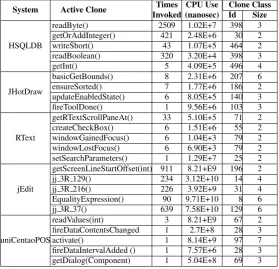
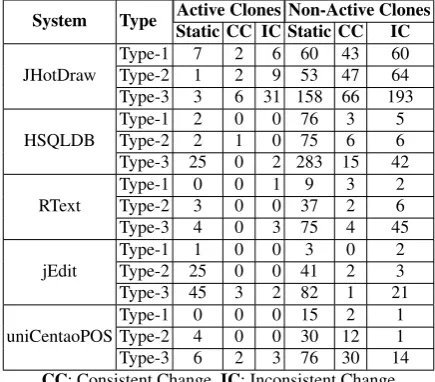
containing active clones. Again, this shows that fewer files need to be considered when focusing on clones that are active during runtime. Table7provides the statistics of the frequently executed active clones and their CPU time consumptions while Table8shows the breakdown of the active clones’ activeness in terms of genealogy based on types. This explains which active clones types change more frequently and which ones not.
Clones are considered harmful for a number of reasons, including: there is the potential for bug propagation during cloning, cloning increases the size of the codebase, and changes in one clone may require changes to other clones during maintenance. These issues increase the potential for a higher maintenance effort as well as may burden the software developer with an additional cognitive load. Dynamic analysis provides a way to aid in our comprehension of clones. Sys-tems containing clones could be segmented based on testing to make the maintenance task more modular. As well, runtime information allows us to consider other clone properties. Knowing which clones are the most CPU intensive during a particular set of system uses, could help iden-tify places where optimizing one clone could be an important improvement to the system as a whole if we make similar changes to the clones in its clone class.
Table 4: Test Based Metrics for Active Clones
System Use Set Test Nint Np
Method Clones
NACLONELACLONEFACLONE%MACLONE%CCACLONE
HSQLDB
Search Select 461 89 40 545 22 8.6 6.8
Data Entry Insert 441 87 35 492 22 7.9 6.2
Admin
Update 441 89 35 492 22 7.9 6.6
Delete 441 87 35 506 25 7.9 6.6
Create 442 90 35 492 22 7.9 8.0
JHotDraw Draw
Circle 798 189 58 654 27 7.2 19.9
Rectangle 797 189 56 639 26 7 19.5
Triangle 819 195 60 645 28 7.3 19.5
RText Compose Edit text 591 153 11 265 7 1.8 11.25
jEdit Compose Edit Text 3220 310 220 400 44 5.2 37.7
uniCentaoPOS
Search Select 101 37 5 43 5 4.9 3.2
Data Entry Insert 373 85 17 141 15 14.9 9.2
Admin
Update 76 32 4 55 4 5.2 0.8
Delete 68 28 4 30 4 5.9 0.6
Table 5: Lines of Code and Number of Files Associated With Traces, Clones and Active Clones
Metrics System
HSQLDB JHotDraw RText jEdit uniCentaoPOS
%LCLONE 3 13.4 8.9 6.4 10.6
%LACLONE 0.24 1.2 0.31 0.71 0.31
%FCLONE 57.11 59.22 25.3 28.2 35.8
%FT RACE 17.3 61.2 47.9 51.9 17.5
%FACLONE 4.2 9.1 2.3 7.4 3.1
44 with active clones while uniCentaoPOS contains 486 files, 174 with clones, and 4–15 files with active clones. Also if we compare the percentage coverage of active clones, lines of code, files and clone classes (Table 5) we find that a fewer percentage of clones are active for each individual test.
We can see that although the systems have a high concentration of clones, relatively few of them are executed. Only those clones that are test specific are active and are shown to be used more often. For example, if we consider the results in Table 5 then in the case of JHotDraw the lines of code for method clones is 13.4% (denoted by %LCLONE)) but only 1.2% (denoted
by %LACLONE) of code are containing active clones and likely requiring attention during
Table 6: Active Clones by Type of User Interface Event for Each Test
System Test UI Event Type UI Traces MI %AC CPU Time (ns)
Total %AC
HSQLDB
Select mouseClick (JButton) 3 191 6.8% 8.31E+10 14.8 threadSignal 50 1555 5.2% 2.86E+12 47.6
Insert mouseClick (JButton) 2 203 6.4% 7.31E+11 14.8 threadSignal 36 1076 7.2% 1.86E+12 51.26
Update mouseClick (JButton) 2 192 6.8% 3.16E+11 3.12 threadSignal 28 1160 7.2% 2.93E+12 44.44
Delete mouseClick (JButton) 2 204 6.4% 3.76E+11 3.79 threadSignal 28 885 7.9% 1.93E+10 42.5
Create mouseClick (JButton) 3 196 11.6% 2.05E+11 4.86 threadSignal 51 1164 7% 1.02E+12 3.12
JHotDraw
Circle
mouseClick (mouse event) 17 397 6.8% 1.66E+12 25.8 mouseClick (Button) 12 89 3.3% 1.34E+10 0.47 threadSignal 1 490 6.1% 9.60E+11 33.8
Triangle
mouseClick (mouse event) 13 375 6.9% 6.03E+11 17.02 mouseClick (Button) 12 89 3.3% 8.60E+10 3.79
threadSignal 1 490 6.1% 1.29E+12 57.09
Rectangle
mouseClick (mouse event) 13 399 6.0% 1.73E+11 7.7 mouseClick (Button) 12 89 3.3% 6.03E+10 3.92
threadSignal 1 490 6.3% 1.00E+12 67.18
RText Edit text
mouseClick (JButton) 1 18 2.2% 8.00E-3 0.001 mouseClick (JMenuItem) 5 18 1.6% 2.50E+6 0.005 displayUpdate 30 124 3.2% 3.65E+7 0.080 threadSignal 11 79 2.5% 4.49E+10 15.5
jEdit Edit text
mouseClick (Timer) 5 18 1.6% 2.39E+12 9.9 displayUpdate 30 124 0% 4.83E+11 0
threadSignal 11 79 2.5% 2.22E+13 85.2
uniCentaoPOS
Select mouseClick (JButton) 2 71 7.0% 7.43E+10 44.8 mouseClick (Timer) 50 1555 0% 2.86E+12 0
Insert mouseClick (JButton) 4 203 6.4% 1.61E+11 43.8 mouseClick (Timer) 36 1076 7.2% 1.86E+12 11.9
Update mouseClick (JButton) 1 51 7.8% 6.50 +9 64.1 mouseClick (Timer) 23 206 12.2% 2.93E+12 44.44
Delete mouseClick (JButton) 1 29 0 1.15E+10 0 mouseClick (Timer) 53 208 13.9% 1.93E+10 66.2
UI: User InterfaceMI: Method InvocationAC: Active Clone
%FACLONE). For JHotDraw and RText the percentage of files in the trace denoted by %FT RACE are
61.2% and 47.9% while the percentage of files containing active clones denoted by %FACLONE
are 9.1% and 2.3% respectively. Similarly, in case of jEdit and uniCentaoPOS %FT RACEis 51.9%
and 17.5% while %FACLONE is 7.4% and 3.1% respectively.
we exercised. If we observe closely the statistics and comparison of active clones in terms of lines of code, files, and clone classes with active clones we can clearly see that active clones are very few in number involving less lines of code and less file coverage. For instance, in the case of HSQLDB a reduced number of lines of code, files and classes are found active per test. This may help guide a software developer in prioritizing which clones to look at by giving inspec-tion priorities to active clones and their corresponding active clone classes instead of looking for every clone in the system.
RQ1: To what extent are clones active during runtime? Analysing our subject systems we see that clones are active even for simple tests and that with typical modest uses of a system that they are at least an order of magnitude fewer in number than the number of clones in a system. Active clones could be used to prioritize clone inspection during maintenance tasks by allowing us to focus on those clones related to the task at hand.
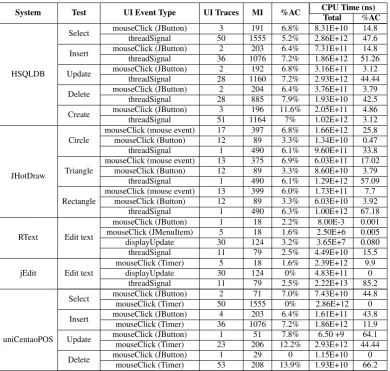
We can analyze active clone runtime properties related to the traces, such as frequency of invo-cation, order of invoinvo-cation, relation of invocation to typical system uses, and resource utilization (i.e., CPU usage). Table 6shows the active clone characteristic and the CPU usage of all the systems over each test case based on user interface (UI) events. The columnCPU timedenotes the total time consumed by events within the test and the column%Active CPU Timesignifies the percent of CPU time consumed by the active clones executed by the corresponding event within the test. The system implementation under test is divided into two groups: GUI (Graphical User Interface) logic code and business logic code identified by the type of UI event. Thread events correspond to business logic functionality, and mouse clicks, keyboard presses and similar events correspond to GUI code. In the case for hsqldb, where mouse clicks on buttons and so on are grouped as GUI code while thread signals comprising the execution of the system’s functional-ity/features are grouped as business logic code. For jhotdraw, the test case includes drawing a figure in an editor and therefore mouse events such as mouse press, mouse drag, mouse release and so on fall into the GUI section while the thread signal indicates business logic execution, as is the case for hsqldb. Similarly, for rtext a new event displayUpdate occurs and indicates GUI code being executed, and events such as mouse click and thread signal are analogous to that of hsqldb and jhotdraw.
Figure 3: Change Patterns of Active Clones
and be used an an indicator of tracking abnormal behaviour of them in the clone class.
At the same time a segmented active clones can help developers identify which section of the system’s code to inspect as a part of the maintenance task. Thus, there is a possibility that effort may be reduced by providing the developer with more detailed, fine grained data on active clones. For instance, if new features in the GUI are being added or modified as part of the maintenance task then the corresponding UI events and the associated active clones can help them in program comprehension. Code inspection may be reduced and the segmented active clones can further provide a way for effective clone management. As an example, we notice that for a number of uses, active clones are taking up a significant portion of the CPU time. For example, 33%–67% of the CPU time is involved with active clones for a small set of traces. When we look at the active clones in more detail we see that clones from an active clone class are involved in multiple trace. If we look at Table7 we can find that active clone methods gets executed in all the tests with higher number of frequencies and CPU time consumption in all the five systems. Interestingly, we can also observe in case of HSQLDB, RText and uniCentaoPOS that the fragments in the same clone class gets executed with a higher number of invocations. For instance, in HSQLDB methods readByte() and readBoolean() belong to the same clone class 398 and is invoked 2509 and 320 times which is a significant amount. For RText, methods windowGainedFocus() and windowLostFocus() belonging to the same clone class and gets executed six times each while for uniCentaoPOS methods fireDataContentsChanged() and fireDataIntervalAdded() are invoked once.
Table 7: Frequently Executed Active Clones by System
System Active Clone Times CPU Use Clone Class Invoked (nanosec) Id Size
HSQLDB
readByte() 2509 1.02E+7 398 3 getOrAddInteger() 421 2.48E+6 30 2 writeShort() 43 1.07E+5 464 2 readBoolean() 320 3.20E+4 398 3 getInt() 5 4.09E+5 496 4
JHotDraw
basicGetBounds() 8 2.31E+6 207 6 ensureSorted() 7 1.77E+6 186 2 updateEnabledState() 6 8.05E+5 140 3 fireToolDone() 1 9.56E+6 103 3
RText
getRTextScrollPaneAt() 33 5.10E+5 71 2 createCheckBox() 6 1.51E+6 55 2 windowGainedFocus() 6 1.04E+3 79 2 windowLostFocus() 6 6.90E+3 79 2 setSearchParameters() 1 1.29E+7 25 2
jEdit
getScreenLineStartOffset(int) 911 8.21+E9 196 2 jj 3R 129() 234 3.12E+10 14 4 jj 3R 216() 226 3.92E+9 31 4 EqualityExpression() 90 9.71E+10 8 6 jj 3R 37() 639 7.58E+10 129 6
uniCentaoPOS
readValues(int) 3 8.21+E9 67 2 fireDataContentsChanged 1 2.7E+8 28 3 activate() 1 8.14E+9 97 7 fireDataIntervalAdded () 1 7.57E+6 28 3 getDialog(Component) 1 5.04E+8 69 3
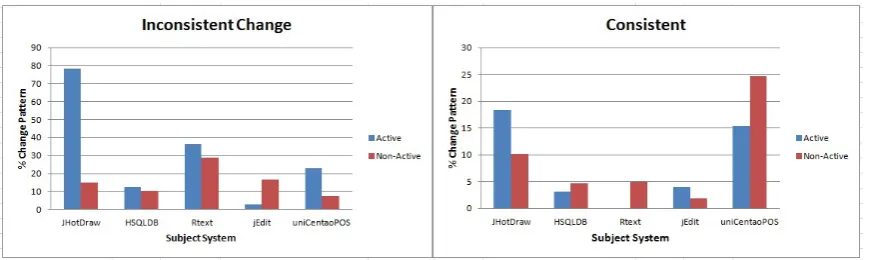
identified their patterns. In our study we have considered two significant types of change patterns, a) consistent, and b) inconsistent change patterns. We then compared the activeness of clones against the active and the non-active code clones. Figure3 shows the change patterns of the active clones and non-active clones for each systems.
If we look closely at Figure 3 for the consistent change, we can see that for the systems JHotDraw, HSQLDB, jEdit and uniCentaoPOS both the active and the non-active clones change at the same time and the difference in activeness between them is less than 6% with an exception of RText where no active clones participate in the change pattern. Therefore, active clones do play a vital role and have significant impact on the maintenance activity.
Although practice of code cloning speeds up the development process, it also poses threat of bug propagation due to inconsistently changing the clone fragments. If we observe Figure3 we can also see that active clones are more active than the non-active clones and surpasses the non-active ones. In case of JHotDraw, HSQLDB, RText and uniCentaoPOS the active clones have changed more inconsistently than the non-active clones. In case of JHotDraw almost 80% of the active clones are changed inconsistently compared to non-active clones which is around 15%. Similarly for HSQLDB, RText and uniCentaoPOS the percentage of inconsistent changes of active and non-active clones are around 15%, 35%, 22% and 10%, 29% and 8% respectively. However in case of jEdit even though the non-active clones have changed more inconsistently than the active clones we still get some active clones that have changed inconsistently.
Table 8: Number of Genealogies of Active and Non-Acitve Clones by Type
System Type Active Clones Non-Active Clones Static CC IC Static CC IC
JHotDraw
Type-1 7 2 6 60 43 60 Type-2 1 2 9 53 47 64 Type-3 3 6 31 158 66 193
HSQLDB
Type-1 2 0 0 76 3 5
Type-2 2 1 0 75 6 6
Type-3 25 0 2 283 15 42
RText
Type-1 0 0 1 9 3 2
Type-2 3 0 0 37 2 6
Type-3 4 0 3 75 4 45
jEdit
Type-1 1 0 0 3 0 2
Type-2 25 0 0 41 2 3 Type-3 45 3 2 82 1 21
uniCentaoPOS
Type-1 0 0 0 15 2 1
Type-2 4 0 0 30 12 1 Type-3 6 2 3 76 30 14 CC: Consistent Change,IC: Inconsistent Change
study we see that awareness of active clones and their runtime behaviour may help support main-tenance by allowing developer’s to focus on similar code fragments whose improvement could benefit the use of the system as a whole and on clone classes that are involved in system uses related to the task at hand. This is well supported by the research questions RQ1 and RQ2. The dynamic properties of active clones such as times of invocations, CPU time, and active clone genealogies can be used to prioritize clone inspection during maintenance activities. Clones that are invoked a greater number of times and that occupy higher percentage of CPU time can be put at the highest priority in the list of clone inspection during clone management.
benefits to software maintenance, especially when clones need to be managed. We can conclude that further enhancement in clone management activity can be done by prioritizing the clone inspection based on types.
7
Threats to Validity
There are a number of threats to the validity of our analysis. Execution traces are based on the tests we provided. Additional testing would reasonably result in additional methods being executed with the possibility of additional active clones being identified and thus the reduction in clones to be considered may not be as significant. However, our intention of this study is to only focus on test specific clones during the maintenance of that related functionality, and it is obvious that there will be a reduction of active clones (hence the reduction of active clone classes) for maintenance as evident by our results.
8
Related Work
Code clone research traditionally focused on clone detection. Recently, managing code clones has become of interest to the research community. A number of tools supporting management of clones have already been proposed. Tools such as CLONEBOARD [WZD08] tracks changes by dynamically monitoring clipboard activity. CloneTracker [DR08] maintains a model of all clones in the codebase and handles clone changes using linked resolution. There are also a great many efforts towards analyzing and managing clones [XXJ11, YCY+13,HKKI05,TG12, MLPB13, PTK13]. Overall, our work significantly differs from all others in the sense that we use dynamic analysis to get a subset of clones related to a particular maintenance task and thus can prioritize clones of the systems based on the maintenance task at hand. To the best of our knowledge this is the first study to investigate runtime implications of source code clones.
Zibran and Roy [ZR13] proposed a method of ranking the important candidate clones for refactoring. Our work differs from these, as we focused on detecting and tracking only a subset of clones related to the maintenance tasks at hand.
9
Conclusion And Future Work
by helping to prioritize their efforts and providing clone awareness.
As future work we plan to further support clone management using the approach and explore the relationships between active clones with more complete and different kinds of testing. We also plan to make the technique available for more general use by integrating it into the Eclipse IDE as a plugin.
Bibliography
[CR11] J. R. Cordy, C. K. Roy. The NiCad Clone Detector. In Proc. ICPC Tool Demo Track, pp. 219–220. 2011.
[CZD+09] B. Cornelissen, A. Zaidman, A. van Deursen, L. Moonen, R. Koschke. A Systematic Survey of Program Comprehension through Dynamic Analysis. IEEE Transactions on Software Engineering 35(5), pp. 684–702. 2009.
[DR08] E. Duala-Ekoko, M. Robillard. Clonetracker: Tool support for code clone manage-ment. In Proc. ICSE, pp. 843–846. 2008.
[HKKI05] Y. Higo, T. Kamiya, S. Kusumoto, K. Inoue. ARIES: refactoring support tool for code clone. SIGSOFT Software Engineering Notes 30(4), pp. 1–4. 2005.
[HL05] A. Hamou-Lhadj, T. Lethbridge. Measuring Various Properties of Execution Traces to Help Build Better Trace Analysis Tools. In Proc. ICECCS, pp. 559 – 568. 2005.
[JDHW09] E. Juergens, F. Deissenboeck, B. Hummel, S. Wagner. Do code clones matter? In Proc. ICSE’, pp. 485–495. 2009.
[KG08] C. J. Kapser, M. W. Godfrey. Cloning considered harmful” considered harmful: pat-terns of cloning in software. In Proc. ICSE 13(6), pp. 645–692. 2008.
[Kha13] M. A. Khan. Supporting Source Code Feature Analysis Using Execution Trace Min-ing. M.Sc. thesis, University of Saskatchewan, p. 113. 2013.
[KHH+01] G. Kiczales, E. Hilsdale, J. Hugunin, M. Kersten, J. Palm, W. Griswold. An overview of AspectJ. Lecture Notes in Computer Science, pp. 327–353. 2001.
[KLM+97] G. Kiczales, J. Lamping, A. Mendhekar, C. Maeda, C. Lopes, J. M. Loingtier, J. Ir-win. Aspect-Oriented Programming. In Proc. ECOOP 1241, pp. 220–242. 1997.
[KSNM05] M. Kim, V. Sazawal, D. Notkin, G. C. Murphy. An empirical study of code clone genealogies. In Proc. ESEC-FSE, pp. 187–196. 2005.
[LW08] A. Lozano, M. Wermelinger. Assessing the effect of clones on changeability. In Proc. ICSM, pp. 227–236. 2008.
[PTK13] J. R. Pate, R. Tairas, N. A. Kraft. Clone evolution: a systematic review. Journal of Software: Evolution and Process 25(3), pp. 261–283. 2013.
[RC07] C. K. Roy, J. R. Cordy. A survey on software clone detection research. School of Computing Tech Report 2007-541, Queens University, Canada, p. 115. 2007.
[RC08] C. K. Roy, J. R. Cordy. NICAD: Accurate detection of near-miss intentional clones using flexible pretty-printing and code normalization. In Proc. ICPC, pp. 172–181. 2008.
[RC09] C. K. Roy, J. R. Cordy. A mutation/injection-based automatic framework for evalu-ating code clone detection tools. In Proc. ICST Workshop, pp. 172–181. 2009.
[RC10] C. K. Roy, J. R. Cordy. Near-miss function clones in open source software: an empirical study.Journal of Software: Evolution and Process22(3):165–189, 2010.
[Roy09] C. K. Roy. Detection and analysis of near-miss software clones. In Proc. ICSM, pp. 447–450. 2009.
[Sou] Sourceforge. SourceForge: www.sourceforge.net.
[SRS11] R. K. Saha, C. K. Roy, K. A. Schneiderl. An Automatic Framework for Extracting and Classifying Near-Miss Clone Genealogies. In Proc. ICSM, pp. 293–302. 2011.
[SRSP13] R. K. Saha, C. K. Roy, K. A. Schneider, D. E. Perry. Understanding the Evolution of Type-3 Clones: An Exploratory Study. In Proc. MSR, pp. 139–148. 2013.
[SS09] A. Sutherland, K. Schneider. UI Traces: Supporting the Maintenance of Interactive Software. In Proc. ICSM, pp. 563–566. 2009.
[TG12] R. Tairas, J. Gray. Increasing clone maintenance support by unifying clone detection and refactoring activities. Information & Software Technology 54(12), pp. 1297– 1307. 2012.
[WZD08] M. de Wit, A. Zaidman, A. van Deursen. Managing Code Clones Using Dynamic Change Tracking and Resolution. In Proc. ICSM, pp. 169–178. 2008.
[XXJ11] Y. Xue, Z. Xing, S. Jarzabek. CloneDiff: semantic differencing of clones. In Proc. IWSC, pp. 83–84. 2011.
[YCY+13] Y. Yamanaka, E. Choi, N. Yoshida, K. Inoue, T. Sano. Applying clone change noti-fication system into an industrial development process. In Proc. ICPC, pp. 199–206. 2013.