Reference & User Services Quarterly, vol. 59, no. 1, pp. 23–30
© 2019 American Library Association. All rights reserved.
Permission granted to reproduce for nonprofit, educational use.
In this study, the authors examined the value of research consultations, an impor-tant component of reference services. Pre-vious research explored the sustainability and scalability of a large-scale research consultation project from the librarian perspective. Through survey responses from the perspectives of more than 1,500 students, the authors gathered evidence on the impact of research consultations on student confidence and their perceptions of the approachability and helpfulness of library personnel.
L
ibrarians understand that the disciplinary information envi-ronment is difficult for the nov-ice user to navigate, and as such may be particularly anxiety-inducing for those new to academic research. To address these concerns and build student confidence and knowledge of the available research resources and services, Penn State’s Schreyer Business Library personnel and a Smeal College of Business faculty member established a multi-year collaboration to familiar-ize entry-to-discipline students with foundational business concepts and core business research skills.Management 301 (MGMT 301), Basic Management Concepts, is a required course for acceptance into the Smeal College of Business. Enrollment
is primarily comprised of first- and second-year students. The faculty member, Professor Ronald Johnson, strongly considers MGMT 301 the course in which students begin to learn the “language of business,” and estab-lish foundational business acumen and literacy. In MGMT 301, students are required to complete a research assign-ment and to meet with business library personnel for a research consultation. Known to students as “research consul-tants,” full-time business librarians and staff, and part-time student peer educa-tors contribute to the staffing model. At this meeting, MGMT 301 students have the opportunity to ask research consultants questions on completing company and industry research. The research consultation also provides an opportunity for the student to develop a positive perception of library person-nel as helpful and approachable, and establish a connection and rapport that encourages future interactions.
The consultations take place in a one-on-one or small-group setting, a unique learning environment for stu-dents in a high-enrollment course. In the fall semester, the class enrollment is approximately 300 students, com-posed of mostly of second-year stu-dents. In the spring semester, the class enrollment size is approximately 1,600
Lauren Reiter and
Carmen Cole
Lauren Reiter ([email protected]) is Business Liaison Librarian, Penn State University Libraries, and Carmen Cole
is Sally W. Kalin Librarian for Learning Innovations, Information Sciences and Business Liaison Librarian, Penn State University Libraries.
Beyond Face Value
students, composed of mostly of first-year students. As a result of this collaboration, the majority of students enrolled in the Smeal College of Business have directly engaged with business library personnel, resources, and services through research consultations.
Reiter and Huffman published a paper evaluating partici-pation data and examining the logistics of offering research consultations for this high-enrollment course.1 While the
article showed that the large-scale reference project was scal-able and sustainscal-able from the library perspective, questions remained on if the research consultation model was meeting the intended aims of helping students feel comfortable and confident using library resources and working with library personnel. Through survey research, we aim to evaluate the project from the student perspective, building on the pre-vious research addressing the library’s perspective on the research consultation model.
LITERATURE REVIEW
Library anxiety has been widely observed and extensively studied in library science since Constance Mellon identi-fied and named the phenomenon.2 Since, librarians have
attempted myriad approaches in reference and instruction to mitigate the effects of anxiety. Additionally, through open houses, improved signage, and more welcoming services, librarians have sought ways to help students feel more comfortable and confident navigating the library. Although underexplored in the literature, research consultations are another approach to helping students gain confidence in conducting research and relieving library anxiety, as noted by participants in a study by Magi and Mardeusz.3
Exposure to library resources and services through research consultations demonstrates to students that librar-ians are approachable and helpful, while also correcting any misperceptions that may increase anxiety. Studies have examined perceptions of librarians from a variety of angles: What positive or negative perceptions do students have about librarians? What perceptions have they formed from outside influences? What misconceptions do students have about librarians and their roles?
Occupational stereotypes may form the foundation of negative impressions, and student perceptions of librarians have been examined through this lens. Although not directly focused on academic librarianship, Seale determined that mass media depictions of librarians generally fall into five distinct categories, and that these stereotypical representa-tions may have an effect on the public’s perceprepresenta-tions of librar-ians.4 Using Seale’s and additional categorizations, Attebury
analyzed 100 YouTube videos created by both librarians and non-librarians for stereotypical representations.5 Not
surprisingly, librarians overwhelmingly tended to portray themselves as hero/ines or as fun/positive compared to depictions in non-librarian produced videos. Jennings pro-vided a review of the literature on librarian stereotypes and
concluded that any profession will have persons fitting that profession’s stereotypes.6 While research has shown that
librarian stereotypes persist and awareness may be helpful, Jennings stressed the importance of moving beyond the preoccupation with combating stereotypes and focusing on the public-facing services provided.
Stereotypes, among other factors, can inform whether or not a student regards a librarian as approachable. To evaluate perceptions of librarian approachability, Bonnet and McAlexander used the visual cues of age, gender, and race in an image-rating survey.7 In a later study, Bonnet and
McAlexander performed a similar image-rating survey, but used the visual cues of affect and attire to assess librarian approachability.8 Langridge, Riggi, and Schultz assessed
stu-dents’ perceptions of librarians, including approachability, also using an image-rating component and questions about media portrayals of librarians.9 The three studies similarly
found that demographic characteristics and appearance affected the perceived approachability of the librarian. Because negative perceptions of librarian approachability may prevent students from using the library, librarians have devised strategies for addressing this problem. For example, Muszkiewicz determined that the creation of a “Get to Know Your Librarian” orientation program for incoming students held at Valparaiso University’s Christopher Center Library lessened student anxiety and increased feelings of approach-ability towards librarians.10
Other studies have examined the perceived helpfulness of librarians. Fagan conducted a survey to examine students’ perceptions of academic librarians and provided thoughts on what librarians may do to address misconceptions includ-ing librarians’ willinclud-ingness to help students.11 Encouragingly,
88 percent of the survey respondents disagreed with the statement that librarians were too busy to help students, but were less positive when rating “librarians’ willingness to change their services to meet their patrons’ needs.”12
Vinyard, Mullally, and Colvin explored how students search for information, as well as what prompted students to seek help from a librarian.13 Through one-on-one interviews, the
authors determined that students preferred searching for information independently, and would seek assistance only when frustrated by the amount of time it took to perform research. Once connected with a librarian for assistance, all of the study participants stated that they found the librar-ians to be helpful and would ask for research assistance in the future. Brenza, Kowalsky, and Brush surveyed student reference assistants about their perceptions of the library.14
Although none of the survey questions specifically focused on how the reference assistants perceived librarians, one student, when asked, “What is the most important thing stu-dents need to know about the library?” offered commentary about the librarians: “They [the librarians] can help you find anything you need and will do it so happily.”15 These findings
consultations present an opportunity to reinforce percep-tions of librarians as helpful and approachable.
Library literature includes numerous studies exploring research consultations from both the librarian and student perspective. Butler and Byrd investigated research consulta-tions from both the librarian and student perspectives and identified where perceived values aligned.16 For example,
the authors found that in 46 out of 80 (58 percent) research consultations they reviewed the librarian and student agreed that the session was “very useful.”17 Notably, there were also
23 cases in which the librarian underestimated how use-ful the student found the consultation, which Butler and Byrd pointed to as evidence of “provider pessimism” or the phenomenon of the librarian not feeling like they met the student’s need.18 In such cases, even though the student may
have found the research consultation useful, the librarian may be left wondering if the session was worth their or the student’s time.
Providing in-depth attention to an individual student or student team involves the time commitment of the appoint-ment, as well as any time spent by the librarian preparing for the meeting. Several studies evaluated time spent by librar-ians on research consultations.19 Other research discussed
the need to evaluate research consultations to ensure that the time spent matches the benefit to the populations served.20
Discussions and findings tended to show that while research consultations do require a time investment, the time is well spent. Yi suggested research consultations were valuable as a supplement to library instruction in the classroom.21
Librar-ians spent 32 percent of their teaching time on research consultations. Notably, in this example, research consulta-tions were assessed as part of library instruction rather than reference or another area of service.
In addition to supplementing information literacy instruc-tion, the literature identifies other types of value provided by research consultations, including the relationship-building potential of the interaction. For example, Savage discussed research consultations as a unique opportunity for student engagement analogous to a professor’s office hours.22
Simi-larly, but from the student perspective, Watts and Mahfood reported that students in their study saw librarians as equiv-alent to their professors after their research consultations, appreciated the individualized attention, and acknowledged the librarian’s expertise.23 Studies by Magi and Mardeusz,
and Rogers and Carrier also singled out librarian’s focused attention and their subject knowledge as important benefits of research consultations from the student perspective.24
Magi and Mardeusz specifically discussed how students valued focused time with the librarian and that they had the opportunity to ask questions of someone with experience and expertise. Rogers and Carrier labeled undivided atten-tion and the subject expertise of the librarian as two of four main aspects of a research consultation valued by students.25
The other two benefits the authors identified were the high level of interaction and engagement, and the chance to meet in an environment that facilitated the other three valued
aspects of a research consultation service. Studies examin-ing research consultations have found students value the content and attention received, all of which inform and aid in enhancing positive perceptions of librarians.
While studies have identified valued features of research consultations that may balance out the time spent, other aspects of research consultations, such as when students are introduced to the service during their college careers, have received limited attention in the literature. Faix, MacDonald, and Taxakis compared the effectiveness of research consul-tations for freshmen and senior undergraduate students, finding that upper-division students benefit more than lower-division students.26 According to their study,
fresh-men quickly became overwhelmed by too many sources. The authors noted more research is needed on how to design research consultations for freshmen students.
Although significant research has been conducted on the value of research consultations from the student perspective, the number of students surveyed has been relatively small, ranging from 16 to 95 participants, according to a scoping review of research consultation assessment methods by Fournier and Sikora.27 Research implies that the helpfulness
and approachability of librarians are valued in research con-sultations; however, these aspects have not been the focus of extensive study. Furthermore, there is a lack of explora-tion into the impact of consultaexplora-tions on the confidence and comfort of students conducting research. In this study, we surveyed more than 1,500 students, focusing on student research confidence and their views of library personnel as helpful and approachable. Specifically, we investigated the following research questions:
z Did overall research confidence increase after having a
research consultation?
z Are there differences in the research confidence level
ratings of first- and second-year students?
z Did students perceive library personnel as helpful?
Approachable?
We focused on confidence rating as an indicator of how students felt about their ability prior to and after research consultations. This study was not intended to evaluate research competence nor was the confidence rating used as an indicator of their research ability.
METHODOLOGY
student peer educators were known to MGMT 301 students as “research consultants,” we chose to use this term in the survey instead of business library personnel.
For MGMT 301 students who met with a research con-sultant, four quantitative questions gauged the level of confidence about conducting research for their assignment prior to meeting with a research consultant, and the level of confidence after meeting with a research consultant, as well as the level of approachability and helpfulness of the research consultant. Students that did not have a consulta-tion were directed to a qualitative quesconsulta-tion that asked about their choice for not meeting with a research consultant. Demographic information was also collected (see appendix A). Of the demographic information, only class standing was cross-tabulated with the quantitative survey questions as it was most relevant to our research questions.
MGMT 301 is offered in Fall and Spring semester of each academic year. To ensure all students had the oppor-tunity to meet with a research consultant, we deployed the surveys near the end of the semester during Fall 2016 and Spring 2017. The faculty member promoted the survey to MGMT 301 students during class time and via email. Those who completed the anonymous survey received extra credit points towards their final grade in the course. The identi-fying information needed to record extra credit points was collected through a separate survey instrument.
In Fall 2016, the total population surveyed was 257. Of the 257 students surveyed, 251 responded. However, not all 251 respondents fully completed the survey. We removed 17 incomplete surveys in order to have consistent data for analysis. We received 234 complete responses, resulting in a response rate of 91 percent. In Spring 2017, the total popula-tion surveyed was 1,559 and 1,402 responded to the survey. Of the 1,402 responses, we removed 8 incomplete responses for data consistency. We received 1394 completed surveys, resulting in a response rate of 89 percent. For the Fall 2016 and Spring 2017 academic year, 1,628 of the 1,816 surveys taken were complete and used in the analysis.
DATA AND ANALYSIS
Population Breakdown
Of the 234 surveys analyzed from Fall 2016, 226 (97 per-cent) students met with a research consultant. In Spring 2017, 1,359 (97 percent) out of 1,394 students met with a research consultant. In total, 1,585 students opted to have a research consultation. Of the 43 remaining students that indicated they did not meet with a research consultant, 39 provided answers to the qualitative question asking them about their choice for not meeting with the consultant. Over-whelmingly, students noted time constraints and scheduling conflicts as their reason for not meeting with the consultant. Several students admitted to procrastinating and missing the opportunity for a meeting.
Focusing on the students that did meet with a research consultant, in Fall 2016, 15 (6 percent) were first-year stu-dents, 203 (90 percent) were second-year stustu-dents, and 8 (4 percent) identified themselves as a different class standing. All of the students that identified themselves as an “other” class standing stated that they were in their third year at Penn State.
In Spring 2017, of the students that met with a research consultant, 1,258 (92.4 percent) were first-year students, 93 (6.8 percent) were second-year students, and 8 (0.6%) identi-fied themselves as a different class standing. Of the students that identified themselves as an “other” class standing, 5 were in their third year at Penn State, 2 in their fourth, and 1 in their fifth (see table 1).
Research Confidence: Before
and After Consultations
To determine the effectiveness of these consultations, we asked students to reflect on their level of confidence per-forming library research before their consultation. Of the total that met with a research consultant in Fall 2016, 62 (27.4%) reported feeling confident about their ability to per-form library research prior to meeting with a research con-sultant, while 109 (48.2%) felt somewhat confident and 55 (24.3%) felt not confident. In Spring 2017, 422 (31.1%) of stu-dents reported feeling confident about their ability to perform library research before their consultation, while 760 (55.9%) felt somewhat confident and 177 (13%) felt not confident.
We also asked students to consider their level of confi-dence performing library research after their consultation. Of the total that met with a research consultant in Fall 2016, 192 (85%) reported feeling confident about their ability to perform library research after meeting with a research con-sultant, while 32 (14%) felt somewhat confident and 2 (1%) felt Table 1. Students Who Met With a Research Consultant by Class Standing in Fall 2016 and Spring 2017
Class Standing Number of Students
First-year 1,273 (80%)
Second-year 296 (19%)
Other 16 (1%)
Total 1,585
Table 2. Confidence Rating: Before and After Research Consultations in Fall 2016 and Spring 2017
not confident. Of the total that met with a research consul-tant in Spring 2017, 1,148 (84.5%) reported feeling confident about their ability to perform library research following their research consultation, while 203 (14.9%) felt somewhat confi-dent and 8 (0.6%) felt not confident (see table 2).
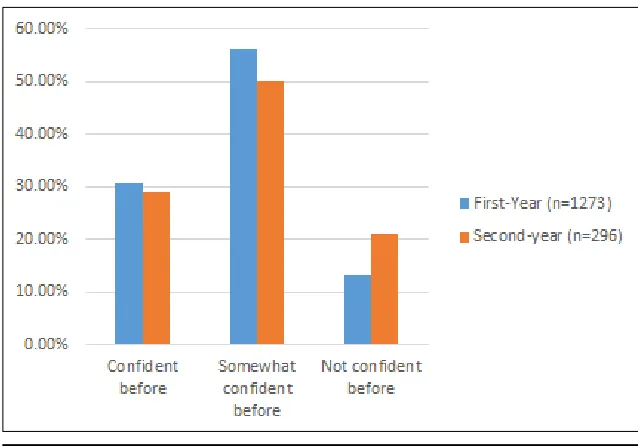
To explore whether or not there were differences in the research confidence ratings of first- and second-year stu-dents, we compared these results by class standing. Of the total first-year students (n = 1,273) that met with a research consultant, 391 (31%) reported feeling confident about their ability to conduct research before the meeting, 716 (5%) reported feeling somewhat confident, and 16 (13%) reported feeling not confident. Similarly, of the total second-year stu-dents (n = 296), 86 (29%) reported feeling confident before the research consultations, 18 (50%) reported feeling some-what confident, and 62 (21%) reported feeling not confident (see figure 1).
After meeting with a research con-sultant, both first- and second- year students reported similar levels of con-fidence. Of the total first-year students (n = 1,273), 1,073 (84%) reported feeling confident about their ability to conduct research after the meeting, 192 (15%) reported feeling somewhat confident,and 8 (<1%) reported feeling not confident. Simi-larly, of the total second-year students (n = 296), 254 (86%) second-year stu-dents reported feeling confident, 40 (14%) reported feeling somewhat confident, and 2 (<1%) reported feeling not confident after their research consultation (see figure 2).
Approachability
Of the total that met with a research consultant in Fall 2016, 211 (93.4%) considered the research consultants to be approachable, while 14 (6.2%) con-sidered them to be somewhat approach-able and 1 (0.4%) considered them be not approachable. In Spring 2017, 1216 (89.5%) of the total students that met with a research consultant considered them to be approachable, while 137 (10.1%) considered them to be somewhat approachable and 6 (0.4%) considered them be not approachable (see table 3).
First- and second-year students rated the approachability of research consul-tants similarly. Of the total first-year students in the analysis, 1,136 (89%) found research consultants approachable, 130 (10%) rated them to be somewhat approachable, and 7 (1%) found them to be not approachable. Of the second-year students, 275 (93%) considered research consultants to be approachable, 21 (7%) found them somewhat approachable, and 0 (0%) rated them as not approachable.
Helpfulness
Of the total that met with a research consultant in Fall 2016, 203 (89.8%) considered the research consultants to be help-ful, while 22 (9.7%) considered them to be somewhat helpful and 1 (0.4%) considered them to be not helpful. In Spring 2017, 1,065 (78.4%) of the total that met with a research consultant in Spring 2017 considered them to be helpful, while 264 (19.4%) considered them to be somewhat helpful and 30 (2.2%) considered them be not helpful (see table 4).
There was a slight difference in the helpfulness ratings by first- and second-year students. Of the first-year students in the analysis, 999 (79%) found research consultants helpful,
Figure 1. Confidence rating before research consultation, by class standing
247 (19%) rated them to be somewhat helpful, and 27 (2%) found them to be not helpful. Of the second-year students, 256 (87%) considered research consultants to be helpful, 36 (12%) found them somewhat helpful, and 4 (1%) rated them as not helpful.
DISCUSSION
By providing students with one-on-one or small group research consultations during a lower-division course, we hypothesized that business library personnel were situat-ing students to feel more confident conductsituat-ing business research. Survey results show that research confidence rat-ings increased dramatically after meeting with a research consultant, suggesting this type of intervention is effec-tive from the student perspeceffec-tive. Although high-volume research consultations are time-intensive for library person-nel, we find it encouraging that students show an increase in research confidence as a result of the interaction. Previ-ous literature highlighted the relationship-building poten-tial, focused attention, and librarian expertise as valuable aspects of research consultations.28 Our findings reveal an
additional benefit of research consultations not discussed in-depth in previous literature: increased research confidence of students. Given ongoing concern with decreasing library anxiety and increasing student comfort with library use, the results provide further evidence of the value of research consultations to students and the importance of committing personnel time to the endeavor.
While we expected research confidence to increase overall, we expected to find notable differences in research confidence ratings between first- and second-year students. Typically, second-year students have had the opportunity to acclimate to the academic environment and may have conducted library research in other courses. Surprisingly, in this study, the confidence rating percentages of first- and second-year students are very similar. Although this find-ing warrants further research, we speculate that a possible explanation is that the difference between a first-year student and a second-year student may only be a single semester, depending on matriculation date. Another possible explana-tion is that first-year students may feel more confident than their ability warrants given their lack of experience with research in the higher education environment. This expla-nation is consistent with Kruger and Dunning’s findings
that unskilled people overestimate their intellectual abili-ties.29 Our study evaluated research confidence and did not
assess research competence; however, the overconfidence of first-year students in their information literacy skills is also a recurrent finding in studies on the topic.30 Additionally,
MGMT 301 is generally the first business course taken by both first- and second-year students and therefore they may have similarly limited experience with research in the disci-plinary context. Knowing that research confidence does not necessarily increase with years of experience in the academic environment, library personnel can leverage the learning context afforded by research consultations to evaluate the individual needs of students new to a discipline.
We anticipated students to rate library personnel as approachable and helpful based on anecdotal student feed-back from previous semesters, and overall, results supported this expectation. The most notable finding was the difference between the helpfulness ratings by first- and second-year stu-dents. More second-year students rated research consultants as helpful than first-year students. Related to our findings on research confidence, we conjecture that second-year students may be more aware of what they do not know and thus have a greater appreciation for research consultation assistance. Our findings on approachability and helpfulness offer further evi-dence that consultations provide the foundation of positive relationships between business students and library person-nel. Research consultations succeed in effectively connecting students new to disciplinary research to the resources and people they can return to for help.
While beyond the scope of this study, analysis of the qualitative data gathered from the students that chose to meet with a research consultant would yield additional insights on research consultations from the student perspec-tive. Specifically, these qualitative data could be analyzed for possible insights into what factors affect student ratings of confidence, helpfulness, and approachability. Additional ave-nues for exploration could include the impact of prior library instruction on research confidence, and general education and disciplinary learning goals as they relate to research consultations. Ideally, these studies could be longitudinal in order to assess the lasting impact of research consultations and early career library interventions on the individual over time. Familiarizing students with the resources of their dis-cipline in an entry-to-major course may have the potential to increase student learning gains in upper-level courses where more intensive research may be required.
Table 3. Approachability
Rating Number of Students
Approachable 1,427 (90%)
Somewhat approachable 151 (10%) Not approachable 7 (<1%)
Total 1.585
Table 4. Helpfulness
Rating Number of Students
Helpful 1,268 (80%)
Somewhat helpful 286 (18%)
Not helpful 31 (2%)
CONCLUSION
Research consultations are one way to create a learning experience in which students gain research confidence and acclimation to their institution’s library resources and personnel. Introducing students to the library personnel assigned to their discipline through course-related research consultations may ease overall library anxiety and subtly correct any misconceptions students have about the roles of academic library personnel.
The Reiter and Huffman article supplied evidence that library personnel are able to successfully build and maintain a sustainable model to support the management of research consultations for a high-enrollment course.31 Gathering data
from the student perspective provides insight into the impact of the service. Because of the size of the population surveyed, we are able to draw conclusions about the effectiveness of research consultations on confidence, and perceptions of library personnel approachability and helpfulness. The study suggests that one-on-one and small-group consultations support a dramatic shift in research confidence while also reinforcing library personnel as approachable and helpful. From both the student and library perspective, this course-related service is well worth the time investment.
ACKNOWLEDGEMENTS
We wish to thank Angela Davis, Cheryl McCallips, John Meier, and Diane Zabel for reviewing early drafts of this article. Thank you to Michael Wright for their support and encouragement.
References
1. Lauren Reiter and J. P. Huffman, “Yes Virginia, It Will Scale: Using Data to Personalize High-Volume Reference Interactions,”
Journal of Academic Librarianship 42, no. 1 (2015): 21–26. 2. Constance A. Mellon, “Library Anxiety: A Grounded Theory
and Its Development,” College & Research Libraries 47, no. 2 (1986): 160–65, https://crl.acrl.org/index.php/crl/article/view /14195/15641.
3. Trina J. Magi and Patricia E. Mardeusz, “Why Some College Students Continue to Value Individual, Face-to-Face Research Consultations in a Technology-Rich World,” College & Research Libraries 74, no. 6 (2013): 605–18, https://doi.org/10.5860/crl 12-363.
4. Maura Seale, “Old Maids, Policeman, and Social Rejects: Mass Media Representations and Public Perceptions of Librarians,”
Electronic Journal of Academic and Special Librarianship 9, no. 1 (2008), http://southernlibrarianship.icaap.org/content/v09n01 /seale_m01.html.
5. Ramirose Ilene Attebury, “Perceptions of a Profession: Librar-ians and Stereotypes in Online Videos,” Library Philosophy and Practice 12, no. 2 (2010): 1–22, https://digitalcommons.unl.edu /cgi/viewcontent.cgi?article=1454&context=libphilprac. 6. Eric Jennings, “The Librarian Stereotype: How Librarians are
Damaging Their Image and Profession,” College & Undergraduate Libraries 23, no. 1 (2016): 93–100.
7. Jennifer L. Bonnet and Benjamin McAlexander, “Struc-tural Diversity in Academic Libraries: A Study of Librarian
Approachability,” The Journal of Academic Librarianship 38, no. 5 (2012): 277–86.
8. Jennifer L. Bonnet and Benjamin McAlexander, “First Impres-sions and the Reference Encounter: The Influence of Affect and Clothing on Librarian Approachability,” The Journal of Academic Librarianship 39, no. 4 (2013): 335–46.
9. Melissa Langridge, Christine Riggi, and Allison Schultz, “Stu-dent Perceptions of Academic Librarians: The Influence of Pop Culture and Past Experience,” in The Librarian Stereotype: Deconstructing Perceptions and Presentations of Information Work, eds. Nicole Pagowsky and Miriam Rigby (Chicago: Association of College & Research Libraries, 2014), 229–55.
10. Rachael Muszkiewicz, “Get to Know Your Librarian: How a Simple Orientation Program Helped to Alleviate Library Anxi-ety,” Public Services Quarterly 13, no. 4 (2017): 223–40. 11. Jody Fagan, “Students’ Perceptions of Academic Librarians,” The
Reference Librarian 37, no. 78 (2003): 131–48.
12. Fagan, “Students’ Perceptions of Academic Librarians,” 139. 13. Marc Vinyard, Colleen Mullally, and Jaimie Beth Colvin, “Why
do Students Seek Help in an Age of DIY? Using a Qualitative Approach to Look Beyond Statistics,” Reference & User Services Quarterly 56, no. 4 (2017): 257–67, https://doi.org/10.5860/rusq .56.4.257.
14. Andrew Brenza, Michelle Kowalsky, and Denise Brush, “Percep-tions of Students Working as Library Reference Assistants at a University Library,” Reference Services Review 43, no. 4 (2015): 722–36.
15. Brenza, Kowalsky, Brush, “Perceptions of Students,” 732. 16. Kathy Butler and Jason Byrd, “Research Consultation
Assess-ment: Perceptions of Students and Librarians,” Journal of Aca-demic Librarianship 42, no. 1 (2016): 83-86.
17. Butler and Byrd, “Research Consultation Assessment,” 85. 18. Butler and Byrd, “Research Consultation Assessment,” 85. 19. Ramirose Attebury, Nancy Sprague, and Nancy J. Young, “A
Decade of Personalized Research Assistance,” Reference Services Review 37, no. 2 (2009): 207–20; Crystal D. Gale and Betty S. Evans, “Face-to-Face,” College & Undergraduate Libraries 14, no. 3 (2007): 85–101; Hua Yi, “Individual Research Consultation Service: An Important Part of an Information Literacy Program,”
Reference Services Review 31, no. 4 (2003): 342–50.
20. John Watts and Stephanie Mahfood, “Collaborating with Faculty to Assess Research Consultations for Graduate Students,” Behav-ioral & Social Sciences Librarian 34, no. 2 (2015): 70–87. 21. Yi, “Individual Research Consultation Service,” 344.
22. Devin Savage, “Not Counting What Counts: The Perplexing Inattention to Research Consultations in Library Assessment Activities” (paper presented at the Association of College and Research Libraries Conference, Portland, Oregon, March 2015), http://www.ala.org/acrl/sites/ala.org.acrl/files/content/confer ences/confsandpreconfs/2015/Savage.pdf.
23. Watts and Mahfood, “Collaborating with Faculty,” 78.
24. Magi and Mardeusz, “Why Some College Students,” 612; Emily Rogers and Howard S. Carrier, “A Qualitative Investigation of Patrons’ Experiences with Academic Library Research Consulta-tions,” Reference Services Review 45, no. 1 (2017): 18–37. 25. Rogers and Carrier, “A Qualitative Investigation,” 34.
26. Allison Faix, Amanda MacDonald, and Brooke Taxakis, “Research Consultation Effectiveness for Freshman and Senior Undergraduate Students,” Reference Services Review 42, no. 1 (2014): 4–15.
27. Karine Fournier and Lindsey Sikora, “Individualized Research Consultations in Academic Libraries: A Scoping Review of Practice and Evaluation Methods,” Evidence Based Library and Information Practice 10, no. 4 (2015): 247–67.
“Collaborating with Faculty,” 82–83.
29. Justin Kruger and David Dunning, “Unskilled and Unaware of It: How Difficulties in Recognizing One’s Own Incompetence Lead to Inflated Self-Assessments,” Journal of Personality and Social Psychology 77, no. 6 (1999): 1121–34.
30. Melissa Gross and Don Latham, “What’s Skill Got to Do With It? Information Literacy Skills and Self-Views of Ability Among
First-Year College Students,” Journal of the American Society for Information Science and Technology 63, no. 3 (2012): 574–83; Robin Price et al., “Embedding Information Literacy in a First-Year Business Undergraduate Course,” Studies in Higher Education
36, no. 6 (2011): 705–18.
31. Reiter and Huffman, “Yes Virginia, It Will Scale,” 25–26.
APPENDIX A. SURVEY QUESTIONS
1. Did you meet with a research consultant for the Busi-ness Information Project?
Yes
No (If No, skip to question 8)
2. How would you rate your level of confidence about doing library research for your assignment before meet-ing with the research consultants?
Confident
Somewhat confident Not confident
3. How would you rate your level of confidence about doing library research for future assignments after meet-ing with the research consultants?
Confident
Somewhat confident Not confident
4. How would you rate the approachability of the research consultant?
Approachable
Somewhat approachable Not approachable
5. How would you rate the helpfulness of the research consultant?
Helpful
Somewhat helpful Not helpful
6. Would you meet with a research consultant again for assistance with future assignments? Why or why not?
7. Do you have any final comments or do you have any suggestions for how we may improve the research con-sultation service in the future? (Skip to question 9)
8. What was the reason you chose not to meet with a research consultant?
9. Please indicate your class standing
First-year Second-year
Other (Please specify)
10. Please indicate your current or intended major
Accounting
Corporate Innovation and Entrepreneurship Finance
Management
Management Information Systems Marketing
Risk Management
Supply Chain and Information Systems Undecided Business Major
Major outside of Smeal College of Business
11. What is your gender?
Male Female Other
12. What is your race?
White/Caucasian African American Hispanic
Asian
Native American Pacific Islander Other
13. Are you an international student?