ARTIGO ORIGINAL
Long-term Neuropsychiatric and Neuropsychological
Sequelae of Endovascularly Treated Aneurysmal
Subarachnoid Hemorrhage
Sequelas Neuropsiquiátricas e Neuropsicológicas,
a Longo Prazo, de Hemorragia Subaracnoideia
Aneurismática Tratada Endovascularmente
Lídia SOUSA1, Ana ANTUNES1, Tiago MENDES1, Sofia REIMÃO2, Lia Lucas NETO2, Jorge CAMPOS2
Acta Med Port 2019 Nov;32(11):706–713 ▪ https://doi.org/10.20344/amp.10894
1. Department of Psychiatry and Mental Health. Santa Maria University Hospital. Lisbon. Portugal. 2. Department of Neuroradiology. Santa Maria University Hospital. Lisbon. Portugal.
Autor correspondente: Lídia Sousa. [email protected]
Recebido: 02 de junho de 2018 – Aceite: 03 de junho de 2019 | Copyright © Ordem dos Médicos 2019
ABSTRACT
Introduction: There is limited evidence regarding long-term outcomes of aneurysmal subarachnoid hemorrhage survivors. Most
fol-low-up programs are relatively short and focused on physical functions. Endovascular aneurysmal embolization enables recovery of normal vascular architecture. However, there is growing evidence that neuropsychological and behavior sequelae can significantly im-pact the lives of these patients, even when treatment is successful. In this study, we reviewed cognition, psychiatric and neuropsycho-logical symptoms, global functionality, and health-related quality of life 10 to 12 years after an aneurysmal subarachnoid hemorrhage.
Material and Methods: A cross-sectional observational study was carried out in a university hospital. All cases of aneurysmal
suba-rachnoid hemorrhage admitted between January 2004 and December 2006 and endovascularly treated were reviewed. Participants underwent a neuropsychological evaluation and a clinical interview with a psychiatrist.
Results: Fourteen patients participated in the study. Almost 70% (n = 10) showed cognitive impairment; in more than 40% (n = 6) of
the subjects, significant symptoms of anxiety were identified, and 35% (n = 5) were classified as having clinical depression. Relevant posttraumatic symptoms were reported by more than 70% (n = 10) of patients, and almost 30% (n = 4) showed other moderate neu-ropsychiatric symptoms. Overall, health-related quality of life was impaired, and personality changes were frequently reported by the participants and their relatives.
Discussion: A significant prevalence of ongoing deficits in high-level functioning and reduced health-related quality of life were observed
in a sample of young and professionally active individuals that were successfully treated and discharged from follow-up consultations.
Conclusion: There is a need for better follow-up strategies, targeting more subtle deficits and psychological symptoms after
aneurys-mal subarachnoid hemorrhage.
Keywords: Activities of Daily Living; Endovascular Procedures; Mood Disorders; Subarachnoid Cognitive Dysfunction; Subarachnoid
Hemorrhage/complications RESUMO
Introdução: As evidências sobre a evolução a longo prazo dos sobreviventes de uma hemorragia subaracnoideia aneurismática são
relativamente limitadas. A maioria dos programas de follow-up têm uma curta duração e são focados principalmente nas funções motoras. Apesar da embolização aneurismática endovascular permitir uma recuperação da arquitetura vascular normal, há evidências crescentes de que certas sequelas neuropsicológicas e comportamentais podem afetar significativamente a vida desses pacientes, a longo prazo, mesmo quando o tratamento é bem-sucedido. Neste estudo, analisamos os sintomas cognitivos, psiquiátricos e neuropsi-cológicos, a funcionalidade global e a qualidade de vida relacionada com a saúde, 10 a 12 anos após uma hemorragia subaracnoideia aneurismática.
Material e Métodos: Um estudo observacional, transversal, foi realizado num hospital universitário. Todos os casos de hemorragia
subaracnoideia aneurismática, admitidos entre janeiro de 2004 e dezembro de 2006, tratados endovascularmente, foram revistos. Os participantes foram sujeitos a uma avaliação neuropsicológicas e a uma entrevista clínica com um psiquiatra.
Resultados: Participaram no estudo 14 doentes. Cerca de 70% (n = 10) apresentavam compromisso cognitivo; em mais de 40%
(n = 6) foram identificados sintomas significativos de ansiedade e 35% (n = 5) foram classificados como tendo depressão clínica. Sintomas de stress pós-traumático relevantes foram relatados por mais de 70% (n = 10) e quase 30% (n = 4) apresentavam sintomas neuropsiquiátricos moderados. Em geral, a qualidade de vida relacionada com o estado de saúde encontrava-se reduzida e relatos de alterações de personalidade foram frequentemente feitos pelos participantes e seus familiares.
Discussão: Uma prevalência significativa de défices em altos níveis de funcionamento e uma redução da qualidade de vida
relacio-nada com a saúde foi observada numa amostra de indivíduos jovens e profissionalmente ativos, que foram tratados com sucesso e tiveram alta das consultas de seguimento.
Conclusão: São necessárias melhores estratégias de follow-up, visando défices cognitivos e sintomas psicológicos mais subtis, após
uma hemorragia subaracnoideia aneurismática.
Palavras-chave: Atividades da Vida Diária; Hemorragia Subaracnoideia/complicações; Perturbações da Cognição; Perturbações do
ARTIGO ORIGINAL INTRODUCTION
The rupture of an intracranial aneurysm, causing sub-sequent accumulation of blood in the subarachnoid space, is a life-changing event associated with substantial morbid-ity, aside from a mortality rate of approximately 50% in the acute phase.1 Despite the relatively low incidence, affecting
around 9 subjects per 100 000 person-years worldwide,2 the
relatively young age of occurrence makes it even more strik-ing in terms of public health. Peak incidence is estimated between 40 – 60 years of age,3 thus affecting people that are
still in the most productive years of their life and are expected to carry on with many personal and professional responsibil-ities. Many studies report up to 40% of survivors not being able to return to work,4–7 and some only being able to take
on fewer responsibilities and/or work for fewer hours.4,8–10
Most studies evaluating the cognitive status of survivors focused on short-term outcomes. In a Portuguese sample of 108 acute subarachnoid hemorrhage (SAH) patients (61 aneurysmal, 47 non-aneurysmal), Caeiro et al found a high percentage of neuropsychiatric disturbances: depres-sion (45%), apathy (42%), denial (21%), and catastrophic reaction (17%).11
While it is almost consensual that memory, executive function, and language deficits are common cognitive sequelae of an aneurysmal subarachnoid hemorrhage (aSAH), there is still a lot to be known regarding long-term outcomes many years after the event. Recent studies have created controversy: for example, by reporting cognitive recovery during the first years and a new decline in subse-quent years.12
Changes in personality and significant mental health symptoms have also been reported following SAH. In one of the longest post-SAH evaluation studies (a mean follow-up after aSAH of 8.9 years), the authors described that almost 60% of the patients reported changes in personality, with increased irritability being present in 37% and increased ‘emotionality’ in almost 30% of the sample.7 It is consensual
that, at least in the short term, the quality of life after SAH is significantly impaired; however, much remains to be investi-gated,13 particularly concerning long-term outcomes.
The aim of the present study is to assess and describe the cognitive status, specific psychiatric (anxiety, depres-sion, and posttraumatic stress) and neuropsychiatric symp-toms, functional impairment, and health related quality of life (HRQL) in a cohort of 10- to 12- year survivors of aSAH that underwent endovascular treatment.
MATERIAL AND METHODS
This cross-sectional observational study was carried out in a university hospital where approval was obtained from the Ethics Committee. The study followed the Declaration of Helsinki, and informed written consent was obtained before any procedure. Hospital records were assessed to obtain clinical information about the admission, treatment, and fol-low-up of the patients. Participants were invited to a single session that combined an interview with a psychiatrist and a neuropsychological evaluation.
The neuropsychological assessment, performed by an experienced neuropsychologist, included the Subjective Memory Complaints Scale14 and the Montreal Cognitive
Assessment (MoCA)15 and lasted about 20 minutes. After
a short break of at least 30 minutes, the Instrumental Activities of Daily Living Questionnaire,16 the Quality of
Life Questionnaire (short form 36),17,18 the Hospital Anxiety
and Depression Scale,19 the Neuropsychiatric Inventory,20
and the Posttraumatic Stress Diagnostic Scale21 were
per-formed by two trained psychiatrists. The second part of the evaluation had an approximate duration of 40 minutes.
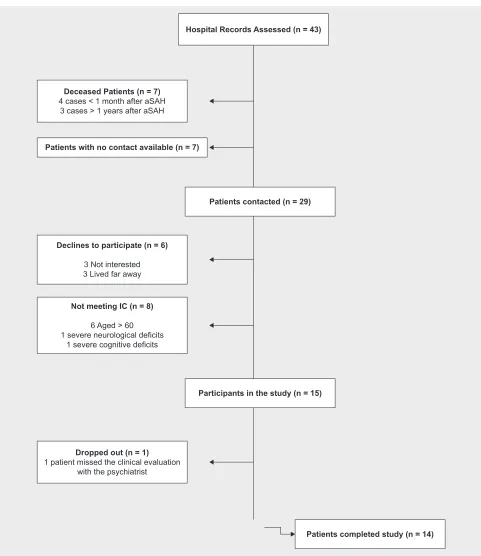
All cases of aSAH admitted between January 2004 and December 2006 and endovascularly treated were reviewed. Patients were considered suitable for full assessment and participation if the following inclusion criteria (IC) were met: (a) spontaneous subarachnoid hemorrhage (aSHA) with angiography-confirmed etiology of intracranial aneu-rysmal rupture and receipt of endovascular treatment, (b) neurological recovery without signs of focal neurological deficits, and (c) informed consent from the patient or a legal representative before any procedure. Exclusion criteria were the following: a previous diagnosis of dementia; intel-lectual disability; age under 18 or above 60 years at the time of aSAH; unwillingness or incapacity to cooperate; a previ-ous diagnosis of a major psychiatric disorder; a previprevi-ous history of cerebral trauma, stroke, neurosurgical interven-tion, or another major neurological event before the aSAH. Forty-three patients were identified through hospi-tal records, and it was possible to get in contact with 29 of them. A total of 15 patients complied with the inclusion criteria and agreed to participate. One patient dropped out before the beginning of the study due to an unexpected personal issue, and another dropped out during the study, having completed only half of the clinical evaluation. The recruitment and sample composition (n = 14) are illustrated in Fig. 1.
The checklist of items of the STrengthening the Reporting of OBservational studies in Epidemiology Statement,22 which should be included in reports of
obser-vational studies, was used.
Clinical measurement outcomes
Montreal Cognitive Assessment (MoCA) is a 30-point test validated in the setting of mild cognitive impairment23
and frequently used as a cognitive screening assessment tool in the context of vascular events such as aSAH.24 It
includes six subtests (visuospatial/executive function, nam-ing, attention, abstraction, recall, and orientation), with more emphasis on tasks involving frontal executive function and attention.23 There is compelling evidence that
MoCA-assessed cognitive function is an important determinant of good outcomes after aSAH.25
The Subjective Memory Complaints Scale (SMCS)26 is
ARTIGO ORIGINAL
complaints score). A score equal to or lower than 3 implies that the complaints have no relevance. The Portuguese ver-sion of the scale, adapted from Ginó et al,14 was used.
Instrumental Activities of Daily Living (IADL) is an instrument to assess independent living skills through eight domains of cognitive or physical function (telephon-ing, shopp(telephon-ing, food preparation, housekeep(telephon-ing, launder-ing, use of transportation, use of medication, and financial behavior), with a practical utility in widely diverse settings,
for population groups of different ages, and for a variety of goals.27
The Quality of Life Questionnaire (QoL) (short form 36, SF36) is a 36-item, patient-reported survey that consists of eight scaled scores (vitality, physical functioning, bodily pain, general health perceptions, physical role functioning, emotional functioning, social functioning, and mental health) along with a summary of physical and mental measures. It is a generic measure of health status as opposed to one Figure 1 – Sample composition and recruitment
Participants in the study (n = 15) Patients contacted (n = 29) Patients with no contact available (n = 7)
Deceased Patients (n = 7)
4 cases < 1 month after aSAH 3 cases > 1 years after aSAH
Declines to participate (n = 6)
3 Not interested 3 Lived far away
Not meeting IC (n = 8)
6 Aged > 60 1 severe neurological deficits
1 severe cognitive deficits
Dropped out (n = 1)
1 patient missed the clinical evaluation with the psychiatrist
Hospital Records Assessed (n = 43)
ARTIGO ORIGINAL
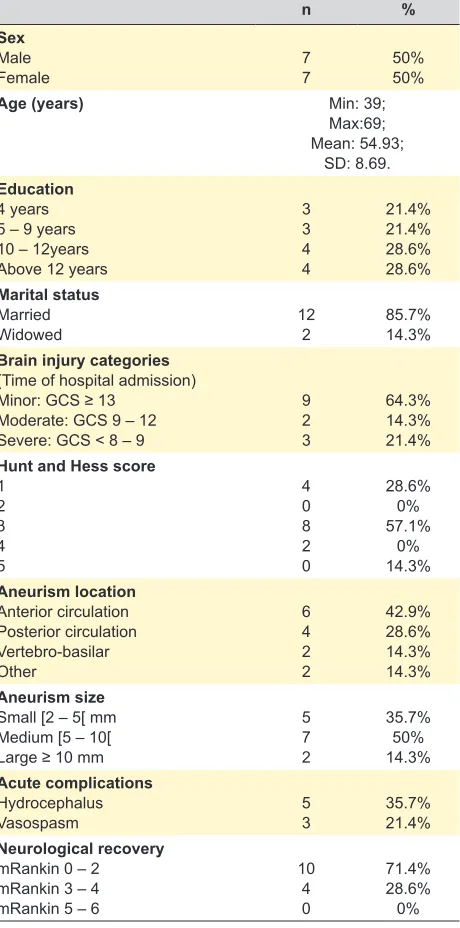
Table 1 – Sample composition (sociodemographic and clinical data; n = 14)
n %
Sex Male
Female 77 50%50%
Age (years) Min: 39;
Max:69; Mean: 54.93;
SD: 8.69. Education
4 years 5 – 9 years 10 – 12years Above 12 years
3 3 4 4 21.4% 21.4% 28.6% 28.6% Marital status Married
Widowed 122 85.7%14.3%
Brain injury categories (Time of hospital admission) Minor: GCS ≥ 13
Moderate: GCS 9 – 12 Severe: GCS < 8 – 9
9 2 3 64.3% 14.3% 21.4% Hunt and Hess score
1 2 3 4 5 4 0 8 2 0 28.6% 0% 57.1% 0% 14.3% Aneurism location Anterior circulation Posterior circulation Vertebro-basilar Other 6 4 2 2 42.9% 28.6% 14.3% 14.3% Aneurism size
Small [2 – 5[ mm Medium [5 – 10[ Large ≥ 10 mm
5 7 2 35.7% 50% 14.3% Acute complications Hydrocephalus
Vasospasm 53 35.7%21.4%
Neurological recovery mRankin 0 – 2 mRankin 3 – 4 mRankin 5 – 6
10 4 0 71.4% 28.6% 0% that targets a specific age group or disease.28 Each item is
directly transformed into a 0–100 scale, with lower scores representing a higher degree of disability.
The Hospital Anxiety and Depression Scale (HADS) is a self-rated, 14-item scale that includes 7 items related to anxiety and 7 related to depression. This is a questionnaire that performs well in screening for the separate dimensions of anxiety and depression not only in patients from non-psy-chiatric hospital clinics but also from the general popula-tion.29 A cut-off of 8 for the subscales of anxiety and
depres-sion of HADS was used, as suggested in the literature.29
The Neuropsychiatric Inventory Questionnaire (NPI) uses responses from caregivers in a structured interview format to assess 10 behavioral domains (delusions, hallu-cinations, agitation, dysphoria, anxiety, apathy, irritability, euphoria, disinhibition, and aberrant motor behavior); two additional domains (night-time behavioral disturbance, appetite/ weight changes) are commonly added, resulting in a total of 12 domains. The questionnaire provides symptom severity and distress ratings for each domain of behavioral functioning.30 This instrument also allows caregiver
disrup-tion assessment; for each of the twelve neuropsychiatric symptoms, caregivers rate the level of distress they expe-rience on a scale from 0 (none) to 5 (very severe).30 Here,
we considered a caregiver to be the closest relative that the patient identified and brought to the evaluation.
The Posttraumatic Stress Diagnostic Scale (PTSDS) focuses on evaluating the experience of a potentially trau-matic event in order to provide both a measure of PTSD symptom severity and a PTSD diagnosis. It includes 17 self-reported items regarding symptoms experienced in the previous month.31 In this study, we used the civilian version21
of this scale, and the sum of total scores was considered to screen for significant posttraumatic symptoms. A cut-off of 24 points was considered clinically relevant.
A validated Portuguese version of each of the aforemen-tioned instruments was used.
For qualitative data collection, short semi-structured interviews were conducted with the patient and the family informant before the application of any formal psychological tests. The clinician let the patient and family member talk freely at the beginning of the interview and then asked spe-cific questions about any symptoms arising after subarach-noid hemorrhage, limitations in daily life, and their impact both at a personal and at a social level. Field notes were recorded and analyzed.
Data analysis
Notes taken during the clinical interviews with a psy-chiatrist were analyzed at a semantic level and according to a deductive approach. Quotes were used to illustrate recurrent themes. Descriptive statistics were performed in order to characterize sociodemographic and clinical varia-bles. Results were described and interpreted in comparison with normative data for age, gender, and education of the Portuguese population.
RESULTS
Sample composition
ARTIGO ORIGINAL endovascularly treated with coil placement. Fifty percent of the patients had acute complications, with hydrocephalus
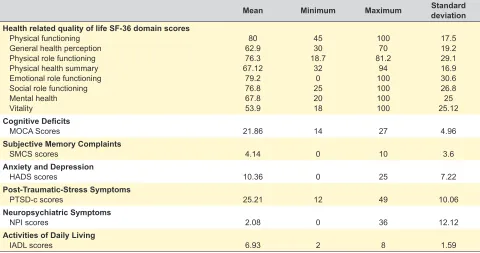
being reported in 35.8% (n = 5) of the cases and vasos-pasm in 51.4% (n = 3) of the cases. A good neurological recovery, defined as a score of 2 or lower in the modified Rankin Scale (mRS) upon discharge, was observed in 71.4% of the cases (n = 10). Patients were in the hospital for 20 days on average, and in only 35.7% (n = 5) of the cases a physical rehabilitation program was performed after dis-charge. More results on sample composition are presented in Table 1. Table 2 summarizes the main quantitative results of the study.
Qualitative data
Most patients and/or representative family member reported subjective changes in personality. We selected some quotes that in our opinion illustrate the recurrent theme of personality change, expressed during the inter-views: “I easily get irritable and nervous and shout at peo-ple… I was not like that before”; “He is not the same per-son”; “He is more socially disinhibited and irritable”; “He gets really anxious about his performance in simple things”; “My concentration and cognitive performance overall were never the same again… my confidence is also impaired.”
Overall, patients were happy to be followed up, with some stating, “It is good to know that the hospital is still keeping an eye on us”; “I have been thinking about going to the doctor to do a check-up, it has been a long time since I had my brain checked”; “There are so many questions that remained in our head… it is good to talk about it”; ”It is reassuring to be followed up.” Fear of recurrence was expressed by almost all the patients: “We never know when it can happen again.” Other recurrent complaints were the difficulty in maintaining concentration and the frequent
occurrence of headaches. Some patients also reported that since the event, their self-confidence had decreased sig-nificantly, mainly related to cognitive tasks: “I don´t feel the same confidence in me… It´s difficult for me to concentrate and I get tired easily… I have headaches afterwards when I try harder.”
Quantitative data
Health-related quality of life (HRQL): The SF-36 health-related quality of life score was decreased in all domains when compared with normative data of the Portuguese population.32 Vitality and general health
percep-tion were the domains with the lowest scores, followed by mental health. Results are detailed in Table 2.
Cognitive deficits and subjective complaints: About 67% (n = 10) of the subjects showed significant cognitive impairment when MOCA scores were compared with norma-tive data of the Portuguese population, taking into account age and education.15 Cognitive domains with bad
perfor-mance were verbal memory and learning (85.7% lost at least 2 points out of 5 in the delayed recall test) and visuospa-tial functions (57.1% showed some degree of impairment). Subjects lost on average 3 out of 5 points in both domains.
The average score on the SMCS was 4.14 (min = 0, max = 10, SD = 3.6); when compared with normative data of the Portuguese population,33 57% of the patients (n = 8) had
significant memory complaints. The most frequently report-ed cognitive complaints were the following: general com-plaints about memory (57%; n = 8), concentration deficits (43%; n = 6), forgetting about where things are left (43%; n = 6), difficulty in finding words (43%; n = 6) and being considered forgetful by other people (43%; n = 6).
Anxiety and depression: A total of 43% (n = 6) of the subjects scored above the cut-off level of 8 points in the
Table 2 – Summary of main quantitative results
Mean Minimum Maximum Standard deviation
Health related quality of life SF-36 domain scores Physical functioning
General health perception Physical role functioning Physical health summary Emotional role functioning Social role functioning Mental health Vitality
80 62.9 76.3 67.12
79.2 76.8 67.8 53.9
45 30 18.7
32 0 25 20 18
100 70 81.2
94 100 100 100 100
17.5 19.2 29.1 16.9 30.6 26.8 25 25.12
Cognitive Deficits
MOCA Scores 21.86 14 27 4.96
Subjective Memory Complaints
SMCS scores 4.14 0 10 3.6
Anxiety and Depression
HADS scores 10.36 0 25 7.22
Post-Traumatic-Stress Symptoms
PTSD-c scores 25.21 12 49 10.06
Neuropsychiatric Symptoms
NPI scores 2.08 0 36 12.12
Activities of Daily Living
ARTIGO ORIGINAL
anxiety subscale, and 35.7% (n = 5) were classified as hav-ing significant symptoms of depression.
The current use of any psychotropic medication was assessed, and 28.6% (n = 4) of the patients reported regu-larly taking at least one anxiolytic drug.
Posttraumatic stress symptoms: From the total sam-ple, 71,4% (n = 10) of the participants scored 24 or higher in the Portuguese version of the PTSD checklist.21
Neuropsychiatric symptoms and caregiver dis-ruption: A total of 30.8% (n = 4) of patients had moder-ate neuropsychiatric symptoms as defined by a total NPI score between 20 and 50 (min = 0, max = 36, mean = 12.08, SD = 12.12) in the NPI Portuguese version.34 Around 77%
(n = 10) reported one or more domains of neuropsychiatric disturbance. The most common neuropsychiatric distur-bances were the following: depression (54%; n = 7), night-time behavior disturbances (54%; n = 7), irritability/lability (46%; n = 6), agitation/aggression (46%; n = 6), apathy/ indifference 31% (n = 4), and anxiety 31% (n = 4). Caregiver disruption scores varied between 0 and 19 (mean = 6.62, median = 5). In 38.5% (n = 5) of the subjects, the total score of caregiver disruption was over 5, which is considered clin-ically relevant.
Activities of daily living and return to work: From all the patients, 57% (n = 8) lost at least one point in the Portuguese version of the IADL questionnaire.16 Also, 93%
(n = 13) of patients were active when the SAH occurred. Ten years after the event, 42.8% (n = 6) was not active anymore (7% unemployed and 36% with early retirement). Patients who returned to work after the event took on average 4.5 months to return (min = 2, max = 12, SD = 3.35). In 35.7% of the cases (n = 5), this occurred because patients’ working hours and / or responsibilities were reduced.
DISCUSSION
Surviving a potentially lethal neurological event can be a life-changing experience, not only due to the neurological sequelae but also due to the psychological reaction of the individual in its social context. Our study aimed to increase the understanding of the long-term outcomes of aSAH sur-vivors, regarding high-level cognitive functioning, personal-ity, and neuropsychiatric symptoms.
In a sample of young and professionally active individ-uals that survived an aSAH with a good neurological out-come, we identified a surprisingly high prevalence of neu-ropsychiatric symptoms and functional deficits ten years after the neurological event.
Analyzing the qualitative data, we found that in more than half of the cases, either the patient or the family inform-ant reported significinform-ant and persistent personality changes after the event. Increased irritability, anxiety symptoms, and concentration deficits were consistently reported and point-ed out as the cause of significant burdens to the patient and family. Importantly, none of the patients had been questioned before by a health professional about these symptoms and their implications. Our data are consistent with a recent follow-up study on good-outcome survivors
of an aSAH, in which the authors reported that 31% of the patients believed that close relatives noticed changes in their psychological condition as a result of the event.35
One of our participants manifested clear hypomanic symptoms after the event, being overactive and overtalka-tive, showing reckless behavior, and having a consistently hyperthymic mood. There was no record of previous mood changes or any significant psychiatric family history. To our knowledge, there are no reported cases of persistent hypomanic or maniac features many years after an aSAH, although they have been reported during the acute phase.11
Obsessive, prolific artistic output arising after a subarach-noid hemorrhage has also been described previously.36
Another important detail is that all the participants manifested their satisfaction with being followed up, and it was reported to decrease their anxiety of recurrence. The patients also complained that they had not been given much information regarding their prognosis and the risk of recurrence and were satisfied to be given an opportunity to discuss this.
Focusing on the quantitative data, it is striking that all domains of HRQL were impaired, particularly vitality and mental health, thus reflecting impairment in high-level cog-nitive and emotional functioning, as opposed to physical deficits, which are traditionally given more importance.
The cognitive status of the patients was also surprising, especially for a sample of professionally active and edu-cated patients. Verbal memory, learning, and visuospatial functions were the most significantly impaired domains, which could explain the significant cognitive complaints. This is concordant with the fact that, after the event, most patients needed to work fewer hours or even assume fewer responsibilities. It is impressive that none looked for med-ical attention regarding these symptoms, despite clearly assuming them to be sequelae of the aSAH. To what extent a cognitive rehabilitation program could have helped them to fully recover their previous level of functioning seems an important question to consider.
The prevalence of psychiatric symptoms such as anxie-ty and depression was also striking. According to the recent national epidemiological study of mental health conducted in Portugal, the lifetime prevalence figures of any anxie-ty disorder or any mood disorder are 25.8% and 19.3%, respectively, for the adult population.37 In our sample, the
figures are much higher, with 40% of the patients having significant anxiety features and around 35% scoring above the cut-off value for depression in the HADS.
The estimated rate of anxiolytics use was 23.4% for females and 9.8% for males in the aforementioned epide-miological study.37 We identified a prevalence of 30% in our
sample of aSAH survivors.
Lifetime PTSD prevalence in the general Portuguese population is estimated to be around 5%.37 In this
ARTIGO ORIGINAL another relevant finding, with anxiety, agitation, and irrita-The prevalence of neuropsychiatric symptoms was
bility being the most frequent complaints and generating significant family distress. This is in accordance with the results of a recent cross-sectional study that evaluated patients 1 – 4 years after SHA.38 The authors reported that
forty-two (41%) patients had one or more domains of neu-ropsychiatric disturbance, frequently including agitation/ aggression, depression, apathy/indifference, irritability/labil-ity, and appetite/eating disturbance.
Despite all participants being classified and having had a good neurological recovery, all the patients lost at least 1 point in the IADL regarding tasks such as ability to use a telephone, shopping, food preparation, handling finances; which is surprising in a sample of young, active, and rela-tively educated patients with many social responsibilities.
The reported results are concordant with another study performed in the same hospital about 10 years before, in which minor cognitive deficits and high scores on a depres-sion scale were frequent findings in a cohort of perimesen-cephalic SAH patients. The length of follow-up of the par-ticipants in this study varied from 3 months to 7 years, but half of the patients (n = 9) were followed up for more than 4 years after the event.39
The present study has several limitations that should be mentioned. Firstly, our sample is small, and we could not establish a comparison with pre-event data. We were not able to investigate statistically significant differences between our sample and the general population, and it was not possible to control for important covariates such as edu-cation, age at the event, and severity of aSAH. A battery of more specific neuropsychological tests would have been important to refine the characterization of a patient’s defi-cits. Finally, it was not possible to investigate anatomical and/or functional brain changes and establish correlations with clinical profiles. Neuroimaging studies suggested that the long-term cognitive deficits after aSAH can be attribut-ed to macroscopic changes in brain structure (i.e., rattribut-educattribut-ed mesiotemporal volumes, ischemic lesions, global brain atrophy).40 In the acute phase of a SAH, higher hematic
densities in the left and right basal sylvian fissures and in the 4th ventricle have been associated with denial, as was the occurrence of hydrocephalus.11 Apathy was associated
with blood in the left or right lateral ventricles.11
Studies in animal models have also suggested a cor-relation with changes at the synaptic level.40 However, to
our knowledge, correlations between neuroimaging findings and clinical profiles in the long term are still lacking detailed characterization.
Nonetheless, our results are still informative, reinforc-ing the growreinforc-ing body of evidence on this topic, strongly
suggesting that we still lack proper and timely screening tests for uncovering important emotional and cognitive problems when following up survivors of aSAH.
CONCLUSION
In our sample, many years after an aSAH, and despite a successful treatment and good neurological recovery, patients reported significant sequelae in high-level func-tioning, with functional impairment in basic activities of dai-ly living, decreased quality of life, and a high prevalence of psychiatric symptoms. This is especially relevant in a sample of young patients with many personal and social responsibilities.
Obtaining a better understanding of how surviving an aSAH impacts cognition and mental health in the long term could inform the development of more efficient follow-up programs. This would allow survivors to fully explore the potential to resume their previous level of functioning, thus improving their quality of life, and, in a broader perspective, decreasing the burden to society. In particular, paying atten-tion to the psychological variables and neuropsychiatric symptoms and systematically including these in follow-up programs could have an enormous impact in terms of public health. In our opinion, the instruments used here were sim-ple and quickly administered and thus could be embedded in routine clinical practice.
More studies are needed in order to define optimal fol-low-up strategies, regarding not only the content of the eval-uations but also their timing.
ACKNOWLEDGMENT
We would like to thank all the participants who kindly agreed to participate in this study.
PROTECTION OF HUMANS AND ANIMALS
The authors declare that the procedures were followed according to the regulations established by the Clinical Research and Ethics Committee and to the Helsinki Declaration of the World Medical Association.
DATA CONFIDENTIALITY
The authors declare having followed the protocols in use at their working center regarding patients’ data publication.
CONFLICTS OF INTEREST
All authors report no conflict of interest.
FUNDING SOURCES
This research received no specific grant from any funding agency in the public, commercial, or not-for-profit sectors.
REFERENCES
1. van Gijn J, Kerr RS, Rinkel GJ. Subarachnoid haemorrhage. Lancet. 2007;369:306–18.
2. de Rooij NK, Linn FH, van der Plas JA, Algra A, Rinkel GJ. Incidence of subarachnoid haemorrhage: a systematic review with emphasis on
region, age, gender and time trends. J Neurol Neurosurg Psychiatry. 2007;78:1365–72.
ARTIGO ORIGINAL
4. Vilkki JS, Juvela S, Siironen J, Ilvonen T, Varis J, Porras M. Relationship of local infarctions to cognitive and psychosocial impairments after aneurysmal subarachnoid hemorrhage. Neurosurgery. 2004;55:790–802. 5. Hackett ML, Anderson CS. Health outcomes 1 year after subarachnoid
hemorrhage: an international population-based study. The Australian Cooperative Research on Subarachnoid Hemorrhage Study Group. Neurology. 2000;55:658–62.
6. Carter BS, Buckley D, Ferraro R, Rordorf G, Ogilvy CS. Factors associated with reintegration to normal living after subarachnoid hemorrhage. Neurosurgery. 2000;46:1326–33.
7. Wermer MJ, Kool H, Albrecht KW, Rinkel GJ, Aneurysm Screening after Treatment for Ruptured Aneurysms Study Group. Subarachnoid hemorrhage treated with clipping: long-term effects on employment, relationships, personality, and mood. Neurosurgery. 2007;60:91–7. 8. Tomberg T, Orasson A, Linnamägi Û, Toomela A, Pulver A, Asser T.
Coping strategies in patients following subarachnoid haemorrhage. Acta Neurol Scand. 2001;104:148–55.
9. Hop JW, Rinkel GJ, Algra A, van Gijn J. Changes in functional outcome and quality of life in patients and caregivers after aneurysmal subarachnoid hemorrhage. J Neurosurg. 2001;95:957–63.
10. Buchanan KM, Elias LJ, Goplen GB. Differing perspectives on outcome after subarachnoid hemorrhage: the patient, the relative, the neurosurgeon. Neurosurgery. 2000;46:831–8.
11. Caeiro L, Santos CO, Ferro JM, Figueira ML. Neuropsychiatric disturbances in acute subarachnoid haemorrhage. Eur J Neurol. 2011;18:857–64.
12. Preiss M, Koblihova J, Netuka D, Bernardova L, Charvat F, Benes V. Verbal memory capacity after treatment for ruptured intracranial aneurysm-the outcomes of three psychological tests: within a month, 1 year after and 5-7 years after treatment. Acta Neurochir. 2012;154:417–22.
13. Noble AJ, Schenk T. Which variables help explain the poor health-related quality of life after subarachnoid hemorrhage? A meta-analysis. Neurosurgery. 2010;66:772–83.
14. Ginó S, Guerreiro M, Garcia C, Mendonça A, Guerreiro M. Subjective memory complaints (QSM). Escalas e testes na demência 2ª ed. Lisboa: Grupo de Estudos de Envelhecimento Cerebral e Demência; 2008. p. 117–20.
15. Freitas S, Simoes MR, Alves L, Santana I. Montreal Cognitive Assessment (MoCA): normative study for the Portuguese population. J Clin Exp Neuropsychol. 2011;33:989–96.
16. Araújo F, Pais Ribeiro J, Oliveira A, Pinto C, Martins T. Validação da Escala de Lawton e Brody numa amostra de idosos não institucionalizados. Livro de Atas do 7º Congresso Nacional de Psicologia da Saúde. Porto: Sociedade Portuguesa de Psicologia da Saúde; 2008. p. 217–20. 17. Ferreira PL. Criação da versão portuguesa do MOS SF-36. Parte I —
Adaptação cultural e linguística. Acta Med Port. 2000;13:55–66. 18. Ferreira PL. Criação da versão portuguesa do MOS SF-36. Parte II —
Teste de validação. Acta Med Port. 2000;13:119–27.
19. Pais-Ribeiro J, Silva I, Ferreira T, Martins A, Meneses R, Baltar M. Validation study of a Portuguese version of the Hospital Anxiety and Depression Scale. Psychol Health Med. 2007;12:225–35.
20. Ferreira A, Ribeiro O, Martins S, Fernandes L. Inventário neuropsiquiátrico (NPI): contributo para a validação da versão portuguesa. Sinapse. 2014;14:152.
21. Marcelino D, Gonçalves SP. Perturbação pós-stress traumático: características psicométricas da versão portuguesa da Posttraumatic Stress Disorder Checklist — Civilian Version (PCL-C). Rev Port Saúde Pública. 2012;30:71–5.
22. von Elm E, Altman DG, Egger M, Pocock SJ, Gotzsche PC, Vandenbroucke JP, et al. The Strengthening the Reporting of Observational Studies in Epidemiology (STROBE) statement: guidelines for reporting observational studies. J Clin Epidemiol. 2008;61:344–9. 23. Nasreddine ZS, Phillips NA, Bedirian V, Charbonneau S, Whitehead V,
Collin I, et al. The Montreal Cognitive Assessment, MoCA: a brief screening tool for mild cognitive impairment. J Am Geriatr Soc. 2005;53:695–9.
24. Schweizer TA, Al-Khindi T, Macdonald RL. Mini-Mental State Examination versus Montreal Cognitive Assessment: rapid assessment tools for cognitive and functional outcome after aneurysmal subarachnoid hemorrhage. J Neurol Sci. 2012;316:137–40.
25. Wong GK, Lam SW, Wong A, Lai M, Siu D, Poon WS, et al. MoCA-assessed cognitive function and excellent outcome after aneurysmal subarachnoid hemorrhage at 1 year. Eur J Neurol. 2014;21:725–30. 26. Schmand B, Jonker C, Hooijer C, Lindeboom J. Subjective memory
complaints may announce dementia. Neurology. 1996;46:121–5. 27. Lawton MP, Brody EM. Assessment of older people: self-maintaining
and instrumental activities of daily living. Gerontologist. 1969;9:179–86. 28. Ware JE Jr, Gandek B. Overview of the SF-36 Health Survey and
the International Quality of Life Assessment (IQOLA) Project. J Clin Epidemiol. 1998;51:903–12.
29. Bjelland I, Dahl AA, Haug TT, Neckelmann D. The validity of the Hospital Anxiety and Depression Scale. an updated literature review. J Psychosom Res. 2002;52:69–77.
30. Cummings JL, Mega M, Gray K, Rosenberg-Thompson S, Carusi DA, Gornbein J. The Neuropsychiatric Inventory: comprehensive assessment of psychopathology in dementia. Neurology. 1994;44:2308–14. 31. Blanchard EB, Jones-Alexander J, Buckley TC, Forneris CA.
Psychometric properties of the PTSD Checklist (PCL). Behav Res Ther. 1996;34:669–73.
32. Ferreira PL, Santana P. Percepção de estado de saúde e de qualidade de vida da população activa: contributo para a definição de normas portuguesas. Rev Port Saúde Pública. 2003;21:15–30.
33. Alagoa Joao A, Maroco J, Gino S, Mendes T, de Mendonca A, Martins IP. Education modifies the type of subjective memory complaints in older people. Int J Geriatr Psychiatry. 2016;31:153–60.
34. Ferreira AR, Martins S, Ribeiro O, Fernandes L. Validity and reliability of the European portuguese version of neuropsychiatric inventory in an institutionalized sample. J Clin Med Res. 2015;7:21–8.
35. Preiss M, Netuka D, Koblihova J, Bernardova L, Charvat F, Kratochvilova D, et al. Quality of life 1 year after aneurysmal subarachnoid hemorrhage in good outcome patients treated by clipping or coiling. J Neurol Surg A Cent Eur Neurosurg. 2012;73:217–23. 36. Lythgoe MF, Pollak TA, Kalmus M, de Haan M, Chong WK. Obsessive,
prolific artistic output following subarachnoid hemorrhage. Neurology. 2005;64:397–8.
37. Caldas de Almeida J, Xavier M. Estudo epidemiológico nacional de saúde mental. Lisboa: Faculdade de Ciências Médicas da Universidade Nova de Lisboa; 2013.
38. Wong GK, Lam SW, Chan SS, Lai M, Tse PP, Mok V, et al. Neuropsychiatric disturbance after aneurysmal subarachnoid hemorrhage. J Clin Neurosci. 2014;21:1695–8.
39. Madureira S, Canhao P, Guerreiro M, Ferro JM. Cognitive and emotional consequences of perimesencephalic subarachnoid hemorrhage. J Neurol. 2000;247:862–7.