Paepalanthus rectifolius,
a new name in Eriocaulaceae (Poales)
Livia Echternacht1,2, Marcelo Trovó3,4, Paulo Takeo Sano1
1 Laboratório de Sistemática Vegetal, Departamento de Botânica, Instituto de Biociências, Universidade de São Paulo, Rua do Matão 277, CEP 05508-900, São Paulo, SP, Brasil 2 UMR 7207 CNRS MNHN UPMC, Cen-tre de Recherche en Paléobiodiversité et Paléoenvironnements, MNHN, 57 rue Cuvier, CC48, F-75005, Paris, France 3 Departamento de Botânica, Instituto de Biologia, Universidade Federal do Rio de Janeiro, CCS, Bloco A1, Cidade Universitária, Ilha do Fundão, CEP 21941-590, Rio de Janeiro, RJ, Brasil 4 Evolution and Biodi-versity of Plants, Faculty for Biology and Biotechnology. Ruhr UniBiodi-versity Bochum, D-44780 Bochum, Germany
Corresponding author:Livia Echternacht ([email protected])
Academic editor:Muthama Muasya | Received 22 December 2011 | Accepted 7 March 2012 | Published 9 March 2012
Citation: Echternacht L, Trovó M, Sano PT (2012) Paepalanthus rectifolius, a new name in Eriocaulaceae (Poales). PhytoKeys 10: 7–12. doi: 10.3897/phytokeys.10.2591
Abstract
Syngonanthus weddellii var. gracilis Moldenke (1973) was described very briefly based on a single collection. A careful analysis reveals that this variety has dimerous flowers, free petals of the pistillate flower and bifid stigmatic branches. It is therefore misplaced in Syngonanthus Ruhland (1900). We transfer it to Paepalan-thus Mart. (1834) at the species level, as it is distinct from morphologically similar species: Paepalanthus flaccidus (Bong.) Koern. (1863), Paepalanthus trichophyllus (Bong.) Koern. (1863), and Paepalanthus stric-tus Koern. (1863). The epithet gracilis is no longer available, hence, we have coined the name Paepalanthus rectifolius. We also provide a full description, illustrations, a distribution map, and pertinent comments.
Keywords
Brazil, Goiás, Nomenclature, Syngonanthus, Taxonomy
Introduction
Paepalanthus Mart. (1834) is one of the largest genera of Eriocaulaceae, comprising ca. 400 species (Giulietti and Hensold 1990, Stützel 1998). It is differentiated from
Syngonanthus Ruhland (1900), which encompasses ca. 130 species, primarily by its completely free petals of the pistillate flower (Ruhland 1900, 1903). Both genera are widely distributed throughout the Neotropics, with a few species occurring in Africa,
www.phytokeys.com
Copyright L. Echternacht et al. This is an open access article distributed under the terms of the Creative Commons Attribution License 3.0 (CC-BY), which permits unrestricted use, distribution, and reproduction in any medium, provided the original author and source are credited.
Livia Echternacht et al. / PhytoKeys 10: 7–12 (2012) 8
Central America, and in the case of Syngonanthus, also in North America (Koernicke 1863, Ruhland 1903, Giulietti and Hensold 1990, Stützel 1998).
In the last century, Harold Norman Moldenke published hundreds of new Erio-caulaceae taxa, most of them based on the specimens of his personal herbarium, now hosted in the LL herbarium, and on the specimens deposited in the NY herbarium. Many of these descriptions are quite short, especially those from taxa below the species level. Thus, the identification of such taxa is problematic, relying obligatorily on the analysis of the type specimens. Recent analysis of these specimens leads to the con-clusion that Syngonanthus weddellii var. gracilis Moldenke (1973) is misplaced within
Syngonanthus and should be considered a distinct species in Paepalanthus. In order to solve this issue, we propose the following nomenclatural changes. We also provide a full description, comments, illustrations, and a distribution map.
taxonomy
Paepalanthus rectifolius Trovó, Echtern. & Sano, nom. nov. urn:lsid:ipni.org:names:77118000-1
http://species-id.net/wiki/Paepalanthus_rectifolius
Fig. 1
Replaced name: Syngonanthus weddellii Moldenke var. gracilis Moldenke, Phytologia 25: 224. 1973. TYPE: BRAZIL. Goiás. Pirenópolis: Serra dos Pirineus, ca. 18 km E of Pirenópolis town, 1000 m alt., 15 Jan. 1972, H. S. Irwin, W. R. Anderson, M. Stieber & E. Y. Lee 34259 (holotype, LL!; isotype, NY!).
Livia Echternacht et al. / PhytoKeys 10: 7–12 (2012) 10
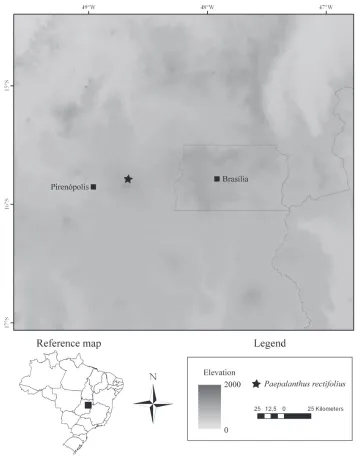
Figure 2.Paepalanthus rectifolius Trovó, Echter & Sano distribution map.
1.0–1.5 mm long, hairy toward the apex, soon glabrescent, trichomes with clavate api-cal cells, brown to dark in the apex, cream at the base, apex truncate, membranaceous; petals free, ca. 1.0 mm long, densely pilose toward the apex, trichomes with clavate apical cells, hyaline, membranaceous; gynoecium ca. 0.5 mm long, ovary ca. 0.2 mm long, style ca. 0.2 mm, appendages ca. 0.05 mm long, hyaline, inserted at the same point of the stigmatic branches, stigmatic branches 0.2 mm long, bifid. Seeds not seen.
Comments. Syngonanthus weddellii var. gracilis Moldenke was misplaced in Syn-gonanthus as this taxon has truly free petals on the pistillate flower and bifid stigmatic branches. It is therefore transferred at the species level to Paepalanthus, a genus encom-passing such morphological traits. The epithet gracilis,however, has been previously used in Paepalanthus by Koernicke (1863). Thus, since it is not available, we propose the new name Paepalanthus rectifolius, referring to straight and ascending leaves, which differ the species from the most similar ones. Paepalanthus rectifolius is known only from the type specimens collected in the mountains east of Pirenópolis, in the Serra dos Pirineus, Goiás, Brazil (Fig. 2). During our research on Eriocaulaceae systematics, we studied collections from several herbaria (B, BHCB, BM, BR, BRLU, C, CESJ, ESA, ESALQ, F, G, HUEFS, INPA, K, L, LE, LL, M, MO, NY, OUPR, OXF, P, R, RB, S, SP, SPF, UEC and UPS; acronyms in Thiers continuously updated). However, despite the presence of several collections from the Serra dos Pirineus, we did not find other specimen of P. rectifolius besides the type. Individuals with immature as well as old inflorescences were collected in January.
The morphologically related species are Paepalanthus flaccidus (Bong.) Koern. (1863), Paepalanthus trichophyllus (Bong.) Koern. (1863), and Paepalanthus strictus
Koern. (1863), three species with dimerous flowers recently excluded from Paepalan-thus sect. Diphyomene Ruhland (1903) (Trovó and Sano 2010). As mentioned above,
Paepalanthus rectifolius differs from these three species by its ascending and straight leaves (vs. recurved). It is easily differentiated from P. strictus and P. trichophyllus by its linear leaves (vs. lanceolate), golden involucral bracts (vs. dark castaneous), and linear floral bracts (vs. oblong). Paepalanthus flaccidus is the most similar species, due to the linear leaves, to the golden involucral bracts, whose internal series might also be tufted in the apex, and to the villous pubescence, with long pedicellate trichomes. Both may be considered sympatric as they are reported to Goiás and occur in the same habi-tats. Paepalanthus rectifolius is distinguished from P. flaccidus by its much longer leaves (2.0–4.0 cm vs. 0.5–1.5 cm), linear floral bracts (vs. oblong), and staminate flowers without lobes (vs. markedly lobed).
Acknowledgements
Livia Echternacht et al. / PhytoKeys 10: 7–12 (2012) 12
references
Giulietti AM, Hensold N (1990) Padrões de distribuição geográfica dos gêneros de Eriocaul-aceae. Acta Botanica Brasilica 4: 133–158. doi: 10.1590/S0102-33061990000100010 Koernicke F (1863) Eriocaulaceae. In: Martius KFP, Eichler AW (Eds) Flora Brasiliensis 3(1).
Typographia Regia, München, 312–320.
Martius KFP (1834) Eriocaulaceae. Analles des Sciences Naturelles, Botanique 2: 25–43. Moldenke HN (1973) Notes on new and noteworthy plants LVI. Phytologia 25: 220–224. Ruhland W (1900) Eriocaulaceae. In: Urban I (Ed.) Symbolae Antillanae, seu, Fundamenta
florae Indiae Occidentalis. Fratres Borntraeger, Berlin 482–494.
Ruhland W (1903) Eriocaulaceae. In: Engler A (Ed) Das Pflanzenreich. IV 30 (Heft 13). W. Engelmann, Leipzig, 1–294.
Stützel T (1998) Eriocaulaceae. In: Kubitzki K (Ed) The Families and Genera of Vascular Plants IV - Flowering Plants: Monocotyledons - Alismatanae and Comelinanae (except
Gramine-ae). Springer - Verlag, Berlin, 197–207.
Thiers B (continuously updated) Index herbariorum: a global directory of public herbaria and associated staff. New York Botanical Garden’s Virtual Herbarium. http://sciweb.nybg.org/ science2/IndexHerbariorum.asp [accessed 5 March 2012]
Trovó M, Sano PT (2010) Taxonomic survey of Paepalanthus sect. Diphyomene Ruhland