International Journal of Advances in Social Science and Humanities
Available Online at: www.ijassh.com
RESEARCH ARTICLE
Javier Carreón Guillén|May 2017| Vol.5|Issue 5|06-13 6
Expected and Perceived Governance in a Social Rehabilitation Center from Mexico City
Cruz García Lirios
1,Javier Carreón Guillén
2, Jorge Hernández Valdés
3, José Marcos Bustos Aguayo
4Maria Luisa Quintero Soto
5Social Work/Autonomous National University of México, México
Abstract: It is obvious that in the social rehabilitation centers, the governance studies suppose the negotiation, the mediation, the conciliation and the arbitration, and all this regarded to the management and administration previously agreed; both the treatment of addictions, the learning of certain trades, commissions, recreation, as well as recreation; all oriented to both early freedom and social reintegration. In that context, the objective of the present study was to establish the reliability and validity of an instrument that measures governance in social rehabilitation institutions. For the case, an exploratory study was carried out with a non-probabilistic selection of 100 inmates. From a structural model [χ2 = 94.044 (13gl) p = 0.000; GFI = 0.917; NFI = 0.901; CFI = 0.913; RMR = 0.008; HOELTER = 0.002] two dimensions were established concerning governance; this is, the expected and the perceived governance, which accounted for more than 20% of the total variance. Based on these findings, there are lines of research concerning the social rehabilitation governance; mainly based on a mechanism attached to the addictions treatment and the social abilities learning.
Keywords:Governance, security, rehabilitation, contrasting, adjustment.
Introduction
Provisions for social change understood as evaluations and expectations, either unfavorable or favorable to the administration and management of public services, with regard to the rehabilitation of addictions, the early release, as well as employment reintegration; have been approached as inherent factors to the life quality and the subjective well-being. Consequently, the objective of the present work is the contrasting of relations of dependence model between the variables that the state of knowledge has associated with respect to public policies and prison services [1].
For this purpose, a review of the literature was carried out in order to establish the central topics of the social rehabilitation agenda and its effects on the resources availability and prison services management. In relation to the cited literature, there are research lines related to defenselessness and hyperopia, as explanatory factors for the rehabilitation impact and addictions treatment about users’ provisions on human rights, early release and labor reintegration.
From a critical dialectical or historic
materialist perspective and an approach from the solidary governance or consensual administration, considering, of course, the dialogue of knowledge; the present work conceptualizes the misunderstandings between the authors, discussing the approaches of Colli, Feyerabend and Foucault around the rationality and scientific instrumentality, Marx with respect to the State, Zabludowsky in relation to patrimonialism, Naranjo alluding to affectivity and finally Dussel in terms of transmodernity [2].
Thus, the imbalance between management and resource administration for public safety reveals a conflictive relationship with dissident groups to security policies. That implies that the rational and affective systems used in the theoretical and conceptual framework will explain the relationship between public policies and local security styles [3].
implement and evaluate a model of intervention in vulnerable, marginalized and excluded groups with regard to community health promotion, with emphasis In governance rights such as negotiation, mediation, conciliation and arbitration.
A non-experimental study was carried out with a selection of 100 inmates. The information was processed in a statistical package. Subsequently, the trajectories of dependency relations between the variables extracted from the state of knowledge were contrasted. The empirical test of the model will allow the study of the effects of social rehabilitation on public health, resources and prison services, as well as the prevention of addictions.
Critic Theory of the Governance
The conceptualization of the relationship between State and society implies the analysis of the public services quality; specifically, with emphasis on governance, understood as a system of management and consensual administration; all based on a specific negotiation, mediation, conciliation and arbitration.
However, the social work discipline and profession, as it is linked to public policies and programs related to the fight against crime, is, of course, immersed in a bureaucratic structure, which inhibits its
professional practice, intervention,
management and mediation; regarding the conflicts that can be generated between rulers and citizens. In this sense, the Colli’s
sociohistorical approach, Feyerabend's
critical anarchism, Foucault's marginal perspective, Zabludowsky's patrimonialist
approach, Marx's critical dialectical
approach, Naranjo's psychoanalytic stance, as well as Dussel's trans modernity of security; allow not only the explanation, but also the understanding of the vicissitudes between society and the State with regard to security. In this context, it will be possible to theorize the symmetries between rulers and governed, with respect to public security and the penitentiary system [4]
As for Colli, he argues that madness and mania are the antecedents of Hellenic
rationality; Feyerabend's criticism
complements this assumption with his idea
of scientific anarchism, while Foucault's marginal vision establishes the rationalism consequences in vulnerable, marginalized and excluded groups. Insofar as the relationship between society and State is approached by Zabludowsky, from the socio-political patrimonialism. For his part, Marx's approach maintains that political economy is the basis of social structures, but Naranjo's vision warns that emotional pathologies are the cause of the ills that afflict humanity [5].
It will be Dussel's perspective on a change in the agenda of modernity, in which security was a central theme of what he calls trans modernity, to account for fetishism in matters of prevailing vigilance and punishment, in the relationship between authorities and inmates of rehabilitation centers; which are the elements to be contrasted in order to be able to specify a model for the study of the dispositions related to the expected governance-consensual management and administration based on the rights to negotiation, mediation, conciliation and arbitration of addictions, early freedom and limited or expanded social reintegration in favor of individuals-as well as perceived governance; -that is, management and administration of social rehabilitation observed [6].
In proposing that philosophy finds its origin in the mythical passages of the Hellenic culture, Colli warns that the labyrinth is the symbol par excellence of reason. The individuals who are lost in the labyrinth are rational because, according to mythology, Theseus acquires an animal form to defeat the God who has condemned humans to get lost in the labyrinth. The reason is the result of the disagreement with the gods in a scenario of chaos; humans acquire a form of instrumental rationality that allows them to transpose their existence to the nature laws which, as if they were a labyrinth, would prevent humanity from developing steadily [7].
Javier Carreón Guillén| May 2017| Vol.5|Issue 5|06-13 8 deduction are manifestations of a freedom of
knowledge rather than a chaos around it. Scientific anarchism would be an order factor since science travels through periods of uncertainty that later clarifies by virtue of its disposition to order. However, anarchism means freedom. Thus, a scientific approach to the relationship between society and State would imply the freedom of interrelation between political and social actors; however, given the asymmetry between common law offenses and federal crimes, individuals would be "liberated" from their violent essence, but would be exposed to the tyranny of State unilateralism [8].
Indeed, Foucault observes that deprivation of liberty in psychiatric hospitals is a consequence of the expert opinion, which starts from a repressive logic against those who are cataloged as "mentally ill" simply because they do not recognize that they live in the chaos, and that the grievances committed to their alleged victims, are actually faults to order. Criminals, for example, are those who live, according to the expert system analyzed by the author, in absolute disorder and whose "irregular" acts evidence as immoral and pathological [9].
The dichotomy analyzed by Foucault allows running between freedom and crime. The fundamental difference is that those who assume conventional values are those who seek the impartation of justice against those who seek the freedom of violent instincts at the cost of inhibiting the capacities of coercion or defense of their peers. In Foucault's conception, peaceful societies are "abnormal" since their lifestyles are opposed to the violence instituted as necessary for the establishment of an economic, political and social order [10].
Finding that psychologists adjust abnormal behavior to mental illness and criminological profiles, Foucault opens the discussion about the establishment of an irrational actor in the scene of the legal and psychological order, although that implies that justice and rights are reduced to scrutiny of guilt rather than responsibility. This has significant implications for the understanding of the relationship between society and the State, since criminal psychologists have adjusted the criminal profile to narcissistic or psychotic lifestyles, and have not delved into
those behaviors guided by norms and alternative values such as conformity and obedience [11]
However, the principles guiding human behavior may be found in the relationship between society and State. Zabludowsky warns that patrimonialism is a system of authoritarian domination with domestic traits. This implies that social systems, like science according to Colli, have an authoritarian origin [12].
Rationality is a product of differences between fiefs or prebends, substitutes for domestic authority and stands as an alternative order seeking alliances between monarchies, to counteract the expansionist empires onslaught. That is why over time, the political systems of the East were
confined to the most exacerbated
authoritarianism, not having diversified the functions that could fragment, while
specializing decision-making. On the
contrary, in the West, patrimonialism led to a series of functions that made the planning of a government more rational and thus authoritarianism was diluted [13].
The differences between the West and the East explain the development of the moral system in Europe and the United States, while in China and Japan, this system of conventions on what is good and what is bad for an individual and a society, last to emerge well into the eighties. In the case of Latin America, moral values will begin to manifest after a period of economic prosperity administered by authoritarian regimes [14].
Indeed, Zabludowsky's conception is an instrument of despotic legitimacy that reaches its splendor in Latin American societies of the twentieth century if the dictatorships in South America or the hegemony of a party in Mexico are considered as examples. Bureaucratic countries that preserve as patrimony to the political system itself. Political decision-making is the product of a despotic heritage that is complemented by a bureaucratic structure [15].
than the relations of socio-political power the ones that explain the asymmetries between ruling and ruled classes.
The Marx’s historical materialist approach, in proposing that the relations of production are the basis of the structure that determines the discursive relations of power exposed by Foucault and the patrimonial relations presented by Zabludowsky, opens the discussion about the origin of social work as an instance in which conflicts are observed and changes are anticipated. In Marx's words, individuals are immersed in a production relationship which, as it is put before other production modes, costs are solved by the workers themselves, while profits are usurped by the owners of capital.
That is, each worker is a "closed" system that does not depend on their skills and knowledge to deal with the economic, political and social differences; which in the end put him in the proletarian class. On the other hand, the capitalist economic system, being open to the influence of other production modes, generates the resources, which will enable it to transform its adverse environment [16].
The capitalist production mode in
interacting with other forms of production also generates social contradictions that lead to its own transformation (p.8). Such is the case of the social revolution which, according to Marx, is determined by the negation or contradiction of the system or mode of production, with respect to the differences of the working and the bosses' classes. In that sense, social work assumes as closed
systems both individuals, groups,
communities, and societies; as to the nations, since its internal dynamics allows it to interrelate with its surroundings and also to transform it [17].
In an opposite sense, the notion of internal dynamics is interpreted by Naranjo as the
elements of a social enneagram1. The
pathologies that individuals develop at an early age are key in explaining "social ills". Given the economic emphasis of Marx, which is based on a productive social formation,
1
The enneagram is the subjective superstructure that precedes historical materialism, because it is considered that everything starts in the personality of the individual and not in their economic relations of production.
Naranjo puts forward a series of psychological indicators that guide collective actions. While Marx observes material conditions of existence as determinants of emotional problems, Naranjo, on the other hand, would argue that these are the emotional instances the ones that would influence the production relations [18].
If merchandise production symbolizes the critique of political economy in Marx's
thought, consciousness represents in
Naranjo's posture a reverberation of the emotional conditions of existence. The perturbation of consciousness would be for Naranjo interference for the material action of existence [19].
The will to not know, the disturbed consciousness, the reverberation of his emotional conditions of existence is the one that Foucault worried about to adjust to the inventory of diseases in the psychiatric
hospitals of France. Personality
consciousness is one that Marx is interested in discerning to show that the relations of production forge proletarian attitudes, even if this implies actions of conflict and economic change. It is thus that an "undisturbed consciousness" is the one, for its part to Zabludowsky presents as a direct effect of patrimonialism [20].
While within the framework of public security governance, the internal conscience is disturbed and it can be observed the pathologies listed by Naranjo, or in it, there are the discursive relations that Foucault warns as an endemic evil of psychiatry at the dawn of the first half of the twentieth century [21].
Following the authors' logic, security policies are the result of two systems: one authoritarian-rational that guided decisions and behaviors based on costs and benefits and another; of flexible-emotional character that determined lifestyles from heuristic principles. They both influenced State forms, government regimes, public policies, social
programs, and strategies for crime
prevention and the delivery of justice [22].
Javier Carreón Guillén| May 2017| Vol.5|Issue 5|06-13 10 second system and emotional structure
consequences are discernible in the pathologies between decision makers and those who are governed. Both systems and structures are related to the power that
economic, political, social, cultural,
educational, scientific, technological and academic elites exert over working, vulnerable, marginalized and excluded communities. As rationality or emotion intensifies, it leads to obvious conflicts, from which it is possible to anticipate a series of changes in the relations between the various actors [23].
In the conflict context and social change, the mediation of social work is fundamental to find an intermediate point between the order of rationality and the chaos that implies emotionality. The design of an intervention model will have to start from the assumption that both systems, rational and emotional, have generated conflicts and changes that lead society and the State to a gradual change, in which public security is oriented towards pacification through values and standards of trust and solidarity, rather than combating crime through the order forces.
Therefore, from the theoretical and conceptual frameworks put forward, the governance critical theory warns the limits
of the unilateral management and
administration of the State with respect to the participation of civil society in the matter of public security.
The governance critical theory places in the capitalist mode of production the problems that prevent society from achieving pacification; however, it highlights civil initiatives against the patrimonial policies of the rulers.
Although critical governance theory points to the effects of the capitalist system on public security, it is also true that it does not clarify the process of negotiation, mediation, conciliation and arbitration between political and social actors; with regard to the addictions treatment, early freedom and social reintegration.
Model Specification for the Governance Study
Public security studies show that the
management and the consensual
administration between governors and citizens are affected inasmuch as convictions and addictions intensify.
If rationality is rooted in the government between the rulers and the governed, that is, the side effects are the effects of a democratic, participatory and deliberative system in which the authorities and users of public security services build a public agenda that implies to them to be co-responsible of the decisions regarding the
financing and distribution of the
penitentiary services.
If state forms and regimes of patrimonial government have determined the formation of institutions, organizations and adherent groups of the ruling elites, then it is essential to discuss their effects on public policies and programs of the penitentiary services.
If the production relations have their support in the capitalist political economy, then it was necessary to observe their effects in the exploitation of wage labor, in order to anticipate the advent of labor unions, guilds and parties that would legitimize the security policies.
If pathological emotionality has its basis in
disturbed consciousness, then its
consequences should be discerned in criminal decisions and actions, which exalt the penitentiary system of vigilance and punishment.
If vulnerable, marginalized and excluded groups have been product of authoritarian
rationality, patrimonialism, production
relations and the disturbed consciousness; then it is urgent to debate the relationships that the future generations will have with their governors in terms of public security.
Method
A non-experimental, transversal and
exploratory study was conductued.. A non-probabilistic selection of 100 inmates of the Social Rehabilitation Center (Cevareso by its acronym in Spanish) of Mexico City was
conducted. The Carreón’s Subjective
eight items related to negotiation, mediation, conciliation and arbitration concerning the treatment of addictions, early release and labor reinsertion.
The Delphi technique was used to homogenize the meanings of the words included in the items. The inmates were interviewed at the Cevareso facilities, specifically in the area of social work, with a written guarantee of confidentiality and
anonymity, as well as information
concerning the null effect of the replies to the penitentiary status of the inmate. The information was processed in the statistical package for Social Sciences (SPSS, version
14th). Measures of central tendency and
dispersion, reliability and validity were estimated with the parameters of Crombach, Kayser Meyer Olkin Alpha, Barttlet test, chi square, goodness of fit and residual.
Results
Table No. 1 shows optimal alpha values to establish an internal consistency between the items and the factors. It is possible to observe that the correlations between the items and the factors indicate two relative
dimensions regarding both expected
governance and perceived governance. Both types of governance correspond to a subjective order, due to the fact that they are weighted from a self-report rather than an unbiased and systematic observation. Table: 1: Descriptive of the instrument
Key Sub-scale M DE Alfa F1 F2
Expected Governance(negotiation, mediation and conciliation between authorities and inmates regarding conflicts and particular
benefits)
0,893
EG1 The treatment of an addiction is a negotiation with oneself 3,24 0,18 0,821 0,671
EG2 Early freedom is a personal decision 3,51 0,20 0,832 0,693
EG3 Reinsertion into society is a process that depends on the authorities 3,82 0,14 0,843 0,662 EG$ The abandonment of an inmate is a responsibility of international
law 3,04 0,11 0,821 0,614
Perceived Governance(negotiation, mediation, and conciliation between authorities and inmates regarding conflicts and perceived
benefits)
0,899
PG1 I feel that an addiction is treatable with the help of experts 3,21 0,23 0,804 0,732 PG2 I believe that early release is only possible with the support of
experts 3,26 0,11 0,823 0,704
PG3 I think that the labor reinsertion should be guided by an expert 3,94 0,12 0,841 0,771 PG$ I feel that abandonment is advisable to start a life free of violence 3,04 0,15 0,852 0,732
Source: Elaborated with the study data.
Extraction method: main axes, rotation promax. Adequacy and sphericity [χ2 = 123.12 (12gl) p = 0.000; KMO = 0.0673]. F1 = Expected Governance (21% of the total variance explained). F2 = Perceived Governance (20% of the total variance explained). All items have 0 = unlikely, 1 = very unlikely, 2 = unlikely, 3 = likely, 4 = very likely response options.
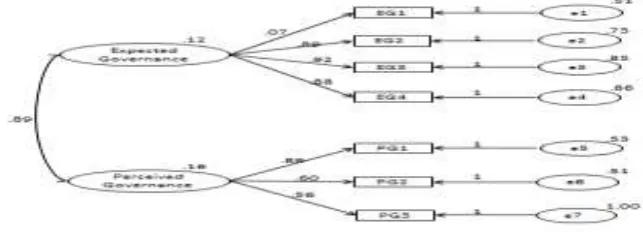
Two factors related to expected governance were obtained which explained 21% of the total variance explained and perceived governance with 20% of the total variance explained. Figure No. 1 shows that the main reflector of the first factor is the indicator EG1 and for the case of perceived governance the indicator PG2 is its main reflector (0.7 and 0.6 respectively).
Figure 1: Model of indicators reflecting governance
Javier Carreón Guillén| May 2017| Vol.5|Issue 5|06-13 12 The adjustment and residual values [χ2 =
94.044 (13gl) p = 0.000; GFI = 0.917; NFI = 0.901; CFI = 0.913; RMR = 0.008; HOELTER = 0.002] suggest the acceptance of the null hypothesis with respect to the close
relationship between the theoretical
relations and the empirical data of the variables.
Conclusion
The contribution of the present study to the state of knowledge lies in the establishment of two factors related to expected governance and perceived governance, as a result of the exploratory factor analysis of main axes with promax rotation. Such structure can be confirmed with a probabilistic selection that allows to infer the results to a more general population.
However, it is necessary to point out that from its beginnings; social work has mediated the relationship between the State and citizenship. The State in its various forms and regimes of government, assuming that society is dependent on its decisions, as
well as on the management and
administration of security, has confined the intervention of social work to the study of its social determinants, rather than to the promotion of violence-free relationships. Public policies, through the institutions, sponsored the fight against crime as the central axis of national security. This is how social work was involved in a series of decisions aimed at confronting organized crime to the detriment of local security needs.
Social programs and institutional guidelines on local development have been influenced by public policies, in which social work practice has been adjusted to the intensive use of resources rather than to crime prevention. Thus, the management and mediation of conflicts between communities for the defense of their human rights has been circumvented by security policies and, as a consequence, social work intervention has remained outside the conflicts between civil society and the State in respect of human rights.
Security policies defined as governmental decisions and actions geared to economic growth based on the persecution and
condemnation of organized crime have reduced the competencies of social work to a minimum. In this sense, vulnerable, marginalized and excluded groups; which suffer from the unequal distribution of resources have not only been invisible, but also stigmatized as criminals or vulnerable to crime.
The intervention of social work in communities and indigenous peoples where organized crime prevails is fundamental for local development. However, social policies to combat poverty and crime have been directed at the discretionary distribution of financial resources, without regard to the customs and practices of communities, their self-defense networks, and the availability of local resources.
This panorama is analyzed from the relation between society and State, understood as an asymmetric relation. When citizenship is considered an open system, the scarcity of resources indicates the entropy towards which society is directed and its forms of government.
However, society and government are not entities in equilibrium from where they can intervene to adapt them to the contingencies of their environment. The imbalance is not considered as a cause of stability and adaptation, since it is the security climate that influences the socio-political system and, this not generating its stability is exposed to changes in the environment.
The demand for security implies an imbalance that will be solved with the prevention of crime and the delivery of justice. However, a greater demand for a climate of insecurity propitiates that the security system increases the vigilance and the punishment. In both cases, the imbalance becomes a stability within the system avoiding entropy.
However, public policies and local
This is so because the organized sectors of civil society walk on different and even opposing paths that far from adding efforts generate a low intensity confrontation with a view to a major conflict.
Acknowledgements
The autor thans: Leticia Cano Soriano, Director of National School of Social Work, National Autonomous University of Mexico and National Council for Science and Technology.
References
1. J Potter (1996) La representación de la realidad. Discurso, retórica y construcción social. (Barcelona, Piidos)
2. K Marx (2000) Introducción a la crítica de la economía política. (México: Siglo XXI, 1857) 3. P Feyerabend (1975) Contra el método.
Esquema de una epistemología anarquista. (Londres: NBL,)
4. V Fuentes, J Muyor, Z y Galinda (2010) ZEl trabajo social y las nuevas formas de reorganización del cuidado. Una aproximación al propósito de la ley de la dependencia. Alternativas, 17 (1):83-102.
5. A Eito (2012) La participación del usuario en el trabajo social. una mirada desde el presente hacia la concepción de humanismo. Acciones e Investigaciones Sociales, 32 (1):245-255. 6. A France (2011) Reflexiones en torno a la
Segunda Conferencia Mundial sobre: Trabajo Social y Desarrollo Social, acciones e impactos. Rumbos, 7(1):22-31
7. C Naranjo (2000) El eneagrama de la sociedad. Males del mundo, males de la sociedad. (México: La Llave,)
8. E Dussel (2014) 16 tesis de economía política. Una interpretación filosófica. (México: Siglo: XXI,)
9. G Colli (1990) El nacimiento de la filosofía. (Colombia: Universidad del Valle,)
10. G Zabludosky (1987) Max Weber y la dominación patrimonial en América latina. Revista Mexicana de Ciencias Políticas y Sociales, 124(1):75-96.
11. J Carreón (2016) Desarrollo Humano: Gobernanza, Desarrollo Local y Emprendimiento Social. (México: UNAM-ENTS)
12. M Foucault (2002) Arqueología del saber. (México: Siglo XXI)
13. M Foucault (1987) Hermeneútica del sujeto. (Buenos Aires: La Piqueta)
14. M Foucault (2000) Los anormales. (México: FCE)
15. M Foucault (2007) Nacimiento de la biopolítica. (México, FCE)
16. M Foucault (2003) Vigilar y castigar. (Buenos Aires, Siglo XXI)
17. M Quiroga, F Vargas, Ay Cruz (2010) Trabajo social y responsabilidad social: notas para una discusión ideológica. Tabula Rasa, 12(1):175-193
18. M Weber (2002) Economía y Sociedad. (México, FCE)
19. N Luhmann (2006) Sociología del riesgo. (México: UIA)
20. N Morera (2010) El vínculo entre las ciencias sociales y el trabajo social: algunos elementos para su discusión. Reflexiones, 89(1):235-241 21. [P Bourdieu (1998) La dominación masculina.
(Barcelona: Anagrama)
22. PBourdieu (1990) Sociología y Cultura. (México: Grijalbo,)