Milieu matters: Evidence that ongoing lifestyle
activities influence health behaviors
Rob Lowe1, Paul Norman2, Paschal Sheeran3
*
1 Swansea University, Swansea, United Kingdom, 2 University of Sheffield, Sheffield, United Kingdom, 3 University of North Carolina at Chapel Hill, Chapel Hill, North Carolina, United States of America
Abstract
Health behaviors occur within a milieu of lifestyle activities that could conflict with health actions. We examined whether cognitions about, and performance of, other lifestyle activi-ties augment the prediction of health behaviors, and whether these lifestyle factors are especially influential among individuals with low health behavior engagement. Participants (N = 211) completed measures of past behavior and cognitions relating to five health behav-iors (e.g., smoking, getting drunk) and 23 lifestyle activities (e.g., reading, socializing), as well as personality variables. All behaviors were measured again at two weeks. Data were analyzed using neural network and cluster analyses. The neural network accurately pre-dicted health behaviors at follow-up (R2= .71). As hypothesized, lifestyle cognitions and activities independently predicted health behaviors over and above behavior-specific cogni-tions and previous behavior. Additionally, lifestyle activities and poor self-regulatory capabil-ity were more influential among people exhibiting unhealthy behaviors. Considering ongoing lifestyle activities can enhance prediction and understanding of health behaviors and offer new targets for health behavior interventions.
Introduction
Research into predictors of health behaviors tends to focus exclusively on cognitions concern-ing the behavior of interest, and eschews questions about other ongoconcern-ing lifestyle activities [1]. Researchers interested in exercise ask questions about exercise behavior, those interested in smoking ask questions about smoking, and researchers concerned with alcohol consumption enquire about drinking behavior [2]. The rationale for focusing on behavior-specific cogni-tions comes from models such the theory of planned behavior [3–6] which assume that vari-ables not specified by the model, such as other ongoing activities, only affect behavior via their influence on behavior-specific cognitions. However, daily life demands that people manage multiple intentions and behaviors [7–10]; performance of any particular health behavior occurs within an interdependent set of activities undertaken during the same time period. The present study tests whether cognitions about, and performance of, other ongoing lifestyle activities enhances the prediction of focal health behaviors beyond the influence of behavior-specific intentions, attitudes, norms, and perceived behavioral control. We also examine
a1111111111 a1111111111 a1111111111 a1111111111 a1111111111
OPEN ACCESS
Citation: Lowe R, Norman P, Sheeran P (2017) Milieu matters: Evidence that ongoing lifestyle activities influence health behaviors. PLoS ONE 12 (6): e0179699.https://doi.org/10.1371/journal. pone.0179699
Editor: Pietro Cipresso, IRCCS Istituto Auxologico Italiano, ITALY
Received: December 9, 2015
Accepted: June 2, 2017
Published: June 29, 2017
Copyright:©2017 Lowe et al. This is an open access article distributed under the terms of the Creative Commons Attribution License, which permits unrestricted use, distribution, and reproduction in any medium, provided the original author and source are credited.
Data Availability Statement: The data have been uploaded to Figshare:https://figshare.com/ account/home#/collections/3796357.
whether other ongoing lifestyle activities are especially influential for people who donot
engage in health behaviors.
Predicting health behaviors
Several theories including the theory of planned behavior, protection motivation theory, and the health action process approach have been developed to specify the factors that predict health behaviors (see [2] for a review). A recent analysis of 10 such health behavior theories indicated that the models converged onintentions,attitudes,norms, andperceived behavioral
control /self-efficacyas key predictors [11]. Intentions summarize people’s motivation to act and
are construed as the most immediate and important predictor of health behaviors. Intentions, in turn, are determined by the person’s overall evaluation of the consequences of performing the behavior (attitude), perceived social pressure to act (subjective norm), and perceptions of the act’s ease or difficulty (perceived behavioral control, PBC). Meta-analyses indicate that these four predictors account for 14% to 24% of the variance in health behaviors [6,12]. How-ever, a large proportion of behavior variance is unexplained [13] suggesting a role for other pre-dictor variables. Several studies have tested whether additional cognitive constructs such as descriptive norms and self-identity improve behavioral prediction (reviews by [14–16]). How-ever, these additional constructs also concern the focal behavior. The possible significance of other ongoing activities for predicting health behaviors has largely been ignored.
The role of other ongoing activities
There have been calls for a deeper analysis of how health behaviors fit into wider lifestyle choices and for an enlargement of health behavior theories to accommodate facilitating and conflicting goals (e.g., [17,18]). Daily routines require managing multiple goals and behaviors during scheduled time periods [19]. Health behaviors are part of this milieu of ongoing activities. Enact-ment of health behaviors could be influenced by cognitions about, and performance of, these other lifestyle activities in two main ways. First, ongoing activities could facilitate performance of health behaviors. Facilitation can occur (a) because the behaviors overlap, i.e., performing the ongoing activity involves performing the health behavior; for instance, taking a long walk in the countryside entails exercise behavior, or (b) because the behaviors are related instrumentally; for example, reading for pleasure or watching a video could constitute strategies that enable some-one to avoid getting drunk [20,21]. Second, ongoing activities could conflict with, and so inhibit, focal behaviors [22]. Resource limitations may require prioritizing one behavior over another, or other ongoing activities may be incompatible with a focal health behavior. For exam-ple, it is not possible to read for pleasure and engage in exercise at the same time [19]. Addition-ally, ongoing activities could deplete self-control resources and so compromise the effective pursuit of health goals. For example, forcing oneself to study over an extended period could make it hard to resist a tempting snack [23]. In sum, factors such as behavioral overlap, instru-mental relations, behavior compatibility, and material or self-control resources may determine whether ongoing lifestyle activities enable or inhibit enactment of health behaviors.
To date, only a small body of research, predominantly focusing on physical activity, has examined how health behaviors fit into wider lifestyle choices. For instance, conflicting behav-iors predicted less physical activity over and above the effects of physical activity intentions and perceived behavioral control [24]. Similarly, intentions to watch TV significantly predicted less physical activity two weeks later, even after accounting for behavior-specific cognitions [25]. However, other studies have failed to observe significant relationships between perceived goal conflict and physical activity [26,27]. It appears that the case is not yet made that ongoing lifestyle activities have an important influence on health behavior performance.
The present research
We extend previous studies concerning the influence of other ongoing activities on focal health behaviors in three key ways. First, whereas previous studies assessed a single health behavior (physical activity), the present study considers a suite of health behaviors. We focus simultaneously on smoking, excessive alcohol consumption, dietary behaviors, and exercise because these behaviors have substantial effects on mortality and morbidity (e.g., [28–30]). Assessing several focal behaviors simultaneously also reflects the reality that people undertake multiple health behaviors as well as multiple other lifestyle activities. Second, the present study examined a large and unbiased set of ongoing lifestyle activities. Twenty-three other behaviors that participants could undertake during the same follow-up period as the focal health behav-iors were specified. These other activities were unbiased in that (a) no attempt was made to select behaviors that were likely to conflict with or facilitate performance of the focal behaviors, and (b) participants were not sensitized to the aims of the research by assessingperceptionsof goal conflict or facilitation. Third, the present study examined both the overall impact of ongo-ing lifestyle activities on focal behavior performance and individual differences in how much influence was exerted by those other activities.
Our individual difference analyses were inspired by counteractive control theory (e.g., [31]) which proposes that people who successfully pursue focal behaviors are likely to have devel-oped efficient mechanisms for managing conflicting activities. Conversely, people who engage less in focal behaviors are reliant on conscious, effortful shielding of those behaviors from alternative activities, and so are more likely to be tempted by distractions. Fishbach et al. [31] showed that for participants good at controlling their weight, priming competing goals such as tempting chocolates automatically activated weight control goals. For participants who were poor at self-regulating their weight, on the other hand, priming engendered no activation of the weight control goal. Thus, we predicted that there would be a negative relationship between undertaking other lifestyle activities and focal health behaviors, but only for partici-pants who infrequently perform health behaviors. Consistent with Fishbach et al.’s analysis [31], we also predicted that people who engaged less in health behaviors would be character-ized by low scores on key personality variables relevant to goal management [32,33]: general-ized self-efficacy, action control, self-esteem, and locus of control. Self-efficacy encompasses a person’s belief about their ability to overcome obstacles to a desired goal, and determines effort exerted in achieving the goal [34]. Action control refers to people’s ability to regulate interfer-ing emotions when strivinterfer-ing to achieve a desired goal [35]. Self-esteem refers to people’s atti-tude toward themselves and is shaped by life experiences, including accomplishments and failures [36]. Locus of control refers to the degree to which people believe they are instrumen-tal in causing life events, and the extent to which these beliefs are reinforced when outcomes are or are not consistent with such beliefs [37].
In sum, the present study deployed a series of innovations to test whether other ongoing activities influence performance of focal health behaviors. Two hypotheses were tested: (1) cognitions about, and performance of, other ongoing activities would predict health behaviors over and above the influence of behavior-specific cognitions, and (2) participants with low engagement in health behaviors would (a) be especially liable to influence by other ongoing activities, and (b) exhibit poor self-regulatory capability according to standard personality measures.
Method
specified by the British Psychological Society. Participants were informed that taking part in the research was voluntary and that completing the questionnaires would be taken to indicate consent. Participants were instructed not to sign the questionnaire. An anonymous code was used to match responses from both time-points.
Participants and procedure
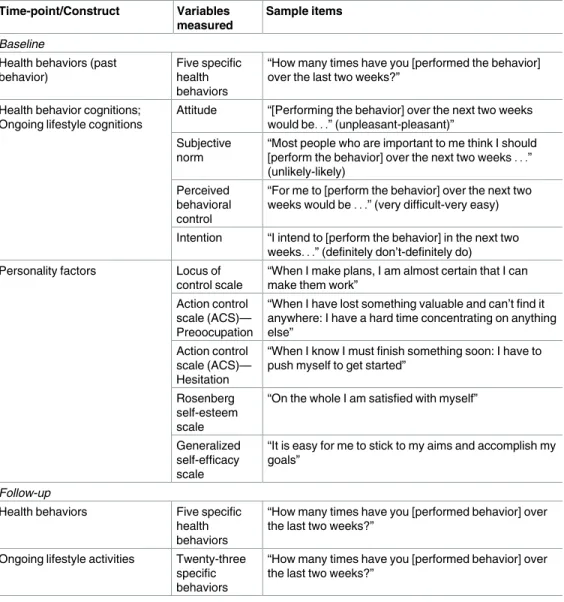
A longitudinal questionnaire survey of 28 behaviors was conducted among a convenience sample of 211 Psychology undergraduates (68.7% women,M-age = 20.26,SD= 2.92). At base-line, participants completed a questionnaire that measured cognitions about, and frequency of performance of, five health behaviors and 23 other lifestyle behaviors, as well as several person-ality factors. Two weeks later, participants completed a follow-up questionnaire concerning their frequency of performing the 28 behaviors (seeTable 1for overview of study variables).
Behaviors. We identified behaviors from a pilot test of lifestyle activities among 31 UK
undergraduates. The final set of behaviors was selected on the basis that approximately one-half of the participants engaged in the behaviors at the specified frequency in the previous two
Table 1. Variables measured at each time-point.
Time-point/Construct Variables
measured
Sample items
Baseline
Health behaviors (past behavior)
Five specific health behaviors
“How many times have you [performed the behavior] over the last two weeks?”
Health behavior cognitions; Ongoing lifestyle cognitions
Attitude “[Performing the behavior] over the next two weeks would be. . .” (unpleasant-pleasant)”
Subjective norm
“Most people who are important to me think I should [perform the behavior] over the next two weeks. . .” (unlikely-likely)
Perceived behavioral control
“For me to [perform the behavior] over the next two weeks would be. . .” (very difficult-very easy)
Intention “I intend to [perform the behavior] in the next two weeks. . .” (definitely don’t-definitely do) Personality factors Locus of
control scale
“When I make plans, I am almost certain that I can make them work”
Action control scale (ACS)— Preoocupation
“When I have lost something valuable and can’t find it anywhere: I have a hard time concentrating on anything else”
Action control scale (ACS)— Hesitation
“When I know I must finish something soon: I have to push myself to get started”
Rosenberg self-esteem scale
“On the whole I am satisfied with myself”
Generalized self-efficacy scale
“It is easy for me to stick to my aims and accomplish my goals”
Follow-up
Health behaviors Five specific health behaviors
“How many times have you [performed behavior] over the last two weeks?”
Ongoing lifestyle activities Twenty-three specific behaviors
“How many times have you [performed behavior] over the last two weeks?”
weeks. Baseline and follow-up behaviors were assessed with items devised specifically for the study. Participants were presented with the stem, “How many times have you [performed the behavior] over the last two weeks?” (with minor variations), and entered the number in a space provided. The study examined fivehealth-related behaviors: engaging in at least 20 min-utes of moderate/vigorous exercise, smoking cigarettes, getting drunk, number of days had eaten at least one piece of fruit, and eating fast food. Twenty-threeother lifestyle activitieswere assessed: buying a magazine, buying a newspaper, reading for pleasure, taking vitamin pills, visiting a friend, going out for a meal, attending all lectures, getting at least 7 hours sleep, buy-ing clothes, not lybuy-ing-in past 9.00am, gobuy-ing to the cinema, gobuy-ing for a walk, engagbuy-ing in inde-pendent study, writing a letter, recycling bottles, visiting the countryside, going to the library, avoiding eating meat, renting a video, going shopping, visiting parents, going clubbing, and tidying room. Two additional behaviors were assessed (going to the sports center, going to the pub) but were not included in the analyses because they overlap too greatly with the target health behaviors of exercise and avoiding getting drunk, respectively.
Cognition measures. Cognitions were measured on 7-point semantic differential scales.
Item wording followed the standard format for measuring each construct (e.g. [38]).Intention
was assessed by two items (e.g., “I intend to [perform the behavior] in the next two weeks. . .”; definitely don’t-definitely do).Attitudewas measured by three items “[Performing the behav-ior] over the next two weeks would be. . .” (bad-good, unenjoyable-enjoyable, unpleasant-pleasant)”.Subjective normwas measured by two items (e.g., “Most people who are important to me think I should [perform the behavior] over the next two weeks. . .”; unlikely-likely).
Per-ceived behavioral control(PBC) was measured by four items (e.g., “For me to [perform the
behavior] over the next two weeks would be. . .”; very difficult-very easy). The internal reliabil-ity of TPB variables for the 28 behaviors was high (median alphas = .97, .82, .92, and .83, for intention, attitude, subjective norm, and PBC, respectively).
Personality factors. Participants completed five standard personality scales: Rotter’s
Locus of Control Scale [37], the preoccupation and hesitation subscales of the Action Control Scale (ACS) [39], the Generalized Self-Efficacy Scale [40], and the Rosenberg Self-Esteem Scale [36]. These scales generally exhibited satisfactory internal reliability (alphas = .58, .77, .75, .79, and .86, respectively). Although the reliability of the locus of control scale was modest, it was retained because the scale’s reliability and validity are well established [41].
Analysis strategy
Results
Predicting health behavior at follow-up
There were five types of predictors: health behavior cognitions, other lifestyle activities, cogni-tions about other lifestyle activities, personality factors, and baseline health behaviors. We examined the ability of the neural network to use these variables to predict follow-up health behavior. The predictors were used as inputs to the network, and the follow-up health behavior index was the target that the network was trying to predict. We explored the association between each type of predictor and follow-up health behavior separately across five test waves (one for each predictor type). The predictive utility of all predictor types together was assessed in a sixth test wave, referred to as thesaturated model.
The network used each predictor type to estimate target health behavior index scores. The association between the network’s estimated and actual health behavior index scores were explored via correlation and regression (Table 2). The regression analyses examined whether other ongoing lifestyle activities and lifestyle cognitions enhanced prediction of health behav-iors over and above the effects of health behavior cognitions and personality factors, as well as baseline health behavior. In these analyses, the network’s output (health behavior index esti-mate) derived from health behavior cognitions (intentions, attitude, subjective norm, and PBC) was entered on the first step. The second step contained the network’s output for person-ality factors. The third step comprised the network’s output for lifestyle cognitions and activi-ties. Finally, the fourth step contained the network’s output for baseline health behavior.
Correlations showed that health behavior cognitions, lifestyle cognitions, ongoing lifestyle activities, and baseline health behaviors—but not personality factors—were each significantly associated with health behavior scores (Table 2). That is, the respective predictors enabled the network to estimate target health behavior.
In the regression analyses (Table 2), health behavior cognitions explained 18% of the vari-ance on the first step,F(1, 209) = 45.59,p<.001. At step 2, personality contributed a negligi-ble variance (<1%),Fchange(1, 208) = 1.13,p = ns. At step 3, lifestyle cognitions and ongoing activities explained an additional 24% of the variance,Fchange(2, 206) = 44.80,p<.001. On the final step, the inclusion of baseline health behaviors accounted for an additional 29% of the variance,Fchange(1, 205) = 205.87,p<.001. Importantly, cognitions about, and performance of, other lifestyle activities both significantly predicted health behavior at follow-up even after health behavior cognitions and past behavior had been taken into account (βs = .16 and .19, respectively,p<.001). The final model accounted for 71% of the variance,F(5, 205) = 103.42,
p<.001.
Table 2. Correlations and hierarchical regression analysis of health behavior on predictor types from the neural network.
Step Predictor r Adj R2 Adj R2Change Step 1β Step 2β Step 3β Step 4β
1 Health behavior cognitions .42*** .18 .18*** .42*** .42*** .42*** .13**
2 Personality factors .09 .18 .00 .07 .04 .04
3 Lifestyle cognitions .30*** .30*** .16***
Ongoing lifestyle activities .47*** .42 .24*** .35*** .19***
4 Baseline health behaviors .80*** .71 .29*** .65***
Note. **p<.01, ***p<.001.
Identifying health behavior clusters and their predictors
Data from the saturated model test run, where all sets of predictor variables were presented together to the neural network, were submitted to a two-stage cluster analysis [43,44]. The aim was to empirically determine groups of participants who were similar in terms of the rela-tionship between predictor variables and health behavior performance at follow-up (seeS1 Filefor technical details). We then determined how each participant group differed from the other groups regarding their health behavior scores and scores on predictor variables. For each variable in each group, we computed Cohen’sd[45] for the comparisons between the respec-tive group mean and the mean of the other groups combined. Based on the assumption that effect sizes of medium magnitude or larger would be especially meaningful, a variable was con-sidered salient, i.e., capable of discriminating the relevant health behavior group, if group dif-ferences on predictor variables were |d|.50. (A difference of this magnitude is also
conventionally significant atp<.001.)
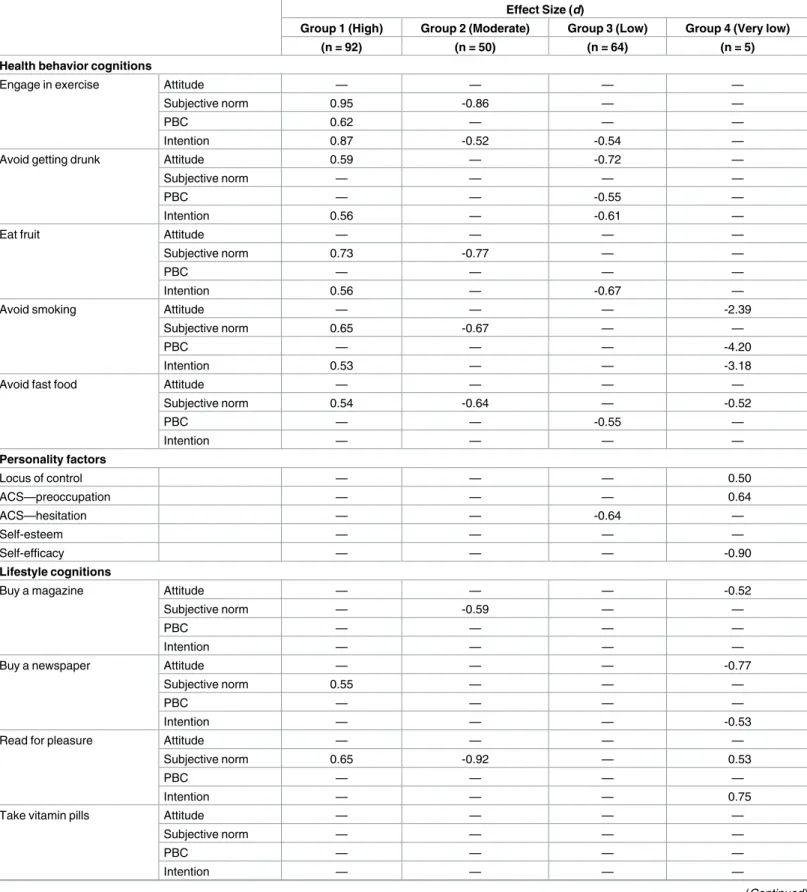
The network identified four participant groups according to predictor-output characteris-tics present in their data (Table 3). As expected, groups differed in their health behavior perfor-mance. Group 1 showed high engagement in health behaviors (d= 0.98,n= 92), group 2 showed moderate engagement (d= 0.32,n= 50), group 3 showed low engagement (d= -1.11,
n= 64), and group 4 showed very low engagement (d= -2.22,n= 5). Although this last group was small, this cluster was retained because the pattern of responding was interpretable and provided information about a minority of participants who were committed smokers.Table 3
showsd-values exceeding±0.5 (Table A inS1 Fileprovides alld-values).
As predicted, different variables were salient for different groups (seeTable 3). For partici-pants with high levels of engagement in health behaviors at follow-up (group 1), health cogni-tions were salient: Intencogni-tions and subjective norms were strong for four out of the five health behaviors. Despite their frequent performance of health behaviors, there was no difference in how often group 1 participants engaged in the 23 ongoing lifestyle activities compared to the other groups;dvalues for these activities did not exceed±0.5. This is consistent with the idea that these potentially competing activities were managed efficiently. Interestingly, participants in this group also felt normative pressure to engage in those other activities.
A different pattern emerged for participants with moderate engagement in health behaviors (group 2). The factor that most clearly discriminated this group was low levels of normative influence. Weak subjective norms were apparent for four of the five health behaviors and for 13 out of the 23 other ongoing activities (57%). Like group 1, ongoing lifestyle activities and personality variables were not salient for this group.
Consistent with predictions, ongoing lifestyle activities were salient for the low engagement in health behavior group (group 3). In particular, participants in this cluster showed a high degree of social engagement (visiting a friend, going clubbing); they were also likely to engage in behaviors that were antithetical to their academic goals (lying in past 9.00 a.m., not attend-ing all lectures). A number of cognitions about the health behaviors were salient, notably weak motivation as indicated by low intention for three of the five behaviors. Intention was also salient for 6 of the 23 other activities (26%), five of which indexed low motivation, especially for behaviors related to studying. One personality variable distinguished this group from the other participants, namely, low scores on the hesitation sub-scale of the ACS. This finding indicates that participants in group 3 experienced problems in initiating action.
Table 3. Effect sizes for predictor variables for groups with different levels of engagement in health behaviors.
Effect Size (d)
Group 1 (High) Group 2 (Moderate) Group 3 (Low) Group 4 (Very low)
(n = 92) (n = 50) (n = 64) (n = 5)
Health behavior cognitions
Engage in exercise Attitude — — — —
Subjective norm 0.95 -0.86 — —
PBC 0.62 — — —
Intention 0.87 -0.52 -0.54 —
Avoid getting drunk Attitude 0.59 — -0.72 —
Subjective norm — — — —
PBC — — -0.55 —
Intention 0.56 — -0.61 —
Eat fruit Attitude — — — —
Subjective norm 0.73 -0.77 — —
PBC — — — —
Intention 0.56 — -0.67 —
Avoid smoking Attitude — — — -2.39
Subjective norm 0.65 -0.67 — —
PBC — — — -4.20
Intention 0.53 — — -3.18
Avoid fast food Attitude — — — —
Subjective norm 0.54 -0.64 — -0.52
PBC — — -0.55 —
Intention — — — —
Personality factors
Locus of control — — — 0.50
ACS—preoccupation — — — 0.64
ACS—hesitation — — -0.64 —
Self-esteem — — — —
Self-efficacy — — — -0.90
Lifestyle cognitions
Buy a magazine Attitude — — — -0.52
Subjective norm — -0.59 — —
PBC — — — —
Intention — — — —
Buy a newspaper Attitude — — — -0.77
Subjective norm 0.55 — — —
PBC — — — —
Intention — — — -0.53
Read for pleasure Attitude — — — —
Subjective norm 0.65 -0.92 — 0.53
PBC — — — —
Intention — — — 0.75
Take vitamin pills Attitude — — — —
Subjective norm — — — —
PBC — — — —
Intention — — — —
Table 3. (Continued)
Effect Size (d)
Group 1 (High) Group 2 (Moderate) Group 3 (Low) Group 4 (Very low)
(n = 92) (n = 50) (n = 64) (n = 5)
Visit a friend Attitude — — — —
Subjective norm — -0.84 — —
PBC — — — —
Intention — -0.57 — —
Go out for a meal Attitude — — — —
Subjective norm — -0.97 — —
PBC — — — —
Intention — -0.56 — —
Attend all lectures Attitude — — — —
Subjective norm — — — —
PBC — — -0.62 -0.59
Intention — — -0.55 —
7 hours sleep Attitude — — -0.51 —
Subjective norm 0.50 — — —
PBC — — — 0.72
Intention 0.53 — -0.61 1.03
Buy clothes Attitude — — — —
Subjective norm 0.56 -1.23 — —
PBC — — — —
Intention — — — —
Not lying-in past 9.00am Attitude — — -0.60 —
Subjective norm — — — —
PBC — 0.56 -0.52 -0.53
Intention — — -0.62 —
Go to cinema Attitude — — — —
Subjective norm 0.74 -0.83 — —
PBC — — — -0.75
Intention 0.60 — — —
Go for a walk Attitude 0.66 — — —
Subjective norm 0.89 -1.01 — —
PBC — — — —
Intention 0.96 -0.61 -0.50 —
Independent study Attitude 0.68 — -0.55 —
Subjective norm — — — —
PBC — — — -0.97
Intention 0.71 — -0.61 —
Write a letter Attitude — — — 0.54
Subjective norm — -0.82 — —
PBC — — — -0.64
Intention — — — —
Recycle bottles Attitude — — — —
Subjective norm 0.56 — — —
PBC — — — —
Intention — — — —
Table 3. (Continued)
Effect Size (d)
Group 1 (High) Group 2 (Moderate) Group 3 (Low) Group 4 (Very low)
(n = 92) (n = 50) (n = 64) (n = 5)
Visit the countryside Attitude — — — —
Subjective norm 1.02 -1.33 — —
PBC — — — —
Intention 0.67 -0.71 — —
Go to the library Attitude — — — -0.51
Subjective norm — -0.64 — —
PBC — — — -0.77
Intention — — — —
Avoid eating meat Attitude — — — —
Subjective norm — — — —
PBC — — — —
Intention — — — —
Rent a video Attitude — — — —
Subjective norm — — — —
PBC — — — —
Intention — — — —
Go shopping Attitude — — — —
Subjective norm — -1.02 — —
PBC — — — -0.58
Intention — — — -0.62
Visit parents Attitude — — — —
Subjective norm — — — —
PBC — — — -0.67
Intention — — — —
Go clubbing Attitude — — — —
Subjective norm — -0.64 0.67 —
PBC — — — —
Intention — — 0.92 —
Tidy room Attitude — — — —
Subjective norm — -0.73 — —
PBC — — — -0.92
Intention — — — —
Ongoing lifestyle activities
Buy a magazine — — — -0.53
Buy a newspaper — — — -0.77
Read for pleasure — — — —
Take vitamin pills — — — 0.52
Visit a friend — -0.57 0.53 -0.63
Go out for a meal — — — —
Attend all lectures — — -0.56 -0.62
7 hours sleep — — — —
Buy clothes — — — —
Not lying-in past 9.00am — — -0.54 -0.53
Go to cinema — — — -1.11
Go for a walk — — — -0.57
would be especially salient for this group. This proved to be the case, but the effect was in the opposite direction to what was anticipated. Group 4 engaged infewer, not more, alternative activities. Participants were less likely to read (magazines, newspapers), socialize (visit friends, go for walks, go to the cinema), and pursue their academic goals (attend lectures, avoid lying in, independent study) compared to the other groups. The only lifestyle behavior that they engaged in more frequently than other participants was taking vitamin supplements. Lifestyle cognitions were also salient, and there was evidence of low perceived control for 9 of the 23 behaviors (39%). Personality factors were salient for this group. Participants exhibited low self-regulatory capability as shown by elevated external locus of control [37], low generalized self-efficacy [40], and high scores on the ACS-preoccupation subscale [35]. High preoccupation scores indicate a tendency to ruminate about setbacks and failure rather than get started on one’s goal pursuit [39]. Thus, the personality data and the findings for cognitions about other ongoing behaviors indicated this small cluster of participants exhibited poor action control.
Discussion
This study aimed to understand health behaviors in context, and in particular, how people coordinate health actions in relation to other ongoing activities. Cavallo and Fitzsimons [46] pointed out that “most investigations into multiple goals have usually examined only two goals” (p. 293). To better capture the reality of striving for multiple goals, the present research assessed five health behaviors together with 23 other ongoing behaviors that participants might undertake during the same follow-up period. Two key novel findings emerged. First,
Table 3. (Continued)
Effect Size (d)
Group 1 (High) Group 2 (Moderate) Group 3 (Low) Group 4 (Very low)
(n = 92) (n = 50) (n = 64) (n = 5)
Independent study — — — -0.74
Write a letter — — — —
Recycle bottles — — — —
Visit the countryside — — — —
Go to the library — — — -1.03
Avoid eating meat — — — —
Rent a video — — — —
Go shopping — — — -0.72
Visit parents — — — —
Go clubbing — — 0.73 —
Tidy room — — — —
Baseline health behaviors
Engage in exercise 0.90 — -0.72 —
Avoid getting drunk 0.52 0.64 -0.98 -0.51
Eat fruit 0.77 — -1.03 —
Avoid smoking — — — -4.07
Avoid eating fast food — — -0.85 —
Note. Only values of d exceeding±0.5 are shown.
Group 1 = high engagement in health behavior group, Group 2 = moderate engagement group, Group 3 = low engagement group, Group 4 = very low engagement group,
PBC = perceived behavioral control, ACS = Action Control Scale [39].
other ongoing lifestyle activities influenced health behavior performance. Cognitions about, and enactment of, other ongoing activities significantly predicted health behavior at follow-up. These lifestyle variables accounted for a significant increment in the variance explained in behavior, over and above the influence of past behavior and cognitions about the health behav-iors. Second, there were notable individual differences in the extent to which other ongoing activities and the other predictor variables influenced health behaviors. For participants who exhibited moderate and high levels of health behavior at follow-up, the behavior-specific cog-nitions and past performance were salient. On the other hand, cogcog-nitions about, and the enact-ment of other activities were salient for participants who exhibited low and very low
engagement in health behaviors. Moreover, both low engagement groups were characterized by poor action control as indexed by the ACS [39]. These findings suggest that ongoing activi-ties are not mere extraneous variables that health behavior theories can afford to ignore. Life-style cognitions and behaviors forge a consequential context for health behavior performance —a milieu that matters, and matters differently for different people.
The present study has theoretical, practical, and analytic implications for health behavior research. The theoretical implications are four-fold. First, our findings support other evidence [47] questioning the “sufficiency assumption” of the theory of planned behavior (TPB)–the idea that extraneous variables only influence the target behavior via their effects on attitude, subjective norm, perceived behavioral control, or intention [3]. It should be noted that the present study supported the predictive validity of TPB variables. The cognitions specified by the TPB explained 18% of the variance in health behaviors. This finding is in line with McEa-chan et al.’s [6] meta-analysis of the TPB and health behaviors, and suggests that our use of neural network analysis did not disadvantage the TPB’s power to predict behavior. Nonethe-less, cognitions about, and performance of, other ongoing activities directly predicted behavior even after TPB variables and prior behavior had been taken into account, and explained a meaningful increment in the variance. These findings suggest that the TPB may need to be extended to take account of the important influence of other ongoing activities on health behaviors.
Second, the present study tested, and found support for, a prediction derived from counter-active control theory [31] that other ongoing lifestyle activities would be especially influential among participants who do not engage in health behaviors. Fishbach et al. [31] used priming paradigms to demonstrate that, for people who are successful at self-regulation, the presence of competing goal pursuits (temptations) was automatically countered by increased activation of the health goal—unlike people who are unsuccessful at self-regulation. In the present study, cluster analysis identified groups of participants who were more versus less successful at per-forming health behaviors. We observed equivalent effects to those obtained by Fishbach et al. [31]. In particular, even though participants who successfully engaged in health behaviors (group 1) were no less likely to engage in other lifestyle behaviors compared to the other groups, these participants still held strong health-related intentions. Conversely, among partic-ipants who did not engage health behaviors (group 3), cognitions and performance in relation to other ongoing behaviors were highly salient and health-related intentions and PBC were weaker. This is consistent with the idea that these participants have less efficient mechanisms for handling competing goals. Thus, the present findings would seem to support counteractive control theory in a field setting.
indicated problems in action initiation with an external locus of control, low levels of general-ized self-efficacy, and rumination about setbacks and failure (high scores on the preoccupation sub-scale of the ACS). The influence of these personality variables was observed only when dis-tinct groups were analyzed. We observed no significant overall association between personality variables and health behavior performance in the regression analyses. Findings may suggest that the influence of personality factors, and self-regulatory capability in particular, is subtle and may be masked in analyses of whole-sample data. Self-regulatory capability is important but only for participants who need to change their health behaviors—the key target group for interventions (see also [32]).
The final theoretical implication concerns the influence of subjective norms among partici-pants who showed moderate and high levels of engagement in health behaviors. This finding was not anticipated, not least because subjective norm typically is a weaker predictor of inten-tions and behavior compared to attitude and PBC (e.g., [6]). Subjective norms were salient for participants showing moderate and high levels of engagement in health behaviors, and were as salient as intention for high-engagement participants. The salience of subjective norm also dif-fered for the moderate versus high engagement groups. Whereas thed-value for subjective norms was positive for 4 out of the 5 health behaviors among participants with high levels of engagement, thed-value wasnegativefor 4 out of the 5 health behaviors among participants with moderate levels of engagement. An equivalent pattern was observed for subjective norm in relation to other ongoing activities. These findings may suggest that social pressure to engage in health behaviors is important and is especially important for the transition from moderate to high levels of engagement in health behaviors. One possible reason why the important influence of subjective norm was more apparent here compared to previous research is that neural networks can better handle non-linear relationships compared to tradi-tional regression analysis. Future research might therefore do well to test non-linear as well as linear relationships when testing the role of subjective norms.
The present findings also have implications for practice, and in particular for interventions to promote health behavior change. A useful innovation of the present research was to identify different clusters indicative of health behavior engagement and discover the key factors that characterize those clusters. Our findings suggest that different intervention strategies may be effective according to participants’ current health behavior performance. Targeting subjective norms could be effective among participants who currently exhibit moderate levels of perfor-mance (see, e.g., [48,49]). For participants with low levels of engagement in health behaviors, interventions might be better targeted at weak intentions and low PBC regarding health behav-iors. This group also had positive cognitions about, and high levels of engagement in, socializ-ing (e.g., visitsocializ-ing friends, clubbsocializ-ing) and negative cognitions about, and low levels of
engagement in, academic work (e.g., studying, attending lectures). This suggests that interven-tions may need to address participants’ broader life goals and seek to alter the priority that is attached to socializing versus academic and health behaviors. Participants with low levels of engagement in health behaviors also exhibited problems initiating action. As implementation intentions are known to facilitate getting started on one’s goal pursuits (review by [50]), this self-regulation tool could prove beneficial for low engagement participants [51–53].
The present research also has analytic implications as it suggests that neural networks are a valuable technique that could be exploited more fully in health behavior research (e.g. [42,
whatvariables are importantfor whomand so inform the design of future behavior change interventions [55].
Limitations
As with any new program of research, the present study has limitations that should be acknowledged. First, participants were university students and so caution should be exercised in extrapolating the findings to the other populations; further tests are needed using more rep-resentative and clinical samples to warrant generalizations. Second, behavior was followed up after two weeks. This short time-frame is not a problem for the current study because the essential question was not abouthabitchange per se, but rather variations in health behavior resulting from wider contextual factors within a given time frame. However, future research may want to explore effects of context and habit change with an extended follow-up period. Third, we acknowledge that questionnaire responses may be subject to some recall bias and error when participants considered their behavior and cognitions over the preceding period. Fourth, to reduce participant burden, behavior was assessed by single-item self-report mea-sures. Future studies would do better to deploy objective measures of health behaviors (e.g., cotinine tests to measure smoking, pedometers to measure exercise). Fifth, we were able to assess only a limited set of behaviors and personality variables in the present study. Improved indices of dietary behavior (e.g., changes in BMI), measures of other important health behav-iors (e.g., sleep, condom use), and laboratory tests of self-control and executive function would be valuable supplements in future research. Furthermore, broader contextual factors, not con-sidered here, such as SES, ethnicity, and place (e.g., urban vs. rural) will affect opportunities, time and physical resources needed for behavioral engagement. Future research may want to explore how such structural factors may moderate, or be mediated by, the influence of ongoing lifestyle activities on health behaviors. Finally, the sample size was modest. Nonetheless, the network was able to extract meaningful information, and the early stopping procedure (described inS1 File) gives us confidence that findings can be applied more widely. However, caution is especially warranted in drawing strong conclusions about participants with very low engagement in health behaviors. This group contained a very small number of participants, and additional studies are needed to corroborate the present findings.
Conclusion
Notwithstanding these limitations, the present research offers new insights into how milieu matters for health behaviors. Health actions typically are undertaken in the same settings and during the same time periods as other ongoing lifestyle activities. Moreover, health behaviors and other lifestyle activities both draw upon the same limited pool of self-control resources for their successful execution (e.g., [56]). The present findings suggest that health behavior theo-ries will be enriched and the prediction of health behaviors will be improved when other life-style activities are considered alongside the focal health behavior(s). Most important, taking account of the many, varied lifestyle intentions and behaviors that people regularly manage affords new targets for health behavior change interventions, especially for people who most need to change their behavior.
Supporting information
S1 File. Supporting information for milieu matters.
Author Contributions
Conceptualization: PS RL PN.
Data curation: RL PN.
Formal analysis: RL.
Funding acquisition: PS.
Investigation: PN PS RL.
Methodology: RL PS PN.
Project administration: PS.
Resources: RL PN PS.
Software: RL.
Supervision: PS.
Validation: RL PN PS.
Visualization: PS RL PN.
Writing – original draft: PS RL PN.
Writing – review & editing: PS RL PN.
References
1. Abraham C, Sheeran P. Implications of goal theories for the theories of reasoned action and planned behaviour. Curr Psychol. 2003; 22(3):264–80.https://doi.org/10.1007/s12144-003-1021-7
2. Conner M, Norman P. Predicting and changing health behavior: Research and practice with social cog-nition models. Third ed. Maidenhead, UK: McGraw Hill; 2015.
3. Ajzen I. The Theory of Planned Behavior. Organ Behav Hum Dec. 1991; 50(2):179–211.https://doi.org/ 10.1016/0749-5978(91)90020-T
4. Becker MH, Maiman LA, Kirscht JP, Haefner DP, Drachman RH. Health Belief Model and Prediction of Dietary Compliance—Field Experiment. J Health Soc Behav. 1977; 18(4):348–66.https://doi.org/10. 2307/2955344PMID:617639
5. Rogers RW. Protection Motivation Theory of Fear Appeals and Attitude-Change. J Psychol. 1975; 91 (1):93–114.https://doi.org/10.1080/00223980.1975.9915803PMID:28136248
6. McEachan RRC, Conner M, Taylor NJ, Lawton RJ. Prospective prediction of health-related behaviours with the Theory of Planned Behaviour: a meta-analysis. Health Psychol Rev. 2011; 5(2):97–144.
https://doi.org/10.1080/17437199.2010.521684
7. Atkinson JW, Birch D. The dynamics of action. New York: Wiley; 1970.
8. Carver CS, Scheier M. On the self-regulation of behavior. Cambridge, UK: Cambridge University Press; 1998.
9. Dodge KA, Asher SR, Parkhurst JT. Social life as a goal coordination task. In: Ames C, Ames R, editors. Research on Motivation in Education. 3. Orlando: Academic Press; 1989. p. 107–35.
10. Shah JY, Friedman R, Kruglanski AW. Forgetting all else: On the antecedents and consequences of goal shielding. J Pers Soc Psychol. 2002; 83(6):1261–80.https://doi.org/10.1037//0022-3514.83.6. 1261PMID:12500810
11. Sheeran P, Maki A, Montanaro E, Avishai-Yitshak A, Bryan A, Klein WMP, et al. The Impact of Chang-ing Attitudes, Norms, and Self-Efficacy on Health-Related Intentions and Behavior: A Meta-Analysis. Health Psychology. 2016; 35(11):1178–88.https://doi.org/10.1037/hea0000387PMID:27280365 12. Godin G, Kok G. The theory of planned behavior: A review of its applications to health-related
behav-iors. Am J Health Promot. 1996; 11(2):87–98. PMID:10163601
14. Conner M, Armitage CJ. Extending the theory of planned behavior: A review and avenues for further research. J Appl Soc Psychol. 1998; 28(15):1429–64.https://doi.org/10.1111/j.1559-1816.1998. tb01685.x
15. Rise J, Sheeran P, Hukkelberg S. The Role of Self-identity in the Theory of Planned Behavior: A Meta-Analysis. J Appl Soc Psychol. 2010; 40(5):1085–105.
16. Rivis A, Sheeran P. Descriptive norms as an additional predictor in the theory of planned behaviour: A meta-analysis. Curr Psychol. 2003; 22(3):218–33.https://doi.org/10.1007/s12144-003-1018-2 17. Abraham C, Sheeran P. Acting on intentions: the role of anticipated regret. The British journal of social
psychology / the British Psychological Society. 2003; 42(Pt 4):495–511. Epub 2004/01/13.https://doi. org/10.1348/014466603322595248PMID:14715114.
18. Massey EK, Gebhardt WA, Garnefski N. Adolescent goal content and pursuit: A review of the literature from the past 16 years. Dev Rev. 2008; 28(4):421–60.https://doi.org/10.1016/J.Dr.2008.03.002 19. Riediger M, Freund AM. Interference and facilitation among personal goals: Differential associations
with subjective well-being and persistent goal pursuit. Pers Soc Psychol B. 2004; 30(12):1511–23.
https://doi.org/10.1177/0146167204271184PMID:15536236
20. Bagozzi RP, Bergami M, Leone L. Hierarchical representation of motives in goal setting. The Journal of applied psychology. 2003; 88(5):915–43. Epub 2003/10/01.https://doi.org/10.1037/0021-9010.88.5. 915PMID:14516253.
21. Riediger M, Freund AM, Baltes PB. Managing life through personal goals: Intergoal facilitation and intensity of goal pursuit in younger and older adulthood. J Gerontol B-Psychol. 2005; 60(2):P84–P91.
22. Lee TW, Locke EA, Latham GP. Goal setting theory and job performance. In: Pervin A, editor. Goal con-cepts in personality and social psychology. Hillsdale, NJ: Lawrence Erlbaum Associates; 1989. p. 291–326.
23. Vohs KD, Heatherton TF. Self-regulatory failure: a resource-depletion approach. Psychol Sci. 2000; 11 (3):249–54. Epub 2001/03/29. PMID:11273412.https://doi.org/10.1111/1467-9280.00250
24. Presseau J, Tait RI, Johnston DW, Francis JJ, Sniehotta FF. Goal Conflict and Goal Facilitation as Pre-dictors of Daily Accelerometer-Assessed Physical Activity. Health Psychology. 2013; 32(12):1179–87.
https://doi.org/10.1037/a0029430PMID:22888818
25. Rhodes RE, Blanchard CM. Do sedentary motives adversely affect physical activity? Adding cross-behavioural cognitions to the theory of planned behaviour. Psychol Health. 2008; 23(7):789–805.
https://doi.org/10.1080/08870440701421578PMID:25160881
26. Li KK, Chan DKS. Goal conflict and the moderating effects of intention stability in intention-behavior relations: Physical activity among Hong Kong Chinese. J Sport Exercise Psy. 2008; 30(1):39–55.
27. Presseau J, Sniehotta FF, Francis JJ, Gebhardt WA. With a little help from my goals: Integrating inter-goal facilitation with the theory of planned behaviour to predict physical activity. Brit J Health Psych. 2010; 15:905–19.https://doi.org/10.1348/135910710x494105PMID:20385039
28. Burns H. Health in Scotland 2010: Annual report of the Chief Medical Officer for Scotland. Edinburgh, UK: Scottish Government; 2010.
29. Jewell T. Chief Medical Officer for Wales annual report 2010. Cardiff, UK: Welsh Government; 2010.
30. Mokdad AH, Marks JS, Stroup DF, Gerberding JL. Actual causes of death in the United States, 2000. Jama-J Am Med Assoc. 2004; 291(10):1238–45.https://doi.org/10.1001/jama.291.10.1238PMID:
15010446
31. Fishbach A, Friedman RS, Kruglanski AW. Leading us not unto temptation: Momentary allurements elicit overriding goal activation. J Pers Soc Psychol. 2003; 84(2):296–309.https://doi.org/10.1037/ 0022-3514.84.2.296PMID:12585805
32. Ferguson E. Personality is of central concern to understand health: towards a theoretical model for health psychology. Health Psychol Rev. 2013; 7:S32–S70.https://doi.org/10.1080/17437199.2010. 547985PMID:23772230
33. Norman P, Conner M. Predicting and changing health behavior: Future directions. In: Conner M, Nor-man P, editors. Predicting health behavior: Second edition. Maidenhead, UK: Open University Press; 2005. p. 324–71.
34. Bandura A. Self-efficacy: toward a unifying theory of behavioral change. Psychological review. 1977; 84 (2):191–215. Epub 1977/03/01. PMID:847061.
35. Kuhl J. A theory of action and state orientations. In: Kuhl J, Beckmann J, editors. Volition and personal-ity: Action versus state orientation. Seattle, WA: Hogrefe & Huber; 1994. p. 9–46.
37. Rotter JB. Generalized expectancies for internal versus external control of reinforcement. Psychological monographs. 1966; 80(1):1–28. Epub 1966/01/01. PMID:5340840.
38. Conner M, Sparks P. Theory of planned behaviour and health behaviour. In: Conner M, Norman P, edi-tors. Predicting Health Behaviour. Second ed. Maidenhead, UK: Open University Press; 2005. p. 170–222.
39. Kuhl J. Action versus state orientation: Psychometric properties of the Action Control Scale (ACS-90). In: Kuhl J, Beckmann J, editors. Volition and personality: Action versus state orientation. Seattle, WA: Hogrefe & Huber; 1994. p. 47–59.
40. Schwarzer R, Jerusalem M. Generalized Self-Efficacy scale. In: Weinman J, Wright S, Johnston M, edi-tors. Measures in health psychology: A user’s portfolio Causal and control beliefs. Windsor, UK: NFER-Nelson; 1995. p. 35–7.
41. Lefcourt HM, editor. Research with the locus of control construct: Extensions and limitations. New York: Elsevier; 2013.
42. Walker I, Milne S. Exploring function estimators as an alternative to regression in psychology. Behavior research methods. 2005; 37(1):23–36. Epub 2005/08/16. PMID:16097341.
43. Clatworthy J, Hankins M, Buick D, Weinman J, Horne R. Cluster analysis in illness perception research: A Monte Carlo study to identify the most appropriate method. Psychol Health. 2007; 22(2):123–42.
https://doi.org/10.1080/14768320600774496
44. Milligan GW. An examination of the effect of six types of error perturbation on fifteen clustering algo-rithms. Psychometrika. 1980; 45(3):325–42.https://doi.org/10.1007/Bf02293907
45. Cohen J. A Power Primer. Psychol Bull. 1992; 112(1):155–9.https://doi.org/10.1037/0033-2909.112.1. 155PMID:19565683
46. Cavallo JV, Fitzsimons GM. Goal competition, conflict, coordination, and completion: How intergoal dynamics affect self-regulation. In: Elliot HAAJ, editor. Goal-directed behavior. Hove, UK: Psychology Press; 2012. p. 267–99.
47. Sniehotta FF, Presseau J, Araujo-Soares V. Time to retire the theory of planned behaviour. Health Psy-chol Rev. 2014; 8(1):1–7.https://doi.org/10.1080/17437199.2013.869710PMID:25053004
48. Cialdini RB, Kallgren CA, Reno RR. A Focus Theory of Normative Conduct—a Theoretical Refinement and Reevaluation of the Role of Norms in Human-Behavior. Advances in Experimental Social Psychol-ogy. 1991; 24:201–34.https://doi.org/10.1016/S0065-2601(08)60330-5
49. Schultz PW, Nolan JM, Cialdini RB, Goldstein NJ, Griskevicius V. The constructive, destructive, and reconstructive power of social norms. Psychol Sci. 2007; 18(5):429–34. Epub 2007/06/20.https://doi. org/10.1111/j.1467-9280.2007.01917.xPMID:17576283.
50. Gollwitzer PM, Sheeran P. Implementation intentions and goal achievement: A meta-analysis of effects and processes. Adv Exp Soc Psychol. 2006; 38:69–119.
51. Armitage CJ, Arden MA. A volitional help sheet to increase physical activity in people with low socioeco-nomic status: A randomised exploratory trial. Psychol Health. 2010; 25(10):1129–45.https://doi.org/10. 1080/08870440903121638PMID:20309777.
52. Luszczynska A, Scholz U, Sutton S. Planning to change diet: a controlled trial of an implementation intentions training intervention to reduce saturated fat intake among patients after myocardial infarction. J Psychosom Res. 2007; 63(5):491–7.https://doi.org/10.1016/j.jpsychores.2007.06.014PMID:
17980221.
53. Orbell S, Hodgkins S, Sheeran P. Implementation intentions and the theory of planned behavior. Pers Soc Psychol B. 1997; 23(9):945–54.https://doi.org/10.1177/0146167297239004
54. Lowe R, Bennett P, Walker I, Milne S, Bozionelos G. A connectionist implementation of the theory of planned behavior: Association of beliefs with exercise intention. Health Psychology. 2003; 22(5):464– 70.https://doi.org/10.1037/0278-6133.22.5.464PMID:14570529
55. Sheeran P, Klein WMP, Rothman AJ. Health Behavior Change: Moving from Observation to Interven-tion. Annu Rev Psychol. 2017; 68:573–600.https://doi.org/10.1146/annurev-psych-010416-044007
PMID:27618942
56. Baumeister RF, Bratslavsky E, Muraven M, Tice DM. Ego depletion: Is the active self a limited resource? J Pers Soc Psychol. 1998; 74(5):1252–65.https://doi.org/10.1037/0022-3514.74.5.1252