i
AN EXAMINATION OF THE IMPACT OF A 21
STCENTURY
TECHNOLOGY GRANT ON SELECTED SCHOOLS IN A NORTH
CAROLINA DISTRICT
Scott S. Smith
A dissertation proposal submitted to the faculty of the University of North Carolina at Chapel Hill in partial fulfillment of the requirements for the degree of Doctorate of
Education in the School of Education.
Chapel Hill 2007
Approved by, Advisor: Barbara Day Reader: Robert Bellamy Reader: Fenwick English
ii © 2007
iii ABSTRACT
SCOTT S. SMITH: An Examination of the Impact of a 21st Century Technology Grant on Selected schools in a North Carolina School District
(Under the direction of Barbara D. Day)
The ever increasing demand on schools to produce students that are technology literate is growing at an alarming rate. Schools find themselves on the brink of the digital age and are faced with vast needs to successfully integrate and infuse technology into the classroom. This technological revolution is changing the face and climate of technology in and out of the classroom. Educators must embrace these changes and take on the challenge to produce students that are well versed in the use of technology. Helping students become 21st century citizens is the ultimate goal; however many needs must be addressed for success to occur. Through a needs assessment survey, the researcher sought trends related to the use technology in the classroom based on conditions in the educational setting.
The purpose of this study was to examine teachers’ opinions and needs to
v DEDICATION
vi ACKNOWLEDGEMENTS
Many have supported me in this endeavor: family, friends, loved ones and many superior educators have also assisted me along the way. Professor Xue Lan Rong helped me better understand diversity and different types of learners, while broadening my vision of what educators are capable of. Professor Fenwick English taught me more about myself as a leader than he will ever realize. He inspired me to study great leaders and use historical references as a guide. Dr. Robert Bellamy showed me how a
practitioner can succeed in the educational system and still have great joy after years of dedication and service. Professor and friend, Richard “Dick” Riedl has been an
vii TABLE OF CONTENTS
LIST OF TABLES...x
LIST OF FIGURES ... xi
CHAPTER I INTRODUCTION...1
Background/Statement of Problem...1
Purpose of Study...7
Research Questions...8
Definition of Terms ...10
Significance of the Study...12
Limitations...12
Summary...13
CHAPTER II LITERATURE REVIEW ...15
Introduction...15
Impact of Selected Conditions on Educational Technology Use ...15
Professional Development and Technology Use in Education...26
Learning Outcomes of Students and Teachers Linked to Technology...33
Conceptual Framework...36
Summary of Literature...37
CHAPTER III RESEARCH DESIGN...40
Purpose ...40
Research Questions...40
Participants/Location of Research ...41
viii
Instrumentation ...43
Procedures/Data Collection Methods ...51
Data Analysis...52
Limitations...54
Summary of Methodology...54
CHAPTER IV RESEARCH FINDINGS...55
Demographic Results...55
Item Analysis ...58
Descriptive Statistics on Construct and Sub Construct Averages ...75
21st Century Schools versus non-21st Century Schools ...78
Summary of Research Findings...81
CHAPTER V DISCUSSION...83
Review of Findings...83
Discussion...84
Impact of Selected Conditions on Educational Technology Use ...84
Professional Development - Opportunities...91
Professional Development – Participation...93
Classroom Practices and Student Outcomes...94
Impact of Technology...95
Limitations...97
Further Research...98
Future Practice ...98
APPENDIX A School Technology Needs Assessment (STNA)...101
APPENDIX B Academic Affairs Institutional Review Board Approval ...109
ix APPENDIX D Informed Consent Letter ...124 APPENDIX E Letter to Administrators...126
x LIST OF TABLES
Table 1: Possible Respondents per Location...42
Table 2: Conditions for Technology Use ...46
Table 3: Professional Development - Opportunities ...48
Table 4: Professional Development - Participation ...49
Table 5: Classroom Activities and Student Activities ...49
Table 6: Impact of Technology ...50
Table 7: Survey Response Rates ...55
Table 8a: Demographic Results...57
Table 8b: Demographic Results...58
Table 9: Conditions for Technology Use ...59
Table 10: Professional Development Opportunities...65
Table 11: Professional Development Participation ...67
Table 12: Classroom Practices and Student Activities...69
Table 13: Impact of Technology ...73
Table 14: Descriptive Statistics – Mean and Standard Deviation...76
Table 15: Cronbach Alpha Scores of STNA ...77
Table 16: STNA Designers’ Cronbach Alpha Scores ...77
Table 17: Comparison of 21st Century Schools to non-21st Century Schools Means...78
xi LIST OF FIGURES
CHAPTER I INTRODUCTION
Background/Statement of Problem
History of American society is marked by change and advancements facilitated by the modernization of technology. Since the invention of the light bulb, our culture has transformed from one of occasional technological use to one dependent upon technology. Positive results of technological advancements are evidenced repeatedly in our society. Throughout all facets of humanity, technological use and functionality has become critical. The field of education is not exempt from this phenomenon. The prominent expectation is that all 21st century learners be prolific in the use of technology and in doing so, they must be active and engaged participants in the information and digital age. “The 21st century learner must have the interest, attitude and ability to appropriately use digital technology and communication tools to access, manage, integrate and evaluate information; construct new knowledge; and communicate with others in order to
Over the past several years, the rapid rate of change in the field of technology has drastically affected the way we live, work and play. Since technology change is so rapid, our educational system must adapt quickly to these changes to accommodate new
technologies, methodologies, and learning styles. The annual conference, Technology as an Agent of Change in Teaching and Learning (TACTL) emphasized the importance of
changing with technology to meet the needs of teachers and learners. As a result of these transformations, technology advocates, have introduced technology mediums into all aspects of learning, seeing it as a catalyst for change that will encourage information processing, problem solving, as well as student centered learning and critical thinking (Getting America’s Students Ready Report, 1996). This is not a local decision or a sporadically enforced rule; it is a national mandate by the federal government. The federal legislation, “No Child Left Behind: Title II Part D: EETT - Enhancing Education Through Technology,” (Bush, 2002) requires technology use and implementation within schools and school districts.
basic employment rights. In short, because we’ve become convinced that over time the influence of technology in higher education will grow even more pervasive” (p. 3). Whereas this is a positive trend, it can also be overwhelming; thus, additional training and support must be provided and encouraged for educators to be able to learn how to effectively use technology in the classroom. The need for educational technology learning opportunities for educators is of tremendous importance.
Concerns surrounding the use of technology in the educational setting are the lack of proper information, connectivity, hardware, software, training and support that
educators should be given. Without adequate support, technology becomes a burden rather than a tool. The bottom line then becomes not how technology is used but if it is used at all. The digital divide was described as a crack or gap in access to technology that manifested itself into inequities in educational, economic, social, and civic
opportunities among sectors of the population. (enGague, 2003). This divide between the individuals increases each time technology is a hindrance rather than an asset.
The predominate need for technology and the gap in proficiency that exist among students and teachers has caused administrators, teachers, parents, students and even the government to push the infusion of technology. Rohan (2003) describes how the
government is awarding contracts to businesses that have a strong technological presence. In essence, the government is telling business and economic communities to “Adapt or Die” as the title of the article states. This push and interweaving of technology into society and into the curriculum is a key component to technology use and is often termed technology integration. According to one definition, technology integration means viewing technology as an instructional tool for the delivery of subject matter in the curriculum already in place (Woodbridge, 2004). In addition, the National Center for Educational Statistics (2006) defines technology integration as:
The incorporation of technology resources and technology-based practices into the daily routines, work, and management of schools. Technology resources are computers and specialized software, network-based communication systems, and other equipment and infrastructure. Practices include collaborative work and communication, Internet-based research, remote access to instrumentation, network-based transmission and retrieval of data, and other methods. This definition is not in itself sufficient to describe successful integration: it is
important that integration be routine, seamless, and both efficient and effective in supporting school goals and purposes (p. 3).
guide them through the necessary changes they need to make in order to be successful in integrating new technology into their classroom. In order to integrate technology, they must first be literate in technology use, yet what does that actually mean?
Technology literacy can be defined in a variety of ways. The International Technology Education Association (ITEA) in 2000 defined technology literacy as “the ability to use, manage, assess, and understand technology” (p. 1). Likewise Pearson and Young (2002) described technology literacy in three different dimensions: knowledge, capabilities, and ways of thinking and acting. The dimension of knowledge refers to the content that we expect students to learn. One’s capability references the development of hands-on skills using math, science, technology, and other concepts to solve
technological problems. The final dimension of ways of thinking and acting is a student’s ability to ask applicable questions about the content and skills they are learning which will inspire them to go farther than before.
The need for technology in the classroom is dependant on the educational setting. The literature does not have one consistent view of technology use, and the opinions about technology in the classroom are varied. Likewise the reasons for technology use and implementation are just as varied. As an example students who need individualized instruction can benefit from the use of technology. Yet, this is only made possible if educators’ needs for technology use are being met. Simply having the tools available is not enough; educators must learn how to use technology appropriately and effectively. As educators become versed in what technologies can offer students, success is
Technology use in the educational setting must, however, start with a vision and a well organized comprehensive plan to provide an environment with access to technology followed by teacher preparation on the effective use of technology. In order for the above mentioned to occur, schools must have funding, staffing and policies in place to support technology and teachers must be properly equipped, supported and trained to use technology in their daily curriculum..
Due to the nature of technology and its quick obsolesce, funding for technology is a major concern. Sun (1996) states, “Historically, schools across the nation have
approached instructional technology as an 'add on' in terms of funding. Although schools have budget lines for staff salaries, transportation, building and facilities maintenance, textbooks, and other essentials, few schools allocate regular funding for the purchase, maintenance, upgrading, support, and professional development related to new technologies”. Without budgets for technology, equipment cannot be purchased and maintained and personnel cannot be hired to assist with the upkeep, use and integration of technology. This causes a multitude of financial concerns for schools, administrators, district personnel and school boards as they try to keep up with this fluidity.
staff development on the integration of technology into the curriculum must continue and must be used on a regular basis as a tool to enhance and promote education.
Purpose of Study
The purpose of this study was to examine what conditions influence technology use; how professional development activities are offered and implemented; what impact technology has on teaching practice and student outcomes; and to determine if a
difference exists between schools meeting some of these specified conditions compared to those who do not. Through a needs assessment, the researcher examined what
conditions contributed to and influenced technology use as well as how schools perceive technology and its use in the educational setting.
Specifically, the researcher examined the impact of fulfilling technology conditions that enhanced and engaged students in the educational process. While research has been conducted in the area of planning and budgeting for technology and staff development for teachers on the use of technology in the classroom, this study examined fulfilling certain conditions related to teachers’ technology needs, to see if there is a significant difference in use. Through a federal 21st Century Community and
teachers. In addition, funding was provided for after school initiatives that involved technology for students, teachers, and the community. Funding was also available to provide specialized technology staff development for these schools. This initiative provided the schools with conditions that do not necessarily exist at other schools within the district.
This grant provided an opportunity to compare the uses of technology of teachers and students in the schools that fulfilled some conditional technology needs to those who had not. Still unknown were what requirements directly caused the effective use of technology in the classroom. Do meeting certain conditions and filling school and teacher needs in certain areas make a difference? Does having access to computers, Personal Digital Assistants (PDA), laptops, computer labs, projectors, and educational software make a significant difference in a school environment? Does prior planning for technology use and integration make a significant difference in its use? Does additional funding for the above said technologies show an increased use? Does having personnel in place to assist with the use of said technologies make a difference? Does professional development for teachers make a significant difference? These are areas where further research should be conducted and therefore the purpose of this study. The research questions are as follows:
Research Questions
1. What are the conditions for technology use in schools related to vision and leadership?
2. What are the conditions for technology use in schools related to planning, budgeting and evaluation?
3. What are the conditions for technology use in schools related to supportive environments for risk taking?
5. What are the conditions for technology use in schools related to resource media, software and tools?
6. What are the conditions for technology use in schools related to community linkages?
7. What are the professional development opportunities that may affect technology use in your school?
8. What are the professional development participation opportunities as it relates to technology use in your school?
9. How do all above mentioned conditions impact classroom practice and reflect on student activities in the classroom?
10.How do all above mentioned conditions affect the impact of technology in the classroom?
11.How do 21st century schools compare to non-21st century schools related to vision and leadership?
12.How do 21st century schools compare to non-21st century schools related to planning, budgeting and evaluation?
13.How do 21st century schools compare to non-21st century schools related to supportive environments for risk taking?
14.How do 21st century schools compare to non-21st century schools related to technical infrastructure and support?
15.How do 21st century schools compare to non-21st century schools related to resource media, software and tools?
16.How do 21st century schools compare to non-21st century schools related to community linkages?
17.How do 21st century schools compare to non-21st century schools related to professional development opportunities that may affect technology use in your school?
18.How do 21st century schools compare to non-21st century schools related professional development participation opportunities as it relates to technology use in your school?
19.How do 21st century schools compare to non-21st century schools related to the
impact on classroom practice and reflect on student activities in the classroom? 20.How do 21st century schools compare to non-21st century schools related to the
affect the impact of technology in the classroom?
believed that educators viewed technology as a never-ending financial hardship. The views would be fairly consistent, with the exception of some schools that fully utilize educational technology as a tool for learning. There would be two extremes, the heavy educational technology schools and the non-users with a moderate number of schools in the middle.
The researcher believed that filling specific conditions and technology needs, with vision and leadership as well as funding for equipment, were significant precursors to the implementation and impact of technology. Before teachers can begin to use and
implement technology, it has to be available to them. In addition, the researcher believed that merely placing the technology in the schools was not enough to make a significant difference in the use and integration of technology into instruction. With proper planning and leadership for technology and quality professional development combined with increased financial resources, technology use in the educational system would flourish.
Definition of Terms
21st century schools: For purposes of this study, this identification is used to
describe three schools in a western NC school district that received a 21st century
community and technology learning center grant.
CTLC: For purposes of this study, this term refers to three schools who received
a 21st century community and technology learning center grant to provide two million dollars for technology over a four year period.
Non-21st century schools: For purposes of this study, this identification is used to
School district in western North Carolina: A medium sized school district in the
foothills of North Carolina, consisting of approximately 14,500 students and 1200 certified teachers.
Digital divide: In the 1990s, the digital divide was characterized as a gap in
technology access that translated into inequities in educational, economic, social, and civic opportunities among sectors of the population. Since then, education leaders have come to realize that access is simply the first step. Equally important are robust home access and the readiness of individuals to use technology, communication networks, and information efficiently, effectively, and productively (NCREL, 2006).
STNA: School Technology Needs Assessment survey
Teacher technology needs: desires and requests of teachers about technology
conditions.
Technology: For purposes of this study, technology will be defined as any
electronic hardware or software for students and teachers to use in the classroom. (i.e. Computer, TV, VCR. Overhead, DVD Player, LCD projector, Hand held device, Smart Board, etc.)
Technology conditions: For purposes of this study, technology conditions will be
Technology integration: Seeman (2003) defines technology integration as a
curriculum in which a holistic approach and understanding of technology is designed in a way that technology is included in the day to day activities. Eisenberg (1996) says technology integration is using computers effectively and in the general content areas to allow students to learn how to apply computer skills in meaningful ways.
Technology literacy: As stated earlier, the ITEA defined technology literacy as
the ability to use, manage, assess, and understand technology (2000).
Significance of the Study
This study has great significance for schools across the world. In determining needs and conditions influencing the use of educational technology, administrators and boards of education can better make decisions related to the classroom. Budgetary constraints alone are a huge consideration; yet teacher attitudes and needs also greatly impact the amount and effectiveness of instruction. If schools understand overall teacher wants, needs and staff development concerns, they will be better able to meet the teachers on the appropriate level and address technology training concerns, while ensuring the tools are available to them. Additionally, the study will assist school districts in planning, decisions making implementation of what they want and need for future endeavors of educational technology. The information gathered will assist school
administrators in the budgeting process as well as planning for professional development activities.
Limitations
was not random and, therefore, cannot be deemed to be completely representative of all school teachers. However, while the results cannot be generalized for all teachers, the study drew a sample for a specific group of teachers in a specific school system. Consequently, the data give a good indication of the needs of teachers in schools with respect to educational technology in a school district on the major construct and sub construct areas as they relate to the research questions.
In addition, the rapid change of technology gives rise to a multitude of issues and concerns when studying technology. New technologies are developed daily that could advertently or inadvertently affect the results of the survey.
The examination of certain conditions is limited in scope. Many influences and conditions, those listed in this study and others, all contribute to what occurs in the classroom. The STNA measures only a few conditions and other external factors, as noted in the conceptual framework, which could be studied at a more in-depth level for additional research. Student achievement is a topic of interest to many. This topic is one that could be studied extensively to see if technology integration truly makes a difference in student achievement.
Summary
As stated above many issues and conditions exist surrounding the use of
CHAPTER II LITERATURE REVIEW
Introduction
Teachers and students across the United States are being expected to use and integrate technology. The premise is that teachers must use technology to produce students that are computer literate--active and engaged participants of the digital age and 21st century learners. In addition, schools are being pressured to narrow the gap of technology skills between students and teachers, students and students, and teachers and teachers. The researcher will attempt to identify the literature related to the use of technology in the classroom and what needs, in the form of certain conditions, affect its use. A number of conditions, including leadership, vision for technology use, proper planning and design, budgetary matters, evaluation strategies, supportive environments, available support (technical and instructional), resources, and community support, invariably impact upon the use of technology in the educational arena. Additionally the researcher will examine the role of professional development for educators. Student and teacher learning outcomes linked to technology will also be examined.
Impact of Selected Conditions on Educational Technology Use
Vision and Leadership
adequately for their integration into curriculum and instructional modalities. This is the responsibility of all educators, but the principal, as the curriculum leader in the school, sets the tone for this environment at the schools, just as the superintendent and other administrative leaders set the tone for the district as a whole.
Leadership, in the area of curriculum integration, is the key to the success of technology in the classroom. “A school that adopts a curriculum that aims for a holistic approach and understanding of technology does so because it produces a better educated person than a curriculum which does not” (Seeman, 2003. p. 2). With leadership in the area of a unified core curriculum, educators can adopt basic principles to guide the use of technology in the classroom. These basic principles will guide the contextual framework and therefore help the teacher decide what best to include in the lesson and what not to include. Technology is simply one of the tools available to the teacher to use. Seeman states that technology education and practice are not only a how-to experience, but
significantly a know-why experience (2003). Leaders are responsible for ensuring that
educators know how-to use technology, but more importantly that they know-why to use
deliver this curriculum. Students and teachers alike should perceive technology as a seamless part of instruction not an additional subject.
Planning, Budgeting and Evaluation
Swanson (2006) further notes that in the United States, the performance of the state educational authorities regarding technology use in schools is average, at best. In fact, this analyst suggests that in terms of technology access, use and capacity, most states fail to have a coordinated plan for use or to allocate resources adequately. North Carolina, for example, touts 99% of the classrooms are connected to the Internet, yet the state does not have codified plan to fund such an endeavor. In addition, the present technology plan in North Carolina is lacking in the area of curriculum integration and coordination with others areas of the educational system. Hauser and Yuill (2004) described the case of one Indiana middle school where successful deployment and use of technology was achieved by creating interdepartmental teams, but this seems to be relatively rare as most schools lack coordinating committees of this type.
Planning is a key factor in the successful use and integration of technology into the curriculum. In his study, Seeman (2003) found that teachers took the time to plan the curriculum first, not simply when to use the technology. The design and implementation of curriculum, the connections across the curriculum and the content standards all led to the instructional methodology the teachers chose and, if applicable, technology was infused into the lesson. McCracken (2000) shares a unique view:
body and soul, technology is incomplete without design. Design cannot be fully appreciated without an understanding of technology. If technology is to be fully understood, then the concepts of design need to be understood (p. 86).
Similarly, Rivero (2006) highlighted the importance of ensuring that computer labs – which are increasingly common and often quite costly to establish and maintain – must be developed with instructional needs and learning outcomes as well as
achievement standards in mind. All too often, this research suggests, schools have embraced costly new technologies without having first planned appropriately to determine how they are to be integrated into curriculum or made meaningful in the context of curriculum. Strategic planning on the integration of technology into
instructional practices promotes learning. Using technology simply because it exist has less value.
Parr (1999) states that the implementation of technology integration should be incremental and teachers need help connecting the technological and pedagogical knowledge. Bailey (1998) compares technology integration to Maslow's Hierarchy of Needs and states that there are 11 themes that must be considered when technology is to
be integrated effectively: change, planning, ethics, teaching and learning, safety, security, curriculum, staff development, technical support, infrastructure, and leadership.
schools, teacher-librarians become technology leaders because of the availability of computers (and Internet access) in libraries and, as significantly, because of natural synergies between the research carried on in libraries and the new communications technologies. Media specialists can take a lead role in fostering use of technology tools in the school and are advised by Loertscher (2006) to focus on using clear goals as learning is designed through technology, to match learning goals to learning tasks, to design authentic tasks that foster genuine learning, and to encourage students to explore the possibilities of new technologies as learning tools. This invariably calls for cross-departmental planning to ensure that standards are addressed in technology programming.
Are technology initiatives really working in our schools and is the cost, rapid revolution, and special skills required to operate a fully technological educational setting worth the investment of resources that we have supplied? Haycock (1999) argues that if we focus on learning and then weave technology into the curriculum, then we do our students and teachers a great service. For this to occur, proper emphasis must be placed in the area of preparation. Planning is the key to making technology a success, and it provides the vision for technology into the classroom (Vojtek, 1998).
and implementation of this plan come in the form of budgeting, staff development, and evaluation.
Supportive Environments for Risk Taking
“Leadership in the twenty-first century compels envisioning change. In the future, leaders must do more that react to change; they must orchestrate it. Openness and eagerness for change are essential traits of leaders” (Day, 1995). As a leader, creating a supportive environment for this change is also a necessary factor in the implementation and integration of technology. In a study, Whitaker and Coste (2002), found that at the beginning of their study 90% of the teachers reported they used some type of technology in their instruction; however, the vast majority used video presentations (i.e. video tapes) (2002). Additionally, there was a visible lack in the use of the Internet and enhanced presentation tools. Two years later, after an interdisciplinary model of strategic development on the use of information technology had been instituted they found that email use to regularly communicate with their students rose from 50% to over 90%. Use of the Internet rose from 30% to 80% and use of advanced presentation tools rose by 44%. Whereas the methodology applied is an important one, we must not forget the time aspect. This two year span made a significant difference for these teachers to be able to process, experience, review and utilize these skills. In addition, having an environment that afforded teachers the opportunities to explore, learn, use and integrate new
technologies was a significant factor.
Strand into every grade level and subject area of the North Carolina Standard Course of Study (SCOS). This requirement has been added to insure technology use in the
classroom as a seamless and integral activity, not as an additional subject.
With the recent revision of the NC Technology Skills Curriculum, NCDPI’s SCOS
provides such a model for teachers to use. According to NCDPI, our students should be able to pass an eighth grade Computer Competency Test before graduation from high school. The test consists of the following areas: Computer Ethics, Telecommunications, Word Processing, Spreadsheets, and Databases. The test was most recently administered online in the eighth grade and subsequent grades throughout high school for those who do not pass. Before our students can acquire the skills necessary to pass such a test, our teachers must become proficient in the use and integration of technology into instruction. The issue here is much greater than just passing a test. Whereas NCDPI has set these standards, they are merely a starting point for the technology skills one is expected to learn.
Technical Infrastructure and Support
is about being functioning, productive citizens of a technological world, and our educators help hold the keys to its success.
Technical infrastructure is a prerequisite for success to occur. Just as visioning, planning, leadership and supportive environments are vital; the connectivity must also be in place. The goal of connectivity and acquisition of technology is one of the most important issues facing school districts. The BETA Commission has set forth four initiatives to prepare 21st century students and the top priority for this group is
empirical observations, statements and references were observed or heard from teachers noting this fact.
In the early 1990’s two middle schools in a western North Carolina district were outfitted with the latest and greatest technology. IBM co-sponsored this initiative and touted ‘the five computer classroom’ as the panacea for educational woes. Years later teachers had the computers stacked in the back of the room not being used by students. Informal discussions revealed lack of proper planning, instruction and support as the main reasons for the non-use. Eventually the schools re-examined their priorities related to technology and its use (and misuse) in the classroom. In 2000, a district wide strategic technology plan was created. This plan was used by the schools to guide and direct the purchase, hiring of personnel (instructional and technical), and integration and use of technology into the schools. Since its inception, this plan has been revised annually.
Resource Media and Software Tools
The Milken Exchange (1998) created seven dimensions (Learners, Learning Environments, Professional Competencies, System Capacity, Community Connections, Technology Capacity, and Accountability) for gauging technology use. It was
Exchange hopes schools will capitalize on the aspects of the value technology can bring to the learning environment.
The use of technology as an educational tool is solidly grounded in a
constructivist view of learning. Only through interaction and inquiry based learning environments do students fully realize the tools they have at hand. Realization of how to use the tools to get the desired result is vital. “When you go to the hardware store to buy a drill, you don’t actually want a drill, you want a hole. They don’t sell holes at the hardware store but they do sell drills, which are the technology to make the holes. We must not lose sight that technology, for the most part, is a tool and it should be used in applications which address educational concerns” (Fletcher, 1996, p. 87)
Cuban (2001) in his book, Oversold and Underused – Computers in the Classroom, offers insight regarding the pressures and the traditions that block many
teachers from making more powerful use of these new tools. His book is important for those who wish to promote significant use of new technologies because it dispels the notion that merely installing computers automatically translates into a transformation of classroom activities, otherwise known as curriculum integration. While he does not offer a plan to translate these technology investments into impressive learning gains, his discussion of the roots of disappointment should help technology planners improve their efforts. Technology hardware, software and other resources should be viewed as a tool, one in which students and teachers can re-engineer fundamental activities for learning to occur effectively and efficiently.
learning through real-life applications. Through a district technology initiative teachers had the opportunity to change instruction relative to technology integration. Teachers were evaluated on: integration of technology into instruction, transformation of
traditional lessons, creating a team environment to support each other, use of the media center as a vital technological resource, and sharing resources and ideas. Through the efforts of the teachers, the realization was made that technology is one of many tools available for teaching and learning and that use and availability of the technology coincide. The placement of computers in the classrooms did not guarantee use. “Technology opens a whole new realm of possibilities for creating exciting learning environments that will ensure our children the opportunity for successful and productive lives in the 21st century. However, as education leaders, we must recognize that
technology will not have an optimal impact until schools reorganize their structures, priorities, and methods.” (Day, 1995)
Community Linkages
Using community linkages to support technology is also a major contributing factor to technology use in the educational setting. As stated earlier, the BETA Commission is a driving force of educational reform in North Carolina. The alliance between the business and industry sector and education proves the importance of such partnerships. In addition, alliances such as this spur additional communication between the educational system and those outside of that arena. The Milken Exchange (1998) discusses community connections as follows:
now get involved. Community investments in technology for schools not only benefit K-12 students, but also pay dividends for citizens in new opportunities. Possibilities include: increased access to computer services, electronic
information on the Internet and higher education classes via satellite or interactive video, student access to expertise among local and global community members and some compelling new ways in which students can give back to both communities through their high-tech expertise (p.26).
With the proliferation of electronic communications, email has become a normal and everyday part of life. Educators are embracing this along with the Internet to disseminate information to parents and the public. Students today have grown up with the Internet, email, cell phones and text messaging and consider this type of connectivity and communication commonplace. Educators (from another era) must adopt and adapt to these forms of communication. Schools use technology communication tools to
“collaborate, publish, and interact with peers, experts and other audiences. Students use a variety of media and formats to communicate information and ideas effectively to
multiple audiences” (Day, 1999).
Professional Development and Technology Use in Education
In-service Teachers
While it is certainly necessary to understand how various conditions impact technology use in the schools, a few of which were mentioned above, the issue of
providing them with the training needed to master the tools themselves. This analyst suggests that before any new technology tools are introduced into the classroom, teachers should be provided with staff development activities that will enable them to learn how, when and why these tools should be implemented.
In this same context, McCarthy (2006) described the importance of surveying teachers as to their perceptions of the types of professional development or learning activities related to educational technology needed. It is vital that the teacher participate in professional development opportunities; however, research related professional development shows that teachers “expressed a need for continued effective technology training to stay on top of that rapidly evolving field. Significantly, they wanted to have personal control over their own professional development, which included pursuing college courses or advanced degrees, conferences, workshops, and training in new techniques”(Dagenhart, et. al, 2005). Staff development is increasingly seen as an important element in achieving the goals of the No Child Left Behind Act (NCLB), which also calls for using technology to the fullest to improve student achievement. Rather than simply providing staff development programs, schools should determine the level of technology knowledge teachers possess and work forward from that point.
Technology-focused staff development in education, according to Bush (2005), is often best delivered through technology itself rather than in more traditional settings or formats. Teachers should be encouraged to use online programs to become more
available online to help teachers become conversant with technology and its potential is highly recommended. Such training is cost-efficient and enables teachers to advance at their own pace.
Love and Isles (2006) commented on the fact that state and district curriculum authorities are encouraging students and teachers to use asynchronous online discussion groups to communicate with each other and with others outside of their schools or
classes. While this is an important potential source of learning it is a new communication channel for both teachers and students, and does require that teachers learn how to create and maintain online chat rooms, discussion groups, blogs, and monitor online activities. Here again, professional development is needed. The problem, as identified by Love and Isles (2006), is that there is less support than needed for teachers who are attempting to build cyber-communities in school contexts. This is an instance in which the potential of technology maintains a pace greater than the resources (including professional
development) available for facilitating its proper use.
One strategy for providing help to teachers who are being asked to integrate computer and other technologies into their classrooms is to create summer school
programs for them. Anderson (2004), for example, suggested that Media Specialists who are actively involved in staff development are an ideal source of professional instruction for these kinds of programs. Making provisions for teachers to participate in programs during “down time” and summer breaks from the classroom may also make it possible to offer intensified learning experiences. A successful summer technology program,
teachers, summer breaks from the classroom are viewed as a vital time for rest and relaxation; nonetheless, the summer school program is an excellent opportunity to make use of school computer labs and other facilities to enhance teachers’ ability to deploy technology appropriately and effectively in their classrooms. Briggs (2006) pointed out that teachers are being challenged to use many mobile or hand held devices in their classrooms. However, they are also expressing concerns that adequate training on the use of such devices is not being provided.
Professional development for teachers is another key ingredient to the success of technology integration. Scheffler (1999) states that regardless of the number of
computers placed in the classroom, the key to how those computers are used lies with the teacher. Sources state that 99% of our classrooms are connected to the Internet. This, however, is of no consequence unless our teachers know what to do with the tools in front of them. Vojtek & Vojtek (1997) note that wires and hardware will not make all the technological connections; the human connections must take place as well. The learning process is most important, and the technology is there as a tool to help insure, promote, and encourage the learning process. Teaching and learning, not technology, should be the focus, and teachers feel less overwhelmed when they realize this important point.
Clifford (1998) states that as much as 15 to 20% of our annual technology budgets should be set aside for technology staff development. Due to inadequate training and staff development, teachers are falling increasingly behind in the skills necessary to implement the use of technology as a tool in the classroom. Twenty percent of the annual budget is an outstanding goal. On average systems spend less than 151% of their
need to be worthwhile for the teachers. They should have short and long-term goals, have structure and policies, have an assessment component, provide different delivery options, and should be supportive (Lesey, 1998). The training requirements should also have a hands-on emphasis, should occur over time, should involve modeling, mentoring, and coaching, and should provide post training access (Roblyer, 1998). In other words, "one shot" training efforts do not transfer to the classroom, and therefore, the large investment in the technology is wasted. Agencies such as the National Staff
Development Council (2001) have shown staff development training must be ongoing, sustained and supported across the curriculum. In particular,
…sit-and-get training sessions or one-time-only workshops have not been effective in making teachers comfortable with using technology or adept at integrating it into their lesson plans. Instead, a well-planned, ongoing professional development program that is tied to the school's curriculum goals, designed with built-in evaluation, and sustained by adequate financial and staff support is essential if teachers are to use technology appropriately to promote learning for all students in the classroom (NCREL, 2000).
NCDPI and the North Carolina SCOS, technology should be used routinely across all grade levels and subject areas as students and teachers perform their work. At that point, technology is no longer the object of the lesson but becomes a means for the lesson. When this happens, technology is fully integrated into the curriculum (Eib, 1998). If technology is woven into the curriculum, it becomes an everyday occurrence, resulting in true integration and infusion.
The need for educational technology as an integral part of the preparation of teachers has been well established. The gap however continues to grow between teacher preparation on technology use and student knowledge of technology use. As an example, university faculty in teacher education programs must become literate and proficient in the use of technology in the classroom and must understand the curricular significance of its use. When this occurs, transference of knowledge and technology skills from
professor to student (prospective teacher) will occur. This modeling approach will then flow down to the classroom of those pre-service teachers when they arrive in the classroom.
The integration of technology should be viewed as an evolutional process not a revolutional one (Vann, 1997). We must first define technology integration to our educators. Educators must understand that teaching technology, simply because it is available, is not appropriate. They must understand that the curriculum is primary and that technology is simply a tool to help them teach the curriculum and realize its full potential.
It is not, however, just the pre-service teachers who are lacking. Current
learn to use technology meaningfully in their instruction. Applicable technology staff development activities must occur to keep current teachers up-to-date on the major concepts and application involving technology and its use in the classroom.
Pre-service Teachers
This change must occur over time, and it must start in the Colleges of Education, and continue through our school districts, buildings, and classrooms (Falba, 1999). Institutions of Higher Education must lead the way with the training of teachers.
Additionally, current teachers should continue staff development to hone and continually update their technology skills as related to the curriculum. Learning is a life long
process, and teachers are full participants in this process.
In order for technology to be used by our teachers, they must be properly trained, supported and prepared to use and infuse technology into their curriculum. After teachers reach the classroom, professional development on the integration of technology into the curriculum must continue and must be used on a regular basis as a tool to enhance and promote education. In addition, teacher education programs around the nation are examining their own programs and are being challenged to prepare prospective teachers to use technology appropriately in their instruction. The National Council for
Accreditation of Teacher Education (NCATE) in October of 2003 revised their
accreditation guidelines to include sections for institutions to respond to new standards for initial technology teacher education programs. These standards are based on the International Society for Technology in Education (ISTE) and Council of Technology Teacher Education curriculum standards. In order for technology to be fully integrated, there should be a clear vision and goal; training and continuous support for teachers should exist; systemic planning, evaluation, and revision should be constantly occurring (Eisenberg, 1999).
Professional development is vital; however, as in all areas of professional
development, educators need the time to attend to and then implement the skills acquired. Educators, both those in the classroom and those preparing to teach, need staff
development opportunities to assist them with the integration of educational technology.
Learning Outcomes of Students and Teachers Linked to Technology
standards-based teaching and assessment methodologies. This is as applicable in the technology arena as elsewhere (Bush, 2005). In many instances, the use of specific technology rubrics is recommended as a means of ensuring that technology tools accomplish what they are meant to accomplish in terms of learning outcomes (Loveland, 2005).
Dillon (2006) underscored this issue in a discussion of the skills required for success in a new century in which communication technologies are becoming a dominant influence over teaching and learning as well as the workplace. This educator suggests what matters is not mastering technology but mastering the skills that can be facilitated through technology use. Teachers and students alike must recognize that technology tools are being used not as an end in themselves but rather as a means to an end. The goal being, naturally, improved skill mastery, learning, and achievement for both students and teachers. Standards-based education is clearly here to stay, and all participants in the educational system are being held to new and higher levels of accountability.
Dornisch and Sperling (2006) noted that technology-enhanced texts are being used in more and more classrooms across the country to improve student learning. Though these researchers focused on the use of a specific learning strategy (Prompted Elaborative Interrogation), their comments regarding the proliferation of online and CD-ROM-based textbooks are relevant herein. These new “texts” are a viable alternative to more traditional print texts that have been the standard for so long. However, when using these new texts, it is vital that instruction be designed so that proper and authentic
to simply assume that any and all texts available online or via CD-ROM are likely to be appropriate for all classroom use.
Teachers and students can also be assessed via ePortfolios which are assemblies of materials and products that are representative of learning activities and which can be assessed with respect to learning outcomes. Wickersham and Chambers (2006), writing about the use of this strategy in teacher education, suggest that there are several benefits to such materials. They can be useful in assisting teachers in developing organizational skills, mastering technology itself, and transferring skills from one domain to another. Most significantly, by educating teachers on how to use such portfolios and the
technologies underpinning them, the teachers are being prepared for classroom proficiency in transferring their knowledge to students.
Teacher opinions and perceptions are one measure of how technology is changing the face of the learning environment. Starr (2003) reported in a survey of six hundred teachers, 85% felt that technology (classroom computers) improve student performance. In addition, 72% believed that students who had access to technology at home have a major advantage over those who do not, 63% said technology increased their
communications with parents and 76% stated that staff development and training is key to technology use. Whereas these are not scores directly related to student achievement they are indicators of success for all students and teachers.
Conceptual Framework
Seeman (2003) believes in a holistic approach to technology education. He believes that three basic principles combine to create this holistic approach: the social principle, the environmental principle and the tool principle. The social principle refers to the necessary human factor as both a resource and a constraint. The environmental principle refers to the environmental setting or conditions both as a resource and
constraint. The tool principle refers to anything we give use-value or worth to as both a resource and constraint. These three principles combined design a setting applicable for designing or implementing technological use.
principle and external factors support the notion of the environmental principle. Figure 1, details staff development, conditions and other influential indicators to build the inner core for technology literacy in schools. These three factors combine to create an
environment where technology literacy can be achieved.
Figure 1
Summary of Literature
Many factors may influence needs in schools related to the integration of
for optimal conditions in schools for technology use. Planning and vision are key to technology integration and implementation. A well organized and succinct plan with proper leadership, goals and objectives is paramount. In addition, a concrete and shared plan sets an environment for vision and goals to be attained and for educators to feel comfortable taking the necessary risks involved. Conditions such as adequate technical support and hardware and connectivity also play a key role. Resources such as hardware, software, and access coupled with properly placed personnel fuel the optimal conditions influencing technology use. Initiatives and policies such as North Carolina’s Standard Course of Study incorporate a level of technology competency and use in every grade level and subject from kindergarten to twelfth grade to spear head the efforts for technology integration. Other national initiatives such as the ISTE and NCLB also call for technology literacy of our students. Educators will be valuable contributors to the use of technology.
The use of technology in the classroom is varied. Likewise the reasons for technology use, or lack of use, are just as varied. The ultimate goal is to have technology fully integrated into the curriculum so that it is a seamless task for students and teachers alike. When this occurs, our students and teachers are well on their way to effectively using technology. However, this must start with teacher preparation. Professional
CHAPTER III RESEARCH DESIGN
Purpose
The purpose of this chapter is to set out the procedural aspects of the study. To deal with accuracy of information, a quantitative approach using a cross-sectional survey design instrument was chosen. This approach allows a higher degree of objectivity to determine what respondents think independent of the views of the researcher and to reduce researcher bias. This is particularly important in this study because of the
researcher’s strong involvement on a daily basis in the use of educational technology as a tool to promote learning in this particular school district. This chapter will report on the approach chosen and how the survey instrument was administered and the data were analyzed. The study centered on what conditions influence technology use; how professional development activities are offered and implemented; and what impact technology has on teaching practice and student outcomes; and to determine if a difference exists between 21st century schools and non-21st century schools.
Research Questions
This study proposed the following questions for examination:
1. What are the conditions for technology use in schools related to vision and leadership?
2. What are the conditions for technology use in schools related to planning, budgeting and evaluation?
3. What are the conditions for technology use in schools related to supportive environments for risk taking?
4. What are the conditions for technology use in schools related to technical infrastructure and support?
6. What are the conditions for technology use in schools related to community linkages?
7. What are the professional development opportunities that may affect technology use in your school?
8. What are the professional development participation opportunities as it relates to technology use in your school?
9. How do all above mentioned conditions impact classroom practice and reflect on student activities in the classroom?
10.How do all above mentioned conditions affect the impact of technology in the classroom?
11.How do 21st century schools compare to non-21st century schools related to vision and leadership?
12.How do 21st century schools compare to non-21st century schools related to planning, budgeting and evaluation?
13.How do 21st century schools compare to non-21st century schools related to supportive environments for risk taking?
14.How do 21st century schools compare to non-21st century schools related to technical infrastructure and support?
15.How do 21st century schools compare to non-21st century schools related to resource media, software and tools?
16.How do 21st century schools compare to non-21st century schools related to community linkages?
17.How do 21st century schools compare to non-21st century schools related to professional development opportunities that may affect technology use in your school?
18.How do 21st century schools compare to non-21st century schools related professional development participation opportunities as it relates to technology use in your school?
19.How do 21st century schools compare to non-21st century schools related to the impact on classroom practice and reflect on student activities in the classroom? 20.How do 21st century schools compare to non-21st century schools related to the
affect the impact of technology in the classroom?
Participants/Location of Research
In 2002-2003 three elementary schools in this district received a Federal CTLC grant. This grant brought nearly two million dollars to these three 21st century schools over a four year period of time. These funds were used for a vast array of expenses to meet technology needs and to create an environment where optimal conditions existed for technology use. Expenses ranged from the purchase of equipment (computers,
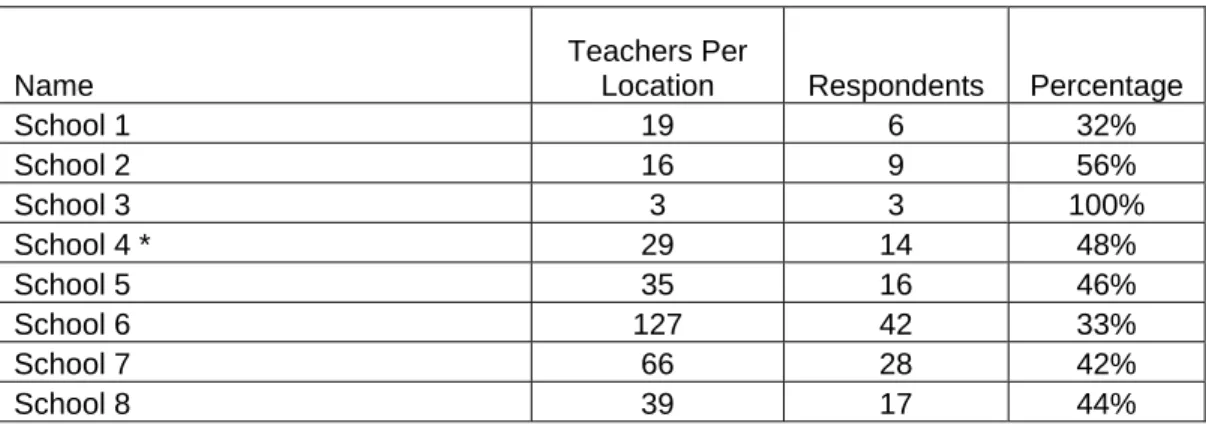
facilitator at each location, after school tutors and assistants, to providing professional development opportunities. The researcher sought to determine if there was a relationship in technology use by comparing these 21st century schools’ responses on the survey to the other schools in the district that did not receive the grant. Table 1 below depicts the number of possible respondents per location.
Table 1: Possible Respondents per Location
Name Teachers Per Location
School 1 19
School 2 16
School 3 3
School 4 * 29
School 5 35
School 6 127
School 7 66
School 8 39
School 9 154
School 10 * 40
School 11 48
School 12 21
School 13 57
School 14 36
School 15 * 32
School 16 28
School 17 46
School 18 11
School 19 33
School 20 32
School 21 42
School 22 43
School 23 22
School 24 42
School 25 58
School 26 32
School 27 36
School 28 49
Grand Total 1196
Researcher Role
The researcher used Survey Monkey (an online survey site:
www.surveymonkey.com) to set up the questionnaire where the data resided, thus the researcher did not have access to the data until the survey was completed. Survey Monkey did not track the messages for the source of the sender. Thus, neither the researcher nor the managers of Survey Monkey were able to identify the individual completing the survey.
The researcher, at no time, had access to each participant or the actual email addresses, ensuring confidentiality for the participants. Since the instrument chosen was emailed to a group of individuals, the researcher had no idea which recipients responded and therefore anonymity was maintained. Since this questionnaire involved no more than minimal risk, privacy for recruitment was not applicable. There was a small chance for persons to be identifiable based on the information requested but the researcher assured anonymity and confidentiality.
Instrumentation
Informed consent was obtained through an introduction letter emailed to all possible participants (1196 certified teachers) in the public school district. Actual participation in this survey implied consent to participate. Through the introduction letter, explanation was given regarding the anonymity of the survey participants. This survey posed nothing more than minimal risk and did not require a signature for consent.
Participants were emailed the informed consent letter and invitation to participate in the survey in February 2007. A follow-up letter to participants and a letter to
administrators was sent approximately a week to ten days later encouraging participation in the survey. All certified teachers were invited to participate; all had an email address and access to the Internet in every classroom and media center.
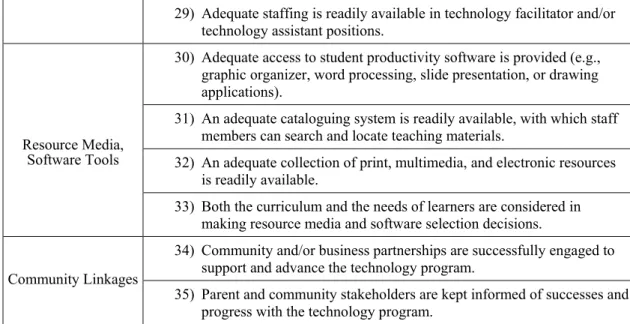
The STNA was used in this public school district to survey 1196 teachers to better understand their needs related to technology in the classroom. The instrument consists of the following major constructs and sub constructs addressed by the STNA:
• Section I: Professional Profile
• Section II: Conditions for Technology Use
o Vision and Leadership
o Technology Planning, Budgeting, and Evaluation o Supportive Environment for Risk Taking
o Technical Infrastructure and Support o Resource Media, Software and Tools o Community Linkages
• Section III: Professional Development – Opportunities
o Skills, Policies and Structures
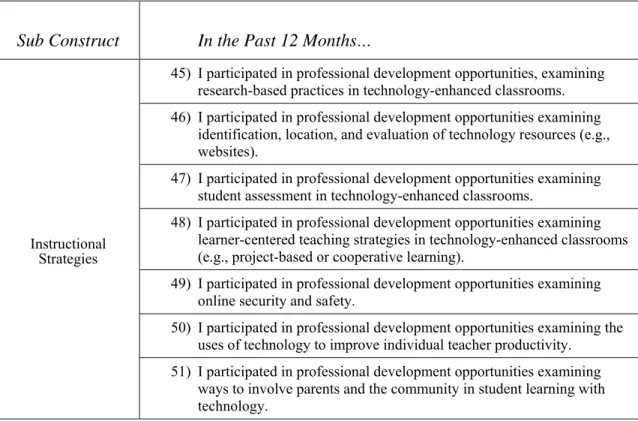
• Section IV: Professional Development – Participation
o Instructional Strategies
• Section V: Classroom Practices
o Instructional Strategies o Planning
• Section VI: Student Activities
o Tools and Tasks
• Section VII: Impact of Technology
o Teaching Practices o Student Outcomes
The instrument consists of seven major sections or constructs:
Section I: Professional Profile for obtaining demographic information consisting of the three items (items 1-3): school, number of years in education (0-3, 4-10, 10-20, 20-30, 30+) and the grade level(s) (PK, K, 1,2,3,4,5,6-8, 9-12).
Section III: Professional Development – Opportunities (Table 3), covering one sub construct, consist of eight likert scale questions (questions 36 through 44) to address the conditions related to research questions 7 and 17.
Section IV: Professional Development – Participation (Table 4), covering one sub construct, consist of seven yes/no questions (questions 45 through 51) to address the conditions related to research questions 8 and 18.
Sections V and VI: Classroom Practices and Student Activities respectively (Table 5), covering three sub constructs, consist of 20 likert scale questions (questions 52 through 72) to address the conditions related to research questions 9 and 19.
Section VII: Impact of Technology (Table 6), covering two sub constructs, consist of nine likert scale questions (questions 73 through 81) to address the conditions related to research questions 10 and 20.
Table 2: Conditions for Technology Use
Section II. Conditions for Technology Use
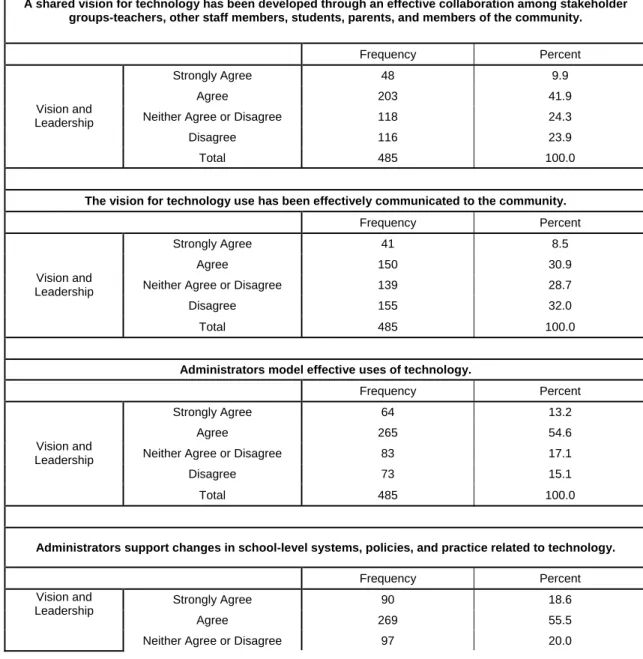
Respondents were asked to rate the questions on a likert scale with the following responses: “Strongly Agree," "Agree," "Disagree," or "Strongly Disagree.”
Sub Construct Questions
4) A shared vision for technology has been developed through an effective collaboration among stakeholder groups—teachers, other staff members, students, parents, and members of the community. 5) The vision for technology use has been effectively communicated to
the community.
6) Administrators model effective uses of technology.
7) Administrators support changes in school-level systems, policies, and practice related to technology.
Vision and Leadership
9) An effective long-range school technology plan is in place. 10) The school technology plan is developed by a leadership team or
committee involving a variety of school stakeholders (i.e., media coordinator, technology facilitator, teachers, students, and community members).
11) The school technology plan is monitored and updated adequately. 12) The budget for technology resources is adequate in size to support
decisions arising from planning and to continuously update and replace technology systems as they become outdated.
13) Supplemental sources of funding are actively pursued to support technology (e.g., external grants, collaboration with community or parent groups, and support from businesses).
14) Teachers and other staff members support the school technology plan. 15) Multiple sources of data are used to evaluate the implementation of
technology programs.
16) Multiple sources of data are used to evaluate the impact of technology programs on teacher practice and productivity.
Technology Planning, Budgeting,
and Evaluation
17) Multiple sources of data are used to evaluate the impact of technology programs on academic achievement and other student outcomes. 18) Teachers are encouraged to take risks and be inventive with
technology use.
19) Teachers who are innovators with technology receive incentives or rewards for their hard work (e.g., funding, perks, waivers, special opportunities).
20) The media center can be flexibly scheduled to provide equitable access to resources and instruction.
21) Computer labs can be flexibly scheduled for equitable access to resources and instruction.
Supportive Environment for Risk
Taking
22) Mobile computers can be flexibly scheduled to provide equitable access to resources and instruction.
23) An adequate technology base is available (e.g., computers, digital cameras, projection devices, scanners, printers).
24) Communication systems within the school are adequate (e.g., e-mail among teachers and staff, network drives to upload lesson plans and grades to the main office).
25) Systems to communicate with parents and the community are adequate (e.g., e-mail, teacher, and/or school Web pages).
26) Reliability and speed of connections to the external Internet, online databases and resources, etc., are adequate.
27) Adequate access to technical support is available (e.g., to troubleshoot hardware or software problems, maintain systems).
Technical Infrastructure and
Support