ADAPTATION AND SHIFTING LIVELIHOODS IN THE SMALL-SCALE FISHERIES OF THE GALÁPAGOS MARINE RESERVE, ECUADOR
Kim Engie
A dissertation submitted to the faculty at the University of North Carolina at Chapel Hill in partial fulfillment of the requirements for the degree of Doctor of Philosophy in the Department
of Geography.
Chapel Hill 2015
Approved by:
Stephen J. Walsh
Elizabeth Havice
Pamela Jagger
Diego Quiroga
© 2015 Kim Engie
ABSTRACT
Kim Engie: Adaptation and Shifting Livelihoods in the Small-Scale Fisheries of the Galápagos Marine Reserve, Ecuador
(Under the direction of Stephen J. Walsh)
In many areas, finding alternate livelihoods for fishers has been promoted to alleviate
environmental strain but encountered difficulty because of often understudied, multiple roles that
fishing fulfills, making job market dynamics easily misunderstood. I use the concept of social
adaptation to study both individual adaptive capacities to find alternate work, and the
social-structural creation of vulnerability to declining incomes and limited work options outside of
fishing in the Galápagos Marine Reserve. Sub-analyses draw from (a) a formal household survey
(N=167), (b) open-ended interviews (N=127), (c) participant observation, (d) government
surveys and documents (e) and historical narratives.
A livelihoods-based analysis of labor mobility shows that those most able to move
through fishing were a small minority with tertiary degrees, vertical social ties, or large family
and social networks. For the vast majority of active fishers, the ability to leave fishing is
weakly explained by individual differences and is more contingent on the changing nature
of alternate opportunities. Although people have always transitioned from fishing to tourism,
the highest-returning options have clearly constricted with privatization of tour operator
rights over time. Combined with increasingly strict conservation governance regimes, today’s
fisher social vulnerability is situated in a particular Galápagos context of narrowing adaptive
coping strategies and prospects for upward mobility, all the while remaining elevated
Regulatory changes have left a newly created alternate, recreational fishing, out of
reach for most fishers. Analysis of these changes shows the intertwined influences between
fishing and other industries as fishers negotiate with non-fishing actors for livelihood options. I
suggest using regulatory debates to represent an explicitly social feedback loop to more strongly
articulate the unclear ways that resilience and complexity frameworks, increasingly applied to
Galápagos contexts, conceptualize the development of “alternate stable states”. While some
scholars argue that despite tighter controls a more restricted “race for fish” among registered
fishers continues to degrade resources, I argue that collectively, the desire and
demonstrated multi-year efforts to find other jobs make a lack of alternate work the real culprit
ACKNOWLEDGEMENTS
I owe infinite thanks to many people for their support, encouragement and aid, which
made this study possible. I am indebted to the kindness and generosity of the San Cristobal
community and all of the fishermen and women who generously shared their stories and time
with me, opening their homes and lives. I will never forget their generosity and spirit, and my
thoughts are with them as they continue to navigate new political and economic developments
since my fieldwork was done in 2012, with the current renegotiation of the Special Law of the
Galápagos. Isaac Pluas, Ricardo Castillo, Washington Escarabay, the Yepez family, and many
others made my six month stay more than hospitable, and helped me find my way in the
community. My two field assistants Karla Mosquera-Avila and Gabriela Jijon provided
invaluable high spirits and guts during community interviewing. Emily Willis, then a senior at
UNC-Chapel Hill was also great company one summer while researching Galápagos institutions.
Paola Pozo and Patricia Polo are generous, warm friends in Ecuador who have provided
logistical and translation work over the years. Thanks to Dr. Carlos Mena, Dr. Diego Quiroga
and colleagues at the Universidad San Francisco de Quito also for support and interest in
Ecuador, and allowing me to stay at the Galápagos Academic Institute for the Arts and Sciences
(GAIAS) briefly in 2012. I am also grateful to those at numerous institutions for their aid and
support in searching for information and documents, including at the Galápagos National Park,
the Port Captain of San Cristobal, the Galápagos Governing Council, and the two fishing
My committee has provided guidance and exposure to the wide variety of scholarly work
that informs this project, and has been a source of support throughout the years. Thanks to Dr.
Elizabeth Havice, Dr. Gabriela Valdivia, Dr. Pam Jagger, Dr. Diego Quiroga, and most
especially my chair, Dr. Stephen J. Walsh for academic and professional support and advice.
Thanks to former colleagues in the Spatial Analysis Lab, Dr. Laura Brewington, Dr. Ben
Heumann, Dr. Amy McCleary, and Dr. Dan Weiss, as well as Phil Page at the Galápagos
Science Center for their friendship, advice, and cross-continental company at happy hours in
Chapel Hill, Carrboro, and field work stints in the Galápagos and Ecuador. Phil deserves
additional thanks for his steadfast support in the face of unraveling field permits and visas for us
all over the years. Thanks to the Carolina Population Center (CPC) and Jan Hendrickson-Smith
for support and providing a great environment for training and finding peers in
population-environment work. I also thank the Galápagos Science Center, CPC, Tinker Foundation, UNC
Dept. of Geography, and NSF IGERT program for financial support for this project and my
studies.
At UNC I found essential support and camaraderie for the long days of dissertation
crafting through a fantastic writing group with Dr. Conor Harrison, Dr. Elizabeth Hennessy, and
Dr. Autumn Thoyre, who also helped strengthen my work. Thanks to several inspiring reading
groups throughout the years; a race reading group with Stevie Larson, Adam Bledsoe, and Dr.
Yousuf Al-Bulushi and a political ecology reading group, or THiNKS (Thinkers in Nature,
Knowledge and Society) with Pavithra Vasudevan, Haruna Suzuki, Mabel Gergan, Justine
Williams, and Paolo Bocci. The many graduate students and colleagues who provided their
friendship and shared learning in the wonderful communities of UNC, Chapel Hill, Carrboro,
Finally my family deserves special mention for their unwavering support for my pursuits
in higher education, visits, and not least for the cooking, company and moral support of my
parents Lin Yen and Kean Engie in the last month of tidying dissertation details, when my little
son Dylan decided to come into the world just in time to witness the crossing of the last t and dotting of the last i. He and my now husband, Kevin Woodcock, have given these years more meaning and dimension than they ever could have otherwise, and I will always be grateful.
TABLE OF CONTENTS
LIST OF FIGURES ... xiv
LIST OF TABLES ... xvi
CHAPTER 1: INTRODUCTION ... 1
I. Introduction ... 1
II.Project Approach & Conceptual Framework ... 6
A. A Sustainable Livelihoods Approach to Fishing ... 7
A1. Sustainable Rural Livelihoods ... 7
A2. The Sustainable Livelihoods Approach to Fishing ... 12
B. The Political Ecology and Economy of Adaptation ... 14
C. Sustainable Livelihoods Perspectives on Complex Social-Ecological Systems ... 18
III.Methods ... 21
A. Data Collection ... 24
A1. The 2012 Galápagos Livelihood Survey ... 24
A2. Participant Observation & Interviews ... 27
A3. Documentation and Databases ... 27
B. Data Analysis ... 28
IV.Chapter Outline ... 30
V.Contributions from the Galápagos ... 32
CHAPTER 2: SETTING: THE CHANGING SEAS OF THE GALÁPAGOS ISLANDS ... 35
I. The Biophysical Environment ... 35
II. Fish and Fishermen ... 37
A1. Salted Cod ... 39
A2. Lobster ... 40
A3. Sea Cucumber ... 42
A4. Whitefish ... 43
A5. Sharks and Illegal Fishing ... 44
B. Political Organization and Interests ... 45
C. Institutions and Governance Regimes ... 47
D. Fluctuating Social Conditions: Socio-demographics and Livelihood Diversity ... 51
E. Changing Seas ... 55
III. Galápagos Fishing Livelihoods In 2012 ... 56
A. Livelihood Portfolios among Registered Fishers ... 57
A1. Strategies of Transitioning Away From Fishing ... 60
A2. Strategies of Long-Term Livelihood Diversity ... 62
A3. Strategies of Fishing Exclusively ... 63
B. Conclusion: Continuing Fluctuations in Social Conditions ... 64
B1. Changing Species Impact ... 64
B2. Socio-demographics of Exiting and Recent Labor Flows Between Sectors ... 65
CHAPTER 3: A LIVELIHOODS APPROACH TO DECLINING PARTICIPATION IN GALÁPAGOS FISHERIES: COMMUNITY PERSPECTIVES ... 68
I. Introduction ... 68
II.Background ... 70
A. To Fish Or Not To Fish: What are the Questions? ... 70
B. Study Contributions: The Dollars and Sense of Alternate Livelihoods in Galápagos ... 73
III.Results ... 75
B. Hypotheses Around Labor Mobility Through Fishing ... 81
B1. Hypothesis I: Labor Mobility & Asset Bases ... 82
B2. Hypothesis II: Relative Poverty Comparison ... 84
B3. Hypothesis III: Job Satisfaction ... 87
IV.Discussion ... 89
A. Asset Bases, Labor Mobility & Social Difference: Mixed Methods Implications & Validity ... 90
B. Mediating Processes ... 93
B1. Conservation Governance within a Protected Area ... 93
B1.1. Policies & the Value of Boat Ownership ... 94
B1.2. Social Capital & Institutions ... 95
B2. Labor Preferences & Multiple Labor Markets ... 96
C. Livelihoods and Bioeconomics: Implications for Modeling Linked Social-Ecological Change ... 98
C1. Income, Labor Mobility, and Long-Term Profit Maximizing ... 99
C2. Good Enough to Leave: Satisficing in Exiting ... 101
C3. The “Satisfaction Bonus” ... 102
D. A Livelihoods Approach to Declining Participation: Policy Implications ... 103
V.Conclusions ... 104
CHAPTER 4: CONSERVATION GOVERNANCE AND ADAPTIVE FISHING STRATEGIES: SOCIAL VULNERABILITIES OVER TIME ... 107
I. Introduction ... 107
II.Methodological Approach ... 109
III.The Social Conditions of Adaptive Fishing Responses ... 110
A. Quantitative Analysis ... 110
IV.Processes of Marginalization and Precarity: The Changing Face of Tourism ... 122
A. “All the people now here are children of fishermen” ... 123
B. The Changing Accessibility Of Touristic Labor ... 124
V.The Double-Edged Sword of Conservation Governance ... 129
A. The Blade: Economic Trade-offs & Privileging Biological Conservation ... 129
A1. Socioeconomic Effects on Fishing Operations & Livelihood Diversification ... 130
A2. Institutions & Uncertainty ... 131
B. The Buffer: Conservation Boundaries and Privileged Spaces of Protection ... 133
B1. The Banishment of Industrial Fishing Development ... 134
B2. Economic Prosperity ... 136
VI.Institutions, Adaptation, & Change Over Time ... 138
VII.Conclusion ... 143
CHAPTER 5: THE EVOLUTION OF RECREATIONAL FISHING IN THE GALÁPAGOS MARINE RESERVE: ADAPTIVE LIVELIHOOD FEEDBACKS ... 144
I. Introduction ... 144
II.Background & Theoretical Context ... 147
A. Adaptive Change in Social-Ecological Systems and the Galápagos ... 147
B.Study Contributions: Strengthening Social Application of Resilience and Complex Systems in the GMR throughLivelihoods Perspectives on Adaptive Change ... 150
B1. Dynamism in Asset Bases & Scale ... 151
B2. The Politics & Structure of Participation ... 152
B3. Significance ... 155
III.Methods ... 156
IV.Pesca Vivencial: A Very Brief Social History ... 157
B. The Stakeholders and Visions of Pesca Vivencial ... 158
C. Regulatory Evolution ... 161
D. Governing Boundaries: Tourism & Fisheries ... 162
E. Fishing Practices and Participants ... 165
V.Discussion: Pesca Vivencial’s Complex Feedbacks: Contributions from a Livelihood Perspective ... 169
A. Which Roads to Alternate Stable States are Being Paved? ... 170
B. Failures, Opportunities, & Struggles for Social Equity & Access ... 172
C. Regulatory Feedbacks: The Negotiation & Creation of Livelihood Alternates ... 174
D. Dynamism in Assets & Policy Implications ... 178
VI.Conclusions ... 180
CHAPTER 6: CONCLUDING REFLECTIONS ... 182
I. Introduction ... 182
II.Summary of Main Findings ... 185
A. The Political Ecology and Economy of Adaptation: Individuals, Institutions, Communities, & Responsibility ... 186
A1. Responsibility & the Social-Structural Creation of Vulnerability ... 186
A2. Adaptive Pathways, Uptake, and Indeterminacy ... 188
B. Fisher Exits ... 190
B1. Evidence-Based Evaluation of Conservation Outcomes ... 190
B2. Livelihood Contributions to Cross-Sector Analysis of Fisher Behavior ... 192
C. Conservation Governance ... 194
C1. Structuring Forces: Conservation Governance and Tourism Markets ... 194
C2. Environmental Implications & Fishing For “Win-Win” Solutions” in Conservation Interventions ... 196
A. Equity: Conservation Within & Beyond Protected Areas ... 199
B. Dealing with Overcapacity: Rights-Based Approaches and Livelihood Diversity ... 200
Appendix A: Survey for Active Fishers ... 203
Appendix B: Survey for Inactive Fishers ... 212
Appendix C: Descriptive Statistics of Occupational Diversity ... 219
References ... 223
LIST OF FIGURES
Figure 1.1. Catch, inactive and active participants in the two major fisheries of sea
cucumber and lobster in the Galápagos Marine Reserve from 1997 – 2012. ... 2
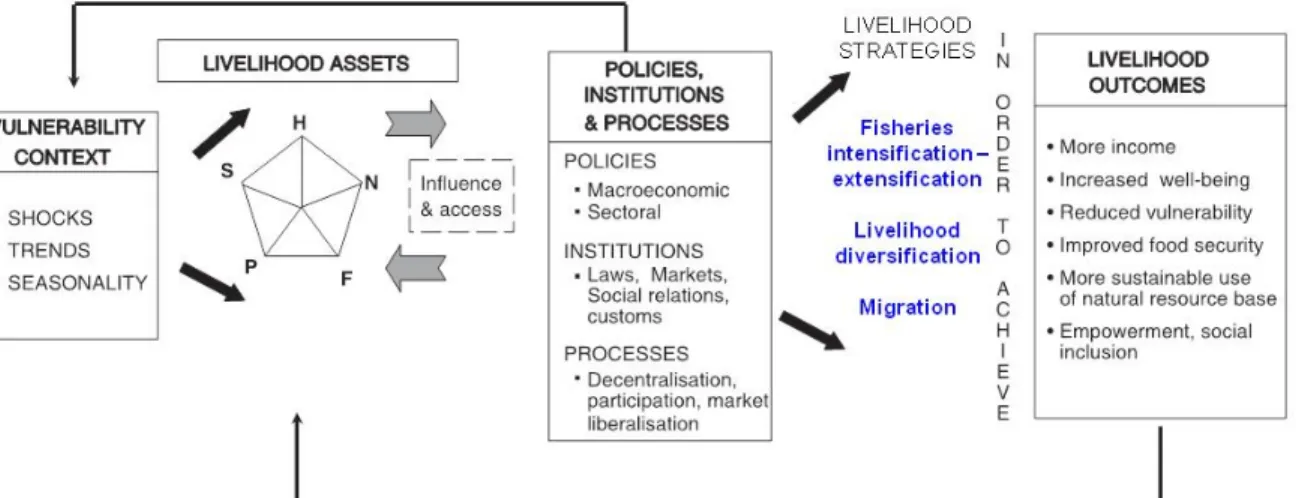
Figure 1.2. The sustainable livelihoods framework of understanding a livelihood as composed of assets, activities, and mediating processes. This project places focus on livelihood strategies, highlighted in blue. Adapted from the UK Department for
international Development and Allison and Horemans 2006. ... 9
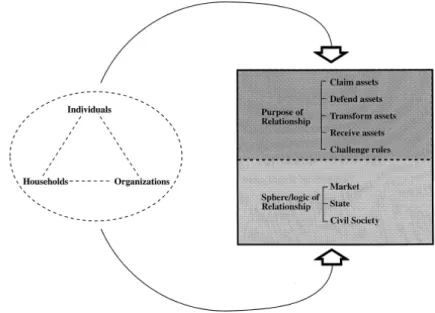
Figure 1.3. Bebbington’s conceptualization of livelihood asset use and transformation, stressing their interactions within the market, state, and civil society, and change from the specific nature of household relationships with other actors. From Bebbington
1999. ... 10
Figure 1.4. “Fishing strategies” of intensification, diminishment, or no change are based on how individuals transition between different levels of fishing engagement, from
full-time to inactive. ... 29
Figure 2.1. The Galápagos archipelago, major islands, and capitol, Puerto Baquerizo
Moreno. The Galápagos Marine Reserve extends 40 nm beyond the coastlines. ... 36
Figure 2.2. Various vessel types in the Galápagos fishing fleet. A larger wooden bote on the left in construction. Botes are given a coat of paint before going to sea. A line of
fibras and pangas on the right, which are similar in shape but differ in material and
length. The boat with a cabin in the foreground is a fibra. Photos by author. ... 39
Figure 2.3. The participatory management structure within the Galápagos Marine Reserve. Spanish acronyms are used for the AIM, JMP, CEDENMA, and
UCOOPEPGAL. Modified from Heylings and Bravo 2007. ... 50
Figure 2.4. The fishing status of individuals according to the time they entered fishing. ... 58
Figure 2.5. Work that survey respondents reported having worked in, besides fishing. Frequency counts are overlapping, so that one person could be counted in several
categories depending on the number of jobs they hold. ... 59
Figure 3.1. The diverse occupational activities of registered members of COPAHISA, the
fishing cooperative on Isabela Island. Data from Gravez 2008. ... 74
Figure 3.2. Categories of non-fishing work that survey respondents are engaged in, broken down by their active or inactive status. Occasional fishermen, whose income from fishing is <10% of their annual income, are grouped in the inactive category
here. Active fishermen include those who own boats but do not go to sea themselves. ... 80
is defined as from 2009-11, and long-term is broadly over the course of their careers.
Trends are similar among groups. ... 85
Figure 4.1. Clusters of survey respondents who have diminished (green crosses),
intensified (black circles), and maintained the same fishing levels (red triangles) over their careers, as separated by via discriminant analysis. The x- and y-axes represent calculated discriminant functions that summarize social characteristics and fishing
patterns. ... 112 Figure 4.2. Structure coefficient values of each of the 37 discriminating variables in each
discriminant function (DF). Coefficients are ordered by their DF1 value, since DF1 accounted for more of a group’s character than DF2. The structure coefficients (i.e., their scores on the x-axis) signify each variable’s contribution to a function. Negative scores to “yes/no” variables indicate stronger “no’s”, and vice versa. Scores closer to
zero contribute less to a DF. ... 114
Figure 4.3. Survey respondent answer to how they would respond to a sudden cash need
of $1000 in one week. ... 120
Figure 4.4. Job types gained or lost from 2009-2012. Frequency counts are overlapping, so that one person could have gained or lost more than one job type, for instance if they gained two additional jobs from 2009-12. Detailed descriptions of job types here
are in Appendix B. ... 127
Figure 5.1. The adaptive renewal cycle or “infinity loop” developed by Gunderson and Holling (2001) and representing cycles of organization and reorganization of energy and capital in a system. The system is most brittle and least resilient in the K phase as privileging economic stability grows sectors for a time, but leads to inevitable
inflexibility in both ecosystems and human response. The system is most open to various development trajectories from the “backloop” of release to reorganization.
LIST OF TABLES
Table 1.1. Major survey metrics of household assets, activities, and their change over the
past three years. ... 26
Table 2.1. Gross and per capita income estimates for the sea cucumber and lobster
fisheries over time. All figures are in U.S. dollars. ... 52
Table 2.2. Survey respondents who are intensifying or diminishing their fishing engagements from 2009-12 (left), and through the course of their working career
(right). ... 57
Table 2.3. Specific jobs held by survey respondents that are contained in the loose
categories graphed in Figure 2.5. ... 60
Table 2.4. Fishing preferences of survey respondents, according to their fishing status in
the 2011-12 season. ... 61
Table 2.5. Survey respondents who have ever applied for a permit for any tourism-related
operation (e.g., operating tour boats for day tours or cruises, recreational fishing). ... 61
Table 3.1. Alternate labor taken up by those recently diminishing their fishing levels
(2009-11). ... 78
Table 3.2. Bivariate associations between different assets and metrics of relative poverty and economic security with fishing strategies from 2009 – 11 (A) and career-wide (B). Fishing strategies were condensed into three groups: intensified, diminished, and
same. ... 83
Table 3.3. Bivariate correlations between fishing strategy and household income, fishing income, and self-assessed changes in material standards of living from 2009-11.
Results from both Fisher’s exact tests and chi-squared tests are shown. ... 84
Table 3.4. Survey respondents who would and would not still go into fishing if they had
their lives to live over. ... 88
Table 3.5. Bivariate correlations between fishing strategy, fishing status, fishing preference, and (a) whether one would still choose to be a fisher for the years that they did/are doing it, and (b) whether one liked being a fisher for the years that they
were/are one. Results from both Fisher’s exact tests and chi-squared tests are shown. ... 88
Table 4.1. Discriminant variables input into the linear discriminant analysis, and their possible responses. Responses were converted from categorical to ordinal and whenever possible, a “1” was given to the values that might align with lesser social
vulnerability according to past scholarship. ... 111
Table 4.3. Statistical summary of the LDA analysis. Table (A) values give metrics of the degree of separation between groups, and Table (B) tests the likelihood that the
sample data findings would be found, if differences did not exist in the population. ... 117
Table 4.4. Reported income from the entire household (left) and from fishing (right), of survey respondents. Total household income is reported for all survey respondents (N = 167), and fishing income for active fishers (N = 119). Survey instruments for active
and non-active fishers contained slightly different income bracket questions. ... 118
Table 4.5. Self-assessed changes in material standard of living from 2009 – 2011 for survey respondents who intensified, diminished, or maintained their fishing levels in
the long- and short-term. ... 119
Table 4.6. Rates of chronic disabilities among survey respondents and from the 2010 Ecuadorian census. The census question does not use the word “chronic” but records
disabilities that last for at least one year. ... 121
Table 4.7. Rates of household children that have studied or are studying abroad. The Galápagos Living Standards survey question asked of all household members who
have studied abroad, rather than only the children. ... 121
Table 4.8. A selection of quality of life indicators for the Galápagos and mainland
Ecuador. ... 137
Table 5.1. Regulatory evolution of Pesca Vivencial, from the proposal as first presented by fishing sector representatives (top row), followed by major changes in subsequent
legislation. ... 164
Table 5.2. Summary of select involvement among surveyed fishers involved in Pesca Vivencial in San Cristobal. Numbers in each column indicate the frequency of responses. In 2012, these questions were posed about pesca artesanal vivencial, in
CHAPTER 1 Introduction
I.
“The term ‘fisheries management’ has been much in vogue in recent years, being taken to express a more subtle approach to the fisheries problem than the older terms “depletion” and
“conservation”. Briefly, it focuses attention on the quantity of fish caught, taking as the human objective of commercial fishing the derivation of the largest sustainable catch.”
- H.S. Gordon 1954: 128 - In 2008 a competition was held in the Galápagos Marine Reserve (GMR) to allow a
limited number of fishermen and women (henceforth referred to as “fishers” and “fishermen”
interchangeably) to convert their vessels into tour boats. Managers at the Galápagos National
Park (GNP) received a flood of applications1 but awarded only 16 permits, or “cupos”. Fitting
long-term institutional goals to reduce the fishing footprint in the GMR, competition outcomes
did not cleanly do so. A rule that did not allow more than one cupo in a family to the fourth
degree of kinship was announced after many fishers had submitted applications that took up to $8000USD to prepare, disqualifying them. Justified to promote equitable access to the wealthy
tourism industry2, certain families that were awarded several cupos also had relatives in
government, raising ire. One fisher decided to annul a 17-year marriage so his brother-in-law’s
tourism cupo would not disqualify him (El Universo 2009). In the end dozens of fishing families
who had invested in embracing the “greener” tourism industry were told, in effect, to keep
fishing.
1 77 applications were submitted (GNP 2009).
This competition and its aftermath highlight the many tensions, political negotiations, and
uneven outcomes connected to changing resource use trends within a society, even when trends
are widely considered beneficial. The entirely small-scale fishing fleet of the Galápagos Islands
exists within the fourth largest marine reserve in the world, a United Nations World Heritage Site
renown for its biological abundance and endemism. Shrinking the fishing footprint has
widespread stakeholder support and aligns with both social and conservation goals.
Figure 1.1 Catch, inactive and active participants in the two major fisheries of sea cucumber and lobster in the Galápagos Marine Reserve from 1997 – 2012.
After decades of erratic markets, declining abundance and increasingly stringent
regulations, Galápagos fisheries have undergone a metamorphosis of remarkable proportions,
declining in active participants and catch (Fig 1.1). However, not only the fact that people are
leaving fishing but how and why they do so critically shapes future impacts on marine
and sea-based tourism, and niche marketing for Galápagos seafood all have diverse implications
for conservation. Lack of data on this rapidly changing sector makes ecosystem impacts, social
impediments and even transitional directions extremely difficult to assess, while future choices
ahead for Galápagos society are “frightening, uncertain, and partially undesirable” (Ospina 2006)
because individual and societal trade-offs in development for conservation are inevitable. In the
end, Galápagos fishers and citizens find themselves at a crossroads.
This dissertation studies the decline and ongoing reorganization of fisheries in the
Galápagos Marine Reserve – through its work force, politics, social connections, and most
specifically, the occupational change of registered fishers. The analyses presented here study the
politics and the socioeconomic realities of finding alternate livelihoods as inextricably
intertwined and co-produced.
This project is centered around two themes. The first is one of outwardness regarding the social dimensions of fishing. In 1954 Gordon noted that the term “fisheries management” was
focused heavily on the quantity of fish caught, influenced by managers who were trained
predominantly in biology and concerned with the human effects on the production side of a
fishing system, or its fish stocks – an observation that is largely still applicable today. This focus
on optimizing harvests has slowly driven conventional governance to an ever-more detailed
accounting of gear types, vessels and humans and led to a narrow sector-based perspective that
disengages potentially important relationships outside the fisheries sector (Holling and Meffe
1996; St. Martin 2001). The literature on fisher behavior in the quantitative social sciences,
although calling for branching out beyond the historically biological focus of fisheries
management (e.g., Hilborn 1989; Salas and Gaertner 2004), remains sector-based by focusing
analyzing the "dynamic behavior of fishing fleets" through fleet investment, movement, catching
power, and discarding.
Acknowledging the dynamic nature of the label, “fisherman” is part of the outward
orientation of these analyses. There are two elements of understanding “fisherman” as dynamic.
First, because many former fishers are now working in tourism and others have second or third
jobs, econometrically understanding the ‘fishing sector’ beyond active fishermen more
realistically incorporates how changing environmental impacts relate to how people move
through fishing over time. Secondly, St. Martin (2001) notes that conventional bioeconomic
approaches to fisheries management, described above, treat fishers as points of degradation that
behave atomistically to maximize profit. Instead, social scientists have shown that fishers are
also knowing, active, participants, holding the key to solutions and not just potential degraders of
ecosystems, and embedded in broader communal spaces (Berkes 2003; Mansfield 2004; St.
Martin 2007).
How can one study fishing while not obscuring its tight connections to the broader
economy and society? My approach is to trace material benefits to individual fishers from other
sectors through the main avenue of work. In the Galápagos as elsewhere, the effect of the
tourism industry on fishing via alternate jobs is of enormous importance (e.g., Young 2003;
Fabinyi 2010), yet remains almost entirely unstudied. The following chapters showthat the
distribution of tourism benefits via work is highly differentiated among registered fishers since
the demand for job opportunities is higher than the supply. Documenting these relationships
analyzes how other sectors affect fishing activity rather than analyzing fishing activity itself, in
this way going beyond traditional sector analyses.
fallacy of controllability of fisheries systems (Wilson 2006; Mahon et al. 2008), in other words
agreeing that perfect knowledge of fishing resources and their fluctuations is unattainable.
Fisheries science has long been focused on determining the “optimal” amount of fish to harvest
and on gathering more information with which to perfect quantification. Given this fallacy of
controllability however, some fisheries social scientists have noted that efforts are better served
by asking how people adapt to changing circumstances in fishing rather than seeking to quantify
the components of variability in fisheries change (Garcia and Charles 2008; Mahon et al. 2008).
The overarching question of this project is, In what ways can we understand how Galápagos fishers are “adapting” to social-ecological change? By asking how people adapt rather than seeking objective “causes” of ecological change, this project recognizes that people occupying
different social, economic, and political positions in society experience change differently.
Various chapters ask after the motives for how Galápagos fishers are adapting to change, how
adaptation manifests for different individuals, and about the role of inequality in shaping the
adaptive capacity of individuals and households to direct their livelihoods and decisions. Three
sub-questions are central to this study:
1. In conditions of declining profitability and resource abundance, how have some individuals
been able to (a) reduce their dependence on the local marine resource base while (b)
maintaining their material standard of living?
I investigate the role of inequality in shaping the adaptive capacity of individuals and
households to direct their livelihoods and decisions. I analyze adaptation and
vulnerability to changing circumstances from multiple social positions.
2. How does job switching through fishing interface with conservation management policies?
apart fishers within the Galápagos Marine Reserve from many modern industrial
fisheries. I analyze how conservation policies interact with occupational change and
occupational pluralism, a long-observed trait of many fishermen in the Galápagos, as well
as changing harvest abundances and markets.
3. What is the political economy of diversification from fishing?
I pair fine-scale individual level analysis of fisheries change with a broader analysis of
the Galápagos coastal tourism economy, asking, what are Galápagos fishers adapting to? The actions and options of fishermen must be understood as reactions to not only changes
in marine resource abundance, but the structures of economic opportunity open to them –
namely from tourism, the cash cow of the Galápagos economy.
II. Project Approach & Conceptual Framework
Scholarship on entry and exit from fishing is scattered across anthropology, labor
economics, natural resource management, marine policy, fisheries science and resilience and
complexity work. I apply a sustainable livelihoods interpretation to this broad and scattered
literature to help synergize insights into a cohesive manner, interpreting entry and exit from
fishing as livelihood change.
Sustainable livelihoods, the specific area in which this project is framed, is part of
broader political ecology scholarship. Political ecology studies ecological change as intertwined
with its political, economic and social contexts, a basic tenet being that environmental
governance actions “hold implications for the distribution and control of resources” (Robbins
2004: 9), and are therefore political. There is always more than one option to react to
policies is therefore vital.
Like other strands of political ecology, a major emphasis of the sustainable rural
livelihoods approach (SRL) has been to analyze social difference and how differences affect
poverty and social outcomes and connect to governance. SRL uses as a central analytic focus a
‘livelihood’, or the ways and means through which people go about making a living.
I put livelihoods in conversation with other frameworks in this project for various
reasons. First, broader political ecological scholarship on adaptation and vulnerability is
incorporated to study the contexts of vulnerability with greater definition and robustness. This
helps to address livelihood critiques over the years that include an undertheorization of various
elements such as the “vulnerability” context where shocks, trends, and seasonality are broadly
noted as affecting wellbeing (leftmost box in Fig 1.2; Prowse 2008). Second, I use livelihoods
concepts to engage with and question resilience and complex adaptive systems framings of
social-ecological adaptation, important given its rising influence on how change over time is
understood and acted upon in governance, including in the Galápagos (e.g., Watkins 2008;
Gonzalez et al. 2008; Denkinger and Vinueza 2014). The following sections first review the
sustainable livelihoods framework, and then the intersections made between SRL and other
bodies of knowledge in this project.
A. A Sustainable Livelihoods Approach to Fishing A1. Sustainable Rural Livelihoods
The “livelihoods approach” has roots in rural development work where it evolved as a
framework for poverty alleviation, and draws from a simple premise that misunderstanding how
Angelsen et al. 2011). Prowse (2008) notes that until the 1970s conventional macroeconomic
narratives of agrarian change considered informal, non-wage work as backwards and its
reallocation to “modern” capitalist sectors a key to economic growth. Ellis (2000) and
Bebbington (1999) point to an overarching focus on raising small farm productivity in rural
development policies until the 1990s, thought to improve economic growth in all sectors. In short
the ways that farmers made a living in informal, non-waged work were misunderstood, with a
focus on different spheres of the economy (e.g., formal/informal, capitalist/non-capitalist,
rural/urban) far greater than that placed on the connections and overlaps between them. Policy
interventions could be out of touch with local goals and clashing with peoples’ abilities to earn a
living. A prime example are policies that treated job diversity as a temporary phase between two
stages and encouraged specialization, when many rural peoples use job diversity as long-term,
permanent strategies for various monetary and non-monetary reasons (Ellis 2000; Carswell
2002).
While much livelihoods work has focused more on social rather than ecological
dynamics, I also keep attention placed on how these dynamics connect to ecosystem impacts by
noting that the “sustainability” in question in sustainable livelihoods is understood as the
maintenance or improvement of people’s ability to make a living while not degrading the resource base (Scoones 1998; DfID 2000).
Households and individuals often have differential access to resources and activities that
enable some people to benefit more from government policies and market contexts over time and
to better weather political and personal uncertainties. These markers of social difference have
included land tenure (Adams and He 1995) and cattle ownership and off-farm skills (Dercon and
to resources in turn intersects with different abilities “to be and to act” in the manner of one’s
choosing (Bebbington 1999).
Both micro- and macro-scale approaches have been taken to study social differences. On a
micro-scale has been the prominent “assets-mediating processes-activities” framework (Fig 1.2),
which begins with a focus on household asset bases, the portfolio of work activities they engage
in, and the mediating processes that enable people to actually translate their assets into activities.
Such accounting stems from the definition of a livelihood as:
“…the assets (natural, physical, human, financial and social capital), the activities, and the access to these (mediated by institutions and social relations) that together
determine the living gained by the individual or household.” (Ellis 2000: 10)
Figure 1.2. The sustainable livelihoods framework of understanding a livelihood as composed of assets, activities, and mediating processes. This project places focus on livelihood strategies, highlighted in blue. Adapted from the UK Department for international Development and Allison and Horemans 2006.
Assets are distilled into various “capitals” and analyzed either conceptually or quantified
with various survey procedures. Assets “owned, controlled, claimed, or in some other means
accessed by the household” (Ibid., 31) are regarded as a foundation of understanding peoples’
options for adaptation and thus also their vulnerability to changes. Households are a common
interdependencies occur between a group of individuals” (Ellis 2000: 18). Ellis’ (2000)
definition above inherited from Chambers and Conway’s (1992) earlier one, but added stress on
access to resources and their mediation by institutions and social relations (see also Bebbington
1999).
While there is a danger of placing undue emphasis on econometric accounting in livelihood
surveys, awareness of what resources people have available to them provides insight into how
some may maneuver change in a more beneficial way than others (Scoones 1998; Scoones
2009). Sustainable livelihood frameworks, while abandoned by some NGOs for the difficulty
and time-consuming nature of operationalizing an entire livelihood framework (Prowse 2008;
Scoones 2009), remains a valuable tool for micro-level research of understanding how people
make a living in particular times and places, when research is focused and goals prioritized.
Figure 1.3. Bebbington’s conceptualization of livelihood asset use and transformation, stressing their interactions within the market, state, and civil society, and change from the specific nature of household relationships with other actors. From Bebbington 1999.3
On a more macro-scale of analysis, Bebbington (1999) suggested joining such accounting
to multiple scales in a similar framework that emphasized and visualized how rural people
intersect with regional and global state, market, and civil society forces. The ways households
interact with such forces shape the nature of their opportunities and constraints in using,
transforming, and defending their assets, and therefore hold the key to understanding how
livelihood pathways shift over time (Fig 1.3).
Livelihood studies can also emphasize broader political economic structures and
foreground “mediating processes” over measuring household assets, an umbrella term for the
myriad processes that sit between a set of concrete assets on the one hand and the portfolio of
activities that households ultimately engage in (e.g., Bebbington 2001). Conditions such as social
relationships, household dynamics, and market dynamics, and relations with institutions,
organizations, and the state mediate differential outcomes between human societies and
ecosystem processes (Frank et al. 2007). Livelihoods work also explicitly recognizes that work
and compensation have multiple forms, monetary and non-monetary, formal and informal (e.g.,
Allison and Ellis 2001)4.
I note that livelihood scholarship crosses disciplines, epistemologies and ontologies to
produce vastly different types of studies ranging from work that emphasizes struggles over
meaning and identity or the co-production and interpretation of space (e.g., Batterbury 2001;
Bebbington 2001; Perramond 2010; King 2011) to more positivist and post-positivist work that
also measures asset bases and seeks to test various hypotheses about factors that affect livelihood
changes (e.g., Lindenberg 2002; McSweeney 2004; Pender et al. 2004; Angelsen 2011), with
many bleeding aspects of these elements together. This project is more based in the latter, and
this review reflects that basis.
A2. The Sustainable Livelihoods Approach to Fishing
Allison and Ellis (2000) were one of the first proponents of bringing livelihoods insights
to the study of small-scale fisheries, which until then had made little use of it despite its decades
old existence. They argued for the potential of many SRL insights to inform how the social
dynamics of fisheries are understood, including occupational diversity and seasonality, linking
household and individual activities to broader economies beyond fishing, considering fishing’s
non-economic roles in people’s lives, foregrounding local and community perspectives, and
introducing methodologies for studying differential abilities or desires to leave fishing.
Fisheries policies arguably suffer from similar myopic views of the micro-scale ways that
fishers earn a living and the large role job diversity often plays that spurred terrestrial livelihoods
insights. Guiding much fisheries management, classic economic theory is merged with biomass
production models in “bioeconomics” (Gordon 1954). Fishers are simplified to rational actors
that always act to maximize their economic profit (St Martin 2001) and are not trusted to
self-regulate under open access conditions, viewpoints still commonly circulated (May et al. 2008).
Labor movements into and out of fishing are regarded as a matter of weighing opportunity costs
of alternate jobs when fishing is no longer profitable (Gordon 1954; Smith 1981). However in
the Galápagos as elsewhere, weighing socioeconomic alternates does not occur within a vacuum
but involves negotiations with other stakeholders in broader political processes, the availability
of alternate jobs, and uneven access to various types of work. As a result, leaving fishing is an
inherently political process.
similar movement in marine and fisheries policy paralleling that which took place in the 1990s in
rural development, of a “major shift in the scope and nature …from the general to the particular,
from seeking single solutions with widespread application to addressing specific problems in a
limited context, from implementing solutions from above to permitting solutions to be generated
from below” (Ellis 2000: 27). In the marine realm this has included calls for community-based
management, ecosystem-based management, co-management and participatory governance (e.g.,
Christie et al. 1994; Pollnac et al. 2001; IUCN 2007; St. Martin et al. 2007; Charles and Wilson
2009).
I engage with livelihoods work and methods to study fisheries change as embodied. By
this I mean that instead of studying how fishing is changing, I study how fishermen are changing
and move away from the characterization of “fishing” change through anonymised, aggregate
catch levels alone. Livelihoods framings allow for a clearer delineation of how marine resource
use practices fit into the lives of Galápagos residents, who is leaving, and who is not. I look to
both Ellis’ (2000) and Bebbington’s (1999) framings of livelihoods to analyze how individual
social difference as well as broader state, market, and civic society forces have affected
Galápagos fishers, respectively.
Speaking to the narrowly sector-based character of much of fisheries research, insight
that rural livelihoods may be cyclically complex and diverse leads to views that any one
employment option should not be overly emphasized without study of the role it plays in the
greater coastal economy (Allison and Ellis 2000). I consider fisheries jobs in terms of
exchangeability with others in the greater economy in the Galápagos, rather than in isolation, just
one part of a portfolio of assets that fishermen may draw from, and bottom-up job changes
2000). I ask how different individual livelihood strategies intersect with job diversification,
understood as part of a larger process through which people seek to secure desired life strategies
(Owusu 2009). While many livelihoods scholars in anthropology and geography argue that
livelihood struggles over meaning are underemphasized in relation to the economic earning
potential of various occupations, in the Galápagos the socioeconomic element of fisheries
livelihoods are less studied, and emphasized here.
B. The Political Ecology and Economy of Adaptation
Sustainable rural livelihoods approaches were taken up enthusiastically in the rural
development field in the 1990s, including Britain’s Department for International Development
(DfID) where it was a popular policy and planning tool (DfID 2000; Prowse 2008; Scoones
2009). Rural development is not a discipline but “an organizing principle for anti-poverty
policies in rural areas of low income countries” (Ellis 2000: 25). While SRL “provided a
common language for different sectors and academic disciplines” (Prowse 2008: 17) and a firm
dedication to poverty alleviation, the focus on application may have contributed to critiques of an
undertheorization of various element such as the “vulnerability context”. The broader literature
on the political ecology of adaptation brings in greater precision here.
Political ecological insights into social change and adaptation are inherited from the
major intellectual roots of both cultural ecology and political economy (Robbins 2004). Cultural
ecologists analyze societies’ relations to nature through their material needs (i.e., food, shelter),
and consider changes in natural resource use as dictated by cultural preferences and practices
(i.e., Nietschmann 1973; Denevan 1983). Denevan (1983) importantly linked adaptation to the
evolve in any inevitable way, and are not simply contingent upon the availability or invention of
new options and their diffusion. Rather a range of options, in agricultural or fishing practices for
instance, likely exist in any given time, and their uptake is a negotiated process couched within
needs, culture, and politics. In early Mesoamerica for example, domesticated crops appeared
6000 years before agriculture provided even 50% of the diet (Denevan 1983).
Political ecology scholars have also placed intense focus on the broader political
economy of adaptation, emphasizing the social-structural creation of vulnerability. Rather than
conceptualizing risk as external to human societies and lodged within a biophysical hazard such
as a hurricane or drought, scholars such as Watts (1983) “highlighted the social nature of
so-called ‘natural disasters’ ” (Bassett and Fogelman 2013: 44). In studying Nigerian famines,
Watts concluded that rural Hausa communities were “conceptually prepared” to cope with
drought, but undermined in their ability to do so by a colonial system that had transformed the
structure of their society and traditional systems of food production and coping. Therefore, their
weak adaptive capacity was shaped not by poor individual decision-making but structurally by
broader political economic dynamics (Watts 1983). Although risk lies within biophysical (lack of
rain) as well as social (introduction of a colonial capitalist system) phenomena, exclusive focus
on the biophysical leads to a lack of attention on the (at least) equally influential social,
economic, and political processes that create uneven exposure to risk.
Adaptive capacity is therefore a social process, determined by “…political-economic
dynamics and social relations” (Bassett and Fogelman 2013: 45). Adaptation studies that focus
exclusively on only individual actions reveal only proximate factors of risk and vulnerability,
and tend to characterize adaptation as the need for small, “purposeful” adjustments, downplaying
different conceptualizations of risk and question framing in a political economic and a classic
hazards analysis of adaptation and risk:
“The hazards school asks, How do people choose the degree of risk they will bear and the adjustment they will make? In contrast, political economists ask, How is vulnerability shaped by political economic processes and the social relations of production in which constraint rather than choice limits adaptive capabilities? (45)”
Vulnerability, or one’s exposure to a risk or susceptibility to harm (Leach et al. 2008) is a
key concept with important contrasts with resilience. Scholars such as Adger (2006) have noted
that resilience can be either desirable or undesirable; it has been described as having “…no
normative element in theory since it is based on the observation of SES’s [social-ecological
systems] – observing that some are stable and persistent and others are not” (Leach et al. 2008:
5). In contrast vulnerability is explicitly normative; its minimization is regarded as a social
benefit where “some risks are unacceptable and should be avoided at all costs” (Leach et al. 2008:5, italics in original). A vulnerability approach to social adaptation therefore includes
explicit analysis of political decisions.
In short, scholarship across cultural ecology and the political economy of adaptation note
that exposure to disasters and one’s ability to cope with them is often uneven, and help an SRL
analysis foreground how vulnerability and coping must be studied within the context of not only
ecological or biophysical dynamics, but also the broader societal structures in which people live.
I look to these geographical concepts of adaptation to sharpen and at the same time
broaden the scope of how fisheries livelihood changes are conceptualized. First, I emphasize the
indeterminacy of adaptive pathways and retaining a sense of openness to development options
from this literature to avoid “…directionality and ideas of ‘progress’ in development” in
livelihoods framings (Scoones 2009: 184). Scoones (2009) notes that questions around how
transformation through the disciplining practice of ‘development’?” is often unquestioned in
livelihood analyses, even though many have an explicitly normative policy purpose (184). It is
easy to assume that fewer active fishermen is always better than more for environmental
robustness for instance, and therefore moving as many people out of fishing as possible is
beneficial. However, the analyses in this project do not presuppose any occupational change as
“better” than others in particular directions. In the Galápagos the choice to diversify out of
fishing and remain in it may both be acceptable “goals” within a wide envelope of environmental
sustainability. Arguably and propitiously, the choices that fishers face are exceptionally open
compared to other areas where there is often little option but to leave stagnating industries or
suffer both environmental degradation and worsening incomes(Allison and Ellis 2001; Cinner et
al. 2009; Fulanda et al. 2009). The GMR therefore provides an important vantage point from
which to theorize social adaptation outside of these crisis-driven situations, thanks to marine
ecosystems’ relative health compared to many other places from what is discernible from sparse data accounts.
By maintaining this openness this project seeks to help sharpen the definition of adaptive
capacity as empirically applied to all fishing communities. Nelson et al.’s (2007) definition of
adaptive capacity5 importantly encompasses “maintaining the option to develop” as well as
maintaining the functions and structural identity of a system in the face of change and shocks
(397). The adaptive capacity of a fishing community as conceptualized here is not only the
ability to maintain fishing livelihoods, but the capacity to change in the manner of one’s
choosing, whether that be leaving or remaining in fishing. This analytic stance encapsulates the
theme of outwardness that runs throughout the project.
5 Adaptive capacity as defined by Nelson et al. (2007) in the climate change literature is “the preconditions
Countering directionality comes into play in terms of not only a normative judgment of
livelihood choices as described above, but in terms of refuting an assumption of a simple
relationship between availability and uptake of adaptive strategies, as cultural ecologists like
William Denevan noted:
“A simplistic example of such [neo-environmental-deterministic] reasoning is as follows: the climate became drier, migration occurred to a wetter climate; ergo, the drought caused the migration. The reasoning instead should be: the climate became drier, a new adaptation became necessary; the option chosen was migration to a wetter climate” (1983: 405).
In observing the transitioning Galápagos fishing industry, one causal chain might go:
there was a fish stock collapse, fishermen expanded into previously unexploited species that are
now also declining, therefore the stock collapse caused environmental degradation to spread.
Reasoning should instead proceed as: there was a fish stock collapse, what were the options for
adapting to a stock collapse, and why did expansion into new species occur?
Finally, I stress the policy implications of adaptive strategies as social processes on
multiple scales, adopting a “reformist” adaptation approach that asks after both small,
incremental adjustments and larger, systemic transformation (Bassett and Fogelman 2013).
C. Sustainable Livelihoods Perspectives on Complex Social-Ecological Systems
The contemporary momentum, academic and political currency of the overlapping and
connected concepts of resilience and complex adaptive systems (CAS) makes them an important
and highly influential aspect of fisheries governance and one of the rising frameworks to stress
dynamic change, albeit in very different ways from livelihoods and political ecology. While
resilience and complex systems concepts of change have drawn strong reactions across academic
spheres, of uptake and embrace but also alarm (e.g., Folke 2006, Walker and Salt 2006; Walker
between resilience, political ecology, and other traditions like development studies can develop
(e.g., Leach et al. 2008). As Thrift put it, “[complexity] does have interesting and even important
things to say. But … in an increasingly mediatized world, complexity theory is, to an extent, just
another business opportunity. It is up for sale and it is being sold” (1999:33).
Heeding these calls, I engage with complex systems scholarship in this project to ask how
livelihoods scholarship can contribute to making fisheries applications of complex systems more
sensitive to issues of social equity, fairness, and the political dynamics of governance decisions
and structures, issues it currently lacks – particularly given it’s rising use in Galápagos contexts
(e.g., Watkins 2008; Gonzalez et al. 2008; Denkinger and Vinueza 2014). Nelson et al. (2007)
note that equity is historically not treated deeply in the adaptation and resilience literature.
Mahon et al. (2008: 106) point out that, “the capacity to self-organize and adapt does not
necessarily result in sustainable or fair resource use systems”, which “…will depend on the
balance of power among stakeholders and their appreciation for these issues”.
In many ways complex systems science is an ecological corollary to livelihoods work, the
former contrasting itself against reductionist science, and the latter against neoclassical
economics. In parallel with this project’s application of livelihoods, complexity also stresses the
indeterminacy of adaptive pathways and refutes claims to any linear or ‘natural’ stage of
progression in development. Both can be considered network analytic approaches, placing
greater focus on studying relations between entities (or entities as relations) than on the static properties of entities (both human and non-human) themselves. And while seemingly disparate,
Holling’s (2001) “Adaptive Renewal Cycles” (ARCs), Denevan’s (1983) adaptive strategies and
the political economy of adaptation are all ways of conceptualizing both incremental and
although conclusions differ: rethinking how stability is characterized and managed in
ecosystems (Holling and Meffe 1996), and the reworking rather than diminishment of
quantitative methods around social dynamics (Manson 2001).
These frameworks have gained strong resonance among the fisheries science community
(e.g., Allen and McGlade 1987; Holling and Meffe 1996; Wilson 2006; Garcia and Charles
2008) and are compelling because they explain the loss of global marine ecosystem variability,
encompassing both economic structures that incentivize producing fish as commodities, and
mechanistic logic from mathematical explanations of increasing ecosystem brittleness (Levin
1998; Levin 2005). They have done so by spurring a reconceptualization of marine ecosystems,
considering them inherently uncertain and lacking any inevitable “average” or “normal” stable
equilibrial state (Wilson 2006). Although ecological, this reconceptualization has been a critical
aspect of building support among fisheries scientists for governance reform because it indicts the
conventional approach to fisheries management as becoming locked into controlling variability
above all else to produce fish as commodities (Holling and Meffe 1996). Complex dynamics
form from the bottom up, and historical events influence which pathways emerge among a
multiplicity of possibilities. The most important implication of CAS is that there is no “grand
plan” for change, recovery, and disturbance – all are instead driven by bottom-up processes. In
short, a CAS is a highly abstract, mathematical concept that describes a particular set of
processes in terms of organization and behavior.
At the same time however, because the influence of power imbalances on governance
reforms (including in fisheries) are rarely outlined empirically, its detractors have argued that
Leach et al. 2008; Walker and Cooper 2011)6. In terms of global risk management, examples put
forth include the contention that those most vulnerable to hurricanes and natural disasters must
become more “resilient” (Walker and Cooper 2011). While the theory is more expansive,
scholarship on managing for ecosystem resilience (i.e., adaptive management) remains weakly
able to legitimize knowledge falling outside of a narrow scientific definition, recognize politics,
address dynamic behavior in social science via mathematical models, and recognize the multiple
ways that people and institutions could potentially, and actually do, adapt to change (Leach et al.
2008).
III.Methods
My approach is akin to what Prowse (2008) calls “reflexive inductive livelihoods
research” or an extended livelihoods approach, adopting an explicitly critical realist
epistemology that foregrounds dialogue and reflexivity, is interdisciplinary, and extends out from
positivist social science in various ways including triangulation of qualitative and quantitative
work iterated and integrated over time. I did not conduct long-term ethnography as is part of
Prowse’s (2008) advocated method; however I spent an intense amount of time in the field in one
small community and stressed dialogue, reflexivity, and sensitivity in ongoing interactions
between myself and participants. Prowse (2008) also notes that analyzing mediating processes
such as market logic and institutional processes “in context” of their observed practices and
operations rather than from a priori assumptions of their purposes and goals helps to expand
6 Walker and Cooper (2011) note that in complexity’s rise in global risk management, it’s “naturalizing metaphors”
livelihood work as reflexive and inductive (see details in Chapter 4).
The epistemological viewpoint of critical realism is part of a “post-positivist paradigm”,
which asserts that objects in the world exist and can be known apart from human perceptions and
knowledge of them (in contrast to pure social constructivism). Guba and Lincoln (1994)
characterize post-positivism as claiming to be value-free and mainly trying to ameliorate the
“context stripping” that positivism is susceptible to (197); others characterize it however as
acknowledging that human subjectivities are central to shaping action and understandings of the
world (in contrast to Popper-esque positivism) (Collier 2005; Poon 2005; Prowse 2008). In the
sense of using quantitative methods to study uneven development, I engage with broader
post-positivist movements in Geography (Barnes 2009; Wyly 2009). Wyly (2009) notes that
“…radical geographies has generally not encouraged an acceptance of the tools, languages, or
analytical strategies of spatial science as legitimate part of the emancipatory critical enterprise”
due to historical alignments of “mathematical/statistical/quantitative epistemology, and elite
conservative politics”, particularly with spatial science in post-WWII America (314). While such
stances have softened, the application of statistics toward a progressive politics of equity and
inclusion is a still thin area in geography that has been coined “critical quantitative geographies”
and “strategic positivism” (Barnes 2009; Wyly 2009).
The basic outlines of the declining Galápagos fishing industry, like others elsewhere, are
easy to identify from statistics on employment, yearly fleet catches and active participants, and
profit and loss calculations. Beyond aggregate economic data however, social equity has subtle
interactions with employment and place, which demand empirical study of community
perspectives and their complexities. Qualitative analysis of interviews and participant
surveys, participant observation, and interviews to resource use patterns helps translate the
degree to which different aspects of social change affect resource use, and thus environmental
change. Quantitative analysis is thus a critical other half to my project. I argue this scholarship is
understandable to fisheries managers and scientists and acknowledges the importance of
ecological change.
I therefore conduct a field-based and historical study with a concurrent, parallel mixed
methods design where qualitative and quantitative data was gathered concurrently, and analyzed
in parallel (Creswell and Plano Clark 2007). There is a long tradition of mixed methods in
livelihood work that have combined detailed surveys with historical narratives of change to
produce multi-scalar, compelling narratives of how livelihoods have unfolded and intersected
with global forces in various places (e.g., Adams and Mortimore 1997; Batterbury 2001). The
foundations for the three empirical analyses in Chapters 3, 4, and 5 stem from mixed methods
that include (1) a formal household survey and descriptive statistics, (2) open-ended interviews
and participant observation, and (3) historical document and database analysis of demographic
and employment trends in the Galápagos Islands.
Although transitions are occurring all through the Galápagos archipelago, I focus on one
island, San Cristobal, in order to more rigorously detail fisheries dynamics over a snapshot of
time. San Cristobal is the birthplace of commercial fishing in the Galápagos, and still the port
home of its seco salado or salted cod fleet, although cod vessels traverse the entire archipelago on their two-week trips. I focus on the island of San Cristobal because of known variety in
multi-species harvest strategies and livelihood transitions occurring there, and because accuracy is
A. Data Collection
I first generate empirical data on fine-scale social and occupational changes in San
Cristobal fisheries. This analysis is a preliminary attempt to improve spotty documentation of the
recent changes in the socioeconomic dimensions of Galápagos fishing.
A1. The 2012 Galápagos Livelihood Survey
The sustainable livelihoods “assets-mediating processes-activities” framework is central to
my data collection on the differential ability of households to cope with change. I focus on
household asset bases, the portfolio of work activities they engage in, and the mediating
processes that enable people to actually translate their assets into activities in two ways:
quantitatively through a household livelihood survey, and qualitatively through interviews,
participant observation, and document analysis.
Analyses in this project follow Ellis’s (2000) categorization of five types of capital assets.
These are physical capital, or things “brought into existence by economic production processes”
(e.g., homes, boats), natural capital or the natural resource base (e.g., land, water, fish stocks),
financial capital or stocks (e.g., cash, credit, income), human capital (e.g., education, health), and
social capital (e.g., personalized networks, ties, and mutual obligations).
I conducted an original structured survey (N=167) from March – August 2012 in San
Cristobal among individuals within the fishing community. Deliberately administered to
individuals who were engaged in fishing to different degrees (49 full-time, 57 part-time, 12
occasional, and 46 inactive) 7, I measured household assets, activities, and their changeover the
7 I categorize fishing participation into four levels following the Food and Agricultural Organization (FAO) of the