ii
PERSON LEVEL ANALYSIS IN LATENT GROWTH CURVE MODELS
Ruth E. Baldasaro
A dissertation submitted to the faculty of the University of North Carolina at
Chapel Hill in partial fulfillment of the requirements for the degree of Doctor of Philosophy in
the Department of Psychology (Quantitative).
Chapel Hill
2012
Approved by:
Daniel J. Bauer
Patrick J. Curran
A. T. Panter
Andrea M. Hussong
iii
ABSTRACT
RUTH E. BALDASARO: Person Level Analysis in Latent Growth Curve Models
(Under the direction of Daniel J. Bauer)
Latent growth curve modeling is an increasingly popular approach for evaluating longitudinal
data. Researchers tend to focus on overall model fit information or component model fit information
when evaluating a latent growth curve model (LGCM). However, there is also an interest in
understanding a given individual’s level and pattern of change over time, specifically an interest in
identifying observations with aberrant patterns of change. Thus it is also important to examine model fit
at the level of the individual. Currently there are several proposed approaches for evaluating person level
fit information from a LGCM including factor score based approaches (Bollen & Curran, 2006; Coffman
& Millsap, 2006) and person log-likelihood based approaches (Coffman & Millsap, 2006; McArdle,
1997). Even with multiple methods for evaluating person-level information, it is unusual for researchers
to report any examination of the person level fit information. Researchers may be hesitant to use person
level fit indices because there are very few studies that evaluate how effective these person level fit
indices are at identifying aberrant observations, or what criteria to use with the indices. In order to better
understand which approaches for evaluating person level information will perform best for LGCMs, this
research uses simulation studies to examine the application of several person level fit indices to the
detection of three types of aberrant observations including: extreme trajectory aberrance, extreme
variability aberrance, and functional form aberrance. Results indicate that examining factor score
estimates directly can help to identify extreme trajectory aberrance, while approaches examining factor
score residuals or examining a person log-likelihood are better at identifying extreme variability
iv
communality. All of the factor score estimate approaches were able to identify functional form aberrance,
as long as there were a sufficient number of observation times and either higher communality or a greater
v
Acknowledgements
This work could not have been done without the excellent training and mentorship provided
by all of the faculty in the L.L. Thurstone Psychometic Lab. I have learned a tremendous amount
from Dr. Robert MacCallum, Dr Patrick Curran, Dr. Abigail Panter, Dr. David Thissen, Dr.
Sy-Minn Chow, and my advisor Dr. Daniel Bauer. I’m especially indebted to Dr. Daniel Bauer for
being a patient teacher, who taught me how to focus my ideas and showed me that some of the best
research ideas come from collaborating with other researchers.
In addition to the lab, I was also fortunate to work with Dr. Andrea Hussong, Dr. Michael
Shanahan and Dr. Andrea Howard who all challenged me to be thoughtful about the purpose of my
work and how to communicate it to others. I am also thankful for all the support and
encouragement I received from the members of the Bauer Lab. I couldn’t have made it through
graduate school without watching Dr. Sonya Sterba and Dr. Nisha Gottfredson go through it first.
Lastly, this dissertation would not have been completed without the support of my family
and my faith. I’m especially thankful for the continuous encouragement and frequent babysitting
from the Baldasaros and for my son Calvin who has been a constant reminder of how hard work
learning new things results in greater freedom. I’m also greatly indebted to my husband Nick,
whose endless support kept me going when I wanted to give up. He made sure I finished this
document. Finally, I’m thankful to God who has blessed me with many gifts and wonderful people
vi
TABLE OF CONTENTS
LIST OF TABLES ... viii
LIST OF FIGURES ... x
CHAPTER 1. Introduction ... 1
Introduction to Latent Growth Curve Modeling ... 3
Types of Aberrant Observations in Longitudinal Data ... 5
Current Approaches for Person Level Analysis in a LGCM... 8
Factor Score Analysis ... 9
Person Level Fit Analysis ... 19
Limitations of Previous Work on Person Level Analysis for LGCMs ... 23
Current Research ... 24
Hypotheses Regarding Detection of Extreme Trajectory Aberrance ... 27
Hypotheses Regarding Detection of Extreme Variability Aberrance ... 28
Hypotheses Regarding Functional Form Aberrance ... 29
Summary of Current Research ... 30
2. STUDY 1: Evaluating Approaches to Detect Extreme Trajectory Aberrance in LGCMs ... 33
Population models ... 34
Data Generation ... 36
Fitted Model ... 37
Identifying Aberrant Observations... 37
Evaluation of Diagnostic Procedures ... 39
Results ... 40
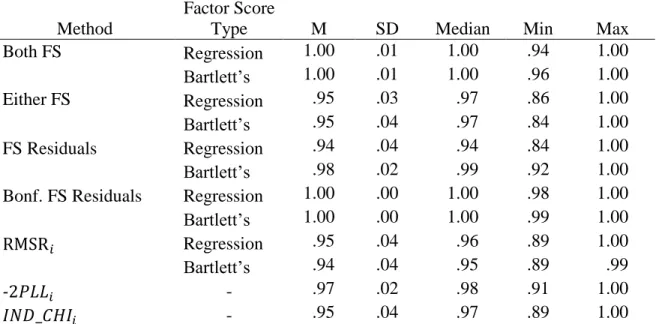
Overall Performance ... 40
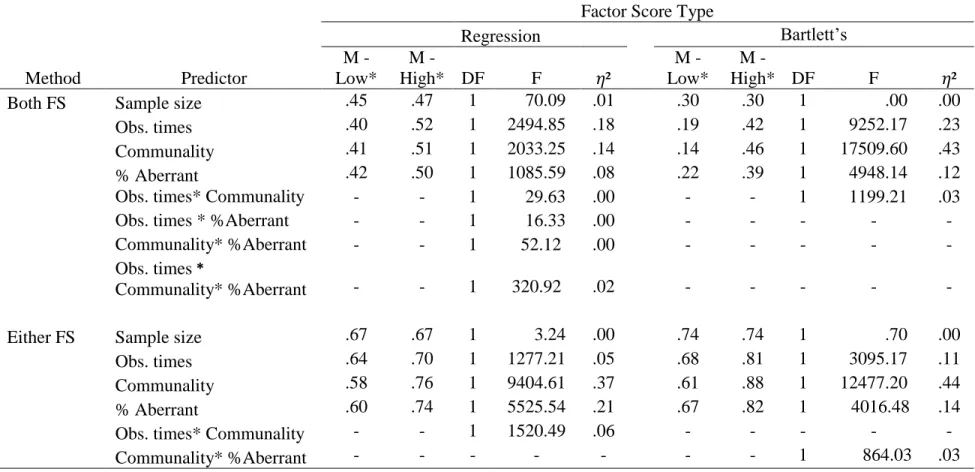
Impact of Experimental Conditions ... 43
3. STUDY 2: Evaluating Approaches to Detect Extreme Variance Aberrance in LGCMs ... 54
vii
Data Generation ... 56
Fitted Model ... 56
Identifying Aberrant Observations... 57
Evaluation of Diagnostic Procedures ... 57
Results ... 58
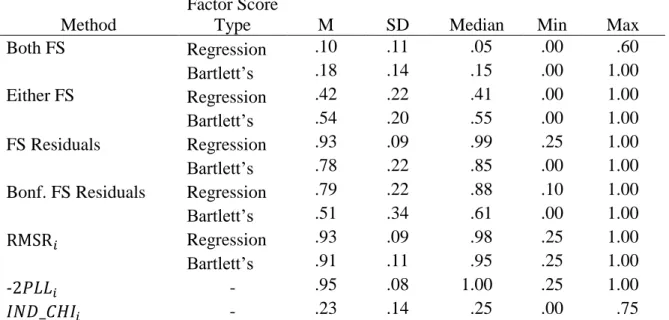
Overall Performance ... 58
Impact of Experimental Conditions ... 59
4. STUDY 3: Evaluating Approaches for Detecting Functional Form Aberrance in LGCMs ... 64
Population Models ... 65
Data Generation ... 66
Fitted Models ... 67
Selecting a Person-Level Data Generating Model ... 67
Evaluation of Model Selection Procedures ... 71
Results ... 72
Overall Performance ... 72
Impact of Experimental Conditions ... 75
5. Discussion ... 80
Discussion of Study Specific Results ... 80
Extreme Trajectory Aberrance Results ... 80
Extreme Variability Aberrance Results ... 82
Extreme Functional Form Aberrance Results... 84
Discussion of Overall Performance of Person Level Analysis ... 86
Limitations of the Current Research ... 88
Recommendations for Researchers ... 91
Future Directions ... 93
viii
LIST OF TABLES
Table
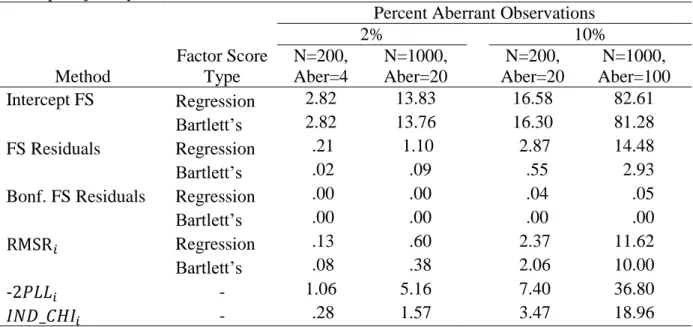
1. Mean number of true positives across conditions for Study 1 examining extreme
intercept trajectory aberrance. ... 95
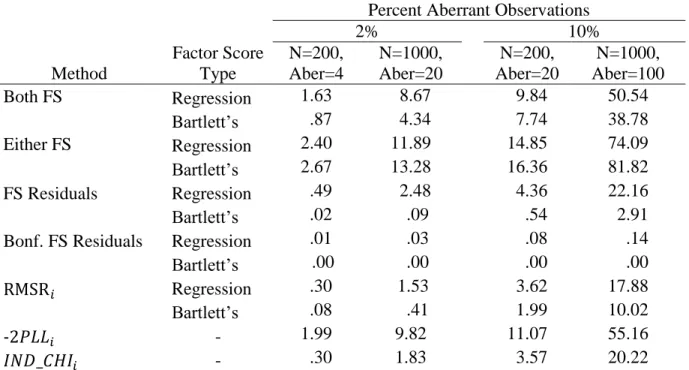
2. Mean number of true positives across conditions for Study 1 examining extreme
intercept and slope trajectory aberrance. ... 96
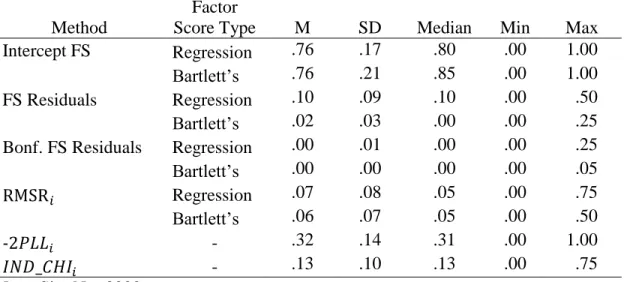
3. Sensitivity across conditions for Study 1 examining extreme intercept trajectory
aberrance. ... 97
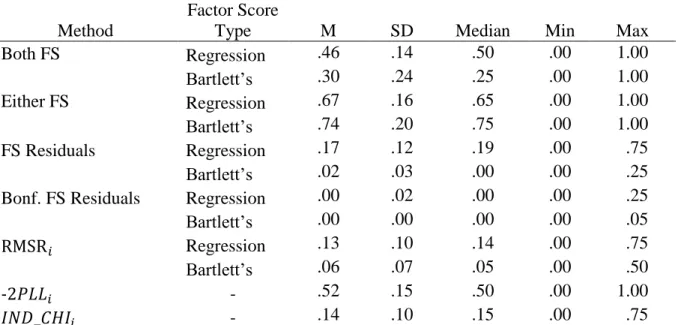
4. Sensitivity across conditions for Study 1 examining extreme intercept and slope
trajectory aberrance. ... 98
5. Specificity across conditions for Study 1 examining extreme intercept trajectory
aberrance. ... 99
6. Specificity across conditions for Study 1 examining extreme intercept and slope
trajectory aberrance. ... 100
7. Sensitivity means by experimental condition and final ANOVA model results for methods examining factor score estimates and factor score residual analysis for
Study 1 examining extreme intercept trajectory aberrance. ... 101
8. Sensitivity means by experimental condition and final ANOVA model results for methods examining factor score estimates for Study 1 examining extreme intercept
and slope trajectory aberrance. ... 102
9. Sensitivity means by experimental condition and final ANOVA model results for factor score estimates residual methods for Study 1 examining extreme intercept and
slope trajectory aberrance. ... 103
10. Sensitivity means by experimental condition and final ANOVA model results for
log-likelihood methods for Study 1 examining extreme intercept trajectory aberrance. ... 104
11. Sensitivity means by experimental condition and final ANOVA model results for log-likelihood methods for Study 1 examining extreme intercept and slope trajectory
aberrance. ... 105
12. Specificity means by experimental condition and final ANOVA model results for methods examining factor score estimates and factor score residual analysis for
ix
13. Specificity means by experimental condition and final ANOVA model results for methods examining factor score estimates for Study 1 examining extreme intercept
and slope trajectory aberrance. ... 107
14. Specificity means by experimental condition and final ANOVA model results for factor score estimates residual methods for Study 1 examining extreme intercept and slope trajectory aberrance. ... 108
15. Specificity means by experimental condition and final ANOVA model results for log-likelihood methods for Study 1 examining extreme intercept trajectory aberrance. ... 109
16. Specificity means by experimental condition and final ANOVA model results for log-likelihood methods for Study 1 examining extreme intercept and slope trajectory aberrance. ... 110
17. Mean number of true positives across conditions for Study 2 examining extreme variability aberrance. ... 111
18. Sensitivity across conditions for Study 2 examining extreme variability aberrance. ... 112
19. Specificity across conditions for Study 2 examining extreme variability aberrance. ... 113
20. Sensitivity means by experimental condition and final ANOVA model results for approaches examining factor score estimates directly and factor score estimate residual based approaches for Study 2 examining extreme variability aberrance. ... 114
21. Sensitivity means by experimental condition and final ANOVA model results for log-likelihood methods for Study 2 examining extreme variability aberrance. ... 115
22. Mean number of true positives across conditions for Study 3 examining functional form aberrance. ... 116
23. Sensitivity across conditions for Study 3 examining functional form aberrance. ... 117
24. Specificity across conditions for Study 3 examining functional form aberrance. ... 118
25. AUC across conditions for Study 3 examining functional form aberrance. ... 119
26. AUC means by experimental condition and final ANOVA model results for methods examining factor score estimates for Study 3 examining functional form aberrance. ... 120
27. AUC means by experimental condition and final ANOVA model results for methods examining factor score residuals for Study 3 examining functional form aberrance. ... 121
x
LIST OF FIGURES
Figure
1. Mean sensitivity for detecting extreme intercept aberrance using the regression factor
score approach as a function of number of observation times and communality. ... 123
2. Mean sensitivity for detecting extreme intercept aberrance using the Bartlett’s factor score
approach as a function of number of observation times and communality. ... 124
3. Mean sensitivity for detecting extreme intercept aberrance using Bartlett’s factor score approach as a function of percent of aberrant observations and number of
observation times. ... 125
4. Mean sensitivity for detecting extreme intercept and slope aberrance using the approach examining both regression factor scores as a function of communality, number of
observation times and percent of aberrant observations. ... 126
5. Mean sensitivity for detecting extreme intercept and slope aberrance using the approach examining both Bartlett’s factor scores as a function of number of observation times
and communality. ... 127
6. Mean sensitivity for detecting extreme intercept and slope aberrance using the approach examining either regression factor score as a function of number of observation
times and communality. ... 128
7. Mean sensitivity for detecting extreme intercept aberrance using the Bartlett’s factor score residual approach as a function of percent of aberrant observations and number of
observation times. ... 129
8. Mean sensitivity for detecting extreme intercept and slope aberrance using the Bartlett’s factor score residual approach as a function of percent of aberrant observations and
number of observation times. ... 130
9. Mean sensitivity for detecting extreme intercept and slope aberrance using the regression factor score residuals approach as a function of number of observation times and
communality. ... 131
10. Mean sensitivity for detecting extreme intercept and slope aberrance using the regression
approach as a function of number of observation times and communality. ... 132
11. Mean sensitivity for detecting extreme intercept aberrance using the - approach as
xi
12. Mean sensitivity for detecting extreme intercept and slope aberrance using the approach examining either Bartlett’s factor scores as a function of percent of aberrant
observations and communality. ... 134
13. Mean specificity for detecting extreme intercept aberrance using the regression factor score approach as a function of communality, number of observation times and
percent of aberrant observations. ... 135
14. Mean specificity for detecting extreme intercept aberrance using the Bartlett’s factor score approach as a function of communality, number of observation times and
percent of aberrant observations. ... 136
15. Mean specificity for detecting extreme intercept and slope aberrance using the approach examining both Bartlett’s factor scores as a function of communality, number of
observation times and percent of aberrant observations. ... 137
16. Mean specificity for detecting extreme intercept and slope aberrance using the approach examining either regression factor scores as a function of communality, number of
observation times and percent of aberrant observations. ... 138
17. Mean specificity for detecting extreme intercept and slope aberrance using the approach examining both regression factor scores as a function of number of observation
times and communality. ... 139
18. Mean specificity for detecting extreme intercept and slope aberrance using the approach examining both regression factor scores as a function of percent of aberrant
observations and communality. ... 140
19. Mean specificity for detecting extreme intercept and slope aberrance using the approach examining either Bartlett’s factor scores as a function of percent of aberrant
observations and number of observation times. ... 141
20. Mean specificity for detecting extreme intercept and slope aberrance using the approach examining either Bartlett’s factor scores as a function of percent of aberrant
observations and communality. ... 142
21. Mean specificity for detecting extreme intercepts using the Bartlett’s factor score residual approach as a function of percent of aberrant observations and number of
observation times. ... 143
22. Mean specificity for detecting extreme intercept and slope aberrance using the Bartlett’s factor score residual approach as a function of percent of aberrant observations and
xii
23. Mean specificity for detecting extreme intercept and slope aberrance using the -
approach as a function of percent of aberrant observations and communality. ... 145
24. Mean sensitivity for detecting extreme variability aberrance using the approach examining both regression factor scores as a function of number of observation
times and communality. ... 146
25. Mean sensitivity for detecting extreme variability aberrance using the approach
examining both regression factor scores as a function of communality and percent of
aberrant observations. ... 147
26. Mean sensitivity for detecting extreme variability aberrance using the approach examining either regression factor score as a function of number of observation
times and communality. ... 148
27. Mean sensitivity for detecting extreme variability aberrance using the Bartlett’s
approach as a function of number of observation times and percent of aberrant
observations. ... 149
28. Mean sensitivity for detecting extreme variability aberrance using the - approach
as a function of number of observation times and communality. ... 150
29. Mean sensitivity for detecting extreme variability aberrance using the
approach as a function of sample size and number of observation times. ... 151
30. Mean sensitivity for detecting extreme variability aberrance using the approach as a function of number of observation times and percent of aberrant
observations. ... 152
31. Mean trajectories for reading scores over time for the linear (black), small quadratic (blue), and large quadratic (red) over 8 time points. Note that the large quadratic trajectory may not be a plausible trajectory for reading over time. However, the goal of the simulation is to determine the impact of the size of the difference in
trajectories on the selection of an appropriate functional form for a given individual. ... 153
32. Example ROC plot using the difference in regression factor score residuals approach with an AUC of .40. The grey line represents chance classification and the black line
represents the results from a replication with an AUC. ... 154
33. Mean, 5th and 95th percentile ROC plot from the results of the regression quadratic score
approach. ... 155
34. Mean, 5th and 95th percentile ROC plot from the results of the Bartlett’s quadratic score
xiii
35. Mean, 5th and 95th percentile ROC plot from the results of the difference in the
regression factor score residuals approach. ... 157
36. Mean, 5th and 95th percentile ROC plot from the results of the difference in the Bartlett’s
factor score residuals approach. ... 158
37. Mean, 5th and 95th percentile ROC plot from the results of the difference in the
regression approach. ... 159
38. Mean, 5th and 95th percentile ROC plot from the results of the difference in the Bartlett’s
approach. ... 160
39. Mean, 5th and 95th percentile ROC plot from the results of the difference in -
approach. ... 161
40. Mean ROC plots for each combination of the levels of number of observation times and
quadratic size from the results of the regression quadratic factor scores approach ... 162
41. Mean ROC plots for each combination of the levels of number of observation times and
communality from the results of the Bartlett’s quadratic factor scores approach ... 163 42. Mean ROC plots for each combination of the levels of number of observation times and
quadratic size from the results of the Bartlett’s quadratic factor scores approach ... 164 43. Mean ROC plots for each combination of the levels of number of observation times and
communality from the results of the difference in regression factor score residuals
approach ... 165
44. Mean ROC plots for each combination of the levels of number of observation times and communality from the results of the difference in Bartlett’s factor score residuals
approach ... 166
45. Mean ROC plots for each combination of the levels of number of observation times and
communality from the results of the difference in the regression approach. ... 167
46. Mean ROC plots for each combination of the levels of number of observation times and
communality from the results of the difference in the Bartlett’s approach. ... 168
47. Mean ROC plots for each combination of the levels of number of observation times and quadratic size from the results of the difference in regression factor score residuals
approach ... 169
48. Mean ROC plots for each combination of the levels of number of observation times and quadratic size from the results of the difference in Bartlett’s factor score residuals
xiv
49. Mean ROC plots for each combination of the levels of number of observation times and
quadratic size from the results of the difference in the regression approach. ... 171
50. Mean ROC plots for each combination of the levels of number of observation times and
quadratic size from the results of the difference in the Bartlett’s approach. ... 172
51. Mean ROC plots for each combination of the levels of communality and quadratic size
from the results of the difference in the Bartlett’s approach. ... 173
52. Mean ROC plots for each combination of the levels of number of observation times and
communality from the results of the difference in - approach. ... 174
53. Mean ROC plots for each combination of the levels of number of observation times and percent of aberrant observations for the small quadratic size (1/20th linear) from the
results of the difference in - approach. ... 175
54. Mean ROC plots for each combination of the levels of number of observation times and percent of aberrant observations for the large quadratic size (1/10th linear) from the
1 Chapter 1
Introduction
Latent growth curve modeling is an increasingly popular approach for evaluating longitudinal
data because it provides information about how individuals change over time both on average, as well as
how much variability there is in change over time. It also provides a method which allows researchers to
test whether covariates can explain why some individuals appear to have different levels or patterns of
change over time. Researchers tend to focus on overall model fit information or component model fit
information when evaluating a latent growth curve model (LGCM). However, given the interest in
understanding a given individual’s level and pattern of change over time, it is also important to examine
model fit at the level of the individual. Examining individual-level information can quantify how well or
poorly a given model explains an individual’s observations, identify outliers or subgroups of individuals
who are not well represented by a given model, and/or provide evidence of model misspecification. Thus,
examining person-level data can help answer the question: Are there individuals in a set of data for whom
a given model does not represent observations well?
This is an important question to answer because the goal of fitting a statistical model like a
LGCM is to test a theory for how a set of variables is related. There are many ways that an individual’s
observations may appear to be poorly represented by a statistical model. This typically occurs when the
model implies a relationship among the observed variables that is systematically different from the
observed data. One example of an individual whose observations are systematically different from what a
model implies about the individual would be someone whose observed depression scores are consistently
much higher than average in a college student sample. This individual could represent normal variability
2
that is distinct from the population of college students that the researcher intended to sample. Another
way that an individual’s observations may appear systematically different is when the model-implied
functional form does not represent the individual’s observed data well. For example, the model may
imply a positive linear trend in reading ability over time, but the data for an individual shows a nonlinear
relationship. This difference between the model-implied functional form and the observed pattern in the
data could occur simply by chance, if the individual’s reading ability happened to improve slowly initially
and then accelerated over time, or it may be evidence that the model is misspecified and that the theory
the model is testing is incorrect about how reading ability changes over time. These are just a few
examples of how a model may not represent an individual’s observations well. Whenever a researcher
finds these individuals in his or her data, the researcher should contemplate why these individuals are
present in the data. Some possibilities are (1) the individuals represent observations from different
populations, (2) there is a characteristic of the individuals that can explain their differences, or (3) the
model has been misspecified for these individuals. Alternatively, it could be that these observations
appear to be aberrant simply by chance. Thus, having aberrant observations may provide information on
different populations in a given sample, suggest a need to bring covariates into a model, or suggest a need
to change how a model is specified. As a result, it is important to have methods to identify these aberrant
individuals.
Currently there are several proposed approaches for evaluating person level information from a
LGCM including factor score based approaches (Bollen & Curran, 2006; Coffman & Millsap, 2006) and
person log-likelihood based approaches (Coffman & Millsap, 2006; McArdle, 1997). Even with multiple
proposed methods for evaluating person-level information, it is unusual for researchers to report any
examination of the person-level information despite the recommendation to do so in several text books
and articles (Bollen & Curran, 2006; Carrig, Wirth, & Curran, 2004; Coffman & Millsap, 2006; McArdle,
1997; Preacher, et al, 2008). The lack of reported examination of person-level information in applications
3
(Goldstein, 2003; Raudenbush & Bryk, 2002; Snijders & Bosker, 1999), which are similar models to
LGCMs (Bauer, 2003; Chou, Bentler, & Pentz, 1998; Curran, 2003; MacCallum, Kim, Malarkey, &
Kiecolt-Glaser, 1997). Also, the increasing interest in examining heterogeneity in longitudinal data
(Nagin, 1999, 2005; Muthén, & Muthén, 2000; Muthén, 2001, 2002) suggests that researchers would be
interested in procedures to examine model results at the level of the individual.
Because of the recommendations to perform person level analysis and the interest in
understanding model fit at the level of the individual, it is unclear why researchers do not report person
level analysis in applications of LGCMs. A potential reason for the absence of person level analysis in
LGCMs could be the lack of information regarding the performance of the approaches for person level
analysis. There are many strategies for evaluating person level information, but there are very few studies
that evaluate how well the approaches perform in practice, especially for LGCMs. There is also very little
information on how these approaches perform relative to each other. It would be useful to know which
approaches are better for identifying different types of aberrant individuals. To better understand which
approaches for evaluating person level information will perform best for LGCMs, I will first provide an
introduction to latent growth curve models. Next, I will describe in greater detail the types of aberrant
observations that could appear in longitudinal data. Then I will review the proposed approaches for
evaluating person level information in order to identify aberrant observations from a variety of statistical
models, as well as information about the performance of these approaches. After reviewing the proposed
approaches, I will identify the information that is needed to understand how to apply these approaches to
a LGCM effectively. Last, I will provide an overview and hypotheses for the current research, which aims
to provide evidence for how well these approaches work, and under what conditions they perform better
or worse.
Introduction to Latent Growth Curve Modeling
Latent growth curve modeling is one approach for modeling changes in a variable over time. In a
4
underlying trajectory of change over time with the addition of random time-specific error. This model can
be represented as
(1)
where represents a vector of the observed repeated measurements for person , is the matrix of
weights or factor loadings representing the functional form of the latent trajectory, is a vector of the
latent trajectory parameters for person , and is a vector of time-specific error for person . The vector
of latent trajectory parameters ( ) can be represented as
(2)
where represents a vector of mean trajectory parameters, and represents a vector containing the
deviations from the mean trajectory parameters for person . It should be noted that Equations 1 and 2 are
for an unconditional LGCM. For a conditional LGCM, predictors of the observed data could be included
in Equation 1, and predictors of the individual latent trajectory parameters could be included in Equation
2.
The mean and covariance structure derived from Equation 1 and 2 can be used to obtain
parameter estimates for the LGCM. The covariance structure is
(3)
where is the covariance matrix for the latent variables, is the covariance matrix for the observed
variables, and is the covariance matrix for the disturbances or error variances. The mean structure is
(4)
Together, Equations 3 and 4 represent model-implied mean and covariance structure of the
5
aberrant observations that can appear in longitudinal data and some potential explanations for why
aberrant observations occur.
Types of Aberrant Observations in Longitudinal Data
There are many ways that individuals can appear aberrant in longitudinal data. To help illustrate
some of the more commonly observed types, I will first provide a description of the general pattern for
the aberrant observations and then provide a few examples of why an individual may have a given type of
aberrance. After each type of aberrant individual is described, I will provide a summary of some potential
explanations for why a given individual may appear aberrant relative to the rest of the data.
One type of aberrant observation in longitudinal data is that of individuals who have extremely
high or low levels relative to the average level in a given sample. Earlier I described an example of an
individual with consistently high depression ratings. This type of aberrance could also appear in
educational data as individuals who show either extremely high or extremely low academic ability
relative to their peers. As with the depression data, these observations could simply occur as legitimate
observations that appear at the extremes of the distribution of ability, or they could represent individuals
who are from a fundamentally different population. As an example, certain individuals may appear to
have extremely low reading ability because they are being tested in a language in which they are not
native, or because of some developmental disability.
In addition to having an extremely high or low level relative to the average level, individuals
could appear to be aberrant in longitudinal data because their rate of change over time is much faster or
slower than average. For example, students who start out extremely low in academic performance but
show dramatic improvement over time may appear to have a positive growth in ability over time that
occurs much faster than average. As with the previous examples, this individual could represent the
normal variability in academic performance, albeit extreme relative to his or her peers. Alternatively, this
6
ability could be bored at younger ages and not take testing very seriously, resulting in choosing answers
that cause the student to appear to have a lower than average ability. As the student gets older, the student
may become more motivated, perhaps by the opportunities that become available to students who perform
well on the test (e.g. more or better college opportunities), resulting in choosing answers that better reflect
the student’s true ability, which is higher than average. This would result in a pattern of observations
with an extremely high positive change over time, which would appear aberrant relative to the other
individuals in the sample, but which could be explained if motivation were measured and included in the
model.
The previous two examples describe individuals whose longitudinal data appear to have extreme
level or slope differences from the average level and slope observed in the sample. It is also possible to
have some combination of these extremes. Overall, these types of aberrant observations could be
described as extreme trajectory aberrance.
In contrast to extreme trajectory aberrance, it is also possible for an individual to have an overall
trajectory that is close to the average trajectory observed in the sample, but appear aberrant because the
observations at each time point show significantly higher variability relative to other individuals. For
example, an individual may appear on average to have normal, stable depression scores over time based
on his or her model implied trajectory. That individual could have observed depression scores that are at
relatively normal levels at each time point or the individual could have observed depression scores that
fluctuate over time between healthy low levels and clinically problematic high levels over time. In the
second case, the individual would appear to be aberrant due to the high variability in their scores relative
to other individuals in the sample. This variability could occur simply by chance, perhaps because the
study happens to measure the individual at times when they are experiencing healthy low levels of
depression, and then also shortly after a family member passes away or the individual loses his or her job.
7
someone who has bipolar disorder. This type of aberrant observations could be described as extreme
variability aberrance.
Another way an individual’s observations may appear aberrant in longitudinal data is when the
shape of the trajectory specified by the model does not represent the shape of the trajectory of the
observed data for an individual well. Earlier I provided an example of an individual whose reading ability
improved slowly initially and then accelerated over time, while the model specified a linear change in
reading ability over time. A similar situation could occur when observing the progression of mental
health over time. A study following individuals during and after treatment could test the hypothesis that
improvement in mental health is linear over a short time period, while an individual’s observations may
show a nonlinear change over time. It could be that the nonlinearity in the observed data just occurred by
chance, or it could be evidence that the pattern of change implied by the theory being tested is incorrect.
This type of aberrance could be described as functional form aberrance.
Yet another possible form of aberrance in longitudinal data would be an individual who has one
or a few observations that are extremely different from the rest of his or her observations. This could
occur in an academic setting because the individual is very sick the day of testing or if the individual is
only able to cheat on one or a few of the tests. In substance use research, this could occur if one or a few
of the time points happen to occur during a period of time when the individual is experimenting with
drugs, but for an individual who does not typically use substances. This type of aberrant observation
could be described as aberrance due to time-specific outliers.
These different types of aberrant observations can cause problems when trying to understand the
overall trends in longitudinal data. Whether or not an aberrant observation is problematic depends on why
the aberrant observation appears in the data set. There are many possible explanations for why an
individual’s observations may not be well represented by a latent growth curve model. I will describe four
8
because the individual is from a different population. For these individuals, a researcher may want to
exclude them from the sample because the individuals are not from the population of interest. A second
explanation for why an individual may appear aberrant is because there is some characteristic of these
individuals that can explain the difference between what the model implies and the observed data. For
these individuals, researchers would not want to exclude them from the sample, but covariates should be
included in the model to explain why these individuals appear to be aberrant relative to the other
individuals in the sample. A third explanation for why an individual may appear to be aberrant is because
the model is incorrectly specified. In this situation, researchers may decide that the individuals provide
evidence that a theory does not result in an accurate representation of the data, and therefore the theory
needs to be revised. Finally, an individual may appear to be aberrant simply by chance. For these
individuals the model is not misspecified, there is no characteristic of these individuals to explain their
aberrance, and the individual is from the population of interest. In this situation, researchers would want
to include the individuals because they are valid observations of how a construct is changing over time.
These potential patterns of aberrant observations in longitudinal data and potential explanations
for aberrance are not intended to include all possible types or explanations of aberrance. They are
intended to provide some examples of how and why aberrant observations may appear. Given that these
patterns of observations may result in researchers making decisions about including or excluding
individuals or covariates, or revising theory, it is important to be able to identify these aberrant
individuals. The following sections will examine potential approaches that use person level analysis to
identify aberrant individuals in LGCMs.
Current Approaches for Person Level Analysis in a LGCM
Based on a review of the previous work on person level analysis in LGCMs and the analyses
done for other models, there appear to be two general approaches to person level analysis, factor score
analysis and person level fit analysis. To better understand what each of these approaches can provide
9
implementing each approach. After presenting the approaches and strategies of implementing them, I will
describe what research is needed in order to support the use of these strategies for identifying different
types of aberrant observations in LGCMs.
Factor Score Analysis
There are several approaches for evaluating person level information using factor score estimates.
These approaches either focus solely on the factor score estimates, or use the factor score estimates to
generate predicted observations and calculate residuals for analysis. The motivation behind examining the
factor score estimates directly is typically either to identify unusual individuals or subgroups at the level
of the latent variables, or to check for any unusual patterns in the factor score estimates suggesting model
misspecification. The motivation behind calculating predicted observations and residuals is typically to
quantify the fit of the model in terms of how far the predicted observations are from the observed data.
These quantifications of model fit provide an index of model fit at the level of the individual, which could
potentially be used to compare models. To better understand how these factor score based approaches are
implemented, I will first describe approaches for calculating factor score estimates, predicted values, and
residuals, then describe how several researchers have proposed using these calculations to perform person
level analysis.
There are several methods of calculating factor score estimates. In order to select a method for
calculating factor score estimates one must understand both the general and specific properties of factor
score estimates. The most important general property of factor score estimates is that they are predictions,
not estimates, of latent variables. Factor score estimates are predictions because of factor indeterminacy.
Factor indeterminacy occurs because there are more unknown variables than known variables in latent
variable models. Factor indeterminacy results in the ability to find infinite sets of factor score estimates,
factor loadings, and unique factors that can explain the pattern of relationships among observed variables
equally well. This means that factor score estimates cannot be uniquely determined, although the degree
10
have been warned not to treat these scores as the true latent variable scores (Gorsuch, 1983), and not to
make fine comparisons using factor score estimates (Bollen, 1989). However, Gorsuch (1983) argues that,
“Indeterminacy of factor scores is only a serious problem if one reifies the factors from a given study into ultimate realities. The present approach is to consider factors as constructs that will, hopefully, aid in theory development. Constructs are always abstractions from data and never observed. The best one can expect with any construct is that a psychometrically good operational representative will be found for it (Nunnally, 1978).”
Thus, Gorsuch argues that as long as factor score estimates are a good representation of the latent factors,
they can be used as predictions of the latent factors. Similarly, Raykov and Penev (2002) argue that the
issue of factor indeterminacy, or lack of unique factor score estimates, does not necessarily imply that the
information contained in a given set of factor score estimates lacks meaning. In addition to these
arguments, there is empirical evidence that factor score estimates can be useful for identifying unusual
observations or model misspecifications (Bollen & Arminger, 1991; McDonald & Bolt 1998; Raykov &
Penev, 2002; Bauer, Baldasaro, & Gottfredson, 2012).
As stated previously, there are many ways to calculate factor score estimates (Grice, 2001a;
2001b). This study will focus on two approaches, the regression method, also known as the empirical
Bayes method (Thomson, 1936,1951; Thurstone, 1935), and Bartlett’s method, also known as the
generalized least squares (GLS) method (Bartlett, 1937). I will now describe the specific properties of
these two methods.
Factor score estimates regression method.Factor score estimates can be generated by the
regression method (Thomson, 1936, 1951; Thurstone, 1935). Regression factor score estimates are
calculated as
̂
̂
[
̂
]
(5)where is the covariance matrix for the latent variables, is the factor loading matrix,
̂
is the11
person ,
̂
is a vector of the model-implied means for the observed variables and is a vector of thelatent variable means. The motivation behind the regression method was to develop a way to produce an
equation that would calculate the best prediction of the factor score for any person (Bartholomew, Deary,
& Lawn, 2009). These are equivalent to empirical Bayes estimates (Bartholomew & Knott, 1999;
Skrondal & Rabe-Hesketh, 2004). These predictions are shrunken towards the distribution of the latent
variables in the fitted model. The level of shrinkage depends on factor determination, which depends on
the informativeness of the observed data. As the number and communality of measured variables
increases factor determination increases (Grice, 2001a). In the multilevel modeling (MLM) literature, the
shrinkage of empirical Bayes estimates has been found to be greater for individuals with fewer
observations, and when within-subject variability is large relative to between-subjects variability
(Verbeke & Molenburghs, 2000). For longitudinal data, fewer observations would be equivalent to fewer
time points, and greater within-subject variability relative to between-subject variability, would be
equivalent to greater time-specific variability relative to latent trajectory variability. Empirical Bayes
estimates are often described as ‘shrunken’ because they tend to shrink towards the mean, which makes
them both more biased but also more precise (Hox, 2010). Gorsuch (1983) notes that these factor score
estimates have the highest correlation with actual factors.
Factor score estimates Bartlett’s method.Factor score estimates can also be generated by
Bartlett’s method (Bartlett, 1937). Bartlett’s factor score estimates are calculated as
̂
[
̂
]
(6)
This method is sometimes referred to as the generalized least squares (GLS) method (Bollen & Curran,
2006) or the maximum likelihood method (Skrondal & Rabe-Hesketh, 2004). Bartlett’s scores minimizes
the size of the unique factors by minimizing the sum of the squared errors divided by their standard
deviations. In contrast to the regression method, the motivation behind Bartlett’s method was to calculate
12
the prediction be unbiased and have minimized variance (Bartholomew, Deary, & Lawn, 2009). By
minimizing the unique variances, Bartlett’s approach results in factor score estimates that are
conditionally unbiased (Goursuch, 1983; Skrondal & Rabe-Hesketh, 2004). This means that unlike the
regression method, which is known to provide biased predictions, Bartlett’s approach should provide
unbiased predictions given that the model is properly specified.1
Bartlett’s method optimizes a different set of criteria than the regression method, which means
that applying the two approaches to the same model with the same data will not result in identical factor
score estimates for a given person. The rank order of individuals in terms of their factor score estimates
will differ across these factor score methods unless the individuals in the data are independent and the
latent factors are uncorrelated (McDonald, 2011). Researchers are typically encouraged to use whichever
approach is appropriate given the aims of their factor score analysis (Tucker, 1971). McDonald (2011)
has argued that it is not clear which of these factor score approaches should be used when examining
longitudinal models such as the LGCM. Because these approaches optimize different criteria, it is likely
that there are some person level analysis approaches that would favor using Bartlett’s factor score
estimates over regression factor score estimates, while other person level analysis approaches may favor
regression factor score estimates over Bartlett’s. Thus, in order to determine with factor score approach is
appropriate for a given person level analysis approach, both of these approaches for calculating factor
score estimates need to be examined.
Residuals from factor score estimates.In addition to calculating factor score estimates,
researchers can use the scores to generate predicted values and residuals for the researcher’s observed
data. Predicted values for a LGCM can be calculated as
1 Note that Equation 5 and 6 would represent the factor score equations for unconditional LGCMs. These
equations could be extended to conditional LGCMs with exogenous predictors by replacing with a vector of
13
̂
̂
(7)
where
̂
is a vector of the predicted values, and
̂
is the vector of factor score estimates for person . The factor score estimates can be calculated using the factor score methods described in Equation 5 and 6,or from any other factor score method. The predicted values from different factor score methods will not
be equal.
Residuals are calculated using the following equation
̂
̂
(8)
where
̂
is a vector of residuals for person . This residual calculation can be used for any factor scoremethod. As with the predicted values, the residuals for person will not be identical for different factor
scoring methods.
Person level analysis using factor score estimates.Many approaches have been proposed to use
factor score estimates, predicted values, or residuals for person level analysis. I will first describe the
approaches proposed in the LGCM literature. In addition to the LGCM literature, I will also highlight
some approaches described in the multilevel modeling and structural equation modeling literature that
may be useful in LGCM applications.
In their book on latent growth curve modeling, Bollen and Curran (2006) provide instructions for
how to evaluate person level diagnostics using factor score estimates. Bollen and Curran suggest that
researchers use factor score estimates of the latent intercepts and slope factors to perform diagnostics in
the same way as how ordinary least squares (OLS) estimates of the intercept and slope for each individual
are used. They give an example of how to perform a person level analysis with OLS estimates of the
latent intercept and slope factors, and also provide equations for several popular factor scoring methods.
In their example of OLS diagnostics, they examine plots of the estimated intercepts and slopes for
14
as a means of quantifying the closeness of a linear model to the observed data. They argue that a strong
linear trend would be indicated by R-squared values of 0.7 or more. Thus, Bollen and Curran propose
methods for using factor score estimates both to identify unusual observations and to quantify model fit.
However, they did not provide any information on the limitations of these approaches, or how well these
approaches would work.
Coffman and Millsap (2006) also describe using factor score methods to produce estimates of
individual latent trajectories. First, they discuss using factor score estimates to calculate predicted latent
variables and then generate predicted observations which can then be used in a residual analysis. For an
example of how to implement a residual analysis they cite the work done by Bollen and Arminger (1991)
on person-specific residual analysis in structural equation modeling (SEM). Coffman and Millsap propose
that Bollen and Arminger’s residual analysis for SEM could also be used for person level diagnostics for
LGCMs. However, Coffman and Millsap did not implement this residual analysis approach with a LGCM
or evaluate its performance.
In addition to describing a residual analysis approach, Coffman and Millsap (2006) also discuss
the procedure described by Meredith and Tisak (1990) for obtaining empirical Bayes estimates for the
latent variables, and how these estimates could be used to evaluate person level diagnostics. Specifically,
Coffman and Millsap describe how the empirical Bayes estimates could be used to calculate predicted
latent trajectories for each individual, and then show how the predicted latent trajectories could be
compared to the observed data by computing a root mean squared residual for each individual ( )
√ ̂ ̂ (9)
where is the total number of time points for person . The is a numerical index of how close the
15
analysis, this proposed approach to person level diagnostics was not implemented or evaluated for
effectiveness, nor has it been compared to other proposed strategies.
In addition to the LGCM literature, the literature on multilevel models (MLMs) can offer some
strategies for using factor score estimates to evaluate LGCMs at the level of the individual. Several
authors discuss the similarities and differences between MLMs and LGCMs (Bauer, 2003; Chou, Bentler,
& Pentz, 1998; Curran, 2003; MacCallum, Kim, Malarkey, & Kiecolt-Glaser, 1997). A multilevel model
and a LGCM applied to the same data can result in identical parameter estimates when the models have
the same constraints. Given this similarity, it is worthwhile to examine what analysis of the person level is
recommended in multilevel modeling. In a longitudinal MLM, examining person level information
involves estimating the level 2 random effects or residuals. These level 2 estimates or residuals can be
examined for outliers, subgroups, or assumption violations. Estimates of the person level random effects
are usually calculated using a Bayesian approach and the estimates are referred to as “empirical Bayes”
estimates (Langford & Lewis, 1998; Snijders & Bosker, 1999; Verbeke & Molenberghs, 2000; Hox,
2010). However, some authors also discuss using ordinary least squares estimates (Raudenbush & Bryk,
2002; Skrondal & Rabe-Hesketh, 2004). Once person level estimates are obtained, a variety of plots can
be used to examine the distributions of the estimates or their residuals (e.g. histograms, boxplots, and
scatterplots) for outliers or subgroups (Langford & Lewis, 1998; Snijders & Bosker, 1999; Verbeke &
Molenberghs, 2000; Raudenbush & Bryk, 2002; Hox, 2010). The normality of the estimates can be
evaluated by examining skew or kurtosis, and residuals can be examined for normality using a normal
Q-Q plot (Langford & Lewis, 1998). Some textbooks also recommend examining plots of unstandardized
residuals and their relationship with relevant covariates to check for functional form, homoscedasticity,
and influential observations (Snijders & Bosker, 1999; Raudenbush & Bryk, 2002). Similar to linear
regression, there are formulas available for calculating Studentized residuals, leverage, and influence for a
MLM (Langford & Lewis, 1998). These statistics can be compared to cut-off values to identify
16
some additional ideas for how to use factor score estimates for person level diagnostics in applications of
LGCMs.
In contrast to the multilevel modeling research, structural equation modeling (SEM) research has
not spent as much time on the issue of person level analysis. While MLM textbooks routinely discuss
person level analysis, textbooks on SEM typically discuss evaluating models using overall model fit,
component fit, or proportion of variance explained (Bollen, 1989; Bollen & Long, 1991; Kaplan, 2000;
Schumacker & Lomax, 2004; Mulaik, 2009). Person level analysis is generally discussed in research
examining how to use factor score estimates or factor score based residuals, to identify outliers or
violations of model assumptions (Bollen & Arminger, 1991; McDonald & Bolt, 1998; Raykov & Penev,
2002), or how much a person contributes to model misfit using person log-likelihoods (Reise &
Widaman, 1999; Sideris, 2006). Both the residual analysis and person log-likelihood approaches attempt
to identify individuals who do not fit with a given model. I will discuss the person log-likelihood
approaches later. In the subsequent sections I will highlight the SEM work on using factor score estimates
for person level analysis.
The use of factor score estimates for person level analysis was demonstrated by Bollen and
Arminger (1991) when they developed person-specific residual analysis in SEM. They proposed two
factor score methods for calculating unstandardized residuals. The first method estimated unstandardized
residuals with a weight matrix chosen so as to minimize the sum of squared residuals. This method is
based on the regression method of calculating factor score estimates (Thomson, 1936, 1951; Thurstone,
1935). The second method estimated unstandardized residuals with a weight matrix chosen so as to
minimize the sum of squared errors divided by their standard deviation. This method is based on the
Bartlett’s method of calculating factor score estimates (Bartlett, 1937). Bollen and Arminger (1991) also
proposed ways to calculate variances and standardized residuals for each method. The variance for the
residuals from the regression method is
17 and for residuals from Bartlett’s method the variance is
( ̂ ) (11)
To standardized the residuals Bollen and Arminger used the following calculation
̂ ̂ √ ̂
(12)
where ̂ is the jth residual of ̂, which is the vector of residuals for person , and ̂ is the
jth diagonal element of ̂ . The same calculation can be used for the residual and variance estimates
from either the regression or Bartlett’s method. Bollen and Arminger provided recommendations for how
to examine residuals graphically and with statistical criteria. Specifically, they recommended using a
simultaneous test of statistical significance for the sample residuals for a person. They calculated the test
statistic as follows
̂ ̂ ̂
(13)
where the residual ( ̂) and variance ( ̂ ) estimates can come from either the regression or Bartlett’s
method. The test statistic follows a chi-distribution with degrees of freedom equal to the number of
observed variables; for the latent curve model this will be the number of observed time points. Because
is calculated for each individual, Bollen and Arminger recommended that researchers apply a
correction for multiple significance testing. They proposed several corrections, including a Bonferroni
correction or simply selecting a different alpha level and dividing it by the number of significance tests
examined.
Bollen and Arminger used simulations to examine how well the two approaches performed at
identifying outliers. The simulation studies found that these approaches to estimating residuals were
helpful at identifying unusual observations even at small sample sizes. It was emphasized that the
methods proposed were one way to identify outliers, in this case, observations that were not
18
influential observations. This would mean that when the observation is removed from the model,
substantial changes in model parameters or overall fit would occur. The authors warn that examining
residuals does not guarantee that all outliers or influential observations will be identified and suggest that
there is a need to develop statistics similar to the regression diagnostics: DFBETAS, Cook’s D, and
DFITS. They also emphasized that as with any new procedure, more research would be needed to
identify the strengths and limitations of their proposed procedures.
Similar to Bollen and Arminger (1991), McDonald and Bolt (1998) showed how to use the
regression method first to obtain factor score estimates for calculating predicted observations and then to
calculate residuals. McDonald and Bolt focus on how factor indeterminacy influences residual analysis in
SEM. Specifically, they examined the detection of departures from the assumptions of linearity using
residuals calculated by taking the difference between the predicted observations based on factor score
estimates and the observed measures. They found that the factor indeterminacy did not hinder the ability
to use residual analysis for this purpose. The authors argued that their findings provide evidence that
residual analyses in SEM can be used to detect outliers or assumption violations even with factor
indeterminacy.
Raykov and Penev (2002) were the first to specifically emphasize using factor score estimates to
evaluate person level model fit. They created person level residuals by generalizing Bartlett’s based
residuals proposed by Bollen and Arminger (1991). They showed how the person level residuals can be
used to evaluate model fit by examining plots of the residuals for trends that suggest model
misspecification. Raykov and Penev (2002) defined person fit as the difference between the observed data
and the predicted data based on the model estimates, and contrasted person fit to the traditional overall
model fit indices that examine the difference between the observed and model implied covariance
19
In addition to the previously described work on residual analysis, several researchers have
examined ways to calculate residual-based Mahalanobis distance (Ke-Hai, Wing Kam, & Reise, 2004),
and case influence measures (Lee & Wang, 1996; Pek & MacCallum, 2011; Tanaka, Watadani, & Moon,
1991) for structural equation models. Pek and MacCallum (2011) provide a comprehensive overview of
how to calculate several outlier indices common to linear regression in an SEM setting. One challenge to
using the case influence measures is that they are typically computationally burdensome with large
sample sizes, because they involve fitting the model of interest to the full sample and then again,
removing one observation at a time. This burden may be remedied by incorporating these calculations
into SEM software programs. Until then, researchers may prefer person fit indices that only require
minimal computational burden, like the previously described factor score approaches or the person
log-likelihood-based indices, which are described next.
Person Level Fit Analysis
In addition to factor score approaches, several researchers have discussed using a measure of
person level fit to evaluate how well an individual’s observations fit with a given model. Preacher,
Wichman, MacCallum, and Briggs (2008, p. 21) recommend that researchers examine individual fit
criteria in addition to global fit criteria. They argue that person fit should be examined in order to
determine whether the individual growth curves are approximated well. Several articles propose using
person log-likelihood indices to evaluate person level fit in a LGCM (McArdle & Bell, 2000; McArdle &
Hamagami, 2001; Mehta & West, 2000). Only a few articles show how to implement an analysis using
person log-likelihoods (Blozis & Cho, 2008; Coffman & Millsap, 2006; McArdle, 1997). Specifically,
McArdle (1997) partitioned the overall log-likelihood into person log-likelihoods using a formula for a
person log-likelihood described by Lange, Westlake and Spence (1976)
20
Where is the number of measured variables. The overall for a given model, can be calculated by
taking two times and then taking the sum of the - across the individuals in the sample.
McArdle examined a plot of the person log-likelihoods to look for individuals who made greater
contributions to the overall model misfit. After identifying individuals with large person log-likelihoods
(relative to the other individuals), he then calculated the percent of the overall log-likelihood that was
contributed by the unusual individuals. Thus, McArdle (1997) identified two ways for examining
individual log-likelihoods for unusual observations: using a plot of the person log-likelihoods and
calculating the percent of the overall log-likelihood a given individual contributes. McArdle emphasized
two benefits of examining person log-likelihoods. First, he argued that examining person log-likelihood
would help to clarify the interpretation of statistical indices, such as the likelihood-ratio-test. Second, he
argued that examining person log-likelihoods would provide a means for examining the data for outliers
or subgroups.
In the context of structural equation modeling, Reise and Widaman (1999) argued that could
quantify person fit, such that small negative values of would indicate that a pattern of observed data
was likely to occur given the model of interest, while large negative values would indicate that a pattern
of observed data was not likely given the model of interest. Large negative values of would
therefore be evidence that an observation is an outlier given the model of interest. Because there were no
means to compare to a standardized distribution, Reise and Widaman (1999) used the formula in
Equation 14, to calculate , an individual’s contribution to overall model misfit
(15)
where is the person log-likelihood for the model of interest and is the person
log-likelihood for a saturated model. They argued that the would result in value that would
represent an individual’s contribution to the overall model fit chi-square. Thus, high positive values of
21
both real and simulated data, they found that the was normally distributed with a mean of zero
and a standard deviation of 1.2 for real data and .2 for simulated data. Given the differences from the
standard normal distribution, they recommended two strategies that researchers could use for evaluating
. The first approach would be to conduct a simulation and judge any relative to the
distribution from the simulation results. The second approach would be to select a criterion by which to
select individuals for further examination, say the highest 1%. To evaluate the performance of ,
Reise and Widaman compared it to (Drasgow, Levine & Williams, 1985), a traditional person fit index
from item response theory. They found that the two indices were only weakly correlated, but
identified similar individuals as outliers as those identified by , suggesting that the could be
an appropriate approach to evaluating person fit in structural equation models.
Coffman and Millsap (2006) also applied the work by Lange, Westlake, & Spence (1976) to
decompose overall log-likelihood into a person-specific log-likelihood, which they describe as an “index
of the covariance weighted distance between an individual’s scores and the group averages (p 6).”
Coffman and Millsap used the person log-likelihood to show that poor global model fit may hide good
approximation to individual observations. They compared - to for evaluating individual
model fit in LGCMs using simulated data from an unconditional linear LGCM. The results of the
simulation study indicated that - and were only correlated .159 for the linear LGCM,
suggesting that the indices provide different information regarding person fit. Examination of the -
and showed that the largest - values indicated large deviations from a linear trajectory,
while small - indicated trajectories that were more linear. Unlike the - , large did
not indicate observations that deviated most from a linear trajectory and small did not identify
linear trajectories. They also followed the recommendation of McArdle (1997) and examined the percent
contribution to overall model misfit for individuals with high - . They found in their empirical
example that even observations with the largest - did not contribute substantially to overall model
22
very large for individuals with large - . Coffman and Millsap argued that identifying person fit can
allow researchers to (1) identify individuals for whom the model fit well or poorly, (2) identify outliers, or
(3) use person fit indices for model diagnostics, similar to regression diagnostics. They argued that these
three purposes for evaluating model fit are important because they can help to refine models, eliminate
data entry errors, and identify model misspecification.
A limitation to all of the proposed approaches to evaluating person level information in a LGCM
is that very little work has been done to evaluate the effectiveness and limitations of these approaches.
Sideris (2006) is one exception. Sideris compared several approaches to identifying aberrant observations
in the context of SEM. In his research, Sideris extended the work done by Reise and Widaman (1999) to
create an index of person fit that allowed for missing data. This index, called , is created by
calculating a person likelihood that accounts for the missing data pattern and weights the person
log-likelihood by the number of measured variables for person . The , is calculated as follows
[ | ̂ | ( ̂ ) ̂ ( ̂ )] (16)
where is the number of measured variables for person and ̂ is the covariance matrix for the
individuals with the same missing patterns as person . Sideris used a simulation study to compare this
index of person fit to a model free residual analysis (Bollen, 1987), the (Reise & Widaman,
1999), and a mixture modeling approach (Yung, 1997). The consistently outperformed
at identifying aberrant observations. Its performance was similar to the residual analysis, but had the
advantage of being able to handle missing data. The mixture modeling approach was found to be
ineffective for identifying aberrant observations. These results suggest that it is possible that a for a
model of interest could be used for identifying aberrant observations and that it is not necessary to use the
which includes the extra calculation of comparing the from the model of interest to the