Procedurally Generated
Genetic Keys
Senior Project
Adam Levasseur
Abstract
This project presents a method for creating multi-part models based on input keys to generate new, variant models via genetic algorithms. By utilizing 3D models as modular parts, this method allows for the generation of a unique, compound model based on one or multiple input keys. This paper explains the process of creating and testing such generation styles using simple geometry to create more complex, compound models.
Introduction
Repetitive loading of 3D models for the sake of small changes, or variants, can consume valuable time. By loading fewer, modular 3D models and procedurally combining their geometry, an application can use less time spent loading models and more time spent on the rest of the application. When
considering the application for video games, this style of procedural generation fits to create new and often interesting content. The purpose of this project is to explore the process of creating a procedural generation application and designing an evaluation function to automatically produce successor models.
The system designed for this project uses C++ as the language of choice and implements OpenGL graphics and simulates physics based on the Bullet Physics engine. The OpenGL code used is an adaptation of base code supplied by Professor Wood for the “Introduction to Computer Graphics” course offered at CalPoly. This base code was originally designed to be able to display single,
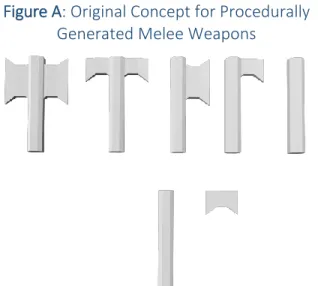
Figure A: Original Concept for Procedurally
Generated Melee Weapons
Figure B: Original Early Evaluation Criteria for
Generated Swords
Center of mass within lower third of model to simulate a balanced sword
Top of model must merge to a single vertex Lower third of model must have at least one
separate material/mass to simulate a handle
Optional portions of model include:
Pommel: separate material than handle to bring center of mass closer to handle Guard/hilt: aesthetic portion that may also
bring center of mass closer to handle
Handle Guard: aesthetic portion that alters the center of mass to give the sword a direction use; thus altering the performance of the sword if implemented
The original objective and theme of this project was to procedurally create and evaluate 3D models of melee weapons (e.g. axes, swords, shields, etc.). The original concepts and evaluation criteria can be seen in Figure A and Figure B. However, due to the limitations of the Bullet Physics engine and the lack of mechanical physics knowledge for measuring aspects like “sharpness” and blunt force, the project was re-oriented to produce a simpler genetic algorithm for 3D keys. The rest of this paper focuses on this new theme and the evaluation process.
Related Work
“Borderlands 2”
Borderlands 2 Concept Art [1]
“Evolving Virtual Creatures” [3]
Sims’ Diagram for Connected Graphs to Model Phenotypes [3]
Algorithm
Often geometry modelled in editing programs such as Blender and Maya are partitioned into separate shapes or meshes, rather than one continuous mesh. These multi-part models allow for selective graphical features like color, texture, and animation. This project utilizes the selectivity of multi-part models to procedurally generate a multi-part model from an individual model.
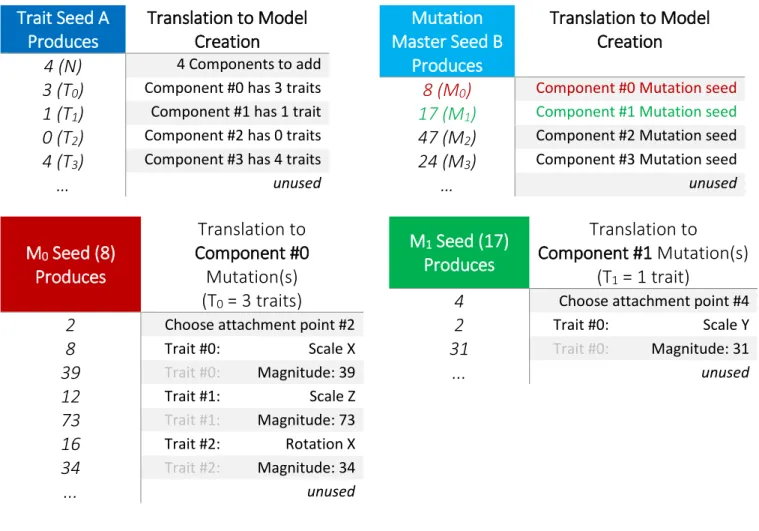
Figure C: Model Creation using Pseudo-Random Seeds
Trait Seed A
Produces
Translation to Model
Creation
4 (N)
4 Components to add3 (T0)
Component #0 has 3 traits1 (T1)
Component #1 has 1 trait0 (T2)
Component #2 has 0 traits4 (T3)
Component #3 has 4 traits…
unusedMutation
Master Seed B
Produces
Translation to Model
Creation
8 (M
0)
Component #0 Mutation seed17 (M
1)
Component #1 Mutation seed47 (M2)
Component #2 Mutation seed24 (M3)
Component #3 Mutation seed…
unusedM
0Seed (8)
Produces
Translation to
Component #0
Mutation(s)
(T
0= 3 traits)
2
Choose attachment point #28
Trait #0: Scale X39
Trait #0: Magnitude: 3912
Trait #1: Scale Z73
Trait #1: Magnitude: 7316
Trait #2: Rotation X34
Trait #2: Magnitude: 34...
unusedM
1Seed (17)
Produces
Translation to
Component #1 Mutation(s)
(T
1= 1 trait)
4
Choose attachment point #42
Trait #0: Scale Y31
Trait #0: Magnitude: 31...
unusedTrait Seed
The first key, or Trait seed, is shown in the upper-left table of Figure C. It uses the first number generated, N, to determine the number of additional model geometries, or components, for the initial model. The next N numbers generated by the first seed determine the number of
geometric transformations, considered as traits, for each component (T0, T1, …, TN - 1). Finally, for aesthetic purposes, these N numbers generated are also used to color the component model.
Mutation Master Seed
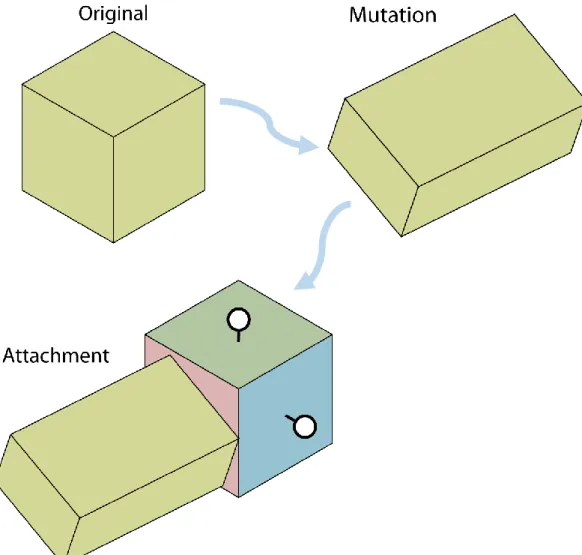
The second seed is shown in the upper-right table of Figure C. It generates the next generation of seeds that are used to determine which transformations are applied and their magnitudes (M0, M1, …, MT - 1). This determination is done by using this second generation of numbers to seed the pseudo-random number generator for randomly determining where and how to attach the new components (numerically seen in the lower tables of Figure C). First, every component is allowed one trait to randomly translate the component to one of the available attachment points on the currently generated multi-part model (as seen in Figure D). After the component’s attachment point is determined, the second generation of numbers are used to apply
transformations with random magnitudes (as seen in Figure E). Finally, after all trait
Figure D: Parent model with attachment points displayed
Genetic Mixing
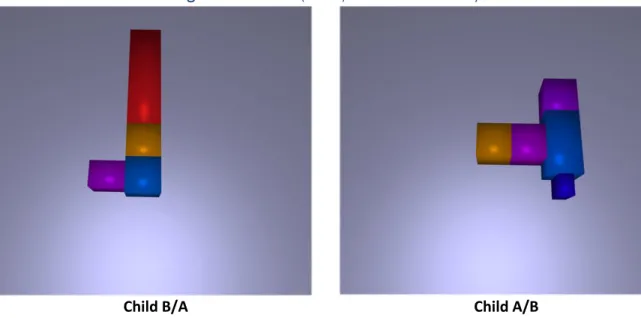
Once a model is constructed, it stores the original seed keys (Trait seed and Mutation seed) to allow for the passing of “genes” to offspring models. When using two generated parent models, the offspring model is created using a mixture of their seed keys (i.e. Trait seed from parent A and Mutation seed from parent B). Figures F and G present a two generations of procedurally generated models using a single-gene model to produce two variant, child models.
Parents
In Figure F, Parents A and B have been generated with different Trait and Mutation Master Seeds. Looking at the Parent A image, an initial model (shown as the orange cuboid) with four components (shown as the two purple and two blue cuboids). Similarly, in Parent B, an initial model (shown as the orange cuboid) with three components (shown as the blue, red, and purple cuboids) is generated.
Figure F: First (Parent) Generation of Keys
Parent A
Trait Seed: 208, Mutation Master Seed: 176
Parent B
Trait Seed: 243, Mutation Master Seed: 133
Children
Figure G: Second (Child) Generation of Keys
Child B/A
Trait Seed: 243, Mutation Master Seed: 176
Child A/B
Trait Seed: 208, Mutation Master Seed: 133
Results
Genetic Testing
Overall, this method of procedural generation is successful in creating new 3D multi-part models. Given two input keys, the same model will always be produced. Similarly, given four input keys, two parent models will be produced using the first two keys for one model and the last two for the other. In this four-key method, the two models are then used to breed a new combination or offspring model based on a mixture of the parents’ keys.
Evaluation
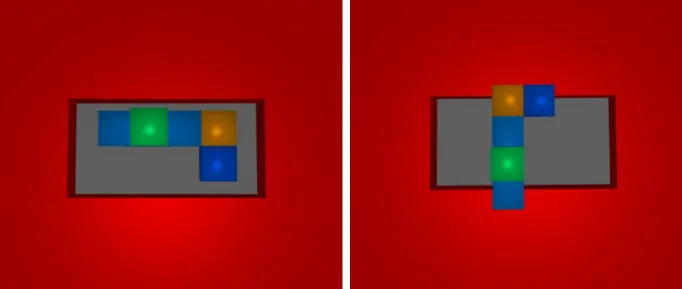
Finally, to evaluate and compare these models, a simple collision test was designed using the Bullet Physics engine for the application of procedurally developing a key model. In this test, a keyhole model is previously prepared and placed in the 3D space with an appropriate collision mesh. If the generated model passes far enough passed the keyhole model, the test is
Figure H: Example Evaluation Orientations for Trait Seed: 129, Mutation Master Seed: 39
Test #0, Rotation 0° about –axis, PASS Test #2, Rotation 90° about Y–axis, FAIL
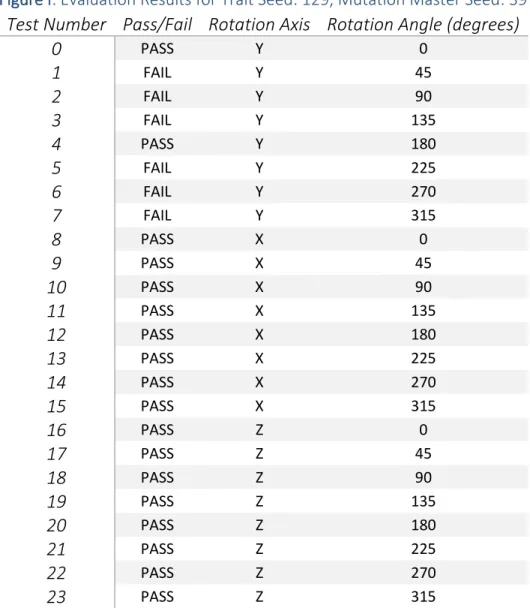
Figure I: Evaluation Results for Trait Seed: 129, Mutation Master Seed: 39
Test Number Pass/Fail Rotation Axis Rotation Angle (degrees)
0
PASS Y 01
FAIL Y 452
FAIL Y 903
FAIL Y 1354
PASS Y 1805
FAIL Y 2256
FAIL Y 2707
FAIL Y 3158
PASS X 09
PASS X 4510
PASS X 9011
PASS X 13512
PASS X 18013
PASS X 22514
PASS X 27015
PASS X 31516
PASS Z 017
PASS Z 4518
PASS Z 9019
PASS Z 13520
PASS Z 18021
PASS Z 22522
PASS Z 27023
PASS Z 315Reflections and Future Work
Generation
Evaluation
Further work on this project will include analysis of this first evaluation to continue testing the models until the best possible orientation is found. In the current implementation, the key models are tested at eight rotations about each axis independently using a binary, pass/fail function. A total of twenty-four current tests are implemented as a simplified collision-fitting algorithm. In these tests, if the model can fall completely through the keyhole model, the test passes and the next test is executed. If the model, instead, stops without passing through the keyhole mode, then the test fails and the remaining tests are executed to determine the best, passing orientations of the key model. This testing process is similar to blindly attempting to insert a new key into a keyhole/lock.
3D Modelling Software Plugin
This implementation uses a previously designed OpenGL program that was created to learn basic OpenGL and general computer graphics concepts. This program has been further modified to introduce random, multi-component models, implement the Bullet Physics engine, and produce new, procedurally-generated genetic models based on model data. While this series of modifications has proved beneficial for learning low-level implementations, using higher-level languages like MEL and Python via Blender and Autodesk Maya could produce similar, if not better results at a faster development rate. Implementing this algorithm within an interface where physics engines and modelling functions are already established and refined would reduce low-level focus and introduce a greater avenue for learning and understanding Maya or Blender plugins.
Physical Calculations
Originally, this project was designed in tandem with the implementation of the Bullet Physics engine to calculate and evaluate the physical properties of the generation models. For example, the colors depicted in the program were designed to indicate the density of the model in the Bullet Physics engine (from 0 BulletMass/volume to 10 BulletMass/volume). These calculations proved difficult to query from the Bullet Physics engine and, instead, were calculated using the research paper written by C. Zhang and T. Chen for extracting physical properties from 2D/3D meshes [2]. These methods proved useful for designing more realistic models, however the evaluation function was simplified to enable the feature of basic genetic generation. Although these methods are no longer necessary for the current implementation of the procedural generation, future work could utilize these numerical calculations in order to determine more physically realistic scenarios.
References / Bibliography
[1] BradyGames. The Art of Borderlands. DK Games, 2012.
[2] C. Zhang and T. Chen. Efficient Feature Extraction in 2D/3D Objects in Mesh Representation [Online]. Available: http://chenlab.ece.cornell.edu/Publication/Cha/icip01_Cha.pdf