NEUROCOGNITIVE INVESTIGATIONS OF HABITUAL BEHAVIOR MODIFICATION
Theresa Helen McKim
A dissertation submitted to the faculty at the University of North Carolina at Chapel Hill in partial fulfillment of the requirement for the degree of Doctor of Philosophy in the Department
of Psychology & Neuroscience (Behavioral Neuroscience).
Chapel Hill 2016
Approved by:
ii © 2016
iii
ABSTRACT
Theresa Helen McKim: Neurocognitive Investigations of Habitual Behavior Modification (Under the direction of Charlotte A. Boettiger)
iv
v
vi
ACKNOWLEDGEMENTS
My sincere gratitude to:
The members of my dissertation committee, Charlotte Boettiger, Karen Grewen, Kathryn Reissner, Donita Robinson, and Margaret Sheridan. Thank you for your thoughtful suggestions and guidance throughout the progression of my dissertation.
My advisor, Charlotte. Thank you so much for your support and guidance throughout my graduate career. You have helped me to develop the skills to not only lead a successful research career, but to mentor students and encourage a passion for neuroscience. I am forever grateful to my science mother.
The past and present members of the CABLab. Working with all of you has been a delight. I have had the opportunity and pleasure to work with so many talented undergraduate research assistants throughout my time at UNC, and sincerely thank them for all of their help with my projects. A special thanks to my colleague, Monica Faulkner, for all of the time spent with me throughout the years, and for keeping me sane through it all. To Samantha Dove, I thank you so very much for all of your help throughout my time at UNC and couldn’t have been so productive without your help; I wish you the best in your graduate career.
vii
TABLE OF CONTENTS
LIST OF TABLES ...x
LIST OF FIGURES ... xi
LIST OF ABBREVIATIONS ... xiii
I. General Introduction ...1
1.1 Animal Models of Goal-Directed and Habit Behavior ... 3
1.2 Paradigms to Measure Habitual responding in Humans ... 5
1.3 Habitual Behavior in Addiction ... 9
1.4 The Role of Stress in Facilitating Habitual Behavior ... 14
1.5 Non-Invasive Brain Stimulation as a Method to Probe Neural Circuit Control over Habits ... 19
viii
II. The Effects of Stress Timing on Habitual Responding in Males...28
2.1 Introduction ... 28
2.2 Methods ... 32
2.3 Results ... 42
2.4 Discussion ... 62
III. The Effects of Stress Timing and Menstrual Cycle Phase on Habitual Responding in Females ...68
3.1 Introduction ... 68
3.2 Methods... 73
3.3 Results ... 79
3.4 Discussion ... 103
IV. The Effects of Transcranial Alternating Current Stimulation (tACs) on Habitual Responding in Addiction...109
4.1 Introduction ... 109
ix
4.3 Results ... 119
4.4 Discussion ... 138
V. General Discussion ...145
x
LIST OF TABLES
Table 2.1. Sample Demographics and Psychometric Data ...44
Table 2.2. No Significant Differences Reported between Subjective Stress
Rating and SECPT Parameters Based on Stress Timing ...46
Table 3.1. Sample Demographics and Psychometric Data ...81
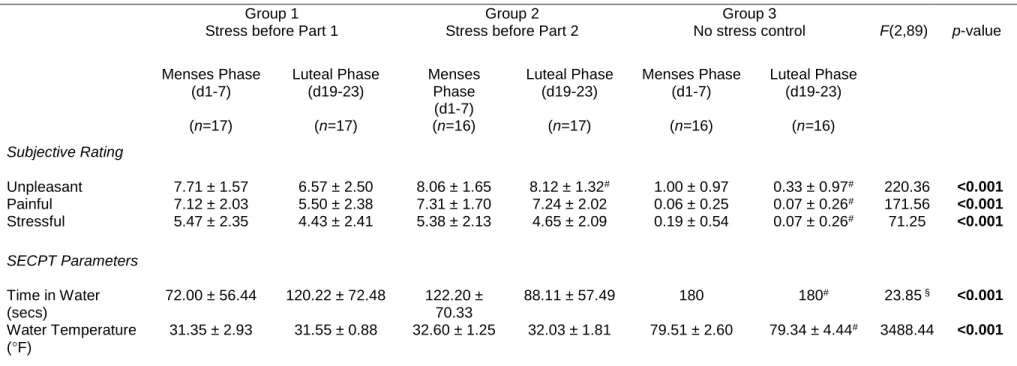
Table 3.2. Subjective Stress Rating and SECPT Parameters Based on Stress
Timing and Menstrual Cycle Phase ...85
Table 4.1. Sample Demographics and Psychometric Data Demonstrate
xi
LIST OF FIGURES
Figure 1.1. Schematic of HABIT paradigm. ...27
Figure 2.1. Schematic of Test session (session 1) protocol. ...41
Figure 2.2. Salivary cortisol change over time relative to baseline cortisol average ...48
Figure 2.3. Heart rate and heart rate variability measures (IBI and HF) over time
by immersion group ...52
Figure 2.4. Accuracy performance for FAM and NOV sets before and after response
devaluation by stress group ...55
Figure 2.5. Total percentage of perseverative errors and change in perseverative
error rate over time by group ...59
Figure 2.6. Correlations between biological measures of stress and perseverative
errors ...61
Figure 3.1. Salivary cortisol change over time relative to baseline cortisol average
by stress group and cycle phase. ...87
Figure 3.2. Heart rate change over time and lnRMSSD by stress group and cycle
phase ...90
Figure 3.3. Accuracy performance for FAM and NOV sets before and after response
devaluation by stress group and cycle phase. ...94
Figure 3.4. Total percentage of perseverative errors for FAM and NOV sets (top) and
xii
Figure 3.5. Correlations between biological measures of stress and perseverative
errors. ...102
Figure 4.1. Study protocol and example electrode montage and stimulation
parameters for bilateral DLPFC tACs...116
Figure 4.2 Percentage of participants reporting sensations during active stimulation
and sham stimulation. ...123
Figure 4.3. Performance for FAM and NOV sets by group during HABIT Test Part 1
based on within subject randomization to stimulation condition...127
Figure 4.4. Performance for FAM and NOV sets after response devaluation during
HABIT Test Part 2 ...133
Figure 4.5. Total percentage of perseverative errors and change over time by
stimulation condition. ...136
Figure 4.6. Cumulative distribution frequency plot for FAM set change in
xiii
LIST OF ABBREVIATIONS
ADHD Attention deficit hyperactivity disorder
ANCOVA Analysis of covariance
ANOVA Analysis of variance
AUDIT Alcohol use disorders test
BART Balloon analog risk task
BIS Barratt Impulsivity Scale
BOLD Blood oxygen level dependent
BPM Beats per minute
BSMSS Barratt simplified measure of social status
CAARS Connors’ adult ADHD rating scale
CPT Cold pressor task
DLPFC Dorsolateral prefrontal cortex
DLS Dorsolateral striatum
DMS Dorsomedial striatum
DSM-V Diagnostic and statistical manual
xiv DUSI Drug use screening inventory
EEG Electroencephalography
FAM Familiar set
fMRI Functional magnetic resonance imaging
FTQ Family tree questionnaire
HABIT Hidden association between images task
HF High frequency
HPA Hypothalamic pituitary adrenal
HRV Heart rate variability
Hz Hertz
IBI Interbeat interval
IGT Iowa gambling task
IQ Intelligence quotient
lnRMSSD Natural logarithm transformed RMSSD
LOC Locus of control scale
MIST Montreal imaging stress test
xv NOV Novel set
OCD Obsessive compulsive disorder
OFC Orbitofrontal cortex
OSPAN Operation span
PFC Prefrontal cortex
PMC Premotor cortex
RMSSD Root mean square of successive differences
RT Reaction time
SAS Statistical and computing software
SECPT Socially evaluation cold pressor test
SES Socioeconomic status
SILS Shipley institute of living scale
SNS Sympathetic nervous system
SPSS Statistical package for the social sciences
S-R Stimulus-response
STAI State-Trait anxiety inventory
xvi
tACs Transcranial alternating current stimulation
TAF Thought action fusion scale
tDCs Transcranial direct current stimulation
TLT Tower of London task
TMS Transcranial magnetic stimulation
TSST Trier social stress test
UNC University of North Carolina
VBM Voxel based morphometry
vmPFC Ventromedial prefrontal cortex
1
CHAPTER 1
GENERAL INTRODUCTION
Addiction is a chronic disorder characterized by cycles of repeated drug or alcohol use, withdrawal, abstinence periods and relapse, which reinitiates the drug or alcohol use. Due to the cyclic nature of the disorder, it poses a large burden on society and necessitates access to treatment resources. In 2015, the National Survey on Drug Use and Health estimated that 21.7 million individuals over the age of 12 needed treatment for a drug or alcohol problem (SAMSHA, 2016). In contrast, only 10.8% (2.3 million) of those people needing treatment were able to receive it at a treatment facility. When considering alcohol use problems alone, it is the fourth leading cause of preventable death in the United States (Stahre et al., 2014). These statistics suggest that there are large economic, social/familial, and health costs to both the individual as well as society in terms of lost productivity and health care. Given the high prevalence of these disorders as well as high relapse rates, there is an increasing need for effective treatment options and research to investigate the underlying neurobiological mechanisms of dysfunction.
2
perform daily routines that are automatized and efficient, affording the ability to simultaneously use cognitive resources for more demanding tasks, such as creating a plan for future action selection. While these automatized behaviors are advantageous in many situations, it is possible for such behaviors to become detrimental to one’s health if they become inflexible. For example, we colloquially, refer to these behaviors as ‘bad habits’. In the case of alcohol use, it may occur despite serious adverse health consequences such as cirrhosis of the liver. This sort of disregard for adverse outcomes of substance use is a diagnostic criterion for addiction, suggesting that addiction can be construed, in some cases, as a disorder of maladaptive habitual actions.
3
neurobiological mechanisms by utilizing transcranial alternating current stimulation (tACs) of the PFC to prevent the shift toward habitual behavior in individuals with an SUD history. To substantiate our proposed studies and rationale for choice of methods and target brain regions, we will discuss the translational findings from animal models of habits and addiction, and review their neural correlates. We will then discuss supporting evidence for the biological actions of stress within frontostriatal circuitry and the proposed mechanisms of action for non-invasive stimulation of PFC to promote top-down control over habitual responding.
Animal Models of Goal-Directed and Habit Behavior
4
continues to press the lever with the degraded outcome and does not register the change in probability of reward delivery, and thus the need to alter behavioral responding. An alternative to contingency degradation is the use of sensory specific satiety and/or conditioned taste aversion to manipulate outcome value. The motivation for behavioral responding is manipulated in sensory specific satiety by providing ad libitum access to one reward type prior to testing responses. Conditioned taste aversion pairs one reward type with a compound such as lithium chloride to induce sickness. Once the devaluation manipulation has occurred (after training), the animal’s responding is then tested to determine whether their actions are guided by the value of the rewards or whether their actions continue to occur regardless of the current outcome value. If the animal continues to take an action after the outcome of that action has been devalued, that action is classified as habitual, due to a failure to update the current value of the reward; alternatively, if the corresponding action diminishes or ceases, this is taken as evidence that the action is still guided by motivation to obtain the outcome of that action, and is performed in a goal-directed manner.
5
Killcross, 2003; Killcross and Coutureau, 2003; Yin et al., 2004, 2006b; Stalnaker et al., 2010). Recent work has also demonstrated that the rodent mPFC, the putative rodent homolog of the dorsolateral PFC (DLPFC) (Farovik et al., 2008), flexibly controls action selection by facilitating switching between well-practiced and newly acquired T-maze running behavior (Smith et al., 2012b; Smith and Graybiel, 2013). This experimental evidence from animal models suggests that learning results in changes within frontostriatal circuits that ultimately converge within the striatum, which acts as a hub to integrate incoming signals from various neural regions to control behavior.
Paradigms to Measure Habitual responding in Humans
6
studies of the DMS (Tricomi et al., 2004; Valentin et al., 2007; Tanaka et al., 2008; de Wit et al., 2009b; Mattfeld et al., 2011; O'Doherty, 2011).
A second commonly used task to investigate habit in humans utilizes an incongruent task condition to induce response conflict during action selection; overlapping associations between stimuli and outcome images are present in incongruent trials to preferentially engage a habitual response strategy, as using a goal-directed strategy is disadvantageous (de Wit and Dickinson, 2009). In contrast, congruent trials can be successfully learned and performed by either goal-directed or habit-based response selection. Neuroimaging data from this task demonstrate that goal-directed action selection is accompanied by increased vmPFC activity. Additionally, several task stimuli were devalued to result in a loss of points, and participants were tested for ‘slips-of-action’ or continued responding for the now devalued images, similar to a ‘go-no-go’ paradigm. Diffusion tensor imaging (DTI) analysis of this aspect of the task showed that white matter connectivity between the vmPFC and caudate positively correlated with goal-directed choice behavior, while connectivity strength between the anterior putamen and the premotor cortex (PMC) negatively correlated with responses dependent upon outcome value, taken as evidence of habit-based actions (de Wit et al., 2012). Further analysis of putamen structure using voxel-based morphometry (VBM) also showed that individuals with greater gray matter density in the putamen were more likely to show vulnerability to slips-of-action during testing. These data from healthy controls provide further support for the neural basis of goal-directed versus habitual control within corticostriatal neural circuitry.
7
8
controls (Smittenaar et al., 2014). These inconsistencies, in combination with data from addiction studies showing deficits in goal-directed behavior and preference for habit-based strategies (Ersche et al., 2016; McKim et al., 2016a), suggests further testing with this task in populations with special disorders to disentangle changes in neurobiological function that may result in abnormalities in action selection.
post-9
devaluation, and allows for assessment in multiple contexts, such as pharmacological therapeutic interventions, without practice effects that may confound results. We have previously demonstrated the utility of this task in individuals with an SUD history (McKim et al., 2016a), and will further test the applicability of this behavioral paradigm to manipulations of stress and tACs to modify habitual behavior.
Habitual Behavior in Addiction
10
2011). Furthermore, studies on cocaine (Zapata et al., 2010), amphetamine (Nelson and Killcross, 2006), and intravenous nicotine self-administration (Clemens et al., 2014) in rodents show that chronic exposure to each of these three drugs of abuse produces a shift in operant behavior from goal-directed to habitual. Despite differences in drug type used and paradigm for training or administration, drugs of abuse can have potent effects on the development of habitual responding, and may even accelerate their development in specific circumstances. These studies provide a foundation for further study in humans, and suggest the need to examine the continuum of alcohol and drug use behavior, including individuals that use these substances/alcohol regularly without meeting criteria for addiction (heavy binge drinkers) as well as individuals meeting criteria for addiction and persons in recovery.
11
devaluation, and therefore more habit-based responding. A further study by this group that examined acute alcohol effects on behavioral action selection parallels that of animal studies (Corbit et al., 2012; Lopez et al., 2014) by providing exposure and self-administration of alcohol prior to behavioral testing. Using the same behavioral paradigm described previously with chocolate and water rewards, but only chocolate outcome devaluation, non-contingent alcohol administration facilitated a behavioral switch to habitual responding for the devalued reward after devaluation (Hogarth et al., 2012b).
12
similarly to healthy controls on execution and learning of S-R associations (McKim et al., 2016a); the SUD group is specifically impaired in replacing responses to familiar stimuli after response devaluation. Relative to healthy controls, individuals in the SUD group showed increased perseverative errors for well-practiced S-R sets in which the response contingency changed, suggesting an inability to change automatized S-R associations. Regardless of task variations and substance of abuse, the data discussed above from human studies is beginning to mirror results from animal studies, potentially implicating drugs of abuse in potentiating habitual behavior above and beyond goal-directed actions specific to the context of drug use. An outstanding question is whether these changes in behavior are consequent to addiction or represent a pre-existing trait.
13
14
The Role of Stress in Facilitating Habitual Behavior
Alcohol and drug use may be motivated by a desire to increase the positive and rewarding effects of the drug, such as social interaction or mood elevation, or, alternatively, for negative reinforcement, such as decreasing negative affect or alleviating the stress/anxiety that may result from withdrawal. These outcome-based motivations are thought to be most prominent in driving drug-use or -seeking behavior to initiate the addiction cycle, when behavior may still be under control of the outcomes (goal-directed); however, if an individual has transitioned to regular drug use and then is able to remain abstinent, triggers such as stress can promote relapse, presumably through reactivation of both goal-directed and habitual neural circuitry that may ultimately compete for control of action selection. Therefore, stress may hypothetically promote relapse through a return to behavioral responses in an automatized manner (habitual) once drug use has been re-initiated. Stress has been shown to be a predictor of relapse behavior, but the underlying neurobiological mechanisms are not well understood (Sinha, 2012; Bossert et al., 2013; Sinha, 2013; Mantsch et al., 2016).
15
water for up to 3 minutes, and told they were being video-taped for facial expressions, while being monitored by an unfamiliar and unfriendly experimenter. In the first study to test the SECPT and instrumental learning for food rewards based on the task used by Valentin et al. (2007), participants underwent stress or a control condition and then trained on the learning task. Outcome devaluation then occurred through consumption to satiety, and testing occurred in extinction. Results showed that exposure to stress rendered behavior habitual through an increase in the number of responses to the devalued outcome (Schwabe and Wolf, 2010). As the results of that study could not rule out an effect of stress on learning versus extinction performance, a follow-up study alternatively administered the SECPT or control condition after learning and devaluation, but immediately prior to extinction testing. This study confirmed the habitual nature of responding (Schwabe and Wolf, 2011). Furthermore, to block the stress effect of the SECPT on habitual responding, propranolol, a beta-adrenergic antagonist, was administered prior to stress and devaluation (Schwabe et al., 2011b). Propanolol was found to prevent habitual responding to the devalued reward when tested during extinction, and suggests that targeting noradrenergic signaling may be an effective way to diminish the stress-induced shift away from goal-directed responding.
16
in valuation (Schwabe et al., 2012). That study also found that striatal brain areas implicated in habitual behavior, the caudate and putamen, demonstrated increased activation during training, whereas activity in the putamen during extinction was unaffected by the combination of hydrocortisone and yohimbine administration and did not correlate with changes in stress hormones. These data further support the impact of stress on PFC function that reflects preferential impairment of neural circuitry supporting goal-directed actions by the excess stress hormones, and manifests behaviorally as habitual responding.
17
stressed participants (relative to controls) the volumes of the caudate and the left mOFC were lower whereas that of the putamen was increased. When measured again after recovery from stress, the volumes of the caudate and mOFC increased, while the volume of the putamen showed a trend toward a decrease, suggesting that the neural changes associated with stress are transient and reversible with time if stress abates. These studies are in agreement with evidence from animal models of chronic stress, which have demonstrated atrophy in the mPFC and associative striatal areas along with hypertrophy in the DLS, which accompanied habit-based responding for the devalued action-outcome contingency (Dias-Ferreira et al., 2009).
18
19
behavioral study to manipulate stress timing in healthy controls to investigate the effects of stress on the execution of practice versus new learning of S-R sets and to examine whether stress results in deficits of re-learning or changing habit-based behaviors after response devaluation.
Non-Invasive Brain Stimulation as a Method to Probe Neural Circuit Control over Habits
20
of stimulation on action selection. A follow-up study by this group instead used tDCs to manipulate action selection in the two-step decision task, and showed that anodal stimulation of the right DLPFC did not change the use of either model-based or model-free action selection strategies (Smittenaar et al., 2014). These mixed findings demonstrate the need for further investigation into the effects of non-invasive brain stimulation techniques on action-selection.
21
between brain areas (Thut et al., 2012). These advantages reinforce the use of tACs to remedy aberrant neural circuit function is neuropsychiatric disorders such as addiction.
22
incorporating a reward-punishment reversal of learned response associations, found that bilateral DLPFC stimulation in the theta frequency resulted in better reversal learning, although individuals were more likely to use a less advantageous response strategy for reward (Wischnewski et al., 2016). There is even less published data on the effects of tACs in neuropsychiatric populations; the two studies of note have targeted declarative memory in children with ADHD, demonstrating improvement in performance after tACs was delivered to bilateral DLPFC during sleep (Prehn-Kristensen et al., 2014), whereas gamma tACs of left DLPFC did not enhance working memory performance in patients with schizophrenia in comparison to the improvement in performance found with left DLPFC tDCs in the same study (Hoy et al., 2016). The therapeutic benefit of non-invasive tACs is highly promising and has practical applicability in the real world; available parameters for current intensity and frequency can be tailored on an individual basis in combination with portability of the device outside of a clinic or laboratory setting. The mixed effects in stimulation studies (TMS and tDCs) in addiction demonstrate a need for interventions with more direct manipulation of neural circuit communication, in combination with behavioral paradigms to adequately test habitual and goal-directed action selection.
Goals of the Current Dissertation
23
However, only one study to date has examined differences in these neural circuits with a S-R association paradigm in alcohol dependence (Sjoerds et al., 2013). Behavioral studies employing S-R paradigms in addiction suggest that the deficits in goal-directed behavior result from reduced PFC control over the striatum, but direct evidence at the neurobiological level is lacking. Furthermore, our study is the only one to date that has investigated the habit ‘breaking’ process in abstinent substance users; such knowledge is critical to understanding attempts to change habit-based responses to drug stimuli during recovery from addiction and thus promote relapse. The studies proposed within this research plan are designed to provide novel insight into the neurobiological processes that underlie S-R learning and re-learning impairments, with the potential to identify novel therapeutic interventions for SUDs.
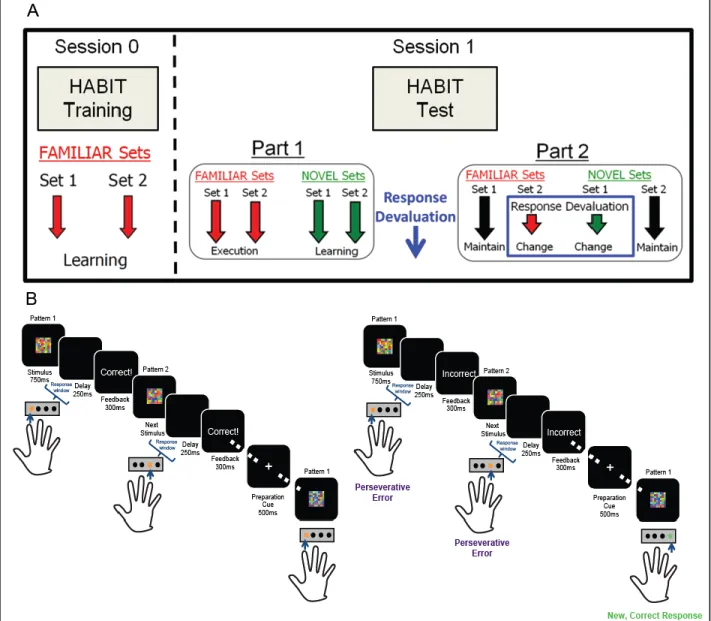
We will use our HABIT behavioral paradigm in conjunction with a stress manipulation to potentiate habitual responding in healthy controls, while also separately testing non-invasive tACs of bilateral DLPFC to reduce habitual responding in persons with a history of an SUD. Our S-R task design uniquely allows elucidation of the effect of stress on attempts to change behavior during habitual responding. As demonstrated in Figure 1.1, our HABIT paradigm includes a Training (top panel A: ‘Session 0’) and a Test session (top panel A: ‘Session 1’) in which participants learn S-R associations during training and then practice these S-R sets (‘FAMILIAR’)
intermixed with newly introduced S-R sets during Part 1 of testing (‘NOVEL’); during this portion
24
continue to push the previously correct response for an S-R set with changed contingencies (Figure 1.1B). Our task also includes built in controls that include S-R sets that do not have changed response contingencies to control for context change and differences in positive versus negative feedback; we can also rule out deficits in responding that may be due to response inhibition (McKim et al., 2016a). We have previously demonstrated that individuals with a history of lifetime diagnosis of a SUD show deficits in perseverative errors after response devaluation relative to control subjects. Our HABIT paradigm will further enable the manipulation of stress timing during the test session to elucidate stress effects on learning versus re-learning S-R associations. We will also directly manipulate neural circuit function with bilateral DLPFC tACs to reduce perseverative responding in persons with an SUD history.
25
response devaluation. As we describe in Chapter 2, the stress effects seem to depend on sympathetic activation, unopposed by counteracting parasympathetic activation. In Chapter 3 we further tested whether the effect of stress timing on habitual behavior varied across the menstrual cycle in females using the same methods as Chapter 2. In contrast to males, we did not find differences in stress timing on habitual responding in females; this effect was not dependent on menstrual cycle phase. Importantly, we demonstrate biological activation of HPA and sympathetic stress response to the SECPT, but these effects do not contribute to deficits in performance in females, supporting the necessity of examining gender differences and the role of sex hormones on cognitive tasks. Together, the studies described in Chapters 2 and 3 establish the stress sensitivity of the forms of learning assessed by our task, highlighting sex differences, and possible physiological mediators of the stress effects. These findings expand the utility of our task, and lay the groundwork for studies investigating interventions to reduce habitual responding, which could then be applied to clinical populations. Although this study population did not include those with SUDs, these results lend insight into how acute stress may serve as a potent relapse trigger in people with SUDs, as the mechanisms by which stress promotes a return to drug use remain unclear (Sinha, 2012; Sinha, 2013). Our findings may guide future studies that identify neurobiological mechanisms by which stress promotes relapse in addicts.
26
27
28
CHAPTER 2
THE EFFECTS OF STRESS TIMING ON HABITUAL RESPONDING IN MALES
Introduction
The stress response is a naturally occurring biological reaction to psychological or physical threat and harm to the body. The initial and rapid response of the sympathetic nervous system (SNS) results in increased heart rate among other characteristic bodily effects encompassing the ‘flight or fight’ response. In contrast, the timing of HPA axis activation is slower relative to the SNS, but this system also releases neurotransmitters and hormones such as glucocorticoids, e.g. cortisol, that play an active role in the stress response. Importantly, these systems have dynamic effects over time that are regulated by negative feedback loops to return the body to normal homeostatic levels of activity and neurotransmitter/hormone balance once the stressor has subsided. However, prolonged or uncontrollable stress may increase susceptibility to various disorders, including the use of drugs or alcohol as a coping mechanism. For example, individuals with SUDs are hypothesized to have dysregulated HPA axis activity (Stephens and Wand, 2012), although it is unclear whether these changes within the system are a predisposition to, or a result from, drug or alcohol use behavior. Additionally, stress is a potent predictor of relapse behavior in SUDs, but the underlying biological mechanism of this effect are unclear (Sinha et al., 2011; Sinha, 2012). These data suggest that targeting the neurobiological underpinnings of stress may be potential treatment options and facilitate behavioral change strategies to prevent drug use behavior.
29
paradigms in humans. Shifts in action-selection toward a more habit-based behavioral strategy in SUDs (Sjoerds et al., 2013; Sebold et al., 2014; Banca et al., 2016; McKim et al., 2016a) is similar to behavioral findings in stress studies. For example, studies using a psychosocial stress manipulation, the SECPT, have demonstrated that stress prior to instrumental training, or after outcome devaluation (i.e. post-training) but prior to extinction testing, results in an increase in responding toward the devalued outcome relative to the non-devalued outcome, suggesting heightened habit-based actions in healthy males (Schwabe and Wolf, 2009, 2010). Moreover, administration of hydrocortisone and the α2-adrenoreceptor antagonist, yohimbine, to mimic biological stress effects increases habitual responding for a devalued instrumental outcome (Schwabe et al., 2012), although administration of either pharmacologic agent alone did not shift behavioral strategy. This research group further tested pharmacological blockade of SECPT stress effects prior to instrumental acquisition with propranolol, and demonstrated that blockade of noradrenergic activity resulted in a shift toward decreased responses to t devalued outcome, indicative of more goal-directed behavior (Schwabe et al., 2011b). These studies suggest that the putative neuroendocrine mechanism of action of the SECPT in healthy adult males is the combined elevation of cortisol and noradrenergic activity.
30
that included restraint stress in combination with tail shocks, exposure to an elevated platform, and loud sound and bright light stimuli, rendered behavior habitual after equivalent instrumental training to the single stress groups. Interestingly, the researchers tested plasma corticosterone levels in a separate cohort of animals exposed to one of the three stressors, but not undergoing instrumental training, which showed no difference between levels of corticosterone, and suggest a similar HPA axis response among the stress groups. Multiple facets of the stress response, in addition to the biological corticosterone response (cortisol in humans), may be important in determining whether physical versus psychosocial stressors can potentiate habitual responses for instrumental actions. These results highlight stressor severity as an important factor in regulating the shift between goal-directed and habitual responding.
31
illustrating that novel ways to cope with stress or change the use of these behaviors may have implications for preventing relapse in addiction, where stress is known to be a predictor in treatment outcome.
Taken together, the above data suggests that acute and chronic stress can result in shifts in behavior to habit-based responding. Whether this behavior coincides with a shift towards the predominate use of the brain regions governing habitual behavior, or instead merely reflects deficits in goal-directed circuit control over behavioral output that is habitual, is an outstanding question. Furthermore, existing study paradigms in humans have limited capacity to measure the development of habits over the time frame of multiple training days and test that are employed in rodent studies; this further confounds findings at the behavioral level, suggesting that the behaviors trained in the lab may not have transitioned to the ingrained behaviors that characterize disorders such as Obsessive Compulsive Disorder (OCD) and addiction. Results from human studies have also demonstrated that acute stress effects on habit behavior in the lab can occur regardless of the timing of the stressor (Schwabe and Wolf, 2009, 2010); these studies are not able to directly assess the effect of habit on goal-directed acquisition versus performance of habitual responding. Although this may be more readily studied in animal models, no studies to our knowledge have addressed this gap within the literature to draw parallels between species.
32
psychosocial stress on habit-based action-selection and goal-directed S-R learning behavior. Additionally, our task employs a novel response devaluation manipulation to quantify changes in habit-based responding while also ruling out effects attributable to generalize deficits in response inhibition following stress, which to our knowledge, has not been tested to date.
We used a between subjects design that included a training and separate testing session. Participants were trained on S-R sets during the initial (training) session and were randomized to one of three groups prior to the second session: SECPT stress prior to HABIT Test Part 1, SECPT stress prior to HABIT Test Part 2, or the no stress control group. We measured perseverative errors, the tendency to respond to the previously correct but now incorrect buttons after response devaluation. This allows us to quantify the response strategy participants employed when attempting to overcome highly trained versus newly acquired S-R associations. We also collected physiological measures of stress, including heart rate and saliva samples for cortisol and salivary α-amylase, and subjective ratings of the SECPT stress induction.
Methods
Participants
33
6 hours prior to the Test session. Each subject provided written informed consent as approved by the UNC Office of Human Research Ethics.
General Procedure
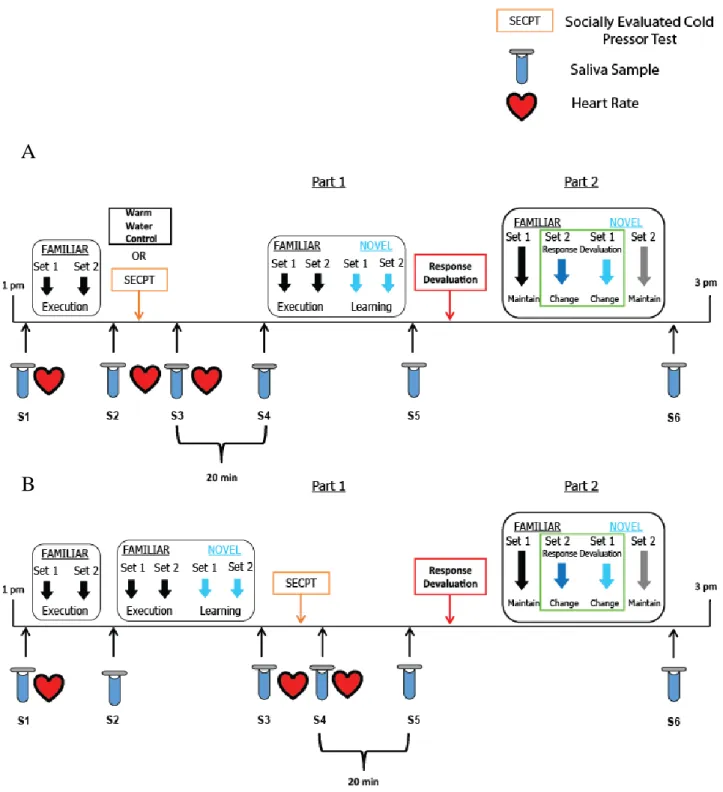
Subjects participated in 2 sessions, with at least 1 night’s sleep between the first and second sessions. Subjects were either paid for their participation, including performance bonuses in the Test session, or participated for class credit; students that participated for credit were entered into a gift card drawing at the end of the semester, with more entries for greater accuracy during the Test session. During Session 0, participants completed a battery of standard questionnaires (see “Behavioral Inventories”), followed by behavioral training on the computerized S-R learning task (see “Behavioral Task”); no stress manipulation took place during Session 0. Based on literature suggesting that performance on the operation span (OSPAN1 working memory task predicts sensitivity to the SECPT (Otto et al., 2013), participants also completed the automated OSPAN (Unsworth et al., 2005). S-R Learning and habitual responding was then tested during Session 1. We used a between subjects design and participants were randomly assigned to one of three groups for the Test session: 1. Stress before HABIT Test Part 1; 2. Stress before HABIT Test Part 2; 3. No stress control. All sessions took place between the hours of 1200 and 1700 to control for the diurnal rhythm of cortisol secretion. The experimental procedure is illustrated in Figure 2.1.
Behavioral Inventories
34
test (AUDIT; Saunders et al., 1993) and substance use behavior with the Drug Use Screening Inventory, Domain I (DUSI-I; Tarter, 1990). We calculated density of familial alcohol abuse using the Family Tree Questionnaire (FTQ; Mann et al., 1985). Neuropsychological questionnaires included the Barratt Impulsivity Scale (BIS-11; Barratt, 1994), Rotter’s Locus of Control scale (LOC; Rotter, 1966), the State-Trait Anxiety Inventory (STAI; Spielberger, 1985), the Thought Action Fusion scale (TAF; Shafran et al., 1996), the Connors’ Adult ADHD Rating Scale (CAARS; Connors, 1997), and the Perceived Stress Scale (Cohen et al., 1983). Education and occupation were quantified with the Barratt Simplified Measure of Social Status (BSMSS) (BSMSS; Barratt, 2006). We estimated IQ with the Shipley Institute of Living Scale (SILS; Zachary, 1991).
Behavioral Task
35
session, participants first demonstrate retention of the previously learned (FAMILIAR) associations, then the learning task begins (HABIT Test Part 1; Fig. 2.1). In the learning task, blocks of the two FAMILIAR sets are interspersed with blocks composed of two new stimulus sets (NOVEL sets), to measure new S-R learning, and blocks of a control condition, consisting of novel, unrelated stimuli (No Rule set); blocks consist of 15 randomly selected stimuli from the relevant set. Following 6 “runs” of 15 blocks each (3 per set-type), subjects are informed that the correct responses for two sets (one FAMILIAR and one NOVEL set) have changed (HABIT Test Part 2; Fig. 2.1). As the
previously correct responses for the changed sets produces a negative rather than positive outcome, one can construe this change in response contingency as a response “devaluation,” which is not to be confused with outcome devaluation procedures traditionally used in studies of habitual responding (Dickinson, 1985). This “response devaluation” manipulation allows us to quantify habitual responding when attempting to overcome both well-learned (FAMILIAR) and freshly
learned (NOVEL) S-R associations, as the proportion of perseverative errors can be taken as an index of the degree to which responses are outcome independent (i.e. habit-based), as opposed to outcome-driven (i.e. goal-directed). By introducing S-R changes for both FAMILIAR and NOVEL
sets, at a point where performance is approximately equivalent, we can rule out performance deficits due to impaired response inhibition. Moreover, including FAMILIAR and NOVEL sets in
which correct responses do not change allows us to control for effects on performance of time and of context change.
Stress Protocol
36
(SECPT), described in detail elsewhere (Schwabe et al., 2008). In brief, participants were ask to immerse their non-dominant hand up to and including the wrist into ice water (33°F) for up to 3 min. Participants were asked to face in the direction of and look toward two video cameras, and were told that the camera(s) would record their facial expressions during the immersion procedure. An unsociable and unfamiliar experimenter monitored participants during the SECPT. During the SECPT monitoring, the unsociable experimenter wore a white lab coat, and held a timer and a clipboard. Most of the unsociable experimenters employed in this study were female, but males were used in five cases. The gender distribution of experimenters did not differ between stress groups χ2(1)=0.29, p=0.61), and we found no effect of experimenter gender on our index of habitual responding, FAMILIAR perseverative errors (F(1,32)=0.08, p=0.79). Including experimenter gender as a covariate in our analyses did not qualitatively alter our effects of interest.
37
between stress groups (p=1.00). To assess responses to the SECPT, we collected subjective ratings of the SECPT, along with biological measures of heart rate, salivary cortisol, and salivary α-amylase from all participants in each group.
Subjective Stress Ratings
Participants completed subjective ratings immediately after the SECPT or control condition; this consisted of a questionnaire rating the stressfulness, unpleasantness, and painfulness of the SECPT manipulation on a scale of 0 (not at all) to 10 (very much), based on Schwabe et al. (2008).
Heart Rate
To measure changes in autonomic nervous system function as a result of the SECPT, we measured heart rate at three time points during the Test session. To collect this data, participants cleaned their skin with an alcohol pad and dried the areas with gauze prior to the placement of disposable Ag-AgCl foam electrodes (Biopac Systems, Inc; Goleta, CA). Electrodes were placed according to the three lead system: below the right and left collarbone area, and below the left ribcage. Electrode signals were sent via a Bionomadix wireless transmitter to a Bionomadix RSPEC receiver/amplifier system (Biopac Systems, Inc), and collected in Acqknowledge 4.3 (Biopac Systems, Inc) with a sampling rate of 500 Hz.
38
in a quiet room at a desk. They were instructed to remain as still as possible to minimize noise artifact and were allowed to read magazines provided or remain seated at the desk with their eyes closed. The duration of heart rate collection during the SECPT varied, with a maximum duration of 3 min; heart rate was recorded for as long as the participant held their hand submerged in the water and the recording was stopped when they requested to remove their hand. Electrocardiogram data was visualized, cleaned for artifacts, and processed offline using Mindware 3.0 HRV software (MindWare Technologies, Ltd; Gahanna, OH) by a research assistant blind to group assignment.
Heart Rate Variability (HRV) Measures
39
provide information about the amount of variance or power of the time series within the high frequency band (HF; 0.15-0.4 Hz), as the HF power band primarily reflects parasympathetically mediated input to the heart (Freedland and Steptoe, 2010; Thayer et al., 2012). For the frequency domain analyses, we report normalized units, by taking the raw millisecond squared values to calculate the following normalized units : HF/(LF +HF) (Burr, 2007).
Salivary Cortisol
40
Salivary α-Amylase
Salivary α-amylase concentration provides a non-invasive measure of SNS activation, as salivary α-amylase secretion is controlled by direct sympathetic innervation of the salivary glands (Schumacher et al., 2013). Thus, to assay sympathetic response to the SECPT, we assayed α-amylase concentration in the saliva samples collected pre-stress (~5 min pre-SECPT) and post-stress, at both 5 and 20 min post-SECPT. Salivary α-amylase levels were determined using a kinetic enzyme assay protocol (Salimetrics). Inter- and intra-assay coefficients of variance were both below 5%.
Data Analysis
41
Figure 2.1. Schematic of Test session (session 1) protocol. (A) Top panel depicts the timing of the socially evaluated cold pressor test (SECPT) or warm water control condition, heart rate, and
saliva sample collection for participants in the stress before HABIT Test Part 1 group. (B) Bottom panel depicts timing of the SECPT, heart rate, and saliva sample collection for
participants in the stress before HABIT Test Part 2 group.
A
42
Results
Demographic and Psychometric Data
The three test groups did not differ in terms of education, SES, age, or ethnicity (Table 2.1). We also failed to detect any significant differences between groups in terms of psychometric variables (Table 2.1). Importantly, the groups were matched in terms of self-reported perceived stress, which can impact the response to an acute stressor (Radenbach et al., 2015b). Groups were also matched in terms of working memory measured via the automated OSPAN (all p’s>0.24;
Table 2.1), another factor linked to stress sensitivity (Otto et al., 2013).
Behavioral Performance during HABIT Training
During the HABIT Training session, subjects were required to reach a performance criterion of 90% accuracy for each (FAM) set. The order of FAM sets was counterbalanced across participants and set order did not differ between groups, χ2(2) = 2.88, p=0.24. Training to criterion took ~25 min, with no significant differences between groups in the average number of training blocks (of 40 trials) needed to learn the first FAM set, (Stress before HABIT Test Part 1: 4 ± 2.5
blocks; Stress before HABIT Test Part 2: 5 ± 5 blocks; No stress control: 3 ± 1.5 blocks;
F(2,49)=1.66, p=0.20, η2=0.06). Learning the associative rules for the second FAM set was always more rapid, and the required number of blocks again did not differ between groups (Stress before HABIT Test Part 1: 2.5 ± 1 blocks; Stress before HABIT Test Part 2: 2 ± 1 blocks; No stress control: 2 ± 1 blocks; F(2,49)=0.18, p=0.84, η2=0.01). Participants were then required to reach 70% accuracy in a third practice version of the task that switched between FAM sets 1 and 2. Groups
43
44 Table 2.1. Sample Demographics and Psychometric Data
Group 1 Stress before Part 1 Group 2 Stress before Part 2 Group 3 No stress control
F(2,50) p-value
Demographics (n=19) (n=18) (n=16)
Age (yrs) 20 ± 2 21 ± 5 21± 4 0.52 0.60
SILS (calculated) IQ 107 ± 5 107 ± 5 105 ± 6 0.57 0.57
Education (yrs) 14 ± 1 14 ± 1 14 ± 2 0.56 0.58
SES 19 ± 10 19 ± 9 19 ± 9 0.007 0.99
Ethnicity (% non-white) 16 22 38 0.02 0.24#
Substance Use related
AUDIT Total 2 ± 3 5 ± 4 4 ± 5 1.76 0.18
Consumption 2 ± 3 4 ± 3 2 ± 2 1.38 0.26
Dependence 0 0.39 ± 0.61 0.50 ± 1 2.55 0.088
Harm 0.32 ± 0.67 1.11 ± 1.53 0.75 ± 1.95 1.40 0.26 DUSI-I (%) 0.04 ± 0.08 0.15 ± 0.16 0.14 ± 0.19 3.14 0.052 FTQ density (%) 0.09 ± 0.11 0.18 ± 0.21 0.12 ± 0.11 1.58 0.22
Psychometric
Perceived Stress 14 ± 6 15 ± 5 15 ± 7 0.08 0.93
BIS Total 59 ± 10 62 ± 12 60 ± 10 0.41 0.67
Attention 17 ± 4 18 ± 4 16 ± 4 0.69 0.50
Motor 21 ± 3 22 ± 5 21 ± 4 0.53 0.59
Non-planning 22 ± 5 23 ± 7 23 ± 5 0.23 0.79
LOC 10 ± 3 9 ± 3 11 ± 4 1.60 0.23
STAI-State Anxiety 40 ± 10 41 ± 9 41 ± 13 0.10 0.91
STAI-Trait Anxiety 35 ± 9 36 ± 10 37 ± 10 0.19 0.83
TAF Total 18 ± 15 15 ± 6 19 ± 14 0.52 0.60
Moral 17 ± 13 12 ± 6 15 ± 12 0.92 0.41
Self 1.05 ± 2.39 2.0 ± 2.40 2.75 ± 2.96 1.91 0.16 Others 0.11 ± 0.46 1.06 ± 1.66 1.12 ± 2.16 2.45 0.10 Connors ADHD Scale
DSM Inattention 7.74 ± 4.28 9.33 ± 4.63 9.36 ± 4.38 0.78 0.46 DSM Hyperactivity 7.00 ± 4.00 9.00 ± 4.80 7.43 ± 4.00 1.10 0.34 DSM ADHD 14.74 ± 7.23 18.33 ± 7.61 16.79 ± 6.77 1.15 0.33
Working Memory
OSPAN Score 44.17 ± 17.61 51.28 ± 14.08 46.19 ± 16.54 0.93 0.40 OSPAN Total 58.17 ± 10.89 63.78 ± 9.67 61.50 ± 8.21 1.52 0.23 Accuracy Errors 3.72 ± 2.84 5.50 ± 4.66 4.44 ± 1.90 1.26 0.29 Math Errors 5.17 ± 3.00 6.11 ± 4.87 5.88 ± 2.45 0.33 0.72 Speed Errors 1.44 ± 1.34 0.67 ± 1.00 1.44 ± 2.00 1.66 0.20 Values are reported as mean ± standard deviation. Reported p-values reflect the results of ANOVA. IQ, Intelligence Quotient; SES, Socioeconomic Status; AUDIT, Alcohol Use Disorders Identification Test; DUSI-I, Drug Use Screening Inventory, Domain I; FTQ, Family Tree Questionnaire;, Barratt Impulsivity Scale; LOC, Locus of Control; SILS, Shipley Institute of Living Scale; STAI, State-Trait Anxiety
45
Subjective, Endocrine, and Autonomic Responses to Stress
We measured stress induction via the SECPT using subjective stress ratings, as well as measures of salivary cortisol, salivary α-amylase, heart rate, and heart rate variability.
Subjective Stress Ratings
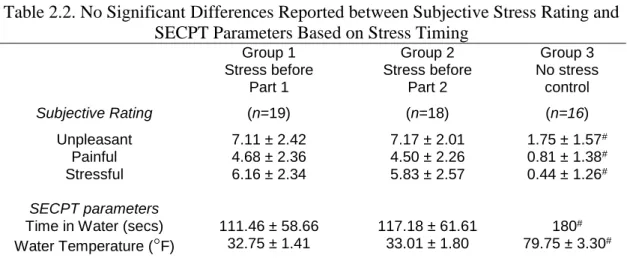
We observed a significant effect of group on the amount of time the participants held their hand in the water bath (F(2,50)=9.61, p<0.001), which was driven by significantly shorter times in both the stress before HABIT Test Part 1 group (111.45 ± 58.66 s, p<0.001), and the stress before HABIT Test Part 2 group (117.18 ± 61.61 s, p<0.001) relative to the control group (180 s). Critically, duration of ice water immersion did not differ between the two stress groups (p=1.00). Thus, the two stress groups experienced equivalent cold pressor effects.
46
Table 2.2. No Significant Differences Reported between Subjective Stress Rating and SECPT Parameters Based on Stress Timing
Group 1 Stress before Part 1 Group 2 Stress before Part 2 Group 3 No stress control
Subjective Rating (n=19) (n=18) (n=16)
Unpleasant 7.11 ± 2.42 7.17 ± 2.01 1.75 ± 1.57#
Painful 4.68 ± 2.36 4.50 ± 2.26 0.81 ± 1.38#
Stressful 6.16 ± 2.34 5.83 ± 2.57 0.44 ± 1.26#
SECPT parameters
Time in Water (secs) 111.46 ± 58.66 117.18 ± 61.61 180#
Water Temperature (°F) 32.75 ± 1.41 33.01 ± 1.80 79.75 ± 3.30#
Values are reported as mean ± standard deviation. Reported p-values reflect the results of one-way ANOVA between groups. #Indicates significant difference relative to the stress
before Part 1 group resulting from Bonferroni corrected post-hoc tests.
Salivary Cortisol
We detected no significant differences between groups in baseline salivary cortisol prior to the SECPT/control immersion (~5 and ~25 min after HABIT Test session start; all p’s >0.30
47
p=0.03) at this time point. We note that salivary cortisol levels at the end of the HABIT Test session did not differ between groups (p=0.49). Together, these data indicate that the SECPT effectively induced this biological indicator of stress in both stress groups.
48
Figure 2.2. Salivary cortisol change over time relative to baseline cortisol average. Plot illustrates the time course of the change in salivary cortisol values (nmol/L) as a function of stress group and cortisol responder status. (A) Solid lines represent the control group, dashed lines represent the stress before HABIT Test Part 1, and dotted lines represent the stress before HABIT Test Part 2. Significant changes in cortisol (time×group interaction: F(4.74,118.48)=12.68, p<0.001, η2=0.32) measured at 20 min post stress for males stressed before HABIT Test Part 1 (S4; 3.00 ± 4.40 nmol/L, p=0.001) and males stressed before HABIT Test Part 2 (S5; 3.22 ± 6.17 nmol/L, p=0.03) show significant increases relative to the control group at S4 (-1.44 ± 1.93 nmol/L) and S5 (-1.59 ± 2.24 nmol/L). Cortisol levels at baseline (S3) and at the end of the study session (S6) did not differ between groups (p’s>0.30). (B) Dashed lines represent cortisol responders and solid lines
indicate cortisol non-responders. Light blue lines depict males stressed before HABIT Test Part 1 and dark blue lines depict males stressed before HABIT Test Part 2.
49
Heart Rate Measures
Heart Rate data
50
2 mounted a parasympathetic defense against the SECPT. We explored this possibility further using HRV and -amylase analyses, below.
Heart rate variability (HRV) measure I: RMSSD
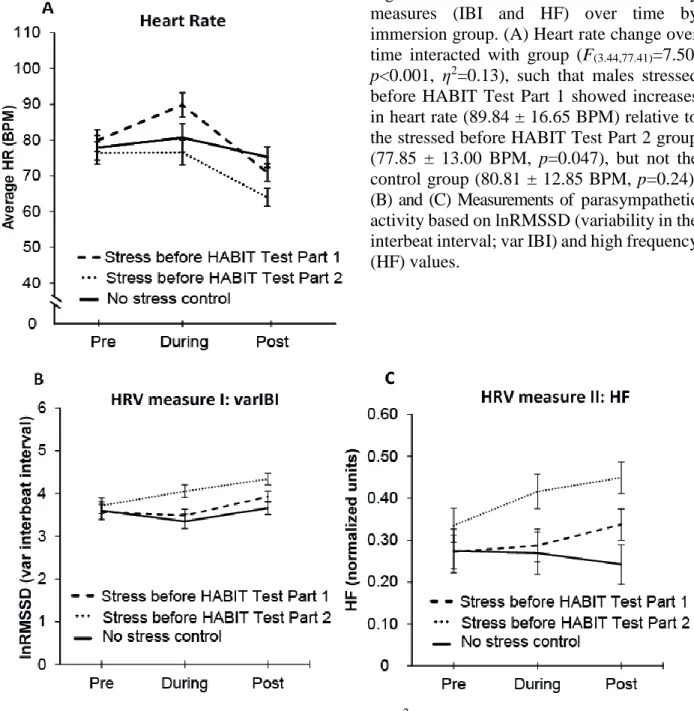
To probe parasympathetic activity, we first quantified variance in the interbeat interval (IBI) of successive heart beats as changes in the RMSSD from the same data used to calculate heart rate; data were natural log transformed due to violations of normality for raw RMSSD values (Shapiro-Wilk test: p’s<0.016). A repeated measures ANOVA found significant main effects of
both time (F(2,90)=9.13, p<0.001 η2=0.16) and group (F(1,45)=3.79, p=0.03, η2=0.17) on lnRMSSD (Fig. 2.3B). The time effect was driven by an increase in lnRMSSD from the immersion to post-immersion epochs (F(1,45)=15.30, p<0.001). As is evident in Figure 2.3B, the group effect was due to higher lnRMSSD in the group stressed before HABIT Test Part 2 (4.94 ± 0.13), relative to the control group (3.54 ± 0.15, p=0.04); we observed a trend toward group×time interaction (F(4,90)=2.19, p=0.076, η2=0.07).
Heart rate variability (HRV) measure II: HF
51
52
Figure 2.3. Heart rate and heart rate variability measures (IBI and HF) over time by immersion group. (A) Heart rate change over time interacted with group (F(3.44,77.41)=7.50,
p<0.001, η2=0.13), such that males stressed before HABIT Test Part 1 showed increases in heart rate (89.84 ± 16.65 BPM) relative to the stressed before HABIT Test Part 2 group (77.85 ± 13.00 BPM, p=0.047), but not the control group (80.81 ± 12.85 BPM, p=0.24). (B) and (C) Measurements of parasympathetic activity based on lnRMSSD (variability in the interbeat interval; var IBI) and high frequency (HF) values.
(B) Significant effects of time (F(2,90)=9.13, p<0.001 η2=0.16) and group (F(1,45)=3.79, p=0.03,
η2=0.17) demonstrated that males stressed before HABIT Test Part 2 had higher var IBIs relative to the control group (p=0.04). (C) A significant main effect of group again demonstrated greater HF power in the males stressed before HABIT Test Part 2 (0.40 ± 0.03), relative to both the stressed before HABIT Test Part 1 group (0.30 ± 0.03, p=0.046), and the control group (0.26 ± 0.04,
53
Salivary α-Amylase
As a means of assessing sympathetic activation, we analyzed changes in salivary α-amylase at 5 min and 20 min post-immersion, anticipating a rise in salivary α-amylase at 5 min in the stressed groups, with weaker effects at 20 min. However, a repeated measure ANOVA detected no main effects of time (F(1.65, 80.74)=0.42, p=0.66, η2=0.01) or group (F(2,49)=0.65, p=0.53, η2=0.03; data not shown), and no interaction between time and stress group (F(3.30, 80.74)=1.37, p=0.25,
η2=0.05). Qualitatively similar results were obtained when cortisol responder status was included in the analysis (all F’s<1.67, p’s>0.20).
Behavioral Results
Stress Effects on Learning New Sets and Execution of Familiar S-R Sets
To assess performance pre-contingency change, we conducted a mixed model repeated measures ANOVA with set-type (FAM/NOV) and time (early, mid, late) as within subject factors,
and stressed prior to Part 1 (n=19) versus not (n=34), as the between subjects factor. We found expected main effects of set-type, with higher accuracy for FAM versus NOV sets (F(1,51)=113.38,
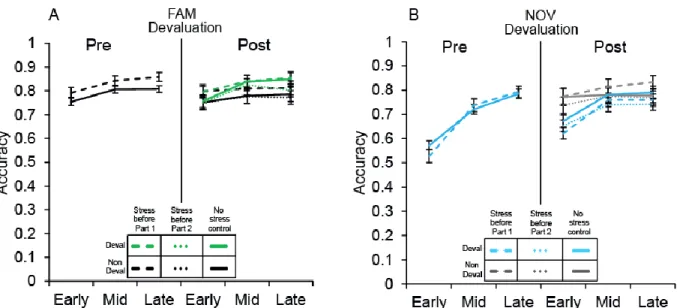
p<0.001, η2=0.67), and time, with accuracy improving from early (0.66 ± 0.01) to mid (0.78 ± 0.01) to late (0.81 ± 0.01) runs (F(1.72,87.86)=130.04, p<0.001, η2=0.71; Fig. 2.4). We also found a significant set-type×time interaction (F(2,102)=84.80, p<0.001, η2=0.61), reflecting a greater improvement of NOV set performance over time (Fig. 2.4). To decompose the significant interaction between set-type and time, we ran separate repeated measures ANOVAs to evaluate time and group for each set-type. Performance improved over time for the FAM sets
54
on FAM set performance (F(1,51)=3.40, p=0.071), likely reflecting ~3% more accurate performance in FAM sets prior to contingency change for the stressed group (Fig 2.4, far left panel). Consistent
with our prior data, accuracy increased significantly with time for the NOV sets (F(1.73,88.39)=167.12,
p<0.001). We detected no main effect of group on NOV set learning (F(1,51)=0.05, p=0.82), but did
find a marginal interaction between time and group (F(1.73,88.39)=3.09, p=0.057), which reflects a steeper initial improvement in accuracy in the stressed group relative to the unstressed group (F(1,51)=5.02, p<0.001; Fig 2.4). Altogether, these data indicate that SECPT exposure slightly enhances performance of established S-R associations and acquisition of new S-R associations.
55
Figure 2.4. Accuracy performance for FAM and NOV sets before and after response devaluation
by stress group. For accuracy prior to devaluation (left panels of A and B), we found a significant set-type×time interaction (F(2,102)=84.80, p<0.001, η2=0.61), reflecting greater improvement in NOV set accuracy over time regardless of stress. Performance improved over time for the FAM
sets (F(1.77,90.32)=20.54, p<0.001) for both groups, and there was a trend for better FAM set performance in the stress group (dashed line; F(1,51)=3.40, p=0.071). For NOV sets, we found a marginal interaction between time and group (F(1.73,88.39)=3.09, p=0.057), which reflects a steeper initial improvement in accuracy in the stressed group (dashed line) relative to the not stressed group (solid line; F(1,51)=5.02, p<0.001). Accuracy performance post-devaluation (right panels of A and B) demonstrated significant interactions between contingency change and time (F(2,100)=18.86, p<0.001) and set-type and time (F(2,100)=3.44, p<0.05), indicating significant changes in performance between FAM versus NOV sets. A significant set-type×contingency change interaction (F(1,50)=43.97, p<0.001) showed that performance on FAM sets was higher overall for
the set with changed response contingencies (green lines; 0.81 ± 0.01) relative to the set that did not (black lines; 0.78 ± 0.02). In contrast, for NOV sets, overall accuracy was lower for the set with changed response contingencies (“Deval”, blue lines; 0.73 ± 0.01) relative to the unchanged set (“Non Deval”, grey lines; 0.78 ± 0.02). There were no significant effects of group (F(1,50)=0.58,
p=0.57) or group interactions (all F’s<1.69, p’s>0.16).
Behavioral Performance in Part 2 for Familiar and Novel S-R sets
To evaluate task performance post-contingency change, we first conducted a mixed model ANOVA with within subject factors of set-type (FAM or NOV set), contingency change (yes or no),
56
p<0.001, η2=0.10), reflecting higher accuracy in FAM sets (0.80 ± 0.01) versus NOV sets (0.75 ± 0.01), and increasing accuracy from the early (0.74 ± 0.01) to mid (0.79 ± 0.01) to late (0.80 ± 0.01) time bins (Fig. 2.4A&B, right panels). We also detected significant interactions between contingency change and time (F(2,100)=18.86, p<0.001) and set-type and time (F(2,100)=3.44,
p<0.05), indicating significant changes in performance between FAM versus NOV sets between the early to mid time points (F(1,50)=4.61, p<0.05); this was also true for sets with changed response contingencies from early to mid time points (F(1,50)=30.98 p<0.001). Furthermore, a significant set-type×contingency change interaction (F(1,50)=43.97, p<0.001) indicated that performance on FAM sets was higher overall for the set with changed response contingencies (0.81 ± 0.01) relative
to the set that did not change (0.78 ± 0.02). In contrast, for NOV sets, overall accuracy was lower for the set with changed response contingencies (0.73 ± 0.01) relative to the set without (0.78 ± 0.02). These findings are consistent with our prior findings with this task (McKim et al., 2016a). We found no significant effect of group (F(1,50)=0.58, p=0.57) nor a group interaction with set-type, contingency change or time (all F’s<1.69, p’s>0.16). The absence of group effects indicate
that stress did not impact overall accuracy over time following response devaluation.
We also evaluated task performance post-contingency change in terms of RTs, conducting an identical ANOVA to that described above, but taking RT as the dependent measure. We found significant main effects of set-type (F(1,50)=11.36, p=0.001), with faster RTs for FAM sets (500.15 ± 6ms) relative to NOV sets (509.27 ± 6ms), and contingency change (F(1,50)=7.23, p=0.01), with
57
demonstrated that NOV sets with changed responses resulted in slower RTs (519ms ± 6ms) relative to changed contingency FAM sets (501ms ± 7ms), which was not the case for sets with unchanged
contingencies, whether NOV (499ms ± 7ms), or FAM (499ms ± 6ms). We found no significant effect of group (F(1,50)=1.61, p=0.21) or group interaction with set-type, contingency change, or time (all F’s<0.71, p’s>0.54). The absence of effects with group indicate that stress did not impact
RTs over time after the contingency change manipulation.
Habitual Responding: Quantifying Perseverative Errors Post-Contingency Change
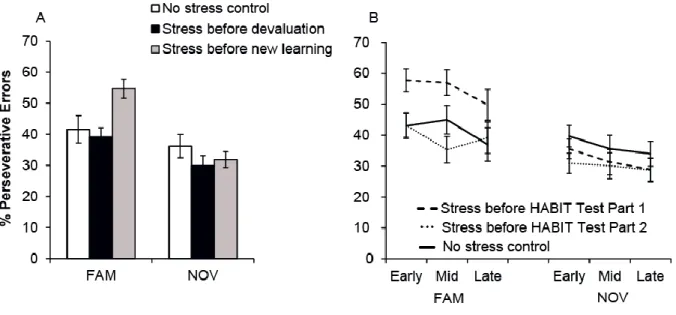
To quantify the degree to which responses were habitual, we calculated the percentage of perseverative errors relative to total errors following S-R contingency change (McKim et al., 2016a). A type by immersion group mixed model ANOVA found a large main effect of set-type on perseverative errors (F(1,50)=30.62, p<0.001 η2=0.33) as well as a set-type by group interaction (F(2,50)=5.56, p=0.007, η2=0.12). There was a trend for a significant main effect of group (F(2,50)=2.66, p=0.08, η2=0.11). To further evaluate the set by group interaction, a follow-up one-way ANOVA for each set-type (FAM and NOV) demonstrated that for the FAM set, groups differed significantly in terms of the proportion of perseverative errors (F(2,52)=6.39, p=0.003, η2=0.80). This result reflects more perseverative errors committed by the group stressed before HABIT Test Part 1 (0.55 ± 0.13), relative to either the group stressed before HABIT Test Part 2 (0.39 ± 0.11,
p=0.005) or the no stress control group (0.42 ± 0.18, p=0.026); the latter two groups did not differ significantly from one another (p=1.00). In contrast to these effects for FAM sets, although performance was nearly equivalent for FAM and NOV sets at the end of the HABIT Test Part 1 (Fig
2.5A), we detected no significant group effect on percentage of perseverative errors for the NOV
58
We next assessed whether perseverative errors were stable over time or if they could be overcome during the post-contingency re-learning period (i.e. HABIT Test Part 2). A set-type by time by group ANOVA found significant main effects of set-type (F(1,50)=30.58, p<0.001, η2=0.17) and time (F(2,100)=4.60, p<0.05, η2=0.02), and a significant interaction between set-type and group (F(2,50)=5.72, p<0.05, η2=0.07; Figure 2.5B). To probe the set-type by group interaction, we ran a mixed model ANOVA (time×group) separately for FAM and NOV set performance. For FAM S-R
sets, there was no effect of time on percentage of perseverative errors (F(2,100)=2.11, p=0.13); however, we did find a significant effect of immersion group (F(2,50)=6.39, p=0.03, η2=0.26), indicating that the greater tendency of group stressed before HABIT Test Part 1 to commit perseverative errors for the FAM sets that was sustained throughout Part 2 (Fig. 2.5B, dashed line). In contrast, for NOV S-R sets, we detected a significant main effect of time on percentage of
perseverative errors (F(2,100)=3.89, p=0.02, η2=0.07), but no main effect of group (F(2,50)=0.92,
59
Figure 2.5. Total percentage of perseverative errors and change in perseverative error rate over time by group. (A) We found a significant interaction between set-type and group (F(2,50)=5.56,
p=0.007, η2=0.12) that reflected increased perseverative errors for the FAM set (F(2,52)=6.39,
p=0.003, η2=0.80). For the FAM set, the group stressed before HABIT Test Part 1 showed a higher
proportion of perseverative errors (grey bar; 0.55 ± 0.13) relative to either the group stressed before HABIT Test Part 2 (black bar; 0.39 ± 0.11, p=0.005) or the no stress control group (white bar; 0.42 ± 0.18, p=0.026). There were no significant group effect on percentage of perseverative errors for the NOV set with changed S-R contingency (F(2,52)=0.86, p=0.43). (B) We found a significant
interaction between set-type and group over time (F(2,50)=5.72, p<0.05, η2=0.07). There was a significant effect of immersion group (F(2,50)=6.39, p=0.03, η2=0.26) for FAM sets, indicating the greater tendency of the group stressed before HABIT Test Part 1 to commit perseverative errors was sustained throughout Part 2. This was not the case for NOV S-R sets, where perseverative errors decreased over time regardless of group (F(2,100)=3.89, p=0.02, η2=0.07).
Independence of Perseverative Error Effects from Cortisol Response
To determine the contribution of cortisol changes to the observed behavioral differences in perseverative errors, we also conducted a two-way ANOVA with immersion group and cortisol responder status as between subject factors on the measurement of perseverative errors for the FAM
60
p=0.55), nor a significant interaction between group and cortisol response (F(1,33)=0.007, p=0.93). Thus, the effects of SECPT on habitual responding appears to be independent of an individual’s cortisol response to the stressor.
Correlations between Biological Measures of Stress and Perseverative Errors
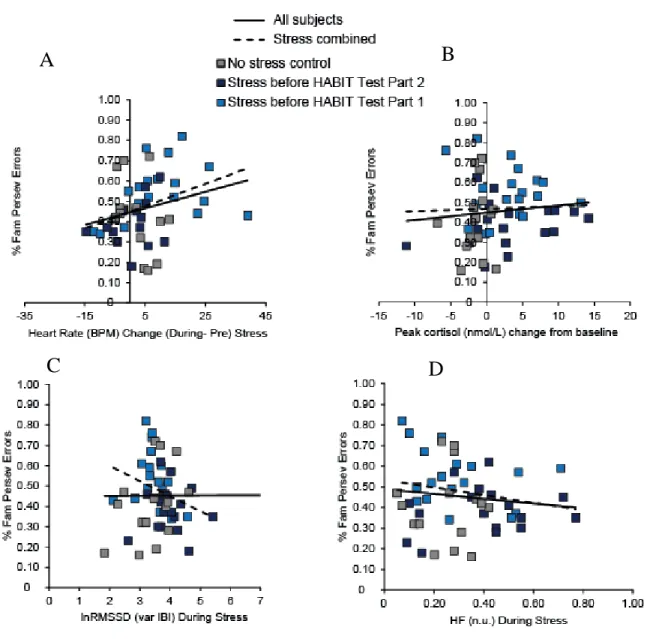
We examined correlations between the biological measures of stress and perseverative errors for the FAM S-R set with changed response contingencies. We found a trend for a positive
correlation between the difference in heart rate from pre- to during stress (Spearman’s ρ=0.28,