Sharif University of Technology
Scientia IranicaTransactions B: Mechanical Engineering www.scientiairanica.com
Research Note
Lycopodium dust ame characteristics considering char
yield
M. Bidabadi
a, S.A. Mostafavi
a,1,*, H. Beidaghy Dizaji
band F. Faraji Dizaji
a a. School of Mechanical Engineering, Department of Energy Conversion, Combustion Research Laboratory, Iran University ofScience and Technology, Tehran 16887, Iran.
b. School of Mechanical Engineering, Department of Aerospace Engineering, Iran University of Science and Technology, Tehran 16887, Iran.
Received 25 December 2011; received in revised form 10 April 2013; accepted 15 July 2013
KEYWORDS Analytical model; Lycopodium particle; Flame temperature; Burning velocity; Char content.
Abstract. Organic dust ames deal with a eld of science in which many complicated phenomena like pyrolysis or devolatization of solid particles and the combustion of volatile and char particles take place. One-dimensional ame propagation in the cloud of a fuel mixture has been analyzed, in which the ame structure is divided into three zones: Preheat zone, reaction zone and post ame zone. It is assumed that particles pyrolyze rst to yield a fuel mixture consisting of gaseous and charry fuel. In this research, the eect of char content on the pyrolysis process has been taken into account and a novel non-linear burning velocity correlation is obtained. Our results are in reasonable agreement with experimental data.
© 2013 Sharif University of Technology. All rights reserved.
1. Introduction
Nowadays, the greenhouse eect is one of the most challenging issues for the human environment, and CO2 is an important greenhouse gas. By increasing
electricity consumption, CO2generation rate increases,
and scientists are eager to nd new approaches to generate electricity with no CO2 production. Also,
human activity produces much waste, like agricultural and municipal solid waste, an excessive amount of which threatens the health of humans and other life forms. The Stirling engine is one of the best solutions
1. Present address: Department of Mechanical Engineering, Faculty of Engineering, Arak University, Arak,
38156-88349, Iran.
*. Corresponding author. Tel.: +98 21 77240540; Fax: +98 21 77240488
E-mail addresses: [email protected] (M. Bidabadi), [email protected] and [email protected] (S.A. Mostafavi), Beidaghy [email protected] (H. Beidaghy Dizaji) and [email protected] (F. Faraji Dizaji)
for both of these problems. These engines help to get rid of agricultural waste and also produce heat and power without increasing the amount of CO2 in the
atmosphere. The Stirling engines are fed by a micro-scale biomass up to 500 micrometers to enhance their eciency. Furthermore, a dual heat source (solar and biomass) can be used for Stirling engines to increase their conformity with nature [1].
Another important issue to threaten humanity is the dust explosion phenomenon. This phenomenon occurs in wheat silos and also in industries associated with micro-scale particles. A dust explosion is likely to occur when a nely divided combustible solid (in practice, the mean diameter of the particles should not exceed 1 mm) happens to be dispersed as a cloud in the air (with a typical mass loading between 10 and 1000 grams of dust per cubic meter or cloud), and when an appropriate ignition source (hot body, ame, electrical or mechanical spark, etc.) is activated inside this mixture. The heat evolved from the ignition source initiates the combustion of the particles located
in the vicinity of the ignition point. These particles, themselves, act as an ignition source for the adjacent slabs of the mixture, so that a `combustion zone' is allowed to propagate without additional input of en-ergy throughout the cloud. This `combustion zone' has generally a nite thickness and is called the `ame' [2]. A combustible dust explosion hazard may exist in a variety of industries, including: food (e.g. candy, starch, our, feed), plastics, wood, rubber, furniture, textiles, pesticides, pharmaceuticals, dyes, coal, metals (e.g. aluminum, chromium, iron, magnesium, and zinc), and fossil fuel power generation. The vast majority of natural and synthetic organic materials, as well as some metals, can form combustible dust. Any industrial process that reduces a combustible material and some normally noncombustible materials to a nely divided state present a potential for a serious re or explosion [3].
The most common dust explosion occurs in un-derground coal mines. In a coal mine tunnel, coal dust explosion is usually caused by gas explosion. Moving at the speed of sound, pressure wave resulting from a gas explosion lifts the deposited coal dust in the air. Then, the gas ame reaches the coal dust, causing a dust explosion, which is more severe than the original [4]. In order to have a better understanding of the process of generating heat and power from micro-biomass particles in Stirling engines, and also to predict a dust explosion phenomenon and it's severity, it is essential to study the combustion process of micro organic dust.
Lycopodium has been known as a reference parti-cle in organic dust combustion studies since it is mono-size, which is a basic assumption in analytical mod-els [5,6]. Researchers have done many studies about lycopodium dust combustion, both experimentally [7-9] and analytically [10-12]. Han et al. [7] used the Thermal Gravity Analysis test (TGA) to achieve the combustive properties of lycopodium particles, and also calculate the burning velocity, ame temperature and ame length. Proust [8] reported the burning velocity and ame temperature for three dierent particles; lycopodium, starch and sulphur. Two methods for determining laminar burning velocities have been used: the classical `tube method' and a `direct method', based on the simultaneous determination of the ame speed and the mixture velocity ahead of the ame front, using a tomographic technique. Seshadri et al. [10] studied, analytically, the structure of premixed ames propagating in combustible systems, containing uniformly distributed volatile fuel particles, in an oxidizing gas mixture. Bidabadi et al. [11] presented an analytical model for lycopodium dust combustion considering temperature dierence between the gas and particles.
In this research, an analytical model is used
to calculate the ame characteristics of lycopodium particles, including the eect of char yield, which has not been previously considered. In previous studies [5,6,10,11,13], it is assumed that the only product of the pyrolysis procedure of the lycopodium particle is methane gas. However, it is not a precise assumption, because when an organic particle is exposed to heat sources, it is cracked into gas, liquid and solid phases that are named, respectively, gas, tar and char [14-17]; tar, eventually, converting into gas and char. In this article, our organic sample is the lycopoduim particle, 90% of which converts to methane gas when it is pyrolyzed. Other remained components of the lycopodium particle are converted to char, but tar production is neglected, since tar itself consequently cracks into methane and char.
To analyze the combustion of organic dust, the ame structure is divided into three zones. The rst zone is the preheat zone, where the rate of chemical reaction is small. The second zone is an asymptotically thin reaction zone, where convection and the rate of va-porization of the particles are negligible in comparison with the reaction rate, and, nally, there is a post-ame zone. In next section, the conservation equations and required state equations needed to formulate the phenomenon are completely described. At the end, we compare our results with experimental results, and it is shown that our results are in reasonable agreement with the experimental results of Proust [8] and Wingerden et al. [9].
2. Governing equations
A one-dimensional steady model is used to simulate the combustion of organic dust, the ame of which is propagated in a uniformly distributed mixture of fuel particles. The initial density of the particles is nu and
the initial radius of the particles is ru. Biomass
py-rolysis involves numerous extremely complex reactions with many intermediate and nal products. According to this, many models of biomass degradation have been presented by dierent scientists [18]. In this study, a new model is presented to analyze the lycopodium organic dust ame. Also, a one step global pyrolysis model is used in which it is presumed that organic fuel decomposes into volatiles (gas) and carbon (char).
Since a large percent of produced gas is methane, the gas properties are considered the same as methane. Also, it is assumed that fuel mixture properties are calculated based on the mass fraction of methane and carbon in the mixture. It is also presumed that by burning the fuel mixture in an air oxidizer bed, CO2
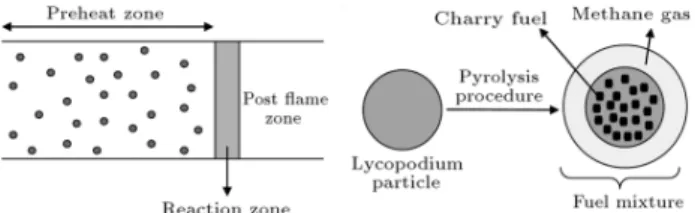
and H2O will be the products of combustion. Figure 1
shows a schematic gure of the ame structure divided into three zones: preheat zone, reaction zone and post ame zone.
Figure 1. The ame structure of dust particles.
Reaction occurs in a thin zone, O("), whereas preheat and post ame zones have considerable length. This assumption is based on asymptotic ame analysis or high Zeldovich number, and " is dened as a reciprocal of the Zeldovich number.
Mass conservation, organic particle mass conser-vation (solid particles) and fuel mixture conserconser-vation equations, along with energy conservation equations, are used to formulate the physical phenomena of solid particle combustion. Furthermore, the equation of state of the fuel mixture is used to restrict the equations in an atmospheric combustion condition to create a unique solution to our problem [10].
Since solid organic particles crack into gas and char when they are exposed to heat, summation of the fractions is equal to unity (vs g + vs c) = 1, which
means that the fuel mixture is only a combination of gaseous and chary fuel. vs g and vs c are the gaseous
fuel and chary fuel fractions of the solid particle. 3. Nondimensionalization of governing
equations
These parameters are used to nondimensionalize gov-erning equations:
= (T(T Tu)
f Tu); yF =
YF
YF c; ys=
Ys
YF c;
m = V
uVu = 1; Z =
uVuC
u x: (1)
In the above equation, Tfis ame temperature and YF c
is dened as:
YF cQ = C(Tf Tu): (2)
Finally, these dimensionless quantities are dened: !g= ( uwg
uVu)2CYF c; !c=
uwc
(uVu)2CYF c;
ys=4nssr 3
3YF c ; Q =
Qpyr
Q ; = 4:836Anu1=3u(Tf Tu)n
V2
uu4=3CYF c1=3s2=3
: (3)
In the above equations, Vu is burning velocity. The
Lewis number for the fuel mixture, and the ratio of the diusion of heat to mass diusion, is dened as below:
Le = u
uDuC: (4)
It is supposed that q has a negligible quantity (close to zero), which means that released heat from the reaction is greater than the heat absorbed by the particles for devolatilization. In this case, we replace with .
Thus, dimensionless equations yield: d
dZ = d2
dZ2 + (!g+ !c)
u
; dyF
dZ =
1 Le
d2yg
dZ2 + ys
2
3n (!g+ !c)u
; (5)
dys
dZ = ys
2 3n:
The above equations are solved in each zone according to their boundary conditions and appropriate assump-tions in order to obtain a reliable model for organic dust combustion and to predict ame characteristics. 4. Solution of governing equation in each zone 4.1. Preheat zones ( 1 < Z < 0)
In the asymptotic solution, (" ! 0), it is possible to neglect the reaction term, because, in the preheat zone, particles pyrolyze to yield a mixture of gaseous and chary fuel and there is no reaction. The energy equation and boundary conditions are:
d
dZ = d2
dZ2; Z =0 ! =1; Z = 1 ! =0:
(6) By solving the above equation, the nondimensional temperature distribution is:
= exp(Z); Z 0: (7)
The mass conservation equation of organic particles converts to:
dys
dZ = y
2 3
s[exp(Z)]nZ = 1 ! ys= YYF u
F c = :(8)
YF u, in the above equation, is the amount of fuel
mixture that is available in the initial particles. Thus:
ys= [13 enZ]3; (9)
a, in the above equation, is dened in the terms below:
Thus, the conservation equation of the fuel mixture is changed to:
dyF
dZ = 1 Le
d2y F
dZ2 + [
1
3 aenZ]2enZ: (11)
Boundary conditions are:
Z = 1 ! yF = 0; Z = 0 ! yF = 0: (12)
Finally, by solving the fuel mixture equation, the following equation is obtained:
yF =C1eLe:Z Le:
2 3
n2 nLeenZ+
2Le:a1 3
4n2 2nLee2nZ
Le:a2
9n2 3nLee3nZ:
C1= Le:
2 3
n2 nLe
2Le:a1 3
4n2 2nLe+
Le:a2
9n2 3nLe; (13)
and:
dyF
dZ
0 = Le[3a
2
3 + a3 3a213]: (14)
4.2. Post ame zone (0 < Z < +1)
Before analyzing the reaction zone, the post-ame zone is primarily investigated.
= 1; ys= constant; yF = 0: (15)
In the post-ame zone, the available mass fraction of solid particles is approximately equal to the quantity of ysat the end of the vaporization zone (i.e. Z = 0 )
4.3. Reaction zone (Z = o)
In this zone, the rate of reaction is considerable, and convection and devolatilization terms are negligible in comparison with diusion and reaction terms. It means:
d
dZ 0;
dyF
dZ 0; ys
2
3n 0: (16)
Governing equations in this zone convert into the following equations:
dys
dZ = 0 ! ys= cte; d2
dZ2 = (!g+ !c)
u
; d2y
F
dZ2 = Le:(!g+ !c)
u
: (17)
In the above equations, gaseous and chary fuel reaction rates are dened as:
!g= ( uwg
uVu)2CYF c; !c =
uwc
(uVu)2CYF c;
wg = vgWgkgCg; wc= vcWckcCc;
kg = Bgexp
E
g
RT
; kc = Bcexp
E
c
RT
: (18) Subscripts c and g denote char and gas and C, W and k are the molar concentration, molecular weight and the constant rate of the overall reaction, respectively. v is the stoichiometric coecient of the fuel components, which represents the amount of produced gas and char in the devolatilization process:
vg= vs g and vc = vs c: (19)
In order to analyze the reaction zone expansion param-eter, " = 1
Zeis dened to expand the reaction zone. By
using ", all our previous parameters are expanded and rewritten as:
=Z"; y=yF yFF
" ; t =
1
" : (20) yFF is the mass fraction of the fuel mixture prior to the
reaction zone. Using the above expanded parameters, conservation Eq. (17) are rewritten as follows:
d2t
d2 = "(!g+ !c)
u
; d2y
d2 = "Le:(!g+ !c)
u
: (21)
Solving the above equations, burning velocity is achieved, which is the primary purpose of this article.
V2
u =2"2Le:DuF
vgBg:exp
Eg
RTf
+ vcBc:exp
Ec
RTf
:(Le + b)
: (22)
According to Eq. (22), burning velocity is a function of Tf, which is an indeterminate parameter. We need
another expression in order to simultaneously solve these two expressions and calculate indeterrminate parameters. In the resumption, the process of nding this expression is explained.
In Eq. (17), by combining each side of the energy, gaseous fuel and chary fuel conservation equations together, the following equation is produced:
d2
dZ2 +
1 Le
d2yF
By integrating Eq. (23) from Z = 0 to Z = 0+, it is
possible to achieve the following matching condition:
d
dZ
0
+ 1 Le
dyF
dZ
0
= 0: (24)
Finally, by substituting Eqs. (7) and (14) into Eq. (24), the following expression, which connects burning veloc-ity and ame temperature, is achieved:
3a23 + a3 3a213 1 = 0: (25)
5. Results and discussion
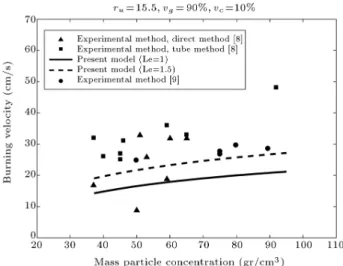
In order to predict ame characteristics, like burning velocity and mass fractions of a generated fuel mix-ture, the explicit expression for the burning velocity in Eq. (22) should be solved, simultaneously, with Eq. (25). To evaluate the accuracy of the presented model, the obtained burning velocity is compared with the ame velocity, which is calculated by Proust [8] and Van Wingerden et al. [9]. Proust calculated the burning velocity of lycopodium as a function of mass particle concentration in both the direct and tube methods. To compare our results with experimental data, we require some initial data, like rp = 15:5 m
and vs g = 0:9, which are related to the physical and
chemical characteristics of lycopodium particles. As shown in Figure 2, it is understood that our result is in reasonable agreement with experimental data.
In gas ame analysis, two types of resistance exist against ame propagation; heat transfer resistance and chemical reaction resistance. In dry dust ame, pyrolysis (devolatization) resistance is also added to these resistances. In fact, the interactions between these resistances in each ame control the ame charac-teristics like burning velocity and ame temperature. It
Figure 2. The variation of burning velocity as a function of mass particle concentration for both the present model and experimental data [8,9].
is clear that mass transfer resistance exists in all types of the above ames.
As shown in Figure 3, it is clear that by increas-ing char content, the adiabatic ame temperature of the fuel mixture, CH4 + C, which is obtained from
thermodynamics, increases. This happens because the energy density of chary fuel is higher than methane fuel. It is notable that in measuring adiabatic temperature, the rate of reaction is neglected. The only factor that aects adiabatic temperature is the combustion heat, which is related to the enthalpy of formation. Also, it is understood that by increasing the equivalence ratio, adiabatic temperature decreases due to an excessive amount of fuel, which remains unburned because of an insucient oxidizer.
On the other hand, as shown in Figure 4, an increase in char content causes a decrease in burning velocity. In fact, a carbon particle has fewer tendencies to react with oxygen in comparison with methane,
Figure 3. The variation of adiabatic ame temperature as a function of equivalence ratio ('u) for dierent char contents.
Figure 4. The variation of burning velocity as a function of equivalence ratio for dierent char contents.
Figure 5. The variation of ame temperature as a function of equivalence ratio for dierent char contents.
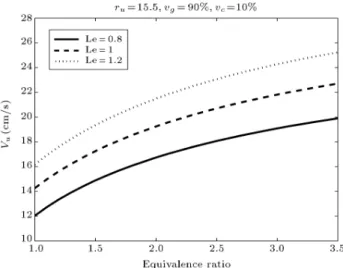
Figure 6. The variation of burning velocity as a function of equivalence ratio for dierent Lewis number.
due to the solid structure of carbon. Furthermore, according to Figure 5, by increasing char content, ame temperature decreases.
The Lewis number variation (ratio of thermal diusivity to mass diusivity) has a strong eect on the burning velocity. An increase in Lewis number is associated with a noticeable rise in thermal diusivity. This improves the pyrolysis condition in the preheat zone, due to an increase in the amount of induced heat from the reaction zone into the preheat zone. As a result, burning velocity is increased, which is shown in Figure 6.
The Lewis number has also a dual eect on generated gaseous fuel. At rst, an increase in Lewis number accelerates the vaporization process of solid fuel particles, due to an intense increase in the thermal diusivity eect. On the other hand, an increase in Lewis number is associated with a sharp reduction in mass diusivity, which implies that the combustion condition has deteriorated. However, it is clearly
Figure 7. The variation of ame temperature as a function of equivalence ratio for dierent Lewis number.
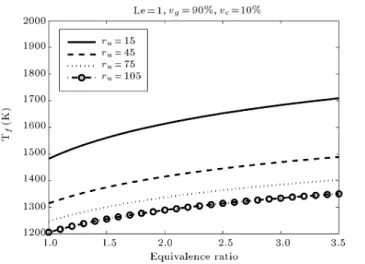
Figure 8. The variation of burning velocity as a function of equivalence ratio for dierent particle radius.
understood that thermal diusivity has a dominant eect, which increases in Lewis number, causing an increase in burning velocity. Also, by increasing Lewis number, ame temperature increases, as shown in Figure 7.
Finally, the eect of particle radius on ame properties has been investigated. By decreasing the particle radius eective surface, the surface exposed to heat increases and, eventually, improves the pyrolysis process, which increases the amount of generated fuel mixture. As shown in Figure 8, burning velocity is increased by reducing particle size. Again, a similar trend is observed for ame temperature, illustrated in Figure 9.
6. Conclusion
In this study, an analytical model for the combustion of a lycopodium dust cloud is presented to determine the eect of char content. Furthermore, the eect
Figure 9. The variation of burning velocity as a function of equivalence ratio for dierent particle radius.
of dierent parameters, like particle size and Lewis number, is also investigated. From obtained results, it is understood that an increase in char content causes a reduction in burning velocity, but a reverse trend is observed in the adiabatic temperature of the ame. These contrary trends can be explained by distinguishing between available energy in the chary fuel and its tendency to react. Chary fuel has more energy compared to methane gas, but it has a lower tendency to react. So, a higher adiabatic temperature is achieved, while burning velocity decreases. Ad-ditionally, ame temperature, which is coupled with burning velocity, also decreases. It is notable that burning velocity and ame temperature have a similar trend when a parameter is varied. Also, the eect of Lewis number and particle radius are also investigated. An increase in Lewis number improves the pyrolysis procedure of organic dust and, consequently, burning velocity increases. Besides, a reduction in particle radius increases the amount of generated fuel mixture, which increases burning velocity.
Nomenclature
A Parameter characterizing rate of devolatilization of fuel particles
a Dened in Eq. (10)
Bg Frequency factor characterizing rate of
gas phase oxidation
Bg Frequency factor characterizing rate of
solid phase oxidation
b = yF F" Scaled mass fraction of fuel at the boundary between the reaction zone
C Heat capacity of mixture
Cg Molar concentration of gas
Cc Molar concentration of char
CF Molar concentration of fuel mixture
Cp Heat capacity of the gas
Cs Heat capacity of a fuel particle
D Diusion coecient
Eg Activation energy characterizing the
gas reaction, Eq. (18)
Ec Activation energy characterizing the
char reaction, Eq. (18)
kg Rate constant of the gas reaction
kc Rate constant of the char reaction
Le Lewis number, Eq. (4)
m Dened in Eq. (1)
n Temperature exponent characterizing
rate of devolatilization of fuel particles ns Local number density of particles
(number of particles per unit volume) nu Local number density of particles
(number of particles per unit volume) Q Heat release per unit mass of gas and
char fuel consumed
Qpyr Heat associated with devolatilizing
unit mass of fuel
q Dened in Eq. (3)
R Gas constant
r Radius of fuel particle
T Temperature
t Dened in Eq. (20)
V Velocity
Vu Burning velocity (Eq. 22)
vs c Char yield
vs g Gas yield (vs g+ vs c = 1
Wc Molecular weight of char
Wg Molecular weight of gaseous fuel
wc Reaction rate characterizing
consumption of char, Eq. (18) wg Reaction rate characterizing
consumption of gaseous fuel, Eq. (18)
wpyr Rate of devolatilization of fuel particles
Y Mass fraction
YF c Dened in Eq. (2)
YF u Gas and char fuel available in the
particles in the ambient reactant stream
yF Dened in Eq. (1)
ys Dened in Eq. (1)
y Dened in Eq. (20)
Z Scaled independent variable, Eq. (1) Greek Symbols
8 Volume
YF u=YF c
Dened in Eq. (3)
" 1/Ze, expansion parameter
Independent variable dened in Eq.
(20)
Dened in Eq. (1)
Value of calculated neglecting the
heat of devolatilization of particles
g Dened in Eq. (A.10)
c Dened in Eq. (A.10)
Thermal conductivity reactant mixture
Density of reactant mixture
s Density of fuel particle
v Stoichiometric coecient
'u Equivalence ratio, based on fuel
available in the particles in the ambient reactant stream
!c Dened in Eq. (3)
!g Dened in Eq. (3)
Subsecripts
b Adiabatic conditions after completion of chemical reactions
c Char
f Conditions at the reaction zone
F Fuel mixture (methane+char)
g Gaseous fuel (methane)
o2 Oxygen
s Solid fuel particles
u Conditions in the ambient reactant stream
References
1. Zeiler, M., Podesser, E., Dermouz, H., Enzinger, P., Gunczy, S., Lauer, M., Padinger, R. and Wenzel, A. \Sustainable energy supply of an austrian winery based on solar and biomass driven microCHCP", Proceedings of the 16th European Biomass Conference and Exhibi-tion From Research to Industry and Markets Valencia, Spain, (2008).
2. Proust, C. \Dust explosions in pipes: A review", Journal of Loss Prevention in the Process Industries, 9(4), pp. 267-277 (1996).
3. National Fire Protection Association (NFPA) \Indus-trial re hazards handbook", 3rd Ed., NFPA Inc. (1990).
4. Yan-song Zhang, Li-li Han and Lei Wang \Mechanism research of gas and coal dust explosion", Journal of Coal Science & Engineering, 15(2), pp. 171-174 (2009).
5. Bidabadi, M. and Rahbari, A. \Novel analytical model for predicting the combustion characteristics of pre-mixed ame propagation in lycopodium dust parti-cles", Journal of Mechanical Science and Technology, 23, pp. 2417-2423 (2009).
6. Bidabadi, M., Haghiri, A. and Rahbari, A. \The eect of Lewis and Damkohler numbers on the ame propagation through micro-organic dust particles", International Journal of Thermal Sciences, 49, pp. 534-542 (2010).
7. Han, O.S., Yashima, M., Matsuda, T., Matsui, H., Miyake, A. and Ogawa, T. \Behavior of ames propa-gating through lycopodium dust clouds in a vertical dust", Journal of Loss Prevention in the Process Industries, 13, pp. 449-457 (2000).
8. Proust, C. \Flame propagation and combustion in some dust-air mixtures", Journal of Loss Prevention in the Process Industries, 19, pp. 89-100 (2006).
9. Van Wingerden, K., Stavseng, L. and Bergen, N. \Measurements of the laminar burning velocities in dust-air mixtures", http://www2.gexcon.com/download/VDI2.pdf.
10. Seshadri, K., Berlad, A.L. and Tangirala, V. \The structure of premixed particle-cloud ames", Combus-tion and Flame, 89, pp. 333-342 (1992).
11. Bidabadi, M. and Rahbari, A. \Modeling combustion of lycopodium particles by considering the temper-ature dierence between the gas and the particles", Combustion, Explosion and Shock Waves, 45(3), pp. 278-285 (2009).
12. Bidabadi, M., Shakibi, A. and Rahbari, A. \The radiation and heat loss eects on the premixed ame propagation through lycopodium dust particles", Jour-nal of the Taiwan Institute of Chemical Engineers, 42, pp. 180-185 (2011).
13. Haghiri, A. and Bidabadi, M. \Modeling of laminar ame propagation through organic dust cloud with thermal radiation eect", International Journal of Thermal Sciences, 49, pp. 1446-1456 (2010).
14. Di Blasi, C. \Analysis of convection and secondary reaction eects within porous solid fuels undergoing pyrolysis", Combustion Science and Technology, 90, pp. 315-340 (1993).
15. Vijeu, R., Gerun, L., Tazerout, M., Castelain, C. and Bellettre, J. \Dimensional modelling of wood pyrolysis using a nodal approach", Fuel, 87, pp. 3292-3303 (2008).
16. Bryden, K.M., Ragland, K.W. and Rutland, C.J. \Modeling thermally thick pyrolysis of wood", Biomass and Bioenergy, 22, pp. 41-53 (2002).
17. Mousques, P. \Modelisation du couplage des reactions chimiques-transferts de chaleur/matiere en vue du dimensionnement des reacteurs de pyrolyse", PhD Thesis, Universite de Perpignan (2001).
18. Prakash, N. and Karunanithi, T. \Advances in mod-eling and simulation of biomass pyrolysis", Asian Journal of Scientic Research, pp. 1-27 (2009). Appendix
By substituting wg and wc in Eq. (3), the following
equations are achieved: !g= (uvgWgCgBg
uVu)2CYF cexp
Eg
RT
; !c= (uvcWcCcBc
uVu)2CYF cexp
Ec
RT
: (A.1)
In order to solve our equations, ( E
RT) should be
con-verted into (( E
RTf) + t). This process is explained in
the following equations: E
RT =
E R(T Tf+ Tf)
=Tf !T E
RT =
E
R(Tf )
= E(Tf+ ) R(T2
f + 2) 20
! E
RT =
E RTf +
E RT2
f:(A.2)
By using Ze = (1
"), the following equation is obtained:
Ze =E(TRTf 2Tu)
f = 1 " ! E RT2 f = 1
"(Tf Tu): (A.3)
Then, Eqs. (A.2) and (A.3) are combined: E
RT2 f =
"(Tf Tu) =
Tf T
"(Tf Tu);
Tf T
Tf Tu = 1
T Tu
Tf Tu
Eq: (1)! Tf T
Tf Tu = 1 ; E RT2 f = 1 "
Eq: (20)! E
RT2
f = t: (A.4)
Finally, by substituting Eq. (A.4) in Eq. (A.2), the following relation is achieved:
E
RT =
E
RTf + t !
( Eg
RT = RTEgf t
Ec
RT = RTEcf t
: (A.5)
By substituting Eq. (A.5) into Eq. (A.1), the last abstract mathematical problem is nished and we return to the primary problem and its solution:
!g= (uvgWgCgBg uVu)2CYF cexp
Eg
RTf t
; !c= (uvcWcCcBc
uVu)2CYF cexp
Ec
RTf t
: (A.6)
By substituting Eq. (A.6) in the energy conservation equation (Eq. (21)), it is rewritten in the following terms:
d2t
d2 =
u
"
uvgWgCgBg
(uVu)2CYF c exp
Eg
RTf t
+(uvcWcCcBg
uVu)2CYF cexp
Ec
RTf t
(Le= u
uDuC!) d2t
d2
=":Le:DV2 uF
uYF c
(vgWgCgBg): exp
Eg
RTf t
+ (vcWcCcBc): exp
Ec
RTf t
:
(A.7) Now, using the following equations from Eqs. (1) and (20), it is possible to nd another expression for YFc,
which is used in Eq. (A.7): y=yg yFF
" ! yF = "y+ yFF
b=(yFF=")! y
F
= "(y+ b);
YF =m mF F + mair =
mg+ mc
mg+ mc+ mair
=mmF ! YF = F88F = F =WFCF;
YF c= YyF F =
YF
"(y+ b) ! YF c=
WFCF
"(y+ b): (A.8)
It is possible to calculate b, which is used in the above equations, using the following equations:
b =yFjZ= "
" = Ze.Le
2
3
n2 nLe(e
Le Ze eZen)
2a13
4n2 2nLe(e
Le
Ze e 2nZe)
+9n2a23nLe(e LeZe e3nZe)
: (A.9)
By substituting the above expressions in Eq. (A.7) and rewriting it, the following equation is obtained:
d2t
d2 = [(g+ c)(y+ b)] exp( t);
g= " 2:Le:D
uF
V2 u
vgBg: exp
Eg
RTf
; c ="
2:Le:Du
F
V2 u
vcBc: exp
Ec
RTf
Combining Eq. (25) results in the following expression: (d2t
d2 = "(!g+ !c)u
d2y
d2 = ":Le(!g+ !c)u
yields!d2[t Le1y]
d2 = 0:
(A.11) The boundary condition for the above equation is de-termined, via the boundary condition, when ! +1, and the solution for the post-ame zone is determined as follows: dt d = dt dZ dZ d = d(1 " )
dZ " = d dZ ! ddtj!+1= dZdjZ!0+= d(1)
dZ jZ!0+= 0;(A.12)
dy d = dy dZ dZ d =
d(yF yFF
" )
dZ " = dyF
dZ
! dydj!+1= dydZFjZ!0+ = 0: (A.13)
Integrating twice from Eq. (A.11) and utilizing the Expressions (A.12) and (A.13) lead to:
t = Le1 y: (A.14)
By substituting the above relations in Eq. (A.10), the following equation is achieved:
d2t
d2 = [(g+ c)(Le:t + b)]exp( t): (A.15)
The boundary condition for variable t is determined from the boundary condition:
dt
dj! 1=
d
dZjZ!0 =
d(exp(Z))
dZ jZ!0 (A.16)= 1: By, using the below substitution and rewriting Eq. (A.15) and using some mathematical operations, it is possible to obtain burning velocity:
P = ddt ! dd2t2 = Pdpdt !
(
P jZ=0 =ddtj! 1= 1
P jZ=0+= ddtj!+1= 0 (A.17)
=
T Tu
Tf Tu
! 1 =
Tf T
Tf Tu
t=1 "! t
=
1 Tf Tu
Tf Tu
" ! 8 > > < > > :
tjZ=0 =
1 Tf Tu
Tf (Tf)
"
= +1 tjZ=0+=
1 Tf Tu
Tf Tf
"
= 0 (A.18)
Eq: (A:15)! PdP = f[(
g+ c)(Le:t + b)] exp( t)gdt:
(A.19) By integrating from Eq. (A.19), we have:
P2
2 0
1=[(g+ c):f[Le:( te
t e t)]:
b:e tg]0
+1: (A.20)
Eventually, Eq. (A.20) is rewritten as: 1
2 = (g+ c):(Le + b): (A.21)
Now, after all complex mathematical operations, which are completely explained in the above relations, by substituting g and c in Eq. (A.10), the primary
aim of this article, which is burning velocity, is written in the following expression:
V2
u =2"2Le:DuF
vgBg:exp
Eg
RTf
+ vcBc:exp
E
c
RTf
:(Le + b)
: (A.22)
Biographies
Mehdi Bidabadi received his BS degree in Mechan-ical Engineering from Iran University of Science and Technology, where he is a faculty member, and MS and PhD degrees from Sharif University of Technology, Iran, and McGill University, Canada, respectively. His research interests include: dust ame propagation mechanisms, combustion, wind tunnels and gas dynam-ics, development of a new experimental apparatus to produce laminar ow and optimization of smoke wind tunnels. He has published several research papers in the eld of dust combustion.
Seyed Alireza Mostafavi received a BS degree in Mechanical Engineering from Shahrood Univer-sity of Technology, Iran, in 2004, an MS degree in Mechanical Engineering from Isfahan University of Technology, Iran, in 2008, and a PhD degree in Mechanical Engineering from Iran University of Science and Technology in 2013. He is a faculty member in the Mechanical Engineering Department at Arak University, Iran. His research interests include energy, combustion and the environment, especially numerical and experimental study of reactive uid ow. He has published several research papers in these elds.
Hossein Beidaghy Dizaji received his BS degree in Mechanical Engineering from the Islamic Azad
University of Tabriz, Iran, in 2009, and his MS degree in Aerospace Engineering (Propulsion), in 2011, from Iran University of Science and Technology, where he is currently working in the Combustion Research Labora-tory. His research interests include combustion, renew-able energy (biomass and solar), internal combustion engines (included gas turbines), thermo uid systems (power plants and cooling systems) and experimental uid mechanics.
Farzad Faraji Dizaji received his BS degree in Mechanical Engineering from the University of Tabriz, in 2009, and his MS degree in Mechanical Engineering, in 2011, from Iran University of Science and Technol-ogy, where he is currently working in the Combustion Research Laboratory. His research interests include combustion and explosion, renewable energy (biomass and bio-fuel), internal combustion engines (included gas turbines) and experimental uid mechanics.