English grammar,
punctuation and spelling
Mark schemes
Key stage 2
SAMPLE BOOKLET
Published July 2015
This sample test indicates how the national curriculum will be assessed from 2016.
[BLANK PAGE]
Contents
1. Introduction
4
2. Structure of the key stage 2 English grammar, punctuation and spelling test 4
3. Content domain coverage
4
4. Paper 1: questions
5
4.1 Content domain coverage for Paper 1: questions
5
4.2 General guidance on marking Paper 1: questions
7
4.3 Explanation of the mark schemes for Paper 1: questions
9
5. Mark schemes for Paper 1: questions
10
6. Paper 2: spelling
23
6.1 Content domain coverage for Paper 2: spelling
23
6.2 General guidance on marking Paper 2: spelling
23
6.3 Pupil version of Paper 2: spelling
23
1. Introduction
The Standards and Testing Agency (STA) is responsible for the development and delivery of statutory tests and assessments. STA is an executive agency of the Department for Education. The 2014 national curriculum will be assessed for the first time in May 2016. The sample test and mark schemes set out how the new national curriculum will be assessed from 2016 onwards. This test has been developed to meet the specification set out in the test framework for English grammar, punctuation and spelling at key stage 2. The test frameworks are on the GOV.UK website at www.gov.uk/sta.
A new test and mark scheme will be developed each year.
The key stage 2 tests will be marked by external markers. The sample tests will be marked by teachers if they are used to prepare pupils for the 2016 tests.
Scaled score conversion tables are not included in this document. Conversion tables are produced as part of the standard-setting process. As the sample tests are not subject to standard setting, they are not available for these tests. Scaled score conversion tables for the 2016 tests will be published at www.gov.uk/sta in June 2016.
A variety of questions has been included in this sample test to demonstrate the formats and curriculum content that pupils may encounter in a live test. A commentary is provided in the mark scheme that accompanies each question.
This sample test mark scheme is provided to give teachers an indication of how the tests will be marked. The mark schemes for the sample tests have been subject to a shorter process than the full, rigorous development process that is used for live mark schemes. The pupil examples are based on responses gathered from the test trialling process.
The sample test and mark schemes have been reviewed by teachers and other expert reviewers.
2. Structure of the key stage 2 English
grammar, punctuation and spelling test
The key stage 2 English grammar, punctuation and spelling test materials comprise: • Paper 1: questions (50 marks)
• Paper 2: spelling (20 marks)
3. Content domain coverage
4. Paper 1: questions
4.1 Content domain coverage for Paper 1: questions
Table 1 sets out the content domain coverage for questions in Paper 1. Information relating to the codes in Table 1 can be found in the key stage 2 English grammar, punctuation and spelling test framework.
Table 1: Content domain coverage for questions in Paper 1
G1 G2 G3 G4 G5 G6 G7
Grammatical terms / word classes
Functions of sentences
Combining words, phrases and clauses
Verb forms, tenses and consistency
Punctuation Vocabulary Standard English and formality
1 1
2 1
3 1
4 1
5 1
6 1
7 1
8 1
9 1
10 1
11 1
12 1
13 1
14 1
15 1
16 1
17 1
18 1
19 1
20 1
21 2
G1 G2 G3 G4 G5 G6 G7
Grammatical terms / word classes
Functions of sentences
Combining words, phrases and clauses
Verb forms, tenses and consistency
Punctuation Vocabulary Standard English and formality
23 1
24 1
25 1
26 1
27 1
28 1
29 1
30 1
31 1
32 1
33 1
34 1
35 1
36 1
37 1
38 1
39 1
40 1
41 1
42 1
43 1
44 1
45 1
46 1
47 1
48 1
4.2 General guidance on marking Paper 1: questions
The following guidance applies to all questions in Paper 1. Please read this carefully before applying the individual mark schemes.
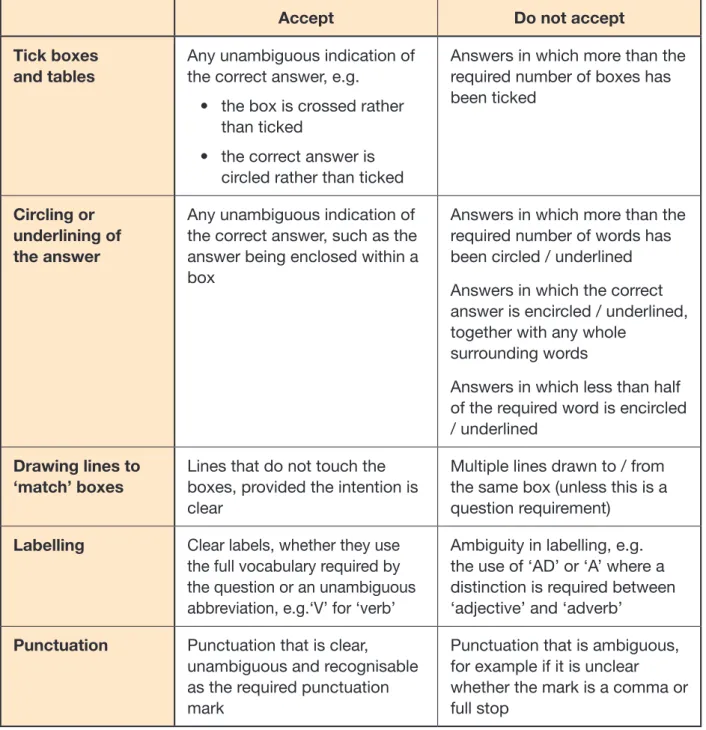
Table 2: General guidance on marking Paper 1
Accept Do not accept
Tick boxes and tables
Any unambiguous indication of the correct answer, e.g.
• the box is crossed rather than ticked
• the correct answer is circled rather than ticked
Answers in which more than the required number of boxes has been ticked
Circling or underlining of the answer
Any unambiguous indication of the correct answer, such as the answer being enclosed within a box
Answers in which more than the required number of words has been circled / underlined Answers in which the correct answer is encircled / underlined, together with any whole
surrounding words
Answers in which less than half of the required word is encircled / underlined
Drawing lines to ‘match’ boxes
Lines that do not touch the boxes, provided the intention is clear
Multiple lines drawn to / from the same box (unless this is a question requirement)
Labelling Clear labels, whether they use the full vocabulary required by the question or an unambiguous abbreviation, e.g.‘V’ for ‘verb’
Ambiguity in labelling, e.g. the use of ‘AD’ or ‘A’ where a distinction is required between ‘adjective’ and ‘adverb’
Punctuation Punctuation that is clear, unambiguous and recognisable as the required punctuation mark
Punctuation that is ambiguous, for example if it is unclear whether the mark is a comma or full stop
Accept Do not accept Sentences and
capital letters
A sentence that has a capital letter and an appropriate
punctuation mark indicating the end of the sentence
Capital letters that are clear and unambiguous. Where letters do not have unique capital letter forms, the height of the capital letter will be similar to, or greater than, that of letters with ascenders
Answers in which capital letters are omitted or placed inappropriately in a sentence, or where an entire word is capitalised
Ambiguity in the comparative sizes of letters
Spelling Where no specific mark scheme guidance is given, incorrect spellings of the correct response should be accepted
Incorrect spellings of answers for which the mark scheme requires correct spelling Correct spelling is generally required for questions assessing contracted forms, plurals, verb tenses, prefixes and suffixes
Answers outside the expected space
A correct answer given somewhere other than the answer space, providing it is not contradicted by another answer written elsewhere
Correct answers that are written in the ‘blank’ within a question, rather than in the expected space below it
Correct answers in which the pupil has written out a word or sentence that is already provided
Answers that are given outside the expected space and
contradicted by another answer written elsewhere
More than one answer given
Multiple answers that are all correct according to the mark scheme
Both correct and incorrect responses given
Accept Do not accept Handwriting Answers that are clear,
unambiguous and recognisable, including letters or punctuation marks that have been reversed, but which are still clearly
identifiable to the marker
Answers that are unclear or ambiguous
Crossed-out answers
Correct answers that have not been crossed out
Correct answers that replace a crossed-out attempt
Crossed-out answers, whether or not these have been replaced by a further attempt
4.3 Explanation of the mark schemes for Paper 1: questions
Markers should familiarise themselves with the marking guidance in section 4.2 of this document before applying the mark schemes below.
The mark schemes contain the following information for each question: • a question number
• the question from the test paper
• what is required to answer each question – either a correct answer or examples of different types of creditworthy response
• how many marks are available for this question • any additional guidance that may be relevant • the content domain reference.
5. Mark schemes for Paper 1: questions
The commentary has been added to the sample test mark scheme to provide an explanation of how the new national curriculum is assessed through the English grammar, punctuation and spelling test.
Question Requirement Mark
1
G2.2
What time will the film start ✓
1m
Commentary: This question assesses knowledge of the grammatical patterns that indicate a question and the use of question marks. It appears as the first item in the sample test since initial trialling data shows it to be the question that the most children answered correctly. Subsequent questions are arranged in difficulty order based on trialling data. This question uses a typical multiple-choice format.
2
G4.2
is was ✓
1m
Commentary: This question assesses tense consistency. This was assessed as ‘tense agreement’ under the previous test framework. It is not necessary to know the term ‘tense consistency’ to answer the question correctly. The mark will also be awarded if pupils write the correct response into the spaces in the sentence.
3
G6.2
Award 1 mark for all five correct.
re mature
de understood
mis legible
im frost
il do
1m
Question Requirement Mark
4
G5.6b
Immediately after dinner, we did the washing up. ✓
1m
Commentary: This question assesses understanding of the use of commas after fronted adverbials, although it is not necessary to explicitly identify the fronted adverbial or to know the term in order to answer the question correctly. This is a new part of the framework.
5
G4.1a
The roof was replaced in 1970. ✓
1m
Commentary: This question assesses identification of the past tense and knowledge of the term. This is a new part of the test framework, in addition to the generic test reference code for verbs.
6
G7.1
Award 1 mark for two correct words encircled.
We was / were planning to hold a cake sale at school. I was / were chosen to design the posters.
1m
Commentary: This question assesses Standard English forms for verb inflections. Questions requiring Standard English forms for verb inflections also appeared in previous tests, under the test reference code for subject–verb agreement.
7
G5.8
Award 1 mark for the correct contracted form. • doesn’t
1m
Commentary: This question assesses the use of apostrophes for contracted forms. It is not necessary to know the term ‘apostrophe’ in order to answer the question correctly, but the term ‘contracted form’ is used in the question and will be used in questions assessing this area of the content domain. Note that the correct spelling of the word and correct placement of the apostrophe are required for the award of the mark; this is the case with all questions in which pupils have to write a contracted form.
8
G2.2
This is the book you asked for, isn’t it ✓
1m
Commentary: This question assesses knowledge of the grammatical patterns that indicate a question and the use of question marks. Pupils will need to recognise that question tags can be used to form questions in order to answer this question correctly.
9
G5.8 The children’s clothes were hanging up. ✓
1m
Commentary: This question assesses understanding of the possessive apostrophe with plural nouns.
10
G1.5 plants ✓
1m
Commentary: This question assesses pronouns. It is not necessary to identify the pronoun or to know the term in order to answer the question correctly.
11
G1.5b
They bought new jumpers for themselves and a warm scarf for Dad. 1m
Commentary: This question assesses identification of pronouns and knowledge of the term.
12
G1.3
Award 1 mark for a correct adjective formed from ‘create’, e.g. • creative
Do not accept misspellings.
1m
Commentary: This question assesses adjectives. It requires pupils to know the term and to form an adjective of their own from a given root word in order to answer the question correctly. Correct spelling is required for the award of the mark; this is the case with all questions in which pupils have to form words from a given root word or add prefixes or suffixes to a given word.
13
G3.1a
The table which is made of oak is now black with age. 1m
Commentary: This question assesses identification of relative clauses and knowledge of the term. This is a new part of the test framework, in addition to the generic test reference code of clauses.
14
G3.1a as a relative clause ✓
1m ✓
Question Requirement Mark
15
G4.1c
Award 1 mark for a correctly completed table.
Sentence Modal verb indicates certainty
Modal verb indicates
possibility
It will be very cold
tomorrow. ✓
John might have missed
the train. ✓
Ann can speak six
languages. ✓
You could finish your work by the end of the lesson.
✓
1m
Commentary: This question assesses understanding of modal verbs to indicate degrees of possibility. This is a new part of the test framework, in addition to the generic test reference code of verbs.
16
G5.11
Award 1 mark for the correct response. • semi-colon
Also accept plausible misspellings and responses that do not use a hyphen, e.g. • semicolon
• semi colon
1m
Commentary: This question assesses identification of the semi-colon and knowledge of the term, as well as an understanding of its function in separating two related main clauses. Semi-colons were previously assessed only in the Level 6 test.
17
G3.1
Award 1 mark for a correctly completed table.
Sentence Main clause Subordinate clause
Billie, who was nine years old,
loved to play tennis. ✓
Billie’s mum bought her a tennis racket so that she could play more often.
✓ Billie could not play tennis with
her friend Lana because Lana did not have a racket.
✓
1m
18
G1.4
Award 1 mark for all three conjunctions encircled.
Once Harry had checked the weather forecast, he set off on his walk. Whilst climbing up the mountain, he was unaware of the dangers ahead. He needed to turn back immediately since a storm was coming.
1m
Commentary: This question assesses identification of conjunctions and knowledge of the term. The term ‘conjunction’ is a new part of the framework. The term ‘connective’ is no longer used. The mark is not awarded if additional words are also encircled or if a circle extends to include surrounding words (see page 7). This applies to all questions of this type.
19
G6.1
Award 1 mark for both words encircled.
He was lucky to win first prize – he knew it was fortunate that his closest rival had decided not to take part.
1m
Commentary: This question assesses identification of synonyms and knowledge of the term.
20
G1.7
Award 1 mark for three correct sentences ticked. Ali locked the door before he left.
The shops are beyond the main road. ✓ My brother is behind me in the race. ✓ Barry is below Andrew in the register. ✓
1m
Commentary: This question assesses identification of prepositions and knowledge of the term. In the first option, the word ‘before’ functions as a conjunction rather than a preposition.
21
G1.1 G1.2
Award 1 mark for a grammatically correct sentence that uses cover as a noun and is correctly punctuated, e.g.
• Where is the cover for your mobile phone?
• I put a cover over the food.
Award 1 mark for a grammatically correct sentence that uses cover as a verb and is correctly punctuated, e.g.
• You should cover your mouth when you cough. • We decided to cover the paper with glitter.
Do not accept responses that add inflected endings to cover, e.g. • I covered it up.
• The covers were put over the plants.
Question Requirement Mark
22
G6.4 build
✓
1m
Commentary: This question assesses word families by asking for the meaning of a word root. Three examples of words containing this word root are also given.
23
G6.1
Award 1 mark for all four correct.
meandering confront
sympathetic unfeeling
evade unbelievable
plausible straight
1m
Commentary: This question assesses antonyms and knowledge of the term.
24
G3.4
Award 1 mark for a grammatically correct sentence containing a subordinate clause and using correct punctuation, e.g.
• The children played on the swings until it was late.
• The children, who went to my school, played on the swings.
• The children, chattering happily, played on the swings.
• Before going to school, the children played on the swings.
Do not accept:
• punctuation errors
• responses that use a phrase instead of a subordinate clause, e.g. • The children played on the swings until tea time.
• responses that rewrite the sentence by adding another main clause, e.g. • The children played on the swings and then they went home.
1m
Commentary: This question assesses subordinate clauses.
25
G1.9
Nadia ate strawberries. 1m
Commentary: This question assesses identification of the subject and object of a sentence, as well as understanding of these terms. This is new test framework content.
26
G5.1
Award 1 mark for all six words encircled.
henry tudor married his first wife, catherine, in june 1509. they married in london.
1m
Commentary: This question assesses understanding of capital letters used for different purposes. The response will also be accepted if a single circle is drawn around ‘henry tudor’.
27
G4.4
The bad weather led to the cancellation. ✓
1m
Commentary: This question assesses identification of the active voice, and knowledge of the term. Passive and active voices were previously assessed only in the Level 6 test.
28
G5.9 The wind was blowing – howling, actually – so
we headed for home. ✓
1m
Commentary: This question assesses knowledge of dashes to indicate parenthesis. The previous test framework reference to brackets has been replaced by the wider reference of punctuation for parenthesis, which includes dashes, as a new part of the test framework.
29
G5.12
African elephants are the largest animals in the world they can weigh up to 10 tonnes. 1m
Commentary: This question assesses the use of the single dash to mark the boundary between independent clauses.
30
G4.1d Gemma was doing her science homework.
✓
1m
Commentary: This question assesses identification of the past progressive form and knowledge of the term. This is a new part of the test framework.
Question Requirement Mark
31
G2.3 Before you go out, ask your mother for the shopping list. ✓
1m
Commentary: This question assesses identification of commands and knowledge of the term.
32
G5.7
Award 1 mark for a correctly punctuated response, e.g. • She asked him, “Do you want a banana?”
Also accept minor errors that preserve the basic meaning, e.g. • She asked him, “Would you like a banana?”
• She asked him, “Do you want bananas?”
1m
Commentary: This question assesses the use of inverted commas and other punctuation to indicate direct speech. Responses that change or significantly add to the meaning of the original sentence are not accepted, e.g. She asked him, “Do you know where the bananas are?”.
33
G5.9
Award 1 mark for correctly placed brackets.
Lisa (who had been playing the piano since she was nine) had achieved Grade 7.
1m
Commentary: This question assesses the use of brackets to indicate parenthesis. The previous test framework reference to brackets has been replaced by the wider reference of punctuation for parenthesis.
34
G1.6 G1.3
Award 1 mark for a correctly completed table.
Sentence Adjective Adverb
It is a direct flight to Spain. ✓
I hate arriving late. ✓
The door opened wide. ✓
That is the wrong spelling. ✓
1m
35
G5.6a
Award 1 mark for an explanation of the meaning of both sentences, e.g.
• The commas in the first sentence mean that all mangoes taste delicious / all mangoes are grown in hot countries.
There are no commas in the second sentence, so it means that only mangoes grown in hot countries taste delicious.
Also accept responses that are not written in full sentences.
Do not accept responses that explain only one sentence.
Do not accept responses that discuss the function of the commas without fully explaining the effect on the meaning, e.g.
• There are commas in the first sentence so those words aren’t important.
1m
Commentary: This question assesses understanding of how commas can clarify or change the meaning of a sentence. This is a new part of the test framework, replacing commas to mark phrases or clauses. In this case, the commas affect meaning because they indicate whether the relative clause is non-defining (as in the first sentence) or defining (as in the second sentence), but it is not necessary for children to use this terminology in their answer. Pupils need to explain the effect on meaning in both sentences in
their answer.
36
G5.13 There are thirty seven-year-olds in Class 2.
✓
1m
Commentary: This question assesses knowledge of hyphens and knowledge of the term. This is a new part of the test framework.
37
G4.4
Award 1 mark for a correctly punctuated sentence using the passive voice, e.g. • We were drenched.
• We were drenched by the pouring rain. • We were drenched by the rain.
Do not accept responses that change the verb or tense, e.g. • We were soaked [by the pouring rain].
• We are drenched [by the pouring rain].
1m
Commentary: This question assesses the use of the passive voice. Passive and active voices were previously assessed only in the Level 6 test. Pupils may omit the preposition phrase (agent) in their answers. Recognisable misspellings are also accepted.
Question Requirement Mark
38
G3.4
Award 1 mark for a correctly completed table.
Sentence
after used as a
subordinating conjunction
after used as a
preposition
He moved here after the end
of the war. ✓
Entry is free after 5pm in
the evening. ✓
I went to the cinema after
I had eaten my dinner. ✓
1m
Commentary: This question assesses identification of subordinating conjunctions and prepositions and knowledge of the terms. The term ‘conjunction’ is a new part of the test framework. The term ‘connective’ is no longer used.
39
G6.3
Award 1 mark for a correctly completed table.
Noun Adjective
care Accept an appropriate adjective, e.g. careful / careless / carefree / careworn nature Accept an appropriate adjective, e.g. natural
mess Accept an appropriate adjective, e.g. messy danger Accept an appropriate adjective, e.g.
dangerous
beauty Accept an appropriate adjective, e.g.
beautiful / beauteous
Also accept responses using capital letters.
Do not accept misspellings.
1m
Commentary: This question assesses the use of suffixes to transform given nouns to their adjectival forms. Correct spelling is required for the award of the mark; this is the case with all questions assessing suffixes or prefixes.
40
G1.4
Award 1 mark for a correctly completed table.
Sentence Subordinating
conjunction
Co-ordinating conjunction
I like ice-skating and roller-skating. ✓ Jamie likes roller-skating, but he
has never tried ice-skating. ✓
Jamie will go ice-skating if I go
with him. ✓
1m
Commentary: This question assesses knowledge and classification of conjunctions. The term ‘conjunction’ is a new part of the test framework. The term ‘connective’ is no longer used.
41
G4.3
Award 1 mark for the subjunctive form. • were
Do not accept responses using capital letters.
1m
Commentary: This question assesses the use of the subjunctive and understanding of the term. This is a new part of the test framework. Answers will be marked as incorrect if they wrongly use capital letters to write their response into the space in the sentence; this is the case with all questions of this type.
42
G1.8
Award 1 mark for all three determiners encircled.
Two apple trees screened the open windows on one side.
1m
Commentary: This question assesses identification of determiners and knowledge of the term. In the new test framework, the term ‘determiners’ incorporates the previous term ‘articles’.
43
G3.2
Award 1 mark for the full noun phrase underlined. That book about the Romans was interesting.
1m
Commentary: This question assesses identification of noun phrases and knowledge of the term.
44
G4.1b
Award 1 mark for the correct words underlined. Rachel loves music… has wanted … for her birthday.
1m
Commentary: This question assesses identification of the perfect form of the verb and knowledge of the term. This is a new part of the test framework.
Question Requirement Mark
45
G5.5
Award 1 mark for a grammatically correct response that uses correct punctuation and lists all the information given, e.g.
• The milkshake ingredients are bananas, semi-skimmed milk, honey and marshmallows (for decoration).
Also accept:
• The milkshake contains bananas; semi-skimmed milk; honey; and marshmallows (for decoration).
• responses that use a serial comma before ‘and’
• misspellings
• responses that change the order of items in the list
• responses using a colon after an independent introductory clause, e.g.
• The milkshake includes a number ingredients: bananas, semi-skimmed milk, honey and marshmallows (for decoration).
Do not accept:
• responses that omit any item or ‘(for decoration)’
• a list using bullet points.
1m
Commentary: This question assesses the use of commas in lists. The use of commas in lists is a new part of the test framework, replacing the previous general reference to commas. It is unacceptable to use a colon before the list, unless this follows an independent clause.
46
G1.5a
Award 1 mark for a suitable possessive pronoun: • mine
• yours
• his / hers
• ours
• theirs.
Do not accept: responses using a possessive determiner and noun, e.g. • my books
• his toys.
1m
Commentary: This question assesses the use of possessive pronouns and knowledge of the term. This is a new part of the test framework, in addition to the generic test reference code for pronouns.
47
G1.6
Award 1 mark for the adverb encircled.
“Soon,” he thought, “I’ll be able to see my family.”
1m
48
G5.10
Award 1 mark for a correctly placed colon.
The school offered three clubs for its pupils: art and craft, dance and chess.
1m
Commentary: This question assesses the use of the colon and knowledge of the term. Colons were previously assessed only in the Level 6 test.
49
G5.2 full stop ✓
1m
6. Paper 2: spelling
6.1 Content domain coverage for Paper 2: spelling
This information is provided in Table 3.
6.2 General guidance on marking Paper 2: spelling
The following guidance applies to all questions in Paper 2. Please read this carefully before applying the individual mark schemes.
• If the pupil makes more than one attempt, it must be clear which answer the pupil wishes to be marked. If the pupil makes two or more attempts and it is not clear which is to be considered, the mark is not awarded.
• The pupil can answer in upper or lower case, or a mixture of the two. The exception to this is for days of the week and months of the year, which must be written in lower-case letters with an initial capital letter for the award of the mark.
• If the pupil has answered with the correct sequence of letters but has incorrectly inserted an apostrophe or a hyphen, the mark is not awarded.
• If the pupil has answered with the correct sequence of letters but these have been separated into clearly divided components, with or without a dash, the mark is not awarded.
6.3 Pupil version of Paper 2: spelling
Spelling
1. Sara wanted to be an explorer and new lands.
2. The spy was sent on a secret .
3. For PE lessons, your clothes should be and comfortable.
4. The showed which way to go.
5. China is a large .
6. Laura won a medal for .
7. Not all berries are .
8. Sit up straight to improve your .
9. Karen went on a ride in Lapland.
10. Misha ate a chocolate pudding.
END OF TEST
11. Dogs can follow the of other animals.
12. The magician performed an .
13. Jane had to the cloakroom to get her gloves.
14. The skydiver released her .
15. There is an of blackberries at the end of the summer.
16. Ali was late for school.
17. First, the sugar in 300ml of hot water.
18. The grey clouds looked in the sky.
19. Omar put the cutlery back in the .
7. Mark schemes for Paper 2: spelling
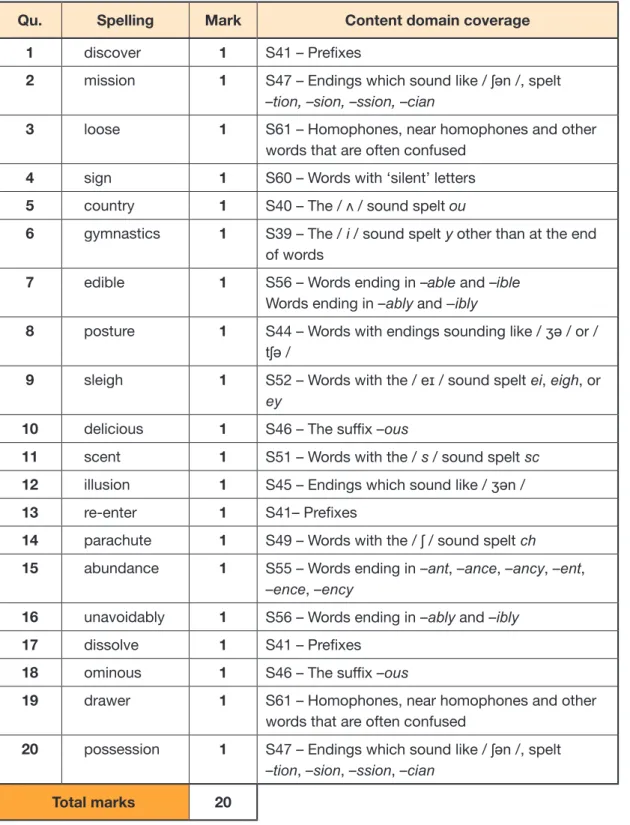
Table 3 sets out the content domain coverage for spellings in Paper 2. Information relating to the codes in Table 3 can be found in the key stage 2 English grammar, punctuation and spelling test framework.
Table 3: Mark schemes for Paper 2
Qu. Spelling Mark Content domain coverage
1 discover 1 S41 – Prefixes
2 mission 1 S47 – Endings which sound like / ʃən /, spelt
–tion, –sion, –ssion, –cian
3 loose 1 S61 – Homophones, near homophones and other
words that are often confused
4 sign 1 S60 – Words with ‘silent’ letters
5 country 1 S40 – The / ʌ / sound spelt ou
6 gymnastics 1 S39 – The / i / sound spelt y other than at the end
of words
7 edible 1 S56 – Words ending in –able and –ible
Words ending in –ably and –ibly
8 posture 1 S44 – Words with endings sounding like / ʒə / or /
tʃə /
9 sleigh 1 S52 – Words with the / eɪ / sound spelt ei, eigh, or
ey
10 delicious 1 S46 – The suffix –ous
11 scent 1 S51 – Words with the / s / sound spelt sc
12 illusion 1 S45 – Endings which sound like / ʒən /
13 re-enter 1 S41– Prefixes
14 parachute 1 S49 – Words with the / ʃ / sound spelt ch
15 abundance 1 S55 – Words ending in –ant, –ance, –ancy, –ent,
–ence, –ency
16 unavoidably 1 S56 – Words ending in –ably and –ibly
17 dissolve 1 S41 – Prefixes
18 ominous 1 S46 – The suffix –ous
19 drawer 1 S61 – Homophones, near homophones and other
words that are often confused
[BLANK PAGE]
Additional printed copies of this booklet are not available. It can be downloaded from www.gov.uk/government/publications.
© Crown copyright and Crown information 2015
Re-use of Crown copyright and Crown information in test materials
Subject to the exceptions listed below, the test materials on this website are Crown copyright or Crown information and you may re-use them (not including logos) free of charge in any format or medium in
accordance with the terms of the Open Government Licence v3.0 which can be found on the National Archives website and accessed via the following link: www.nationalarchives.gov.uk/doc/open-government-licence. When you use this information under the Open Government Licence v3.0, you should include the following
attribution: ‘Contains public sector information licensed under the Open Government Licence v3.0’ and where possible provide a link to the licence.
Exceptions – third-party copyright content in test materials
You must obtain permission from the relevant copyright owners, as listed in the ‘2016 sample tests copyright report’, for re-use of any third-party copyright content which we have identified in the test materials, as listed below. Alternatively you should remove the unlicensed third-party copyright content and/or replace it with appropriately licensed material.
Third-party content
These materials contain no third-party copyright content.
If you have any queries regarding these test materials contact the national curriculum assessments helpline on 0300 303 3013 or email [email protected].