Solving the Dirichlet problem constructively
D.S. BRIDGESM. MCKUBRE-JORDENS
Abstract: The Dirichlet problem is of central importance in both applied and abstract potential theory. We prove the (perhaps surprising) result that the existence of solutions in the general case is an essentially nonconstructive proposition: there is no algorithm which will actually compute solutions for arbitrary domains and boundary conditions. A corollary of our results is the non-existence of constructive solutions to the Navier-Stokes equations of fluid flow. But not all the news is bad: we provide reasonable conditions, omitted in the classical theory but easily satisfied, which ensure the computability of solutions.
2010 Mathematics Subject Classification03F60 (primary); 46S30 (secondary) Keywords: constructive analysis, Dirichlet problem, Brouwerian example, Markov’s principle, omniscience principle.
1
Introduction
It is a well-known theorem of classical mathematics that the following Dirichlet problem has a (unique) solution:
Problem 1 (The Dirichlet boundary-value problem) Given an open, bounded inte-grable setΩ inRn and a uniformly continuous boundary conditionf :∂Ω→R, find a functionusuch that
(1) ∆u=0onΩ, u(x)=f for allx∈∂Ω.
Less well-known is the fact that, despite there being existence proofs of solutions which at first sight appear to be algorithmic, the theorem has no proof which is entirely constructive—in other words, there is no algorithm which will compute solutions to the Dirichlet problem for arbitrary open, bounded, integrable domains with arbitrary uniformly continuous boundary data. Accordingly, since Dirichlet boundary value problems are a special case of the Navier-Stokes equations of fluid flow, there is no
universal algorithm that will deliver solutions for arbitrary Navier-Stokes systems.1 Working within the Bishop-style constructive mathematical framework (BISH),2 we prove this rigorously in Theorem4and Proposition9.
It is possible, however, to recover a lot of the classical theory while respecting com-putability. We also present the following positive (and perhaps more important) result, formalised in Theorem7: if the Dirichlet problem has computable weak solutions on arbitrary close internal approximations to a domainΩ⊂RN which satisfies some mild regularity conditions, then it has a (perforce unique) computable weak solution onΩ
as well.
Throughout, we use the unqualified term ‘existence’ to meanconstructive (or com-putable) existence. We assume that the reader has access to general sources on con-structive analysis, such as the pioneering reference [3] and its second incarnation [4], or the more recent presentation in [5].
2
Geometric and measure-theoretic background
When discussing a boundary-value problem in Rn for n ≥ 2, we need to take into account the geometric and measure-theoretic properties of the domain. Accordingly, we present some notions defined in [9] and [6]. First, though, we mention that a subset
Sof a metric space X islocatedif the distance
ρ(x,S)≡inf{ρ(x,y) :y∈S}
exists (i.e. is computable) for each x in X.3 Every totally bounded subset of X is located. Even ifSis not necessarily located, we write
• ρ(x,S)<r to mean that there existss∈S withρ(x,s)<r, • ρ(x,S)≥r to mean thatρ(x,S)≥r for allx∈X, and • ρ(x,S)>r to mean thatρ(x,S)≥r0 for somer0 >r.
LetS,Ωbe subsets of X. If there existsr >0 such thatx∈Ωwheneverρ(x,S)<r, then we say thatSiswell containedinΩ, and we writeS⊂⊂Ω. We define Ωto be
1The problem of proving the existence of solutions to the Navier-Stokes equations is one of
the so-calledMillennium Prize Problemsposed by the Clay Mathematics Institute; see [13].
2For all practical analytic purposes,BISHcan be regarded as mathematics developed with
intuitionistic logic and a corresponding set- or type-theoretic framework, such as those in [1,16].
3The locatedness of every inhabited subset ofRimplies the law of excluded middle; hence
• edge coherentifx∈Ω wheneverx∈Ωandρ(x, ∂Ω)>0;
• approximated internally by compact sets if for each ε > 0 there exists a compact—that is, complete and totally bounded—set K ⊂⊂ Ω such that if
x∈Ω−K, then ρ(x, ∂Ω)< ε.
In keeping with the literature we adopt the usual conventions concerning the notation ∂Ω, Cn(Ω),Cn0(Ω), H1(Ω) and H10(Ω): Cn(Ω) is the space of real-valued functionsn
times uniformly differentiable on compact subsets ofΩ;Cn0(Ω) is the space consisting of elements ofCn(Ω) with compact support well contained in Ω; H1(Ω) is the space of square-summable functions whose weak derivatives are also in L2(Ω); and H01(Ω) is the completion ofC01(Ω) inH1(Ω).
In [6], Proposition 23 shows that ifΩ is approximated internally by located sets, then it is edge coherent; and Proposition 24 says that ifΩis edge coherent, totally bounded, and has totally bounded boundary, then it is approximated internally by compact sets. An important property applicable to an open subset of RN is thepointwise exterior cone condition: for each x ∈ ∂Ω, there exist r, θ > 0 and a right circular cone C
with vertexx, vertex angle θ, and height r such thatC∩Ω ={x}. To pass from this to the (uniform)exterior cone condition, we need the numbers r, θto be constructed independent of the point x ∈∂Ω. Proposition 3.20 of [18] shows that if Ω ⊂RN is
edge coherent, totally bounded, and satisfies the uniform exterior cone condition, then
Ωis approximated internally by compact sets.
The details of constructive integration theory are presented in [4] (Chapter 6), to which we refer the reader. However, it is convenient to present some aspects of that theory here.
Let X be a locally compact metric space, µ a positive measure on X, and L1(µ) the space of µ-integrable functions on X. By a complemented set in X we mean an ordered pair S = S1,S0 of subsets of X such that ρ(x,y) > 0 for all x ∈ S1 and
y∈S0; if the resulting characteristic function χS:S1∪S0 → {0,1}, defined by
χS(x)=
(
1 ifx∈S1
0 ifx∈S0,
is integrable, we callSanintegrable set, withmeasureµ(S)≡R
χS. We say that the
complemented setS iscompact(respectively,closed) ifS1 is compact (respectively, closed). When K is a compact subset of X, we write K for the complemented set (K,−K), where
is themetric complement of K;4 if, moreover, K is an integrable set, then we call it—or, loosely,K—anintegrable compact setinX.
We say that a compact setK⊂X isstrongly integrableif the following holds:
there exists c>0 such that for eachε >0 there existsδ >0 such that
R
f −c< ε whenever f ∈C(X), 0≤f ≤1, f(x)=1 for all x∈K,
and f(x)=0 for all x withρ(x,K)≥δ.
In that case, K is integrable, and µ(K) = c. Here is the fundamental result about approximating integrable sets by strongly integrable ones. (Note that ‘K<A’ means thatχK≤χA on a full set.)
Theorem 2 Let µ be a positive measure on a locally compact metric space X, and let A be an integrable set with positive measure. Then for each ε >0, there exists a strongly integrable compact setK such thatK<Aandµ(A−K)< ε.
The Dirichlet problem can be re-stated as:
Problem 3 (The Dirichlet problem) Given an open, bounded integrable setΩinRn andf inL2(Ω), find a functionu such that
(2) ∆u=f onΩ, u(x)=0for allx∈∂Ω,
Under reasonable conditions onf, (2) is equivalent to (1), in the sense that existence of the solution to either version entails the existence of the solution in the other; see [14, p. 131].
By aweak solutionto the Dirichlet problem (2) we mean a function uinH01(Ω) such that
(3) hu,viH1
0(Ω)≡ −
Z
Ω
∇u· ∇v=
Z
Ω
fv
for allv∈H10(Ω).
Before going into more detail, we remind the reader of some important but related issues. First is the (constructive) stability of solutions: Theorem 2 of [9] states that if
uf is the weak solution of the Dirichlet problem (2), then for all functions ginL2(Ω),
kuf −ugkH ≤γkf −gk2,
4This should not be confused with thecomplement
∼K≡ {x∈X:∀y∈K(ρ(x,y)>0)}
whereγ is the constant in Poincar´e’s inequality. From this it follows that for a given functionf inL2(Ω) the Dirichlet problem (2) has at most one weak solution.
Next, there is a group of problems which are constructively equivalent to the existence of weak solutions to (2) (for details, see [9, pp. 658–661] and [8, pp. 1159–1160]):
• The total boundedness in the L2 norm of the set
S=
v∈C10(Ω) :kvkH≤1 .
• The uniform continuity in the double norm onH10(Ω)∗of the mappingλv7→vˆ(ξ)
from S∗ to R. Here λv denotes the bounded linear functional u 7→ hu,vi on
H01(Ω).
• The locatedness ofH01(Ω) inH01(BR) for eachR>0 such thatΩ⊂⊂BR. Here,
by extending eachu ∈H01(Ω) by zero outside Ω, we regardH10(Ω) as a subset ofH01(BR) whereBR =B(0,R)⊂Rn.
While these have been identified as equivalent problems, none of these have been solved. Thus in the present paper we establish that the constructive solution toanyof these problems requires more than the usual classical hypotheses, and provide some quite reasonable constructively sufficient conditions.
3
The Dirichlet problem, classically
Associated with Problem3is theDirichlet energy functional
(4) J(u)=
Z
Ω
k∇uk2+2uf
dx.
Dirichlet’s principle states that the following two conditions are (classically) equivalent (see e.g. [17, pp. 178–179 and pp. 186–187]).
(i) The functionuis a weak solution of the Dirichlet problem (2). That is,usatisfies (3) whenever v∈H01(Ω).
(ii) The functionuminimizes the Dirichlet energy functional (4) inH01(Ω). That is,
J(u)≤J(v) wheneverv∈H01(Ω).
Minor modifications convert the classical proof of equivalence into a constructive proof. As with the equivalences identified at the end of the previous section, however, the proof remains silent on the question of how to actually compute the function u in
H10(Ω) which solves (2). Typical classical approaches to finding a u which satisfies either condition proceed along these lines:
(i) Define a bounded linear functionalϕonH01(Ω) by ϕ(v) :=−
Z
Ω
vf dx
and apply the Riesz Representation Theorem to find an elementuofH10(Ω) such that
φ(v)=hu,vi
for allv inH01(Ω); then usolves the Dirichlet problem.
(ii) Construct a minimizing sequence for the functional J, the infimum of which is guaranteed to exist by the least upper bound principle; then use (weak) sequential compactness to extract a (weakly) convergent subsequence, the limit of which solves the Dirichlet problem.
Constructively, (i) will not guarantee a solution to the Dirichlet problem, since the representability of ϕ is constructively equivalent to its normability. That is, ϕ can be represented only if its norm can be (explicitly) computed. The reason (ii) will not work constructively lies in the application of the least upper bound principle and the sequential compactness argument, as neither of these are provable using only constructive methods. See [8] for details.
4
Any general method must go constructively wrong
In this section we prove that the existence of a weak solution of the general Dirichlet problem for a domainΩ⊂R2cannot be proved constructively. To make the following examples easier to follow, we return to the version (1) from the introduction.
Still working withinBISH, we remind the reader of two important principles:Markov’s principle,
MP: For each binary sequence (an)n≥1, if it is impossible that an = 0
for alln, then there exists n such thatan=1,
and thelimited principle of omniscience,
LPO: For each binary sequence (an)n≥1, eitheran =0 for all n, or else
there existsn such thatan=1.
Markov’s principle is consistent with (though not included in)BISH, is commonly employed in recursive constructive mathematics (essentially,BISHplus the Church-Markov-Turing thesis and Markov’s principle—see [15]), but, with the aid of Brouwer’s
theory of the creating subject (see [11]) is provably false in intuitionistic mathematics. On the other hand,LPO(which clearly impliesMP) is recursively and intuitionistically false, and is regarded as essentially nonconstructive.
We are aiming for this result:
Theorem 4 The following are equivalent overBISH. (i) LPO.
(ii) Markov’s principle holds, and for every totally bounded, Lebesgue integrable, open subset Ω of RN, and every uniformly continuous function f :∂Ω→ R, the Dirichlet problem has a weak solution in H01(Ω).
Before proving this, though, we put on record a simple, but useful, preliminary propo-sition, and describe a key construction that we use in the proof:
Proposition 5 LPO`IfSis a countable subset ofR, then eitherSis bounded above or else it is unbounded above (that is, for eachc>0, there exists x∈S withx >c). Moreover, ifSis bounded above, then supS exists.5
Proof Let f be a mapping of N+ onto S. Given α, β ∈ R, construct a binary sequence λ ≡ (λn)n≥1 such that if λn = 0, then f(n) < β, and if λn = 1, then
f(n) > α. ApplyingLPOto λ, we see that either f(n) < β for all n or else there existsnsuch thatf(n)> α.
Without loss of generality, we may assume thatf(1) >1. Setting µ1 =0, construct a binary sequence µ ≡ (µn)n≥1 such that for n ≥ 2, if µn = 0, then there exists m
such thatf(m)>n, and ifµn=1, thenf(m)<n+1 for allm. ApplyingLPOtoµ,
we see that eitherSis unbounded above or else it is bounded above. In the latter case, noting the first paragraph of this proof, we see from the constructive least-upper-bound principle ([5], Theorem 2.1.18) that supSexists.
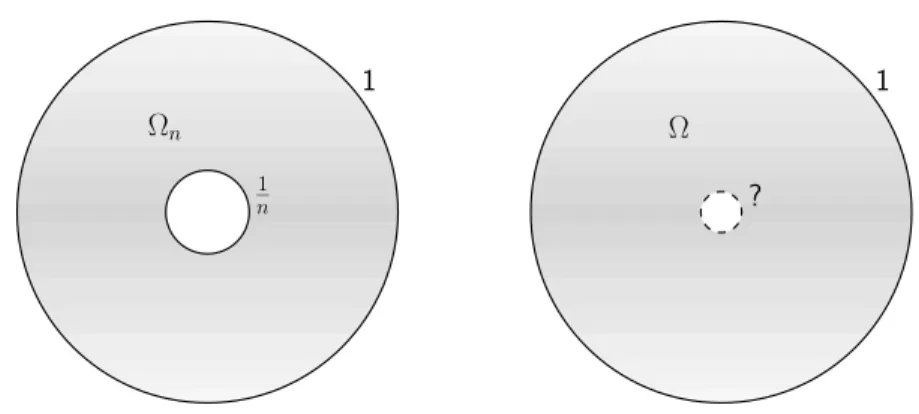
The following lemma embodies our key construction for the proof of Theorem4. Lemma 6 Let (an)n≥1 be an increasing binary sequence witha1 =0. Let Dbe the open unit disc inR2, and for each positive integern define
Tn ≡
x∈R2 : 1
n <kxk<1
.
5It follows that, in contrast to the classical least-upper bound principle for arbitrary inhabited,
bounded subsets ofR, which is equivalent, overBISH, to the full law of excluded middle, the same principle for countable subsets is equivalent toLPO.
Ifan=0, set Ωn ≡D; ifan=1−an−1, setΩk ≡Tn for allk≥n. Define
Ω =
\
n≥1
Ωn
◦
. ThenΩis totally bounded, located and integrable.
Proof First we prove that Ωis totally bounded and hence located. Observe that for each n, Ωn is totally bounded and Ωn+1 ⊂ Ωn, and that if an = 0, then Tn ⊂ Ω.
Given ε > 0, compute a positive integer N > 1/ε. If a2N = 1, then Ω = Ωm for
some m ≤ N, so we can certainly construct a finite ε-approximation to Ω. On the other hand, if a2N = 0, thenT2N ⊂Ω, and we construct a finite ε/3-approximation
{x1, . . . ,xn} to T2N. Given x ∈ Ω, we have either kxk >1/2N or kxk < 1/N. In
the former case, x ∈ T2N, so we can choose k ≤ n such that kx−xkk < ε/3 < ε.
In the casekxk<1/N, we haveρ(x,T2N) <2/3N <2ε/3; choosingy ∈T2N with
kx−yk <2ε/3, and then k≤n such thatky−xkk< ε/3, we obtain kx−xkk< ε.
Thus {x1, . . . ,xn} is a finite ε-approximation to Ω. Since ε > 0 is arbitrary, we
conclude thatΩis totally bounded (and thus located).
To show thatΩis integrable, first observe that for eachn, Ωn is integrable. Construct
the sequence of real numbers (In)n≥1such thatIn=
R
χΩn for eachn. Now form≥n, kIn−Imk=
Z
χΩm −
Z χΩn
≤ π n2
and so (In) is a Cauchy sequence and converges to a limit I. A corollary of the
constructive Lebesgue series theorem (a consequence of [4, Ch. 6 (2.17)]) now informs us thatΩis integrable and has measure limn→∞RχΩn.
Figure1illustrates this construction.
Turning back to the Dirichlet problem, we give theproof of Theorem4:
Proof First assumeLPOand consider the Dirichlet problem (1) withΩ⊂RN totally
bounded, Lebesgue integrable, and open, and withf :∂Ω→Runiformly continuous. SinceLPOimpliesMP, it will suffice to prove that this Dirichlet problem has a weak solution; we base the argument on the Ritz-Galerkin method (see Chapter 9 of [2]). Let (en)n≥1 be an orthonormal basis of H01(Ω), and for each n let Hn be the finite-dimensional subspace of H10(Ω) spanned by {e1, . . . ,en}. Define a linear functional
φonH01(Ω) by
φ(v)≡ −
Z
Ω
1 1 n Ωn 1 ? Ω
Figure 1: The domainΩn (left) whenan=1−an−1, used in the construction from Lemma6; and the domainΩ(right), formed by intersecting theΩn.
Standard estimates, using the H¨older and Poincar´e inequalities [12] (Chapter 5, Theo-rem 3), yield
(5) kφ(v)k ≤γkfk2kvkH1
0(Ω) v∈H
1 0(Ω)
,
where γ is the constant in Poincar´e’s inequality. Thus the linear functional φ is bounded. For each n, since Hn is finite-dimensional, the restriction of φ to Hn is
normed:6 that is,
φ|H
n
≡sup{kφ(v)k:v∈Hn}
exists; moreover (recall (5)) φ|H
n
≤
φ|Hn+1
≤γkfk2. It follows from this and Proposition5that
σ≡supφ|H
n
:n≥1 = lim
n→∞ φ|H
n
exists. We show that φis normed, withkφk=σ. LetPn be the projection of H01(Ω)
ontoHn. For eachv∈H10(Ω),
φ(v)= lim
n→∞φ(Pnv)≤nlim→∞ φ|H
n
kvkH1
0(Ω)=σkvkH01(Ω).
On the other hand, givenε > 0 and choosingn such that 0≤σ−φ|H
n
< ε, we can find a unit vectorv∈Hn such that
φ|H
n
−ε <kφ(v)k ≤ φ|H
n
.
6The statementevery bounded linear functional on an infinite-dimensional Hilbert space is
normedimpliesLPO. The Riesz representation theorem for linear functionals applies if and only if the functional is not just bounded, but normed ([5], Theorem 4.3.6).
Then
0≤σ− kφ(v)k=σ− φ|H
n
+
φ|H
n
− kφ(v)k<2ε.
Sinceε >0 is arbitrary, we conclude thatkφkexists and equalsσ. We are now able to apply the (constructive) Riesz representation theorem ([5], Theorem 4.3.6), to produce
w∈H01(Ω) such that for eachv∈H01(Ω),
−
Z
Ω
vf =φ(v)=hv,wiH1 0(Ω).
The function w is therefore the sought-after weak solution of the Dirichlet problem. Hence (i) implies (ii).
Suppose, conversely, that (ii) holds, and consider the Dirichlet problem (6) ∆u=0 onΩ,u(x)=logkxkfor eachx∈∂Ω.
where Ω is the domain from Lemma 6. Since (0,0) ∈/ ∂Ω and we are assuming Markov’s principle, for each x ∈ ∂Ω we have kxk > 0 and therefore logkxk well-defined. We show that the function f : x logkxk is uniformly continuous on ∂Ω. Let x,x0 ∈ ∂Ω be such that kx−x0k <1/2. Either min{kx,k kx0k} >1/2 or min{kx,k kx0k} <1. In the first case we must have kxk =kx0k =1, so logkxk =
logkx0k =0. In the case min{kx,k kx0k} <1, we may assume thatkxk <1; since (as we observed above)kxk>0, there exists N >2 such thatΩ = ΩN, kxk=1/N,
and thereforekx0k<kxk+1/2<1. Hencekx0k=1/N =kxk. Thus if x,x0 ∈∂Ω
andkx−x0k<1/2, thenf(x)=f(x0).
If an = 0 for all n, then our Dirichlet problem has the unique (weak and strong)
solutionu(x)=0 for allx∈Ω, andRΩu2=0. Ifan=1−an−1 for somen, then (6) has the unique (weak and strong) solutionu(x)=logkxkfor all x∈Ω, and, with the usual polar coordinatesr andθ,
Z
Ω
u2=
Z Z
Ω
r(logr)2drdθ
=π
1 2 −
1
n2log 21
n +
1
n2 log 1
n −
1 2n2
.
Moreover, the last expression is an increasing function ofn that converges to π/2 as
n→ ∞, and in the case n=2 is larger than 1/4. Assume that the Dirichlet problem (6) has a weak solutionw∈L2 Ω. Then eitherRΩw<1/4 orRΩw>0. In the first case, we must have an = 0 for all n; in the second, it is impossible that an = 0 for
all n, so, by Markov’s principle, there exists n such thatan =1. This completes the
5
Constructing a weak solution
In this section we examine the Dirichlet problem. Specifically, in this section we provide conditions that ensure the existence of a weak solution of (2): that is, an elementuof the Hilbert spaceH01(Ω) such that7
hu,viH1
0(Ω) ≡ −
Z
Ω
∇u· ∇v=
Z
Ω
fv v∈C10(Ω).
We call a subsetΩ ofRN aWang domainif it has the following properties: (i) It is edge coherent, totally bounded, and open inRN.
(ii) ∂Ωis compact.
(iii) The complemented setΩΩΩ≡(Ω,−Ω), is Lebesgue integrable, and the divergence theorem applies to it and∂Ω.
(iv) There existsc0>0 such that if (∂Ω)r≡
x∈Ω:ρ(x, ∂Ω)≤r
is integrable, then for eachu in (7)
Z
(∂Ω)r
kuk2≤c0r2 Z
(∂Ω)r
k∇uk2 u∈H01(Ω).
Notice that conditions (i)–(iii) are classically trivial, in the sense that, using classical logic, any bounded domain is easily seen to satisfy them. Yet they yield important computational information: (i) and (ii) embody information about the boundary (clas-sically taken for granted), and (iii) holds as a consequence of the (classical) divergence theorem. Condition (iv) is an inequality which provides information about the norm of candidates for the solution (elements of H01(Ω)); it asserts that the average value ofkuk2 in a band of width r about ∂Ω tends to zero with r and is motivated by the classical theory (see e.g. [17, p. 199, Theorem 6]). These conditions are easily seen to hold classically for domains with located boundary, so examples abound: the unit ball inRn is the canonical example.
Theorem 7 LetΩbe a Wang domain inRN, and letf ∈L2(Ω)(relative to Lebesgue measure µ on Ω). Suppose that there exists a sequence (Ωn)n≥1 of edge coherent, totally bounded, open subsets ofΩ, each having compact boundary, such that for each
n,
7We assume that the reader is familiar with, or has access to, the definition and basic
B Ωn ⊂⊂Ωn+1,
B Ωn and∂Ωn are Lebesgue integrable, withµ(∂Ωn)=0,
B maxρ Ωn,Ω
, ρ(∂Ωn, ∂Ω) →0asn→ ∞, and
B the Dirichlet problem
(8) ∆u=f onΩn, u(x)=0for allx∈∂Ωn
has a weak solutionun inH01(Ωn).
Then the sequence (un)n≥1 converges in H10(Ω) to a weak solution of the Dirichlet problem(1)).
Proof According to [7] (or Lemma 6 of [9]), there existsκ >0 such that ifK ⊂RN is a compact set and ε >0, then there exists aC∞ cutoff functionη :RN → [0,1] such thatη(x)=1 for allx∈K,η(x)=0 wheneverρ(x,K)≥ε, andk∇η(x)k ≤κ/ε for allx∈RN. For convenience, ifr>0, we write
Kr ≡
x∈RN :ρ(x,K)≤r .
Fix ε > 0, and choose t >0 such that if S is an integrable set with µ(Ω−S) <t, then
Z
Ω−S
k∇uk2< 2ε 2 9 1+25c0κ2
. As in the proof of Theorem 3 of [9], we can findδ >0 such that
K ≡
x∈Ω:ρ(x,∼Ω)≥5δ
is compact and integrable,µ(Ω−K)<t, and K2δ ⊂⊂Ωn whenever
maxρ Ωn,Ω
, ρ(∂Ωn, ∂Ω) < δ.
Construct aC∞ functionα:RN →[0,1] such that α(x)=0 for allx∈K, α(x)=1 for allx∈ −Kδ, and k∇α(x)k ≤κ/δ for allx∈RN. Then computeN such that
maxρ Ωn,Ω
, ρ(∂Ωn, ∂Ω) < δ (n≥N).
Given n ≥N, set w≡ un−uN. Then, by similar arguments to ones in the proof of
Theorem 3 of [9],
Z
ΩN
∇w· ∇(w−αun)=0
and hence 4
Z
ΩN
k∇wk2 ≤9 Z
Ωn−K
k∇uk2+9κ
2 δ2
Z
Ωn−K kunk2.
We also get
Ωn−K⊂Ω−K⊂Ω∩K5δ.
Sinceµ(∂Ωn)=0 andu=0 on−Ωn, we see from (7) that
Z
Ωn−K
kunk2=
Z
(∂Ω)5δ
kunk2 ≤25c0δ2 Z
Ω−K
k∇uk2. Hence
4 Z
ΩN
k∇un−uNk2=4
Z
ΩN
k∇wk2 ≤9 1+25c0κ2
Z
Ω−K
k∇uk2. Sinceµ(Ωn−K)<t, it follows that
Z
ΩN
k∇un− ∇uNk2<
ε2 2. Also,K⊂ΩN and thereforeµ(Ω−K)<t; whence
Z
Ω
k∇un− ∇uNk2=
Z
Ω−ΩN
k∇uk2+
Z
ΩN
k∇un− ∇uNk2
< ε 2 2 +
ε2 2 =ε
2
and thereforekun−uNkH1
0(Ω)< ε.
We now see that kum−unkH1
0(Ω) < 2ε whenever m ≥ n ≥ N. Thus (un)n≥1 is a
Cauchy sequence in the complete spaceH01(Ω). Let ube its limit. Given v∈C01(Ω), we compute
Z
Ω
∇un· ∇v=
Z
Ωn
∇un· ∇v+
Z
Ω−Ωn
∇un· ∇v
=−
Z
Ωn fv+
Z
Ω−Ωn
∇un· ∇v
=−
Z
Ω
fv+
Z
Ω−Ωn fv+
Z
Ω−Ωn
∇un· ∇v.
LetLbe a compact support ofvwell-contained inΩ. Computen1such thatL⊂⊂Ωn1.
Thenv=∇v=0 throughout Ω−Ωn1, so
Z
Ω−Ωn fv=
Z
Ω−Ωn
∇un· ∇v=0 (n≥n1). Thus
hu,viH1
0(Ω) =nlim→∞hun,vi=nlim→∞ Z
Ω
∇un· ∇v=−
Z
Ω
fv.
Since v∈C01(Ω) is arbitrary, we conclude that uis the weak solution of the Dirichlet problem (1).
Typical domains involving applications (such as the unit ball, unit cube, etc.) often satisfy the conditions of Theorem7. The paper [10] shows that Green functions can be effectively constructed for a large class of domains, and hence on such domains the Dirichlet problem admits a constructive solution.
We now turn to some properties of the counterexample presented in Lemma6.
6
Revisiting the Brouwerian example in Lemma
6
Recall that we already have established the locatedness and integrability of the setΩ
constructed in Lemma6. We now outline proofs of some properties of this domain. (a) The domain Ωsatisfies a pointwise exterior cone condition, but if it satisfies a
uniform one, then
(9) ∀n(an =0)∨ ¬∀n(an=0).
Since for each x ∈ ∂Ω, either kxk > 1/2 or 0 < kxk < 1, we easily show that Ω
satisfies the pointwise exterior cone condition. But ifΩ satisfies theuniformexterior cone condition, thenLPOholds. To see this, pickr, θ >0 such that for eachx∈∂Ω, there exists a right circular cone with vertex x, vertex angleθ, and heightr such that
C∩Ω ={x}; then compute a positive integer N > 1/2r. Then it is impossible that
an=1−an−1 for somen≥N, so ifaN =0, thenan =0 for alln.
It should be noted that classically the domainΩdoessatisfy the exterior cone condition. (b) The domainΩis edge coherent.
To see this, first note that Ωn is edge coherent for each n. Given x ∈ Ω with
ρ(x, ∂Ω) > 0, pick r such that 0 < r < min 14, ρ(x, ∂Ω). Either x 6= 0 or
kxk < r/2. In the first case, pick a positive integer N > 1/kxk. If aN = 0, then
x ∈ ΩN ⊂ Ω. If aN = 1, then there exists m ≤ N such that x ∈ Ωm = Ω. In
the case kxk <r, for each y ∈ ∂Ω we have kyk ≥ kx−yk − kxk > r/2; whence ρ(0, ∂Ω) ≥ r/2. Computing an integer m > 2/r, we see that if an = 1−an−1 for somen ≥ m, then Ω = Ωn andρ(0, ∂Ω) = 1/n < r/2, a contradiction. It follows
that if am =0, then an =0 for all n; whence Ω = D, and so x ∈Ω. On the other
hand, if am = 1, then Ω = Ωn for some n ≤ m, again Ω is edge coherent, and so
x∈Ω.
Suppose that Ω is approximated internally by compact sets. Choose a compact set
K⊂⊂Ω such that ifx∈Ω−K, then ρ(x, ∂Ω)<1/4, and computer >0 such that if ρ(x,K) ≤ r, then x ∈ Ω. Either r > δ ≡ρ((0,0),K), in which case (0,0) ∈Ω
and we must havean =0 for all n, or else, as we suppose, δ > 0. Now pick y∈K
such thatkyk< δ+r, and set
z≡ δ
δ+ry.
Thenkzk< δ, soρ(z,K)>0; also,
ρ(z,K)≤ kz−yk<r,
soz∈Ω. It follows that ρ(z, ∂Ω)<1/4. Now choosew∈∂Ωsuch thatkz−wk< 1/4. If kwk < 1, then it is impossible that an = 0 for all n. If kwk > 3/4, then
kzk > 1/2 and therefore δ >1/2. Suppose that aN = 1−aN−1 for some N >4; then Ω = ΩN. Since δ > 1/2, we can find ζ ∈ −K with 1/2 <kζk< 3/4. Then
ζ ∈ Ω−K, so there exists v ∈ ∂Ω with kζ−vk < 1/4 and therefore kvk < 1. Thus kvk =1/N < 1/4, which is absurd since kζk >1/2. We conclude from this contradiction thatan =a4for alln≥4. It follows that in both our cases, eitheran=0
for allnor it is impossible that an=0 for all n.
(d) If ∂Ωis totally bounded, then(9)holds.
We have already remarked, in the introduction, that if Ω is edge coherent and totally bounded, and has totally bounded boundary, then it is approximated internally by compact sets. It follows from (b) and (c) that if ∂Ω is totally bounded, then either
an=0 for all nor else it is impossible thatan=0 for alln.
(e) Although Ωis located, if∂Ωis located, then(9)holds.
Indeed, suppose that∂Ωis located; then either ρ 14,0, ∂Ω
>1/4, in which case
an = 0 for all n, or else ρ 14,0
, ∂Ω < 1/2, in which case it is impossible that
an=0 for all n.
(f) If
(∂Ω)r ≡
x∈Ω:ρ(x, ∂Ω)≤r is integrable, then(9)holds.
If (∂Ω)r is Lebesgue integrable then since {x ∈ R2 : kxk = 1} ⊂ ∂Ω, (∂Ω)r has
positive measure. Chooserandεsuch that 0<r≤1/8 andε < πr2/4. By Theorem 2, there exists an integrable compact setK⊂(∂Ω)r such that
As K is compact, it is located. First, observe that the unit circle is in ∂Ω (and the measure of that component of (∂Ω)r is 4πr); call this component of ∂Ω the outer
component. Call any other component of∂Ω, if there is one, theinnercomponent. Now eitherρ(0,K) > r orρ(0,K) < 2r. If ρ(0,K) > r, then there exists a positive integer N such that 1/r < N < 2/r. Suppose that there exists some n ≥ N such thatan =an−1−1. Then there is an inner component of ∂Ω closer to 0 than 1/N. The measure of the corresponding inner component of (∂Ω)ris at least πr2, and so by
(10) and our choice of εthere must be a corresponding inner component ofK. Since
N>1/r andan=0 for all n<N, we have
x:kxk< 1
N
⊂(∂Ω)r.
SinceN <2/r,
µ
x:kxk< 1
N
= π
N2 > πr2
4
and so ρ(0,K) ≤ 1/N < r, a contradiction; hence if an = 0 for each n ≤ N, then
an =0 for alln. On the other hand, ifρ(0,K) <2r≤1/4, then it is impossible that
an=0 for all n.
We see from comments (a) and (c)–(f) that in each case, if a certain property holds
no matter what binary sequence (an)n≥1 is used to define Ω, then we can derive the following:
WLPO: For each binary sequence (an)n≥1, eitheran=0 for all nor it
is impossible thatan =0 for alln.
a lesser version of LPO. We can move from WLPO to the stronger omniscience propertyLPOin these situations if we allow ourselves the use of Markov’s principle; since we made use ofMPin the proof of Theorem4, its further application here is not entirely without warrant. However, forgoingMPin (a) and (c)–(f) shows that each of the properties ofΩin question is genuinely nonconstructive.
(g) Assuming Markov’s principle, we may compute a compact subset K∞ofΩsuch
that
(11) ∂Ω ={x:kxk=1} ∪ K∞− {0}.
Moreover, K∞− {0} is inhabited if and only if an =1for some n.
To prove this, first observe that ∂Ω ={x:kxk=1} ∪
Ifan=0, setKn={0}; ifan=1−an−1, set
Kj =
x:kxk=n−1 (j≥n).
Then each Kn is compact, and ρ(Km,Kn) ≤ n−1 whenever m ≥ n, where ρ is the
Hausdorff metric. Since the set of all compact subsets of the compact space D is complete relative to the Hausdorff metric ([3], page 109, Exercise 12), there exists a compact set K∞ ⊂ D such that ρ(Kn,K∞) → 0 as n → ∞. In fact, we have ρ(K∞,Kn)≤n−1 for each n. Now, given x∈∂Ωand assuming Markov’s principle,
we have x 6= 0 and so we can pick a positive integer N > kxk−1. If aN = 0, then
kxk=1; ifaN =1, then there existsν ≤N such thataν =1−aν−1,K∞−{0}=Kν,
andkxk=ν−1; whencex∈K∞−{0}. Conversely, ifkxk=1, thenx∈∂Ω; whereas ifx∈K∞− {0}, then we easily show that there existsn withK∞=Kn⊂∂Ω. This
completes the proof of (11). It is a simple exercise to prove thatK∞− {0}is inhabited if and only if there existsnwith an=1.
(h) The divergence theorem, suitably tweaked, holds for uniformly continuous func-tions on Ω.
In order to make sense of the divergence theorem in the context of the proof that (ii) implies (i) in Theorem4, we need to be able to construct the appropriate measure for integrals over ∂Ω. Here we have a clear difficulty, since measures are defined for locally compact spaces, and local compactness for ∂Ω is equivalent to locatedness, which runs afoul of (d) above. However, we can still act as if we knew the exact position of∂Ω, as follows. Letu:Ω→Rbe uniformly continuous and let kuk ≤c, wherec>0. If an=0, defineIn≡0. If an=1−an−1, then, referring to (f) above, we see thatK∞=Kn, and we define
Im≡
1
n
Z
kxk=1/n
u(x) dθ(x) (m≥n),
whereθ(x) is polar measure on the circle. We obtain the inequalitykIm−Ink ≤2πc/n
for allm≥n; whence (In)n≥1 is a Cauchy sequence and therefore converges to a limit
I∞∈R. If we define Z
∂Ω
u≡
Z
kxk=1
u(x) dθ(x)+I∞,
then we obtain a real number that equals R
∂Ωu classically. Suppose that, with this
definition, (12)
Z
∂Ω
u6=
Z
Ω
Then, since the divergence theorem holds if either K∞− {0} is inhabited or else
K∞={0}, we must have
¬∀n(an=0)∧ ¬¬∀n(an =0),
which is absurd. Hence (12) is impossible and therefore, since inequality onRis tight, Z
∂Ω
u=
Z
Ω
∇ ·u.
In this sense, the divergence theorem, suitably tweaked, holds for bounded, uniformly continuous functions onΩ.
In view of (h), we should be aware that, although in the second half of the proof of Theorem4the functionu:x logkxkis defined throughoutΩ, we can neither prove it uniformly continuous, nor produce a bound for it, on Ω unless and until we know that there exists n with an = 1−an−1 (or, availing ourselves the use of Markov’s principle, unless and until we know that it is impossible thatan=0 for all n).
7
A limiting result without Markov’s principle
In Theorem4we make use of Markov’s principle. Since this principle is independent of, but compatible with,BISH, the natural question is of course what we may recover without this principle. The following construction and the propositions that follow it shed some light on the limitations that face us.
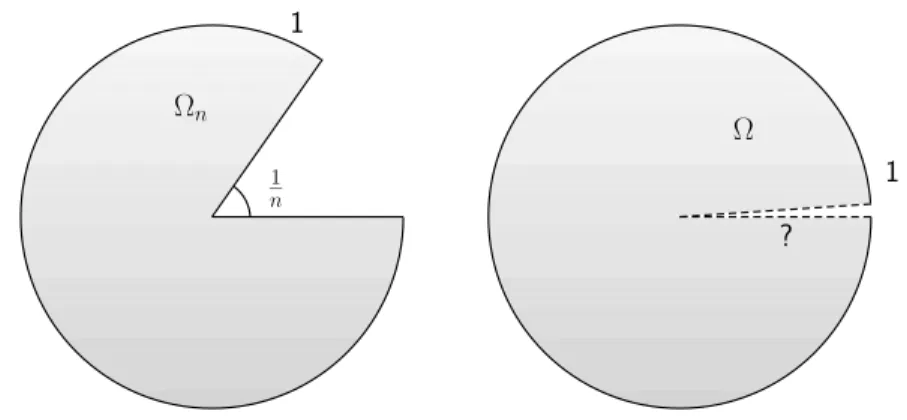
Lemma 8 Let (an)n≥1 be a binary sequence. LetD be the open unit disc inR2 and for each positive integerndefine
Pn=
x∈R2:kxk<1∧0≤argx≤ 1 n
where argx is the argument of x when x is given in the usual polar coordinates. If
an=0, then set Ωn≡D. Ifan =1, then set Ωn≡D\Pn. Note that for each n, Ωn
is totally bounded. Define
Ω =
\
n≥1
Ωn
◦
.
Proof We show that Ω is totally bounded, using an argument similar to that from Lemma6. Given ε >0, choose a positive integerN >3/ε. Either there is a (least)
m≤N such thatam=1 oram=0 for eachm≤N. In the former case, Ω = Ωm and
an ε-approximation to Ωm is also an ε-approximation to Ω. In the latter case, note
thatΩN ⊂Ωand choose a finiteε/3-approximation {x1,x2, . . . ,xn}toΩN. Consider
x ∈ D. Either |argx| >1/N or |argx|< 2/N. In the first case, x ∈ ΩN, so there
existsiwithkx−xik< ε. In the second case,
ρ(x,ΩN)<sin
2
N
< 2
N <
2ε 3 ,
so, choosingy∈ΩN so thatkx−yk ≤2ε/3 andisuch thatky−xik< ε/3 we have
kx−xik < ε. Hence {x1,x2, . . . ,xn} is a finite ε-approximation to D with points
fromΩN ⊂Ω; therefore, sinceΩ⊂D, it is anε-approximation toΩ.
A proof analogous to that in Lemma6shows that, like the annular domain constructed there, this domain is integrable.
The construction is illustrated in Fig.2.
1 n
1 Ωn
?
1 Ω
Figure 2: The domains Ωn (left) when an = 1, and the domain Ω (right), constructed in
Lemma8.
Proposition 9 If for every totally bounded, Lebesgue integrable, open subset Ω of Rn, and every uniformly continuous function f :∂Ω→ R, the Dirichlet problem has
a strong solution inH20(Ω), then WLPOholds.
Proof LetΩbe as in Lemma8. Suppose that the Dirichlet problem
has a strong solution on Ω (it is not difficult to see that the mappingx 1− kxk is uniformly continuous on ∂Ω). Then we may determine whether u(0) <1, in which case 06∈ ∂Ω and an = 0 for all n, or u(0) > 0, in which case it is impossible that
an=0 for all n; thusWLPOholds.
This leads us to the observation that the integrability of the boundary of an integrable domain is essentially nonconstructive, as embodied by the following result:
Proposition 10 If every open, Lebesgue integrable domain in Rn has an integrable boundary, thenWLPOholds.
Proof Let Ω be as in Lemma8; so Ω is integrable. Without loss of generality, let
a1=0. Suppose that∂Ωis integrable. Either R
∂Ωdx<2π+1, in which casean=0
for alln(and in factΩ =D), or elseR∂Ωdx>2π and it is impossible thatan =0 for
alln.
Note that, like the domain from Lemma 6, the domain Ω from Lemma 8 has the following properties. The proofs require only minor modifications, though without the use of Markov’s principle; see the discussion following comments (c)–(f) on pages 14–16.
(a0) The domain Ωsatisfies a pointwise exterior cone condition, but if it satisfies a uniform one, then(9)holds.
(b0) The domainΩis edge coherent.
(c0) If Ωis approximated internally by compact sets, then(9)holds.
(d0) If ∂Ωis totally bounded, then(9)holds.
(e0) Although Ωis located, if∂Ωis located then(9)holds.
(f0) If (∂Ω)r is integrable, then(9)holds.
(h0) The divergence theorem, tweaked as per comment(h)above, holds for uniformly continuous functions on Ω.
Thus if, in any of (a) and (c)–(f), the relevant property holds independently of the binary sequence (an)n≥1 used to defineΩ, thenWLPOis derivable inBISH.
One of the reservations that applied to the annular domain from Lemma6concerning the divergence theorem applies here too: with the boundary condition functionf :x
1− kxk, we cannot necessarily produce candidate functions for the solution. However, any candidate solution functionuis certainly bounded.
It remains an open question whether the existence of weak solutions suffice for the conclusion of Proposition9. Further, Proposition9leaves open the question whether WLPO issufficient to construct solutions to the Dirichlet problem. We conjecture that the existence of solutions to Dirichlet-type problems requires strong computability conditions on the boundary such as its locatedness (which condition is classically trivial). SinceWLPOis not sufficient to locate sets inRn in general, it is unlikely that it would be sufficient for existence of solutions to the Dirichlet problem.
Finally, since solutions to the Dirichlet problem are solutions to a special case of the Navier-Stokes equations of fluid flow, we have the following corollary, indicating that any proof of existence of solutions to these equations will have to be non-constructive. Corollary 11 There is no universal algorithm for computing solutions to the classical Navier-Stokes equations of fluid flow with arbitrary boundary conditions.
Acknowledgement. The authors would like to thank the anonymous referees for constructive comments on drafts of the paper. This work was partially carried out while the second author was a Postdoctoral Fellow supported by the Department of Mathematics & Statistics, at the University of Canterbury, Christchurch, New Zealand.
References
[1] P. Aczel and M. Rathjen,Notes on Constructive Set Theory, Report No. 40, Institut Mittag-Leffler, Royal Swedish Academy of Sciences, 2001; available athttp://www. ml.kva.se/preprints/archive/2000-2001/2000-2001-40.pdf.
[2] K.E. Atkinson and Han Weimin,Theoretical Numerical Analysis: A Functional Anal-ysis Framework, Texts in Applied Mathematics39, Springer Verlag, Heidelberg, 2009. [3] E.A. Bishop,Foundations of Constructive Analysis, McGraw-Hill, New York, 1967. [4] E.A. Bishop and D.S. Bridges,Constructive Analysis, Grundlehren der math. Wiss.
279, Springer Verlag, Heidelberg, 1985.
[5] D.S. Bridges and L.S. Vˆıt¸˘a,Techniques of Constructive Analysis, Universitext, Springer New York, 2006.
[6] D.S. Bridges, F. Richman and Wang Yuchuan, Sets, complements and boundaries, Proc. Koninklijke Nederlandse Akad. Wetenschappen (Indag. Math.) 7(4), 425–445, 1996; doi: 10.1016/S0019-3577(97)89131-8.
[7] D.S. Bridges and Wang Yuchuan, Constructing cutoff functions,New Zealand J. Math. 26, 25–30, 1997.
[8] D.S. Bridges and Wang Yuchuan, Constructive aspects of the Dirichlet problem,J. Univ. Comp. Sci.3(11), 1148–1161, 1997; doi: 10.3217/jucs-003-11-1148.
[9] D.S. Bridges and Wang Yuchuan, Constructive weak solutions of the Dirichlet problem, J. London Math. Soc. (2)57, 655–667, 1998; doi:10.1112/S0024610798006243. [10] Y.K. Chan, Constructive foundations of potential theory,Pacific J. Math.71(2) 405-418,
1977; doi: 10.2140/pjm.1977.71.405.
[11] M.A.E. Dummett,Elements of Intuitionism(second edition), Oxford Logic Guides39, Clarendon Press, Oxford, 2000.
[12] L.C. Evans,Partial Differential Equations, Grad. Studies in Math. 19, Amer. Math. Soc. Providence, RI, 1998.
[13] C.L. Fefferman,Existence and smoothness of the Navier-Stokes equation, Clay Math-ematics Institute, http://www.claymath.org/millennium/Navier-Stokes_ Equations/navierstokes.pdf.
[14] F. John,Partial Differential Equations, (third edition), Applied Mathematical Sciences 1, Springer-Verlag, Heidelberg-Berlin-New York, 1971.
[15] B.A. Kushner, Lectures on Constructive Mathematical Analysis, Amer. Math. Soc., Providence RI, 1985.
[16] P. Martin-L¨of, Intuitionistic Type Theory, Notes by G. Sambin, Bibliopolis, Napoli, Italy, 1984; available at http://www.cs.cmu.edu/afs/cs/Web/People/crary/ 819-f09/Martin-Lof80.pdf.
[17] J. Rauch,Partial Differential Equations, Grad. Texts in Math.128, Springer Verlag, Heidelberg, 1991.
[18] Wang Yuchuan, Constructive Analysis of Partial Differential Equations, D.Phil. thesis, University of Waikato, Hamilton, New Zealand, 1996; http:// waikato.lconz.ac.nz/vwebv/holdingsInfo?bibId=319623. Earlier draft avail-able athttp://www.math.canterbury.ac.nz/~d.bridges/theses/complete_
Wang_thesis_180213.pdf.
University of Canterbury, Christchurch, New Zealand