Liability or equity?
Important Disclaimer:
This document has been developed as an information resource. It is intended as a guide only and the application of its contents to specific situations will depend on the particular circumstances involved. While every care has been taken in its presentation, personnel who use this document to assist in evaluating compliance with International Financial Reporting Standards should have sufficient training and experience to do so. No person should act specifically on the basis of the material contained herein without considering and taking professional advice. Neither Grant Thornton International Ltd, nor any of its personnel nor any of its member firms or their partners or employees, accept any responsibility for any errors it might contain, whether caused by negligence or otherwise, or any loss, howsoever caused, incurred by any person as a result of utilising or otherwise placing any reliance upon this document.
Liability or equity?
When an entity issues a financial instrument, it must determine its classification either as a liability (debt) or as equity. That determination has an immediate and significant effect on the entity’s reported results and financial position. Liability classification affects an entity’s gearing ratios and typically results in any payments being treated as interest and charged to earnings. Equity
classification avoids these impacts but may be perceived negatively by investors if it is seen as diluting their existing equity interests.
Understanding the classification process and its effects is therefore a critical issue for management and must be kept in mind when evaluating alternative financing options.
IAS 32 ‘Financial Instruments: Presentation’ (IAS 32) addresses this classification process. Although IAS 32’s approach is founded upon principles, its outcomes can sometime seem surprising. This is partly because, unlike previous practice in many jurisdictions around the world, IAS 32 does not look to the legal form of an instrument. Instead, it focuses on the instrument’s contractual obligations. Identifying the substance of the relevant obligations can itself be challenging, reflecting the huge variety of instruments issued by different types of entities around the world. Moreover, these principles sometime result in instruments that intuitively seem like equity being accounted for as liabilities. As a result, the IASB has made some amendments to the Standard which depart from its core principles, further complicating the classification process.
Fortunately the member firms within Grant Thornton International – one of the world’s leading organisations of independently owned and
managed accounting and consulting firms – have gained extensive insights into the more problematic aspects of debt and equity classification under IAS 32. Grant Thornton International, through its IFRS team, develops general guidance that supports its member firms’ commitment to high quality, consistent application of IFRS. We are pleased to share these insights by publishing the second edition of ‘Liability or equity? A practical guide to the classification of financial instruments under IAS 32’ (the Guide). The Guide reflects the collective experience of Grant Thornton
International’s IFRS team and member firm IFRS experts. It addresses IAS 32’s key application issues and includes interpretational guidance in certain problematic areas. The second edition of the Guide reflects amendments that have been made to IAS 32 since the Guide was first published and our latest thinking on some of the more problematic areas of interpretation.
Sections of the Guide
The Guide is organised as follows:
• Section Agives an overview of the Guide • Section Bconsiders the basic principle of financial liability classification. It discusses contractual obligations, how they arise and their effects
• Section Clooks at those financial instruments which can be settled in an entity’s own equity instruments and considers whether they should be classified as liabilities or as equity
• Section Daddresses the 2008 amendments to IAS 32 relating to puttable instruments and obligations arising on liquidation
• Section Ediscusses compound financial instruments – instruments which possess both liability and equity components
• Section Fconsiders briefly the IASB’s potential plans for the development of a new model for liability and equity classification.
Appendices A and B set out the full definitions of ‘financial liability’ and ‘equity’ respectively. Appendices C and D discuss certain specific issues raised in the main body of the Guide in further detail.
Grant Thornton International Ltd
Introduction i
A: Overview of the Guide 1
1 Purpose of the Guide 1
2 The importance of classification as liability or equity 1
3 Overview of IAS 32 and its classification process 2
3.1 Financial instruments within the scope of IAS 32 2
3.2 The basics of IAS 32’s classification process 2
3.3 Implications of classification as either liability or as equity 4 B: What is a contractual obligation to pay cash or another financial asset? 5
1 Section overview 5
2 Contractual obligation 6
2.1 Examples of contractual obligations to pay cash or another financial asset 6 2.2 Members’ shares in co-operative entities and similar instruments 8
2.3 Contractual obligation that is not explicit 10
3 Economic compulsion 11
4 Contingent settlement provisions 12
4.1 Settlement terms not genuine 13
5 ‘Linked’ instruments 14
5.1 Dividend pushers and dividend blockers 14
6 Guarantees within a group 15
C: Instruments settled in an entity’s own equity instruments 16
1 Section overview 16
2 The ‘fixed’ test 17
3 The ‘fixed for fixed’ test 18
3.1 Own equity instruments 19
3.2 Obligations to purchase own equity instruments for cash 19 3.3 Put and call options over non-controlling interests 20
3.4 Settlement options 23
4 Problems affecting application of the ‘fixed’ and ‘fixed for fixed’ tests 23 4.1 Contracts to be settled by a fixed number of own equity instruments
in exchange for a fixed amount of foreign currency 23
4.2 Changes to the conversion ratio 24
4.3 Contingent conversion or exercise 25
D: Puttable instruments and obligations arising on liquidation 27
1 Section overview 27
2 The puttable instruments exception 28
2.1 What is a puttable instrument? 28
2.2 The conditions to be met to achieve equity classification under the Amendments 29
3 The obligations arising on liquidation exception 36
3.1 Other contractual obligations 36
3.2 No requirement to consider the expected total cash flows throughout the life
of the instrument 37
3.3 The ‘identical features’ condition 37
4 Changes in classification as a result of the Amendments 38
4.1 Non-controlling interests 38
4.2 Derivatives over puttable instruments and obligations arising on liquidation 38
E: Compound financial instruments 39
1 Section overview 39
2 Examples of compound financial instruments 39
2.1 Financial instruments with payments based on profits of the issuer 40
2.2 Convertible bonds 40
3 Split accounting for a compound financial instrument 41
4 Compound instruments containing embedded non-equity derivatives 42
5 Hybrid instruments 42
6 Conversion of a convertible bond 43
6.1 Early settlement of a convertible bond 43
6.2 Amendment of the terms of a compound instrument to induce early conversion 44
F: Future Developments 45
Appendix A: Definition of a financial liability 46
Appendix B: Definition of equity 47
Appendix C: Steps to follow in applying ‘split accounting’ to a compound instrument 48
Appendix D: Application of the fixed for fixed test 49
A. Overview of the Guide
Summary of requirements
• IAS 32 addresses the equity or liability classification of financial instruments. Certain financial instruments are scoped out of IAS 32
• classification as a financial liability or as equity depends on the substance of a financial instrument rather than its legal form. The substance depends on the instrument’s contractual rights and obligations
• a basic principle of liability classification is that a financial instrument which contains a contractual obligation whereby the issuing entity is or may be required to deliver cash or another financial asset to the instrument holder is a financial liability
• exceptions to the basic principle of classification were introduced in 2008 by the ‘Amendments to IAS 32 and IAS 1: Puttable Financial Instruments and Obligations Arising on Liquidation’
• instruments which may or will be settled in an entity’s own equity instruments are classified according to specific criteria – the ‘fixed’ test for non-derivatives and the ‘fixed for fixed’ test for derivatives
• instruments possessing the characteristics of both equity and liability classification are compound instruments. The equity and liability components are accounted for separately.
1 Purpose of the Guide
‘Liability or equity? A practical guide to the classification of financial instruments under IAS 32’ (the Guide) explains the principles for determining whether the issuer of a financial instrument should classify the instrument as a liability, equity or a compound instrument.
The Guide sets out the classification process in IAS 32 ‘Financial Instruments: Presentation’ (IAS 32) and draws out a number of practical application problems that are often encountered.
2 The importance of classification as liability or equity
Whether an instrument is classified as either a financial liability or as equity is important as it has a direct effect on an entity’s reported results and financial position.
Liability classification typically results in any payments on the instrument being treated as interest and charged to earnings. This may in turn affect the entity’s ability to pay dividends on its equity shares (depending upon the requirements of local law).
Equity classification avoids the negative impact that liability classification has on reported earnings and gearing ratios. It also results in the instrument falling outside the scope of IAS 39 ‘Financial Instruments: Recognition and Measurement’, thereby avoiding the complicated ongoing measurement requirements of that Standard.
3 Overview of IAS 32 and its classification process
To determine whether a financial instrument should be classified as debt or equity, IAS 32 uses principles-based definitions of a financial liability and of equity. In contrast to the requirements of generally accepted accounting practice in many jurisdictions around the world, IAS 32 does not classify a financial instrument between equity and financial liability on the basis of its legal form. Instead, it considers the substance of the financial instrument, applying the definitions to the instrument’s contractual rights and obligations.
Classification of financial instruments is often a challenging issue in practice. This in part reflects the many variations in the rights and obligations of instruments that are found in different types of entities and in different parts of the world. Moreover, some instruments have been structured with the intention of achieving particular tax, accounting or regulatory outcomes with the effect that their substance can be difficult to evaluate.
3.1 Financial instruments within the scope of IAS 32
IAS 32 and its classification principles apply only to financial instruments. As a result, the Standard does not deal with the classification of items within equity which are not financial instruments, such as retained earnings and revaluation reserves. Nor does it deal with the classification of non-financial liabilities.
A ‘financial instrument’ is defined under IAS 32 as:
“any contract that gives rise to a financial asset of one entity and a financial liability or equity instrument of another entity.”
Further, not all financial instruments fall within the scope of IAS 32. The Standard contains detailed scoping paragraphs which, in summary, exclude the following financial instruments from its requirements: • interests in subsidiaries, associates and joint ventures
• employers’ rights and obligations under employee benefit plans • insurance contracts as defined in IFRS 4 ‘Insurance Contracts’
• financial instruments that are within the scope of IFRS 4 because they contain a discretionary participation feature
• financial instruments, contracts and obligations under share-based payment transactions to which IFRS 2 ‘Share-based Payment’ applies.
3.2 The basics of IAS 32’s classification process
Under IAS 32, a financial instrument can be classified as a liability, as equity or as a compound instrument (an instrument which exhibits elements of both equity and liability classification, which must be accounted for separately).
An equity instrument is defined as “any contract that evidences a residual interest in the assets of an entity after deducting all of its liabilities”. Determining whether an instrument is classified as equity is therefore dependent on whether it meets the definition of a financial liability.
3.2.1 Obligations to deliver cash or another financial asset are financial liabilities
The basic principle of liability classification is that a financial instrument which contains a contractual obligation whereby the issuing entity is or may be required to deliver cash or another financial asset to the instrument holder is a financial liability. This principle is reflected in the first part of the definition of a financial liability (the full definition is set out in Appendix A) and is discussed in Section B.
3.2.2 Exceptions: Puttable instruments and obligations arising on liquidation
Exceptions to this basic principle were however introduced in 2008 by the ‘Amendments to IAS 32 and IAS 1: Puttable Financial Instruments and Obligations Arising on Liquidation’. The application of these Amendments results in equity classification for instruments which would otherwise be classified as financial liabilities in some narrowly defined cases. Section D discusses these exceptions.
Diagrammatic illustration of the classification of a financial instrument containing an obligation for the issuer to deliver cash or another financial asset
3.2.3 Instruments settled in an entity’s own equity instruments
Applying the basic principle of liability classification to instruments which may or will be settled in an entity’s own equity instruments is more complicated. Classification of these instruments is governed by the so-called ‘fixed’ test for non-derivatives, and the ‘fixed for fixed’ test for derivatives.
Under the fixed test, a non-derivative contract will qualify for equity classification only where there is no contractual obligation for the issuer to deliver a variable number of its own equity instruments. Under the fixed for fixed test, a derivative will qualify for equity classification only where it will be settled by the issuer exchanging a fixed amount of cash or another financial asset for a fixed number of its own equity instruments. The application of these rules is discussed in Section C.
No Yes
Does the contract contain an obligation for the issuer to
deliver cash or another financial asset?
Equity
Yes No
Does the instrument fall within the scope of the puttable instruments and obligations
arising on liquidation amendments?
Does the instrument contain any equity components (discretionary dividends, etc)?
Financial liability Compound
instrument (apply ‘split acounting’)
Yes No Yes No
Are the criteria in the puttable instruments and obligations
arising on liquidation amendments satisfied?
Diagrammatic illustration of the classification of a financial instrument that will be settled by issue of the entity’s own equity instruments
3.2.4 Compound instruments
Finally, some financial instruments contain both equity and liability components. These are referred to as compound instruments. IAS 32 separates a compound instrument into its equity and liability components on initial recognition, a process sometimes referred to as ‘split accounting’. The accounting for compound instruments is discussed in Section E.
For completeness, Section F of the Guide discusses possible future developments in the approach to distinguishing between financial liabilities and equity. Appendices A and B set out the current definitions of a financial liability and of equity in full.
3.3 Implications of classification as either liability or as equity
Liability classification
• instrument is within the scope of IAS 39 and is therefore measured in accordance with that Standard in future periods
• interest, dividends, losses and gains on a financial instrument classified as a financial liability are recognised as income or expense in profit or loss
• under IAS 39, any transaction costs are included in the calculation of the effective interest rate and amortised over the expected life of the instrument (or a shorter period where that is the period to which the transaction costs relate)
• presented as a liability in the Statement of Financial Position and increases the entity’s debt-equity ratio
Equity classification
• instrument is outside the scope of IAS 39 and is not generally remeasured
• distributions to holders of an equity instrument are debited by the entity directly to equity, net of any related income tax benefit
• transaction costs are accounted for as a deduction from equity, net of any related income tax benefit
• reduces the entity’s debt-equity ratio but may dilute existing owners’ equity interests
Is the contract a non-derivative or a derivative?*
Non-derivative Derivative
Fixed for fixed test: Can the derivative be settled other than by the exchange of a fixed amount of cash or another financial asset for a
fixed number of the entity’s own equity instruments?
Equity Financial liability
Yes No Yes No
Fixed test: Is, or may the entity be, obliged to deliver a
variable number of its own equity instruments?
Financial liability Equity
B. What is a contractual obligation
to pay cash or another financial asset?
Summary of requirements• a basic principle of liability classification is that a financial instrument which contains a contractual obligation whereby the issuing entity is or may be required to deliver cash or another financial asset to the instrument holder is a financial liability
• a contractual obligation may not be explicit but may be established indirectly through the terms and conditions of the instrument
• economic compulsion on its own is not enough to establish a contractual obligation. The obligation must be established through the terms and conditions of the financial instrument
• a financial instrument containing a contingent settlement provision, under which the instrument would be classified as a financial liability on the occurrence or non-occurrence of some uncertain future event beyond the control of both the issuer and the holder, will usually be classified as a financial liability unless the part of the contingent settlement provision that indicates liability classification is not genuine; or the issuer can be required to settle the obligation in cash or another financial asset only in the event of liquidation of the issuer • exceptions to the basic principle of liability classification were introduced in 2008 by the ‘Amendments to
IAS 32 and IAS 1: Puttable Financial Instruments and Obligations Arising on Liquidation’. The application of these Amendments may result in equity classification for instruments which would otherwise be classified as financial liabilities.
1 Section overview
A basic principle of IAS 32 is that a financial instrument is a liability if it contains a contractual obligation for the issuer to deliver either cash or another financial asset to the holder or to exchange financial assets or financial liabilities with the holder (see box).
A financial liabilityis defined under IAS 32.11 as: “any liability that is:
a) a contractual obligation:
(i) to deliver cash or another financial asset to another entity; or
(ii) to exchange financial assets or financial liabilities with another entity under conditions that are potentially unfavourable to the entity; or
b) …
As an exception,…”
By way of contrast, both the payment of dividends and the repayment of capital are discretionary.
Section B answers the question ‘What is a contractual obligation to deliver cash or another financial asset?’. It starts by giving common examples of ‘basic’ contractual obligations that result in liability classification. The Section goes on to consider more complex instruments such as members’ shares in co-operative entities and situations where the contractual obligation is not itself explicit.
Section B also considers the more problematic areas of: • economic compulsion
• contingent settlement provisions
• ‘dividend pushers’ and ‘dividend blockers’ • guarantees within a group.
Exceptions to the general principle that a contractual obligation to deliver cash or another financial asset results in the instrument concerned being classified as a liability are discussed in Section D.
2 Contractual obligation
IAS 32’s classification requirements look to an instrument’s contractual rights and obligations. It is therefore necessary to consider what is meant by a contract. IAS 32.13 explains that:
“ ‘contract’ and ‘contractual’ refer to an agreement between two or more parties that has clear economic consequences that the parties have little, if any, discretion to avoid, usually because the agreement is enforceable by law. Contracts, and thus financial instruments, may take a variety of forms and need not be in writing.”
Liabilities or assets that are not contractual are not financial liabilities or financial assets. For example, income tax liabilities that arise from statutory requirements imposed by governments are not within the scope of IAS 32 (but are accounted for under IAS 12 ‘Income Taxes’). Similarly, constructive obligations, as defined in IAS 37 ‘Provisions, Contingent Liabilities and Contingent Assets’, do not arise from contracts and are not financial liabilities.
2.1 Examples of contractual obligations to pay cash or another financial asset
The following sub-sections discuss common types of contractual obligation that give rise to financial liability classification under IAS 32.
2.1.1 Redeemable shares
The basic principle of IAS 32 has the effect that shares which have a fixed date for redemption, or which give the holder an option to redeem the shares at some point in time, are classified as financial liabilities1. This is because the entity is not able to avoid the obligation to pay cash upon the redemption of the shares2.
1Exceptions to this basic principle were however introduced by the publication in 2008 of ‘Amendments to IAS 32 and IAS 1: Puttable Financial Instruments
and Obligations Arising on Liquidation’ (see Section D).
2For members’ shares in co-operative entities and similar instruments, the application of this basic principle is more complicated – see Section 2.2 for details. Examples of contractual obligations to deliver cash or another financial asset to the holder
of an instrument
• redeemable shares – a fixed redemption date or redemption at the holder’s discretion typically results in liability classification (exceptions exist – see Section D)
• mandatory dividends – a contractual obligation exists where distributions on an instrument are not at the issuer’s discretion
• distributions of a specified percentage of profits – distributions are not at the issuer’s discretion where the terms and conditions of an instrument contain a formula under which a specified percentage of profits must be paid to the holder
See Section
2.1.1 2.1.2 2.1.3
Example: Shares redeemable at the holder’s option
Entity A issues 1,000 shares with a par value of Currency Unit (CU) 100 each. The holder of the shares has the option to require Entity A to redeem the shares at par at any given time.
These shares are classified as liabilities. This is because Entity A does not have the ability to avoid the obligation to redeem the shares for cash should the holder exercise his option to redeem the shares.
If the option to redeem the entity’s shares had instead been at the discretion of the issuer, the shares would have been classified as equity. In this situation, the issuer has a right to pay cash to buy back the shares but no obligation to do so.
2.1.2 Shares with mandatory dividend payments
Where shares are non-redeemable, classification will depend on the other rights attaching to them. It will often be clear from the terms and conditions attaching to an ordinary share that there is no obligation to pay cash or other financial assets, and that it should therefore be classified as equity.
The classification of preference shares may be less straightforward. IAS 32.AG26 contains specific guidance on redeemable preference shares. It clarifies that when preference shares are non-redeemable, the classification depends on a careful analysis of the other rights attaching to them. For instance, if distributions to holders of the preference shares (whether cumulative or non-cumulative) are at the discretion of the issuer, the shares are equity instruments. If distributions are mandatory the shares will be classified as financial liabilities.
Example: Mandatory dividend payments of a fixed percentage
An entity issues preference shares with a par value of CU 100 each. The preference shares are non-redeemable but require the entity to make annual dividend payments equal to a rate of 8% on the par amount. There are no equity components such as the possibility of further discretionary dividends.
The preference shares will be classified as financial liabilities, as the entity has a contractual obligation to make a stream of fixed dividend payments in the future. This means that the 'dividends' will be treated as interest payments and included as an expense in the Statement of Comprehensive Income.
2.1.2.1 Perpetual debt instruments
The non-redeemable preference shares in the above example are one type of ‘perpetual’ debt instrument. Other forms of perpetual debt instrument include some bonds, debentures and capital notes. Perpetual debt instruments normally provide the holder with the contractual right to receive payments of interest at fixed dates extending indefinitely. Holders normally have no right to receive a return of principal (although sometimes, in specified circumstances, they may).
A perpetual debt instrument which has mandatory interest payments (but no equity components) is a liability in its entirety. The value of the instrument is wholly derived from the mandatory interest payments.
2.1.3 Financial instruments with payments based on profits of the issuer
Financial instruments that include contractual obligations to make payments linked to the financial performance of the issuer are quite common. An example of such an instrument is a share that pays a specified percentage of profits of the issuer each period. The terms of the instrument usually include a definition of “profit” for this purpose. The instrument might be either redeemable or perpetual.
An obligation to pay a specified percentage of the profits of the issuer is a contractual obligation to deliver cash. Such an obligation therefore meets the definition of a financial liability (IAS 32.11(a)(i)). This is the case even if the issuer has not yet earned sufficient profits to pay any interest or dividend (see Section B.2.1.4). IAS 32 also makes clear that the ability of the issuer to influence its profits does not alter this classification (IAS 32.25 & IAS 32.AG26(f)).
Statutory dividend obligations
IAS 32.AG12 makes it clear that liabilities or assets that are not contractual (such as income taxes arising from statutory requirements) are not financial liabilities or financial assets.
In some countries entities may be required under national legislation to pay a dividend equal to a certain percentage of their profits or a certain proportion of their share capital. This is an example of a situation in which the overall obligations conveyed by an instrument are affected by the relevant governing law of the jurisdiction of the issuer.
Application of IAS 32 in this situation requires the issuer to consider whether the statutory imposition is part of the contractual terms of the instrument, or should alternatively be viewed as a separate, non-contractual obligation that is outside IAS 32’s scope. This is a point of interpretation. Our preferred view is that the statutory imposition should be viewed as a contractual term if the issuer and the counter-party entered into the
arrangement with the knowledge and expectation that the instrument’s cash flows would be affected by the applicable law.
In some cases, the law may create incentives to pay dividends but does not impose an obligation. For example, an entity may be required under statute to pay a dividend equal to a certain percentage of profits in order to retain a particular tax status. In this case, a contractual obligation does not exist. This reflects the fact that the company is not obliged to pay a dividend even though the tax benefits may be so advantageous as to make it very likely that it will do so in practice.
2.1.4 Restrictions on ability to satisfy contractual obligation
A restriction on the ability of an entity to satisfy a contractual obligation, such as lack of access to foreign currency or the need to obtain approval for payment from a regulatory authority, does not negate the entity’s contractual obligation or the holder’s contractual right under the instrument.
Example: Lack of distributable profits to pay a dividend
An entity issues preference shares with a mandatory redemption date and a fixed dividend rate. Under local company law, the dividends can only be paid and the shares redeemed if there are sufficient distributable profits to do so. The entity currently has no distributable profits.
The lack of distributable profits has no impact on the classification of the shares, which should be accounted for as liabilities (IAS 32.AG26(d)).
Conversely, where payment is at the issuer’s discretion, equity classification should not be affected by an issuer’s expectation of a profit or loss for a period, its intention to make distributions or a past history of making distributions (IAS 32.AG26(a) & (b)).
2.2 Members’ shares in co-operative entities and similar instruments
2.2.1 Background
IFRIC Interpretation 2 ‘Members’ Shares in Co-operative Entities and Similar Instruments’ (IFRIC 2) clarifies how the requirements of IAS 32 relating to debt/equity classification should be applied to co-operative entities.
A co-operative entity is typically defined by national law along the lines of a society endeavouring to promote its members’ economic advancement by way of a joint business operation (the principle of self-help). Members’ interests in such entities are often referred to as ‘members’ shares’.
Under the version of IAS 32 prior to the amendments relating to ‘Puttable Financial Instruments and Obligations Arising on Liquidation’ (see Section D), all instruments which gave the holder the right to demand redemption were classified as liabilities.
Many financial instruments issued by co-operative entities, including members’ shares, have characteristics of equity, including voting rights and rights to participate in dividend distributions. However, some such instruments also give the holder the right to redeem them for cash or another financial asset. The co-operative entity’s governing charter, local law or other applicable regulation may in turn set limits on the extent to which the instruments may be redeemed.
IFRIC 2 was issued to address how the principles of IAS 32 should be applied to such redemption terms in determining whether the financial instruments should be classified as liabilities or equity. 2.2.2 Conditions required for equity classification
IFRIC 2 clarifies that where members’ shares in a co-operative would be classified as equity were it not for the ability of members to request redemption of their shares, it is still possible to achieve equity
classification of those shares if:
• either of the two conditions described below are present or
• the members’ shares have all the features and meet the conditions relating to the exceptions for puttable instruments and obligations arising on liquidation discussed in Section D.
2.2.2.1 The two conditions The conditions are as follows:
1) members’ shares are equity if the entity has an unconditional right to refuse redemption of the members’ shares
2) members’ shares are equity if redemption is unconditionally prohibited by local law, regulation or the entity’s governing charter.
With regard to the second condition, it should be noted that there may be circumstances in which redemption is unconditional only where certain circumstances exist. For example, redemption might be prohibited only as a result of the co-operative failing to meet liquidity constraints set by regulators. This is not an ‘unconditional prohibition’ and, accordingly, the members’ shares are classified as liabilities.
An unconditional prohibition may also apply to only some of the issued shares. For example, redemption may be prohibited only if it would cause the number of members’ shares or the amount of paid-in capital to fall below a specified level. In this situation, members’ shares that are redeemable without breaching the specified limit are liabilities (assuming the co-operative entity has no other unconditional right to refuse redemption, and that the shares do not meet the puttable instruments criteria discussed in Section D).
Example: Redemption prohibited by local law
In Country A, local law prohibits co-operative entities from redeeming members’ shares if, by redeeming them, it would reduce paid-in capital from members’ shares below 80% of the original paid-in-capital from members’ shares. The original paid-in capital is CU 800,000.
This is an example of an unconditional prohibition on redemptions beyond a specified amount, regardless of the entity’s ability to redeem members’ shares. While each member’s share may be redeemable individually, a portion of the total shares outstanding is not redeemable in any circumstances other than upon the liquidation of the entity.
Accordingly CU 640,000 will be classified as equity and CU 160,000 as financial liabilities*.
* It is assumed that the shares do not meet the criteria required for equity classification under either the puttable instruments exception or the obligations arising on liquidation exemptions discussed in Section D.
Example: Liquidity requirements under local law
The example is the same as above, except that liquidity requirements imposed in the local jurisdiction prevent the entity from redeeming any members’ shares unless its holdings of cash and short-term investments are greater than a specified amount. The effect of these liquidity requirements at the end of the reporting period is to prevent the co-operative from paying more than CU 100,000 to redeem the members’ shares.
As in the example above, the entity classifies CU 640,000 as equity and CU 160,000 as financial liabilities*. This is because the amount classified as a liability is based on the entity’s unconditional right to refuse redemption and not on conditional restrictions that prevent redemption only if liquidity or other conditions are not met.
* Again it is assumed that the shares do not meet the criteria required for equity classification under either the puttable instruments exception or the obligations arising on liquidation exemptions discussed in Section D.
2.2.3 Measurement
Where a financial liability is recognised, IFRIC 2 requires the financial liability to be measured on initial recognition at its fair value. It notes that the fair value of the financial liability for redemption should be measured at no less than the maximum amount payable under the redemption provisions, discounted from the first date that the amount could be required to be paid.
Where the amount subject to a partial redemption prohibition changes for whatever reason over the course of time, this will cause there to be a transfer between financial liabilities and equity.
Example: Redemption prohibited by governing charter
The charter of a co-operative states that cumulative redemptions of member shares cannot exceed 20% of the highest number of its member shares ever outstanding. The co-operative entity has issued 100,000 shares at CU 10 each and 50,000 shares at CU 20 each, giving a total at the period end of CU 2,000,000. The shares are redeemable on the holder’s demand.
In such a situation, members’ shares in excess of the prohibition against redemption are financial liabilities* and are measured at fair value on initial recognition. As the shares are redeemable on demand, the fair value of the liability is not less than the amount payable on demand.
This results in the co-operative classifying CU 400,000 as financial liabilities and CU 1,600,000 as equity. Should the co-operative subsequently amend its charter so that cumulative redemptions cannot exceed 25% of member shares outstanding, then it will need to transfer CU 100,000 from equity to liabilities.
* It is assumed that the shares do not meet the criteria required for equity classification under either the puttable instruments exception or the obligations arising on liquidation exemptions discussed in Section D.
2.2.4 Interaction with the puttable instruments and obligations arising on liquidation amendments
Shares in co-operative entities are often redeemable at the option of the holder. If so, the share meets the definition of a puttable instrument in the ‘Amendments to IAS 32 and IAS 1: Puttable Financial
Instruments and Obligations Arising on Liquidation’ (‘the Amendments’) published in 2008 (see Section D.2.1).
As a result, a co-operative with member shares that meet the conditions for equity classification under the Amendments need not consider IFRIC 2.
Example: Interaction with the Amendments to IAS 32 for puttable financial instruments
As in the earlier example, local law prohibits co-operative entities from redeeming members’ shares if, by redeeming them, it would reduce paid-in capital from members’ shares below 80% of the paid-in-capital from members’ shares. At the end of the period, the balance of paid-in capital is CU 800,000.
If the members’ shares meet all of the conditions set out in the Amendments to IAS 32 for equity classification of puttable instruments, they will all be classified as equity. Accordingly, there is no need to consider how IFRIC 2 would otherwise require only a proportion of them to be classified as equity.
Section D explains the Amendments in more detail. 2.3 Contractual obligation that is not explicit
A contractual obligation need not be explicit. It may instead be established indirectly through the terms and conditions of the financial instrument. IAS 32.20 provides two examples of this:
“(a) a financial instrument may contain a non-financial obligation that must be settled if, and only if, the entity fails to make distributions or to redeem the instrument. If the entity can avoid a transfer of cash or another financial asset only by settling the non-financial obligation, the financial instrument is a financial liability.”
Example: Indirect obligation to pay dividends
A financial instrument might contain a condition that the issuer has to transfer a property to the holder of the instrument if it fails to make dividend payments on the instrument. This creates an indirect obligation to make the dividend payments, and the instrument is therefore classified as a liability.
“(b) a financial instrument is a financial liability if it provides that on settlement the entity will deliver either:
ii) cash or another financial asset; or
iii) its own shares whose value is determined to exceed substantially the value of the cash or other financial asset.”
This second example makes it clear that liability classification is not avoided by a share settlement alternative that is uneconomic in comparison to the cash obligation (for the issuer).
Example: Own share alternative substantially exceeding cash settlement option
Entity A has in issue two classes of shares: A shares and B shares. The A shares are correctly classified as equity. The B shares have a nominal value of CU 1 each and are redeemable in 5 years time at the option of the issuer.
Under the terms of the redemption agreement, Entity A has a choice as to the method of redemption. It may either redeem the shares for their nominal value or it may issue 100 A shares. An A share currently has a value of CU 20 and has never traded at a price below CU 10.
The B shares will be classified as a liability. This is because the value of the own share settlement alternative substantially exceeds that of the cash settlement option, meaning that Entity A is implicitly obliged to redeem the option for a cash amount of CU 1 (IAS 32.20(b)).
3 Economic compulsion
As discussed above, a contractual obligation can be explicitly established in an instrument’s contractual terms or could be indirectly established. In relation to this latter issue, IFRIC was asked to consider whether the concept of being economically compelled to pay dividends or to redeem a financial instrument would give rise to a financial liability.
IFRIC noted in their March 2006 meeting that an obligation must be established through the terms and conditions of the financial instrument. Economic compulsion, by itself, does not result in a financial instrument being classified as a liability. IFRIC noted that IAS 32 restricted the role of ‘substance’ to consideration of the contractual terms of an instrument. Anything outside the contractual terms is not therefore relevant to the classification process under IAS 32.
Example: Step-up clause
Entity X has two classes of shares: Class A and Class B shares. The Class A shares are Entity X’s ordinary shares and qualify for equity classification. The Class B shares are not mandatorily redeemable shares but contain a call option allowing Entity X to repurchase them.
Dividends are payable on the Class B shares if and only if dividends have been paid on the Class A ordinary shares. Under the terms and conditions of the Class B shares, dividends are initially payable at a rate equal to that on the Class A ordinary shares. However, the class B shares also contain a ‘step-up’ dividend clause that will increase the (linked) dividend in three years time to a punitive rate of 25% unless Entity X exercises its call option before then.
Does the ‘step-up’ dividend clause mean that the instrument should be classified as a financial liability? No. The instrument should be classified as equity as there is no contractual obligation to pay the dividends or to call the instrument.
4 Contingent settlement provisions
A financial instrument may require an entity to deliver cash or another financial asset, or settle it in some other way that would require it to be classified as a financial liability, but only in the event of the
occurrence or non-occurrence of some uncertain future event. The ‘event’ may be within the control of the issuer or of the holder, or beyond the control of both. These types of contractual arrangements are referred to as ‘contingent settlement provisions’.
If the issuer is able to control the outcome of the event that would otherwise trigger a payment
obligation, it is able to avoid payment. Accordingly, no liability arises. Conversely, if the holder can control the outcome, the holder is effectively able to demand payment and the instrument is classified as a liability. In many instruments, however, neither party controls the ‘event’ in question. Examples of such provisions are payments triggered by:
• changes in a stock market or other index • changes in specified interest rate indices • taxation requirements
• the financial results of the issuer (such as future revenues or net income).
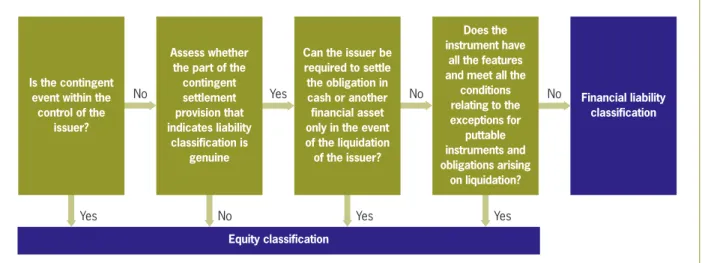
Where a financial instrument contains such a provision, the issuer of the instrument does not have the unconditional right to avoid delivering cash or another financial asset. Therefore the contingent settlement provision results in a financial liability unless one of the following applies:
• the part of the contingent settlement provision that indicates liability classification is ‘not genuine’ (see Section B.4.1)
• the issuer can be required to settle the obligation in cash or another financial asset (or such other way that would cause it to be a financial liability) only in the event of liquidation of the issuer
• (in relatively rare circumstances) the instrument has all the features and meets the conditions relating to the exceptions for puttable instruments and obligations arising on liquidation (see Section D).
Illustration of classification process for contingent settlement provisions
Classification process for an instrument containing an obligation arising only on the occurrence or non-occurrence of uncertain future events
Is the contingent event within the
control of the issuer?
Equity classification
No Yes No No
Yes No Yes Yes
Assess whether the part of the contingent settlement provision that indicates liability classification is genuine
Can the issuer be required to settle the obligation in cash or another financial asset only in the event of the liquidation of the issuer?
Does the instrument have
all the features and meet all the
conditions relating to the exceptions for puttable instruments and obligations arising on liquidation? Financial liability classification
Example: Ordinary shares redeemable in event of stock exchange listing
Entity A issues shares that are redeemable at par in the event of Entity A listing on a stock exchange. The possibility of Entity A listing on a stock exchange is a contingent settlement provision. However, it is not clear-cut whether this ‘event’ is within Entity A’s control.
Our view is that there is a reasonable argument that an entity is able to avoid listing on a stock exchange if it so chooses (the converse is perhaps more debatable, as obtaining a listing requires the involvement and approval of third parties such as exchange regulators). Under this view, the event in question is within Entity A’s control (and not the holder’s control). Hence the shares would be classified as equity instruments.
Note that the same analysis would not apply if redemption in the example was instead contingent on the sale of the company (via current shareholders selling their shares). Normally the sale of the company would be within the holders’ control meaning the shares would be classified as financial liabilities. However, if redemption was only on the sale of the company’s assets, then this may be an event within the company’s control (and hence the shares would not be classified as financial liabilities).
What is within the control of the entity?
The examples above indicate some of the complexities involved in ‘drawing the line’ between what is within the control of the entity and what is not. Differing views exist however on where to draw this line in practice. A common practical issue concerns ‘obligations’ where payments must be approved by the shareholders in general meeting. The question is whether the shareholders are regarded as an extension of the entity in this situation. If so, the shareholders’ rights to approve or reject payments being made amount to a discretion of the entity to refuse payment.
Some commentators hold the view that the shareholders are not part of the entity even when voting as a collective body in general meeting. This view regards the shareholders as acting in their personal capacity as individuals when voting.
Other commentators make a distinction between actions of shareholders as a body under an entity’s governing charter and other individual actions of the shareholders such as selling their shares.
In summary, there is no clear consensus on this issue and judgement will need to be applied in evaluating each particular situation in practice.
4.1 Settlement terms not genuine
IAS 32 does not directly address when contingent settlement terms are not considered to be genuine. However IAS 32’s Application Guidance notes that:
“a contract that requires settlement in cash or a variable number of the entity’s own shares only on the occurrence of an event that is extremely rare, highly abnormal and very unlikely to occur is an equity instrument. Similarly, settlement in a fixed number of an entity’s own shares may be contractually precluded in circumstances that are outside the control of the entity, but if these circumstances have no genuine possibility of occurring, classification as an equity instrument is appropriate.” (IAS 32.AG28)
It is apparent from this guidance then that ‘not genuine’ implies much more than the possibility of settlement being remote.
This is consistent with the Basis for Conclusions section in the Standard, where it is noted that “The Board concluded that it is not consistent with the definitions of financial liabilities and equity instruments to classify an obligation to deliver cash or another financial asset as a financial liability only when settlement in cash is probable.” (IAS 32.BC17)
Example: Changes in a stock market index
A financial instrument which must be repaid in the event of a specified change in the level of a stock market index is an example of an uncertain future event that is beyond the control of both the issuer and the holder of the financial instrument, and which would normally result in classification of the instrument as a financial liability. It is possible however, that the change required in the level of the stock market could be set at such a high level as to be ‘not genuine’. For example, a five-fold increase in the stock market index in a six month period may be historically unprecedented and therefore sufficiently unlikely to be considered ‘not genuine’.
Regulatory change clauses
There has been some debate as to whether ‘regulatory change’ clauses, found in the terms of some instruments issued by financial institutions, contain ‘genuine’ contingent settlement obligations.
Financial institutions are generally required by regulators to maintain certain minimum levels of regulatory capital (equity and some forms of highly subordinated debt). The regulatory capital essentially forms a safeguard to absorb losses to reduce the risk of losses for depositors.
A regulatory change clause will typically require an instrument which, at the date of issue, is classified as regulatory capital to be repaid in the event that it ceases to be so classified. As discussed above, if such a contingent settlement condition is genuine it will result in the instrument being classified as a financial liability.
In many jurisdictions, however, industry regulators have a history of applying changes in the rules regarding regulatory capital prospectively. This means that any existing instruments continue to be regarded as regulatory capital even though they do not meet the new rules, and are not therefore repayable.
In some circumstances, it can then be questioned whether the contingent settlement provision in these instruments is genuine. This requires careful consideration based on each individual set of facts and circumstances.
5 ‘Linked’ instruments
IFRIC addressed the subject of ‘linked’ instruments in its March 2006 meeting.
It noted that where a financial instrument (the ‘base’ instrument) contains a clause whereby dividends must be paid if dividends are paid on another instrument (the ‘linked’ instrument), and that instrument itself contains a contractual payment obligation, then an indirect contractual obligation is created to pay dividends on the base instrument. Accordingly, the base instrument is classified as a liability under IAS 32.
This principle is often relevant to situations where a ‘dividend pusher’ or ‘dividend blocker’ exists, and is discussed in Section B.5.1.
5.1 Dividend pushers and dividend blockers
The term ‘dividend pusher’ denotes a clause in the terms of a financial instrument under which the holder becomes automatically entitled to receive a distribution when a distribution is made on another separate financial instrument.
The term ‘dividend blocker’ is used to denote the converse situation, which is where a distribution cannot be made on a financial instrument unless a distribution has been made on another financial instrument.
Such clauses are sometimes found within an individual entity where the entity has issued more than one type of financial instrument.
Example: Dividend blocker
Entity X has issued two classes of instruments, Class A instruments and Class B instruments. Class A instruments are correctly classified as equity shares. The terms of the Class B instruments are identical to those of Class A other than that they contain a ‘dividend blocker’ under which a dividend cannot be paid on the B instruments unless one has been paid on the A instruments.
In this situation, Entity X has discretion over whether dividends are paid on both the A instruments and the B instruments, and both will therefore be classified as equity.
Dividend pushers and blockers can also be encountered within groups of companies. For instance, an entity within a group may be prohibited from paying a dividend on the financial instruments that it has issued unless a dividend has been declared on a financial instrument issued by another entity within the group. The effect of such clauses may result in the classification of an instrument differing between the consolidated financial statements and the separate financial statements of the entity that has issued the instrument.
Example: Dividend pusher within a group of companies
Group A consists of Parent A and Subsidiary B. Parent A has issued one class of shares which have been correctly classified as equity instruments. Subsidiary B has also issued one class of financial instruments. The terms of the financial instruments issued by Subsidiary B are identical to those issued by Parent A except that they include a ‘dividend pusher’ clause, under which Subsidiary B is obliged to declare a dividend whenever Parent A declares a dividend on its instruments.
In this example, the dividend pusher means that Subsidiary B has no discretion over whether dividends are paid on the instruments it has issued (that decision being taken by the parent). Consequently, should Subsidiary B prepare financial statements, the instruments will be classified as financial liabilities in those statements.
In the consolidated financial statements, however, Subsidiary B’s instruments will be classified as equity (to the extent of any non-controlling interests – the instruments held by parent A will be eliminated on consolidation). This is because Parent A has discretion over whether dividends are paid on its own financial instruments and also, by virtue of the dividend pusher clause, on those of Subsidiary B.
6 Guarantees within a group
The issue of guarantees within a group can result in the classification of a financial instrument differing between the consolidated financial statements and the separate financial statements of the company that has issued the instrument.
Such a situation often arises where one company within a group issues an instrument, and another group company guarantees the instrument by agreeing additional terms directly with the holder of the instrument.
At consolidated financial statement level, all the terms and conditions agreed between the holders of the instrument and all the companies within the group must be considered when deciding whether the group has an obligation to deliver cash or another financial asset or to settle it in a way that causes it to be classified as a financial liability (IAS 32.AG29). The effect of the guarantee is that there is a potential obligation for the group as a whole to transfer cash or other assets on unfavourable terms. The instrument will therefore be classified as a financial liability rather than equity in the consolidated financial statements.
In contrast, the company that has issued the instrument does not consider the additional terms and conditions relating to the guarantee given by the other group company. This means that the instrument may be classified as equity in the separate financial statements of the company that issued it.
C. Instruments settled in an entity’s
own equity instruments
Summary of requirements
• specific rules determine whether instruments that may or will be settled in an entity’s own equity instruments are classified as financial liabilities or as equity
• for a non-derivative financial instrument, equity classification is required if and only if the ‘fixed’ test is met. Where an instrument can be settled using a variable number of an entity’s own equity instruments, it is classified as a liability
• for a derivative financial instrument, equity classification is required if and only if the ‘fixed for fixed’ test is met. If it is possible to settle the derivative other than by exchanging a fixed amount of cash or another financial asset for a fixed number of the entity’s own equity instruments the instrument is classified as a liability • instruments classified as equity are outside the scope of IAS 39 ‘Financial Instruments: Recognition and
Measurement’. Subsequent changes in the value of the instrument are not recognised in the financial statements.
1 Section overview
Equity is defined as “any contract that evidences a residual interest in the assets of an entity after deducting all of its liabilities” (IAS 32.11). Only those instruments which fail the definition of a financial liability can be classified as equity.
The expanded definition of equity in IAS 32.16 states that, as well as including no contractual obligation to deliver cash or another financial asset, an instrument that will or may be settled in the issuer’s own equity instruments will only be classified as equity if “it is:
i) a non-derivative that includes no contractual obligation for the issuer to deliver a variable number of its own equity instruments; or
ii) a derivative that will be settled only by the issuer exchanging a fixed amount of cash or another financial asset for a fixed number of its own equity instruments.”
Exceptions to the rules for equity classification are discussed in Section C.4.1.1 below and in Section D.
An instrument that will be settled by an entity issuing its own equity instruments does not contain an obligation for the issuer to deliver cash or another financial asset. In the absence of this expanded definition, such an instrument would be classified as equity. However, the IASB concluded that such an outcome would not reflect the substance of some of these instruments. IAS 32 therefore includes specific rules to govern their classification. Section C discusses these rules, namely the application of:
• the ‘fixed test’ for non-derivatives that may be settled in an entity’s own equity instruments • the ‘fixed for fixed test’ for derivatives that may be settled in an entity’s own equity instruments. Where equity classification is met, any consideration received is added directly to equity while any consideration paid is deducted directly from equity. Changes in the fair value of an equity instrument are not recognised in the financial statements.
Where equity classification is not met, the contract will be accounted for either as a non-derivative financial liability, or as a derivative asset or liability, depending on the nature of the contract.
Classification process for instruments settled in an entity’s own equity instruments
2 The ‘fixed’ test
For a non-derivative financial instrument that will or may be settled by an entity issuing its own equity instruments, equity classification is required if and only if the so-called ‘fixed test’ in IAS 32 is met. The ‘fixed’ test
IAS 32.11(d) states that a financial liability is any liability that is:
“(d) a contract that will or may be settled in the entity’s own equity instruments and is:
i) a non-derivative for which the entity is or may be obliged to deliver a variable number of the entity’s own equity instruments; or
ii) …”
This part of the definition is sometimes referred to as the fixed test. By fixing upfront the number of shares to be received or delivered on settlement of the instrument in concern, the holder is exposed to the upside and downside risk of movements in the entity’s share price.
A contractual right or obligation to receive or deliver anything other than a fixed number of the entity’s own shares will result in liability classification of the instrument in concern.
The logic behind this test is that using a variable number of own equity instruments to settle a contract can be similar to using own shares as ‘currency’ to settle what in substance is a financial liability. Such a contract does not evidence a residual interest in the entity’s net assets. Equity classification is therefore inappropriate.
IAS 32 contains two examples of contracts where the number of own equity instruments to be received or delivered varies so that their fair value equals the amount of the contractual right or obligation:
1) A contract to deliver a variable number of own equity instruments equal in value to a fixed monetary amount on the settlement date is classified as a financial liability.
Example: Shares used as currency
Entity A issues an instrument for which it receives CU 100,000. Under the terms of the issue, Entity A will repay the debt in 3 years time by delivering ordinary shares to the value of CU 115,000.
Entity A is using its own shares as currency, and the instrument should therefore be classified as a financial liability.
2) A contract to deliver as many of the entity’s own equity instruments as are equal in value to the value of 100 ounces of a commodity results in liability classification of the instrument.
Example: Shares to the value of a commodity
Entity B issues preference shares for CU 1,000. The shares pay no interest and will be settled in three years time by Entity B delivering a number of its own ordinary shares (which are correctly classified as equity) as are equal to the value of 100 ounces of gold. Can the preference shares be classified as equity under the fixed for fixed test?
No. The shares must be classified as financial liabilities as the delivery of ordinary shares to the value of 100 ounces of gold represents an amount that fluctuates in part or in full in response to changes in a variable other
Non-derivatives settleable in an entity’s own equity instruments
Derivatives settleable in an entity’s own equity instruments
Even though both of the contracts in these examples are settled by the entity delivering its own equity instruments, the contracts are not equity themselves. In both cases the entity uses a variable number of its own equity instruments to settle them. They are therefore classified as financial liabilities.
3 The ‘fixed for fixed’ test
In the case of a derivative financial instrument which is to be settled by an entity issuing its own equity instruments, equity classification is required if and only if the so-called ‘fixed for fixed’ test in IAS 32 is met. This test is based on similar logic to the ‘fixed’ test discussed in Section C.2 above.
The ‘fixed for fixed’ test
IAS 32.11(d) states that a financial liability is any liability that is:
“(d) a contract that will or may be settled in the entity’s own equity instruments and is: i) …
ii) a derivative that will or may be settled other than by the exchange of a fixed amount of cash or another financial asset for a fixed number of the entity’s own equity instruments…”
This part of the definition of a liability is often referred to as the ‘fixed for fixed’ rule, as a fixed number of shares must be exchanged for a fixed amount of cash in order for an instrument to avoid classification as a financial liability.
Significance of the fixed for fixed test
If the fixed for fixed test is met, the derivative is classified as equity and falls outside the scope of IAS 39. Subsequent changes in fair value are not recognised in the financial statements. Note however that special rules apply to derivative contracts which include an obligation for the issuer to purchase its own equity instruments (a written put option) – see Section C.3.2 below.
The fixed for fixed test is therefore typically crucial when an entity issues (i) a convertible bond or (ii) share warrants or options.
Apply fixed for fixed test
Treated as equity
Test failed Test passed
Treated as normal derivatives
Within the scope of IAS 39 Outside the scope of IAS 39
Derivative recognised on balance sheet at fair value
with changes in fair value recognised through profit
or loss
Any consideration paid/ received is deducted/added
to equity. Changes in fair value not recognised
Example: Call share option that meets the definition of equity
An issued share option that gives the counterparty a right to buy a fixed number of an entity’s shares for a fixed amount of functional currency is an example of an instrument that meets the fixed for fixed test. Note however that equity classification applies only if the contract can be settled only by ‘gross physical settlement’ – in other words by actual issuance of shares for cash.
For the entity that has issued the option, the contract is an equity instrument as it will settle it by issuing a fixed number of its own equity instruments in return for a fixed amount of cash.
Example: Call share option that fails the definition of equity
An entity issues a share option that gives the counterparty a right to buy a number of shares for a fixed price. Under the terms of the option agreement, however, the number of shares that the counterparty obtains by paying the exercise price varies according to the level of sales that the entity achieves.
The option fails the fixed for fixed test as it is over a variable number of the entity’s shares. The definition of equity is not met, and the option will therefore be accounted for as a derivative in accordance with the requirements of IAS 39.
It should be noted however that if share options are issued in exchange for goods or services, then IFRS 2 ‘Share-based Payment’ would apply. The fixed for fixed test is not then relevant.
3.1 Own equity instruments
For the purpose of applying the fixed for fixed test, ‘own equity instruments’ do not include instruments classified as equity under the ‘Amendments to IAS 32 and IAS 1: Puttable Financial Instruments and Obligations Arising on Liquidation’ (see Section D).
Nor do ‘own equity instruments’ include instruments that are contracts for the future receipt or delivery of the issuer’s own equity instruments.
3.2 Obligations to purchase own equity instruments for cash
A contract that contains an obligation for the entity to purchase its own equity instruments for cash or another financial asset gives rise to a financial liability for the present value of the redemption amount (the forward repurchase price, option exercise price or other specified redemption amount) (IAS 32.23). This is the case even for derivatives over equity instruments that meet the fixed for fixed test and would be equity in the absence of the rule in IAS 32.23.
IAS 32.23 also notes that a contractual obligation for an entity to purchase its own equity instruments gives rise to a financial liability for the present value of the redemption amount even if the obligation is conditional on the counterparty exercising a right to redeem.
Treatment of options over own equity instruments (settled gross by receipt or delivery of own equity instruments)
Written call option, purchased put option, purchased call option over own
equity instruments
The derivative qualifies as an equity instrument if the ‘fixed for fixed’ test is
met. Otherwise the derivative should be accounted for in accordance with IAS 39’s ongoing measurement criteria
Written put option over own equity instruments
Record financial liability for the present value of the redemption amount irrespective of whether the derivative itself qualifies as an