1 | P a g e
Media Release
Helping SMEs Recalibrate for Quality Growth
- SMPs should pay attention to SMEs’ growing demand for advisory services, especially in Tax, Risk Management and Financial Management
Singapore, 3 April, 2013 – Small and Medium Accounting Practices (SMPs) can better support their growth by diversifying from audit and assurance services to provide advisory services and support the internationalisation efforts of Small and Medium Enterprises (SMEs), according to a joint survey by the Institute of Certified Public Accountants of Singapore (ICPAS) and CPA Australia.
The ICPAS-CPA Australia Survey on Advisory Services for Singapore Businesses noted that SMEs have to manage more business complexities as they expand their operations into multiple geographies.
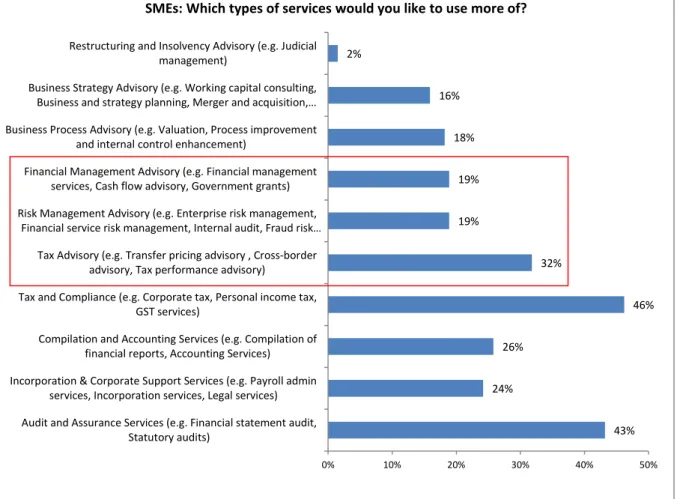
As their business needs evolve, SMEs would like to use more advisory services, especially in Tax Advisory (32 per cent), Risk Management (19 per cent) and Financial Management (19 per cent), the survey found. (Appendix, Figure 1).
“SMEs would be willing to pay for advisory services at the right cost, with a significant number preferring a one-stop shop if the chosen SMP offers the breadth of services,” the survey found.
But despite the demand indicated by SMEs, slightly over half of SMP respondents provide only one or no advisory services (51 per cent) (Appendix, Figure 2).
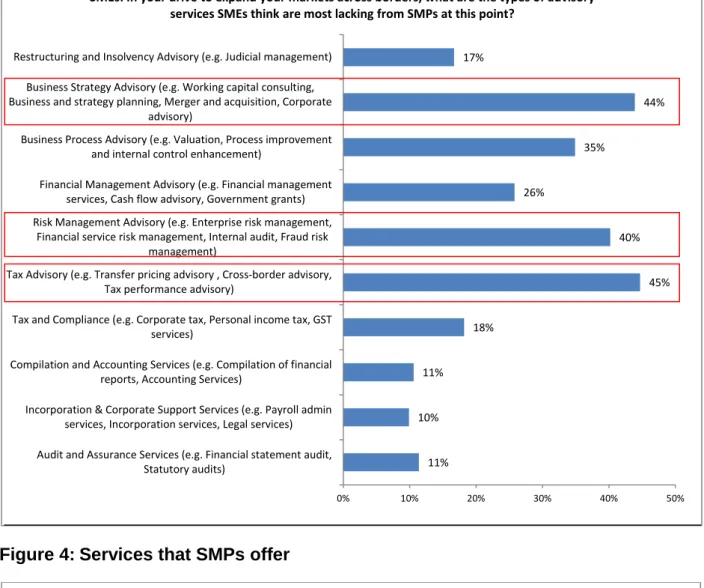
2 | P a g e Correspondingly, SME respondents indicated that there are insufficient Tax (45 per cent), Business Strategy (44 per cent) and Risk Management (40 per cent) advisory services to support their expansion needs (Appendix, Figure 3).
Currently, the top three services provided by SMPs are related to traditional reporting and compliance services such as Audit and Assurance (94 per cent), Compilation and Accounting (88 per cent) and Tax and Compliance (86 per cent) (Appendix, Figure 4).
Opportunities for SMEs to Grow Through Their Partnership with SMPs
SMEs currently engage SMPs more for traditional reporting and compliance services like Audit and Assurance (72 per cent), Tax and Compliance (59 per cent) and Incorporation and Corporate Support (31 per cent) (Appendix, Figure 5). However, SMEs have indicated that they seek to use more advisory services in view of their intention to internationalise1 or expand their business (41 per cent).
SMEs also indicated that they anticipate a future need for more sophisticated advisory services, with the top three being Risk Management (53 per cent), Business Strategy (48 per cent) and Business Process (46 per cent) (Appendix, Figure 6) .
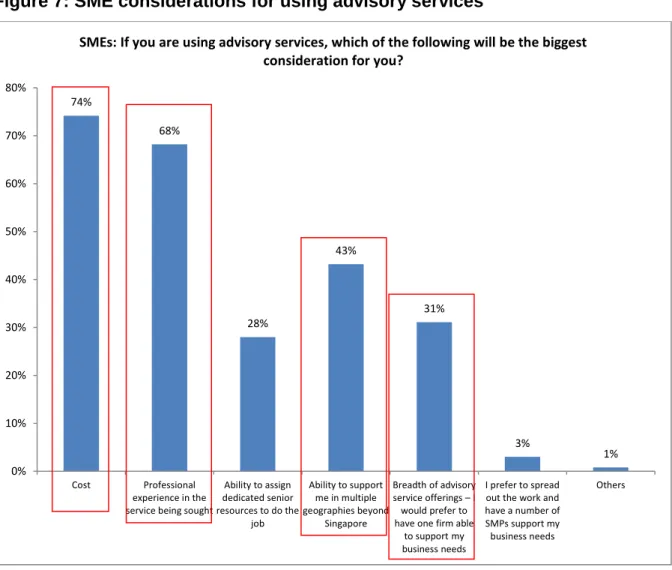
In choosing a trusted business partner to provide the much needed advisory assistance, the SME respondents indicated that cost (74 per cent) is their biggest concern, followed by professional experience (68 per cent), ability to support them in multiple jurisdictions (43 per cent) and breadth of services provided (31 per cent) (Appendix, Figure 7).
This shows that while it is a priority for SMEs to effectively manage their costs, they appear willing to pay, at the right price, for the experience, knowledge, skills and convenience in choosing the right business consultant to assist them with their expansion or internationalisation.
1
3 | P a g e Given that SMEs are looking for a more holistic range of services, SMPs can tap on this growth opportunity by becoming a one-stop shop offering a breadth of advisory services to SMEs. This is especially so for Tax Advisory services, where it was found that even though SMPs perceive demand for it (78 percent), a relatively smaller pool of SMPs (41 per cent) are providing it (Appendix, Figure 8 and 4).
“As trusted business advisors to SMEs, SMPs play an integral role in supporting them. SMPs should seize the opportunity to progress up the value chain by offering advisory services such as tax, financial and risk management, to better support their SME clients in line with their changing needs. ICPAS, as the national accountancy body, will continue to support and work with SMPs in their efforts to grow their capabilities and move up the value chain,” said Yee Cheok Hong, Executive Director (Policy & Strategic Planning/Industry Development), Institute of Certified Public Accountants of Singapore
“The survey brings out one very clear message – SMEs have good appetite to increase their engagements of small and medium practices because they could be more personable, targeted and possibly offer services at more competitive rates. With SMEs making up 99% of all enterprises in Singapore, this market is a low hanging fruit if only SMPs would choose to bite,” said Melvin Yong, Singapore General Manager, CPA Australia.
The “ICPAS-CPA Australia Survey on Advisory Services for Singapore Businesses” was conducted between September and October 2012 and garnered 130 and 108 responses from the SME and SMP community respectively. The survey is aimed at understanding the range of accounting and advisory services needed by SMEs and those provided by SMPs.
-Ends-
For media enquiries, please contact: Institute of Certified Public Accountants of Singapore
Betsy Tan, Communications Manager Tel: 6597 5608 / 9641 6920
Email: [email protected]
CPA Australia
Sheryl Koh, Assistant Marketing Communications Manager
Tel: 6671 6529 / 9821 7891
4 | P a g e
About the Institute of Certified Public Accountants of Singapore
Established in 1963, Institute of Certified Public Accountants of Singapore (ICPAS) is the national accountancy body that develops, supports and enhances the integrity, status and interests of the profession.
The Certified Public Accountant Singapore (CPA Singapore) is a professional in accountancy, finance and business distinguished by their technical expertise, integrity and professionalism, in addition to a recognised accountancy qualification and relevant work experience. CPAs Singapore serve every corner of the world in every industry. Many of them helm some of the most prominent local and international corporations.
ICPAS accords the CPA Singapore designation. Working closely alongside businesses, ICPAS connects its membership to an unmatched range of information resources, events, professional development and networking opportunities. Presently, there are close to 26,000 members making their strides in businesses across all industries in Singapore and around the world.
ICPAS’ international outlook and connections are reflected in its membership of regional and international professional organisations like the ASEAN Federation of Accountants (AFA), the Asia-Oceania Tax Consultants’ Association (AOTCA), the International Federation of Accountants (IFAC) and International Innovation Network (IIN).
For more information, please visit www.icpas.org.sg
About CPA Australia
CPA Australia is one of the world’s largest accounting bodies with more than 144,000 members working in 127 countries. We have operations in chosen markets throughout the world, including all Australian capital cities, Hong Kong, Beijing, Shanghai, Guangzhou, Indonesia, Malaysia, Singapore, Vietnam, New Zealand and the United Kingdom. At present, there are over 7,200 members in Singapore.
CPA Australia advances its members’ interests through its focus on education and knowledge exchange, the development of professional networks, advocacy in relation to policy, standards and regulation and the promotion of value of CPA Australia members to employers, government, regulators and the public. The CPA Australia designation denotes strategic business leadership and is recognised and valued throughout the world.
Our international presence continues to grow in terms of representation on international bodies and influence in the profession globally. In the areas of financial reporting, taxation and corporate governance, we are thought leaders in Australia and internationally.
5 | P a g e
Appendix
Figure 1:Types of services that SMEs would like to use more
Figure 2:Number of advisory services offered by SMPs
43% 24% 26% 46% 32% 19% 19% 18% 16% 2% 0% 10% 20% 30% 40% 50%
Audit and Assurance Services (e.g. Financial statement audit, Statutory audits)
Incorporation & Corporate Support Services (e.g. Payroll admin services, Incorporation services, Legal services) Compilation and Accounting Services (e.g. Compilation of
financial reports, Accounting Services) Tax and Compliance (e.g. Corporate tax, Personal income tax,
GST services)
Tax Advisory (e.g. Transfer pricing advisory , Cross-border advisory, Tax performance advisory)
Risk Management Advisory (e.g. Enterprise risk management, Financial service risk management, Internal audit, Fraud risk…
Financial Management Advisory (e.g. Financial management services, Cash flow advisory, Government grants) Business Process Advisory (e.g. Valuation, Process improvement
and internal control enhancement)
Business Strategy Advisory (e.g. Working capital consulting, Business and strategy planning, Merger and acquisition,… Restructuring and Insolvency Advisory (e.g. Judicial
management)
SMEs: Which types of services would you like to use more of?
18% 8% 4% 7% 11% 14% 37% 1% 0% 10% 20% 30% 40% 6 services 5 services 4 services 3 services 2 services 1 service None No Response
6 | P a g e
Figure 3: Types of advisory services lacking from SMPs
Figure 4:Services that SMPs offer
11% 10% 11% 18% 45% 40% 26% 35% 44% 17% 0% 10% 20% 30% 40% 50%
Audit and Assurance Services (e.g. Financial statement audit, Statutory audits)
Incorporation & Corporate Support Services (e.g. Payroll admin services, Incorporation services, Legal services) Compilation and Accounting Services (e.g. Compilation of financial
reports, Accounting Services)
Tax and Compliance (e.g. Corporate tax, Personal income tax, GST services)
Tax Advisory (e.g. Transfer pricing advisory , Cross-border advisory, Tax performance advisory)
Risk Management Advisory (e.g. Enterprise risk management, Financial service risk management, Internal audit, Fraud risk
management)
Financial Management Advisory (e.g. Financial management services, Cash flow advisory, Government grants) Business Process Advisory (e.g. Valuation, Process improvement
and internal control enhancement)
Business Strategy Advisory (e.g. Working capital consulting, Business and strategy planning, Merger and acquisition, Corporate
advisory)
Restructuring and Insolvency Advisory (e.g. Judicial management)
SMEs: In your drive to expand your markets across borders, what are the types of advisory services SMEs think are most lacking from SMPs at this point?
94% 88% 86% 69% 41% 38% 38% 37% 33% 33% 0% 10% 20% 30% 40% 50% 60% 70% 80% 90% 100%
Audit and Assurance Services Compilation and Accounting Services Tax and Compliance Incorporation & Corporate Support Services
Tax Advisory Financial Management Advisory
Business Strategy Advisory Business Process Advisory Restructuring and Insolvency Advisory Risk Management Advisory
7 | P a g e
Figure 5: Types of advisory services that SMEs use
72% 31% 31% 59% 12% 5% 6% 2% 2% 0% 0% 10% 20% 30% 40% 50% 60% 70% 80% Audit and Assurance Services (e.g. Financial statement audit,
Statutory audits)
Incorporation & Corporate Support Services (e.g. Payroll admin services, Incorporation services, Legal services) Compilation and Accounting Services (e.g. Compilation of
financial reports, Accounting Services) Tax and Compliance (e.g. Corporate tax, Personal income tax,
GST services)
Tax Advisory (e.g. Transfer pricing advisory , Cross-border advisory, Tax performance advisory)
Risk Management Advisory (e.g. Enterprise risk management, Financial service risk management, Internal audit, Fraud risk…
Financial Management Advisory (e.g. Financial management services, Cash flow advisory, Government grants) Business Process Advisory (e.g. Valuation, Process improvement
and internal control enhancement)
Business Strategy Advisory (e.g. Working capital consulting, Business and strategy planning, Merger and acquisition,… Restructuring and Insolvency Advisory (e.g. Judicial
management)
8 | P a g e
Figure 6: Types of new advisory services SMEs anticipate using in future
14% 13% 14% 23% 35% 53% 40% 46% 48% 14% 0% 10% 20% 30% 40% 50% 60%
Audit and Assurance Services (e.g. Financial statement audit, Statutory audits)
Incorporation & Corporate Support Services (e.g. Payroll admin services, Incorporation services, Legal services) Compilation and Accounting Services (e.g. Compilation of
financial reports, Accounting Services) Tax and Compliance (e.g. Corporate tax, Personal income tax,
GST services)
Tax Advisory (e.g. Transfer pricing advisory , Cross-border advisory, Tax performance advisory)
Risk Management Advisory (e.g. Enterprise risk management, Financial service risk management, Internal audit, Fraud risk
management)
Financial Management Advisory (e.g. Financial management services, Cash flow advisory, Government grants) Business Process Advisory (e.g. Valuation, Process improvement
and internal control enhancement)
Business Strategy Advisory (e.g. Working capital consulting, Business and strategy planning, Merger and acquisition,
Corporate advisory)
Restructuring and Insolvency Advisory (e.g. Judicial management)
SMEs: What types of new advisory services would SMEs anticipate using in future and that they would like to see SMPs provide?
9 | P a g e
Figure 7: SME considerations for using advisory services
Figure 8: Level of demand for SMP advisory services 74% 68% 28% 43% 31% 3% 1% 0% 10% 20% 30% 40% 50% 60% 70% 80% Cost Professional experience in the service being sought
Ability to assign dedicated senior resources to do the job Ability to support me in multiple geographies beyond Singapore Breadth of advisory service offerings – I would prefer to have one firm able
to support my business needs
I prefer to spread out the work and have a number of SMPs support my business needs
Others SMEs: If you are using advisory services, which of the following will be the biggest
consideration for you?
12% 2% 2% 1% 1% 31% 10% 9% 6% 7% 7% 35% 22% 20% 23% 25% 20% 13% 31% 33% 39% 30% 32% 8% 35% 36% 32% 38% 39% 0% 20% 40% 60% 80% 100% Tax Advisory Financial Management Advisory Risk Management Advisory Restructuring and Insolvency Advisory Business Process Advisory Business Strategy Advisory
SMPs: Please rate the demand from your customers for the following advisory services.
5. High Demand 4. Good Demand 3. Moderate Demand 2. Low Demand 1. No Demand