Harald Frick
CEOSQL/XML-IMDBg
GPU boosted
In-Memory Database
for
Future computing systems
are parallel,
but
4 cores
•
Programmers have to code the parallelism
•
Lake of development systems and experience
•
Radical departure from general programming wisdom
•
Requires combining CPU and GPU code
•
Requires “close to metal” knowledge for max. performance
•
The Hardware is evolving and changing rapidly
How are we going to program such systems ?
Database systems now are
ubiquitous,
but
4 cores
…changes everything
•
The core DB technology is from the 70s !
•
Database systems now hitting a performance-wall
•
Computer memory grows faster than enterprise data
•
Hardware is evolving rapidly and gets more heterogeneous
•
Parallel computing is a necessity for higher performance
Complete re-engineering of the
database architecture is required to
make a DB kernel multi-core ready
and scalable to 100’s of processors
SQL/XML-IMDBg
The Database has been re-invented
Parallel In-Memory
Database Server
Cost effective
upgrade path
Unlimited scalability
Declarative parallel
data management
and processing
Domain Experts can use a standard
interface (SQL) for massive parallel
computation and data mining
SQL/XML-IMDBg
Bridging the technology gap with
Database Server
Cost effective
Unlimited scalability
Universal
Agenda (1)
•
Overview about general database architecture
•
Short introduction to SQL/XML-IMDB
•
Overview of the re-engineering tasks performed to
make the IMDB database kernel many-core ready
Three levels of re-engineering:
1.
General database architecture
2.
Relational algebra structures and functions
3.Coding level
Agenda (2)
•
Architecture of the database kernel
Explains the overall design principle chosen to make a database kernel ready for massive parallel processing and GPU ready
•
Database Table structure and outline
Explains the vertical partitioning layout and why this is one of the most important pre-requisites for successful GPU co-processing in database kernels
•
Memory management
The memory management subsystem architecture and how to manage memory on a GPU device with missing dynamic memory management facilities
•
Query Optimizer
Gives insights into the Split-Work architecture and explains the Optimizer architecture with a special focus on the dynamic re-optimizing steps performed during query processing
•
Query Executer structure
Explains the architecture of the query Executer with a special focus on processing the split-work plan for distributing the query work between CPU and GPU
Agenda (3)
Summary of presentation:
•
Lessons learned from re-engineering the database kernel
•
Some important conclusions drawn from our experiences regarding
parallelizing and re-engineering a complex application for massive
parallel platforms like GPU’s
•
Outlook on future enhancements planned for the IMDB
DB Architecture overview
XQuery Parser SQL Parser
Internal Query-Tree / Optimizer
Executer
XML Memory Manager SQL Memory Manager
Local/Shared/GPU/Flash… Memory
SQL
Index Manager
XQuery
•
DB Library (DLL, LIB, .NET Assembly)
•
Application embedded SQL/XQuery
statements
•
Functional API
•
Declarative universal data management
•
Kind of
declarative STL
library
•
Data exchange between process boundaries
•
8 years of market experience
•
WIN32, WIN64, Linux32, Linux64, …
SQL/XML-IMDB application practice
Flash
Memory
Shared Memory Function1() {db.ExecXql ( FOR $X … RETURN $X) }
//---Function2()
{
db.ExecSql ( SELECT … FROM ) while( db.Next() ) { … }
}
Sub Command1_OnClick
db.ExecXql ( FOR $X … INSERT Y ) db.ExecSql ( SELECT … FROM ) ---Sub Command2_OnClick
db.ExecXql ( LET $X … ) while db.Next() <> 0 Do
C++ Application in Process A VB Application in Process B
Local Memory
SQL/XML Tables in disk based files
Export/Import (persistence)
Shared Memory
Function1() {
db.ExecXql ( FOR $X … RETURN $X) }
//---Function2()
{
db.ExecSql ( SELECT … FROM ) while( db.Next() ) { … }
}
Sub Command1_OnClick
db.ExecXql ( FOR $X … INSERT Y ) db.ExecSql ( SELECT … FROM ) ---Sub Command2_OnClick
db.ExecXql ( LET $X … ) while db.Next() <> 0 Do
C++ Application in Process A VB Application in Process B
Local Memory
SQL/XML Tables in disk based files
Export/Import (persistence)
Local Memory
Vision:
Integrating the GPU memory
GPU Co-Processor
SQL/XML-IMDBg
4 cores
•
Automatically distribute SQL query work and relational data between
standard CPU cores and high performance graphics GPU’s
•
In-Memory:
CPU-Local Memory
,
CPU-Shared Memory
,
GPU-Memory
Vision:
Seamless utilization of GPU power
Place tables (and indexes) where
you want:
Create Table
Local
TR (…)
Create Table
Shared
TS (…)
Create Table
GPU
TG (…)
Select * From
TR
,
TS
,
TG
WHERE ….
Re-inventing the Database
by
complete re-engineering of
the “old” IMDB
•
Vertical partitioned table structure
•
Arrays instead of Lists, Hash-Tables, Trees …
•
Compression (dictionary based)
•
Regular shaped data structures
•
Only one Index structure
•
Vector processing of Algebra functions
•
Fork-Join model (OpenMP)
Re-Engineering (coding)
•
Reduced program code complexity
– Instruction cache friendlier – Reduced memory footprint – From C++ back to C
•
Arrays everywhere
– Supports memory prefetch – Simple access functions – Loop unrolling
– Simpler buffer management
•
Dynamic, array like SQL data tables
– No space waste (no static pre-allocation)
– Strings represented by ID‘s whenever possible – Simple access/scan functions
•
Simplified index structures
– Array like
– Better parallelizable – Co-Processor friendly
•
RISC like DB core structure
–
Simple and repeating data structures
–
Dynamic Arrays everywhere
–
Dramatically reduced DB-kernel complexity
–
Favors parallel algorithmic structures !
•
Split-Work Optimizer
–
Dynamic mid-query re-optimizing
–
Schedules query execution between CPU and GPU
•
Split-Work Query Executer
–
Work duplication and parallel execution
–
Materialized intermediate results (compressed bitmaps)
–
Vector processing of relational algebra
Agenda (2)
•
General architecture outline of database kernel
Explains the overall design principle chosen to make a database kernel ready for massive parallel processing and GPU ready
•
Database Table structure and outline
Explains the vertical partitioning layout and why this is one of the most important pre-requisites for successful GPU co-processing in database kernels
•
Memory management
The memory management subsystem architecture and how to manage memory on a GPU device with missing dynamic memory management facilities
•
Query Optimizer
Gives insights into the Split-Work architecture and explains the Optimizer architecture with a special focus on the dynamic re-optimizing steps performed during query processing
•
Query Executer structure
Explains the architecture of the query Executer with a special focus on processing the split-work plan for distributing the query work between CPU and GPU
Regular Shaped Structures
and
Dynamic Arrays
DB Architecture (core layout)
L-Table S-Table G-Table Cursor Index
Master Array Descriptor 1 Descriptor n Header Data 1 …n Jump table dynamic size
Very good DB / GPU structure fit
PBSM PBSM
Thread Processors
PBSM
Thread Processors Thread Processors Thread Processors Thread Processors Thread Processors Thread Processors Thread Processors
PBSM PBSM PBSM PBSM PBSM PBSM PBSM PBSM PBSM PBSM PBSM PBSM PBSM
Agenda (2)
•
General architecture outline of database kernel
Explains the overall design principle chosen to make a database kernel ready for massive parallel processing and GPU ready
•
Database Table structure and outline
Explains the vertical partitioning layout and why this is one of the most important pre-requisites for successful GPU co-processing in database kernels
•
Memory management
The memory management subsystem architecture and how to manage memory on a GPU device with missing dynamic memory management facilities
•
Query Optimizer
Gives insights into the Split-Work architecture and explains the Optimizer architecture with a special focus on the dynamic re-optimizing steps performed during query processing
•
Query Executer structure
Explains the architecture of the query Executer with a special focus on processing the split-work plan for distributing the query work between CPU and GPU
Table Layout (1)
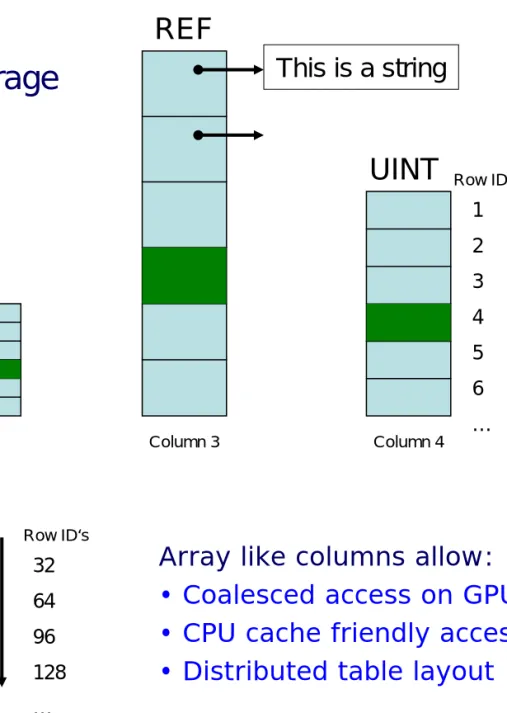
Column 1 Column 2 Column 3 Column 4
1 2 3 4 5 6 … 10100011010010010000111011000010 10100011010010010000111011000010 10100011010010010000111011000010 10100011010010010000111011000010 12345678 …. ... 32 Column Example:
Bool Data Type
Row ID‘s 32 64 96 128
Vertical decomposition - dense data storage
Row ID‘s
INT
DOUBLE
REF
UINT
Array like columns allow:
•
Coalesced access on GPU
•
CPU cache friendly access
•
Distributed table layout
This is a string
Big Problem
Table Layout (2)
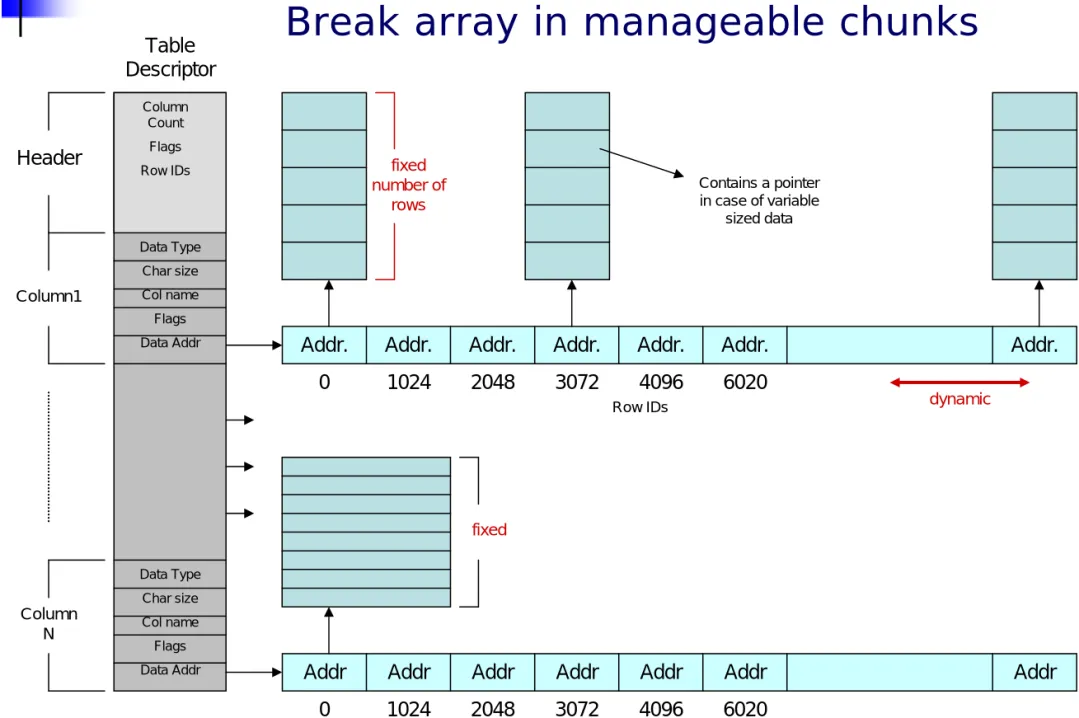
Column Count Flags Row IDs Data Type Char size Col name Flags Data Addr Data Type Char size Col name Flags Data Addr Header Column1 Column NAddr. Addr. Addr. Addr. Addr. Addr. Addr.
0 1024 2048 3072 4096 6020 Table Descriptor fixed number of rows
Addr Addr Addr Addr Addr Addr Addr
fixed
Contains a pointer in case of variable
sized data
Row IDs dynamic
Agenda (2)
•
General architecture outline of database kernel
Explains the overall design principle chosen to make a database kernel ready for massive parallel processing and GPU ready
•
Database Table structure and outline
Explains the vertical partitioning layout and why this is one of the most important pre-requisites for successful GPU co-processing in database kernels
•
Memory management
The memory management subsystem architecture and how to manage memory on a GPU device with missing dynamic memory management facilities
•
Query Optimizer
Gives insights into the Split-Work architecture and explains the Optimizer architecture with a special focus on the dynamic re-optimizing steps performed during query processing
•
Query Executer structure
Explains the architecture of the query Executer with a special focus on processing the split-work plan for distributing the query work between CPU and GPU
TLFS Allocator
(Two-Level Segregate Fit)¾Bitmap based chunk management
¾Simple code structure (instruction cache!)
¾
Memory pools
based !
¾Fastest allocator for shared memory
¾Good cache locality
¾Small size
Memory management (CPU)
POOL 1 …n
Win-OS
VirtualAlloc
Source:
Implementation of a constant-time dynamic storage allocator.
Miguel Masmano, Ismael Ripoll, et al. Software: Practice and Experience. Volume 38 Issue 10, Pages 995 - 1026. 2008.
Local Memory pool
Shared Memory pool
Flash Memory pool
Memory management (GPU)
POOL
Win-OS
VirtualAlloc()
cudaMalloc (
large chunk)
GPU
Data transfer
mem-POOL
cudaMallocHost()
for data transfers
GPU device memory
Host memory
cudaMemcpy
*devPtr = *hostPtr
Table management on CPU and GPU
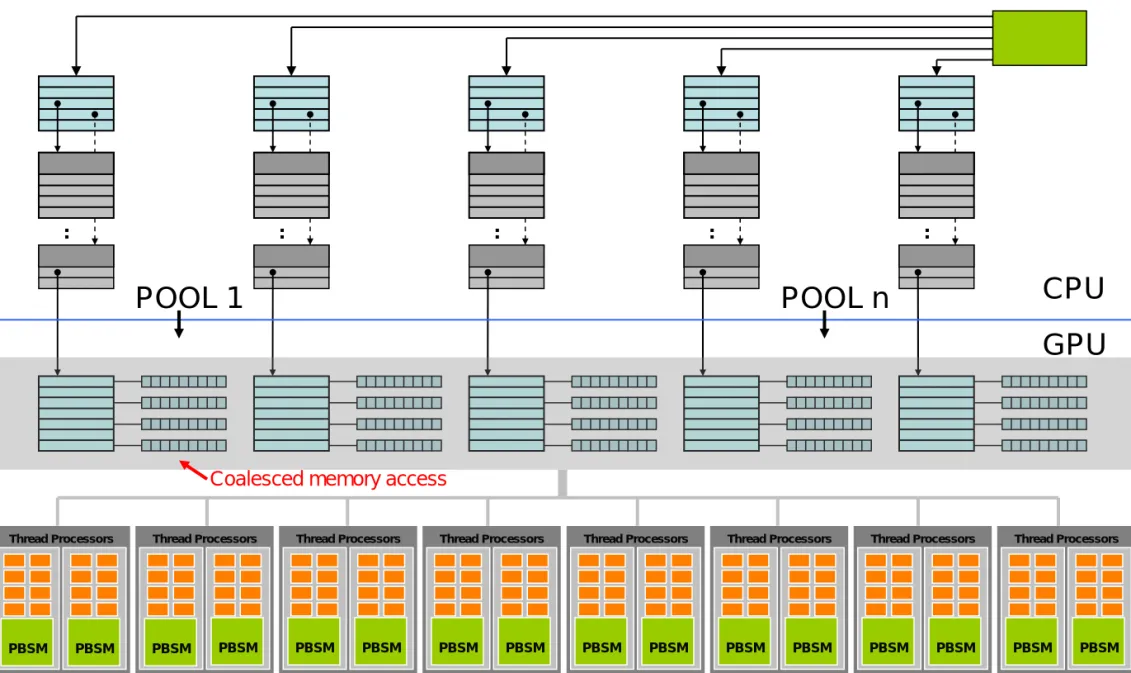
Thread Processors Thread Processors Thread Processors Thread Processors Thread Processors Thread Processors Thread Processors Thread Processors
CPU
GPU
POOL 1
POOL n
Scales to multi GPU clusters
CPU
GPU
Memory POOL 1
Memory POOL n
Split-Work
Executer
Split-Work
Executer
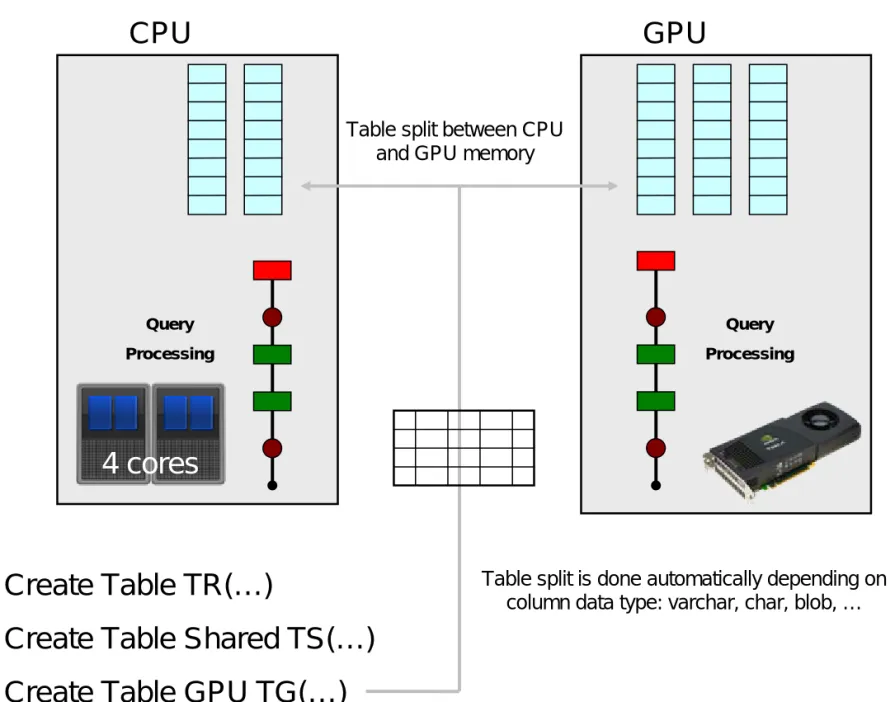
GPU / CPU Table split
Query Processing
CPU
GPU
Create Table TR(…)
Create Table Shared TS(…)
Create Table GPU TG(…)
Table split between CPU and GPU memory
Table split is done automatically depending on column data type: varchar, char, blob, …
Query Processing
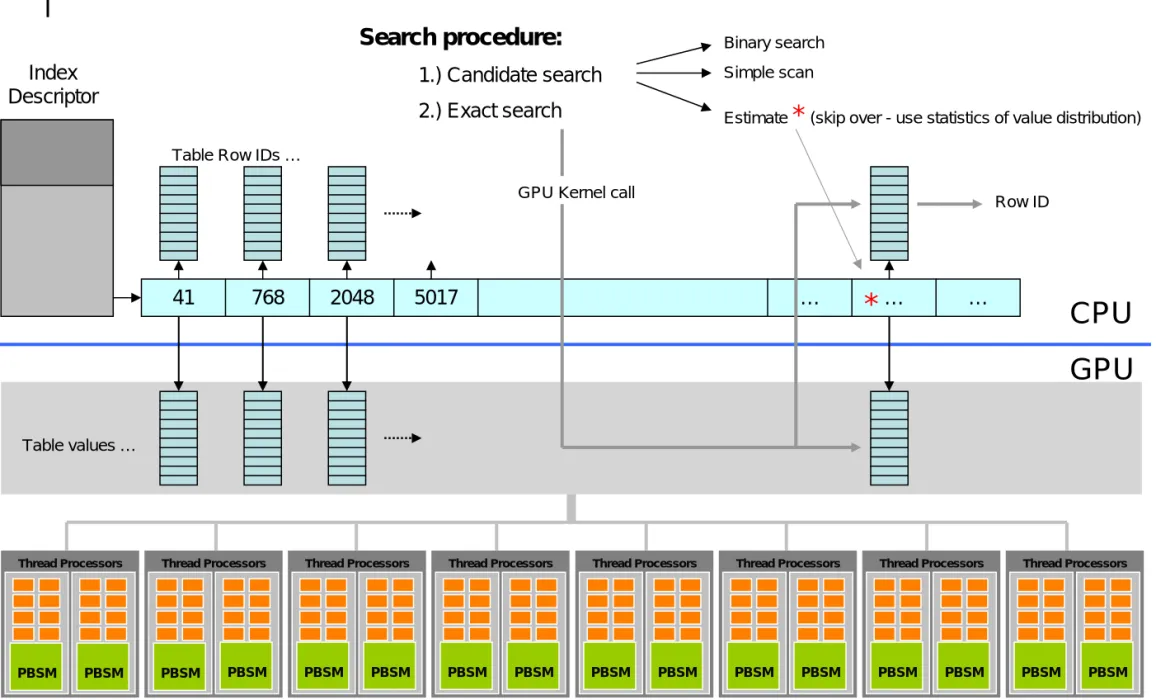
Index Layout
Column ID Table ID Flags Data Type Char size Data Addr Header Index desc. xxx xxx xxx 41 768 2048 5017 Index Descriptor Fixed size Col ID Col ID Col ID 1024 259 768 sorted unsorted or sortedSearch procedure:
1.) Candidate search 2.) Exact searchSearching can be:
1.) Binary search 2.) Scan
Index processing on GPU
Thread Processors Thread Processors Thread Processors Thread Processors Thread Processors Thread Processors Thread Processors Thread Processors
CPU
GPU
… 41 768 2048 5017 Index DescriptorSearch procedure:
1.) Candidate search 2.) Exact search … … Binary search Simple scanEstimate
*
(skip over - use statistics of value distribution)*
GPU Kernel call Table Row IDs …
Table values …
Agenda (2)
•
General architecture outline of database kernel
Explains the overall design principle chosen to make a database kernel ready for massive parallel processing and GPU ready
•
Database Table structure and outline
Explains the vertical partitioning layout and why this is one of the most important pre-requisites for successful GPU co-processing in database kernels
•
Memory management
The memory management subsystem architecture and how to manage memory on a GPU device with missing dynamic memory management facilities
•
Query Optimizer
Gives insights into the Split-Work architecture and explains the Optimizer architecture with a special focus on the dynamic re-optimizing steps performed during query processing
•
Query Executer structure
Explains the architecture of the query Executer with a special focus on processing the split-work plan for distributing the query work between CPU and GPU
Query Optimizer and Executer
SCAN = T1.Col2 40 SCAN = T1.Col3 abcde IDX SCAN T2.Col1 576 00000000001000001000010 00000010010110010100100 IDX SCAN T2.Col2 333 00000000001000001000010 00000010010110010100100 00000000001000001000010 00000010010110010100100 00000000001000001000010 00000010010110010100100 Join Join 00000000001000001000010 00000000001000001000010 00000000001000001000010 JOIN JOINSelected Row ID‘s as compressed bitmap Scanning stage is parallel Re-optimize Re-optimize Join Column array
GPU Table array
Barrier sync.
GPU
CPU
Re-optimizing steps performed during query execution
join stages are parallel
Why is re-optimizing important
¾
True size of intermediate result sets !
–
Split-Work requires re-examination of intermediate results
–
Schedules the query tasks either to CPU or GPU
•
Should sorting be done on GPU or CPU ?
•
Leave intermediate results on GPU or move over ?
•
Perform join processing on GPU or CPU ?
•
Is the table persistent on GPU or on CPU ?
•
…
Split-Work
Re-
optimize
Agenda (2)
•
General architecture outline of database kernel
Explains the overall design principle chosen to make a database kernel ready for massive parallel processing and GPU ready
•
Database Table structure and outline
Explains the vertical partitioning layout and why this is one of the most important pre-requisites for successful GPU co-processing in database kernels
•
Memory management
The memory management subsystem architecture and how to manage memory on a GPU device with missing dynamic memory management facilities
•
Query Optimizer
Gives insights into the Split-Work architecture and explains the Optimizer architecture with a special focus on the dynamic re-optimizing steps performed during query processing
•
Query Executer structure
Explains the architecture of the query Executer with a special focus on processing the split-work plan for distributing the query work between CPU and GPU
Query Executer - basic principle
SCAN SCAN Join JoinScanINT(*start)
{
val = start[1]
*p = start[2]
*bitmap = start[3]
#pragma omp parallel
for(….)
}
T1.Col2 40ScanINT_GPU(*start)
{
….
// call GPU kernel….
ScanInt <<<dimGrid, dimBlock>>> (...)
….
}
Query Compiler
+ Optimizer
Operator Library
Worker Thread
Select …. FROM ….
Operator
Tree
Pre-compiled
operators
Thread Pool
stop
Executer
Function
Data
ScanINT(void *start)
ScanUINT(void *start)
ScanFLOAT(void *start)
ScanDBL(void *start)
ScanIntIDX(void *start)
AddINT(void *start)
AddDBL(void *start)
Vector processing of algebra functions
• Compiler optimization• Filled cache lines
• Memory prefetch support • No instruction cache misses • Loop unrolling
• Branch prediction
Re-optimize
ScanINT_GPU
4 cores
• Coalesced memory access • High bandwidth
• Massive parallel scanning • Fast sorting
• Arithmetic processing • Data local on GPU
GPU Kernel call Function call
Split-Work scheduler scales to multi GPUs
n copies of (partial) program array
CPU thread 1
CPU thread 2
CPU thread n
GPU kernel
call
GPU kernel
call
GPU kernel
call
SQL query processing
Task distribution to
maximize performance !
Scan
Join
Project
4 cores
4 cores
Select age, name, (salary * tax) From T Where
age > 18 and salary > 10,000 and …
age name salary tax