BCcampus White Paper
Competency to Credential: An Alternative Model for
Flexible Learning in Trades Training in British
Columbia and Beyond
T
he Professional Cook Pilot Project
Version: Final
BCcampus provides consulting services and support for post-secondary system collaboration on educational technology innovation projects in British Columbia. Collaboration is often best led and facilitated by a sponsor organization acting as a “collaborative agent” – a neutral system-wide group acting as convener, catalyst, and capacity builder. Working across boundaries, BCcampus adopted a service-based model to develop, implement and operate such endeavours.
Contact information:
Lawrence Parisotto, Director Collaborative Services, BCcampus [email protected]
Michelle Glubke, Manager, Collaborative Services, BCcampus [email protected]
Table of Contents
Introduction ... 4
BCcampus White Papers ... 4
Overview ... 4
Background ... 4
Competency-Based Education ... 4
Tools for Competency-Based Education ... 5
Competency to Credential: Concept, Proof of Concept, and Approach ... 6
The Concept ... 6
Proof of Concept ... 7
Refining the Approach to Trades Training in British Columbia ... 8
Competency to Credential in Action: The Professional Cook Pilot Project ... 9
Findings ... 11
Phase 1: Single Jurisdiction Limited Pilot ... 11
Phase 2: Single Jurisdiction Expanded Pilot ... 12
Future Development ... 14
Systemic Adoption in the Professional Cook Trade ... 14
Multi-Jurisdiction Application ... 14 Challenges ... 15 Long-term sustainability ... 15 Iterative design ... 15 Collaborative endeavour ... 15 Institutional integration ... 15 Discussion ... 15 Conclusion ... 17
Introduction
BCcampus White Papers
This paper is one of a number of BCcampus white papers (http://bccampus.ca/?s=white+paper) published to establish thought leadership on relevant topics in post-secondary education and training in British Columbia. The white papers identify current challenges in post-secondary education and report on how collaborative innovation processes are used to develop and recommend new, improved solutions that integrate educational technologies and pedagogy in ways that are effective in solving current challenges. In some cases, research or evaluation findings are presented.
Overview
This white paper reviews the BCcampus Competency to Credential approach to flexible learning in trades training in British Columbia. First, it considers the broader notion of competency-based education and the development of the Competency to Credential concept in response to current education and training challenges. The paper then considers at a high level how the concept may also be applied to other competency-based education and training programs, such as in health care education. In particular, though, this paper describes how the Competency to Credential approach brings system stakeholders together in a collaborative and unified effort to improve trades training and education system-wide in British Columbia and shows how a broader application to other jurisdictions and trades sectors in Canada might occur.
To exemplify the Competency to Credential approach, the paper focuses on the first two phases of a pilot project targeting certification challengers within the Professional Cook trade in British Columbia.
Background
Competency-Based Education
Competency-based education (or learning) became a popular approach to education and training in the 1980s and 1990s. Competency-based education refers to systems of instruction, assessment, grading and academic reporting that are based on
students demonstrating that they have the knowledge and skills they are expected to learn as they progress through their education (http://edglossary.org/competency-based-learning/). Typically, certifying or professional accrediting bodies develop entry-to-practice competency profiles for learners to become credentialed in a discipline. The competency profile is a document that lists the outcomes or competencies that a learner must have at the
entry‐to‐practice level for the profession. These outcomes or competencies are required in order for a person to satisfactorily perform the duties of the profession. Learning how to do these tasks and achieving the competency needed for safe and effective practice requires
knowledge, skill and judgment that are typically learned through a combination of an education or training program and workplace training.
Education and training programs use the competency profiles to develop curriculum guides and learning resources. Curriculum is both the theory that is taught and assessed in a classroom setting and the skills and application of theory that are taught and evaluated during the
workplace experience component of the program. Trades, technical and health care education and training programs have used competency-based education for decades in Canada.
More recently, though, competency-based education has come to be viewed as an alternative to more traditional educational approaches for academic programs in which students may or may not acquire proficiency in a given course or academic subject, instead earning course credit based on course objectives and course hours. The terms competency-based
education and competency-based learning (and other related terms) have increasingly been adopted by colleges and universities offering online learning and degree programs. In such cases, competency-based learning may entail prospective students receiving academic credit for knowledge and skills they acquired in prior learning – an approach that can reduce tuition costs and accelerate their progress toward earning a degree. For example, a consortium of 13 Washington state community colleges are launching an online competency-based business transfer degree, the first of its kind in the state
(http://www.sbctc.ctc.edu/general/documents/comp-based-issue-paper06-16-14.pdf). It will allow students to advance faster through the degree, especially working adults who already have knowledge and skills.
For post-secondary institutions, the transition to a competency-based education approach may involve significant cultural and business process changes, affecting everything from the
institution’s educational philosophy and culture to its methods of instruction, testing, grading, reporting, promotion and graduation. These changes may create significant barriers to implementation of competency-based education and/or tools to support competency-based education, and may take considerable time to plan and execute.
Tools for Competency-Based Education
As more competency-based education programs are implemented, whether in traditional or new program areas, educational technology tools have been emerging to support them. These tools range from software utilities that enable a single type of student competency-based education project to complex, vendor or open source enterprise-wide solutions that accommodate multiple program areas. The tools can help define and document learning outcomes, map competencies to the curriculum, track student progress, or certify prior knowledge. Competency-based
education and the educational technology tools that support it encourage a rethinking of pedagogy, assessment and the concept of the credit hour
Competency to Credential: Concept, Proof of Concept, and Approach
The Concept
As part of its continual scanning of higher education teaching and learning approaches, BCcampus has monitored the recent interest and developments in competency-based education. In early 2013, using a process combining challenge-driven innovation, iterative design and collaborative leadership, BCcampus developed a high-level concept aimed at alleviating or solving current issues and challenges in sectors where teaching, learning and credentialing are defined by competency frameworks.
Competency to Credential uses innovative educational technologies to better deliver and support education and training in competency-based disciplines, such as those in trades and health care. It utilizes a competency repository based on recognized and approved competency profiles as a fundamental basis for all teaching and learning that occurs through to the
achievement of a credential.
Competency to Credential was initially conceived through a challenge-driven innovation and iterative design process for the delivery of new “horizontal” competency profiles resulting from changing health care strategies across several “vertical” health care professions. Horizontal competencies are those that are common across several disciplines or credentials – vertical competencies are specific to each discipline or credential. The goal was to design a flexible, systemic model for delivery of education and training that is specific to individual learning needs. The initial focus was on collaboratively developing a model for prior learning assessment,
individual learning plans and gap training that would facilitate:
• a comprehensive and coordinated approach to meeting learners’ needs in achieving the
credentials required to enter the job market
• faster attainment of credentials required for qualifications • better access to and flexibility of gap training delivery
• more efficient development and use of common open educational and curricular
resources that reduce redundancies
Because of the challenges considered at the design phase, the Competency to Credential concept included system-wide solutions to many other current challenges. These were explored after the proof of concept stage.
Proof of Concept
Once the Competency to Credential concept had been proposed, designed and reviewed, it required testing and evaluation to determine its efficacy. This was done by means of a proof of concept study with limited investment in time, resources and participants prior to a pilot
implementation.
The proof of concept study allowed for validation of high-level conceptual and technical
requirements identified through stakeholder consultation and analysis of case scenarios in both the health and trade sectors. This study included researching competency-based education models, mapping high-level system requirements, designing the conceptual architecture, and reviewing and selecting the technology. An initial evaluation of tools led to the selection of TotaraLMS, a custom distribution of Moodle. Through stakeholder collaboration and an iterative design process, the TotaraLMS platform was set up and case scenarios were demonstrated in order to validate the requirements.
With the concept, approach and technology in place, the following conceptual requirements were validated during the proof of concept study:
• a learner-driven process for mapping individual pathways to advancement and credential
completion
• a method for identifying gaps in competency proficiency
• a process for learners to access learning material and complete training at a granular
level for which competency proficiency is lacking
• a means for collecting and recognizing experience and qualifications
• a method for storing, organizing, assigning and editing competency frameworks • a collaborative solution that highlights system stakeholder expertise
The following technical requirements were also validated during the proof of concept study:
• open source software • feasible costing model
• interoperability between a competency framework repository and a learning
management system for curriculum storage
• ability to link competencies at a granular level to learning material • user-friendly interface
• learner self-assessment tool • internal communication method
• prior-learning evidence gathering • e-portfolio integration
• badging integration
• reporting mechanism for multiple stakeholders • user roles and security features
• process automation
With both conceptual and technical requirements validated, and an evaluation of the proof of concept study demonstrating that further piloting was warranted, BCcampus proceeded with next steps in the development of the Competency to Credential approach.
Refining the Approach to Trades Training in British Columbia
Both the federal government and provincial governments across Canada have made skills training and development a priority in addressing a predicted looming labour shortage. In British Columbia, the recent review of the Industry Training Authority and B.C.’s Skills for Jobs
Blueprint: Re-engineering Education and Training are attempting to ensure more completions in skilled trades areas.
While these and other reviews and recommendations have addressed structural and organizational changes related to trades training in the province, there are few
recommendations concerning alternative means of trades training that will provide more flexible options to improve outcomes and completion rates for apprentices. Innovation in this regard is isolated and sporadic, occurring in individual training organizations rather than in a systemic fashion.
In response to trades training needs and potential shortages of skilled trades workers in British Columbia, BCcampus refined the Competency to Credential concept for application specifically to trades training. The Competency to Credential approach refined for trades training is
designed to alleviate or solve current challenges with trades training, which include:
• lack of remediation at the competency level
• inability to teach and recognize achievement of common competencies across trades
programs
• lack of consistent documentation of workplace experience • difficulty in performing prior learning assessments
• inability to create individual learning plans and gap training based on individual
• difficult and inconsistent foreign credential recognition
• need for better training and labour market mobility for certificates of qualification,
technical training levels and Red Seal
The three key aspects of the Competency to Credential approach that accomplish this are:
• a competency repository that links competency frameworks to curricular resources at a
granular level
• open and collaborative curriculum development and training delivery through a library of
common learning resources
• flexible blended and online delivery for both technical theory and workplace practical
training and simulation through use of competency-based educational technologies The aspect of the Competency to Credential approach that is supported by new technology tools is the online repository of competency frameworks. Each competency in the framework is linked at a granular level to open curricular resources within a learning management system. The approach is therefore facilitated by an educational technology that supports a competency-based education and training model.
Competency to Credential in Action: The Professional Cook Pilot
Project
BCcampus undertook a pilot project in which the Competency to Credential approach would be applied to trades training to determine whether the flexible, competency-based education approach might solve or alleviate many of the current training challenges at the systemic level. The area chosen for the pilot project was the Professional Cook program, including Professional Cook 1, Professional Cook 2 and Professional Cook 3 (Red Seal).
In collaboration with go2hr, an organization that supports BC’s hospitality and tourism industry, BCcampus further refined the Competency to Credential approach for the Professional Cook Pilot Project, based on needs and requirements specified by go2hr for gap training and the challenge process for professional cooks in British Columbia.
The focus of the pilot project was not only on the implementation of the approach, but also on the implementation of new tools to better support competency-based education and the benefits these tools could provide for systemic adoption of competency-based education. The
educational technology selected for the proof of concept study, TotaraLMS, was also selected for the Professional Cook Pilot project. TotaraLMS (http://www.totaralms.com/) is a custom distribution of the LMS Moodle that overlays competency frameworks on existing Moodle functionality. TotaraLMS includes the following features:
• individual learning and development plans • classroom management • team management • competency management • learning paths • program management • sophisticated reporting • open badges • performance management • certifications
The pilot project was designed to provide a study of the concept and approach in operation, make adjustments to emerging requirements, and capture evidence from expected outcomes. Four phases were initially identified for the project:
• Phase 1: Single Jurisdiction Limited Pilot • Phase 2: Single Jurisdiction Expanded Pilot • Phase 3: Single Jurisdiction Scale Out
• Phase 4: Single Jurisdiction Systemic Adoption
After the evaluation of Phase 1, the potential for a broader application of the Competency to Credential approach was discussed with project stakeholders, other provincial jurisdictions, and federal bodies. This included an opportunity to apply and evaluate the approach across
jurisdictions in one trade sector, with possible application to other trade sectors. As a result, the following phases were added to the activities of the pilot project:
• Phase 5: Multi-Jurisdiction Limited Pilots • Phase 6: Multi-Jurisdiction Expanded Pilots • Phase 7: Multi-Jurisdiction Scale Out
• Phase 8: Multi-Jurisdiction Systemic Adoption
Findings
Phase 1: Single Jurisdiction Limited Pilot
The target audience for Phase 1 was limited to challengers of the Cook (Professional Cook 3) Red Seal certification exam, and those who supported them, in British Columbia. (Additional users would be integrated into the pilot project after Phase 1.)
Nationally, almost 600 people challenge the certification exam in the Cook trade each year, with only a 52% certification success rate. In BC, challengers fared better than the national average, but still only 75% were successful on the Red Seal exam. While BC challengers had a prior learning assessment to determine whether they were ready to take a certification exam, the process did not identify specific gaps in competency proficiency. Challengers were provided with information on program textbooks and other general course material, rather than targeted resources required to fill gaps in proficiency.
There were 43 participants in Phase 1 of the pilot project, including 38 who had previously been unsuccessful one or more times in passing the Red Seal certification exam and 5 whose
assessment did not qualify them to challenge the Red Seal certification exam. The pilot ran for 3 months, with participants involved in a expedited 6-week learning period. The expected
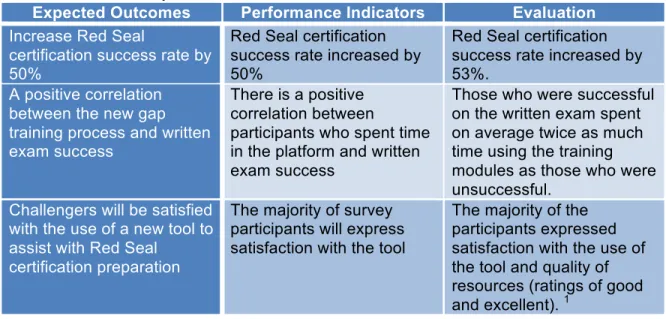
outcomes, performance indicators and results of Phase 1 are shown in Table 1. Table 1: Phase 1 – Expected Outcomes, Performance Indicators and Evaluation
Expected Outcomes Performance Indicators Evaluation
Increase Red Seal
certification success rate by 50%
Red Seal certification success rate increased by 50%
Red Seal certification success rate increased by 53%.
A positive correlation between the new gap training process and written exam success
There is a positive correlation between
participants who spent time in the platform and written exam success
Those who were successful on the written exam spent on average twice as much time using the training modules as those who were unsuccessful.
Challengers will be satisfied with the use of a new tool to assist with Red Seal
certification preparation
The majority of survey participants will express satisfaction with the tool
The majority of the participants expressed satisfaction with the use of the tool and quality of resources (ratings of good and excellent). 1
1This is a general high-level statement referencing survey results administered within the platform by
Phase 2: Single Jurisdiction Expanded Pilot
Phase 2 of the pilot project was designed to test a broader user experience, and expanded to include up to 500 participants in the following categories:
• BC residents, out-of-province residents, international students, new immigrants,
workplace trained and new apprentices in the Professional Cook trade
• Learners in a full training program (at a training provider), with a prior learning
assessment with gap or remedial training, and prior learning assessment with challenge certification
• Users engaged in learner and apprentice relationships, including Professional Cook
training providers (instructors at colleges, institutes and universities), mentors, employers, go2hr and Industry Training Authority staff.
• Users specific to the Professional Cook trade, including trade-specific support staff and
administrators
• Users specific to technical provisioning and support – third-party technical support and
administration staff (not required if service was hosted, administered and supported locally)
There was ongoing review and testing of user requirements and system settings to ensure the fine balance between strict data privacy and seamless user experience.
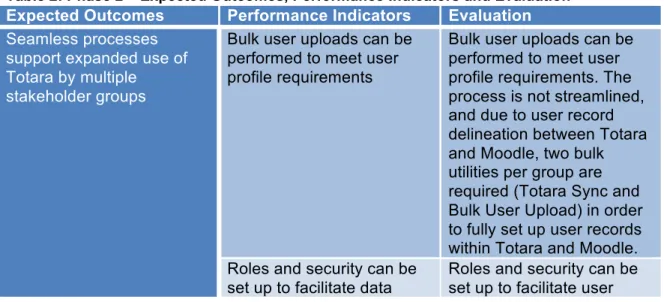
The expected outcomes, performance indicators and results for Phase 2 are shown in Table 2. Table 2: Phase 2 – Expected Outcomes, Performance Indicators and Evaluation
Expected Outcomes Performance Indicators Evaluation
Seamless processes support expanded use of Totara by multiple stakeholder groups
Bulk user uploads can be performed to meet user profile requirements
Bulk user uploads can be performed to meet user profile requirements. The process is not streamlined, and due to user record delineation between Totara and Moodle, two bulk utilities per group are required (Totara Sync and Bulk User Upload) in order to fully set up user records within Totara and Moodle. Roles and security can be
set up to facilitate data
Roles and security can be set up to facilitate user
Expected Outcomes Performance Indicators Evaluation privacy and user
responsibilities
responsibilities and some data privacy requirements. In order to facilitate full data privacy, an additional layer of set up is required using Moodle groups and system-wide Totara audiences. Custom programs can be
built
Custom training programs can be easily built and assigned to users using Totara positions,
competencies and learning plans.
Training providers can obtain required data from Totara
The Moodle Gradebook export and reporting functionality provides training providers with grade data
The Moodle Gradebook export and reporting functionalities provide training providers with grade data. (Evaluation of grade data integration into existing Student Information Systems will take place in Phase 3.)
Common trade
requirements can be met using Totara
Practical training modules can be integrated into the platform
Practical training activities (in-class activities) can be built within the system and associated with a common rubric. (User experience of this functionality will be tested in Phase 3.) A proposed solution for
logbooks is created
A solution using a database activity did not work as well as anticipated, as security within the activity is not enforceable in an intuitive way. A search for a more elegant solution within Totara is underway. A method for supporting
mentorship relationships is created
The performance appraisal functionality was explored for this outcome. Set-up of mentorship relationships will occur in Phase 3.
Additional data focusing on learner and instructor experience and learner success on certification exams from Phase 2 will be captured during Phase 3 of the pilot project.
Future Development
Systemic Adoption in the Professional Cook Trade
Systemic adoption of the Competency to Credential approach in the Professional Cook trade will require system partners to have the resources for, interest in and time for engaging a cultural and business change process. BCcampus will continue to support go2hr in the pursuit of a long-term home for and systemic adoption of all aspects of the competency to credential approach, with attention to:
• sharing the benefits of innovative collaboration and resulting system efficiencies • pursuing engagement of system stakeholders
• fostering relationships that champion movement and disruption in the system
• leveraging lessons learned from ongoing testing and evaluating of the Competency to
Credential approach
Multi-Jurisdiction Application
BCcampus continue to engage stakeholders provincially and nationally, sharing the model and evidence, and seeking feedback and input into the approach. The Competency to Credential approach will enable student and apprentice mobility nationally, as experience and knowledge can be assessed against provincial competency requirements. As an added benefit, system partners will reduce redundancy by working together within one central learning resource, creating and sharing common modules and assessments.
The following phases have been identified for future development of the Professional Cook program across jurisdictions and sectors:
• Phase 5: Multi-Jurisdiction Limited Pilots – Limited pilots involving multiple jurisdictions
in one trade area
• Phase 6: Multi-Jurisdiction Expanded Pilots – Expanded pilots involving multiple
jurisdictions in one or more trade areas
• Phase 7: Multi-Jurisdiction Scale Out – Scaling out of model to accommodate training
providers, learners and employers in the Professional Cook trade in multiple jurisdictions across Canada
• Phase 8: Multi-Jurisdiction Systemic Adoption – Systemic adoption and
operationalization in one or more trade areas in multiple jurisdictions across Canada
Challenges
The challenges below were identified during the initial design stage or emerged during the pilot project and will need further consideration in future phases and development.
Long-term sustainability
During Phases 3 and 4 of the project, a long-term home and cost recoverable model will be explored and established. Some important factors in the long-term sustainability of the central learning resource include scalability, administration, licensing and hosting. Some advantages of using the current selected educational technology, Totara LMS, include scalability and a
feasible licensing and hosting costing model. Iterative design
Working collaboratively requires agility in responding to emergent needs. Iterative design welcomes this aspect of multi-stakeholder participation and enables users to look for and respond to new information that will enhance the model or solution as a whole.
Collaborative endeavour
Maintaining a central learning resource requires stakeholder buy-in and acceptance of one definitive location for the best available tools and material. Users of the resource will need to value the concept of reducing redundancy and working together to create a resource that no one stakeholder group could do one their own.
Institutional integration
Institutional use and integration of an external resource requires further analysis and consideration for appropriate processes and practices. In the initial phases of the project, training providers were consulted, invited to explore and use the material, and asked to provide input into the design and use of the system. During Phases 3 and 4, go2hr will invite all training providers to utilize the resource in its entirety, testing for and capturing feedback for
enhancements.
Discussion
As mentioned previously, nested within the Competency to Credential approach are solutions to other current challenges with trades training, including:
• Common modules – “horizontal” competencies (common competencies such as safety)
can be delivered out of cohorts and recognized across “vertical” (similar or related trades or health professions) credential areas
• Log books – workplace competencies can be demonstrated, assessed and recognized
in a consistent and more formal way
• Prior learning assessment (PLA) – a consistent and efficient process replaces
labourious, inconsistent and time-consuming processes
• Individual learning plans and gap training – PLA results directly in an individual learning
plan to promote gap training
• Red Seal – multi-jurisdictional competency frameworks are directly compared to one
another with identified gaps
• Foreign credential recognition – can be attained quickly through PLA, gap training and
challenge processes
A notable result of collaboration between partners in the trades training system is that learners will gain access to the competency framework for which they will be assessed and a curricular resource library that links directly to this framework. Through self-assessment and prior learning recognition, individual learning pathways are created that guide users to credential completion. Linking competencies at a granular level to learning material will also allow for a sustainable solution to the challenge of assessing the skill level of the labour pool and maintaining competency libraries as competencies change over time. The Competency to Credential approach may also better support training and labour market mobility, as direct inter-jurisdictional comparisons result in gap training or credential recognition.
The Competency to Credential approach could therefore be used as a systemic and flexible learning approach to improve completion rates for apprentices across all areas of trades training by:
• better integrating the 6-weeks of technical training and approximately 40 weeks of
workplace experience each year for new apprentices taking a full program of training
• providing gap training to those workers with some knowledge, skills and experience who
require trades credentials
• providing assessment to those learners who may be able to challenge their trades
At the concept level, competency-based credentialing is also being touted in other jurisdictions as a better way to meet the needs of a dynamic workforce:
A high-quality credentialing ecosystem for the dynamic 21st century economy must be equally dynamic, grounded in competencies, regardless of the type of credential. As
employers continually recalibrate the knowledge, skills and abilities their jobs require, and as occupations are created and adapted, the U.S. needs a credentialing ecosystem that
combines rigor and agility to produce credentials valued by employers, government, educators, students and job seekers. (
http://www.clasp.org/resources-and-publications/files/Developing-a-Competency-Based-Credentialing-Ecosystem.pdf)
Conclusion
Competency-based education is perhaps the most disruptive innovation currently in post-secondary education:
In contrast to other recent trends in higher education, particularly MOOCs (massive open online courses) with their tremendous fanfare, online competency-based education (often shortened to "CBE") stands out as the innovation most likely to disrupt higher education. It serves as the missing link between learning outcomes and industry needs. A true workforce solution, competency-based education has the potential to bridge the widening gap between traditional postsecondary education and the workforce.
Clearly, workforce training, competency-based learning, and online instruction are not new phenomena; it is the combination of all of these into one learning pathway that shows true disruptive potential. Online competency-based education marks the critical convergence of multiple vectors: the right learning model, the right technologies, the right customers, and the right business model. It fuses mastery-based learning with modularization, leading to pathways that are more agile and more adaptable to the changing labor market.
( http://www.educause.edu/ero/article/got-skills-why-online-competency-based-education-disruptive-innovation-higher-education)
BCcampus has demonstrated the potential of educational technology tools that support a systemic and flexible approach to competency-based education and competency-based
credentialing. The collaborative development and phased implementation of the Competency to Credential approach within the Professional Cook trade has resulted in evidence supporting identified performance indicators, as well as stakeholder enthusiasm for a central learning resource library.
Ultimately, BCcampus believes the use of the Competency to Credential approach and tools will assist educational programs that are transitioning to competency-based education and/or competency-based education tools in avoiding many issues and potential barriers to success. Future phases of the current pilot project will focus on the systemic adoption of this approach for the Professional Cook trade within British Columbia and the potential for multi-jurisdictional application within Canada.
Guided by challenge-driven innovation and a mandate to implement systemic education and training solutions in British Columbia, BCcampus will continue to look for opportunities to pilot and evaluate the Competency to Credential approach within other competency-based trades and sectors.
Other BCcampus Resources
Competency-based education: Training for the gap: bccampus.ca/2014/12/16/competency-based-education-training-for-the-gap/
The need for tools in Competency-Based Education: http://bccampus.ca/2015/01/27/the-need-for-tools-in-competency-based-education/