P
ractically every day the Wall Street Journalruns a story about some company in financial difficulty. For example, recently Huffy Corp., a name that adorned the first bicycle of many American children, declared bankruptcy. Its creditors, Chinese suppliers, ended up taking a 30 percent equity stake in Huffy. Other examples are Delphi,Northwest Airlines, and United Airlines. The purpose of this appendix is to explain how creditors and debtors re-port information in financial statements related to these troubled debt situations. Two dif-ferent types of situations result with troubled debt.1 Impairments. 2 Restructurings:
a. Settlements.
b. Modification of terms.
In a troubled-debt situation, the creditor usually first recognizes a loss on impair-ment. Subsequently, the creditor either modifies the terms of the loan or the debtor settles the loan on terms unfavorable to the creditor. In unusual cases, the creditor forces the debtor into bankruptcy in order to ensure the highest possible collection on the loan. Illustration G-1 shows this continuum.
APPENDIX G
ACCOUNTING FOR TROUBLED DEBT
Bankruptcy Loan Impairment Modification of Terms Loan Origination Illustration G-1 Usual Progression in Troubled Debt Situations
IMPAIRMENTS
A
creditor considers a loan1 impaired when it is probable,2based on current information and events, that it will not collect all amounts due (both principal and interest). Creditors should apply their normal review procedures in making the judgment as to the probability of collection.31
FASB Statement No. 114,“Accounting by Creditors for Impairment of a Loan,” (Norwalk, Conn.: FASB, May 1993), defines a loan as “a contractual right to receive money on demand or on fixed and determinable dates that is recognized as an asset in the creditor’s statement of financial posi-tion.” For example, accounts receivable with terms exceeding one year are considered loans. 2
Recall the definitions of probable, reasonably possible, and remote with respect to contingencies, as defined in FASB Statement No. 5.
3
Normal review procedures include examination of “watch lists,” review of regulatory reports of examination, and examination of management reports of total loan amounts by borrower.
OBJECTIVE
1
Describe the accounting for a loan
impairment.
Illustration G-2
Time Diagram for Zero-Interest-Bearing Loan
Illustration G-3 Creditor and Debtor Entries to Record Note
If considering a loan impaired, the creditor should measure the loss due to the
impairmentas the difference between the investment in the loan (generally the principal plus accrued interest) and the expected future cash flows discounted at the loan’s histori-cal effective interest rate.4When using the historical effective loan rate, the value of the in-vestment will change only if some of the legally contracted cash flows are reduced. A com-pany recognizes a loss in this case because the expected future cash flows have changed. The company ignores interest rate changes caused by current economic events that affect the fair value of the loan. In estimating future cash flows, the creditor should use reason-able and supportreason-able assumptions and projections.5
Example of Loss on Impairment
On December 31, 2008, Prospect Inc. issued a $500,000, five-year, zero-interest-bearing note to Community Bank. Prospect issued the note to yield 10% annual interest. As a re-sult, Prospect received, and Community Bank paid, $310,460 ($500,000 .62092) on December 31, 2008.6The time diagram in Illustration G-2 depicts the factors involved.
12/31/12 Number of Periods n = 5 Interest Rate i = 10% 12/31/10 12/31/11 12/31/13 12/31/08 12/31/09 Future Value $500,000 Present Value $310,460 4
The creditor may also, for the sake of expediency, use the market price of the loan (if such a price is available) or the fair value of collateral if it is a collateralized loan. FASB Statement No. 114, par. 13.
5
FASB Statement No. 114,par. 15. 6
Present value of $500,000 due in five years at 10%, annual compounding (Table 2 in Appendix A) equals $500,000 .62092.
Illustration G-3 shows how Community Bank (creditor) and Prospect (debtor) record these transactions.
December 31, 2008
Community Bank (Creditor) Prospect Inc. (Debtor)
Notes Receivable 500,000 Cash 310,460
Discount on Notes Discount on Notes
Receivable 189,540 Payable 189,540
Cash 310,460 Notes Payable 500,000
Assuming that Community Bank and Prospect use the effective-interest method to amor-tize discounts, Illustration G-4 (page 1110) shows the amortization of the discount and the increase in the carrying amount of the note over the life of the note.
1110
Appendix G Accounting for Troubled DebtCommunity Bank
Cash Interest Carrying
Received Revenue Discount Amount of
Date (0%) (10%) Amortized Note
12/31/08 $310,460 12/31/09 $0 $ 31,046a $ 31,046 341,506b 12/31/10 0 34,151 34,151 375,657 12/31/11 0 37,566 37,566 413,223 12/31/12 0 41,322 41,322 454,545 12/31/13 0 45,455 45,455 500,000 Total $0 $189,540 $189,540 a$31,046 $310,460 .10 b$341,506 $310,460 $31,046
Unfortunately, during 2010 Prospect’s business deteriorated due to increased competi-tion and a faltering regional economy. After reviewing all available evidence at December 31, 2010, Community Bank determines that Prospect will probably pay back only $300,000 of the principal at maturity. As a result, Community Bank declares the loan impaired. It now needs to record a loss.
To determine the loss, Community Bank first computes the present value of the ex-pected cash flows, discounted at the historical effective rate of interest (10%). This amount is $225,396. The time diagram in Illustration G-5 highlights the factors involved in this computation. Future Value $300,000 12/31/10 12/31/11 12/31/13 Interest Rate i = 10% Number of Periods n = 3 Present Value $225,396 12/31/12
The loss due to impairment is the difference between the present value of the expected future cash flows and the recorded carrying amount of the investment in the loan. Illustra-tion G-6 shows the calculaIllustra-tion of the loss.
Illustration G-4 Schedule of Interest and Discount Amortization (Before Impairment)
Illustration G-5 Time Diagram for Impaired Loan
Illustration G-6 Computation of Loss Due to Impairment
Carrying amount of investment (12/31/10)—Illustration G-4 $375,657 Less: Present value of $300,000 due in 3 years at 10% interest
compounded annually (Table 2 in Appendix A);
FV(PVF3,10%); ($300,000 .75132) 225,396
Loss due to impairment $150,261
The loss due to the impairment is $150,261, not $200,000 ($500,000 $300,000). Why? Because Community Bank must measure the loss at a present-value amount, not an undiscounted amount, at the time it records the loss.
December 31, 2010
Community Bank (Creditor) Prospect Inc. (Debtor)
Bad Debt Expense 150,261 No entry
Allowance for Doubtful Accounts 150,261
Illustration G-7 Creditor and Debtor Entries to Record Loss on Note
Community Bank (creditor) debits Bad Debt Expense for the expected loss. At the same time, it reduces the overall value of its loan receivable by crediting Allowance for Doubt-ful Accounts.7What entry does Prospect (the debtor) make? It makes no entry because it still legally owes $500,000.8
TROUBLED-DEBT RESTRUCTURINGS
Atroubled-debt restructuring occurs when a creditor “for economic or legal reasons related to the debtor’s financial difficulties grants a concession to the debtor that it would not otherwise consider.”9 Thus a troubled-debt restructuring does not apply to modifica-tions of a debt obligation that reflect general economic condimodifica-tions leading to a reduced in-terest rate. Nor does it apply to the refunding of an old debt with new debt having an ef-fective interest rate approximately equal to that of similar debt issued by nontroubled debtors.
A troubled-debt restructuring involves one of two basic types of transactions: 1 Settlement of debt at less than its carrying amount.
2 Continuation of debt with a modification of terms.
Settlement of Debt
Settling a debt obligation can involve either a transfer of noncash assets (real estate, re-ceivables, or other assets) or the issuance of the debtor’s stock. In these situations, the creditor should account for the noncash assets or equity interest received at their fair value.
The debtor must determine the excess of the carrying amount of the payable over the fair value of the assets or equity transferred (gain). Likewise, the creditor must determine the ex-cess of the receivable over the fair value of those same assets or equity interests transferred (loss). The debtor recognizes a gain equal to the amount of the excess. The creditor normally charges the excess (loss) against Allowance for Doubtful Accounts. In addition, the debtor recognizes a gain or loss on disposition of assets to the extent that the fair value of those assets differs from their carrying amount (book value).
7
In the event of a loan write-off, the company charges the loss against the allowance. In subsequent periods, if revising estimated expected cash flows based on new information, the company adjusts the allowance account and bad debt account (either increased or decreased depending whether con-ditions improved or worsened) in the same fashion as the original impairment. We use the terms “loss” and “bad debt expense” interchangeably throughout this discussion. Companies should charge losses related to receivables transactions to Bad Debt Expense or the related Allowance for Doubt-ful Accounts, because they use these accounts to recognize changes in values affecting receivables. 8
Many alternatives are permitted to recognize income by Community Bank in subsequent periods. See FASB Statement No. 118,“Accounting by Creditors for Impairment of a Loan—Income Recognition and Disclosures” (Norwalk, Conn.: FASB, October 1994) for appropriate methods.
9
“Accounting by Debtors and Creditors for Troubled Debt Restructurings,”FASB Statement No. 15 (Norwalk, Conn.: FASB, June, 1977), par. 1.
OBJECTIVE
2
Describe the accounting for a debt
Transfer of Assets
Assume, for example, that American City Bank loaned $20,000,000 to Union Mortgage Company. Union Mortgage, in turn, invested these monies in residential apartment build-ings. However, because of low occupancy rates, it cannot meet its loan obligations. Ameri-can City Bank agrees to accept from Union Mortgage real estate with a fair value of $16,000,000 in full settlement of the $20,000,000 loan obligation. The real estate has a car-rying value of $21,000,000 on the books of Union Mortgage. American City Bank (credi-tor) records this transaction as follows.
Real Estate 16,000,000
Allowance for Doubtful Accounts 4,000,000
Note Receivable from Union Mortgage 20,000,000
The bank records the real estate at fair value. Further, it makes a charge to the Al-lowance for Doubtful Accounts to reflect the bad debt write-off.
Union Mortgage (debtor) records this transaction as follows.
Note Payable to American City Bank 20,000,000
Loss on Disposition of Real Estate 5,000,000
Real Estate 21,000,000
Gain on Restructuring of Debt 4,000,000
Union Mortgage has a loss on the disposition of real estate in the amount of $5,000,000 (the difference between the $21,000,000 book value and the $16,000,000 fair value). It should show this as an ordinary loss on the income statement. In addition, it has a gain on restructuring of debt of $4,000,000 (the difference between the $20,000,000 carrying amount of the note payable and the $16,000,000 fair value of the real estate).
Granting of Equity Interest
Assume that American City Bank agrees to accept from Union Mortgage 320,000 shares of common stock ($10 par) with a fair value of $16,000,000, in full settlement of the $20,000,000 loan obligation. American City Bank (creditor) records this transaction as follows.
Investment 16,000,000
Allowance for Doubtful Accounts 4,000,000
Note Receivable from Union Mortgage 20,000,000
It records the stock as an investment at the fair value at the date of restructure. Union Mortgage (debtor) records this transaction as follows.
Note Payable to American City Bank 20,000,000
Common Stock 3,200,000
Additional Paid-in Capital 12,800,000
Gain on Restructuring of Debt 4,000,000
Union Mortgage (debtor) records the stock issued in the normal manner. It records the difference between the par value and the fair value of the stock as additional paid-in capital.
Modification of Terms
In some cases, a debtor’s serious short-run cash flow problems will lead it to request one or a combination of the following modifications:
1 Reduction of the stated interest rate.
2 Extension of the maturity date of the face amount of the debt.
1112
Appendix G Accounting for Troubled Debt3 Reduction of the face amount of the debt. 4 Reduction or deferral of any accrued interest.
The creditor’s loss is based on expected cash flows discounted at the historical ef-fective rate of the loan.10 The debtor calculates its gain based on undiscounted amounts, as required by the previous standard. As a consequence, the gain recorded by the debtor will not equal the loss recorded by the creditor under many circumstances.11
Two examples demonstrate the accounting for a troubled-debt restructuring by debtors and creditors:
1 The debtor does not record a gain. 2 The debtor does record a gain. In both instances the creditor has a loss.
Example 1—No Gain for Debtor
This example demonstrates a restructuring in which the debtor records no gain.12 On December 31, 2008, Morgan National Bank enters into a debt-restructuring agreement with Resorts Development Company, which is experiencing financial difficulties. The bank restructures a $10,500,000 loan receivable issued at par (interest paid to date) by: 1 Reducing the principal obligation from $10,500,000 to $9,000,000;
2 Extending the maturity date from December 31, 2008, to December 31, 2012; and 3 Reducing the interest rate from 12% to 8%.
Debtor Calculations. The total future cash flow, after restructuring of $11,880,000 ($9,000,000 of principal plus $2,880,000 of interest payments13), exceeds the total pre- restructuring carrying amount of the debt of $10,500,000. Consequently, the debtor records no gain nor makes any adjustmentto the carrying amount of the payable. As a result, Resorts Development (debtor) makes no entry at the date of restructuring.
The debtor must compute a new effective-interest ratein order to record in-terest expense in future periods. The new effective-inin-terest rate equates the present value of the future cash flows specified by the new terms with the pre-restructuring carrying amount of the debt. In this case, Resorts Development computes the new rate by relat-ing the pre-restructure carryrelat-ing amount ($10,500,000) to the total future cash flow
10
FASB Statement No. 114, par. 42. 11
In response to concerns expressed about this nonsymmetric treatment, the FASB stated that State-ment No. 114does not address debtor accounting because the FASB was concerned that expansion of the scope of the statement would delay its issuance. By basing the debtor calculation on undiscounted amounts, the amount of gain (if any) recognized by the debtor is reduced at the time the modifica-tion of terms occurs. If fair value were used, the gain recognized would be greater. The result of this approach is to spread the unrecognized gain over the life of the new agreement. We believe that this accounting is inappropriate and hopefully will change as more fair value measurements are intro-duced into the financial statements.
12Note that the examples given for restructuring assume the creditor made no previous entries for impairment. In actuality it is likely that, in accordance with Statement No. 114,the creditor would have already made an entry when the loan initially became impaired. Restructuring would, therefore, simply require an adjustment of the initial estimated bad debt by the creditor. Recall, however, that the debtor makes no entry upon impairment.
($11,880,000). The rate necessary to discount the total future cash flow ($11,880,000), to a present value equal to the remaining balance ($10,500,000), is 3.46613%.14
On the basis of the effective rate of 3.46613%, the debtor prepares the schedule shown in Illustration G-8.
1114
Appendix G Accounting for Troubled DebtResorts Development Co. (Debtor)
Cash Interest Reduction of Carrying
Paid Expense Carrying Amount of
Date (8%) (3.46613%) Amount Note
12/31/08 $10,500,000 12/31/09 $ 720,000a $ 363,944b $ 356,056c 10,143,944 12/31/10 720,000 351,602 368,398 9,775,546 12/31/11 720,000 338,833 381,167 9,394,379 12/31/12 720,000 325,621 394,379 9,000,000 $2,880,000 $1,380,000 $1,500,000 a $720,000 $9,000,000 .08 b $363,944 $10,500,000 3.46613% c $356,056 $720,000 $363,944 Illustration G-8 Schedule Showing Reduction of Carrying Amount of Note
Calculator Solution for Interest Rate N Inputs 4 I/YR ? PV 10,500,000 PMT –720,000 FV –9,000,000 3.466 Answer
Thus, on December 31, 2009 (date of first interest payment after restructure), the debtor makes the following entry.
December 31, 2009
Notes Payable 356,056
Interest Expense 363,944
Cash 720,000
The debtor makes a similar entry (except for different amounts for debits to Notes Payable and Interest Expense) each year until maturity. At maturity, Resorts Development makes the following entry.
December 31, 2012
Notes Payable 9,000,000
Cash 9,000,000
Creditor Calculations. Morgan National Bank (creditor) must calculate its loss based on the expected future cash flows discounted at the historical effective rate of the loan. It calculates this loss as shown in Illustration G-9.
14
An accurate interest rate i can be found by using the formulas given at the tops of Tables 2 and 4 in Appendix A to set up the following equation.
$10,500,000 $9,000,000 $720,000
(from Table 2) (from Table 4)
Solving algebraically for i, we find that i3.46613%.
1 (1 1 i)4 i 1 (1 i)4
As a result, Morgan National Bank records bad debt expense as follows (assuming no establishment of an allowance balance from recognition of an impairment).
Bad Debt Expense 2,593,428
Allowance for Doubtful Accounts 2,593,428
In subsequent periods, Morgan National Bank reports interest revenue based on the historical effective rate. Illustration G-10 provides the following interest and amortization information.
Pre-restructure carrying amount $10,500,000
Present value of restructured cash flows: Present value of $9,000,000 due in 4 years
at 12%, interest payable annually (Table 2 in Appendix A);
FV(PVF4,12%); ($9,000,000 .63552) $5,719,680
Present value of $720,000 interest payable annually for 4 years at 12% (Table 4 in Appendix A); R(PVF-OA4,12%);
($720,000 3.03735) 2,186,892
Present value of restructured cash flows 7,906,572
Loss on restructuring $ 2,593,428
Illustration G-9
Computation of Loss to Creditor on Restructuring
Morgan National Bank (Creditor)
Cash Interest Increase of Carrying
Received Revenue Carrying Amount of
Date (8%) (12%) Amount Note
12/31/08 $7,906,572 12/31/09 $ 720,000a $ 948,789b $ 228,789c 8,135,361 12/31/10 720,000 976,243 256,243 8,391,604 12/31/11 720,000 1,006,992 286,992 8,678,596 12/31/12 720,000 1,041,404d 321,404d 9,000,000 Total $2,880,000 $3,973,428 $1,093,428 a $720,000 $9,000,000 .08 b $948,789 $7,906,572 .12 c$228,789 $948,789 $720,000 d$28 adjustment to compensate for rounding.
Illustration G-10
Schedule of Interest and Amortization after Debt Restructuring
On December 31, 2009, Morgan National Bank makes the following entry. December 31, 2009
Cash 720,000
Allowance for Doubtful Accounts 228,789
Interest Revenue 948,789
The creditor makes a similar entry (except for different amounts debited to Allowance for Doubtful Accounts and credited to Interest Revenue) each year until maturity. At ma-turity, the company makes the following entry.
December 31, 2012
Cash 9,000,000
Allowance for Doubtful Accounts 1,500,000
Notes Receivable 10,500,000
Example 2—Gain for Debtor
If the pre-restructure carrying amount exceeds the total future cash flows as a result of a modification of the terms, the debtor records a gain. To illustrate, assume the facts in the
previous example except that Morgan National Bank reduces the principal to $7,000,000 (and extends the maturity date to December 31, 2012, and reduces the interest from 12% to 8%). The total future cash flow is now $9,240,000 ($7,000,000 of principal plus $2,240,000 of interest15), which is $1,260,000 ($10,500,000 $9,240,000) less than the pre-restructure carrying amount of $10,500,000.
Under these circumstances, Resorts Development (debtor) reduces the carrying amount of its payable $1,260,000 and records a gain of $1,260,000. On the other hand, Morgan National Bank (creditor) debits its Bad Debt Expense for $4,350,444. Illustration G-11 shows this computation.
1116
Appendix G Accounting for Troubled Debt15
Total interest payments are: $7,000,000 .08 4 years $2,240,000. Illustration G-11
Computation of Loss to Creditor on Restructuring
Pre-restructure carrying amount $10,500,000
Present value of restructured cash flows:
Present value of $7,000,000 due in 4 years at 12%, interest payable annually (Table 2 in Appendix A);
FV(PVF4,12%); ($7,000,000 .63552) $4,448,640
Present value of $560,000 interest payable annually for 4 years at 12% (Table 4 in Appendix A);
R(PVF-OA4,12%); ($560,000 3.03735) 1,700,916 6,149,556
Creditor’s loss on restructuring $ 4,350,444
Illustration G-12 shows the entries to record the gain and loss on the debtor’s and cred-itor’s books at the date of restructure, December 31, 2008.
Illustration G-12 Debtor and Creditor Entries to Record Gain and Loss on Note
December 31, 2008 (date of restructure)
Resorts Development Co. (Debtor) Morgan National Bank (Creditor)
Notes Payable 1,260,000 Bad Debt Expense 4,350,444
Gain on Restructuring of Allowance for Doubtful Accounts 4,350,444
Debt 1,260,000
Morgan National Bank (Creditor)
Cash Interest Increase in Carrying
Received Revenue Carrying Amount of
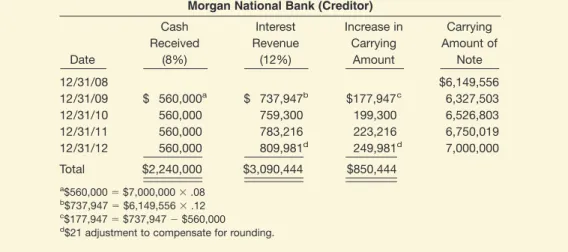
Date (8%) (12%) Amount Note
12/31/08 $6,149,556 12/31/09 $ 560,000a $ 737,947b $177,947c 6,327,503 12/31/10 560,000 759,300 199,300 6,526,803 12/31/11 560,000 783,216 223,216 6,750,019 12/31/12 560,000 809,981d 249,981d 7,000,000 Total $2,240,000 $3,090,444 $850,444 a $560,000 $7,000,000 .08 b $737,947 $6,149,556 .12 c $177,947 $737,947 $560,000 d
$21 adjustment to compensate for rounding. Illustration G-13
Schedule of Interest and Amortization after Debt Restructuring
For Resorts Development (debtor), because the new carrying value of the note ($10,500,000 $1,260,000 $9,240,000) equals the sum of the undiscounted cash flows ($9,240,000), the imputed interest rate is 0 percent. Consequently, all of the future cash flows reduce the principal balance, and the company recognizes no interest expense.
Morgan National reports the interest revenue in the same fashion as the previous ex-ample—that is, using the historical effective interest rate applied toward the newly dis-counted value of the note. Illustration G-13 shows interest computations.
The journal entries in Illustration G-14 demonstrate the accounting by debtor and cred-itor for periodic interest payments and final principal payment.
Resorts Development Co. (Debtor) Morgan National Bank (Creditor) December 31, 2009 (date of first interest payment following restructure)
Notes Payable 560,000 Cash 560,000
Cash 560,000 Allowance for Doubtful Accounts 177,947
Interest Revenue 737,947
December 31, 2010, 2011, and 2012 (dates of 2nd, 3rd, and last interest payments)
(Debit and credit same accounts as 12/31/09
using applicable amounts from appropriate amortization schedules.)
December 31, 2012 (date of principal payment)
Notes Payable 7,000,000 Cash 7,000,000
Cash 7,000,000 Allowance for Doubtful Accounts 3,500,000
Notes Receivable 10,500,000
Illustration G-14 Debtor and Creditor Entries to Record Periodic Interest and Final
Principal Payments
Concluding Remarks
The accounting for troubled debt is complex because the accounting standards allow for use of different measurement standards to determine the loss or gain reported. In addition, the assets and liabilities reported are sometimes not stated at cost or fair value, but at amounts adjusted for certain events but not others. This cumbersome accounting demon-strates the need for adoption of a comprehensive fair-value model for financial instruments that is consistent with finance concepts for pricing these financial instruments.
1 Describe the accounting for a loan impairment. A creditor bases an impairment loan loss on the differ-ence between the present value of the future cash flows (using the historical effective interest rate) and the car-rying amount of the note.
2 Describe the accounting for a debt restructuring. There are two types of debt settlements: (1) transfer of non-cash assets, and (2) granting of equity interest. Creditors and debtors record losses and gains on settlements based
Summary of Learning Objectives for Appendix G
on fair values. For accounting purposes there are also two types of restructurings with continuation of debt with modified terms: (1) the carrying amount of debt is less than the future cash flows, and (2) the carrying amount of debt exceeds the total future cash flows. Creditors record losses on these restructurings based on the ex-pected future cash flows discounted at the historical effective interest rate. The debtor determines its gain based on undiscounted cash flows.
Key Terms
impairment, 1109troubled-debt restructuring, 1111
Exercises
EG-1 (Settlement of Debt) Larisa Nieland Company owes $200,000 plus $18,000 of accrued interest to First State Bank. The debt is a 10-year, 10% note. During 2008, Larisa Nieland’s business deteriorated due to a faltering regional economy. On December 31, 2008, First State Bank agrees to accept an old machine and can-cel the entire debt. The machine has a cost of $390,000, accumulated depreciation of $221,000, and a fair market value of $190,000.
1118
Appendix G Accounting for Troubled Debt Instructions(a) Prepare journal entries for Larisa Nieland Company and First State Bank to record this debt settlement. (b) How should Larisa Nieland report the gain or loss on the disposition of machine and on restructuring of debt
in its 2008 income statement?
(c) Assume that, instead of transferring the machine, Larisa Nieland decides to grant 15,000 shares of its com-mon stock ($10 par) which has a fair value of $190,000 in full settlement of the loan obligation. If First State Bank treats Larisa Nieland’s stock as a trading investment, prepare the entries to record the transaction for both parties.
EG-2 (Term Modification without Gain — Debtor’s Entries) On December 31, 2008, Firstar Bank enters into a debt restructuring agreement with Nicole Bradtke Company, which is now experiencing financial trouble. The bank agrees to restructure a 12%, issued at par, $2,000,000 note receivable by the following modifications. 1. Reducing the principal obligation from $2,000,000 to $1,600,000.
2. Extending the maturity date from December 31, 2008, to December 31, 2011. 3. Reducing the interest rate from 12% to 10%.
Bradtke pays interest at the end of each year. On January 1, 2012, Bradtke Company pays $1,600,000 in cash to Firstar Bank.
Instructions
(a) Based on FASB Statement No. 114,will the gain recorded by Bradtke be equal to the loss recorded by Firstar Bank under the debt restructuring?
(b) Can Bradtke Company record a gain under the term modification mentioned above? Explain.
(c) Assuming that the interest rate Bradtke should use to compute interest expense in future periods is 1.4276%, prepare the interest payment schedule of the note for Bradtke Company after the debt restructuring. (d) Prepare the interest payment entry for Bradtke Company on December 31, 2010.
(e) What entry should Bradtke make on January 1, 2012?
EG-3 (Term Modification without Gain — Creditor’s Entries) Using the same information as in EG-2 above, answer the following questions related to Firstar Bank (creditor).
Instructions
(a) What interest rate should Firstar Bank use to calculate the loss on the debt restructuring?
(b) Compute the loss that Firstar Bank will suffer from the debt restructuring. Prepare the journal entry to record the loss.
(c) Prepare the interest receipt schedule for Firstar Bank after the debt restructuring. (d) Prepare the interest receipt entry for Firstar Bank on December 31, 2010. (e) What entry should Firstar Bank make on January 1, 2012?
EG-4 (Debtor/Creditor Entries for Settlement of Troubled Debt) Petra Langrova Co. owes $199,800 to Mary Joe Fernandez Inc. The debt is a 10-year, 11% note. Because Petra Langrova Co. is in financial trouble, Mary Joe Fernandez Inc. agrees to accept some property and cancel the entire debt. The property has a book value of $80,000 and a fair value of $120,000.
Instructions
(a) Prepare the journal entry on Langrova’s books for debt restructure. (b) Prepare the journal entry on Fernandez’s books for debt restructure.
EG-5 (Debtor/Creditor Entries for Modification of Troubled Debt) Steffi Graf Corp. owes $225,000 to First Trust. The debt is a 10-year, 12% note due December 31, 2008. Because Graf Corp. is in financial trouble, First Trust agrees to extend the maturity date to December 31, 2010, reduce the principal to $200,000, and re-duce the interest rate to 5%, payable annually on December 31.
Instructions
(a) Prepare the journal entries on Graf’s books on December 31, 2008, 2009, and 2010. (b) Prepare the journal entries on First Trust’s books on December 31, 2008, 2009, and 2010.
EG-6 (Impairments) On December 31, 2008, Iva Majoli Company borrowed $62,092 from Paris Bank, sign-ing a 5-year, $100,000 non-interest-bearsign-ing note. The note was issued to yield 10% interest. Unfortunately, dursign-ing 2010, Majoli began to experience financial difficulty. As a result, at December 31, 2010, Paris Bank determined that it was probable that it would receive back only $75,000 at maturity. The market rate of interest on loans of this nature is now 11%.
Instructions
(a) Prepare the entry to record the issuance of the loan by Paris Bank on December 31, 2008.
(b) Prepare the entry (if any) to record the impairment of the loan on December 31, 2010, by Paris Bank. (c) Prepare the entry (if any) to record the impairment of the loan on December 31, 2010, by Majoli Company.
EG-7 (Impairments) On December 31, 2007, Conchita Martinez Company signed a $1,000,000 note to Sauk City Bank. The market interest rate at that time was 12%. The stated interest rate on the note was 10%, payable annually. The note matures in 5 years. Unfortunately, because of lower sales, Conchita Martinez’s financial sit-uation worsened. On December 31, 2009, Sauk City Bank determined that it was probable that the company would pay back only $600,000 of the principal at maturity. However, it was considered likely that interest would continue to be paid, based on the $1,000,000 loan.
Instructions
(a) Determine the amount of cash Conchita Martinez received from the loan on December 31, 2007. (b) Prepare a note amortization schedule for Sauk City Bank up to December 31, 2009.
(c) Determine the loss on impairment that Sauk City Bank should recognize on December 31, 2009.
PG-1 (Loan Impairment Entries) On January 1, 2008, Bostan Company issued a $1,200,000, 5-year, zero-interest-bearing note to National Organization Bank. The note was issued to yield 8% annual interest. Unfortu-nately, during 2009, Bostan fell into financial trouble due to increased competition. After reviewing all available evidence on December 31, 2009, National Organization Bank decided that the loan was impaired. Bostan will probably pay back only $800,000 of the principal at maturity.
Instructions
(a) Prepare journal entries for both Bostan Company and National Organization Bank to record the issuance of the note on January 1, 2008. (Round to the nearest $10.)
(b) Assuming that both Bostan Company and National Organization Bank use the effective-interest method to amortize the discount, prepare the amortization schedule for the note.
(c) Under what circumstances can National Organization Bank consider Bostan’s note to be “impaired”? (d) Compute the loss National Organization Bank will suffer from Bostan’s financial distress on December 31,
2009. What journal entries should be made to record this loss?
PG-2 (Debtor/Creditor Entries for Continuation of Troubled Debt) Jeremy Hillary is the sole shareholder of Hillary Inc., which is currently under protection of the U.S. bankruptcy court. As a “debtor in possession,” he has negotiated the following revised loan agreement with Valley Bank. Hillary Inc.’s $400,000, 12%, 10-year note was refinanced with a $400,000, 5%, 10-year note.
Instructions
(a) What is the accounting nature of this transaction? (b) Prepare the journal entry to record this refinancing:
(1) On the books of Hillary Inc. (2) On the books of Valley Bank.
(c) Discuss whether generally accepted accounting principles provide the proper information useful to managers and investors in this situation.
PG-3 (Restructure of Note under Different Circumstances) Sandro Corporation is having financial diffi-culty and therefore has asked Botticelli National Bank to restructure its $3 million note outstanding. The present note has 3 years remaining and pays a current rate of interest of 10%. The present market rate for a loan of this nature is 12%. The note was issued at its face value.
Instructions
Presented below are four independent situations. Prepare the journal entry that Sandro and Botticelli National Bank would make for each of the following restructurings.
(a) Botticelli National Bank agrees to take an equity interest in Sandro by accepting common stock valued at $2,200,000 in exchange for relinquishing its claim on this note. The common stock has a par value of $1,000,000.
(b) Botticelli National Bank agrees to accept land in exchange for relinquishing its claim on this note. The land has a book value of $1,950,000 and a fair value of $2,400,000.
(c) Botticelli National Bank agrees to modify the terms of the note, indicating that Sandro does not have to pay any interest on the note over the 3-year period.
(d) Botticelli National Bank agrees to reduce the principal balance due to $2,500,000 and require interest only in the second and third year at a rate of 10%.
PG-4 (Debtor/Creditor Entries for Continuation of Troubled Debt with New Effective Interest) Mildred Corp. owes D. Taylor Corp. a 10-year, 10% note in the amount of $110,000 plus $11,000 of accrued in-terest. The note is due today, December 31, 2008. Because Mildred Corp. is in financial trouble, D. Taylor Corp. agrees to forgive the accrued interest, $10,000 of the principal, and to extend the maturity date to December 31, 2011. Interest at 10% of revised principal will continue to be due on 12/31 each year.
Assume the following present value factors for 3 periods.
21⁄4% 23⁄8% 21⁄2% 25⁄8% 23⁄4% 3%
Single sum .93543 .93201 .92859 .92521 .92184 .91514
Ordinary annuity of 1 2.86989 2.86295 2.85602 2.84913 2.84226 2.82861
Instructions
(a) Compute the new effective-interest rate for Mildred Corp. following restructure. (Hint:Find the interest rate that establishes approximately $121,000 as the present value of the total future cash flows.)
(b) Prepare a schedule of debt reduction and interest expense for the years 2008 through 2011.
(c) Compute the gain or loss for D. Taylor Corp. and prepare a schedule of receivable reduction and interest revenue for the years 2008 through 2011.
(d) Prepare all the necessary journal entries on the books of Mildred Corp. for the years 2008, 2009, and 2010. (e) Prepare all the necessary journal entries on the books of D. Taylor Corp. for the years 2008, 2009, and 2010.