ALGORITHMS FOR AUDIO
WATERMARKING AND
STEGANOGRAPHY
N E D E L J KO
C VE J I C
Department of Electrical and Information Engineering, Information Processing Laboratory, University of Oulu
NEDELJKO CVEJIC
ALGORITHMS FOR AUDIO
WATERMARKING AND
STEGANOGRAPHY
Academic Dissertation to be presented with the assent of the Faculty of Technology, University of Oulu, for public discu ssion in Kuusamonsali (Auditorium YB210), Linnanmaa, on June 29th, 2004, at 12 noon.
University of Oulu, 2004
Supervised by
Professor Tapio Seppänen
Reviewed by
Professor Aarne Mämmelä Professor Min Wu
ISBN 951-42-7383-4 (nid.)
ISBN 951-42-7384-2 (PDF) http://herkules.oulu.fi/isbn9514273842/
ISSN 0355-3213 http://herkules.oulu.fi/issn03553213/
Cvejic, Nedeljko, Algorithms for audio watermarking and steganography
Department of Electrical and Information Engineering, Information Processing Laboratory, University of Oulu, P.O.Box 4500, FIN-90014 University of Oulu, Finland
2004
Oulu, Finland
Abstract
Broadband communication networks and multimedia data available in a digital format opened many challenges and opportunities for innovation. Versatile and simple-to-use software and decreasing prices of digital devices have made it possible for consumers from all around the world to create and exchange multimedia data. Broadband Internet connections and near error-free transmission of data facilitate people to distribute large multimedia files and make identical digital copies of them. A perfect reproduction in digital domain have promoted the protection of intellectual ownership and the prevention of unauthorized tampering of multimedia data to become an important technological and research issue.
Digital watermarking has been proposed as a new, alternative method to enforce intellectual property rights and protect digital media from tampering. Digital watermarking is defined as imperceptible, robust and secure communication of data related to the host signal, which includes embedding into and extraction from the host signal. The main challenge in digital audio watermarking and steganography is that if the perceptual transparency parameter is fixed, the design of a watermark system cannot obtain high robustness and a high watermark data rate at the same time. In this thesis, we address three research problems on audio watermarking: First, what is the highest watermark bit rate obtainable, under the perceptual transparency constraint, and how to approach the limit? Second, how can the detection performance of a watermarking system be improved using algorithms based on communications models for that system? Third, how can overall robustness to attacks to a watermark system be increased using attack characterization at the embedding side? An approach that combined theoretical consideration and experimental validation, including digital signal processing, psychoacoustic modeling and communications theory, is used in developing algorithms for audio watermarking and steganography.
The main results of this study are the development of novel audio watermarking algorithms, with the state-of-the-art performance and an acceptable increase in computational complexity. The algorithms' performance is validated in the presence of the standard watermarking attacks. The main technical solutions include algorithms for embedding high data rate watermarks into the host audio signal, using channel models derived from communications theory for watermark transmission and the detection and modeling of attacks using attack characterization procedure. The thesis also includes a thorough review of the state-of-the-art literature in the digital audio watermarking.
Preface
The research related to this thesis has been carried out at the MediaTeam Oulu Group (MT) and the Information Processing Laboratory (IPL), University of Oulu, Finland. I joined the MediaTeam in December 2000 and started my postgraduate studies, leading to the thesis, at the Department of Electrical and Information Engineering in April 2001. Professor Jaakko Sauvola, the director of the MT, docent Timo Ojala, the associate direc-tor of the MT, and professor Tapio Seppänen, the MT’s scientific direcdirec-tor are acknowl-edged for creating an inspiring research environment of the MT.
I was fortunate to have professor Tapio Seppänen, who was at the time the head of the IPL, as my thesis supervisor. His pursuit for the uppermost standards in research was the great source of my motivation. I wish to thank him for his guidance and encouragement, especially during the starting period of my postgraduate study.
I am grateful to the reviewers of the thesis, professor Min Wu from the University of Maryland, College Park, USA, and professor Aarne Mämmelä from the Technical Re-search Centre of Finland (VTT), Oulu, Finland. Their feedback improved the quality of the thesis significantly. I am also thankful to Lic. Phil. Pertti Väyrynen for proofreading the manuscript.
I am thankful to my project managers and team leaders Jani Korhonen, Anja Keski-narkaus and Mikko Löytynoja for knowing how to distribute my workload related to the projects and let me carry out research and study that was not always in the narrow scope of the project. I would like to especially thank to Timo Ojala for his credence and support throughout these years. He invested a lot of time and patience in solving numerous practi-cal problems and in making my life in Oulu more pleasant. He would always find time for my dilemmas and our discussions that ranged from research issues to latest happenings in the Premier League.
I borrowed from them. Dejan Drajic and Zoran Vukcevic, besides being my friends, had a specific role of familiarizing Finland to me and giving me advices that helped me a lot in the everyday life. Dejan Drajic and Jonne Miettunen were my favorite pub mates and "football experts" that I liked to argue with. I thank Sharat Khungar for all the late lunches we had together in Aularavintola and all the new things I learned about the culture of the Indian subcontinent.
I wish also to thank to Protic family, my first cousins Nemanja and Aleksandar and my aunt Jelena and uncle Zivadin. Thank you for your love and support, not only during my PhD studies, but also throughout the hard times my family went trough.
The financial support provided by Infotech Oulu Graduate School, Nokia, Sonera, Yomi, the National Technology Agency of Finland (TEKES), the Nokia Foundation, and the Tauno Tönning Foundation is gratefully acknowledged.
It is hard find words to express my gratitude to my loving parents, Bogdanka and Slavko for everything they have done for me. Thank you for your love, guidance, as well as encouragement that you have unquestioningly given to me. I thank sincerely to my brother Dejan for standing by my side during all ups and downs in my life, for his im-mense support, love and credence. My dedication to hard work and vigor to face all the good and less pleasant things that life brings, I grasp from your love and support you have given to me.
List of Contributions
This thesis is based on the ten original papers (Appendices I–X) which are referred in the text by Roman numerals. All analysis and simulation results presented in publications or this thesis have been produced solely by the author. Professor Tapio Seppänen gave guidance and needed expertise in general signal processing methods. He had an impor-tant role in the development of the initial ideas and shaping of the final outline of the publications.
I Cvejic N, Keskinarkaus A &Seppänen T (2001) Audio watermarking using m se-quences and temporal masking. In Proc. IEEE Workshop on Applications of Signal Processing to Audio and Acoustics, New York, NY, October 2001, p. 227–230. II Cvejic N & Seppänen T (2001) Improving audio watermarking performance with
HAS-based shaping of pseudo-noise. In Proc. IEEE International Symposium on Sig-nal Processing and Information Technology, Cairo, Egypt, December 2001, p. 163– 168.
III Cvejic N & Seppänen T (2002) Audio prewhitening based on polynomial filtering for optimal watermark detection. In Proc. European Signal Processing Conference, Toulouse, France, September 2002, p. 69–72.
IV Cvejic N&Seppänen T (2002) A wavelet domain LSB insertion algorithm for high capacity audio steganography. In Proc. IEEE Digital Signal Processing Workshop, Callaway Gardens, GA, October 2002, p. 53–55.
V Cvejic N&Seppänen T (2002) Increasing the capacity of LSB-based audio steganog-raphy. In Proc. IEEE International Workshop on Multimedia Signal Processing, St. Thomas, VI, December 2002, p. 336–338.
VI Cvejic N &Seppänen T (2003) Audio watermarking using attack characterization. Electronics Letters 13(39): p. 1020–1021.
VII Cvejic N, Tujkovic D&Seppänen T (2003) Increasing capacity of an audio watermark channel using turbo codes. In Proc. IEEE International Conference on Multimedia and Expo (ICME’03), Baltimore, MD, July 2003, p. 217–220.
hopping and attack characterization. Signal Processing 84(1): p. 207–213.
X Cvejic N&Seppänen T (2004) Increasing robustness of an improved spread spectrum audio watermarking method using attack characterization. In Proc. International Work-shop on Digital Watermarking, Lecture Notes in Computer Science 2939: p. 467–473.
Symbols and Abbreviations
A/D Analog to Digital AAC Advanced Audio Coding AWGN Additive White Gaussian Noise BEP Bit Error Probability
BER Bit Error Rate
bps Bits Per Second
CD Compact Disc
CSI Channel State Information D/A Digital to Analog
DC Direct Current
DFT Discrete Fourier Transform
DS Direct Sequence
DSP Digital Signal Processing DVD Digital Versatile Disc DWT Discrete Wavelet Transform FFT Fast Fourier Transform
FH Frequency Hopping
FIR Finite Impulse Response GTC Gain of Transform Coding HAS Human Auditory System
HVS Human Visual System
ID Identity
IID Independent Identically Distributed ISS Improved Spread Spectrum
ISO International Organization for Standardization IWT Integer Wavelet Transform
JND Just Noticeable Distortion LSB Least Significant Bit
MER Minimum-Error Replacement MPEG Moving Picture Experts Group mp3 MPEG 1 Compression, Layer 3
PDA Personal Digital Assistant PDF Probability Density Function
PN Pseudo Noise
PRN Pseudo Random Noise
PSC Power-Density Spectrum Condition QIM Quantization Index Modulation SDMI Secure Digital Music Initiative SMR Signal to Mask Ratio (in decibels) SNR Signal to Noise Ratio (in decibels) SPL Sound Pressure Level
SS Spread Spectrum
SYNC Synchronization
TCP Transmission Control Protocol UDP User Datagram Protocol
VHS Video Home System
WMSE Weighted Mean-Squared Error WEP Word Error Probability
WER Word Error Rate
Aωk Fourier Coefficients of the Watermarked Signal
b Binary Encoded Watermark Message
bb Decoded Binary Watermark Message
co Host Signal
cijt Cost Function
cw Watermarked Signal
cwn Received Signal
C Channel Capacity
Ch Capacity ofLParallel Channels
Ci Magnitude of an FFT Coefficient
demb Embedding Distortion
datt Attack Distortion
f Verification Binary Vector
G Random Variable That Models the Channel Fading Variation
h Entropy
I(r;m) Mutual Information Between Transmitted Watermark Message and Received Signal r
k Key Sequence
K Watermark Key
L Number of Parallel Channels in Signal Decomposition Lb Length of Vector b
Lx Length of Vector x
m Watermark Message
m Subband Index
NRe,Im(ω) Integer Quantized Value
o[f] Observation Sequence pfn False Negative Probability pfp False Positive Probability
px(x) Lx-dimensional Probability Density Function
Q Normalized Correlation
Q(r;s) Probability Matrix
r Received Signal
r Sufficient Statistics at Receiver R+ Set of all Positive Real Numbers
R Redundancy Factor in Spread Spectrum Communications
R Coding Gain
s Watermarked Signal
S Pooled Sample Standard Error Si Quantization Step Size
T2
0, T12 Test Statistics
Ti Audibility Threshold
v(t) Fading Parameter
w Watermark Sequence
wa Added Pattern
wn Noisy Added Pattern
wri Reference Pattern
WLx(K) Codebook Encrypted in the Watermark Key K
x Host Signal
Zg Gaussian Distributed Variable
α Parameter in the Improved Spread Spectrum Scheme λ Parameter in the Improved Spread Spectrum Scheme
λopt Optimal Parameterλfor the Improved Spread Spectrum Scheme
µ(x, b) Improved Spread Spectrum Function
θn Weight for the Expected Squared Error Introduced by thenth Data Element
σ2 Variance of the Quantization Noise
φ(z) Phase of Audio Signal Φk(z) Total Phase Modulation
Contents
Abstract Preface
List of Contributions Symbols and Abbreviations Contents
1 Introduction . . . 17
1.1 Scope of research . . . 19
1.1.1 Application areas . . . 19
1.1.2 Research areas . . . 22
1.2 Problem statement . . . 24
1.2.1 Research problem . . . 24
1.2.2 Research hypothesis . . . 25
1.2.3 Research assumptions . . . 25
1.2.4 Research methods . . . 25
1.3 Outline of the thesis . . . 26
2 Literature survey . . . 27
2.1 Overview of the properties of the HAS . . . 28
2.1.1 Frequency masking . . . 28
2.1.2 Temporal masking . . . 30
2.2 General concept of watermarking . . . 31
2.2.1 A general model of digital watermarking . . . 31
2.2.2 Statistical modeling of digital watermarking . . . 33
2.2.3 Decoding and detection performance evaluation . . . 34
2.2.3.1 Watermark decoding . . . 35
2.2.3.2 Watermark detection . . . 36
2.2.4 Exploiting side information during watermark embedding . . . . 37
2.2.5 The information theoretical approach to digital watermarking . . 39
2.3 Selected audio watermarking algorithms . . . 40
2.3.1 LSB coding . . . 40
2.3.2 Watermarking the phase of the host signal . . . 41
2.3.3 Echo hiding . . . 42
2.3.6 Methods using patchwork algorithm . . . 48
2.3.7 Methods using various characteristics of the host audio . . . 49
2.4 Summary . . . 50
3 High capacity covert communications . . . 51
3.1 High data rate information hiding using LSB coding . . . 52
3.1.1 Proposed high data rate LSB algorithm . . . 53
3.2 Perceptual entropy of audio . . . 56
3.2.1 Calculation of the perceptual entropy . . . 57
3.3 Capacity of the data-hiding channel . . . 58
3.4 Proposed high data rate algorithm in wavelet domain . . . 60
3.5 Summary . . . 63
4 Spread spectrum audio watermarking in time domain . . . 65
4.1 Communications model of the watermarking systems . . . 65
4.1.1 Components of the communications model . . . 66
4.1.2 Models of communications channels . . . 67
4.1.3 Secure data communications . . . 67
4.1.4 Communication-based models of watermarking . . . 69
4.2 Communications model of spread spectrum watermarking . . . 71
4.3 Spread spectrum watermarking algorithm in time domain . . . 73
4.4 Increasing detection robustness with perceptual weighting and redundant embedding . . . 76
4.5 Improved watermark detection using decorrelation of the watermarked audio 78 4.5.1 Optimal watermark detection . . . 79
4.6 Increased detection robustness using channel coding . . . 81
4.6.1 Channel coding with turbo codes . . . 82
4.7 Summary . . . 83
5 Increasing robustness of embedded watermarks using attack characterization . . 85
5.1 Embedding in coefficients of known robustness - attack characterization . 86 5.2 Attack characterization for spread spectrum watermarking . . . 87
5.2.1 Novel principles important for attack characterization implemen-tation . . . 88
5.3 Watermark channel modeling using Rayleigh fading channel model . . . 89
5.4 Audio watermarking algorithm with attack characterization . . . 91
5.5 Improved attack characterization procedure . . . 93
5.6 Attack characterization section in an improved spread spectrum scheme . 94 5.7 Summary . . . 98
1 Introduction
The rapid development of the Internet and the digital information revolution caused sig-nificant changes in the global society, ranging from the influence on the world economy to the way people nowadays communicate. Broadband communication networks and mul-timedia data available in a digital format (images, audio, video) opened many challenges and opportunities for innovation. Versatile and simple-to-use software and decreasing prices of digital devices (e.g. digital photo cameras, camcorders, portable CD and mp3 players, DVD players, CD and DVD recorders, laptops, PDAs) have made it possible for consumers from all over the world to create, edit and exchange multimedia data. Broad-band Internet connections and almost an errorless transmission of data facilitate people to distribute large multimedia files and make identical digital copies of them.
Digital media files do not suffer from any quality loss due to multiple copying pro-cesses, such as analogue audio and VHS tapes. Furthermore, recording medium and distribution networks for analogue multimedia are more expensive. These first-view ad-vantages of digital media over the analogue ones transform to disadad-vantages with respect to the intellectual rights management because a possibility for unlimited copying without a loss of fidelity cause a considerable financial loss for copyright holders [1, 2, 3]. The ease of content modification and a perfect reproduction in digital domain have promoted the protection of intellectual ownership and the prevention of the unauthorized tampering of multimedia data to become an important technological and research issue [4].
A fair use of multimedia data combined with a fast delivery of multimedia to users having different devices with a fixed quality of service is becoming a challenging and important topic. Traditional methods for copyright protection of multimedia data are no longer sufficient. Hardware-based copy protection systems have already been easily circumvented for analogue media. Hacking of digital media systems is even easier due to the availability of general multimedia processing platforms, e.g. a personal computer. Simple protection mechanisms that were based on the information embedded into header bits of the digital file are useless because header information can easily be removed by a simple change of data format, which does not affect the fidelity of media.
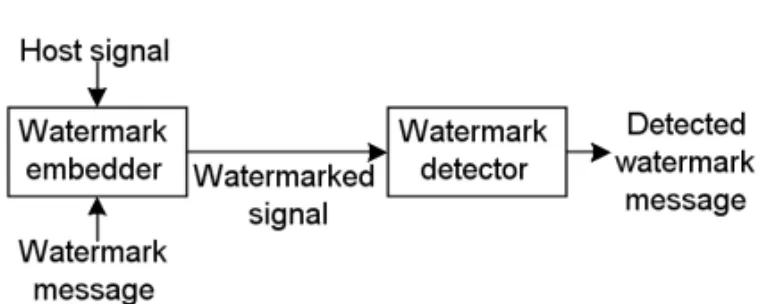
Fig. 1.1. A block diagram of the encoder.
be repeatedly copied and distributed without any obstacles. Modern software and broad-band Internet provide the tools to perform it quickly and without much effort and deep technical knowledge. One of the more recent examples is the hack of the Content Scram-bling System for DVDs [5, 6]. It is clear that existing security protocols for electronic commerce serve to secure only the communication channel between the content provider and the user and are useless if commodity in transactions is digitally represented.
19
graphia, which in turn means writing. It is an art of concealed communication.
Therefore, we can define watermarking systems as systems in which the hidden mes-sage is related to the host signal and non-watermarking systems in which the mesmes-sage is unrelated to the host signal. On the other hand, systems for embedding messages into host signals can be divided into steganographic systems, in which the existence of the message is kept secret, and non-steganographic systems, in which the presence of the embedded message does not have to be secret. Division of the information hiding systems into four categories is given in Table 1.1 [2].
Host Signal Dependent Message Host Signal Independent Message
Message Hidden Covert Communication Steganographic Watermarking
Message Known Non-steganographic Watermarking Overt Embedded Communications
Table 1.1. Four categories of information hiding systems.
The primary focus of this thesis is the watermarking of digital audio (i.e., audio water-marking), including the development of new watermarking algorithms and new insights of effective design strategies for audio steganography. The watermarking algorithms were primarily developed for digital images and video sequences [11, 12]; interest and research in audio watermarking started slightly later [13, 14]. In the past few years, several algo-rithms for the embedding and extraction of watermarks in audio sequences have been presented. All of the developed algorithms take advantage of the perceptual properties of the human auditory system (HAS) in order to add a watermark into a host signal in a perceptually transparent manner. Embedding additional information into audio sequences is a more tedious task than that of images, due to dynamic supremacy of the HAS over human visual system [11]. In addition, the amount of data that can be embedded trans-parently into an audio sequence is considerably lower than the amount of data that can be hidden in video sequences as an audio signal has a dimension less than two-dimensional video files. On the other hand, many attacks that are malicious against image watermark-ing algorithms (e.g. geometrical distortions, spatial scalwatermark-ing, etc.) cannot be implemented against audio watermarking schemes.
1.1 Scope of research
1.1.1 Application areas
detected in a watermark detector. The relative importance of the mentioned properties significantly depends on the application for which the algorithm is designed. For copy protection applications, the watermark must be recoverable even when the watermarked signal undergoes a considerable level of distortion, while for tamper assessment applica-tions, the watermark must effectively characterize the modification that took place. In this section, several application areas for digital watermarking will be presented and advan-tages of digital watermarking over standard technologies examined.
Ownership Protection
In the ownership protection applications, a watermark containing ownership infor-mation is embedded to the multimedia host signal. The watermark, known only to the copyright holder, is expected to be very robust and secure (i.e., to survive common signal processing modifications and intentional attacks), enabling the owner to demonstrate the presence of this watermark in case of dispute to demonstrate his ownership. Watermark detection must have a very small false alarm probability. On the other hand, ownership protection applications require a small embedding capacity of the system, because the number of bits that can be embedded and extracted with a small probability of error does not have to be large.
Proof of ownership
It is even more demanding to use watermarks not only in the identification of the copy-right ownership, but as an actual proof of ownership. The problem arises when adversary uses editing software to replace the original copyright notice with his own one and then claims to own the copyright himself. In the case of early watermark systems, the problem was that the watermark detector was readily available to adversaries. As elaborated in [2], anybody that can detect a watermark can probably remove it as well. Therefore, because an adversary can easily obtain a detector, he can remove owner’s watermark and replace it with his own. To achieve the level of the security necessary for proof the of ownership, it is indispensable to restrict the availability of the detector. When an adversary does not have the detector, the removal of a watermark can be made extremely difficult. However, even if owner’s watermark cannot be removed, an adversary might try to undermine the owner. As described in [2], an adversary, using his own watermarking system, might be able to make it appear as if his watermark data was present in the owner’s original host signal. This problem can be solved using a slight alteration of the problem statement. Instead of a direct proof of ownership by embedding e.g. "Dave owns this image" water-mark signature in the host image, algorithm will instead try to prove that the adversary’s image is derived from the original watermarked image. Such an algorithm provides indi-rect evidence that it is more probable that the real owner owns the disputed image, because he is the one who has the version from which the other two were created.
Authentication and tampering detection
21
prevented. In practical applications it is also desirable to locate (in time or spatial dimen-sion) and to discriminate the unintentional modifications (e.g. distortions incurred due to moderate MPEG compression [15, 16]) from content tampering itself. In general, the watermark embedding capacity has to be high to satisfy the need for more additional data than in ownership protection applications. The detection must be performed without the original host signal because either the original is unavailable or its integrity has yet to be established. This kind of watermark detection is usually called a blind detection.
Fingerprinting
Additional data embedded by watermark in the fingerprinting applications are used to trace the originator or recipients of a particular copy of multimedia file [17, 18, 19, 20, 21, 22, 23, 24, 25]. For example, watermarks carrying different serial or identity (ID) numbers are embedded in different copies of music CDs or DVDs before distribut-ing them to a large number of recipients. The algorithms implemented in fdistribut-ingerprintdistribut-ing applications must show high robustness against intentional attacks and signal processing modifications such as lossy compression or filtering. Fingerprinting also requires good anti-collusion properties of the algorithms, i.e. it is not possible to embed more than one ID number to the host multimedia file, otherwise the detector is not able to distinguish which copy is present. The embedding capacity required by fingerprinting applications is in the range of the capacity needed in copyright protection applications, with a few bits per second.
Broadcast monitoring
A variety of applications for audio watermarking are in the field of broadcasting [26, 27, 28, 29]. Watermarking is an obvious alternative method of coding identification infor-mation for an active broadcast monitoring. It has the advantage of being embedded within the multimedia host signal itself rather than exploiting a particular segment of the broad-cast signal. Thus, it is compatible with the already installed base of broadbroad-cast equipment, including digital and analogue communication channels. The primary drawback is that embedding process is more complex than a simple placing data into file headers. There is also a concern, especially on the part of content creators, that the watermark would introduce distortions and degrade the visual or audio quality of multimedia. A number of broadcast monitoring watermark-based applications are already available on commercial basis. These include program type identification, advertising research, broadcast cover-age research etc. Users are able to receive a detailed proof of the performance information that allows them to:
1. Verify that the correct program and its associated promos aired as contracted; 2. Track barter advertising within programming;
3. Automatically track multimedia within programs using automated software online.
Copy control and access control
di-recting particular hardware or software operations such as enabling or disabling the record module. These applications require watermarking algorithms resistant against intentional attacks and signal processing modifications, able to perform a blind watermark detection and capable of embedding a non-trivial number of bits in the host signal.
Information carrier
The embedded watermark in this application is expected to have a high capacity and to be detected and decoded using a blind detection algorithm. While the robustness against intentional attack is not required, a certain degree of robustness against common process-ing like MPEG compression may be desired. A public watermark embedded into the host multimedia might be used as the link to external databases that contain certain additional information about the multimedia file itself, such as copyright information and licensing conditions. One interesting application is the transmission of metadata along with mul-timedia. Metadata embedded in, e.g. audio clip, may carry information about composer, soloist, genre of music, etc.
1.1.2 Research areas
Watermarking algorithms can be characterized by a number of defining properties [2]. Six of them, which are most important for audio watermarking algorithms [31], represent our research subareas. The relative importance of a particular subarea is application-dependent, and in many cases the interpretation of a watermark property itself varies with the application.
Perceptual transparency
In most of the applications, the watermark-embedding algorithm has to insert addi-tional data without affecting the perceptual quality of the audio host signal [11, 32]. The fidelity of the watermarking algorithm is usually defined as a perceptual similarity be-tween the original and watermarked audio sequence. However, the quality of the water-marked audio is usually degraded, either intentionally by an adversary or unintentionally in the transmission process, before a person perceives it. In that case, it is more adequate to define the fidelity of a watermarking algorithm as a perceptual similarity between the watermarked audio and the original host audio at the point at which they are presented to a consumer.
Watermark bit rate
23
a significant fraction of the host audio bit rate, up to 150 kbps.
Robustness
The robustness of the algorithm is defined as an ability of the watermark detector to ex-tract the embedded watermark after common signal processing manipulations. A detailed overview of robustness tests is given in Chapter 3. Applications usually require robustness in the presence of a predefined set of signal processing modifications, so that watermark can be reliably extracted at the detection side. For example, in radio broadcast monitoring, embedded watermark need only to survive distortions caused by the transmission process, including dynamic compression and low pass filtering, because the watermark detection is done directly from the broadcast signal. On the other hand, in some algorithms robustness is completely undesirable and those algorithms are labeled fragile audio watermarking algorithms.
Blind or informed watermark detection
In some applications, a detection algorithm may use the original host audio to extract watermark from the watermarked audio sequence (informed detection). It often signif-icantly improves the detector performance, in that the original audio can be subtracted from the watermarked copy, resulting in the watermark sequence alone. However, if de-tection algorithm does not have access to the original audio (blind dede-tection) and this inability substantially decreases the amount of data that can be hidden in the host sig-nal. The complete process of embedding and extracting of the watermark is modeled as a communications channel where watermark is distorted due to the presence of strong interference and channel effects [33]. A strong interference is caused by the presence of the host audio, and channel effects correspond to signal processing operations.
Security
Watermark algorithm must be secure in the sense that an adversary must not be able to detect the presence of embedded data, let alone remove the embedded data. The security of watermark process is interpreted in the same way as the security of encryption tech-niques and it cannot be broken unless the authorized user has access to a secret key that controls watermark embedding. An unauthorized user should be unable to extract the data in a reasonable amount of time even if he knows that the host signal contains a watermark and is familiar with the exact watermark embedding algorithm. Security requirements vary with application and the most stringent are in cover communications applications, and, in some cases, data is encrypted prior to embedding into host audio.
Computational complexity and cost
PDA, mobile phone, etc.).
1.2 Problem statement
1.2.1 Research problem
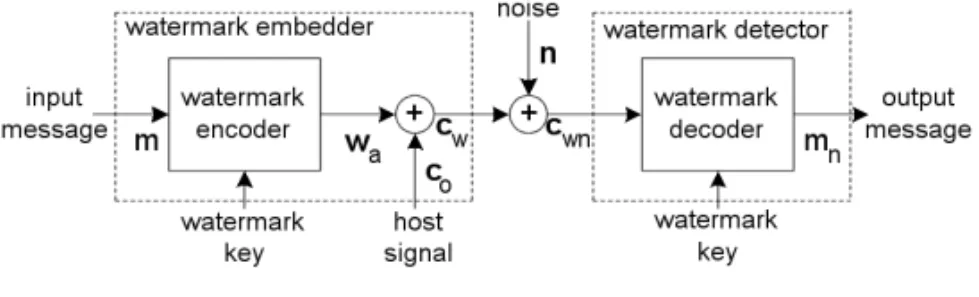
The fundamental process in each watermarking system can be modeled as a form of com-munication where a message is transmitted from watermark embedder to the watermark receiver [2]. The process of watermarking is viewed as a transmission channel through which the watermark message is being sent, with the host signal being a part of that chan-nel. In Figure 1.2, a general mapping of a watermarking system into a communications model is given (more details are provided in Chapter 4). After the watermark is
embed-Fig. 1.2. A watermarking system and an equivalent communications model.
ded, the watermarked work is usually distorted after watermark attacks. The distortions of the watermarked signal are, similarly to the data communications model, modeled as additive noise.
When setting down the research plan for this study, the research of digital audio wa-termarking was in its early development stage; the first algorithms dealing specifically with audio were presented in 1996 [11]. Although there were a few papers published at the time, a basic theory foundations were laid down and the concept of the "magic triangle" introduced (Chapter 3). Therefore, it is natural to place watermarking into the framework of the traditional communications system. The main line of reasoning of the "magic triangle" concept (Chapter 3) is that if the perceptual transparency parameter is fixed, the design of a watermark system cannot obtain high robustness and watermark data rate at the same time. Thus, we decided to divide the research problem into three specific subproblems. They are:
25
SP2: How can the detection performance of a watermarking system be improved using algorithms based on communications models for that system?
SP3: How can overall robustness to attacks of a watermark system be increased using an attack characterization at the embedding side?
1.2.2 Research hypothesis
The division of the research problem into the three subproblems above define the follow-ing three research hypotheses:
RH1: To obtain a distinctively high watermark data rate, embedding algorithm can be implemented in a transform domain, with the usage of the least significant bit coding.
RH2: To improve detection performance, a spread spectrum method can be used, cross correlation between the watermark sequence and host audio decreased and channel coding introduced.
RH3: To achieve the robustness of watermarking algorithms, an attack characterization can be introduced at the embedder, improved channel model can be derived and informed detection can be used for watermark decoding.
1.2.3 Research assumptions
The general research assumption is that the process of embedding and extraction of wa-termarks can be modeled as a communication system, where the watermark embedding is modeled as a transmitter, the distortion of watermarked signal as a communications channel noise and watermark extraction as a communications detector.
It is also assumed that modeling of the human auditory system and the determination of perceptual thresholds can be done accurately using models from audio coding, namely MPEG compression HAS model [15, 16].
The perceptual transparency (inaudibility) of a proposed audio watermarking scheme can be confirmed through subjective listening tests in a predefined laboratory environment with a participation of a predefined number of people with a different music education and background.
A central assumption in the security analysis of the proposed algorithms is that an adversary that attempts to disrupt the communication of watermark bits or remove the watermark does not have access to the original host audio signal.
1.2.4 Research methods
domains (e.g. Fourier domain, wavelet domain), filtering and spectral analysis. Com-munication principles and models are used for channel noise modeling, different ways of signalling the watermark (e.g. a direct sequence spread spectrum method, frequency hopping method), derivation of optimized detection method (e.g. matched filtering) and evaluation of overall detection performance of the algorithm (bit error rate, normalized correlation value at detection). The basic information theory principles are used for the calculation of the perceptual entropy of an audio sequence, channel capacity limits of a watermark channel and during design of an optimal channel coding method. The re-search methods also include algorithm simulations with real data (music sequences) and subjective listening tests.
1.3 Outline of the thesis
Robust digital audio watermarking algorithms and high capacity steganography methods for audio are studied in this thesis. The purpose of the thesis is to develop novel audio watermarking algorithms providing a performance enhancement over the other state-of-the-art algorithms with an acceptable increase in complexity and to validate their perfor-mance in the presence of the standard watermarking attacks. Presented as a collection of ten original publications enclosed as appendices I-X, the thesis is organized as follows.
Chapter 2 introduces the basic concepts and definitions of digital watermarking, in order to place in context the main contributions of the thesis developed as the combina-tion of digital signal processing, psychoacoustic modeling and communicacombina-tions theory. The properties of the HAS that are exploited in the process of audio watermarking are shortly reviewed. A survey of the key digital audio watermarking algorithms is presented subsequently.
A general background and requirements for high capacity covert communications for audio are presented in Chapter 3. A perceptual entropy measure for audio signals and information theoretic assessment of the achievable data rates of a data hiding channel are reviewed. In addition, the results which are in part documented in Papers IV and V, for the modified time domain LSB steganography algorithm and a high bit rate algorithm in wavelet domain are presented.
In Chapter 4, the contents of which are in part included in Papers I, II, III, and VII, several spread spectrum audio watermarking algorithms in time domain are presented. A general model for the spread spectrum-based watermarking is described in order to place in context the developed algorithms. The parts of communication theory, which were used in order to find a relationship between the capacity of the watermarked channel and the distortion caused by a malicious attack, are given in this chapter as well.
Chapter 5, the contents of which are in part presented in Papers VI, VIII, IX, and X, focuses on the increasing of the robustness of embedded watermarks using attack charac-terization. Novel principles important for our attack characterization implementation are presented, as well as watermark channel models of interest. A method for introducing the attack characterization approach in an improved spread spectrum scheme is discussed.
2 Literature survey
This chapter reviews the appropriate background literature and describes the concept of information hiding in audio sequences. Scientific publications included into the literature survey have been chosen in order to build a sufficient background that would help out in solving the research subproblems problems stated in Chapter 1. In addition, Chapter 2 presents general concepts and definitions used and developed in more details in Chapters 3, 4 and 5. We decided to divide the theoretical background into three parts, presented in Chapters 3, 4 and 5 because of the specific structure of the thesis, which presents three different concepts for data hiding in audio, contrary to the usual concept of elaborating a single idea. Therefore, the theoretical background in subjunction to the particular concept is given as a separate subchapter in the respective chapters. In this manner, it much easier for the reader to follow the presented concepts, and the chapters themselves can also be read as standalone readings.
In the first section, the properties of the human auditory system (HAS) that are ex-ploited in the process of audio watermarking are shortly reviewed. A survey of the key digital audio watermarking algorithms and techniques is presented subsequently. The al-gorithms are classified by the signal domain in which the watermark is inserted (time domain, Fourier domain, etc.) and statistical method used for the embedding and extrac-tion of watermark bits.
2.1 Overview of the properties of the HAS
Watermarking of audio signals is more challenging compared to the watermarking of images or video sequences, due to wider dynamic range of the HAS in comparison with human visual system (HVS) [11]. The HAS perceives sounds over a range of power greater than 109:1 and a range of frequencies greater than 103:1. The sensitivity of the HAS to the additive white Gaussian noise (AWGN) is high as well; this noise in a sound file can be detected as low as 70 dB below ambient level.
On the other hand, opposite to its large dynamic range, HAS contains a fairly small differential range, i.e. loud sounds generally tend to mask out weaker sounds. Addition-ally, HAS is insensitive to a constant relative phase shift in a stationary audio signal and some spectral distortions interprets as natural, perceptually non-annoying ones. [11].
Auditory perception is based on the critical band analysis in the inner ear where a frequency-to-location transformation takes place along the basilar membrane. The power spectra of the received sounds are not represented on a linear frequency scale but on lim-ited frequency bands called critical bands [34]. The auditory system is usually modeled as a bandpass filterbank, consisting of strongly overlapping bandpass filters with band-widths around 100 Hz for bands with a central frequency below 500 Hz and up to 5000 Hz for bands placed at high frequencies. If the highest frequency is limited to 24000 Hz, 26 critical bands have to be taken into account.
Two properties of the HAS dominantly used in watermarking algorithms are frequency (simultaneous) masking (Section 2.1.1) and temporal masking (Section 2.1.2)[34]. The concept using the perceptual holes of the HAS is taken from wideband audio coding (e.g. MPEG compression 1, layer 3, usually called mp3)[16]. In the compression algorithms, the holes are used in order to decrease the amount of the bits needed to encode audio signal, without causing a perceptual distortion to the coded audio. On the other hand, in the information hiding scenarios, masking properties are used to embed additional bits into an existing bit stream, again without generating audible noise in the audio sequence used for data hiding.
2.1.1 Frequency masking
noise-masks-29
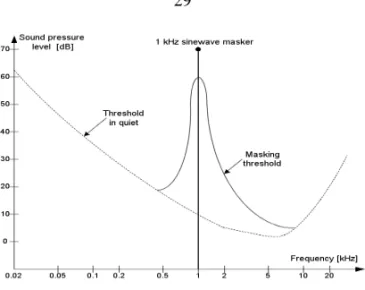
Fig. 2.1. Frequency masking in the human auditory system (HAS), reference sound pressure level is p0= 2·10−5Pa.
tone experiments than in tone-masks-noise experiments due to HAS’s sensitivity toward additive noise. Noise and low-level signal components are masked inside and outside the particular critical band if their SPL is below the masking threshold. Noise contributions can be coding noise, inserted watermark sequence, aliasing distortions, etc. Without a masker, a signal is inaudible if its SPL is below the threshold in quiet, which depends on frequency and covers a dynamic range of more than 70 dB as depicted in the lower curve of Figure 2.1. The qualitative sketch of Figure 2.2 gives more details about the masking threshold. The distance between the level of the masker (given as a tone in Figure 2.2) and the masking threshold is called signal-to-mask ratio (SMR) [16]. Its maximum value is at the left border of the critical band. Within a critical band, noise caused by watermark embedding will be audible as long as signal-to-noise ratio (SNR) for the critical band [16] is higher than its SMR. Let SNR(m) be the signal-to-noise ratio resulting from watermark insertion in the critical band m; the perceivable distortion in a given subband is then measured by the noise to mask ratio:
NMR(m)=SMR-SNR(m) (2.1)
The noise-to-mask ratio NMR(m) expresses the difference between the watermark noise in a given critical band and the level where a distortion may just become audible; its value in dB should be negative.
Fig. 2.2. Signal-to-mask-ratio and Signal-to-noise-ratio values.
masking thresholds are determined, depending on the signal level, type of masker (tone or noise) and frequency range. After that, the global masking threshold is determined by adding all individual masking thresholds and the threshold in quiet. The effects of the masking reaching over the limits of a critical band must be included in the calculation as well. Finally, the global signal-to-noise ratio is determined as the ratio of the maximum of the signal power and the global masking threshold [16], as depicted in Figure 2.1.
2.1.2 Temporal masking
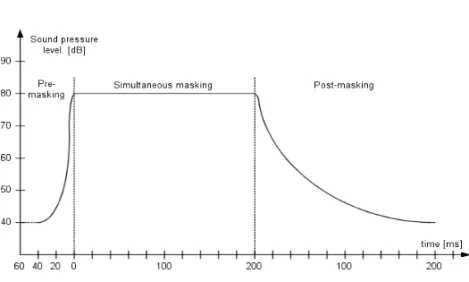
31
Fig. 2.3. Temporal masking in the human auditory system (HAS).
2.2 General concept of watermarking
2.2.1 A general model of digital watermarking
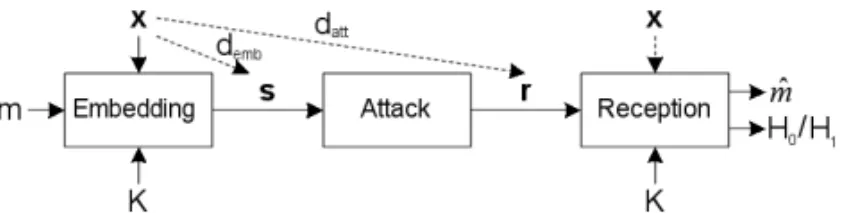
Figure 2.4 gives an overview of the general model of the digital watermarking considered in this chapter. A watermark message m is embedded into the host signal x to produce the watermarked signal s. The embedding process is dependent on the key K and must satisfy the perceptual transparency requirement, i.e. the subjective quality difference be-tween x and s (denoted as embedding distortiondemb) must be below the just noticeable
difference threshold. Before the watermark detection and decoding process takes place, s is usually intentionally or unintentionally modified. The intentional modifications are usually referred to as attacks; an attack produce attack distortiondatt at a perceptually
acceptable level. After attacks, a watermark extractor receives attacked signal r.
The watermark extraction process consists of two sub-processes, first, watermark de-coding of a received watermark message ˆm using key K, and, second, watermark detec-tion, meaning the hypothesis test between:
HypothesisH0: the received data r is not watermarked with key K, and
HypothesisH1: the received data r is watermarked with key K.
that any common signal processing impairing an embedded watermark drastically will be a potential method applied by adversaries that intentionally try to remove the embedded watermark. The watermarking algorithms must be designed to endure the worst possi-ble attacks for a given attack distortiondatt, which might be even some common signal
processing operation (e.g. dynamic compression, low pass filtering etc.). Furthermore, it is generally assumed that the adversary has only one watermarked version s of the host signal x. In fingerprinting applications, differently watermarked data copies could be ex-ploited by collusion attacks. It has been proven that robustness against collusion attacks can be achieved by a sophisticated coding of different watermark messages embedded into each data copy [23]. However, it seems that the necessary codeword length increases dramatically with the number of watermarked copies available to the adversary.
The separation between watermark decoding and watermark detection during the wa-termark extraction should be clearly defined as well. Thus, it is important to differ be-tween communicating a watermark message m (embedding and decoding of a digital watermark) and verifying whether the received data r is watermarked or not (watermark detection). At first glance, the decision between the hypothesesH0 andH1(watermark
detection) appears as a special case of decoding a binary watermark messagem∈ {0,1}. This is not the case because in binary watermark communication the watermarked signal and received signal have some special composition for m=0 and another special structure for m=1. However, in the hypothesisH0of the detection problem, the received data can
have any structure or, equivalently, no structure at all.
The importance of the key K has to be emphasized. The embedded watermarks should be secure against detection, decoding, removal or modification or modification by adver-saries. Kerckhoff’s principle [35], stating that the security of a crypto system has to reside only in the key of a system, has to be applied when the security of a watermarking system is analyzed. Therefore, it must be assumed that the watermark embedding and extraction algorithms are publicly known, but only those parties knowing the proper key are able to receive and modify the embedded information. The key K is considered a large integer number, with a word length of 64 bits to 1024 bits. Usually, a key sequence k is de-rived from K by a cryptographically secure random number generator to enable a secure watermark embedding for each element of the host signal.
Several more detailed models of watermarking systems, including modeling of
33
mark channel with encryption, are given in Chapter 4. Since three communication theory based audio watermarking algorithms are described in Chapter 4, we decided to place more detailed overview of the modeling the watermarking systems using data communi-cations models in there, including all the relevant references.
2.2.2 Statistical modeling of digital watermarking
In order to properly analyze digital watermarking systems, a stochastic description of the multimedia data is required. The watermarking of data whose content is perfectly known to the adversary is useless. Any alteration of the host signal could be inverted perfectly, resulting in a trivial watermarking removal. Thus, essential requirements on data being robustly watermarkable are that there is enough randomness in the structure of the original data and that quality assessments can be made only in a statistical sense. In this section, basic statistical modeling of digital watermarking is introduced and general assumptions are explained.
Let the original host signal x be a vector of lengthLx. Statistical modeling of data
means to consider x a realization of a discrete random process x [6]. In the most general form, x is described by anLx-dimensional probability density function (PDF)px(x).
px(x) = Lx
Y
n=1
pxn(xn) (2.2)
withpxn(xn)being the nth marginal distribution ofx. A further simplification is to as-sume independent, identically distributed (IID) data elements sopxn(xn) =pxj(xn) = px(x). Most multimedia data cannot be modeled adequately by an IID random process
[6]. However, in many cases, it is possible to decompose the data into components such that each component can be considered almost statistically independent. In most cases, the multimedia data have to be transformed, or parts have to be extracted, to obtain a component-wise representation with mutually independent and IID components. The wa-termarking of independent data components can be considered as communication over parallel channels.
Watermarking embedding and attacks against digital watermarks must be such that the introduced perceptual distortion - the subjective difference between the watermarked and attacked signal to the original host signal is acceptable. In the previous section, we introduced the terms embedding distortiondemband attack distortiondatt, but no specific
measure, the embedding distortiondemband attack distortiondattare given by [6]
demb=D(x,s,Θ) = 1
Lx Lx
X
n=1
ΘnE ©
(xn−sn)2 ª
, (2.3)
datt=D(x,r,Θ) =
1 Lx
Lx
X
n=1
ΘnE ©
(xn−rn)2 ª
. (2.4)
In (2.3) and (2.4) E{·}denotes expectation andΘn ∈R+ is the weight for the expected
squared error introduced in the nth data element.xn,sn, andrnare the nth elements of the
host audio x, watermarked sequence s and received signal r, respectively. The weightΘn
lets a simple adaptation of the objective distortion measure to the subjectively different importance of data elements. For IID data, the weightsΘnare usually set to 1 since none
of the data elements is subjectively preferred and the WMSE is reduced to the simple mean-squared error (MSE) distortion measure [6]. Furthermore, the WMSE distortion measure fits well to the component-wise data description introduced above. It is very common that identical weightsΘjcan be used for all elements of the jth data component.
For example, the weighted embedding distortion in the discrete wavelet domain (DWT) [36] can be written as
demb=D ¡©
xDW Tj ª,©sDW Tj ª,©ΘDW Tj ª¢= 1 J
J X
j=1
ΘDW T
j E
n¡
xDW T
j −sDW Tj ¢2o
(2.5) where xDW Tj represents the jth element of the host audio sequence x in wavelet domain and sDW Tj stands for the jth element of the watermarked sequence s in wavelet domain. In practice, an adversary can never evaluate demb since he does not know x. On the
other hand, it is fair to assume, during watermark embedding, that an adversary could obtain a good approximation ofdemb. In contrast, measuring the attack distortion at the
detection side, by D(s,r,Θ), which is practical for an adversary, might be misleading since a perfect attack (r = x, D(s,x,Θ) > 0) would be rated worse than no attack (r=s, D(s,s,Θ) = 0).
The performance of different watermarking schemes for specific stochastic data is ex-tensively analyzed in the literature. It is usually assumed that the embedder and the at-tacker have access to the same stochastic model. Within this framework, provable lim-its for optimal watermarking schemes and optimal attacks can be derived. In practice, provable limits are difficult to obtain, because an improvement of the available statistical models for the data at hand can help an adversary as well.
2.2.3 Decoding and detection performance evaluation
The ultimate goal of any watermarking algorithm is a reliable watermark extraction. In general, extraction reliability for a specific watermarking scheme relies on the features of the original data, on the embedding distortiondemband on the attack distortiondatt.
35
dattand fixed data features and embedding distortiondemb. Different reliability measures
are used for watermark decoding and watermark detection.
2.2.3.1 Watermark decoding
In the performance evaluation of the watermark decoding, digital watermarking is con-sidered as a communication problem. A watermark message m is embedded into the host signal x and must be reliably decodable from the received signal r [6]. Low decoding er-ror rates can be achieved only using erer-ror correction codes. For practical erer-ror correcting coding scenarios, the watermark message is usually encoded into a vector b of lengthLb
with binary elementsbn = 0,1. Usually, b is also called the binary watermark message,
and the decoded binary watermark message isb. The decoding reliability of b can beˆ described by the word error probability (WEP)
pw=Pr(m6= ˆm) =Pr(b6= ˆb), (2.6)
or by the bit error probability (BEP)
pb= 1
Lb lb
X
n=1
Pr(bn 6= ˆbn). (2.7)
The WEP and BEP can be computed for specific stochastic models of the entire water-marking process including attacks. The predicted error probabilities can be confirmed experimentally by a large number of simulations with different realizations of the water-mark key K, the host signal x, the attack parameters and a waterwater-mark message m. The number of measured error events divided by the number of the observed events defines the measured error rates, word error rate, WER and bit error rate BER.
Performance limits can be derived with methods borrowed from the information theory. For example, the maximum watermark rate which can be received in principle without errors is determined by the mutual informationI(r|m)between the transmitted watermark message m and received data r and given by [37]
I(r|m) =h(r)−h(r|m) (2.8)
whereh(r)is the differential entropy of r andh(r|m)is the differential entropy of r con-ditioned on the transmitted message m. The PDFspr(r)andpr(r|m =m)are required
for the computation of h(r)andh(r|m). I(r|m)can be achieved only for an infinite number of data elements. For a finite number of data elements, a non-zero word error probabilitypwor a bit error probabilitypbare unavoidable.
there is still no solution available for the general watermarking problem, digital water-marking is usually analyzed within certain constraints on the embedding and attacks. Additionally, for different scenarios, the watermark capacity might depend on different parameters (domain of embedding, attack parameters, etc.).
2.2.3.2 Watermark detection
Watermark detection is defined as the decision whether the received data r is watermarked (H1) or not watermarked (H0) [6]. In general, both hypotheses cannot be separated
per-fectly. Thus, we define the probabilitypf p (false positive) as the case of acceptingH1
whenH0is true and the probabilitypf nof acceptingH0whenH1is true (false negative).
In many applications, the hypothesis test must be designed to ensure a limited false pos-itive probability, e.g. pf p <10−12for watermark detection in the context of DVD copy
protection. Another option for the evaluation of watermark detection is the investigation of the total detection error probabilitype, which measures both possible error types.
In this thesis, the watermark detection is based on watermarking schemes that have been designed for reliable communication of a binary watermark message b. A subvector f of lengthLfof the watermark message b is used for a validity verification of a received
watermark messageˆb. Without a loss of generality, an all-zero verification message can be used since the security of the embedded watermark is ensured by a key sequence k derived from the key K. Two simple watermark detection methods using the verification bit vector f are discussed. In the first method, a detection based on a hard decision de-coded verification is applied. In the second method, known ende-coded verification bits are exploited to implement detection based on so-called soft values, where the soft values are obtained by a further processing of the received signal.
Hard decision decoding
The verification message f is encoded together with all remaining watermark message bits to obtain the encoded watermark message bc. During the watermark extraction, the
messageˆb is as in the communication scenario. One fraction ofˆb is the decoded wa-termark verification messageˆf that must be equal to f for a valid watermark messageˆb. Therefore, the hypothesis decision rule is given by:
H0: ˆf6=f (2.9)
H1: ˆf=f (2.10)
The false positive probabilitypf pcan be calculated based on the assumption thatPr( ˆfn=
0|H0) = Pr( ˆfn = 1|H1) = 0.5. The probability pf p = 0.5Lf is obtained forLf independent bitsfˆn and depends only on the numberLf of verification bits. The false
negative probability depends on the bit error probabilitypband the number of verification
bits
pf n= 1−(1−pb)Lf. (2.11)
In the expression (2.11) statistically independent received verification bitsfˆnare assumed.
37
ensure the validity of those assumptions. A generalization of the decision rule given above is to acceptH1if the Hamming distance [37],dH( ˆfn,f)is lower than a certain threshold.
In that case, the threshold could be designed to find a better trade-off betweenpf pandpf n.
Soft decision decoding
Detection based on a hard decision decoding is very simple. However, if the accurate statistical models of the introduced attacks are known, soft decision decoding gives po-tentially a better detection performance. The verification message f is equal to the firstLf
bits of b and error correction coding of b is such that the firstLfcbits of the coded wa-termark message bcare independent of the remaining watermark message bits. Without a
loss of generality, we can assume
(bc,0, ..., bc,Lfc−1) =f=0. (2.12)
LetIfdenote the set of the indices of all data elements with embedded coded verification
bits. We assume that the PDFsPr(rIf|H0)andPr(rIf|H1)for receivingrIf depending on hypothesisH0orH1, respectively, are known. Bayes’ solution to the hypothesis testing
problem can be applied, which is
Pr(rIf|H1) Pr(rIf|H0)
> T ⇒accept H1,else⇒accept H0 (2.13)
whereT is the decision threshold. T is a constant depending on the a priori probabil-ities forH1andH0 and the cost connected with different decision errors. ForT = 1,
the decision rule above forms a maximum-likelihood (ML) detector. For equal a priori probabilities, the decision error probability ispe = 12(pf p+pf n). Assuming equal a
priori probabilities and equal costs for both hypotheses, the above decision rule can be reformulated so thatH1is accepted if
P r= Pr(rIf|H1) Pr(rIf|H1) +Pr(rIf|H0)
>0.5 (2.14)
whereP r ∈[0,1]denotes the reliability that a received watermark messageˆb is a valid watermark message. For decision above, pf n and pf p depend directly on the PDFs
Pr(rIf|H0)andPr(rIf|H1).
2.2.4 Exploiting side information during watermark embedding
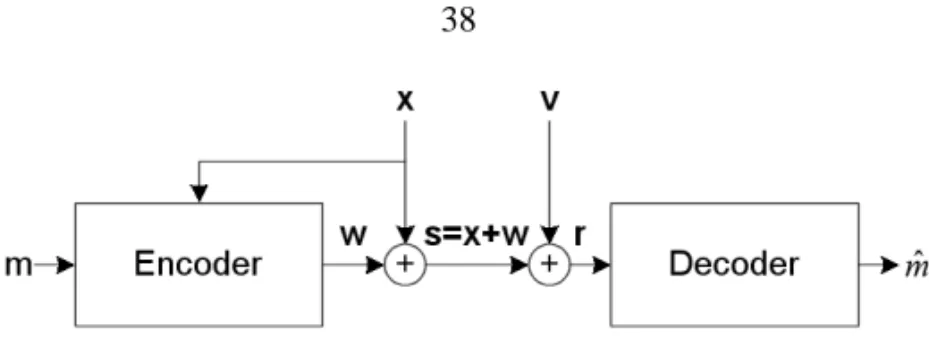
Fig. 2.5. Communication with side information at the encoder over an AWGN channel.
early paper by Shannon [40] are described. Therein, the usefulness of side information at the encoder is shown, without any detailed data of the principal improvements or the optimal exploitation of the side information. Also, one of the assumptions of Shannon’s paper is that the encoder knows only a causal part of the host signal x. Chen and Wor-nell introduced a paper by Costa [41] from year 1983 to the watermarking community. Costa considered communication with side information at the encoder over an AWGN channel as depicted in Figure 2.5. A scheme that was derived by him performs well as if the original data (the side information at the encoder) were perfectly known to the de-coder. Chen and Wornell showed that their previously developed watermarking scheme [38] based on quantization index modulation (QIM) can be considered as a part of Costa’s scheme and that an extended version of QIM can perform as well as Costa’s scheme. It is purely theoretical and thus several practical approaches to implement Costa’s scheme were proposed [42, 43]. Figure 2.5 depicts a block diagram of the considered watermark-ing embeddwatermark-ing into IID host signal x of lengthLxand blind detection. The watermark
messagem ∈ 1,2, . . . , M is embedded with a constraint on the embedding distortion demb. The embedding process exploiting side information of the host signal is separated
into two parts: first, an appropriate watermark sequence w representing the watermark message m is selected, and, second, w is added to the host signal x. The MSE distortion measure is used so that
demb= 1
LxE n
ks−xk2
o
= 1 LxE
n
kwk2
o
. (2.15)
The mapping of m onto sequence w, also of lengthLx, is determined by x and the by
codebookWLx(K), which is encrypted with the watermark key K. Secrecy is obtained by a pseudo-random selection of all entries inWLx(K).
The assumption is that the watermark sequences w are zero mean and IID. The em-bedding distortiondembis then equal to the varianceσ2wof the watermark elementswn.
The AWGN attack is independent of the characteristics of the original and watermarked signal so that attack distortion isdatt=demb+σv2 =σ2w+σ2v. It should be noted that
39
scheme can also be considered as the ultimate performance limit of blind watermarking.
2.2.5 The information theoretical approach to digital watermarking
Early research on watermarking can be characterized by an alternating advancement of watermarking schemes and attacks. A theoretical approach to digital watermarking should give answers about the convergence of this process. Some work in this direction has been published independently by Su et al. [44, 45] and by Moulin et al. [46, 47]. In [44], a power-density spectrum condition (PSC) for watermark signal has been derived, which ensures that a linear estimation of embedded watermark is as hard as possible. Independently, Moulin et al. [46] introduced the notion of the "information hiding game". Information theoretic and game-theoretic concepts are exploited to set up a well-defined theoretical framework for digital watermarking. In [46], Moulin et al. discuss the case of watermarking IID Gaussian host signal. Extensions of this work to non-white Gaussian original data and application to image watermarking have been developed by Su et al. [44, 45] and Moulin et al. [46, 47].
A conceptual description of a watermarking game is given in [46]. Assume watermark-ing of the host signal x with some statistical properties is investigated. First, a nonnegative distortion function for the host signal x of lengthLxis defined. Second, the watermarking
process has to be characterized. This contains: •The set of watermark messages M
•The embedding function depending on the watermark message m and key K and con-strained to the embedding distortiondemband
•The decoding function, which depends on the key K.
Third, the attack channel, constrained by the attack distortiondatt, is defined by the
prob-ability matrixQ(r,s)describing the mapping of a certain watermarked signal s of length Lxto a certain attacked signal r of lengthLxin a statistical sense.
A watermarking process with embedding distortiondemband attack channel with an
attack distortiondattdefine the watermarking game between the embedded and attacker
subject to distortion pair(demb, datt). One suitable objective function of the game is the
achievable watermark rate. A certain watermark rate is achievable for(demb, datt)if there
is a watermark process subject to embedding distortiondembwith ratesR0 > Rsuch that
the probability of the decoding error goes to zero as the signal lengthLxgoes to infinity,
for any attack channel subject to attack distortiondatt.
The watermark capacityC(demb, datt)is the supremum of all achievable ratesRfor
distortions demb, datt. The watermark capacity is achieved if the embedder chooses a