An Investigation of Attention to Social and Non-Social Stimuli in Autism Spectrum Disorder and Typical Development
Antoinette Sabatino
A dissertation submitted to the faculty of the University of North Carolina at Chapel Hill in partial fulfillment of the requirements for the degree of Doctor of Philosophy in the Department of
Psychology Chapel Hill
2013
Approved By:
J. Steven Reznick, PhD
Gabriel S. Dichter, PhD
ii
ABSTRACT
ANTOINETTE SABATINO: An Investigation of Attention to Social and Non-Social Stimuli in Autism Spectrum Disorder and Typical Development
(under the direction of J. Steven Reznick and Gabriel S. Dichter)
Autism Spectrum Disorder (ASD) is a pervasive, neurodevelopmental disorder that can be
characterized by deficits in three symptom domains: significant impairments in language, social
deficits, and restricted and repetitive behaviors. Narrowed interests, perseverative patterns of
attention and reduced visual exploration have been conceptually linked to repetitive behaviors in
ASD, specifically what are known as circumscribed interests (CI) within a narrow range of subject
areas. Individuals with ASD that have CI partake in activities around their interest (collecting,
manipulating, reading, playing, conversing, etc.) and these activities often lead to functional
impairments. Eye-tracking research has investigated different responses to categories of images
reflecting CI that capture attention during passive viewing tasks. Children and adults with ASD
display an attentional bias towards certain categories of nonsocial images (e.g. train, automobiles,
electronic devices, computers). This bias has been conceptualized to reflect an increased salience of
nonsocial images relative to social images (e.g. faces) or other, more commonplace, nonsocial
information (e.g. furniture, clothing, dishes). This dissertation aimed to extend these findings
regarding atypical patterns of attention to social and nonsocial information in children with ASD by
investigating reflexive attention and cognitive control over attention of images related to CI, skills
essential for behavioral and brain development in children with ASD. Analyses included group
comparisons across children with ASD and typically developing controls. Children with ASD
demonstrated a visual preference for non-social objects relative to social information during a
iii
demonstrate an increased rate of directional errors, task performance did not differ across social
and non-social targets. Eye-tracking measures were found to be significantly related to symptom
measures of social-communication impairments and restricted and repetitive behaviors in ASD.
Exploratory comparisons across children with ASD and a pediatric OCD sample, another
development disorder characterized by repetitive behaviors, are also discussed. This study provides
support for the use of visual attention and oculomotor behavior to quantify impairments in ASD as
iv
TABLE OF CONTENTS
List of Tables………..…. v
List of Figures……….……… vi
General Introduction……… 1
Experiment 1: Patterns of attention in response to competing social and non-social stimuli……….. 4
Methods………. 10
Results………. 15
Discussion………. 17
Experiment 2: Cognitive Control over attention to social and non-social stimuli……… 31
Methods……… 36
Results……… 40
Discussion……… 44
General Discussion and Conclusions……… 58
v
LIST OF TABLES
Table
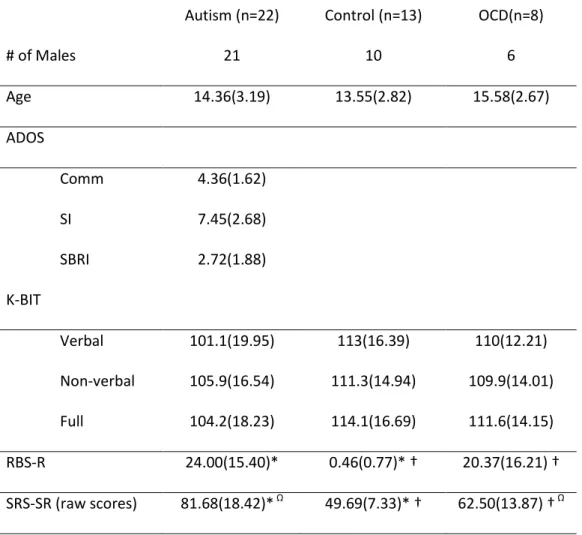
1. EXPERIMENT 1:DEMOGRAPHIC DATA AND SYMPTOM PROFILES……… 23
vi
LIST OF FIGURES
Figure
1. Results from Dichter et al. (2010)……… 24
2. Passive Viewing Task……… 25
3. Gaze Time Data……… 26
4. Gaze Time Data……… 27
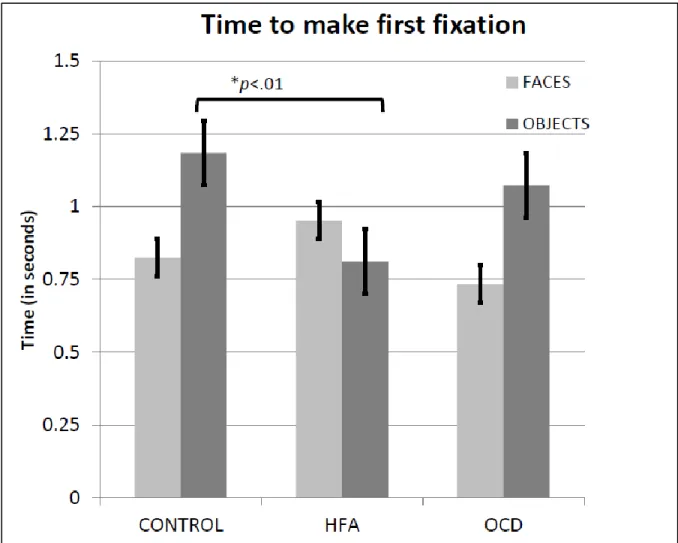
5. Time to make first fixation to faces and objects……….. 28
6. Fixation Count……… 29
7. Relations between eye-tracking measures and symptom measures………. 30
8. Pro- and Antisaccade Task………. 51
9. Example of the method employed to draw areas of interest………. 52
10. Average total number of directional errors……….. 53
11. Average number of directional errors by stimulus type……… 54
12. Cumulative average latency……….. 55
13. Average latency by stimulus type………. 56
GENERAL INTRODUCTION
Though not one of the core diagnostic features of Autism Spectrum Disorder (ASD), aberrant
patterns of attention are frequently observed in individuals with ASD. Early investigations of
children with ASD reported atypical gaze patterns. Children with ASD were frequently described as
making fewer back and forth eye movements and having difficulty orienting towards and focusing
on information in their visual environment (Rincover & Ducharne, 1987). Children with ASD were
described as having “tunnel vision” and being overly focused in visual discrimination tasks,
narrowing in and focusing on specific aspects of their environment while seemingly blocking out
others (Rincover & Ducharne, 1987; Lovaas & Schreibman, 1971). Aberrant social attentional
processes are one of the earliest possible identifiable features of ASD and frequently distinguish
children with the disorder from typically developing children. Although there are obvious
impairments seen within the social domain early in development into adulthood in ASD, other
impairments suggest a more domain-general impairment in visual attention (Landry & Bryson, 2004;
Allen & Courchesne, 2001; Zwaigenbaum et al., 2005; Townsend et al., 2001). Basic deficits in
attention skills such as orienting, disengaging, shifting, and controlling attention may create a
developmental cascade resulting in abnormal social attention processes that have become
characteristic in ASD.
It is widely accepted that individuals with ASD frequently display atypical patterns of
attention towards social information like faces and social scenes (Pelphrey et al., 2002; Dawson et
al., 1998; Sasson et al., 2007). Marked impairments in processing social information may be most
2
when social and non-social information are presented jointly (Klin et al., 2002; Sasson et al., 2008).
Current research indicates that individuals with ASD disproportionately attend to non-social
information (Klin et al., 2004; Sasson et al., 2008). Not only are individuals with ASD viewing social
information in an atypical manner, but they are also attending to these classes of stimuli
significantly less than other non-social information. These patterns of attention have been
hypothesized as being due to the increased saliency of non-social information. Important questions
have arisen such as (1) what are the potential reasons attention is captured by non-social
information, (2) are there specific classes of non-social information that may be driving such
patterns of attention, and (3) what are the implications of having attention disproportionately and
narrowly allocated to segments of the environment (Jones & Klin, 2008)? Human attention is limited
in capacity, and social and non-social information compete for processing resources. Due to these
restrictions, more salient information likely captures attention over less salient information.
The studies described in this dissertation will replicate and extend previous research
regarding aberrant patterns of attention. The overall aim is to use passive viewing attention tasks
and tasks requiring cognitive control in conjunction with eye-tracking technology to identify effects
of social and non-social stimuli on visual attention in ASD. The specific aims are to 1) describe and
quantify patterns of attention in children with ASD in comparison to age-matched controls, 2)
display how non-social information related to circumscribed interests can influence the cognitive
control over attention in ASD, and 3) address questions regarding what makes non-social
information more salient for individuals with ASD. Experiment 1 addresses questions regarding
disproportionate patterns of reflexive attention in response to social and non-social information in
ASD. Experiment 2 focuses on the volitional control over attention in response to social and
non-social information in ASD. To thoroughly address their separate research and discuss their analysis
3
In order to investigate unique patterns of attention within ASD, a small amount of data from
a clinical control group with a similar behavioral phenotype was collected and exploratory analyses
were carried out. Across both experiments, eye-tracking data was collected on a small sample of
children with pediatric obsessive compulsive disorder (OCD). Patients with OCD have often been
reported as having a similar behavioral phenotype to that of ASD, displaying increased impairments
in selective attention tasks and visual search paradigms (Rosenburg et al., 1997; Maruff et al., 1999;
EXPERIMENT 1: PATTERNS OF ATTENTION IN RESPONSE TO COMPETING SOCIAL AND NON-SOCIAL STIMULI (PAIRED SOCIAL VS OBJECT TASK)
Marked impairments in prioritizing social information is a primary characteristic of ASD
(Dawson et al., 1998). Early indicators of ASD include social disinterest, absence of pointing and/or
responding to bids for joint attention, reduced eye contact, and failure to orient to one’s own name
(Maestro et al., 2005; Osterling et al., 2002). In comparison to typically developing controls, a
number of experiments report that children and adults with ASD spend less time looking at the eye
region of the face (Chawarska & Shic, 2009; Klin, Sparrow, de Bilt, Cicchetti, D, & Volkmar, 1999).
Other studies have indicated that differences in ASD are also present in response to other socially
relevant visual stimuli, such as those portraying biological motion or tasks requiring processing of
emotional expression (Klin & Jones, 2008; Rump, Giovanelli, Minshew, & Strauss, 2009).
From early on in development, typically developing infants are more attracted to social-like
stimuli rather than other stimuli equated on lower-level properties (i.e., scrambled or inverted
faces) (Johnson et al., 1991; Turati et al., 2002). This pattern continues throughout development
and, in adults, social preference has been shown to be a strong predictor of attention orienting. In a
study with typically developing adults, participants viewing two scenes presented side by side- one
with a person present and the other without- attended more to the scene with the person present
than without, and while viewing that scene, spent significantly more time looking at the person
(Fletcher-Watson et al., 2008). Not only is attention naturally drawn to social stimuli, but also the
salience of social information appears to be superior to that of non-social information in typical
5
with social stimuli (i.e., faces) and non-social objects, suggests that typical adults are more accurate
at identifying changes in the identity of faces as well as discriminating unfamiliar faces that resemble
one another than performing the same task with non-social objects (Kikuchi et al., 2009; Bruce et al.,
1991).
In contrast to typical development, this prioritization of social information is reduced in ASD
leading to anomalous patterns of attention and eye gaze (Senju and Johnson, 2009) and negative
consequences for the development of social cognition (Chevallier et al., 2012). Dawson et al. (1998)
compared the ability to shift attention towards social stimuli (e.g., name calling, hands clapping)
versus non-social stimuli (e.g., rattle, jack-in-the-box) in children with ASD, typically developing
children, and children with Down syndrome. When compared to control and developmental delay
groups, children with ASD failed to orient to a social stimulus. Instances of social aloofness, absence
of pointing and responding to joint attention bids, reduced eye contact, and failure to orient
towards a social stimulus are currently considered early indicators of ASD (Maestro et al., 2005;
Osterling et al, 2002) because they mimic core symptoms such as lack of spontaneously seeking to
share enjoyment or interests, lack of social and emotional reciprocity, and marked impairments in
the use of non-verbal behaviors (i.e., eye-to-eye gaze)(APA 1994; Lord et al., 2000).
Diminished and anomalous attention to social information has been repeatedly reported in
both children and adults with ASD (Jones and Klin, 2008; Klin et al., 2004; Chawarska et al., 2012);
however, reports are not consistent. Klin and colleagues (2002) reported increased fixation on the
mouth region of the face in adolescents and adults with ASD. These findings were not reproduced in
studies including children with younger participants (Van der Geest et al., 2002; von Hofsten et al.,
2009) suggesting that gaze behaviors may change with development. Other studies have indicated
6
groups, both typically developing children and those with ASD display a particular preference for the
mouth rather than eyes during speech, but this preference is reversed within typical development
over time (Nakano et al., 2010). Other research suggests that the context in which social
information is presented and the inclusion of dyadic cues may be important driving factors for
limited social attention in ASD. In a study of attention to social scenes in toddlers with and without
ASD, children were shown naturalistic social scenes including and devoid of social information (e.g.,
eye contact and speech) (Chawarska et al., 2012). When social information was absent, the
distribution of attention was comparable to that of typically developing and developmentally
delayed children. However, when explicit social cues were introduced, children with ASD spent less
time looking at faces and monitoring lip movements during speech than the other control groups.
Despite inconsistencies in results, taken together these findings further support the widely accepted
view that social information in ASD is not granted the same a priori weight as in typical development
in the competition for attentional resources. In other words, ASD appears to involve an overall
decreased deliberate interest in social information (Chevallier et al., 2012).
Several hypotheses and/or models have been proposed as to why these aberrant patterns
of attention are observed. Experimental evidence reporting domain general impairments in
attention in ASD (i.e., impairments in attention not specific to social information) suggest that due
to general, impaired abilities, children and adults with ASD have difficulty processing and
representing social information (Landry and Bryson, 2004). Other theories have discussed attention
in relation to task demands, cognitive load, and available attentional resources (Dawson, 1991;
Courchesne, Chisum, and Townsend, 1995). Social stimuli are complex, variable, and
unpredictable. Social exchanges require rapid shifting of attention and high level of skill at selective
attention. Therefore, processing social information requires a large amount of attentional resources
7
drawn towards social information due to their processing demands (Dawson, Meltzoff, & Osterling,
1998). However, irregularities have consistently been reported when social and non-social
information are presented concurrently. Klin et al. (2002) compared attention towards social and
non-social information and found that the ASD group attended significantly more to non-social
elements (i.e., objects) and non-critical social elements (i.e., mouths, hairlines, or bodyparts vs.
eyes) than did control participants. These findings support a model that ASD is characterized by not
only decreased visual attention to social stimuli but also increased visual attention to non-social
stimuli (Klin, Jones, Schultz, Volkmar, & Cohen, 2002).
Measures of attention, specifically passive visual exploration, provides a means for
quantifying degrees of impairment related to the presence of circumscribed or narrowed interests, a
sub-domain of restricted and repetitive behaviors in ASD (Pierce and Courchesne, 2001; Sasson et al,
2008). Attention to social stimuli may be moderated by the presence of non-social stimuli related to
circumscribed interests. Sasson et al., (2008; 2011) investigated visual attention in children and
adults with and without ASD to arrays containing both social stimuli (i.e., people) and non-social
stimuli. Non-social stimuli were divided into two categories: those related to circumscribed interest
in ASD (e.g. trains, automobiles, electronic devices) (South, Ozonoff, S, & McMahon, 2005) and
other items such as plants, food, furniture, and clothing. Individuals with ASD disproportionately
explored and fixated longer on objects commonly associated with circumscribed interests. Social
attention was reduced specifically in the context of only objects related to circumscribed interests.
Standard preferential looking paradigms have shed light on differences between
individuals with ASD and comparison groups and have even become indicators of risk for an
eventual diagnosis of ASD in infants and toddlers. With a standard, passive, preferential looking
8
an individual is immediately “drawn to” from a stimulus pair, by including social and non-social
information, clearly observable differences regarding the effects of competing stimulus categories
on attention can be distinguished. When presented inverted and upright point light displays
portraying biological motion, toddlers with ASD displayed significantly reduced preference for
salient human biological motion (Klin et al., 2002). Pierce and colleagues (2011) utilized a
preferential looking paradigm in toddlers with and without ASD; however, more directly addressed
social versus non-social competition. Pairs of video presentations were shown side by side,
displaying moving geometric patterns and children in high action (e.g., dancing, yoga, running).
Toddlers with ASD spent significantly more time fixating on dynamic geometric regions than typically
developing and developmentally delayed children. If a toddler spent more than 69% of his or her
time fixating on the geometric patterns over the course of the entire experiment, the positive
predictive value for accurately classifying that toddler as having an ASD reached 100% (Pierce et al.,
2011). Atypical patterns of attention to competing social and non-social stimuli in adolescents and
adults with ASD suggest these abnormalities may remain consistent across development. Attention
continues to be disproportionately allocated to non-social images when they are concurrently
displayed with social images (i.e., faces) (Sabatino et al., 2012). A pattern of increased focus on
objects supports a model of decreased salience of social information. Decreased saliency likely
explains the atypical and inefficient processing of social information (Klin et al., 1999; Pelphrey et al.,
2002) as well as the inability to interpret emotional states and social situations (Rump et al., 2009)
and a lack of directed attention towards faces (Dichter et al., 2010).
Several studies have explored and interpreted findings as examples of distinct alterations in
visual salience in ASD. Rather than experiencing heightened saliency and perceptual strength for
social information as is seen in typical development, attention is directed elsewhere in ASD and
9
becomes “expert” in are frequently non-social in nature and become increasingly salient (i.e., special
or “circumscribed” interests or even savant skills) (Jones and Klin, 2008; Hermelin, 2001; Thioux et
al., 2006). Few studies have investigated the direct effects of highly salient non-social images
competing for attentional resources with social stimuli. A previous study from our group (Dichter et
al., 2010) investigated visual attention to simultaneously presented social and non-social stimuli
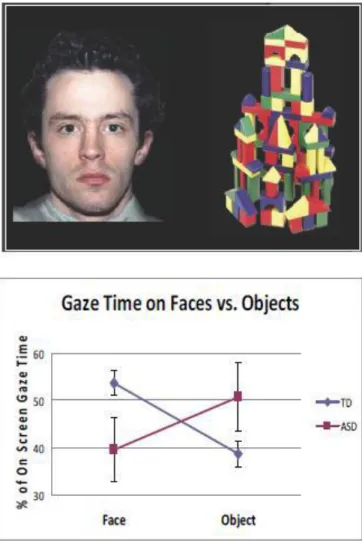
related to circumscribed interests in adults with and without ASD. Results indicated that the ASD
group attended disproportionately to non-social stimuli related to circumscribed interests relative to
social stimuli in comparison to the control group (see Figure 1).
The present study was designed to extend this line of research to examine visual attention
in ASD using a preferential looking paradigm that simultaneously presented social stimuli and
non-social stimuli- faces, objects related to circumscribed interests, and other everyday objects not
related to circumscribed interests. Although the complex array paradigm used in Sasson et al (2008,
2011) recapitulates the complexity of real-world visual scenes by including multiple stimuli, the
presentation of only two stimuli simultaneously in the paired preference paradigm decreased
perceptual load associated with the task. Given that perceptual load moderates selective attention
and visual selection in ASD (Remington et al, 2009; Remington et al, 2012), this parameter is an
important consideration in studies of visual attention in ASD. Previous studies of attention in ASD
have primarily compared individuals with autism to typically developing control individuals or those
with other developmental disorders (i.e., developmental delay) (Chawarska et al., 2012; Mitchell et
al., 2011). Patients with obsessive compulsive disorder (OCD) have often been reported as having
difficulty completing selective attention tasks and visual search paradigms (Rosenburg et al., 1997;
Maruff et al., 1999; Kaplan et al., 2006); however, the extent for dysfunctional basic attention
abilities is still unclear (see also Kuelz et al., 2004). Aside from primary analyses that compared ASD
10
another neurodevelopmental disorder that is characterized by restricted and repetitive behaviors
and aberrant patterns of attention, to specifically characterize the impact of circumscribed interests
on the allocation of attention in ASD.
Based on previous research (Sasson, Turner-Brown, Holtzclaw, Lam, & Bodfish, 2008;
Sasson, Elison, Turner-Brown, Dichter, & Bodfish, 2011; Klin, Jones, Schultz, Volkmar, & Cohen,
2002; Pierce & Courchesne, 2001), it was hypothesized that the ASD group would be characterized
by relatively greater visual attention to the nonsocial than social stimuli, specifically those non-social
stimuli related to circumscribed interests. Sasson et al. (2008; 2011) reported children with ASD
view stimuli in a detail-oriented manner as indicated by the number of discrete fixations on an
image. Due to these findings, it is also hypothesized that children with ASD will display a more
detail-oriented visual style when looking towards non-social images rather than social images. Also,
results from research regarding the prioritization of attention in passive viewing paradigms have
been inconsistent (i.e., looking first at faces over objects and vice versa) (van der Geest et al., 2002;
Dalton et al., 2005; see also Freeth et al., 2011). The current study will investigate the location of
first fixation, face or object, across groups. Finally, exploratory analyses will investigate the extent
to which patterns of visual attention in the ASD sample would predict the magnitude of symptoms in
the ASD sample.
METHODS Participants
Participants included three groups of children (9-18 years): 39 children with ASD (17 were
identified as having autism; whereas, the remainder reached criteria for a spectrum disorder), 13
children with Obsessive Compulsive Disorder (OCD), and 20 typically developing children (TYP). 2
11
(Composite IQ < 70) (Kaufman and Kaufman, 1990); 4 participants from the TYP group, 5 participants
from the OCD group, and 14 additional participants with ASD were excluded due to reduced data
acquisition during the eye-tracking task. Final sample size and demographic information on each
group are reported in Table 1. Groups were matched on age, socioeconomic status (SES), and
gender distribution. The ASD group was recruited through the UNC Autism Research Registry. The
Autism Registry is a tool for subject recruitment available to UNC researchers through the
NICHD-funded Intellectual and Developmental Disabilities Research Center at the Carolina Institute for
Developmental Disabilities (CIDD). Autism spectrum diagnoses were based on a history of clinical
diagnosis informed by scores on the Autism Diagnostic Observation Schedule (ADOS-G) (Lord, et al.,
2000) administered by a research reliable assessor and using standard cutoffs. Children with OCD
were recruited with the help of the Program in Child Affective and Anxiety Disorders (PCAAD;
Director: co-I John March, PhD) with multiple and varied methods, including providing information
to psychology and psychiatry clinics, pediatricians, schools, and other professional and community
settings (e.g., health fairs, parent groups). Typically developing children and adolescents were
recruited via mass emails sent through the UNC-CH listserv. Inclusion/exclusion criteria are listed
below. All participants consented to protocols approved by the Human Investigations Committees
at UNC-Chapel Hill.
Inclusion / exclusion criteria
Children with ASD met the following criteria: 1) Clinical diagnoses of autism;
2) Between the ages of 9-18 years, inclusive; 3) No known genetic/medical conditions;
4) No known sensory deficits (e.g., not blind or deaf); 5) Ambulatory status;
12
7) No nonverbal learning disability (NVLD); IQ above 80 and no MRI contraindications. Children with Obsessive Compulsive Disorder (OCD) met the following criteria:
1) Primary diagnosis of OCD;
2) Between the ages of 9-18 years, inclusive; 3) No known genetic/medical conditions; 4) No mental retardation;
5) No known sensory deficits (e.g., not blind or deaf); 6) Ambulatory status;
7) No comorbid diagnosis of psychosis, bipolar disorder, or any PDD. Children with neurotypical development met the following criteria:
1) Between 9-18 years of age, inclusive; 2) No known genetic/medical conditions; 3) No mental retardation;
4) No known sensory deficits (e.g., not blind or deaf); 5) Ambulatory status;
6) No significant features of any PDD or OCD;
7) Lifetime-free of Axis I psychiatric and neurological disorders; 8) No family history of psychosis, bipolar disorder, PDD, and OCD; 9) No psychotropic medication use;
10)The older TYP subgroup will have no MRI contraindications.
Symptom Measures
Parents or legal guardians of children in all three groups completed parent-report versions
of (a) The Repetitive Behavior Scale-Revised (RBS-R) (Bodfish, Symons, Parker, & Lewis, 2000) and
(b) the Social Reciprocity Scale (SRS-SR) (Constantino & Gruber, 2002), in addition to standardized
measures of intelligence taken via the Kaufman Brief Intelligence Test (K-BIT) (Kaufman and
Kaufman, 1990) and, within the autism group, diagnostic measures via the ADOS-G (Lord et al.,
13
Task & Stimuli
Eyetracking was measured during a passive viewing, paired preference visual task (see
Figure 2). Stimuli were pairs of social and non-social stimuli, either related to circumscribed
interests or other everyday objects not related to circumscribed interests, presented simultaneously
(one on the left of center and one on the right of center; see Figure 2). Twenty stimuli (each
containing one social and one nonsocial stimulus) were presented to each participant, and each
stimulus was presented for 5 seconds with a 1.5-3.5 inter-stimulus interval. Ten social stimuli were
presented with a stimulus related to circumscribed interests, while ten social stimuli were presented
with everyday objects not related to circumscribed interests. Images were approximately 4.5 x 3.5
inches. Whether social or nonsocial stimuli were presented on the left or right was counterbalanced
across trials. Subjects sat approximately 50-60 cm from a 23.5 in display and viewed stimuli
subtending a visual angle of approximately 6o, left and right of center. Participants were instructed
to remain attentive to the display for the duration of each stimulus presentation.
Social stimuli were pictures of mildly pleasant faces (with equal numbers of male and female
faces), from the NimStim set of facial expressions (Tottenham, et al., 2009). The non-social images
were systematically derived by our research group in the following manner (see Sasson et al, 2012
for a fuller description). First, a large number of potential nonsocial images was selected based on
response profiles from semi-structured parent-report interviews about circumscribed interests in
ASDs (e.g., machines, mechanical systems, trains and electronic devices) (South, Ozonoff, S, &
McMahon, 2005; Turner-Brown, Lam, Holtzclaw, Dichter, & Bodfish, 2011). Next, the visual salience
of these images was evaluated via passive-viewing visual exploration eye-tracking studies of children
and adults with and without ASDs (Sasson, Elison, Turner-Brown, Dichter, & Bodfish, 2011; Sasson et
14
relatively greater visual attention (i.e., the number of fixations and duration of fixations) in ASD
samples. These images are conceptually linked to circumscribed interests in ASD and thought to be
of higher interest to individuals with ASD based on these results; therefore, these images are labeled
as “High ASD Interest” images (HAI). Finally, 56 adults with self-identified ASDs provided
significantly higher valence ratings of these nonsocial images relative to 213 adults without ASD,
while the groups did not differ in their valence ratings of other everyday objects not associated with
circumscribed interests (Sasson et al., 2012). These images are labeled as “Lower ASD Interest”
images (LAI). HAI object categories included: trains, tractors, cars, planes, electronics, road signs,
and blocks/block designs. These HAI and LAI nonsocial images were used in the present study and
are depicted in the Appendix of Dichter et al (2012).
Eye-tracking Analysis
Eye-movement data were recorded with a Tobii X120 eye-tracker (Tobii Technology,
Stockholm, Sweden). The system is a stand-alone eye-tracking unit that monitors movement of the
participant’s pupil at 50 Hz by using infrared light to produce reflection patterns on the corneas and
then monitors the movements of these reflections relative to eye position. Eye movement patterns
were analyzed by conducting fixation analyses. A single fixation was defined as remaining within a
radius of 30 pixels for a minimum of 10 msec.
There were three areas of interest (AOIs) within each stimulus: face, object, and exterior
(defined as gaze on the screen but not on either stimulus). One trial from the task was discarded for
due to technical error during data collection that resulted in lack of data collection for that trial
across all three groups. Areas of interest were defined as the smallest possible rectangle needed to
outline each stimulus. The primary dependent variables of interest were (1) the gaze time to face
15
made within each AOI in each stimulus pair. As stated previously, 4 participants from the TYP group,
5 participants from the OCD group, and 14 additional participants with ASD were excluded due to
reduced data acquisition during the tracking task defined by <50 seconds of recorded
eye-tracking data.
RESULTS
Gaze Time Analyses
Between groups t-tests indicated that groups did not differ significantly in total gaze time
summed across the task. Gaze time to faces and objects was extracted for each participant for each
stimulus type: faces (when paired with an HAI image) and HAI objects, faces (when paired with an
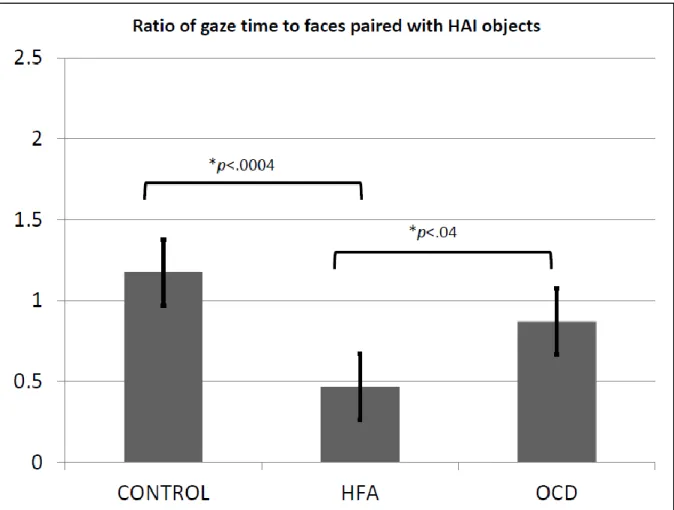
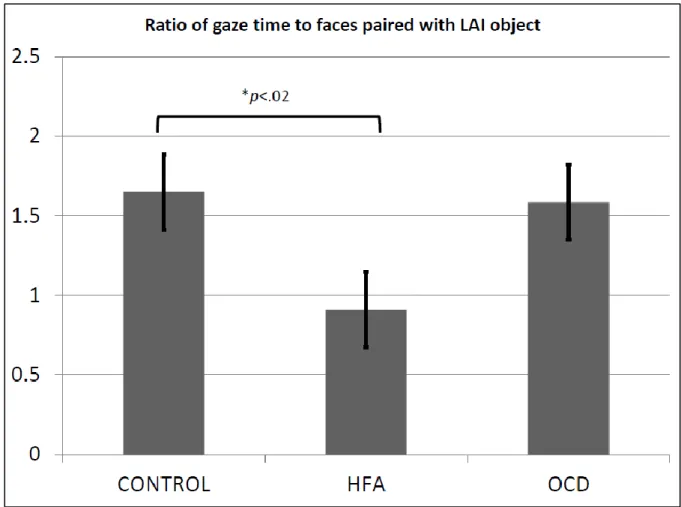
LAI image) and LAI objects. A ratio of gaze time for each type of stimulus pair was then created
(e.g., gaze time to faces: gaze time to HAI objects; gaze time to faces: gaze time to LAI objects) for
each participant and, finally, compared across groups. See Figure 3. Results addressing the primary
aims of the study (i.e., comparisons between ASD and typical development) are reported first.
Between groups t-tests of Face:HAI ratios indicated a significant decrease in looking time to faces in
the ASD group when faces were presented concurrently with HAI objects relative to the control
group, t(38)=3.90, p<.0004. Between groups t-tests of Face:LAI ratios also indicated a significant
decrease in looking time to faces in the ASD group when faces were presented concurrently with LAI
objects relative to the control group, t(38)=2.26, p<.02. Between groups t-tests of Face:HAI ratios
indicated a significant decrease in looking time to faces in the ASD when faces were presented
concurrently with the HAI objects relative to the OCD group, t(30)= -2.14, p<0.04. There were no
significant differences in gaze time proportions between the control and OCD groups. Follow-up
within groups analyses of gaze time indicated that looking time to faces increased across all groups
16
First Fixation Analyses
The average time to first fixate on faces and objects was analyzed between groups. In other
words, this was a metric of the amount of time it took each participant to make their first fixation to
faces and their first fixation to objects. Between-groups t-tests indicated that groups did not differ
significantly in average time to make a first fixation to faces, p<.30. However, the ASD group did
look faster towards objects (M= 0.81 sec; SD= 0.38) relative to typical controls (M=1.18 sec, SD=
0.55), t(38)=2.54, p<.01. Difference in time to make a first fixation to objects between the ASD and
OCD groups (M=1.07, SD= 0.59) approached significance, t(30)= -1.46, p<.15. There were no
significant differences in time to first fixate on objects between the typical control and OCD groups.
See Figure 5.
Discrete Fixation (Individual Fixation Count) Analyses
The total number of discrete fixations on faces and objects was analyzed between groups.
This metric represented the number of individual fixations made within an AOI. Between-groups
t-tests indicated that ASD and typical control groups did not differ significantly in number of discrete
fixations when looking at faces, t(38)= -0.16, p<.80. However, the ASD group did display a reduced
number of discrete fixations when looking at faces (M=170.9, SD=108.2) relative to the OCD group
(M= 332.5, SD= 337.7), t(30)= -2.10, p<.04. Between-group analyses of discrete fixations to faces
between OCD and typical control groups approached significance, t(22)= -1.94, p<.06. Analyses of
discrete fixations to objects, indicated that the typical control group displayed a reduced number of
discrete fixations to objects (M= 159.4, SD= 47.87) relative to both the HFA group (M= 273.9, SD=
113.6), t(38)=-3.80, p<.0005, and the OCD group (M=383.5, SD= 462.2), t(22)=-2.12, p<.04. Within
group analyses of number of discrete fixations indicated that only the ASD group differed on the
17
Symptom Measures
Correlations between eye-tracking measures and the SRS-SR (total score and five subscales),
the RBS-R (total score and six subscales), and the ADOS (three subscales) were evaluated within the
ASD group. Within the ASD group, the amount of time to make an initial fixation to faces was
positively correlated with both the number of items endorsed (r = 0.63, p<.0008) and the score on
the self-injurious subscale (r = 0.68, p<.0002). It was also correlated with the number of items
endorsed (r = 0.43, p<.03) and the score on the ritualistic behavior subscale (r = 0.44, p<.02) of the
RBS-R.
Within the ASD group, the number of discrete fixations while looking at objects was
positively correlated with scores on the social communication (r = 0.47, p<.02) and social motivation
(r = 0.56, p<.004) subscales of the SRS-SR in addition to the total raw score (r = 0.57, p<.003).
Correlations between the number of discrete fixations and the score on the autistic mannerisms
subscale of the SRS-SR approached significance (r = 0.40, p<.055). Number of discrete fixations while
looking at objects was also positive correlated with both the number of items endorsed (r = 0.61,
p<.001) and the score on the self-injurious subscale (r = 0.63, p<.0009), the number of items
endorsed (r = 0.56, p<.004) and the score on the compulsive behavior subscale (r = 0.51, p<.01), the
number of items endorsed (r = 0.78, p<.0001) and the score on the ritualistic behavior subscale (r =
0.72, p<.0001), and the number of items endorsed (r = 0.61, p<.0001) and the score on the
sameness behavior subscale (r = 0.50, p<.01) on the RBS-R in addition to total items endorsed (r =
0.70, p<.0002) and total score (r = 0.63, p<.001). No other correlations were significant. See Figure
7.
18
Individuals with ASD disproportionately explore and perseverate their attention on objects
commonly associated with circumscribed interests (Sasson et al., 2008; 2010). The aim of the
present study was to investigate visual attention while children and adolescents with and without
ASD viewed pairs of concurrently displayed social and non-social stimuli. Non-social stimuli included
either (a) common, everyday object images or (b) object images related to circumscribed interests
known to be salient and rewarding to individuals with ASDs (Sasson et al, 2012; Dichter et al., 2012).
It was hypothesized that children with ASD would preferentially look at non-social objects,
specifically those related to circumscribed interests, over concurrently present social images more
than control participants and those with OCD, another neurodevelopmental disorder characterized
by patterns of restricted and repetitive behaviors.
Analysis of gaze time indicated an overall significant reduction in looking time to faces
relative to object stimuli in the ASD group in comparison to both control and OCD groups.
However, specific classes of non-social information (i.e., those images related to circumscribed
interests and those everyday, common images) did not produce differential effects on attention
across all groups. When faces were presented concurrently with non-social objects related to
circumscribed interests (Face:HAI), the proportion of gaze time to faces in the ASD group was
significantly less than the typical control and the OCD group. However, when faces were presented
with everyday non-social objects (Face:LAI); the ASD group differed significantly from the control
group while the two clinical groups displayed no significant differences in proportion of gaze time.
Although images related to circumscribed interests paired with faces disproportionately captured
attention away from social stimuli and differentiated the ASD group from both typical control and
clinical control groups, attention patterns in the ASD group continued to differ from the typical
controls when faces were paired with other everyday non-social items. A pattern of relatively
19
specific to ASD in addition to an overall decreased salience of social information. Decreased salience
of social information likely contributes to the atypical and inefficient processing of social
information, lack of directed attention towards faces (Klin, Sparrow, de Bilt, Cicchetti, D, & Volkmar,
1999; Sasson, et al., 2007) as well as the inability to interpret social situations (Rump, Giovanelli,
Minshew, & Strauss, 2009).
Further analyses of latency to first look at faces and objects indicated that the ASD group
was quicker to look at objects than both the control and OCD groups, though these results were not
statistically significant and only represent trend level effects. In addition, not only were children and
adolescents with ASD looking more quickly and more often to object stimuli, results pertaining to
discrete fixations indicated they were also doing so with greater detail. Increased detail orientation
may support mechanisms of reduced visual exploration and impairments in visual disengagement
consistently reported in other studies of attention in ASD (Courchesne et al., 1994; Landry and
Bryson, 2004; Zwaigenbaum et al., 2005; Sasson et al., 2008; 2011).
Over-focused, detail-oriented styles of attention may be unique and distinctive to ASD in
comparison to other developmental disorders characterized by under-focused attention, such as
ADHD, or those characterized by perseverative and repetitive behavior patterns, such as OCD. Few
studies to date have investigated unique patterns of attention across ASD and OCD. Research in
OCD has indicated that behavioral phenotypes appear similar across the two disorders (i.e.,
perseverative thoughts and deficits in inhibitory control); however, increased detail-orientation and
overall increased attention to objects has not been reported in OCD. Studies investigating
interrelations between autism spectrum disorders and OCD (Cath et al., 2008; Anholt et al., 2009)
have reported associations between OCD symptom severity and impairments in social processing
and attention switching quantified by an autism symptom measure (Autism Spectrum Quotient, AQ;
20
disproportionate and detail-oriented attention to non-social information relevant to circumscribed
interests may reflect a behavioral phenotype specific to ASD in comparison to another
neurodevelopmental disorder characterized by restricted and repetitive behaviors. These findings
suggest that it is necessary for future research to further address patterns of attention in ASD
relative to other developmental disorders with overlapping behavioral and cognitive phenotypes,
such as OCD.
These results are also consistent with previous research that has utilized comparable
measures of preference and has found that children and adults are “drawn to” non-social elements
(Pierce, Conant, Hazin, Stoner, & Desmond, 2011; Klin & Jones, 2008). For example, Klin and Jones
(2008) reported reduced preference for up-right versus inverted biological motion displays in
two-year olds with ASD. Children with ASD looked less often at up-right point light displays and more
often at inverted displays than both developmentally delayed and typically developing children.
Additional reports of atypical patterns of attention in adolescents and adults with ASD to concurrent
social and non-social stimuli consistent with the current findings suggest these abnormalities may
remain consistent across development (Rice, 2012; Freeth, Chapman, Ropar, & Mitchell, 2010;
Fletcher-Watson, Leekam, Findlay, & Stanton, 2008; Elison, Sasson, Turner-Brown, Dichter, &
Bodfish, 2012).
Significant relations between ASD symptoms and distinct patterns of attention to object
images were also reported within the ASD group. Increased detail-orientation to object images was
positively correlated with several subscales and total scores on both the SRS-SR (Constantino &
Gruber, 2002) and the RBS-R (Bodfish, Symons, Parker, & Lewis, 2000), particularly those involving
social communication and motivation impairments and severity of ritualistic and sameness
behaviors. This replicates and extends previous reports of associations between repetitive behavior
21
relations are not surprising within ASD. Greater attention to, and interest in, non-social as opposed
to social information is an archetypal pattern of behavior and attention in individuals with ASD
(Sasson et al., 2008; 2011; Pierce and Courchesne, 2001; Klin et al., 2002; Jones and Klin, 2008;
Chawarska et al., 2012). Measures of global repetitive behavior severity and impairment in social
communication may serve as an index of a tendency of individuals with ASD to engage less with the
social environment and more with non-social information or objects. This is apparent in those types
of repetitive behaviors such as circumscribed interests and those involving the preoccupation with
and repetitive use of objects. Finally, the positive correlations between the latency to initially
attend to faces and score on the self-injurious subscale of the RBS-R supports previous research
regarding the significant relationships between rate of self-injury and social skill impairment and
symptoms of social withdraw in children and adolescents with ASD (Waters and Healey, 2012).
Limitations of the present study should be addressed in future research. First, all
participants viewed the same set of object images, whereas circumscribed interests in ASD are
idiosyncratic and person-specific. In this regard, object images in the current task were not used as a
proxy for person-specific interests but rather as a ‘press’ to investigate differences in visual
attention to social and salient non-social images across groups. The use of these standardized
object images is likely a conservative estimate of patterns of reflexive visual attention to
person-specific interests, but future research with person-person-specific, age-appropriate images will be necessary
to address this.
Previous research has outlined the moderating effects of lower level visual properties (e.g.,
luminance, contrast) on patterns of attention (Tseng, Cameron, Pari, Reynolds, Munoz, & Itti, 2012).
Studies that control for these visual properties or more thoroughly investigate their effects may
provide further evidence for the moderating effects of stimulus category on the allocation of
22
precisely determine the degree to which circumscribed interests in ASD are impacting cognitive
control over attention. More research is needed to determine whether disproportionate patterns of
attention to social and non-social information also affect volitional control over attention in ASD.
Despite these limitations, the present study extends previous lines of research to address
concurrently presented social stimuli and nonsocial stimuli related to circumscribed interests in ASD.
Social and non-social stimulus pairs elicit disproportionate patterns of attention in ASD. The
proportion of gaze time to faces within the ASD group was reduced when faces were paired with
high interest items; however, when faces were presented with lower interest items, the proportion
of gaze time afforded to faces increased. Although, these findings differed only relative to the
control group and findings in this condition did not demonstrate group differences between ASD
and OCD. Proportion of gaze time to faces differentiated the ASD group from another clinical
control group only when faces were paired with objects relevant to circumscribed interests. These
findings support models of decreased saliency of social information coinciding with an increased
saliency of non-social information within ASD. Assessment of visual attention may be used to
quantify discrete aspects of the repetitive behavior phenotype in ASD, including the modulating
23
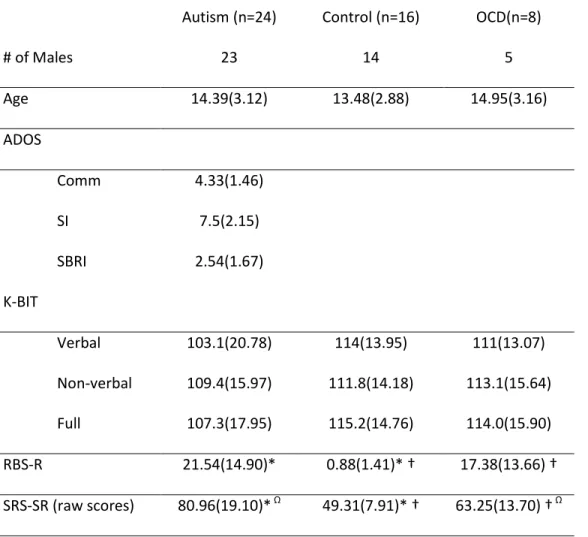
TABLE 1. Experiment 1: SvO. Means (SDs) of demographic data and symptom profiles from sample.
Autism (n=24) Control (n=16) OCD(n=8)
# of Males 23 14 5
Age 14.39(3.12) 13.48(2.88) 14.95(3.16)
ADOS
Comm 4.33(1.46)
SI 7.5(2.15)
SBRI 2.54(1.67)
K-BIT
Verbal 103.1(20.78) 114(13.95) 111(13.07)
Non-verbal 109.4(15.97) 111.8(14.18) 113.1(15.64)
Full 107.3(17.95) 115.2(14.76) 114.0(15.90)
RBS-R 21.54(14.90)* 0.88(1.41)* † 17.38(13.66) †
SRS-SR (raw scores) 80.96(19.10)* Ω 49.31(7.91)* † 63.25(13.70) † Ω
×
MA & IQ-matched* Indicates significant difference between ASD and TYP group, p<.05. † Indicates significant difference between TYP and OCD group, p<.05.
Ω
Indicates significant difference between ASD and OCD group, p<.05.
Abbreviations:
WASI: Wechsler Abbreviated Scale of Intelligence (Weschler, 1999);
ADOS: Autism Diagnostic Observation Scale (Lord et al., 2000); Comm: Communication; SI:
Reciprocal Social Interaction; SBRI: Stereotyped Behaviors and Restricted Interests;
RBS-R: Repetitive Behavior Scale-Revised (Bodfish, Symons, & Lewis, 1999).
24
25
26
27
28
29
30
EXPERIMENT 2: COGNITIVE CONTROL OVER ATTENTION TO SOCIAL AND NON-SOCIAL STIMULI
Perseverative patterns of attention, failure to visually disengage, and reduced visual
exploration have been conceptually linked to repetitive behaviors in ASD (Ozonoff et al., 2000;
Bodfish et al., 2000; South et al., 2005). Of particular interest is the circumscribed interests (CI)
subdomain of restricted and repetitive behaviors. Findings on CI are primarily regarding their rate of
occurrence independent of intellectual impairment, their prevalence across the autism spectrum
and descriptions of common examples (e.g., gadgets, vehicles, electronics, particular animals,
schedules, and numbers). CI appear to be the norm rather than the exception, occurring with equal
prevalence in both high- and low-functioning autism and at similar rates between high-functioning
autism and Asperger’s Syndrome (Bartak and Rutter; 1976; Freeman et al., 1981; South et al., 2005;
Klin et al., 2007). Parent reports have indicated that CI can interfere with functional and more
appropriate forms of play, interaction with peers, and successful day-to-day activities (South et al.,
2005). However, the association between higher-order cognitive processes (i.e., cognitive control)
and CI in autism has not been firmly established. Experimental evidence has illustrated that, within
individuals with ASD, these patterns of narrowed, perseverative attention and reduced visual
exploration are elicited in response to stimuli related to CI (Sasson et al., 2008; 2011). The purpose
of this study was to extend these findings and utilize eye-tracking methodology in conjunction with
an empirically-derived CI image set (Sasson et al., 2008; 2011; 2012) to investigate differential
patterns of attention and the ability of individuals with and without ASD to volitionally control
32
Visual saccade tasks provide a behavioral component and are useful for examining
differential levels of ability to shift, disengage, and control the allocation of attention in response to
different classes of stimuli (Sweeney, Levi, and Harris, 2002). Saccadic eye movements during these
tasks provide objective measures of response inhibition and cognitive control. Depending upon the
specific task, individuals are instructed to generate eye movements in response to a peripheral
target. Visually guided or prosaccade tasks tap into reflexive sensorimotor systems when an
individual is required to attend to a peripheral target when it appears. Another saccade task used to
more directly investigate cognitive deficits and attention is the antisaccade task. The task requires
inhibition of a reflexive saccade to a peripheral target, and instead asks the participant to saccade to
the mirror image location. In other words, these tasks require an individual to look away from a
target, making an anti-saccade (AS), thus measuring the ability to voluntarily suppress a prepotent
response to saccade towards an image when it appears. Studies applying AS paradigms across
various ages have consistently reported deficits in the ability of ASD participants to inhibit prepotent
responses and a tendency to make an increased number in saccade errors (Luna et al., 2007;
Goldberg et al., 2002; Manoach et al., 2011; Mosconi et al., 2009; Minshew et al., 1999). A basic
deficit in response inhibition in ASD seems to be present throughout development. Though
improvement with age in ASD has been reported, proficiency is not achieved and individuals with
ASD continue to display more errors than control groups (Luna et al., 2007).
Confirmation of intact saccade dynamics (i.e., latency, velocity, duration/amplitude) in
adolescents and adults with autism (Minshew et al., 1999) indicate that reports of increased
directional errors reflect an impaired capacity of the prefrontal cortex to suppress
context-inappropriate reflexive responses rather than lower-level deficits in disengaging and shifting
attention. More recent research has replicated these findings and suggests that increased latency in
33
that the deficits in saccadic inhibition may be quantitatively and qualitatively distinct in ASD in
comparison to other disorders such as social-emotional processing disorder (SEPD), schizophrenia,
and obsessive-compulsive disorder (OCD). Specifically in contrast to SEPD and schizophrenia,
individuals with ASD have normal latencies, velocities, and amplitudes and make fewer AS errors;
therefore, impairments are primarily within prefrontal regions and response inhibition rather than
subcortical oculomotor functions associated with the cerebellum and brainstem regions. Attention
in ASD is more qualitatively constrained and a saccade inhibition deficit may be less severe than
other psychotic disorders. If saccade dynamics are intact but errors are made appropriately
suppressing saccades, this strengthens support for disturbances in the prefrontal cortex and
connections that subserve the capacity to suppress behavioral responses to salient stimuli when
responses are not context appropriate.
As indicated previously, eye movement research offers a translational approach for
examining disturbances in frontostriatal systems, controlling the allocation of attention and the
inhibition of prepotent responses when social and non-social information are presented in
conjunction with one another. Studies of saccadic behavior in ASD, such as those cited previously,
have primarily used non-social stimuli such as LED lights and geometric shapes. No studies to date
have utilized these paradigms to investigate differences in control over visual saccades in response
to different categories of images. Eye-tracking research has focused primarily on the extent to
which individuals with ASD show deliberate attention to social information, while few studies have
investigated the distracting power of social versus non-social stimuli nested within a task requiring
cognitive control. Previous eye-tracking results have indicated that the presence of CI can impose a
significant limitation on normative visual search and exploration processes that are important for
experience-dependent learning (Sasson et al., 2008; 2009). Passive-viewing forced-choice
34
salience is altered in individuals with ASD and, in many cases, attention is being disproportionately
captured by specific types of non-social information (Dichter et al., 2010).
Although there is reduced deliberate interest in social information as is measured by passive
looking paradigms, these findings do not necessarily imply that social information has reduced
distracting power for available cognitive resources (Vaidya et al., 2011). Studies using standard
attention tasks and Posner cueing paradigms argue that individuals with ASD, just like typically
developing individuals, automatically orient attention based on perceived gaze to detect a
peripheral target (Posner and Dehaene, 1994; Greene et al., 2011; Dichter and Belger, 2007).
Although, control groups show effects specific to social cues; individuals with ASD are able to
interpret both social and non-social stimuli (e.g. arrows) with equal proficiency (Vlamings et al.,
2005; but see also Goldberg et al., 2008). Riby et al. (2012) recently quantified the degree to which
face stimuli cause distraction when searching for an identified target. Typical adults were slower to
detect a target when a face was present in a visual array, but the same effect was not observed in
adults with autism. Social stimuli, such as faces, do not appear to capture attention in ASD. An
additional important question is whether the relative salience of various stimuli, both social and
non-social, is altered in ASD. In other words, while research suggests that deliberate attention to
social information appears to be reduced in ASD, is it also true that non-social information thought
to be of increased salience in autism disproportionately captures cognitive resources controlling
attention. Measures of reflexive attention suggest that non-social stimuli related to circumscribed
interests capture attention in children and adults with ASD (Dichter et al., 2012; see also results
from Experiment 1); however, it remains unclear whether stimuli conceptually linked to this
35
It is important to also question whether distinct patterns of attention as a function of
stimulus type in ASD are syndrome-specific or relevant to other disorders that impact attentional
and behavioral control. Studies of attention and visual saccades in children with ASD have primarily
compared ASD to typically developing children or children with other developmental disorders and
many studies of cognitive control have compared ASD to other psychotic disorders such as
schizophrenia. This study will explore differences in cognitive control over attention between ASD
and obsessive compulsive disorder (OCD), another neurodevelopmental disorder that is associated
with repetitive behaviors. Experimental evidence from the implementation of antisaccade
paradigms with OCD samples suggests that adults and especially children with OCD have difficulty
inhibiting prepotent responses, exhibiting both an increased number of reflexive glances towards
the peripheral target and, when accurate antisaccades are made, significantly increased latencies in
order to do so (Rosenberg et al., 1997; Maruff et al., 1999). These patterns of results, in comparison
with those reported in ASD, suggest that impairments on antisaccade tasks in OCD are based on
guiding visual saccades and a slowing of psychomotor function as well as some deficits in inhibiting
responses (Mosconi et al., 2009).
The current experiment explored whether social and social stimuli, particularly
non-social stimuli related to circumscribed interests, can influence the cognitive control over attention in
children and adolescents with ASD. This is an important extension of previous research, which
unlike the current study, has focused on reflexive attention to social and non-social stimuli
embedded in passive-viewing tasks. By including the antisaccade task and utilizing social and
non-social stimuli hypothesized to be highly salient for individuals with ASD as well as comparing
performance to different diagnostic groups, qualitatively different constraints on patterns of visual
attention specific to the ASD phenotype can be explored. It is hypothesized that children and
36
an antisaccade task in comparison to typically developing controls; however, only children and
adolescents with ASD will display an increase in directional errors to non-social object targets,
specifically those related to circumscribed interests. Previous findings regarding oculomotor
properties such as saccadic latency and effects of visual hemifield on attention are inconsistent
(Rosenburg et al., 1997; Luna et al., 2004; Mosconi et al., 2009). Analyses will also include group
differences on such measures. In addition to measures of task performance, exploratory analyses
will be carried out to investigate the extent to which patterns of visual attention in the ASD group
would predict the magnitude of autism symptoms.
METHODS
Participants
Participants included three groups of children (9-18 years): 24 children with ASD (14 were
identified as having autism; whereas, the remainder reached criteria for a spectrum disorder), 9
children with Obsessive Compulsive Disorder (OCD), and 17 typically developing children (TYP). Four
participants from the TYP group, 1 participant from the OCD group, and 2 participants with ASD
were excluded due to reduced data acquisition during the eye-tracking tasks (i.e., missing data >
50% of trials). Final sample size and demographic information on each group are reported in Table
2. Groups were matched on age, socioeconomic status (SES), and gender distribution. The ASD
group was recruited through the UNC Autism Research Registry. The Autism Registry is a tool for
subject recruitment available to UNC researchers through the NICHD-funded Intellectual and
Developmental Disabilities Research Center at the Carolina Institute for Developmental Disabilities
(CIDD). Autism spectrum diagnoses were based on a history of clinical diagnosis informed by scores
on the Autism Diagnostic Observation Schedule (ADOS-G) (Lord, et al., 2000) administered by a
37
help of the Program in Child Affective and Anxiety Disorders (PCAAD; Director: co-I John March,
PhD) with multiple and varied methods, including providing information to psychology and
psychiatry clinics, pediatricians, schools, and other professional and community settings (e.g., health
fairs, parent groups). Typically developing children and adolescents were recruited via mass emails
sent through the UNC-CH listserv. Inclusion/exclusion criteria are listed below. All participants
consented to protocols approved by the Human Investigations Committees at UNC-Chapel Hill.
Inclusion/Exclusion criteria
Children with autism met the following criteria: 8) Clinical diagnoses of autism;
9) Between the ages of 9-18 years, inclusive; 10)No known genetic/medical conditions;
11)No known sensory deficits (e.g., not blind or deaf); 12) Ambulatory status;
13) No comorbid diagnosis of psychosis, bipolar disorder, or OCD;
14) No nonverbal learning disability (NVLD); IQ above 80 and no MRI contraindications. Children with Obsessive Compulsive Disorder (OCD) met the following criteria:
8) Primary diagnosis of OCD;
9) Between the ages of 9-18 years, inclusive; 10)No known genetic/medical conditions; 11) No mental retardation;
12) No known sensory deficits (e.g., not blind or deaf); 13) Ambulatory status;
14) No comorbid diagnosis of psychosis, bipolar disorder, or any PDD. Children with neurotypical development met the following criteria:
38 13) No mental retardation;
14) No known sensory deficits (e.g., not blind or deaf); 15) Ambulatory status;
16)No significant features of any PDD or OCD;
17)Lifetime-free of Axis I psychiatric and neurological disorders; 18)No family history of psychosis, bipolar disorder, PDD, and OCD; 19) No psychotropic medication use;
20) The older TYP subgroup will have no MRI contraindications.
Symptom Measures
Parents or legal guardians of children in all three groups completed parent-report versions
of (a) The Repetitive Behavior Scale-Revised (RBS-R) (Bodfish, Symons, Parker, & Lewis, 2000) and
(b) the Social Reciprocity Scale (SRS-SR) (Constantino & Gruber, 2002), in addition to standardized
measures of intelligence taken via the Kaufman Brief Intelligence Test (K-BIT) (Kaufman and
Kaufman, 199) and, within the ASD group, diagnostic measures via the ADOS-G (Lord et al., 2000).
Participant characteristics are reported in Table 2.
Prosaccade and Antisaccade Tasks (PS and AS) & Stimuli
Prosaccade and antisaccade tasks were administered to assess automatic visual attention
and components of cognitive control over voluntary saccades. In the prosaccade task, participants were instructed to look towards the peripheral target, making a “pro”saccade. A central target was
presented for a variable period (1500-2500 milliseconds) prior to being extinguished and then
followed by the presentation of a peripheral stimulus. Sixty total trials were administered: 20 trials
with a social stimulus as the peripheral target, 20 with an object related to CI as a peripheral target,
and 20 with an everyday object as a peripheral target. The peripheral target was presented for a
variable period of 2500-3500 milliseconds. Based on previous oculomotor and visual saccade
39
et al., 2009). The antisaccade task was identical; however, participants were instructed to look to the opposite, mirror location of the peripheral target essentially making an “anti”saccade (See
Figure 8). Every participant completed 10 practice trials before being administered both the
prosaccade and antisaccade task and reached a minimum cut off of 8 of the 10 correct trials before
beginning the formal task. During practice trials, participants were asked to verbalize the correct
on-screen location to attend to (i.e., “Did you look in the box on the right or the box on the left?”,
“Did you make a mistake?”, “Why do you think you made a mistake?”).
Social stimuli were pictures of mildly pleasant faces (with equal numbers of male and female
faces), from the NimStim set of facial expressions (Tottenham, et al., 2009). The non-social images
were systematically derived by our research group in the following manner (see Sasson et al, 2012
for a fuller description). First, a large number of potential non-social images was selected based on
response profiles from semi-structured parent-report interviews about circumscribed interests in
ASDs (e.g., machines, mechanical systems, trains and electronic devices) (South, Ozonoff, S, &
McMahon, 2005; Turner-Brown, Lam, Holtzclaw, Dichter, & Bodfish, 2011). Next, the visual salience
of these images was evaluated via passive-viewing visual exploration eyetracking studies of children
and adults with and without ASDs (Sasson, Elison, Turner-Brown, Dichter, & Bodfish, 2011; Sasson et
al., 2008). These eyetracking studies identified 40 images without social content that garnered
relatively greater visual attention (i.e., the number of fixations and duration of fixations) in ASD
samples. These images are conceptually linked to circumscribed interests in ASD and thought to be
of higher interest to individuals with ASD based off these results; therefore, these images are
labeled as “High ASD Interest” images (HAI). Finally, 56 adults with self-identified ASDs provided
significantly higher valence ratings of these nonsocial images relative to 213 adults without ASD,
while the groups did not differ in their valence ratings of other everyday objects not associated with
40
images (LAI). HAI object categories included: trains, tractors, cars, planes, electronics, road signs,
and blocks/block designs. These HAI and LAI non-social images were used in the present study and
are depicted in the Appendix of Dichter et al (2012).
Eye-tracking Analysis
Eye-movement data were recorded with a Tobii X120 eye-tracker (Tobii Technology,
Stockholm, Sweden). The system is a stand-alone eye-tracking unit that monitors movement of the
participant’s pupil at 50 Hz by using infrared light to produce reflection patterns on the corneas and
then monitors the movements of these reflections relative to eye position. Eye movement patterns
were analyzed by conducting fixation analyses. A single fixation was defined as remaining within a
radius of 30 pixels for a minimum of 10 msec.
There were two areas of interest (AOIs) within each stimulus: the correct on-screen location
and the incorrect on-screen location which was dependent upon the task being PS or AS. Areas of
interest were defined as the outline around the a-priori identified on-screen fixation locations (e.g.,
outlined boxes to left and right of center). The primary dependent variables of interest were (1) the
saccadic accuracy and (2) the latency to saccade to the correct on-screen location. In conjunction
with previous research (Manoach et al., 2011), a saccadic error was defined as a saccade being made
within 3 degrees of the incorrect on-screen fixation location (dependent upon the task being PS or
AS). See Figure 9 for example.
RESULTS
Directional Errors
All groups made more antisaccade than prosaccade errors (task: F(1,40) = 53.40, p<0.0001).