IDEOLOGICAL (MIS)PERCEPTION: VIEWS OF THE IDEOLOGY OF CANDIDATES FOR OFFICE
Ellen E. Gutman
A thesis submitted to the faculty of the University of North Carolina at Chapel Hill in partial fulfillment of the requirements for the degree of Master of Arts in the Department of Political Science.
Chapel Hill 2009
ABSTRACT
ELLEN E. GUTMAN: Ideological (Mis)Perception: Views of the Ideology of Candidates for Office
(Under the direction of James A. Stimson.)
ACKNOWLEDGMENTS
First, I want to thank James Stimson, Michael MacKuen, and John Aldrich for their help and support as members of my committee. Second, I want to thank Gary Marks and my classmates in Poli 782 for their wonderful help and comments on this project this semester.
TABLE OF CONTENTS
LIST OF TABLES . . . v
LIST OF FIGURES . . . vi
Introduction . . . 1
Ideology . . . 3
How Voters Evaluate Candidates . . . 7
Design and Methods . . . 12
Results . . . 15
Discussion . . . 19
LIST OF TABLES
Perceptions of Ideology of Presidential Candidates by Ideology and Candidate Preference . . . 21 Difference in Perceived Self and Candidate Ideology - 2004 . . . 21 Difference in Perceived Self and Candidate Ideology - 2000 . . . 21
LIST OF FIGURES
Introduction
Some of the basic facts about our government are completely unknown by American citizens. Most are unable to express basic facts such as the length of a senator’s term or rights provided to them in the Bill of Rights (Delli Carpini and Keeter 1996). These basic facts escape the minds of most people, but this may not be important. Most people probably know that they have freedom of speech, so it does not seem as necessary for them to know from where this comes. At the same time, just over half of people are voting in presidential elections, so this should imply that people are gathering information when they need to use it. Those decisions must be based on something, so it could be from political knowledge and information.
Given the length and scope of recent presidential elections, it would be strange if voters did not gather information about the candidates. The 2008 election season lasted nearly two years from the time that candidates launched exploratory presidential committees until election day in November. Through that entire time, it was nearly impossible to avoid hearing about the election regularly. This should mean that everyone in the country knew something about the election and had at least semi-well formed opinions about the candidates. Delli Carpini and Keeter (1996) find that the most easily identifiable political figures are presidents, vice presidents, and presidential candidates, so people should know something about these officials. However, when asked, it is unlikely that people could identify some of the basic facts about presidents and presidential candidates, even ones for which they voted.
provides an explanation.
Ideology
Some voters seem to have trouble understanding what exactly ideology is supposed to mean. Stimson (2004) explains that about 22 percent of Americans do not have a good understanding of their own ideology. This portion of the population claims to hold conservative beliefs while it actually hold liberal beliefs. The words “lib-eral” and “conservative” are taken to mean things other than size of government. Liberal is taken to mean “easy” and “lacking standards” while conservative is taken to mean “thoughtful” and “prudent.” Because of this misinterpretation of these words, people often claim to be conservative because of the positives as-sociated with the word more generally, not things related to policy preferences. Whereas liberal is believed to be associated with words with which people do not generally want to be associated, conservative embodies care and thoughtfulness, which people like to consider themselves. Despite the fact that people would likely say they make these judgments about ideology based on policy preferences, it is clear something else must be factoring into their minds; people must be confused about how to identify political beliefs.
In this paper, ideology can mean two different things. The first is a judgment of how big should be the government. Those who want to increase the size of the government are more liberal than those who want to decrease it. This is the standard definition among politicians and pundits and the one that will be used to explain what ideology is supposed to mean. The second possible definition is the one that Stimson explains, where liberal means easy and conservative means thoughtful. In practice, this question asks survey respondents to place themselves on a scale from most liberal to most conservative. In this study, I will be using the seven point version of this scale. This paper will show that both are related to the evaluations that voters make about the ideology of candidates.
From this point forward, the term “ideology” will be used in a manner that
assumes there is some basis for the evaluation of the ideology that survey respon-dents make about themselves and candidates. Whether or not these evaluations are correct is not important, but rather, the distance between them is of con-cern. Whether a respondent believes that both he or she and his or her preferred candidate for office are conservative does not matter, but the fact that he or she believes them both to be on the same end of the spectrum and close together is important. This difference is what will be used throughout the rest of this paper to understand ideology. Since we know that ideology is often misinterpreted, it is no longer a problem by making the assumption that if a voter is misinterpreting ideology, he or she is misinterpreting it across the board, not just for himself or just for candidates.
Beyond the interpretation of their own ideology, voters also have to make judgments about the ideology of others. It is expected that if people are unable to correctly identify their own ideology, it would be even more challenging to identify the ideology of others, particularly candidates for public office. Throughout the campaign season, information about candidates for different offices is circulated widely, but voters seem to hear and remember very little of it. However, when questioned, a majority of voters are willing to express beliefs about the ideology of candidates although the information on which this is based is often unclear.
they likely wanted to know which was right, it was hard to accept the possibility that their understanding was wrong. While ideological positioning is much less extreme, it can create some of the same emotions.
Prior to a presidential election, even before primaries and nominations, political scientists have expectations about the candidates. It is widely expected that there will be one Democrat and one Republican, the former will be more liberal, and we have certain expectations about attributes associated with these people. There is no law that says the election must happen this way, but our experience has shown that it will likely be the case. The average American voter probably shares this expectation. Americans expect certain events to happen at election time in terms of who will run and how campaigns will be a part of their lives.
In terms of ideology, this means that people have expectations about candi-dates holding liberal or conservative beliefs. These are likely related to the un-derstanding that voters have about their own beliefs. A self-identified liberal who has regularly voted for the Democratic candidate in the past will probably expect that the Democratic nominee will hold liberal beliefs, even before a nominee has been chosen, and this expectation will almost certainly be true. In this instance, accuracy and direction fall in line and the voter does not need to differentiate between the two.
However, imagine the self-identified conservative who supports the Democratic candidate in most elections. This person’s beliefs are problematic. When con-sidering the candidates for the upcoming election, this voter will want to identify which candidate is closer to him or her ideologically in order to vote for the “best” candidate. This means that it is important for him or her to view the candidates accurately. However, understanding that the Democratic candidate is probably more liberal than the Republican conflicts with this voter’s beliefs about where candidates stand on the liberal-conservative spectrum. Therefore, the expectation about such a voter will not be complete denial of the real world, but rather, some combination of what is real and what is expected. The goal of accuracy would
lead this voter to believe the candidate to be on the left end of the ideological spectrum; anything different would deny the truth. However, the directional goal will likely lead the voter to expect the candidate to be closer to the middle, which is closer to the voter’s ideology, than at the extreme; anything else would oppose the directional goals. By placing the candidate near the middle of the ideological spectrum, both the accuracy and directional goals are satisfied.
The first voter represents an instance when accuracy and direction are in line, while the second voter is the opposite. Because of this, their understandings of the ideology of the same candidate may be different. The self-identified liberal will have no problem admitting to the fact that the Democratic candidate is liberal. In fact, the voter may even claim the candidate to be even more to the extreme than is true. On the other hand, it would be hard for the self-identified conservative to claim that his or her preferred Democratic candidate is conservative because that would oppose the truth. By claiming this candidate is moderate, it does not deny the reality of a liberal Democrat or oppose the conservatism of the respondent.
The same goals work for the other candidate, as well. Since both voters identify as Democrats, neither probably have any expectation of voting for the Republi-can nominee. However, in identifying the RepubliRepubli-can’s ideology, the accuracy and directional goals are again in play. The liberal voter has no problem calling the candidate a conservative; this voter has not been fooled by the word “conserva-tive.” On the other hand, the conservative Democrat will have a challenge. It will probably be hard to declare a disliked candidate as holding the same ideology as the voter. In this case, the voter will probably claim the candidate to, like the Democratic candidate, be toward the moderate end of the spectrum. Especially if such a voter is confused about the meanings of liberal and conservative in the way that Stimson (2004) claims, he or she will not want to perceive the candidate as a conservative. By claiming this candidate as a moderate, the voter can alleviate some of the conflict without completely ignoring reality.
can accurately identify something about the policy preferences of candidates for office. However, these approximations vary depending on what type of voter is judging. This does not necessarily mean that the correctly self-identified voter is more correct than the incorrectly self-identified voter. This voter has the potential to actually view candidates more to the extremes than they actually are. On the other hand, the wrongly self-identified voter may view both candidates as more moderate. While both voters have some degree of accuracy in their assessments, both may be pulling the candidate toward a certain direction.
How Voters Evaluate Candidates
What do voters consider when they step into the voting booth? Is it ideology, which we know is only correct some of the time? What determines how far voters claim candidates to be from them ideologically? It is probably not the case that all voters claim their preferred candidate to be exactly in step with their own beliefs and the other candidate to be the complete opposite. But, when voters seem to know so little about politics and the candidate, what other criteria are being used in these evaluations?
There is some evidence that voters actually do evaluate candidates based on some considered criteria. The theory of on-line processing contends that people keep a running tally of political information to which they are exposed but quickly forget the actual information soon after hearing it. Despite the fact that they may no longer be able to describe the details, the information has been retained in the form of simply remembering whether it was good or bad. If asked what led people to their beliefs, it may appear as though there was no basis for them because people are often unable to remember specifics, but in reality, the running tally has meaning that people just cannot remember. When this theory was tested by Lodge, McGraw, and Stroh (1989), it was found that, despite the fact that people were unable to remember the specific details of what they had learned about candidates, people generally could identify which candidate matched them
more closely in policy preferences. It seemed that people forgot the facts and took with them only enough information to know which candidate to choose. Because of this, it seems that political opinions are often actually well formed despite the lack of information that many have about candidates.
This theory would lead to the belief that while a voter probably cannot detail the policies of his or her preferred candidate for office, his or her beliefs should still match those of the candidate. If a person is actually making informed decisions and actually using the information he or she has heard throughout a campaign about candidates, he or she should have similar preferences to the candidate whether or not he or she is able to outline those preferences. Not only is this an assumption that on-line processing makes, but it is something that society seems to expect. United States presidents are elected by the vote of the people and the winning candidate should be the one with goals closer to the majority of the people. If this is not what is happening, the Founding Fathers may have been right to not trust the general public to directly elect our highest officials.
the 1960 presidential debates hurt him on election day (Druckman 2003).
Regardless of what information voters are using, they seem to be willing to answer the question of what is the ideology of candidates for office, although some would almost certainly admit to not understanding the assessments they make. However, these evaluations can vary based on things that would seem unrelated to ideology. Those who claimed to always vote believed George W. Bush was an average of a half point more conservative than those who claimed to never vote in 2000. Alternatively, those who claimed to follow the election very closely believed Al Gore was about a third of a point more moderate than those who claimed to not follow the election at all closely on average (Hamilton 2004). If these factors can influence the evaluations of candidates, certainly, the ideology of the voter could have an impact as well.
There are also two other pieces of information that may relate to vote selection and perceived ideologies. On one hand, policy preferences should be a good pre-dictor of vote choice. If voters are actually making decisions based upon the policy preferences of candidates for office and their own preferences, these should be very closely related. If this is true and voters are actually using that policy informa-tion to make their decisions about candidates, this should relate to how closely voters perceive the candidates are to them ideologically. Voters with conservative beliefs that very closely match the platform of George Bush should recognize that they are at the same place ideologically. Therefore, policy preferences should be a good proxy for perceived difference between a candidate’s and a voter’s ideology. Whether or not people can actually identify specific policy preferences of candi-dates (or even their own), the on-line model professes that policy preferences of voters should still match those of preferred candidates for office.
At the same time, other qualities of the candidates cannot be discounted; this is the second factor that may be closely related to perceived ideology. Some voters make decisions on factors unrelated to policy. For example, some may not have voted for Al Gore in 2000 because he just seemed too stiff. Some may not have
voted for Barack Obama in 2008 because he was African-American (alternatively, some may have voted for him because he was African-American). To account for these things, some may perceive the beliefs of these candidates as close to or far from their own, even though they have been formed by beliefs unrelated to policy. This presents the sort of problem where there is a disconnect between accu-racy and directional goals. If a Democratic voter really did not like Catholics, he was faced with a problem when deciding how to judge Kennedy. On one hand, as Democrats, Kennedy and the voter likely had similar policy preferences. How-ever, the voter would not want to vote for a Catholic and would need to find a way to justify that action, even if that justification is just to eliminate cognitive dissonance. The way to handle the situation may be to claim that the ideology of Kennedy was far different from the voter’s self-perceived ideology. As a liberal, the voter could have simply claimed that Kennedy was too conservative for him or her, even if this was not actually true. This would allow the voter the peace of mind to vote against Kennedy without feeling as though a bad decision had been made.
who would support their interests or who would have agreed them ideologically on these important issues. However, if they believed that he was in fact close to them ideologically and ignored these differences, this dilemma was eliminated. By either focusing on just issues with which Obama generally agreed with the black voter base or convincing themselves that these differences did not exist, the decision of how to perceive the candidate was alleviated.
When policy preferences and candidate qualities are in sync, it should be easy to determine how a voter will perceive the candidate; he or she will almost certainly claim that the candidate has an ideology very close, if not identical, to his or her own. However, this becomes more complicated when the two things collide. In this instance, voters must make a decision to choose the candidate whom they like better or to choose the candidate who has more similar policy preferences. It is expected that policy preferences and candidate qualities should both be related to vote choice. The question is which one better creates a perception of ideological likeness between voters and candidates.
Often, voters will like the candidate closest to them ideologically more than the other candidate(s) and feel more warmly to that candidate. In this case, both factors should be excellent predictors of the perceived distance between voters and candidates. Some racist Democrats will never vote for a candidate like Barack Obama because their prejudices will lead them to believe such a candidate could never be a good leader or honest. Therefore, it is quite likely that this voter will focus his or her attention on issues that Obama supports with which the voter does not agree when judging Obama’s candidacy. While there may only be limited things about which they disagree, this may be enough to lead the voter to believe Obama holds beliefs drastically different from his or her own. While McCain may hold different stances than the voter on more issues, none of them likely draw the same amount or type of sentiment as race, and this may cause the voter to believe McCain to be closer ideologically.
Candidate qualities are likely easier for voters to outline than the policy
erences of candidates. Almost anyone in America today could find Barack Obama and John McCain in a stack of photos, but it may be harder to outline either of their stances on immigration. While most people likely have some knowledge about candidates, it is likely that some people do not. Even so, they are probably still able to distinguish the candidates. The less people are assumed to know about the issues in the race for the presidency, the more it would be expected that they would rely on other measures.
It is not uncommon for some voters to like one candidate better than the other but agree more ideologically with the latter. It is probably very hard to vote for a candidate that a voter does not like, and even harder to vote against a candidate that he or she does like. A liked candidate probably has qualities that the voter appreciates, even qualities that the voter may desire to have him or herself. These factors, which include being a good leader or being honest, are likely to cause the voter to believe that he is much like the candidate, and therefore perceive them as close together ideologically. Because of this, I hypothesize that voters will evaluate candidates based on policy preferences but also on the personality traits of the candidates.
Design and Methods
The way to test these expectation is to look at the factors that seem to influence how people rate candidates ideologically. First, this means I will look at whether or not there is variation in the way different voters view the ideology of candidates and then from there, will look at what factors are involved in this variation.
dates were the absolute value differences between the respondent’s self-perceived ideology and expectations about the candidate’s ideology. For example, if a re-spondent claimed to be a 4 on the scale and claimed that George W. Bush was a 6, the difference between them was coded as a 2. This helps to discount the im-portance of correctness in self-perceived ideology and focus on differences between voters and candidates.
The only survey respondents used for this were ones who gave an answer for these questions of ideology. Certainly this does not mean that each respondent would have given the same definition of what he or she was evaluating. However, given the state of elections, particularly for president, most people who claim to have an ideology are aware that the Democrat is more liberal than the Republican. The degree to which this is true varies from one election to the next depending on the particular candidates, but the average voter seems to know this. In 2004 in particular, when John Kerry was almost constantly pegged as a liberal, voters should have been able to place the candidates on the correct side of each other.
However, because of motivated reasoning, my expectation is that these will not be the same for all voters. Voters who are in line with the ideology of their preferred candidate will see that candidate as more extreme than those that are not in line. Conservatives who supported Bush will have no problem claiming Bush is near 7 and Kerry is near 1. Conservatives who voted for Kerry, on the other hand, will not feel so comfortable. These voters would be expected to acknowledge that Kerry is more liberal than Bush but should see the candidates as both closer to the middle. They will be more likely to claim the candidates are closer together on the ideological scale than the first group of voters.
If this holds, the next question to ask is what determines where voters place candidates that accounts for these differences. If voters seem to pull candidates toward them based on their on preferences, then one of two factors is likely driving the evaluation (or some combination of the two).
The first likely factor that leads to voters pulling candidates toward them on
ideology is policy preferences. Since ideology is a policy related term, voters would be expected to believe that candidates with similar policy preferences to their own should be close to them on ideology. However, to account for the lack of knowledge many voters have about the actual preferences of candidates, I will use their beliefs about where candidates stand on policy issues in relation to their own preferences. The NES offers seven questions in which respondents are asked to describe their own preferences and those of the candidates on a seven point scale. These ask opinions about spending and services, defense spending, government involve-ment in standard to living, assistance to blacks, the environinvolve-ment versus jobs, gun control, and women’s role. Together, these offer a wide array of the issues that may be discussed by candidates in any given election.
To get a measure of how close respondents believed candidates were to them on these issues, I took the absolute value of the difference between the respondent’s self-placement and the candidate’s placement and added them all together. This created a measure from 0 to 42 in which higher numbers indicated that respondents believed candidates were further from them on policy issues.
This method helps to accomplish two things. First, it takes out the possibility of people interpreting the scales differently as a factor. While one respondent may interpret a 2 on a particular scale to mean one thing, another respondent may see that same thing to be valued at a 3. However, this is eliminated with the assumption that each individual respondent will value a 2 to be a 2 whether judging his or her own beliefs or the beliefs of a candidate. Secondly, it discounts incorrect beliefs about candidates. It, instead, helps to define whether votersthink they are voting for the candidate closest to their own beliefs.
like to have in a leader but are not related to policies. Despite this attempt to eliminate policy from this measure, it is clear that some voters may believe that a candidate is closer to them on policy issues and therefore convince themselves that he is also a good leader. Or, this measure could be removed from policy for some voters. Either way, it will measure more of the opinions that voters hold about the qualities of the candidates without policy as a factor.
For this measure, each of the five questions had a response of 1-7 with one being the best. Higher numbers on these scales imply that voters did not think candidates were good leaders, knowledgeable, etc. Like the policy questions, I summed the responses to all of these questions to gauge how much candidates were liked on non-policy factors.
There also exists the likelihood that opinions about Bush influence opinions about Kerry and vise versa. The more voters feel separated from George Bush, the closer they probably feel to John Kerry. Therefore, the personal qualities and policy preferences of each candidate alone are not sufficient. To understand the way people view either major candidate in an election, the opinions about both candidates are useful.
For motivated reasoning to hold, the survey respondents would have know approximately where the candidates are ideologically and pull them to be in line with their other views. If this is the case, then the accuracy and directional goals of motivated reasoning are supported by the understanding voters have of the ideology of candidates.
Results
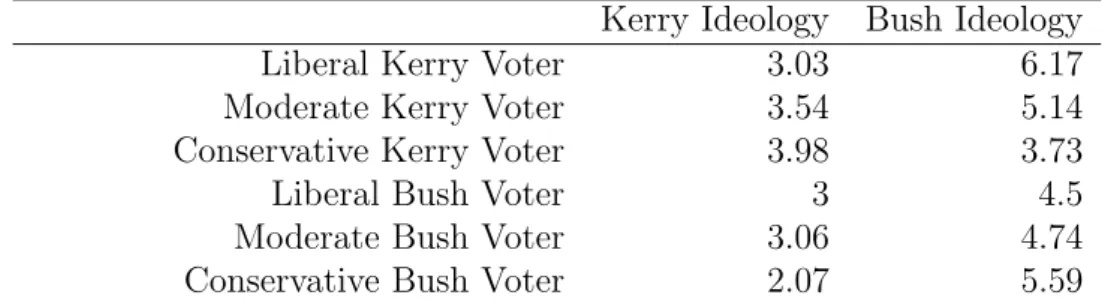
Table 1 shows the perceptions of the ideology of certain candidates for the pres-idency in 2004 based on the ideology of the survey respondent. As the table displays, most people, in the aggregate, recognize that John Kerry is more liberal than George W. Bush, but the degree varies depending on self-perceived ideol-ogy. Those who believed themselves to be liberals and supported John Kerry were
more likely to think he was quite liberal, while self-perceived conservatives who supported John Kerry thought he was much less liberal. Those survey respondents who perceived themselves to be conservative and voted for Kerry may have faced an internal dilemma in which they had to decide if it was acceptable to support a candidate with opposing ideology; to account for this differential, they convinced themselves that Kerry was on their side of the liberal-conservative continuum. Al-ternatively, it is quite likely that many of these people did not realize that they were not actually conservative and believed that since they preferred Kerry, he must be close to them ideologically.
It is hard to specify exactly where these candidates are on the ideological scale. Kerry was certainly more liberal than Bush but where exactly Kerry fit on the scale is challenging to define. Therefore, it is not clear which of these groups is “right,” or even if any group is “right.” The one group that seems to clearly have this wrong is conservatives who voted for John Kerry. On average, this group believed Kerry was more conservative than Bush. Aside from this group, each group places the candidates on the correct side of the ideological spectrum but the distance from the middle varies. Conservative Bush voters found Bush to be more conservative than moderate Bush voters. This point is clarified in Figures 1 and 2 which display the mean and standard deviation of the ideologies of both candidates for each group of voters. Each group places the candidates in an expected location relative to the other groups.
ideologically. That leaves the other 78 percent of the population whose preferred candidate can be correctly predicted based on these bits of information. These ideology differences are a very accurate methods of determining vote choice.
Table 2 displays the results of an ordered logit model that predicts both the ide-ology difference between the respondent and Bush and the respondent and Kerry. Included as independent variables are the closeness of policy preferences as well as the qualities that each candidate is believed to have. For the policy variables, lower values mean preferences closer the to preferences of the survey respondent; for the candidate qualities, lower values mean more trustworthy, honest, etc. Therefore, the expectation is that as these two variables for the candidate in question rise, so will ideological differences and they will fall for the other candidate.
For John Kerry, the policy and qualities for both candidates help to predict how close voters believe Kerry is to their own views. This is expected because voters would likely feel closer to a candidate if they feel the other candidate is further from them. Alternately, the closer a voter feels to candidate, the further away the other candidate likely appears. However, while this is the case for the qualities of the candidates, the policy preferences do not work quite as expected. As respondents believed Kerry’s policy preferences were further from their own, they also believed his ideology was further. However, it was also the case that as respondents believed Bush’s policies were further from their own, Kerry’s ideology was further from them, which was not expected.
The same analysis for Bush worked a little differently. Rather than all four variables influencing how close voters believed Bush was to them ideologically, the policy beliefs of neither Bush nor Kerry came out to be significant. The only variables that seemed to play a role in the proximity of Bush to voters is the personality qualities of both candidates. This is concerning considering the cor-relation between the two Bush variables (relative policy preference and candidate qualities) was -.19 (for Kerry, the correlation was .55). This eliminated the pos-sibility of autocorrelation between the two variables being to blame for the lack
of policy seeming to be important in ideological evaluations. And, while the cor-relation is small, it implies that some people who preferred Bush recognized that he was not like them based on policy. It also helps to explain why voters thought Kerry was more like them ideologically as they believed Bush was more like them on policy.
One reason for this may be the state of the nation during the 2004 election. With the wars in Iraq and Afghanistan as two of the most important issues at the time, it is not unreasonable for voters to have chosen whichever candidate they believed to be the best leader. At the same time, because Bush had been in office for four years at this point, voters may have had a better idea of what policy preferences Bush actually held and could evaluate them more accurately than Kerry, who most voters did not know well. This would imply that people did not just assume that their preferred candidate was close to them on policy issues but actually placed him at a point away from their own views.
Some evidence for this comes from looking at the 2000 election. In this election, Bush was not an incumbent and most people probably had less knowledge about his preferences than in 2004. Additionally, Al Gore was also not an incumbent president, though because he had held the vice presidency for eight years, people likely could better guess his preferences. The results for the 2000 election are in Table 3.
Discussion
When voters evaluate candidates for office, they must be basing those decisions on something. Political scientists regularly assert that most citizens know very little about politics, and yet half of people are voting in presidential elections and those decisions require some sort of beliefs.
The standard definition of ideology used by politicians is that ideological self-identifications are based on actual policy preferences, but we know from Stimson (2004) that this is often untrue. If it is hard to identify one’s own beliefs, it must be even harder to identify another person’s beliefs, especially when that other person’s policy preferences may be unclear. If all of these things were clear to voters, it is unlikely that we would see campaigns, at least not in the way that campaigns are presently run. Candidates must believe that they can sway the opinions of voters based on things other than issues; otherwise, campaigns would focus almost exclusively on policy preferences.
We know that perceived ideology is incorrect for many voters. Not only do they identify themselves wrongly, but many are identifying candidates incorrectly as well. However, this is not a problem if, while the ideological evaluations of candidates and evaluations that voters make of themselves are inaccurate, they at least match. By examining which candidate voters viewed as closer to them ideologically, it is easy to predict vote choice, so this issue is important to under-standing the choices that voters make.
It may be hard for some voters to imagine that their most preferred candidate, regardless of how they came to prefer that candidate, has different goals and ideals than those voters. This model expresses the possibility that voters are aware that the policy preferences of candidates do not match their own, yet, they vote for them regardless. While there is clearly a portion of the population that forms their opinions based on policy issues, it seems there is another group that bases these decisions on something else, such as how much they like the candidates.
This supports some expectations about the things that affect the decisions of
voters. For example, how much voters like candidates has little to no bearing on the ability of most people to do a decent job, especially when that job is the presidency. However, it is likely that this does relate to how people are making decisions about presidential candidates. It seems likely that people can be persuaded into choosing a candidate based on personality. In 2008, Sarah Palin attracted great media attention for being good looking and folksy; she talked about the PTA and dropped the letter “g” from the end of words. This made her appear to voters as someone real, possibly reminding them of a friend or someone with whom they would want to be be friends. This study would support the idea that people may have believed she had similar priorities to them because they liked her character. When voters with different political views like such candidates, it seems they use these opinions to justify the ideologies they perceive. Because policy beliefs and personality traits do not effect ideology equally, it is unlikely that voters believe candidates are like them ideologically first and then make judgments about the other qualities of the candidate. Voters seem to acknowledge at least some areas that candidates are different than them which it implies that these are the variables used to judge the ideology of candidates.
Table 1: Perceptions of Ideology of Presidential Candidates by Ideology and Candidate Preference
Kerry Ideology Bush Ideology
Liberal Kerry Voter 3.03 6.17
Moderate Kerry Voter 3.54 5.14
Conservative Kerry Voter 3.98 3.73
Liberal Bush Voter 3 4.5
Moderate Bush Voter 3.06 4.74
Conservative Bush Voter 2.07 5.59
Values are averages of 2004 ANES data. N=604
Table 2: Difference in Perceived Self and Candidate Ideology - 2004 Self and Kerry Self and Bush Ideology Difference Ideology Difference
Bush-like Policy Preferences 0.07 -0.00
(2.95) (0.15)
Kerry-Like Policy Preferences 0.19 0.01
(7.85) (0.39)
Bush Qualities -0.12 0.34
(2.95) (10.41)
Kerry Qualities 0.11 -0.16
(2.88) (3.97)
Pseudo R-Squared 0.19 0.19
Conducted using ordered logit with 2004 ANES data. Z values are in Parentheses. N=386 for Kerry and 382 for Bush
Table 3: Difference in Perceived Self and Candidate Ideology - 2000 Self and Gore Self and Bush Ideology Difference Ideology Difference
Bush-like Policy Preferences -0.02 0.28
(0.71) (9.13)
Gore-Like Policy Preferences 0.20 -0.02
(7.47) (0.95)
Bush Qualities -0.11 0.16
(2.48) (3.61)
Gore Qualities 0.15 -0.09
(3.44) (1.94)
Pseudo R-Squared 0.19 0.22
Conducted using ordered logit with 2000 ANES data. Z values are in Parentheses. N=309 for Gore and 308 for Bush
References
[1] Cohen, Richard E. 2004. “Kerry Rated Most
Lib-eral Member of Senate.” Government Executive.
http://www.govexec.com/dailyfed/0204/022704nj1.htm. (November 16, 2008).
[2] Delli Carpini, Michael X. and Scott Keeter. 1996. What Americans Know about Politics and Why It Matters. New Haven, CT: Yale University Press.
[3] Druckman, James N. 2003. The Power of Television Images: The First Kennedy-Nixon Debate Revisited.The Journal of Politics 65: 559-571.
[4] “Exit Polls.” 2008. The New York Times.
http://elections.nytimes.com/2008/ results/president/exit-polls.html. (November 13, 2008).
[5] Hamilton, James T. 2004. All the News That’s Fit to Sell. Princeton, NJ: Princeton University Press.
[6] Kanel, Joe Von and Hal Quinley. 2008. “Exit Polls: Gay Marriage in CA.” CNN. http://politicalticker.blogs.cnn.com/2008/11/05/exit-polls-gay-marriage-in-california/. (November 30, 2008)
[7] Kunda, Ziva. 1999. Social Cognition: Making Sense of People. Cambridge, MA: The MIT Press.
[8] Lodge, Milton, Kathleen M. McGraw, and Patrick Stroh. 1989. An Impression-Driven Model of Candidate Evaluation.The American Journal of Political Science 83: 399-419.
[9] Rosenberg, Shawn W. and Patrick McCafferty. 1987. The Image and the Vote Manipulating Voters’ Preferences.The Public Opinion Quarterly 51: 31-47.
[10] Rutenberg, Jim. 2004. “The 2004 Campaign:
Commit- nytimes.com/gst/fullpage.html?res=9D06EEDF123BF935A25757C0A9-629C8B63. (November 13, 2008).
[11] Stimson, James A. 2004. Tides of Consent: How Public Opinion Shapes American Politics. Cambridge: Cambridge University Press.