Emerald Emerging Markets Case Studies
ICON stores: managing a new business venture
Waheed Ali Umrani Abdul Khaliq Doudpota Umair Ahmed
Article information:
To cite this document:
Waheed Ali Umrani Abdul Khaliq Doudpota Umair Ahmed , (2016),"ICON stores: managing a new business venture",
Emerald Emerging Markets Case Studies, Vol. 6 Iss 1 pp. 1 - 20
Permanent link to this document:
http://dx.doi.org/10.1108/EEMCS-03-2015-0030
Downloaded on: 30 May 2016, At: 04:03 (PT)
References: this document contains references to 0 other documents.
To copy this document: [email protected]
The fulltext of this document has been downloaded 2 times since 2016*
Access to this document was granted through an Emerald subscription provided by emerald-srm:270633 []
For Authors
If you would like to write for this, or any other Emerald publication, then please use our Emerald for Authors service
information about how to choose which publication to write for and submission guidelines are available for all. Please visit
www.emeraldinsight.com/authors for more information.
About Emerald www.emeraldinsight.com
Emerald is a global publisher linking research and practice to the benefit of society. The company manages a portfolio of
more than 290 journals and over 2,350 books and book series volumes, as well as providing an extensive range of online
products and additional customer resources and services.
Emerald is both COUNTER 4 and TRANSFER compliant. The organization is a partner of the Committee on Publication
Ethics (COPE) and also works with Portico and the LOCKSS initiative for digital archive preservation.
*Related content and download information correct at time of download.
ICON stores: managing a new business
venture
Waheed Ali Umrani, Abdul Khaliq Doudpota and Umair Ahmed
Waheed Ali Umrani, and Abdul Khaliq Doudpota both are based at the Department of Business Administration, Sukkur Institute of Business Administration, Sukkur, Pakistan. Umair Ahmed is based at the School of Business Management, University of Utara Malaysia, Sintok, Malaysia.
In October 2012, Aamir Ghouri was contemplating how much successful his new venture – Icon Super Store – has been and how to make it more profitable. Distracted by glance from the window of his office at rush of customers entering into elegant building of the store. He felt proud in establishing the first super store in the region of Sukkur after facing many challenges. It took him seven years to transform his idea of expanding his well-established clothing business, Ghouri Department Store, into a one-stop retail super market.
He was also pondering on how to attract the potential customers and what to do with underused space of the store. He was quite unhappy with current situation of ICON, as its two-story building had ground floor fully occupied by grocery and general products. The first floor was temporary filled with crockery products, leaving the second floor completely empty, although the sales of the store grew by 10 per cent on a monthly basis since 2011. When ICON initially started operations, Mr Ghouri realized that major chunk of sales was coming from upper and upper-middle income earning customers. He saw the potential target market comprising middle and lower-middle income groups. These groups constituted a big chunk of population in the region. Mr Ghouri realized that these income groups could become considerable customers of the business if products and shopping deals of their interest are introduced. He underlined that these income groups on a larger scale are more inclined toward purchasing general grocery items at discounted rates. Moreover, Mr Ghouri also visualized that the self-service shopping experience, which was relatively new in the region, would definitely help the business to attract these potential income groups.
Ghouri’ family business background
Forefathers of Aamir surnamed as Ghouri had lived in Barely, India, until 1947, where they had involved into various businesses especially retailing of clothing and dealership of Singer Machines. After the separation of Indian subcontinent and creation of Pakistan, Mr Ghouri’s family migrated to Sukkur. Sukkur is situated at the heart of Sindh province of Pakistan with a notable trade routes linking it with other provinces of the country. Soon after migration, his grandfather opened a cloth shop in Sukkur. Later, the same business was taken over by Ghouri’s father in mid-1960s.
His father was a man of novelty; as soon as his father joined business, he aggressively invested in a number of ventures including door locks and metal buttons manufacturing plant, towel making and automatic laundry factory in Karachi city. But all of these initiatives failed which made the father of Mr Ghouri to realize that it was better for him to focus on strengthening and expanding the his clothing business.
Disclaimer. This case is written solely for educational purposes and is not intended to represent successful or unsuccessful managerial decision-making. The author/s may have disguised names; financial and other recognizable information to protect confidentiality.
Aamir Ghouri
In early 1990s, he graduated with BBA degree from Tiffin University in Pennsylvania, USA. With his outstanding performance in classes, he thought to continue his MBA from the same university. His father was financially supporting him so he had never worked to earn money in USA even for a single day.
Routine study of MBA and monotonous schedule at the university-waking up early in morning, attending classes, working on assignments and projects, preparing and reading all the times, made him tasteless. One day in the first semester of his MBA, without any thought of consequences, he left his studies and started wandering the whole USA for almost a year and in that he spent all money left for completion of his MBA. “This exploration was much like self-exploration, I discovered that I should have been a writer, musician, painter, as I was more artistic in my nature” said he.
In 1995, he returned from USA. When he told his father about incompletion of his studies and spending of money for the studies on touring USA, his father smilingly asked “What will you do now my son? He was so happy to hear that instead of what he was expecting anger from his father and he promptly replied” I want to join you in your business, although I have offers of job from multinational companies in Karachi.” On hearing this, his father could not control his emotions and busted in tears.
He sought a potential for growth in his family business as it had remained traditional and stagnant for last 30 years, so he expanded range of products to readymade garments, crockery, gift item and general products and extended the building of shop on those plots that his father bought earlier. In late 1980s, he had pushed his father to buy neighboring shops and plots at very cheaper rates because owners of those properties were leaving Sukkur due to chronic ethnic and political crisis in the region. While remembering those day, he said “People of our community known as Muhajirs, who had migrated from India and settled in Pakistan, were leaving Sukkur to safer area, Sukkur region became hell for us, people were being bitterly murdered and their properties were being destroyed. But we decided to stay there in spite of lot of pressure from our relative to leave. Those these days were really terrible for my family but we really did not want to resettle any where again”.
He expanded his shop with modern style decoration. He also tried “Self-Service” in ready-made cloths, but it failed. He attributed the failure to the conventional customer service approach in Sukkur that he described as Customer Assisted Sales Model – where a sales person assists the buyer to buy what they may even not prefer to buy.
By the Year 2000, the small shop of Ghouri cloth turned into Ghouri Super Store.
New business idea
“The most unwanted task assigned by my mother that I ever avoided was to buy groceries from Karyana Store-Convenient shop”, Aamir recalled. He detested the attitude of the shop keepers who were usually in hustle, preferred to sell sub-standard groceries and overcharged due to credit sales.
He also noticed while interacting with female customers at the Department store that they wanted to purchase grocery items themselves instead of asking their males, who were not interested in buying such petty items and shopped not according to their requirements. Females along with their males and children spent hours in shopping at Ghouri Department Store.“In contrast to males, for females shopping was not only buying but also feeling the whole experience of outing and enjoyment and they liked more impulsive buying”, he said.
He observed an urge of the shopping grocery by females. Ratio of female buying was increasing day by day in the region of Sukkur, as bi-polar gender roles was gradually diffusing in the society due to increasing education and employment of females. Females of Sukkur enjoyed buying in big marts and superstores in metropolitan cities of Pakistan and complained him that they cannot comfortably do grocery shopping in Sukkur city.
Convenience stores and wholesale market of grocery in Sukkur had never been pleasant for females. The wholesale market was located in a congested area where families felt uncomfortable to shop. Mr Ghouri spotted the need for a superstore in Sukkur region where families could conveniently buy grocery. Exhibit 1 provides detailed information about Sukkur.
During his business visit to Thailand in 2005, he accidentally bought a book titled “Blue Ocean Strategy”. After reading the book, he went overwhelmed by the idea of value innovation (Theinnovationin product, service or delivery that raises and creates value for the market, while reducing or eliminating features and or services that are less valued by the current or future market and resulting in competition irrelevance and exponential growth). Instantly, he was hit by a spark of enthusiasm to open a superstore in Sukkur that would be one of its kind in terms of value, innovative service and shopping experience.
Icon – business development process and challenges
In the year 2005, right after his return from Thailand, Aamir discussed his idea to his family and friends and received mixed responses. Nevertheless, he was determined to seize this opportunity and finally decided to construct a building for super store at 1,200 square feet land near a famous and revered monument known as Masoom-Shah-Jo-Monaro near main market in Sukkur. The land was bought by his father many decades ago, and he got many offers by property dealers to sell it at price around Rs 30 million but he declined.
He wanted to construct a building with a thought for future business expansion, although he was not clear what he would do with extra stories once it was constructed. Making the building unique along with beautiful architectural look for the customers was his ambition, and he contacted Anel Athrom, a famous Srilankan architect. Anel had no experience of working in dry area like Sukkur, but because of the fact that the building was to be constructed next to a prominent historical monument named Masoom-Shah-Jo-Minaro (Masoom Shah’s Tower), he expressed his willingness. Anel Athorm came up with a blue print of the four-story building that was aesthetic and energy efficient, as it was designed to use natural sun light and fresh air. Aamir approved the additional qualities of aesthetic looks and energy efficiency even that would cost 20 per cent more than simple building. The building was designed to cover whole 1,200 square feet land. Front plot, which was Government property left for common use by community, was planned to use for main entrance of the building and parking. It was to take one and half year to turn blue print into actual building. But it happened in more than three years to complete the construction work.
It took seven months instead of normal 15 days to get approval from the Taluka Municipal Administration (TMA), a local sanctioning authority for commercial construction. As soon as Mr Ghouri got the approval, he initiated the construction work. Right after a few days, TMA
stopped the construction work, terming it as dangerous for the monument
(Masoom-Shah-Jo-Minaro). Furthermore, TMA also placed an objection on the construction of four story-building on the account that such a tall building would hinder the view of the monument.
After intense six-month negotiations, TMA sanctioned the construction of two story building without underground and with additional condition that machinery would not be used in digging the land. Anel adjusted original blue print according to new approval by TMA in two mouths. As the land was rocky, labor-intense digging took three more months than the projected time plan.
By the end of 2009, the construction work was completed with a total cost of Rs 25 million. The entire construction cost was met from the profits of Ghouri Departmental Store which left Mr Ghouri with no further funds for investment. Due to this, Mr Ghouri could not immediately invest further in final fixing and finishing which was estimated to cost around two million rupees. Additionally, Mr Ghouri also required nearly a million for inventory
purchases. He contacted many banks for loan out of which a few agreed to lend a maximum of two million rupees with 25 per cent mark up. Mr Ghouri was not willing to pay such a massive markup, and it took him six months to reach to a solution.
By the mid of 2010, Mr Ghouri somehow managed to finish the work and bought the inventories from his personal drawings. In November same year, when Mr Ghouri was finalizing the invitation card for inauguration ceremony of ICON, he received a phone call from TMA authorities informing him regarding blocking of main entry of Icon (The newly developed building – refer Exhibit 2) as the front plot (200 square yards) was a state property. TMA also informed Mr Ghouri that they planned to build garden there. Just after few minutes of this call, a local broker called him and said “I have an offer of Rs 60 million for your ICON building”. With sheer emotional breakup, Mr Ghouri uttered:
“My dream of ICON has been again and again pushed back by TMA, I won’t let them take away my dream. The dream for which I have invested so much of time, money and efforts; even I had not slept many nights wondering what to do with them. Dealing with TMA and all other efforts in building ICON has taken my efforts from Ghouri Departmental Store. Whatever happens, I won’t pay them any bribe and I won’t sell my building either”.
After several days of consultation with his family members, he decided to have a small gate equivalent to small house gates in the street as an entry point for the ICON while putting banners on the main road and street indicating the entry gate. He started the business without conducting any formal opening. The store was not fully operational and very few customers visited daily. But every customer kept asking about why the main entrance was not open. Mr Ghouri kept telling them the reason; many of them bluntly responded “The Authorities need bribe to allow you to open the main entrance”. In a few days this became “talk of the town” as most of the customers visiting to the ICON belonged to influential class. They kept discussing the story in the gathering which mounted social pressure to the bureaucracy and local politicians there.
After several months, Mr Ghouri received a call from a politician who assured him to solve the problem. Then, TMA allowed to open the main entrance. Mr Ghouri developed a small garden in front of area of building with pedestrian passage through the garden to main entrance of ICON. U
Existing business scenerio
The store normally remains open from 10.00 a.m. to 11.00 p.m. for 25 days in a month, and it is closed on every Friday and other business holidays. In normal business days, 20 days a month, 300 customers on an average visited the store in the first year; whereas daily around 800 customers visited the store over the weekends and peak shopping days. Usually, first five days in a month when salaried people collected their monthly pays and bought around 90 per cent grocery for a month.
He was satisfied with increasing trend of customers while remembering the very first day of the store when only twenty customers had shopped. Nevertheless, he wished to increase number of customers and their spending.
Products
The store offered grocery and general products on the ground floor while crockery and home-ware items were placed on the first floor. Mr Ghouri divided the products into three categories according to their nature and margin.
Category 1 comprised locally procured grocery and general products with average margin of 1.5 per cent and inventory stock for six to eight days. Category 2 included imported grocery and general products with average margin of 5 per cent and inventory stock for 15 to 20 days. Category 3 consisted of crockery products with average margin of 10 to 12 per
cent and inventory stock for 20 to 30 days. He felt that inventory stock of Category 1 could be reduced to less than four days with better management of procurement.
He claimed “My store offers high quality product at a heavily discounted rate; we just charge half of the margins compared to other retailers in the market. Unbranded groceries such as spices, rice, wheat, etc are procured from superior suppliers and then are cleaned, sorted and packed in different sizes of bags. Those things other store could not even imagine to offer”.
Customers
Mr Ghouri identified three tiers of customer, after analyzing frequency and amount of spending by customers and observing them shopping at the store. Table Ishows their spending and visits.
He elaborated the tiers
The Platinum Tier denotes to store’s heavily spending customers, typically the ones who are not very much price sensitive. They are mainly females and also regular customer at Ghouri Departmental Store, he added further. They belong to upper and upper-mid class families and prefer comfortable shopping of high-quality products.
The Gold Tier refers to middle class who are a bit price sensitive and buy value products largely. They are the major customers of the store and generally coming from middle class earning backgrounds and their females take active part in buying.
The Visitor Tier comprises customers who come to generally visit the store and buy a few selective products. They mainly belong to lower-mid class with high price sensitivity.
Human resource
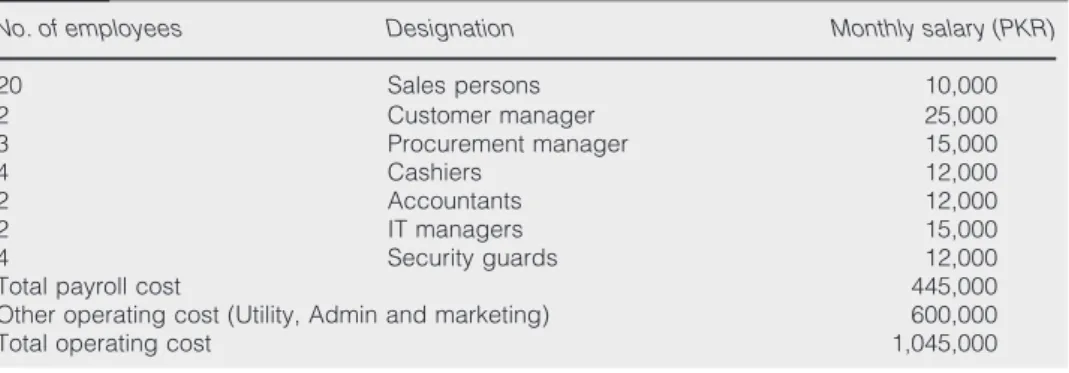
The Icon store started with employee assisted self-service sales model, installing four check-out points along with 20 on-the-floor sales assistants. Executive Manager was hired to oversee the entire operations of the Icon store, the executive manager responds directly to Mr Ghouri for any decision and business operations. Additionally, two supporting staff members were also employed to serve as customer managers along with three Procurement Managers, four Cashiers, two Accountants and two IT Professionals. Refer
Exhibit 3for details of payroll and other operating expenses.
Supply chain management
Managing supply chain was a challenging task in this business. Regular delays in delivery of orders of inventory remained the major hurdle to curtail the unavailability and shortage of in-demand products at the store. Delays were mainly due to persistent strikes and riots in Karachi from where major supply of products came, and outdated roads from Karachi to Sukkur. The attitude of the local wholesellers were also not satisfying, most of them remained understaffed so they could not timely respond to the orders. Mr Ghouri assigned two employees in Karachi for buying the inventories to fasten the process of delivery from there.
Table I Customer segmentation
Tier of customers Spending per customer % of daily customers
Platinum PKR 15,000 10
Gold 5,000 60
Visitors 1,000 30
Quality control
At Icon, there are no sub-standard quality products. As per customers’ feedback, Icon has managed to fulfill 75 per cent of their shopping requirements. For Icon, the Purchase is divided into two categories. First is repeat purchase; it is for the products that are already been in stock and have a demand. Second is purchase of new products (first-time purchase); for this, a meeting takes place between Mr Ghouri, executive manager and purchase managers for final decision. Icon strives to ensure product quality through product sampling, before the new product purchases.
“We invest about twenty to twenty-five thousands in product sampling” says one Purchase Manager. In its office building (beside Icon), it has a kitchen available to test food items.
“We don’t sell only, but we use products by ourselves as well. At times, we use different items at our homes, my family has been a source of feedback for different new products” says Aamir. The Icon has created a culture where managers and workers families are also providing feedback regarding different products. To remain in touch with what is going on in the markets, and to ensure supply of the products on the time, One of Icon’s purchase manager remains in Karachi on permanent basis.
“I cannot improve quality of brands, but can choose number one quality products and sell them at a competitive price says Mr. Ghouri”.
Customer research
To understand the current and potential customers, Mr Ghouri sought the consultancy from two graduates of Sukkur Institute of Business Administration. ReferExhibit 4for results of the survey.
Options for second floor
He was considering following options to use vacant second floor.
Shifting crockery section to second floor and extending grocery section to first floor
The students came up with an idea to start offering a line of fresh food items – meat, fish, vegetable and fruits – at first floor. However, Mr Ghouri considered this option not much viable because he thought that customers would not pay extra for such sorted fresh items as they were habitual to buy such things on daily basis from the main market, and it was difficult to procure and manage fresh items, even just a few superstores in metropolitan cities of Pakistan offered fresh items. But, he knew the ground floor would be insufficient once more customers stepped in, and he might extend this section to first floor in near future.
Opening restaurant with playground
This idea came from Mr Asad, a friend of Mr Ghouri with thorough restaurant business experience in Sukkur. He supported the idea: “Trend of eating out by families in Sukkur is increasing restaurants and there is shortage of good family restaurants in the main city. ICON’s customers are generally in search of eating out. Moreover, playground would attract the families as it provides the entertainment to children”.
Mr Ghouri’s response to this idea was not very motivating due to no experience of the food business. He was not sure as to how the restaurant would be handled, but he still started assessing the viability of this.
Renting the floor for product exhibition
The business development managers at Icon were of the opinion that the second floor might be used for renting purpose to various companies for their product promotion activities such as exhibitions. One recent example was the product promotional activity
regarding the Activation of Chang Hong Ruba, a multinational home appliances company Chang Hong Ruba conducted a product exhibition which was not only a source of revenue generation but also a source of entertainment for Icon customers (Exhibit 5). Many fast moving consumer good (FMCG) and home appliance companies started contacting Mr. Ghouri for arranging such exhibitions at the second floor.
Conclusion
Later that day, in a routine meeting with executive and customer relationship managers, Mr Ghouri discussed his concerns regarding untapped market of middle and lower-middle customers. The executive manager said: “That market is reluctant to buy from fancy stores, they cannot afford to buy expensive products and they usually purchase from convenient shops at credit, they don’t prefer to travel long way to shop at our store”.
Customer relationship manager added “Majority of our customers are wealthy and well educated and they come with their families and admire the hassle free environment of the store, they don’t prefer to shop with the lower income group”.
Mr Ghouri with dispassionate looks said “Core idea of the superstore is to facilitate local families by making their shopping cheaper and friendly under one roof, majority of them belong to lower class, how can we ignore them?” After a few seconds of silence, he added“I am offering the cheapest and quality products in large variety in the most beautiful building of the region, for which they earlier had to go cities like Karachi and Lahore” Customer manager asked “But how could we attract more customers from the lower middle income group?”.
Mr Ghouri murmured “with current profits, I will recover my investment in more than ten years, whereas a normal business recovers it within three to four years. We need to do something, we need to increase profits”. With customer research report in hand and options on table, he was determined to come up with a strategy to address this critical situation.
Keywords:
Pakistan,
Entrepreneurship, Business venture, Icon stores, Sindh, Sukkur
Exhibit 1
Sukkur is the third largest city of Sindh province with population of 1.5 million people, situated on the west bank of Indus River in Pakistan. Sukkur district shares its northern border with Shikarpur and the recently constituted Kashmore districts. Ghotki district is located on the north-eastern side while Khairpur district on the south. The border with India lies further east. Sukkur is also connected by road and by air with all major cities of Pakistan.
The climate of the Sukkur is characterized by hot and hazy weather during summer days with dry and cold weather in winter. During January, the temperature ranges from 7 to 22°C (45 to 72°F). The summer (month of June before the monsoon) temperature averages 35°C (95 °F) though it often reaches up to 42°C (108°F). Generally, the summer season commences in March-April and ends before October. The average rainfall of the district is 88 mm, and ranges from 0.59 to 25.62 mm per month.
At the time of Pakistan’s independence in 1947, Sukkur district comprised approximately 200,000 inhabitants, mostly engaged in agricultural pursuits and fishing industry. Over time, Sukkur has seen a moderate rise in population (2 to 2.5 per cent per annum) as compared to Pakistan’s, except in late 1960s and early 1970s when population growth rate reached 4.43 per cent (1972 census) due to internal migration and establishment of some large bridges on river Indus. According to official census of 1998, Sukkur had one million inhabitants and density of 175.9 persons per square kilometer. According to the 2010 estimations of Pakistan, at least 59.50 per cent of the population of Sukkur district were urban, making it the third-most advanced district in Sindh.
Sukkur is a hub of many small- and large-scale industries. Among important industries are cotton textiles, cement, leather, tobacco, paint and varnish, pharmaceuticals, agriculture implements, hand pumps, lock making, rice husking and sugar. Small-scale cottage industries comprise hosiery, boat making, fishing accessories, thread ball spooling, trunk making brass-wares, cutlery and ceramics.
Exhibit 2
Plate E1
Exhibit 3
Exhibit 4
Customer research
The customers were surveyed and observed when they came to ICON to analyze their shopping habits and views about ICON. The main observations and recommendations were:
majority of customers were well educated and belonged to middle and upper social class;
customers came with their families and on average two persons accompanied single customer;
on an average, a customer spent 60 per cent on Category 1, 30 per cent on Category 2 and 10 per cent on Category 3 of products;
Their average family size was five with monthly expense of Rs 40,000 on groceries; however, the products at ICON could just cover 50 per cent of their required groceries as fresh food items were not available;
females were predominate in shopping in both numbers and participation;
sixty per cent of them had vehicles and came far from sub-urban areas;
majority of them visited twice a month, but their primary buying took place in their one-time visit in the first week of a month;
when they were asked what attracted them most at ICON, majority attributed their buying to sense of security at ICON. Table shows the results; and
ninety-five per cent of customers just stayed at the ground floor and did not buy any crockery products (Figure E1).
Students also surveyed a sample of middle and lower middle class customers whom they identified an immediate potential customers. Their findings and recommendations from this survey were:
Table EI Employment and store operating cost
No. of employees Designation Monthly salary (PKR)
20 Sales persons 10,000
2 Customer manager 25,000
3 Procurement manager 15,000
4 Cashiers 12,000
2 Accountants 12,000
2 IT managers 15,000
4 Security guards 12,000
Total payroll cost 445,000
Other operating cost (Utility, Admin and marketing) 600,000
Total operating cost 1,045,000
Figure E1 Research analaysis
majority of them were living not far away from ICON and bought groceries on month on month basis from discount stores in main market;
sixty per cent of them had businesses and male members usually bought groceries;
their average family size was six and each family spent averagely Rs 30,000 on groceries; and
they knew about ICON but had an image that ICON was expense as Ghouri
Department Store.
Their finding regarding lower class customers who constituted around 70 per cent of population of Sukkur were:
majority of them were on daily wagers and their earnings were insufficient to even meet their basic necessities;
they bought groceries usually on week on week basis; and
Majority of them bought cheaper groceries from utility stores operated by Government to offer basic necessities good at subsidized rates, and they also bought from convenient store due to easy access and credit facility.
Exhibit 5
Plate E2
Plate E3
Exhibit 6
Plate E4 Figure E2
Figure E3
Exhibit 7
Products
Baby care
Baby milk and baby foods
Bakery products
Beverages
Books and stationary
Crockery
Cosmetics
Cutlery
Detergents and cleaners
Electronics
Electrical implements, bulbs and tool kits
Frozen food
Food items
Grocery
Home care
Ice cream and candy shop
Luggage and travel gear
Personal care
Pet foods
Plastics ware
Toiletries
Undergarments
Corresponding author
Umair Ahmed can be contacted at:[email protected]
Abstract
Title–ICON stores: managing a new business venture.
Subject area–Entrepreneurship.
Study level/applicability–Undergraduate – Entrepreneurship.
Case overview–The case concerns to an entrepreneur named Aamir Ghouri, a US graduate, who is concerned about managing the growth of his newly established venture named ICON Stores. The case presents the idea of entrepreneurial mindset characteristics and motivation besides which, it also explains the typical venture creation process in Pakistan and the general rubrics used to measure the entrepreneurial success in the economy.
Expected learning outcomes–The case is designed to help students to understand entrepreneurial mindset, characteristics and motivation; to understand entrepreneurial venture creation process; to learn the common practices regarding the measurement of entrepreneurial success of new venture; and to outline as to how growth of a new venture could be managed profitably.
Supplementary materials–Teaching notes are available for educators only. Please contact your library to gain login details or [email protected] request teaching notes.
Subject code–CSS 3: Entrepreneurship.