Rationally designed carbohydrate-occluded
epitopes elicit HIV-1 Env-speci
fi
c antibodies
Cheng Zhu
1,2
, Elena Dukhovlinova
3
, Olivia Council
3,4
, Lihua Ping
3
, Edgar M. Faison
1
, Shamit S. Prabhu
5
,
E. Lake Potter
3
, Stephen L. Upton
1
, Guowei Yin
1
, James M. Fay
1
, Laura P. Kincer
3,4
, Ean Spielvogel
3
,
Sharon L. Campbell
1,3
, S. Rahima Benhabbour
5,6
, Hengming Ke
1,3
, Ronald Swanstrom
1,3
&
Nikolay V. Dokholyan
1,2,3,6,7
An array of carbohydrates masks the HIV-1 surface protein Env, contributing to the evasion of
humoral immunity. In most HIV-1 isolates
‘
glycan holes
’
occur due to natural sequence
variation, potentially revealing the underlying protein surface to the immune system. Here we
computationally design epitopes that mimic such surface features (carbohydrate-occluded
neutralization epitopes or CONE) of Env through
‘
epitope transplantation
’
, in which the target
region is presented on a carrier protein scaffold with preserved structural properties.
Scaf-folds displaying the four CONEs are examined for structure and immunogenicity. Crystal
structures of two designed proteins re
fl
ect the computational models and accurately mimic
the native conformations of CONEs. The sera from rabbits immunized with several CONE
immunogens display Env binding activity. Our method determines essential structural
ele-ments for targets of protective antibodies. The ability to design immunogens with high
mimicry to viral proteins also makes possible the exploration of new templates for vaccine
development.
https://doi.org/10.1038/s41467-019-08876-w
OPEN
1Department of Biochemistry and Biophysics, University of North Carolina at Chapel Hill, Chapel Hill, NC 27599, USA.2Departments of Pharmacology, Penn
State College of Medicine, Hershey, PA 17033-0850, USA.3Lineberger Comprehensive Cancer Center, University of North Carolina at Chapel Hill, Chapel Hill, NC 27599, USA.4Department of Microbiology and Immunology, University of North Carolina at Chapel Hill, Chapel Hill, NC 27599, USA.5Division of Pharmacoengineering and Molecular Pharmaceutics, Eshelman School of Pharmacy, University of North Carolina at Chapel Hill, Chapel Hill, NC 27599, USA. 6UNC-NCSU Joint Department of Biomedical Engineering, University of North Carolina at Chapel Hill, Chapel Hill, NC 27599, USA.7Departments of
Biochemistry & Molecular Biology, Penn State College of Medicine, Hershey, PA 17033-0850, USA. These authors contributed equally: Cheng Zhu, Elena Dukhovlinova. Correspondence and requests for materials should be addressed to R.S. (email:[email protected]) or to N.V.D. (email:[email protected])
123456789
H
IV-1 carries on a continuous battle with the host immune
system
1,2. As the sole target of neutralizing antibodies, the
virion surface protein Env encodes a glycan shield to
restrict the antibody access to antigenically conserved sites
3,4.
There are about 30 sites of carbohydrate addition on each HIV-1
Env protomer, and about two-thirds of the N-linked
carbohy-drates cover the generally conserved outer domain of Env
5,6. This
glycan shield serves as a barrier to an antibody response that
would otherwise be directed at surface features of Env
7–9.
Var-iation in carbohydrate addition sites has been documented
wherein 90% of HIV-1 strains are missing at least one conserved
glycosylation site
10,11. When Env trimers from different HIV-1
clades (A, B, and C) were used as immunogens, the autologous
neutralizing antibody response was targeted to the protein face at
the site of missing glycans
12,13. Similarly, the SIV variants missing
a dispensable glycan were used to infect macaques and gave rise
to an antibody response that targets the exposed area
3,14.
Infec-tion with a virus missing a glycan on the Env
α
2 helix led to the
development of an antibody escape mutant that reacquired the
original glycosylation site, suggesting that antibodies to such
surface features of Env can provide selective pressure and thus be
protective
15. It is these types of carbohydrate-occluded structural
features we refer to as CONEs. We reason that HIV-1 isolates
present a collective vulnerability at the surface features under
variable glycosylated sites. We set out to exploit their
immuno-genic nature by eliciting antibodies that interact speci
fi
cally with
individual CONEs.
We previously examined the
env
gene of HIV-1 subtype C,
which accounts for ~50% of new infections worldwide, including
samples from acutely and chronically infected individuals
10. Our
results demonstrated moderate conservation of twenty-two
N-linked glycosylation sites on the Env outer face, including
posi-tions 130, 230, 234, 289, 332, 337, 356, and 442 (HXB2
num-bering), with each glycosylation site appearing in 65
–
85% of
HIV-1 isolates. We
fi
nd that seventeen of these moderately conserved
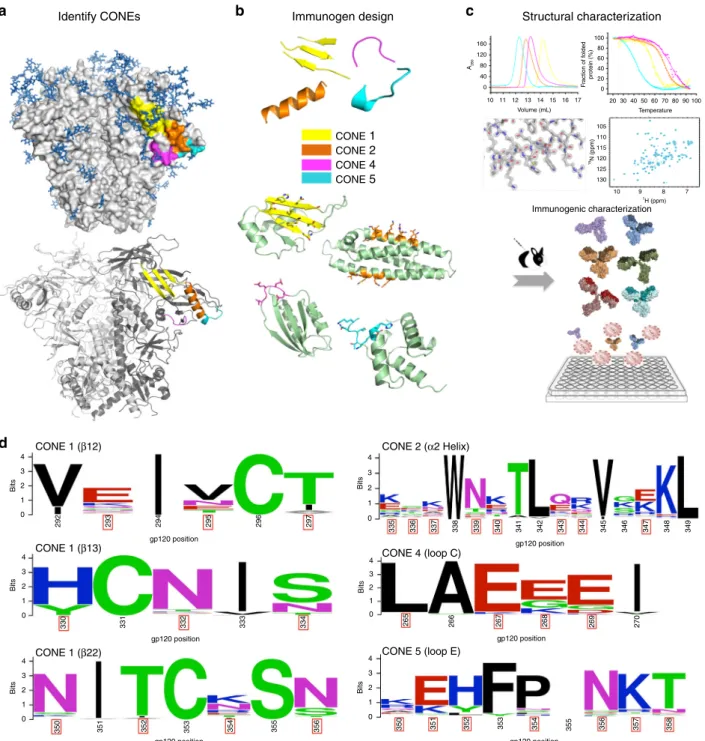
glycosylation sites cluster around six surface structural features,
and we hypothesize the absence of a surface glycan at any one of
these CONEs would expose the underlying protein structural
elements (Fig.
1
a and Supplementary Fig. 1). Analysis of
trans-mitted HIV-1 isolates revealed that 93% were missing at least one
carbohydrate in one of the CONEs, with 80% missing
carbohy-drates in two or more CONEs
10. In previous studies, others have
built structural mimetic of CONE 3 (a four-stranded
β
sheet at
the base of the V1/V2 loops) and CONE 6 (the CD4 binding site)
for structure-guided immunization. Chimeric glycoproteins
encoding CONE 3 bind the broadly neutralizing antibody PG9
16.
Protein nanoparticles containing CONE 6 mimetics engage the
germline precursors of VRC01-class neutralizing antibodies and
direct the evolution of antibodies against the CD4 binding
site
17,18. Here we focus our protein design efforts on four CONEs,
including the structural elements of
β
sheet 12/13/22 (CONE 1),
α
2 helix (CONE 2), loop C (CONE 4), and loop E (CONE 5)
(Fig.
1
b). Small protein mimics of the CONEs are designed by
epitope transplantation and used as immunogens to focus the
antibody response
19–21. Our experimental work
fl
ow includes
biophysical and structural characterization of the designed
pro-teins, followed by immunogenic evaluation in animal models
(Fig.
1
c).
Results
Structure-based immunogen design
. Atomic-level details of the
fully glycosylated, pre-fusion conformation of the Env trimer
have been obtained as crystal and cryo-electron microscopy
structures
5,22. The conformations of the CONEs are well
con-served in the structures of Env from clades A, B, C, and G
(Supplementary Fig. 1b). We identi
fi
ed the substructural elements
of each CONE based on the BG505 SOSIP.664 trimer structure
(Protein Data Bank [PDB]: 4TVP and 4NCO) and adopted the
consensus sequence of clade C HIV-1 Env as the reference for the
immunogen design
23,24(Fig.
1
d and Supplementary Fig. 2). The
rationales for identifying CONEs include: (i) the change of
solvent-exposed area on the Env surface due to absence of
gly-cans. The boundaries of CONE residues can be determined by
modeling the interactions between underglycosylated Env and
immunoglobulin (Supplementary Fig. 3). (ii) whether the
sub-structures of CONEs can be readily matched to existing scaffolds
in PDB (see Methods). (iii) conservation of surface glycan
10,11.
Using a rapid structural motif-mining algorithm
Erebus
25(Sup-plementary Fig. 4, work
fl
ow), we searched the PDB for scaffolds
capable of supporting the disembodied CONE structures
(three-stranded
β
-sheet,
α
-helix, and two separate loops). We estimated
the surface matching between scaffolds and CONEs by analysis of
root-mean-square deviations (RMSD, 0.5
–
3.0 Å) and selected the
top-ranking scaffolds for each CONE (Supplementary Table 1).
The surface amino acids of the CONE-like region within each
scaffold were replaced by solvent-exposed residues in the
con-sensus sequences of CONEs (Supplementary Figs 2 and 4). For
instance, a discontinuous three
β
-strand motif was grafted onto
CONE 1 scaffolds, while the two helixes on the CONE 2 and
scaffold 5 design (C2S5, a similar nomenclature is followed for all
designed proteins) displayed the
α
2 helix-speci
fi
c residues
(Sup-plementary Fig. 5). The modi
fi
ed scaffold was subsequently
relaxed by discrete molecular dynamics
26.
For each scaffold, multiple designs (86 in total) were generated
adopting various combinations of CONE residues and their
substitutes in the consensus sequences. We then estimated the
change in free energy of these substitutions (
ΔΔ
G
mut) using the
Eris
molecular design suite and discarded highly destabilizing
mutations (55 designs of
ΔΔ
G
mut> 6 kcal mol
−1)
27. The
con-formational stabilities of all CONE mimetics were further
evaluated through molecular dynamics simulations, which
allowed us to rapidly screen the designed protein library and
choose the scaffolds that exhibited substantial rigidity around the
CONE segment (root-mean-square
fl
uctuations (RMSF) analysis,
Supplementary Fig. 6). A recent study of massively parallel
protein design demonstrated that structural elements of the most
successful designs exhibit high similarity to natural proteins of
similar local sequences
28. Hence, we reasoned that the success of
epitope transplantation would correlate with the compatibility
between local structure of grafted sequences and their native
conformation in Env, whereas higher RMSF of grafted residues
indicates that the design explores wider conformational states and
likely displays poor agreement to the target structure. Therefore,
we
fi
ltered out the designs featuring signi
fi
cant plasticity of the
grafted epitopes or designated them as alternative scaffolds (21
designs of RMSF > 3.5 Å at CONEs). Overall, three to
fi
ve designs
of each CONE were expressed in
Escherichia coli
(Supplementary
Fig. 5). Of the sixteen candidates tested (one most stable design
for each scaffold), eight could be successfully puri
fi
ed as soluble
proteins (Supplementary Table 2).
Biophysical characterization of designed proteins
. The eight
proteins exhibited circular dichroism (CD) spectra consistent
with the designed topology (Supplementary Fig. 7a). The
stabi-lities of the designs to thermal denaturation were assessed by CD
spectroscopy. Their melting temperatures (T
m) were in the range
(C1S1, C2S5, and C4S3) for immunization experiments and
further structural analysis.
To determine whether the designs recapitulate the native
conformations of each CONE, we solved the crystal structures of
C2S5 (
α
2 helix) and C4S3 (loop C) at resolutions of 2.0 Å and 1.2
Å, respectively (PDB
6CFE
and
6CBU
, Table
1
). The electron
density maps revealed that the side chains of the grafted residues
were well positioned relative to the computational model
(Supplementary Fig. 8). Comparison with the Env trimer protein
revealed a high degree of mimicry: within the epitope region, the
C
α
RMSDs between the designed proteins and Env were 0.42 Å
(C2S5) and 0.34 Å (C4S3), respectively, suggesting that our
CONE mimetics accurately display the Env residues (Fig.
2
a, b).
The C2S5 scaffold is built on a four-helix bundle from
apolipoprotein E3. The two helixes used to display the CONE 2
residues were well matched to the
α
2 helix in terms of the C
α
-C
β
Identify CONEs
CONE 1 (β12) CONE 2 (α2 Helix)
CONE 4 (loop C)
CONE 5 (loop E) CONE 1 (β13)
CONE 1 (β22) 4
gp120 position
gp120 position
gp120 position
gp120 position gp120 position
gp120 position 3
2 1
0
292
330
350 351 352 353 354 355 356
335 336 337 338 339 340 341 342 343 344 345 346 347 348 349
265 266 267 268 269 270
350 351 352 353 354 355 356 357 358
331 332 333 334
293 294 295 296 297
Bits
4
3
2
1
0
Bits
4 3 2 1 0
Bits
4 3
2 1
0
Bits
4
3 2
1
0
Bits
4
3 2
1 0
Bits
Immunogen design Structural characterization
160 100
80 60 40 20
20 30 40 50 60 70 80 90 100 Temperature 0
105 110 115 120 125 130
10 9 8 7
120 80 40 0
1011 12 1314 1516 17 Volume (mL) A280
F
raction of f
olded
protein (%)
15N (ppm)
1
H (ppm)
Immunogenic characterization
CONE 1
CONE 2
CONE 4
CONE 5
a
b
c
d
orientations (Fig.
2
a and Supplementary Fig. 8d). The CONE 4
(loop C) residues were grafted onto the C-terminal loop region of
an
α
/
β
mixed protein (Fig.
2
b). A characteristic array of three
glutamic acids
fl
anked by hydrophobic residues de
fi
nes the
conformation of CONE 4 loop in Env. Our design largely
recapitulates the conformations of two charged side chains (E88
and E89). The hydrophobic residue L86 also adopts a similar
conformation to L265 of Env (Fig.
2
b). Consistent with the
molecular dynamics simulation, we found that the C4S3 loop
adopted a relatively rigid structure, as assessed by the low
B-factors (8
–
12 Å
2, Supplementary Fig. 6).
We also acquired structural information for C1S1 using
nuclear magnetic resonance (NMR). The two-dimensional
1H-15
N heteronuclear single-quantum coherence (HSQC) spectrum
suggests that C1S1 is well folded in solution (Fig.
2
c, right panel).
We were able to assign 72 of 77 peaks corresponding to C1S1
residues with the aid of the HNCACB and CBCA(CO)NH spectra
(Supplementary Fig. 9). The backbone information derived from
C
α
/C
β
chemical shift indicates that C1S1 possesses four
β
-strands
(three from CONE 1 and one from the scaffold protein: hnRNP
RNA-binding domain) and two
α
-helices, as expected based on
the design model (Fig.
2
c, left panel). All CONE 1-associated
residues adopted a
β
-strand conformation (middle panel).
Immunogenic evaluation of CONE immunogens
. We next
immunized small groups of rabbits (four to six per group) with
the designed immunogens to raise CONE-speci
fi
c antibodies.
Two different immunization strategies were applied: incomplete
Freund
’
s adjuvant (FA) and a nanoparticle (NP) formulation
without adjuvant (Supplementary Tables 3, 4, Supplementary
Fig. 10). In these initial immunization experiments, we sought a
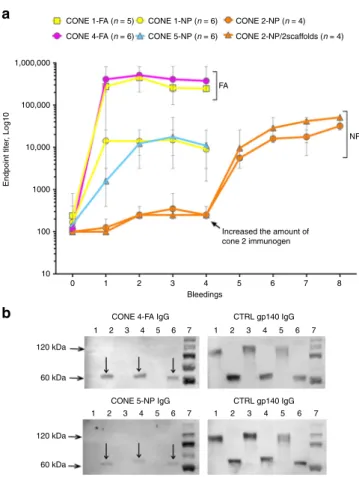
qualitative understanding of the nature of the antibodies that can
be generated to each CONE. The CONE 1, 2, 4, and 5 mimetics
were all immunogenic, giving rise to autologous binding
anti-bodies as determined by enzyme-linked immunosorbent assay
(ELISA, Fig.
3
a). The FA-associated immunization protocols
induced antibodies with the titers more than 10-fold higher than
those induced by NP-associated immunization. As a control
experiment, we also immunized
fi
ve rabbits with a synthetic
peptide of the CONE 4 sequence (LAEEEI). None of these rabbits
could induce antisera of signi
fi
cant titers (Supplementary
Table 5), in contrast to the C4S3-immunized rabbits, indicating
that for a linear epitope, constraining it in the right conformation
with suitable protein scaffolds is favorable for the generation of
functional antibodies.
We then evaluated antibody speci
fi
city for the CONE-derived
epitopes (Supplementary Fig. 11). For each immunogen, an
alternative design (C1S5, C2S3, C4S2, and C5S2, Supplementary
Table 2) with the same CONE grafted onto a different scaffold
protein was used as a control to HIV-speci
fi
c responses. No
HIV-speci
fi
c antibodies were obtained after immunization with CONE
2 (
α
2 helix). The CONE 4 (loop C) and CONE 5 (loop E)
immunogens did induce HIV-speci
fi
c antibodies as assessed by
ELISA and western blot assay. The puri
fi
ed IgG fractions of
anti-CONE 4 and anti-anti-CONE 5 rabbit sera bound to the
deglycosy-lated form of gp120 but not the glycosydeglycosy-lated protein (Fig.
3
b).
We also analyzed the anti-Env responses of individual rabbit
sera in an ELISA assay using the deglycosylated Env SOSIP
trimer. We modi
fi
ed the sequence of SOSIP from the original
BG505 SOSIP.664 isolate
23, so that the exposed residues at the
CONE regions represent the consensus sequences of Env subtype
C. The sera of the rabbits immunized with C1S1 (FA protocol)
contained antibodies that bound Env, featuring a signi
fi
cantly
elevated response to Env in comparison to the homologous
pre-immune sera; in contrast, only one animal generated
strong-binding antibodies with C1S1-NPs (Supplementary Fig. 12). Most
of the animals immunized with C4S3 also generated antibodies
that bound to the deglycosylated SOSIP Env protein, whereas no
such antibodies were detected in animals immunized with C5S3.
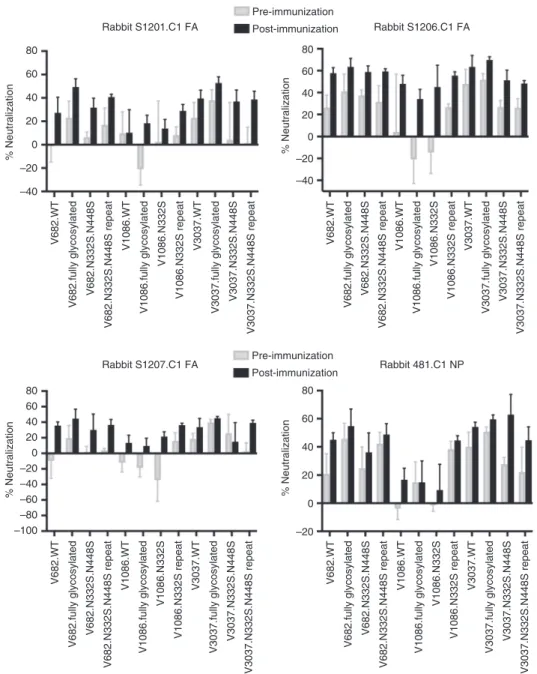
Four C1S1-immunized rabbits generated sera with the highest
reactivity to the SOSIP trimer. We tested these serum samples in
a virus neutralization assay against reporter HIV-1 viruses, which
were pseudotyped using three different
env
gene clones (682,
1086, and 3037, all subtype C). The viruses expressing the WT
Env represent the samples isolated from infected subjects, while
the fully glycosylated Env and the mutants represent the
CONE-concealed and CONE-revealed samples, respectively (Fig.
4
). In
this analysis, we accounted for the animal-to-animal variation by
comparing responses of the pre-immune serum and the
immunization endpoint serum for each rabbit and each virus.
The four post-immunization rabbit sera exhibited modest virus
inhibitory activity in comparison to the homologous pre-immune
serum. The highest responses we observed (50
–
70% inhibition)
were with virus 3037 (missing N332 and N448 glycans) by the
serum of rabbit 481, and with virus 1086 (missing N332 glycan)
by the serum of rabbit S1206. Given the low level of virus
inhibition associated with these sera it is dif
fi
cult to distinguish if
this activity represents true virus neutralization or some type of
nonspeci
fi
c inhibition of infectivity, although we note this activity
is differentially present after immunization. The observed
inhibitory activity did not depend critically on the absence of
the CONE 1-associated glycans on the Env protein surface. If this
Table 1 Crystallographic data collection and re
fi
nement
statistics
C2S5 C4S3
Data collection
Space group P3121 P212121
Cell dimensions
a,b,c(Å) 46.88, 46.88, 140.42 26.07, 57.61, 62.94 α,β,γ(˚) 90, 90, 120 90, 90, 90 Resolution (Å) 50.00–2.00
(2.03–2.00)a
50.00–1.20 (1.22–1.20)
Rmerge 0.064 (0.886) 0.056 (0.130)
I/σI 13.6 (3.7) 18.9 (6.9)
Completeness (%) 99.67 98.40
Redundancy 18.0 (16.5) 14.1 (13.9)
No. of unique reflections 12904 30098
Refinement statistics
Resolution (Å) 39.00–2.00 42.49–1.20
No. of reflections 12849 28610
Rwork/Rfree(%) 23.65/26.87 14.30/15.30 No. of atoms
Protein atoms 2344 771
Ligand/ion 0 1 (SO42−)
Water 17 67
AverageB-factor (Å2)
Protein 70.43 7.54
Ligand/ion NA 7.69
Water 48.78 14.10
RMS deviation from ideality
Bond lengths (Å) 0.004 0.006
Bond angles (°) 0.513 1.198
Ramachandran statisticsb
Favored regions (%) 99.28 89.20
Allowed regions (%) 0.72 10.80
Outliers (%) 0 0
does represent antibody-mediated neutralization, then the
rabbit-raised CONE 1-speci
fi
c antibodies may possess long loops in the
complementarity-determining region that are capable of
pene-trating the glycan shield, as seen in various neutralizing
antibodies characterized previously
1,7,8. In this scenario the
occluded surface features may not be immunogenic under the
glycan shield, but the corresponding antibodies when they exist
may be able to intercalate between structurally dynamic glycan
side chains, thus resulting in neutralization.
Discussion
The strategies that HIV-1 adopts to avoid in vivo neutralization,
including hypervariable protein sequences and a glycan coat that
occludes the conserved protein surface, confounded the attempts
at immunization using Env trimer as antigens
29,30. Here we
described the implementation of an approach based on the
observation that less conserved glycosylation sites are occasionally
absent due to the intrinsic sequence variation in HIV-1. Our
results point to the possibility of generating antibodies that target
surface features of Env at
‘
glycan holes
’
. We found that binding of
anti-CONEs 4 and 5 antibodies to denatured gp120 critically
depended on the removal of the proximal glycan. Also, the
reactivities of anti-CONEs 1 and 4 antibodies with the SOSIP Env
were greatly enhanced after deglycosylation. The magnitude of
inhibitory effect upon HIV-1 infectivity was modest with the
anti-CONE 1 sera tested, although the consistency of the effect against
multiple isolates of HIV-1 Env pseudoviruses is indicative of a
robust activity.
C2S5
C4S3
C1S1
α Helix β Sheet
Δ
C
α
–
Δ
C
β
(ppm)
8
6
4
15N (ppm)
1H (ppm) 2
–2
–4
–6 0
10 20 30 40 50 60 70 80 90 105
110
115
120
125
130
K22 V64
T66
N49 N24
H47 E62 I19
T20 N18 S51
10 9 8 7
β22 β13 β12 Loops
Crystal structure Design model Env
a
b
c
Rational protein design has reinvigorated vaccine design
efforts
19,31,32. Scaffolded immunogens can focus immune
responses to known neutralizing antibody determinants
31or, as
in our work with the HIV-1 CONEs, can facilitate the
exploita-tion of new vulnerable sites. The CONEs reside on an
immu-nogenic
‘
silent face
’
of gp120; however, a recent study reported
the identi
fi
cation of neutralizing antibody VRC-PG05 that
recognizes several CONE 1 residues (E293, N448) as well as
CONE 1 glycans (N295, N448) (Supplementary Fig. 13)
33. This
observation suggests the presence of germline antibody
pre-cursors that engage CONE-related epitopes. To achieve a
func-tional broadly neutralizing response, a viable approach could be
administrating a cocktail of CONE mimetics and SOSIP Env
protein missing corresponding CONE glycans in successive and
combinatorial boosts, focusing the response on the
‘
glycan hole
’
.
We expect that rational design of small, thermal-stable
CONE-like immunogens represents a promising starting point for the
development
of
reproducible
vaccines
against
persisting
infections.
Methods
Determination of the consensus sequence of subtype C gp120. The consensus amino acid sequence of gp120 subtype C was obtained by aligning 183 full-length
envsequences derived by single genome amplification10. The dataset includes: 68
acuteenvsequences, 65 chronicenvsequences, 21 functionalenvclone sequences from GAVI study, and 29envsequences from viruses present in a group of par-ticipants with low CD4 counts. The amino acid position was considered a con-sensus if it was present in 80% of the isolates. The concon-sensus sequences illustration for Fig.1d was prepared using WebLogo34,35.
We also modified the original sequence of a soluble gp140 protein (SOSIP BG505.664) so that the exposed amino acid residues of the protein that originally belonged to HIV-1 subtype A virus were replaced with residues from HIV-1 subtype C virus. The modifications were performed for the regions that correspond to CONE 1, 2, 4, and 5. Sequence manipulations were performed using BioEdit software and HIV Sequence Database Tools available at Los Alamos National Laboratory website (https://www.hiv.lanl.gov/content/sequence/HIV/mainpage.html).
Computational protein design. The identification of scaffold proteins for trans-plantation of CONE epitopes made use of theErebussubstructure search server (https://dokhlab.med.psu.edu/erebus)25. Query structures for this server were
defined as the backbone atoms (Cα,Ν, C=O) of each individual CONE (β12/13/ 22,α2-helix, loop C, and loop E). We aligned the structures of Env trimer (PDB ID: 4TVP and 4NCO for clade A Env, 5FYK for clade B, 5FYJ for clade G) and extracted the coordinates of backbone atoms. The query structures (PDB format) were then provided toErebuswith default search parameters (matching precision 0.5 and minimum weight‘auto’).Erebusscans PDB for matches of structural scaffolds to atom pairs in the query. These resulting scaffolds were ranked based on their RMSD to the query structure (Supplementary Table 1).
Redesign of preexisting scaffolds was accomplished usingEris, a computational platform that automatically performs side-chain repacking and backbone relaxation and calculates the changes in free energy upon mutations (ΔΔG= ΔGMUT−ΔGWT,https://dokhlab.med.psu.edu/eris)27,36. The solvent-exposed area
of each residue in Env was computed with Naccess 2.1.1 (ASA value > 0.3 means exposed). The exposed residues within each CONE were introduced into the corresponding scaffolds byEris. For each single mutation,Eristypically performed 100–300 calculations to reach a converged distribution ofΔΔGvalues. The average
ΔΔGand its standard deviation were obtained. Highly destabilizing mutations (ΔΔG> 6 kcal mol−1) were discarded. The structures of design models were then
relaxed and equilibrated by all-atom DMD simulations.
To estimate the structural rigidity of CONE epitopes within designed proteins, MD simulations were performed under physiological conditions (100 ns simulation at 298 K, 150 mM NaCl, and neutral pH) with Gromacs37. The forcefield
CHARMM36 was adopted with the explicit solvent model TIP3P38. The
simulations were performed at constant temperature (V-rescale thermostat) and pressure (1 bar, Parrinello-Rahman NPT ensemble). The non-bonded interaction cut-off for electrostatics calculations was set to 10.0 Å, and the particle mesh Ewald (PME) method was used in the calculation of long-range electrostatic interactions. Three independent simulations were performed for each design, and the trajectories were analyzed to derive information about the average structure and RMSF.
Protein expression and purification. The genes encoding the designed proteins were synthesized by Biomatik and cloned into BamHI and NcoI restriction sites of pET14b vectors (Invitrogen). All constructs were confirmed by DNA sequencing.
E. coliBL21(DE3) pLysE strains transformed with each individual gene were grown to an optimal density (optical density 0.6 at 600 nm) in Lysogeny broth, and then gene expression was induced with 1 mM isopropyl-β-d-thiogalactopyransoide. Proteins expressed with an N-terminal His tag (MGHHHHHHGSENLYFQG) were purified on a HisTrap column (GE Healthcare) and then by size exclusion chromatography (HiPrep 16/60 Sephacryl S-200 HR). Briefly, cell pellets were resuspended in lysis buffer (20 mM NaH2PO4/Na2HPO4, 40 mM imidazol,
100 mM NaCl, 5 mMβ-mercaptoethanol, pH 7.4) with protease inhibitors (phe-nylmethylsulfonylfluoride and pepstatin A) and lysed by sonication. The super-natant containing protein components was separated from precipitate by centrifugation at 24,000 ×gfor 30 min, passed through 0.22-μmfilter (Millipore), and then loaded onto a HisTrap column. Proteins were eluted with a gradient (5–90%, 500 mM imidazol as 100%) of imidazol in 20 mM NaH2PO4/Na2HPO4,
100 mM NaCl, pH 7.4. For the Sephacryl 200 column 50 mM NaH2PO4/Na2HPO4
and 150 mM NaCl (pH 7.4) was used as running buffer. The His tag was removed by TEV protease (Sigma-Aldrich) following the manufacturer’s procedure. The cleaved proteins were enriched inflow through of the HisTrap column and were further purified through a HiLoad 16/600 Superdex 200 preparatory-grade column (GE Healthcare). The His tags were not removed from proteins conjugated to nanoparticles for immunization.
For NMR measurements,E. coliBL21(DE3) pLysE strains containing the C1S1 gene (in pET14b) were grown in M9 minimal medium with 1.0 g L−1 15NH4Cl and
Endpoint titer
, Log10
1,000,000
100,000
10,000
1000
100
10
0 1 2 3 4 5 6 7 8
Bleedings
CTRL gp140 IgG CONE 4-FA IgG
120 kDa
120 kDa 60 kDa
60 kDa
1 2 3 4 5 6 7 1 2 3 4 5 6 7
CTRL gp140 IgG CONE 5-NP IgG
1 2 3 4 5 6 7 1 2 3 4 5 6 7 Increased the amount of cone 2 immunogen
NP FA
CONE 2-NP (n = 4)
CONE 2-NP/2scaffolds (n = 4) CONE 5-NP (n = 6)
CONE 1-NP (n = 6)
CONE 4-FA (n = 6) CONE 1-FA (n = 5)
a
b
2.0 g L−1 13C dextrose (Cambridge Isotope Laboratories, Inc.). Proteins were
expressed and purified following the same procedure as used for those obtained from cells grown in Lysogeny broth medium.
Chemicals and enzymes were purchased from Sigma-Aldrich unless otherwise indicated. Protein concentrations were determined on a NanoDrop
spectrophotometer using absorption at 280 nm (Thermo Scientific).
Biophysical characterization. CD spectroscopy data was collected using a Chir-ascan Plus instrument (Applied Photophysics, MA). The protein samples were dialyzed against 50 mM phosphate buffer (pH 7.4) and diluted to 0.2 mg mL−1
before analysis. CD spectra were measured from 260 to 185 nm at 20 °C with 50,000 readings taken with 0.5-nm increment. Melting curves were monitored from 20 to 94 °C at 220 nm andfitted to a two-state folding model for the estimation of melting temperatures39.
The protein samples for size exclusion analysis (10μM protein in 40 mM Na2HPO4/NaH2PO4, 100 mM NaCl, pH 7.4) were loaded onto a Superdex 200 10/
300 GL column (GE Healthcare, PA) and eluted with the same PBS buffer at aflow
rate of 0.4 mL/min. UV absorption at 280 nm was monitored. Three molecular weight markers were also analyzed: cytochrome C (12.4 kDa), aprotinin (6512 Da), and vitamin B12 (1355 Da). The log of molecular weight versus elution volume for those proteins was plotted for the column and used to calculate the apparent molecular weight of designed proteins.
Crystallization, data collection, phasing, and refinement. Protein samples for crystallization (10–50 mg mL−1in 20 mM Tris, 150 mM NaCl, pH 8.0) were
pre-pared by column chromatography and ultrafiltration. Sparse matrix screens in 96-well sitting drops were performed on Rigaku Phoenix Liquid Handler with MCSG Crystallization Suite. Crystallization conditions were then optimized for C2S5 and C4S3 in 24-well hanging drops. C2S5 was crystallized in 16% (w/v) polyethylene glycol 20000, 100 mM MES, pH 6.5. C4S3 was crystallized in 30% (w/v) poly-ethylene glycol 3350, 200 mM Bis-tris pH 6.5, and 200 mM LiSO4. Crystals were
cryoprotected in the reservoir solution supplemented with 10% (v/v) glycerol, then flash frozen and stored in liquid nitrogen. The crystals were checked for high quality X-ray diffraction using Rigaku Saturn 944+CDD with ACTOR sample
% Neutralization
80
60
40
20
0
–20
–40
% Neutralization
80
60
40
20
0
–20
–40
% Neutralization
80
60
40
20
0
–20
% Neutralization
80 60 40 20 0 –20 –40 –60 –80 –100
Rabbit S1207.C1 FA Rabbit S1201.C1 FA
Rabbit 481.C1 NP Rabbit S1206.C1 FA
Pre-immunization
Post-immunization Pre-immunization
Post-immunization
V682.WT
V682.fully glycosylated
V682.N332S.N448S
V682.N332S.N448S repeat
V1086.WT
V1086.fully glycosylated
V1086.N332S
V1086.N332S repeat
V3037.WT
V3037.fully glycosylated
V3037.N332S.N448S
V3037.N332S.N448S repeat
V682.WT
V682.fully glycosylated
V682.N332S.N448S
V682.N332S.N448S repeat
V1086.WT
V1086.fully glycosylated
V1086.N332S
V1086.N332S repeat
V3037.WT
V3037.fully glycosylated
V3037.N332S.N448S
V3037.N332S.N448S repeat
V682.WT
V682.fully glycosylated
V682.N332S.N448S
V682.N332S.N448S repeat
V1086.WT
V1086.fully glycosylated
V1086.N332S
V1086.N332S repeat
V3037.WT
V3037.fully glycosylated
V3037.N332S.N448S
V3037.N332S.N448S repeat
V682.WT
V682.fully glycosylated
V682.N332S.N448S
V682.N332S.N448S repeat
V1086.WT
V1086.fully glycosylated
V1086.N332S
V1086.N332S repeat
V3037.WT
V3037.fully glycosylated
V3037.N332S.N448S
V3037.N332S.N448S repeat
changing robot. Diffraction data was then collected on Advanced Photon Source (Argonne National Laboratory) at beamlines 22-ID and 22-BM (wavelength 0.9782 Å) and processed on HKL200040. The structures of C2S5 and C4S3 were
solved by molecular replacement with Phaser of CCP4i and PHENIX41,42. Briefly,
the crystal structures of the scaffold proteins (PDB ID 1BZ4 for C2S5 and 2W4C for C4S3) were used as search models. The structures were built and manually adjusted in Coot and then refined by Refmac5 (or by PHENIX with Composite omit map and TLS refinement options). The structures were validated using PDB validation server, Molprobity and Chiron server (https://dokhlab.med.psu.edu/ chiron)26,43. Data collection andfinal refinement statistics are shown in Table1.
NMR. For NMR measurements,13C and15N-enriched C1S1 protein (1 mM)
was exchanged into NMR buffer (20 mM Na2HPO4/NaH2PO4pH 6.0). Five percent
(v/v) D2O and 10μM DSS (4,4-dimethyl-4-silapentane-1-sulfonic acid) were added
to the protein solution. NMR spectra were acquired at 25 °C on a Bruker Avance III 850 NMR spectrometer. 2D1H-15N HSQC experiments were recorded using
16 scans per increment and a recovery delay of 1.0 s with 2048 and 256 complex points in the direct and indirect dimensions, respectively. Spectral widths used were 7911.393 Hz (1H) and 2152.949 (15N) Hz. Average1H-15N chemical shift
pertur-bations were calculated according to the square root of ((Δσ1H)2+(Δσ15N)2/25),
whereΔσ1H andΔσ15N are the observed changes in1H and15N chemical shifts. 1H-15N HSQC spectra allow for the detection of protons directly bonded to a 15N, including both backbone and side-chain NH resonances. An NH resonance
can be detected for every residue except for proline and the spectrum contains a ‘fingerprint’of the protein backbone. Backbone resonance assignments of C1S1 were obtained by analysis of HNCACB and CBCA(CO)NH spectra recorded on
13C and15N-labeled C1S1 at the same concentration employed for 2D HSQC
experiments. The spectra were recorded with 2048 (1H), 64 (15N), and 128 (13C)
complex points. Spectral widths were 10204.082 Hz (1H), 2929.115 Hz (15N), and
12820.513 Hz (13C).
The assignments of Cα, Cβ, N, and HN chemical shifts were performed with an iterative procedure using the program MARS and manual inspection44. For
chemical shift indexing (CSI),ΔCαandΔCβvalues were calculated by subtracting experiment chemical shifts of Cαand Cβfrom random coil values obtained from the ncIDP server45. The value ofΔCα−ΔCβwas calculated to cancel the systematic
offset contained inΔCαandΔCβand then used to predict secondary structure. G17, G25, G43, G57, G61, G63, and G86 have no Cβand theirΔCα−ΔCβvalues were not calculated. Spectra were processed and analyzed using NMRPipe (NIDDK, National Institutes of Health) and Sparky (University of California, San Francisco).
General immunization procedure. Immunogen injections and animal handling were performed by the Division of Laboratory Animal Medicine staff of UNC-Chapel Hill. All work with animals followed protocols that were approved by the UNC Chapel Hill Institutional Animal Care and Use Committee. Intra-muscular injections were performed on 8–12-week-old New Zealand white female rabbits (2.5–3.0 kg) obtained from Robinson Services. The immunization protocols are summarized in Supplementary Table 3. The immunization scheme was an initial dose of 300μg of each CONE followed by boost injections, supplemented with either incomplete Freund’s adjuvant according to the standard protocol, or nickel-conjugated nanoparticles without additional adjuvant. Immunogen boost injections with the same amount of protein were performed 3 weeks apart. The immunization of loop C peptide was performed by the Custom Antibodies department of Thermo Fisher Scientific company.
For CONE 2 immunization, two changes were introduced. First, the single scaffold-immunogen (C2S5) was compared to two scaffold-immunogens (C2S5+ C2S3) approach. In the latter approach, we alternated injections of the proteins with the same structure and HIV-specific sequence presented on different scaffolds. Second, we assessed the possibility to use the saponin-based adjuvant Matrix-M™ (Novavax AB) as a substitute for the nanoparticles. Matrix-M adjuvant was kindly provided by Novavax, Inc. For thefirst 8 weeks, 30 µg of protein were given at each injection. Lower antibody titers were observed than previously obtained with 300μg of conjugated protein; therefore, the CONE 2 immunization plan was amended. After 8 weeks the amount of immunogen was increased from initial 30
μg protein to 300μg conjugated on nanoparticles, without an adjuvant. This change of protein amount is noted in Fig.3a.
Immunization with nanoparticles. Nickel nanoparticles (NPs) were prepared from warm oil/water (o/w) microemulsion precursors following a reported pro-cedure46,47. In the optimized formulation, Brij 78 (1.75 mg), Brij 78-NTA-Ni
(1.75 mg), TPGS (1.5 mg), and Miglyol 812 (2.5 mg) were weighed into a 7 mL glass vial and heated in a water bath to 65 °C to melt and blend all excipients. A small amount of ethanol (100μL) was added to the melted excipients and the solution was swirled to result in a homogenous mixture. The ethanol was removed com-pletely using a stream of nitrogen and the vial was transferred to a water bath at 65 °C. To the mixture of melted oil and surfactants was added 1 mL offiltered and deionized water pre-heated at 65 °C, and the solution was stirred for 30 min at 65 °C then cooled to room temperature.
NPs (1 mL batches,n=3 for each protein concentration) were characterized for particle size (NanoSight), zeta potential, and Ni content Ni content (ICP-MS) prior to addition of protein. The Ni-NPs (0.5 mL) were incubated with the corresponding amount of His-tagged protein (C1S1, C2S5, C4S3, or C5S3) at 4 °C overnight. Final protein concentrations added to 0.5 mL of Ni-NPs were: 150μg mL−1, 240μg mL−1,
300μg mL−1, 400μg mL−1, and 500μg mL−1. Free His-tagged protein was removed
by spinfiltration using VIVASPIN 500 ultrafiltration tubes (300 kDa MWCO). Sample containing protein and NPs was transferred to a spinfiltration tube and spun at 16,000 rcf for 30 min to remove free unconjugated protein. Purified samples were analyzed by UV absorbance at 280 nm before and after spinfiltration to quantify the percent conjugation of His-tagged protein to NPs at each concentration (n=3). The UV absorbance was measured using a BioTek Synergy 2 UV Spectrometer (Winooski) at a wavelength of 280 nm.
Polyoxyethylene (20) stearyl ether (Brij 78) was purchased from Uniqema (Wilmington, DE). D-alpha-tocopheryl polyethylene glycol 1000 succinate (TPGS) was purchased from Eastman Chemicals (Kingsport, TN). Miglyol 812 is a mixed caprylic (C8:0) and capric (C10:0) fatty acid triglyceride and was purchased from Sasol (Witten, Germany). Brij 78-NTA-Ni was synthesized by Dr. Benhabbour using a reported procedure46. Acetonitrile (CH3CN), dichloromethane (CH2Cl2),
and ethanol (EtOH) were purchased from Fisher Scientific.
Particle size and zeta potential. NPs samples were run on a NanoSight NS500. All samples were diluted to a concentration between 1 × 10⁸and 5 × 10⁸particles
per mL in deionized H2O. Five 60-s videos were taken of each sample to capture
particles movement. The NanoSight software tracked the particles individually and using the Stokes–Einstein equation, calculated the hydrodynamic diameters. The zeta potential of NPs was measure in PBS (pH 7.4) using a Malvern Zeta Sizer 2000 (Malvern Instruments).
ICP-MS analysis. Nickel content was quantified by inductively coupled plasma mass spectrometry (ICP-MS). The Agilent 7500cx ICPMS is outfitted with an octapole reaction cell (ORC) and a high matrix introduction (HMI) system. Standard operating conditions were RF Power 1550 W, argonflows and plasma gas flow 15 L min−1, carrier gasflow 1.03 L min−1, makeup gas 0.15 L min−1and
sampling depth was 8.0 mm. All solutions were prepared using 18 MΩdeionized water and trace metal grade nitric acid (SCP Science). The instrument was tuned daily to maximize sensitivity and minimize production of oxides and doubly charged ions. Sampleflow rate was 330 µL min−1through a Mienhard
TRP-50-A0.5 nebulizer and the Scott double pass spray chamber was cooled to 2 °C. Helium flowed at 4 mL min−1through the ORC to eliminate isobaric interferences, 44Ca16O+and23Na37Cl+, of60Ni. Standards were prepared using single element
standards purchased from High Purity Standards. Scandium was used as internal standard and introduced continuously through a tee junction. Ions45Sc (internal
standard) and60Ni were monitored in a peak hopping mode, using a 100-ms dwell
time, and eight replicates were measured. The Ni standard curve included 13 concentrations levels in the range of 0.5–1000 ppb. This spanned the concentration range of all samples. The standard dataset wasfitted to a linear curve. The coef-ficient of correlation was 0.999. Percent error in calculated concentrations was <5%. For quantitation of Ni in the NPs, preparation included removal of the water from the NPs and resuspension in 2% HNO3solution.
TEM imaging. Preparations of NPs, Matrix-M adjuvant, and protein alone and in combination were negatively stained with 2% sodium phosphotungstate, pH 7.0. Five microliters of suspension was applied to a glow-discharged formvar/carbon-coated 400 mesh copper grid and allowed to adsorb for 1 min or 5 min depending on concentration. Grids were brieflyfloated on droplets of deionized water twice to remove buffer salts and were then transferred to a 25-µl droplet of 2% sodium phosphotungstate, pH 7.0 for 30 s. Excess stain was removed by blotting withfilter paper and the grids were air dried. Grids were observed with a JEOL JEM-1230 transmission electron microscope (JEOL USA) operating at 80 kV, and digital images were acquired using a Gatan Orius SC1000 CCD camera and Gatan Microscopy Suite 3.0 software (Gatan, Inc.).
Western blot. Total rabbit IgG was purified from each animal using rProtein A GraviTrap kit (GE) according to the kit protocol, dialyzed against PBS buffer, and diluted to equal amount per CONE immunization group. The gp120 pro-teins were deglycosylated using PNGase F in SDS buffer (New England Biolabs). Ten percent polyacrylamide gels and standard western blot protocol with SuperBock blocking reagent (ThermoFisher) was applied. The modified gp140 SOSIP-C proteins were produced at UNC Protein Expression & Purification Core. The amount of any protein loaded per lane was 400 ng. Purified IgG pools from immunized animals (1 mg ml−1) were used as primary antibodies at a
dilution of 1:1500. HRP goat anti-rabbit antibody (Thermo Fisher Cat #32460) was used as secondary antibody at a dilution 1:12500. Thefluorescence signal was detected by Amersham ECL Western Blotting Detection Kit (GE) using a BioRad Chemidoc imager. PageRuler Plus Prestained Ladder was used for band size discrimination. To confirm the successful transfer of the gp120 proteins, the blots were stripped using Restore Western Blot Stripping Buffer (ThermoFisher) and restained with anti-gp140 rabbit IgG solution (1 mg ml−1and 1:12,500
dilution) that targeted a variety of epitopes on gp120 and served as our positive control for both glycosylated and deglycosylated proteins. Scans of all blots were supplied in the Source Datafile.
Neutralization assays. To assess neutralizing properties of raised antibodies, we used a panel of HIV-1 pseudoviruses that expressed isolate-specific Env proteins, incubated the virus with rabbit serum, and assessed viral infectivity in the luciferase-expressing TZM-bl cells using a standard protocol (https://www.hiv. lanl.gov/content/nab-reference-strains/html/Protocol-for-Neutralizing-Antibody-Assay-for-HIV-1-in-TZMbl-cells_Apr2017.pdf). TZM-bl cells were obtained from NIH AIDS Reagent program (cat. # 8129). Based on similarities to CONE immunogens, we chose the following HIV-1 isolates with corresponding GenBank IDs: 0665 (GB# KC894076), 0682 (GB# KC894077), 1086 (GB# KC894079), 3003 (GB# KC894087), and 3037 (GB# KC894098). In those cases where the natural isolate lacked one or more of the relatively conserved glyco-sylation sites, these were added back to create the fully glycosylated form for that isolate. The fully glycosylated form was then mutated to remove the glycosyla-tion site at Env posiglycosyla-tions specific for CONE proteins. For CONE 1, a glycan at the position 332 (N332S) or at the position 448 (N448S) was removed. For CONE 2, a single glycan in alpha-helix at the position 337 (N337/339S) was removed. For CONEs 4 and 5, the glycans N289S and N356/358S were removed, respectively. All positions are listed in reference to HXB2 HIV-1 viral strain. The envelope sequences of the isolates were pseudotyped on the HIV-1 subtype C viral backbone, and single-cycle infection virus was produced in HEK293T cells. Pre- and post-immunization sera were heat inactivated and diluted 1:10 in cell growth media. The inhibitory properties of post-immunization serum were compared to those of the pre-immunization serum for each animal. Data were analyzed and plotted using GraphPad Prism 6.0 software.
Reporting summary. Further information on experimental design is available in the Nature Research Reporting Summary linked to this article.
Data availability
The source data underlying Figs2c,3,4and Supplementary Figs 6, 7, 8, 9, 11 and 12 are provided as a Supplementary Source Datafile. The coordinates of the designs C2S5 and C4S3 are available from the RCSB Protein Data Bank with the accession codes6CFEand 6CBU. A reporting summary for this Article is available as a Supplementary Information file. All other data supporting thefindings of this manuscript are available from the corresponding authors (N.V.D. and R.S.) upon reasonable request.
Received: 4 July 2018 Accepted: 1 February 2019
References
1. Klein, F. et al. Antibodies in HIV-1 vaccine development and therapy.Science
341, 1199–1204 (2013).
2. Fraser, C. et al. Virulence and pathogenesis of HIV-1 infection: an evolutionary perspective.Science343, 1243727 (2014).
3. Reitter, J. N., Means, R. E. & Desrosiers, R. C. A role for carbohydrates in immune evasion in AIDS.Nat. Med.4, 679–684 (1998).
4. Wei, X. et al. Antibody neutralization and escape by HIV-1.Nature422, 307–312 (2003).
5. Stewart-Jones, G. B. et al. Trimeric HIV-1-Env structures define glycan shields from clades A, B, and G.Cell165, 813–826 (2016).
6. Cao, L. et al. Global site-specific N-glycosylation analysis of HIV envelope glycoprotein.Nat. Commun.8, 14954 (2017).
7. McCoy, L. E. & Burton, D. R. Identification and specificity of broadly neutralizing antibodies against HIV.Immunol. Rev.275, 11–20 (2017).
8. Pancera, M., Changela, A. & Kwong, P. D. How HIV-1 entry mechanism and broadly neutralizing antibodies guide structure-based vaccine design.Curr. Opin. HIV AIDS12, 229–240 (2017).
9. Crispin, M., Ward, A. B. & Wilson, I. A. Structure and immune recognition of the HIV glycan shield.Annu Rev. Biophys.47, 499–523 (2018).
10. Ping, L. H. et al. Comparison of viral Env proteins from acute and chronic infections with subtype C human immunodeficiency virus type 1 identifies differences in glycosylation and CCR5 utilization and suggests a new strategy for immunogen design.J. Virol.87, 7218–7233 (2013).
11. McCoy, L. E. et al. Holes in the glycan shield of the native HIV envelope are a target of trimer-elicited neutralizing antibodies.Cell Rep.16, 2327–2338 (2016).
12. Klasse, P. J. et al. Epitopes for neutralizing antibodies induced by HIV-1 envelope glycoprotein BG505 SOSIP trimers in rabbits and macaques.PLoS Pathog.14, e1006913 (2018).
13. Klasse, P. J. et al. Sequential and simultaneous immunization of rabbits with HIV-1 envelope glycoprotein SOSIP.664 trimers from clades A, B and C.PLoS Pathog.12, e1005864 (2016).
14. Yuste, E. et al. Glycosylation of gp41 of simian immunodeficiency virus shields epitopes that can be targets for neutralizing antibodies.J. Virol.82, 12472–12486 (2008).
15. Gray, E. S. et al. Isolation of a monoclonal antibody that targets the alpha-2 helix of gp120 and represents the initial autologous neutralizing-antibody response in an HIV-1 subtype C-infected individual.J. Virol.85, 7719–7729 (2011).
16. McLellan, J. S. et al. Structure of HIV-1 gp120 V1/V2 domain with broadly neutralizing antibody PG9.Nature480, 336–343 (2011).
17. Briney, B. et al. Tailored immunogens direct affinity maturation toward HIV neutralizing antibodies.Cell166, 1459–1470 (2016).
18. Jardine, J. et al. Rational HIV immunogen design to target specific germline B cell receptors.Science340, 711–716 (2013).
19. Azoitei, M. L. et al. Computation-guided backbone grafting of a discontinuous motif onto a protein scaffold.Science334, 373–376 (2011).
20. Zhou, T. et al. Transplanting supersites of HIV-1 vulnerability.PLoS One9, e99881 (2014).
21. Zhu, C., Mowrey, D. D. & Dokholyan, N. V. Computational protein design through grafting and stabilization.Methods Mol. Biol.1529, 227–241 (2017). 22. Lee, J. H., Ozorowski, G. & Ward, A. B. Cryo-EM structure of a native, fully glycosylated, cleaved HIV-1 envelope trimer.Science351, 1043–1048 (2016). 23. Julien, J. P. et al. Crystal structure of a soluble cleaved HIV-1 envelope trimer.
Science342, 1477–1483 (2013).
24. Pancera, M. et al. Structure and immune recognition of trimeric pre-fusion HIV-1 Env.Nature514, 455–461 (2014).
25. Shirvanyants, D., Alexandrova, A. N. & Dokholyan, N. V. Rigid substructure search.Bioinformatics27, 1327–1329 (2011).
26. Ramachandran, S., Kota, P., Ding, F. & Dokholyan, N. V. Automated minimization of steric clashes in protein structures.Proteins79, 261–270 (2011).
27. Yin, S., Ding, F. & Dokholyan, N. V. Eris: an automated estimator of protein stability.Nat. Methods4, 466–467 (2007).
28. Rocklin, G. J. et al. Global analysis of protein folding using massively parallel design, synthesis, and testing.Science357, 168–175 (2017).
29. Sanders, R. W. et al. HIV-1 neutralizing antibodies induced by native-like envelope trimers.Science349, aac4223 (2015).
30. West, A. P. Jr. et al. Structural insights on the role of antibodies in HIV-1 vaccine and therapy.Cell156, 633–648 (2014).
31. Correia, B. E. et al. Proof of principle for epitope-focused vaccine design.
Nature507, 201–206 (2014).
32. Impagliazzo, A. et al. A stable trimeric influenza hemagglutinin stem as a broadly protective immunogen.Science349, 1301–1306 (2015). 33. Zhou, T. et al. A neutralizing antibody recognizing primarily N-linked
glycan targets the silent face of the HIV envelope.Immunity48, 500–513 (2018).
34. Crooks, G. E., Hon, G., Chandonia, J. M. & Brenner, S. E. WebLogo: a sequence logo generator.Genome Res.14, 1188–1190 (2004).
35. Schneider, T. D. & Stephens, R. M. Sequence logos: a new way to display consensus sequences.Nucleic Acids Res.18, 6097–6100 (1990).
36. Yin, S., Ding, F. & Dokholyan, N. V. Modeling backboneflexibility improves protein stability estimation.Structure15, 1567–1576 (2007).
37. Van der Spoel, D. et al. GROMACS: fast,flexible, and free.J. Comput. Chem.
26, 1701–1718 (2005).
38. Huang, J. & MacKerell, A. D. Jr. CHARMM36 all-atom additive protein force field: validation based on comparison to NMR data.J. Comput. Chem.34, 2135–2145 (2013).
39. Zhu, C. et al. Slow and bimolecular folding of a de novo designed monomeric protein DS119.Biophys. J.105, 2141–2148 (2013).
41. Adams, P. D. et al. PHENIX: a comprehensive Python-based system for macromolecular structure solution.Acta Crystallogr. D. Biol. Crystallogr.66, 213–221 (2010).
42. Winn, M. D. et al. Overview of the CCP4 suite and current developments.
Acta Crystallogr. D. Biol. Crystallogr.67, 235–242 (2011). 43. Chen, V. B. et al. MolProbity: all-atom structure validation for
macromolecular crystallography.Acta Crystallogr. D. Biol. Crystallogr.66, 12–21 (2010).
44. Jung, Y. S. & Zweckstetter, M. Mars–robust automatic backbone assignment of proteins.J. Biomol. NMR30, 11–23 (2004).
45. Tamiola, K., Acar, B. & Mulder, F. A. Sequence-specific random coil chemical shifts of intrinsically disordered proteins.J. Am. Chem. Soc.132, 18000–18003 (2010).
46. Benhabbour, S. R. et al. In vitro and in vivo assessment of targeting lipid-based nanoparticles to the epidermal growth factor-receptor (EGFR) using a novel Heptameric ZEGFR domain.J. Control Release158, 63–71 (2012). 47. Oyewumi, M. O. & Mumper, R. J. Gadolinium-loaded nanoparticles
engineered from microemulsion templates.Drug Dev. Ind. Pharm.28, 317–328 (2002).
Acknowledgements
We thank Amy Davidson and the UNC DLAM facility for carrying out rabbit immu-nizations. We thank Dr. Michael Miley, Dr. Ash Tripathy, Dr. Brenda Temple, and UNC Macromolecular Interactions Facility and UNC Protein Expression & Purification Facility staff. We thank Dr. Barton Haynes from Duke University for providing the gp120 proteins and Dr. Nancy Haigwood from Oregon Health & Science University for providing the anti-gp140 rabbit IgG solution. We thank Prof. Rogier Sanders from Weill Cornell Medical College for sharing with us the original sequence of SOSIP BG505.664 protein. We thank Ewen Liu for help with the pseudovirus panel preparation. We thank Novavax, Inc for providing us with Matrix-M adjuvant. This work was supported by NIH Grants R01 AI102732 (to N.V.D. and R.S.), GM114015 and GM123247 (to N.V.D.). Infrastructure support from the UNC Center for AIDS Research (NIH award P30 AI50410) and the UNC Lineberger Comprehensive Cancer Center (NIH award P30 CA16068) is gratefully acknowledged.
Author contributions
C.Z., E.D., R.S. and N.V.D. devised the project. R.S. and N.V.D. conceived the main conceptual ideas and were in charge of overall direction and planning. C.Z. designed the computational models and performed the simulations. C.Z., E.M.F., S.L.U. and
J.M.F. carried out protein purification and biophysical experiments. C.Z. and H.K. obtained the crystal structures. C.Z., G.Y., and S.C. obtained and analyzed the NMR spectra. E.D., L.P., and O.C. performed characterization of rabbit antibody response to the immunogens (ELISA, IgG purification, western blots, neutralization assays). S.S.P. and S.R.B. prepared nanoparticle-conjugated immunogens. E.L.P. designed the HIV-1 pseudovirus panel. L.P.K. and E.S. assisted with rabbit sera processing and related experiments. C.Z., E.D., R.S., and N.V.D. wrote the paper with input from all authors.
Additional information
Supplementary Informationaccompanies this paper at https://doi.org/10.1038/s41467-019-08876-w.
Competing interests:The authors declare no competing interests.
Reprints and permissioninformation is available online athttp://npg.nature.com/ reprintsandpermissions/
Journal peer review information:Nature Communicationsthanks the anonymous reviewers for their contribution to the peer review of this work.
Publisher’s note:Springer Nature remains neutral with regard to jurisdictional claims in published maps and institutional affiliations.
Open Access This article is licensed under a Creative Commons Attribution 4.0 International License, which permits use, sharing, adaptation, distribution and reproduction in any medium or format, as long as you give appropriate credit to the original author(s) and the source, provide a link to the Creative Commons license, and indicate if changes were made. The images or other third party material in this article are included in the article’s Creative Commons license, unless indicated otherwise in a credit line to the material. If material is not included in the article’s Creative Commons license and your intended use is not permitted by statutory regulation or exceeds the permitted use, you will need to obtain permission directly from the copyright holder. To view a copy of this license, visithttp://creativecommons.org/ licenses/by/4.0/.