I. Cover Page
Final Report
State Water Resources Control Board 319h Program
Contract # 01-108-255-0
April 1, 2002-March 31, 2005
IMPLEMENTATION OF BEST MANAGEMENT PRACTICES TO MITIGATE ORGANOPHOSPHATE (OP)
PESTICIDE RUNOFF
Gary L. Obenauf California Dried Plum Board
6556 N. Dolores Ave. Fresno, CA 93711 Phone: 559 449 9035
FAX: 559 449 9037
E-ma
California Prune Board/ California Dried Plum Board
3841 North Freeway Blvd. Sacramento, CA 95834
8 February 2005
Funding for this project has been provided in part by the U.S. Environmental Protection Agency (USEPA) pursuant to Assistance Agreement No. C9-98998901-0 and any amendment thereto which has been awarded to the State Water Resources Control Board
(SWRCB) for the implementation of California’s Nonpoint Source Pollution Control Program. The contents of this document do not necessarily reflect the views and policies of
the USEPA or the SWRCB, nor does mention of trade names or commercial products constitute endorsement of recommendation of use.
Management Team:
Gary Obenauf*, Project Manager for California Dried plum Board (CPB).
Bill Olson*, Dried plum Farm Advisor-Butte, Sutter and Yuba Counties, University of California (UC), Cooperative Extension (CE), retired, 2279-B Del Oro Ave., Oroville, CA
95965, ph. 530 538-7201, Fax. 530 538-
Rich Peterson, Executive Director, CPB, P.O. Box 348180, Sacramento, CA 95834-8180,
ph. 916 565-6232, Fax. 916 565-
Franz Niederholzer, Dried plum Farm Advisor-Sutter and Yuba Counties, University of California (UC), Cooperative Extension (CE), 142A Garden Hwy,Yuba City, CA
95991-5593, ph. 530 882-7515, Fax. 530 673-
Betty Yee, California Regional Water Quality Control Board Central Valley Region, 11020 Sun Center Drive #200, Rancho Cordova, CA 95670, ph. (916) 4643, Fax (916)
Parry Klassen, Coalition for Urban/Rural Environmental Stewardship, 196 Bedford Avenue Clovis, CA 93611, ph. (559) 325-9855, Fax (559) 325-
Fred Thomas*, BPS coordinator, CERUS Consulting, P.O. Box 479, Richvale, CA 95974,
ph. 530 891-6958, Fax. 530 891-
John Heier, 4880 E. Butte Road, Live Oak, CA 95953, ph.530 837 9845, Fax. 530 991 1837,
Jed Walton*, 453 Macedo Rd., Gridley, CA 95948, Ph. (530) 846-5414,
Mark Kettmann, 9281 Hwy. 70, Marysville, CA. 95901, ph. 530-742-3231, Fax 530-743-4213, [email protected].
Danny Aguair, 14229 Avenue 180, Tulare, CA 93274, ph. 559-737-3606, Fax: 559-686-0442, [email protected].
Bob Kolberg, 7486 E. Mission, Le Grand, CA. 95333, ph. 4070, Fax
Joe Turkovich, 27606 Walnut Bayou Lane, Winters, CA. 95694, ph. 530-795-2689, Fax
530-758-
Carolyn Pickel, Area IPM Advisor, UC-CE, 142-A Garden Hwy, Yuba City, CA
95991-5593, ph. 530 882-7515, Fax. 530 673-
Beth Teviotdale, Extension Plant Pathologist, UC-CE, Kearney Ag Center, 9240 S. Riverbend Ave., Parlier, CA 93648, ph. 559 646-6538, Fax. 559 646-6593,
Ken Shackel, Pomologist, UC, 3039 Wickson, Davis, CA 95616, ph. 530 752-0928, Fax.
530 752-
Nick Mills, Entomologist, UC, Insect Biology 310 A Wellman Hall, Berkeley, CA
94720-3112, ph. 510 642-1711, Fax. 510 642-
Larry Whitted, Whitted & Assoc., Box 4885, Fresno, Ca. 93744, ph. 209 225-8499,
Mark Dalrymple, Sunsweet Growers, 425 Macedo Road, Gridley Ca. 95948, ph. 530
Rick Buchner, Cooperative Extension Tehama County, 1754 Walnut Street, Red Bluff, CA.
Brent Holtz, Cooperative Extension Madera County, 328 Madera Ave., Madera, CA. 93637,
ph. 559-675-7879 Ext. 209, Fax 559-675-
Bill Krueger, Cooperative Extension Glenn County, PO Box 697, Orland, CA. 95963, ph.
530-865-1107, Fax 530-865-
Maxwell Norton, Cooperative Extension Merced County, 2145 West Wardrobe Avenue, Merced, CA. 95340-6496, ph. 209-385-7403, Fax 209-722- Wilbur Reil, Cooperative Extension Yolo County, 70 Cottonwood Street, Woodland, CA.
95695, ph. 530-666-8143, Fax 530-666-
Steve Sibbett*, Consultant, 2909 Village Ct. Visalia, CA 93277, Visalia, CA. 93291-4584,
ph 559 734-4607, Fax 559 734-
Prune Growers:
Brad Johnson*, 446 Johnson Clan Ave., Gridley, Ca. 95948, ph. 530-846-6511,
Dan Bozzo, 1012 Gridley Ave., Gridley, CA. 95948, ph. 530-846-4460,
Billiou Ranches-Mike Billiou, PO Box 765, Hamilton City, CA. 95951, ph. 530-826-3657. Abbey Ranch-Brother Paul, PO Box 80, Vina, CA. 96092. ph. 530-895-1365, Fax 530-839-2332.
Minch Ranch-Brendon Flynn, PO Box 955, Gerber, CA. 96035, ph. 385-1475, Fax
530-385-
Kulwant Johl, 900 N. George Washington, Yuba City, CA. 95993, ph. 530-673-0921, Fax
530-822-
Joe Turkovich, 27606 Walnut Bayou Lane, Winters, CA. 95694, ph. 530-795-2689, Fax
530-758-
Dan Aguair, 14229 Avenue 180, Tulare, CA 93274, ph. 559-737-3606, Fax:
Don Vossler, 18426 Avenue 160, Porterville, California 93257, ph. 559-784-2486,
Earl Giacolini, 928 West Lincoln Avenue, Easton, California 93706, ph. 559-264-3160. PCAs include: Hans Gabski, John Post, Tom Dowd*, Eric Testerman*, Shawn Copper, Mike Davis, Bruce Carroll, Steve Gruenwald, Gary Walker and Larry Whitted.
CPB Research Subcommittee – Jim Edwards, Ron Giovannetti, Eric Heitman, Mike Hurley, Mark Kettmann, Stan Lester, Ken Lindauer, Neil Mitchell, Ken Overly, Ron Sandage, Dennis Serger, Hans Smith, Todd Southam, Walter Stile Jr., Joe Turkovich, Don Vossler, Jeff Chan, Jerry Sneed, Chris Steggall, Pat Fierreira, Miguel Guzman, Steve Danna, Vernon Vereschagin, John Taylor, Larry Pantane, Steve Kollars, Dick Onyett, Ken Kaplan, Michael Billiou, Peter Orlando, Robert Hatch and Gregory Correa.
Other Participants: State Water Resources Control Board, California Regional Water Quality Control Board Region 5, USEPA Region 9, California Department of Pesticide Regulation, USDA/NRCS, USDA/CSREES.
I1. Executive Summary:
The 319h project was complementary to a larger project funded by several sources and known as the Integrated Prune Farming Practices (IPFP) project. The IPFP was initiated 2 years before the 319h project started. The results reported here include data collected within
the IPFP and 319 projects.
Due to the impending loss of many pesticides, stricter use regulations, and concerns over contaminating natural resources, the IPFP project was initiated to develop research, demonstrate, and implement alternative practices that reduce pesticide use and conserve natural resources.
Treatment threshold is the basis for reducing pesticide usage which may be discharged into the environment which is a 319 objective. Within IPFP, plant nutrition, and irrigation needs were researched and demonstrated but are not included in this report. Target pests germane to 319 include: San Jose scale, European fruit lecanium, leaf curl plum aphid, mealy plum aphid, peach twig borer, and oblique banded leaf-roller.
The past five years’ results show that by monitoring and using treatment thresholds developed by this project, many pounds of pesticides and application costs could have been saved because either treatments were not needed, lower rates of insecticides could have been used, or non-organophosphate materials were effective. Within the five years, we estimate a total of 7,356,708 pounds of pesticide a.i. could have been saved. The growers directly participating in this project saved approximately 90,468 pounds of pesticide i.e. during the five years of this project.
Over the past five years, 113 educational meetings, which discussed progress and implementation of data being developed, were held for an audience of over 3,886 individuals interested in dried plum production. Thirteen newsletters were published and distributed to all 1,114 prune growers and about 500 related industry members in California about the project’s progress. Electronic media was used in at least two counties to advise dried plum growers of pest status and “reduced risk” treatment options.
In 1999 Pest Control Advisors (PCAs) began evaluating the monitoring techniques used in this project. The PCAs generally agreed with the treatment thresholds but felt that many of the monitoring techniques took too long. Efforts were made to streamline the monitoring techniques for wider acceptance.
In 2004 additional grant support was provided by the State Water Resources Control Board and Cal-Fed that allowed PCAs and growers the opportunity to try the monitoring techniques developed and validated in this project. In all, project monitoring techniques were used on 1,200 dried plum acres by five PCAs, four growers and one irrigation consultant. An, end of season, survey filled out by those that used the various monitoring techniques indicated that they were all useful and acceptable.
The ultimate goal of this project was to get growers to make treatment decisions based on some type of monitoring system with the belief that this would reduce the amount of pesticides used in prune production. According to published records the pounds of
pesticides used in prune production have been reduced during the course of this project. A part of the project was initiated during the winters of 2002-03, 2003-04, and 2004-05 developing “Best Management Practice” (BMP) efficacy research in Butte County,
California. This research was conducted by the California Dried Plum Board and the BMP studies are products of a DPR contract with the University of California at Davis.
The objectives of the studies were to 1) evaluate the efficacy of different widths of buffering vegetation strips in reducing the concentration of diazinon in surface runoff from orchards dormant sprayed with diazinon, 2) determine the efficacy of following pesticide application with a relatively small amount of sprinkler irrigation as a means of reducing the
concentration of diazinon in surface runoff from orchards dormant sprayed with diazinon, and 3) determine if a relationship exists between the area of orchard being drained across a vegetated buffer strip and the resulting reduction in diazinon.
The storm pattern during the winter of 2002-03 was atypical and resulted in long periods of dryness between significant storm events. This, combined with the low clay content of the soil in the study orchard and well-established resident vegetation, resulted in no runoff being generated and no samples being collected that were of any scientific value.
The primary conclusion of the first study was that the uncertainties of natural rainfall and corresponding runoff events can potentially be avoided by utilizing sprinkler irrigation systems to simulate rainfall.
In Year 2, a sprinkler irrigation system was installed for the purpose of simulating a rainfall event that was sufficient to produce runoff. Data that resulted from the Year 2 samples strongly suggested that vegetated buffer strips do afford a measurable reduction of diazinon concentration in orchard runoff, that 10 m, 20 m, and 30m buffer strip widths were not significantly different from one another in terms of diazinon concentration in stormwater runoff, that post application sprinkler irrigation reduces diazinon concentration in orchard runoff although the difference was not statistically significant, and that there was no difference in diazinon concentration in orchard runoff flowing over a 20 m buffer strip that drained either 50 m or 100 m of orchard row sprayed with diazinon.
In year 3, the similar treatments were evaluated as in Year 2, but a number of changes were made. A different study site was selected wherein the orchard soil had a higher clay content and was therefore judged to offer greater runoff potential, and the length of the study plots and corresponding buffer strips were scaled down to half the size of those used in Year 2. Data resulting from the Year 3 study elevated our understanding of Year 2 data that suggested that vegetated buffer strips do afford a measurable reduction of diazinon
concentration in orchard runoff regardless of the width of the buffer zone. However, unlike Year 2 data that only accounted for diazinon concentrations in the initial 400 gallons of runoff from treated plots, Year 3 accounted for both concentration in the initial period of runoff and the total volume and concentration of diazinon in runoff from the treated areas. Diazinon concentration measured in the initial runoff were similar between treatments in both years, but this more complete accounting suggests that buffer zones of a given width are likely to become overwhelmed in their mitigation capacity as the size of their associated treated areas becomes larger. Therefore, implementing buffer zones of sufficient width to significantly mitigate diazinon in runoff from large orchards may not be practical, and
would primarily be effective only when rainfall events would not produce excessive runoff. In orchards that have the capability of applying a sprinkler irrigation soon after diazinon has been sprayed are likely to realize sizeable reductions in the diazinon concentration in the runoff from subsequent runoff-producing storm events particularly if the pre-existing soil moisture is not high at the time diazinon is applied and predictably if the soil is a lighter leaching type soil rather than a heavy runoff type. The efficacy of this BMP would likely not be influenced by the size of the treated area. The results of this light sprinkling is also indicative of what might occur when a rainfall event not resulting in runoff occurs soon after the diazinon application. Light rainfall, sufficient to result in infiltration but not sufficient to produce rainfall, may well be beneficial in reducing subsequent load.
IMPLEMENTATION OF BEST MANAGEMENT PRACTICES TO MITIGATE ORGANOPHOSPHATE (OP)
PESTICIDE RUNOFF
III. Table of Contents
I. Cover Page ... 1-3 Management Team... 2-3 II. Executive Summary ... 4-6 III. Table of Contents ...6 IV. Project Goals ...6 V. Background ... 8-12 Introduction ...8 Project Design ... 8-9 Procedure ... 9-12 VI. Project Accomplishments ... 12-49
OBJECTIVE # I. Demonstrate effectiveness of in-season pest
monitoring to assess need for annual diazinon applications ... 12-28 1. Dormant Treatment Decision Guide ... 12-17 2. Pheromone Traps to Aid Treatment Decisions ... 17-23 3. Spring Prune Aphid Monitoring ... 23-25 4. Quality and Harvest Evaluation ... 25-26 5. Demonstrate a Cover Crop and Hedgerow Program ... 27-28 OBJECTIVE #II. Demonstrate site management and in-season
pest and cultural management practices that mitigate surface
runoff from tree fruit orchards ... 29-45 Year 1 ... 29-32 Year 2 ... 33-40 Year 3 ... 40-45 OBJECTIVE #III. Provide widespread awareness of project
results to the dried plum industry ... 45-48 OBJECTIVE #IV. Determine changes in pesticide use as a result of goals 1, 2, and 3 ... 48-49 VII. Other Funding Sources... 49-50 VIII. Future Plans ...50 IX. Matching Funds ...50 IX. Literature Cited ... 50-51 X. Summary of Work Completed ...52 XI. Contract Modifications ...53 XII. Attachments - none
IV. Project Goals:
• Elevate grower awareness and appreciation of the problem of pesticide runoff from Prune Orchards.
• Demonstrate effective alternatives and management practices for grower implementation.
• Encourage implementation of currently available technologies that prevent OP runoff.
V. Background
Introduction
Economics and regulations are creating change in the way dried plums are farmed. Cost of farming is going up, the industry is experiencing problems with over production and the industry will no longer pay for small, poor quality fruit. Federal acts, such as the Federal Clean Air Act, Federal Food Quality Protection Act and California’s Proposition 65, Safe Drinking Water and Toxics Enforcement Act of 1986, dealing with water quality, establish pesticide expiration dates and/or threaten continued use of many pesticides. Regulations established by California Department of Pesticide Regulation (DPR) have created new requirements and certification for application of pesticides. Misuse of natural resources is becoming a common environmental concern.
Alternative low environmental risk pest control and cultural practices need to be researched and results demonstrated to encourage implementation. Treatment thresholds and monitoring techniques need to be discovered so that pesticide use and other cultural practices can be safely reduced, or at least used in a timely fashion when needed.
Project objectives:
1. Demonstrate effectiveness of in-season pest monitoring to assess need for annual diazinon applications.
2. Demonstrate site management and in-season pest and cultural management practices that mitigate surface runoff from tree fruit orchards.
3. Provide widespread awareness of project results to the dried plum industry. 4. Determine changes in pesticide use as a result of goals 1, 2, and 3.
Project design:
IPFP
The “Integrated Prune Farming Practices” (IPFP) project is a research/demonstration effort begun in 1998 where University of California (U.C.) Cooperative Extension dried plum
farm advisors, U.C. Cooperative Extension IPM advisors, U.C. faculty members, U.C. Cooperative Extension specialists and industry representatives participated to advance economically and environmentally sound approaches to dried plum production. Support was initially provided by the California Dried Plum Board (CDPB). Additional support was
provided by the Biologically Integrated Farming Systems (BIFS) program to expand the scope of this project became available in 2000. This project’s accomplishments are reported
The IPFP project was conducted in Tulare, Madera, Fresno, Yolo, Sutter, Yuba, Butte, Glenn and Tehama counties. In most of these counties the project was conducted from 2000 through 2004. The project included 23 orchards designated as either research, demonstration, or implementation orchards chosen to best represent the dried plum industry in California. Research orchards were those where a specific research trial supporting IPFP goals was conducted. For example research controlling aphids with Zinc sprays was conducted in such an orchard. Demonstration orchards are those where two dried plum farming systems were compared: 1) the “conventional” system (a grower’s normal practices with Asana/oil used for a dormant spray) and 2) a “reduced risk” system where pest control and cultural decisions were made based upon monitoring protocols developed during the project. In 2000, 2001 and 2002 a small, untreated “check” area was also present at each site to help validate various components of the low-risk dried plum farming system. Implementation orchards are those project orchards that have converted totally to a “reduced risk” status. In 2003 and 2004 most cooperating demonstration orchards (19) became implementation orchards because the growers saw the “reduced risk” program was working and they no longer wanted to make the comparison. For this reason, there are very little comparison data available for 2003 and/or 2004. Demonstration and implementation orchards numbered 22 in 2000, 26 in 2001, and 26 in 2002.
There were additional sites monitored by pest control advisors (PCAs). The sites monitored by PCAs followed the “reduced risk” program only. The PCAs monitored the orchard using pest protocols developed specifically for PCAs. This was done to see if the monitoring techniques developed in this project would be acceptable to PCAs. PCAs evaluated the following IPFP protocols: dormant spur sampling, pheromone traps for peach twig borer, spring aphid monitoring, and the mite monitoring.
IPFP objectives germane to the 319 project:
1. Develop economic treatment thresholds, monitoring techniques and implement alternative pest control strategies that reduce use of “conventional” biocides.
2. Evaluate more effective use of fertilizers and natural resources. 3. Demonstrate a cover crop and hedgerow program.
4. Encourage adoption of “reduced risk” practices through outreach and extension efforts. IPFP procedures germane to the 319 project:
Monitoring: Field scouts (6) monitored each project site for San Jose scale, European fruit lecanium, European red mite eggs, prune aphids, peach twig borer, oblique banded leaf roller, beneficial insects. These pests are normally controlled with OP’s some of which could wind up in water ways. . Reduced risk recommendations were made base upon the monitoring data. The cooperator agreed to apply these recommendations to the “reduced risk” part of the orchard. As new pest monitoring techniques and recommendations became available they were incorporated into the project. These new monitoring techniques and recommendations came from “satellite” research projects listed later and reported separately.
throughout each season, at final evaluations in July and at harvest. Final evaluations were made before any damaged fruit would fall from the tree. During the final evaluation 1000 fruit from each site was examined for the presence of scale and worm damage. Harvest evaluations were also made. In 1999 and 2000, P-1 grade sheets of the growers’ entire harvest were used in the harvest evaluation and in 2001 and 2002; the Dried Fruit Association of California (DFA of California) evaluated dried fruit samples submitted from each orchard. In 2003 and 2004 project members evaluated 1000 fruit from each site at harvest for presence of scales and worms.
Education/outreach: A major effort was devoted to production of the “Integrated Prune Farming Practices Decision Guide”. This publication is now in its third edition and includes sections describing orchard floor management and mitigation of pesticide runoff. In 2003 the material in this guide was presentedto clientele at six, one day, “Prune Pest and Orchard Management Short Course” meetings. The six meetings were held around the state (Gridley, Yuba City, Woodland, Orland, Red Bluff and at the UC Kearney Agricultural Center in Parlier). Registrants received the Decision Guide binder, UCIPM Tree Fruit Pest Identification Monitoring Cards, a hand lens, a CD database for recording field monitoring information. A meeting evaluation was conducted.
Other meetings: Each year of the project information was extended at dried plum commodity days, field meetings and at other industry and academic meetings held throughout the state
Funding: We recognized the CDPB could not support this project to the extent needed to attract rapid, wide adoption of “reduced risk” practices by clientele. To this end, additional grant support from other agencies was sought to expand the project beyond the capabilities of the CDPB. However; securing other grant funding has been contingent upon prune industry support provided by the CDPB.
Industry survey: The degree industry implements orchard monitoring in the cultural decision process measures the IPFP project success – demonstrating the importance of monitoring when making pest management or other cultural decisions is the cornerstone of the IPFP project. Although we have no objective baseline data when IPFP began in 1999, the basis for initiating such a program was the common knowledge that dried plum growers’ pest control decision process was indeed subjective often resulting in excess treatment. This created a growing concern for both economic and environmental consequences. For example, economic or treatment threshold levels that should “trigger” a decision process were essentially non-existent resulting in practices often being applied by: calendar, because the neighbor does it or, simply due to tradition. At the onset of IPFP, such management strategies, combined with burgeoning dried plum supplies, had reduced profitability margins. In order to have dried plums return an acceptable level of profit, new monitoring-based management strategies for careful and efficient use of inputs, including organophosphate pesticides, were required to reduce costs and environmental contamination. Through education/demonstration of appropriate pest monitoring, IPFP has replaced many conventional treatment strategies and provided grower access to an economically viable, environmentally sensitive decision process. Was the project successful?
In winter of 2003/2004 the CDPB, in cooperation with the U.C.’s Sustainable Agriculture Research and Education Program (SAREP), prepared and sent a survey to all dried plum
growers (1114) in California, to determine the extent monitoring practices developed and promoted within the IPFP program were used in the 2002 season – presumably as a result of extensive educational and demonstration efforts.
Satellite projects: “Reduced risk” concepts needed to be researched before being demonstrated for implementation on a wide scale. Satellite projects, supported by IPFP to evaluate single aspects of “reduced risk”, (e.g. evaluating aphid control with soft chemicals) were established in one or more areas. Satellite projects germane to this 319 project are listed below but results reported separately.
2004
• Fall aphid control with low or below label rates of certain insecticides applied by air blast sprayer – Butte County.
• Fall aphid control with low or below label rates of certain insecticides applied by hand gun – Sutter County.
• Phytotoxicity of dormant oil sprays applied at different timings – Sutter County.
• Fall aphid control with low or below label rates of certain insecticides applied by air blast sprayer – Glenn County.
• Spring aphid control with oil – Butte County. 2003
• Fall prune-tree defoliation for aphid control – Butte County.
•
• Use of pheromone traps to measure
and predict fruit damage – Butte County.
•
• Evaluating Imidan and fall “dormant” applications for aphid control – Butte and Sutter Counties.
• Cost comparison of “reduced risk” or “conventional” approaches to pest monitoring and control – Statewide.
2002
• Controlling mealy plum and leaf curl plum aphids using reduced rates of diazinon and Asana with oil, in a dormant spray – Butte and Sutter Counties.
• Controlling mealy plum and leaf curl plum aphids by using zinc to induce early fall defoliation – Butte and Sutter Counties.
• Using pheromone traps to predict oblique banded leaf roller populations and fruit damage – Butte and Sutter Counties.
• Using water traps to catch fall returning aphids to determine exactly when they return to lay their over-wintering eggs - Statewide.
2001
• Controlling mealy plum and leaf curl plum aphids using reduced rates of diazinon and Asana with oil, in a dormant spray – Butte and Sutter Counties.
• Controlling mealy plum and leaf curl plum aphids by using zinc to induce early fall defoliation – Butte and Sutter Counties.
• Using pheromone traps to predict oblique banded leaf roller populations and fruit damage - Statewide.
years - Statewide.
• Using water traps to catch fall returning aphids to determine exactly when they return to lay their over-wintering eggs - Statewide.
2000
• Biological control of mealy plum aphids using Harmonia axyridis lady beetles - Statewide.
• Pesticide efficacy trial using two types of oil and one type of pesticide for aphid control - Butte, Sutter, Glenn and Tehama Counties.
• Alternate year dormant insecticide program evaluation- Tulare County.
• A new aphid infestation-predicting model - Statewide. 1999
• Material efficacy for control of prune aphids using soft materials including a number of novel products not yet registered - statewide.
Prior to 1999:
• An alternate year dormant spray program to cut pesticide use in half - Tulare County.
• Aphid control using soft chemicals – Statewide. VI. IPFP accomplishments germane to the 319 project:
Objective 1. Demonstrate effectiveness of in-season pest monitoring to assess need for annual diazinon applications.
1. Dormant Treatment Decision Guide
Situation: The dormant spray (usually and OP plus oil) has been in wide use because growers have been taught for many years this is the most efficacious spray they can apply. It: 1) kills a number of pests including: San Jose scale (SJS), peach twig borer (PTB), European red mite (ERM), mealy plum aphid (MPA) and leaf curl plum aphid (LCPA), and 2) is least harmful to beneficials. Also many dried plum growers apply a dormant spray because there is no good “reduced risk” alternative for control of MPA and LCPA.
Recently the dormant spray has been implicated in polluting natural resources. These findings suggested the dormant insecticide spray is being over used. A monitoringtechnique was needed to help growers decide if they required a dormant insecticide treatment.
We developed a dormant treatment decision guide:
Evaluation:
Aphids: During this project’s course, various techniques were attempted to monitor and predict whether MPA and/or LCPA might occur in an orchard in the spring to determine need for a dormant spray. The following were researched:
1.Correlation between fall aphid abundance with spring aphid abundance.
2.Correlation between appearance of aphids in the fall and appearance of aphids in the spring.
aphids flying to and from their alternate hosts in late summer/early fall. It also assumed that if an orchard had a high population of aphids in the spring, the grower would spray for them and there would a lesser population returning in fall resulting in fewer aphids the following spring.
4.Correlation of spring aphid counts in one year vs spring aphid counts the next. No technique was totally reliable.
Scales: A sequential sampling, dormant spur monitoring technique involving sampling spurs in winter for the presence of SJS or EFL crawlers was developed by a statistician and is the other part of the “Dormant Treatment Decision Guide”. This monitoring technique was evaluated for three years before implementation. The treatment threshold is based on the number of fruit spurs that can have scale before scale become present on the fruit. It is believed that presence of scale on fruit is an early sign of a growing scale population that might eventually damage the trees. The monitoring technique involves collecting 100 spurs in winter, examining 20 of them at a time for presence of SJS and EFL. If, after evaluating the first 20 spurs, a decision cannot be made, another 20 are evaluated and so on until a decision is made or all one hundred have been evaluated. In most cases the decision could be made after only looking at the first 20 spurs. The sequential sampling treatment threshold was based on 10 percent of the spurs out of 100 having live scale (see Tables 1 and 2).
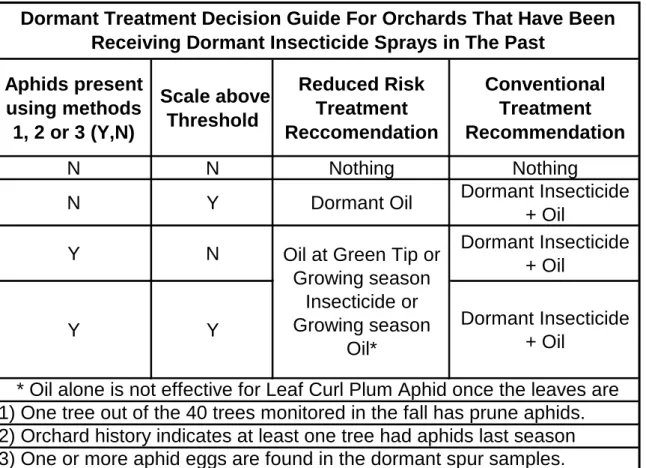
Based on aphid monitoring techniques that had fairly high correlations (techniques 2 and 4) and dormant spur monitoring, two treatment guides were developed and used through 2003 (see Tables 1 and 2). Table 1 was intended for orchards that had been receiving annual dormant insecticide sprays. Table 2 was for orchards that had not been receiving dormant insecticide sprays. For the latter, the aphid treatment threshold was based on orchard history. If 10% or more of the trees had aphids during the last growing season, then a dormant treatment for aphids would be recommended.
Table 1. "Dormant Treatment Decision Guide" used until 2004 for orchards that had been receiving dormant sprays.
Aphids present using methods
1, 2 or 3 (Y,N)
Scale above Threshold Reduced Risk Treatment Reccomendation Conventional Treatment Recommendation
N N Nothing Nothing
N Y Dormant Oil Dormant Insecticide
+ Oil
Y N Dormant Insecticide
+ Oil
Y Y Dormant Insecticide
+ Oil
2) Orchard history indicates at least one tree had aphids last season 3) One or more aphid eggs are found in the dormant spur samples.
Dormant Treatment Decision Guide For Orchards That Have Been Receiving Dormant Insecticide Sprays in The Past
Oil at Green Tip or Growing season
Insecticide or Growing season
Oil*
* Oil alone is not effective for Leaf Curl Plum Aphid once the leaves are 1) One tree out of the 40 trees monitored in the fall has prune aphids.
Table 2. “Dormant Treatment Decision Guide” used until 2004 for orchards that had not been receiving dormant sprays.
Below 10% of Trees Infested w/aphids Above 10% of Trees Infested w/aphids
x N Nothing Nothing
x Y Dormant Oil Dormant Insecticide
+ Oil
x N Dormant Insecticide
+ Oil
x Y Dormant Insecticide
+ Oil
Conventional Treatment Recommendation
*Oil alone is not effective for Leaf Curl Plum Aphid once the leaves are curled.
Dormant Treatment Decision Guide for Orchards That Have Not Been Receiving Dormant Insecticide Sprays in The Past
Oil at Green Tip or Growing season
Insecticide or Growing season Oil*
Orchard History Indicates:
Scale above Threshold Reduced Risk Treatment Recomendation
Results: 1) By following these guides, very few orchards needed to treat for SJS (Figure 1) and no orchard had an outbreak of SJS during the course of the project.
Figure 1. The percent of orchards that needed to be treated for SJS during the course of the project.
Percent of Orchards that needed to Treat or Not Treat for SJS in 2004
0% 20% 40% 60% 80% 100%
No Treatment Needed Treatment Needed
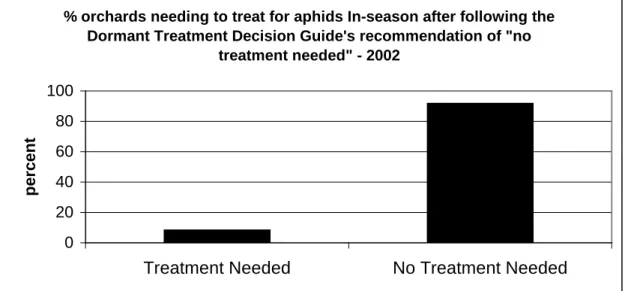
2) In 2002 the two guides failed to accurately predict the need to control aphids in many cases. Two orchards needed to treat for aphids in the spring that were not recommended to do so in the dormant season. Both orchards had not been applying dormant sprays and had no aphid history over the past three years but, never the less, aphids became a problem. Other growers that had no history of aphids in their orchards were also beginning to report aphid problems. Also, the use of these guides did not predict aphid outbreaks or the need to treat in any orchard that hadpreviously used a dormant pesticide treatment (Figure 2). Figure 2. In 2002 nearly 10 percent of the orchards had to treat for aphids after being advised there was no aphid problem.
% orchards needing to treat for aphids In-season after following the Dormant Treatment Decision Guide's recommendation of "no
treatment needed" - 2002
0 20 40 60 80 100
Treatment Needed No Treatment Needed
p
e
rce
n
t
Conclusions: This Dormant Treatment Decision Guide was not reliable in forecasting aphid outbreaks; there is no good way of knowing long-term history of aphid populations in those orchards. As a result of problems predicting aphid outbreaks, all cooperating growers were advised to control aphids in the dormant period or with oil during the bloom period in 2004
unless they had long term history of knowing their orchard was not frequented by aphids. This program was totally successful in 2004.
Dormant Treatment Decision Guide Revision
As a result of problems predicting aphid outbreaks, more work needed to be done with reduced rates of insecticides and/or alternative timings before significant fall rain and saturated soil; alternative pesticides have been tried in the past by several project members with little success. Focus for 2003-04 was a “satellite project” testing reduced rates of insecticides at an early treatment timing. A trial was set up and treated with an orchard sprayer on November 14th 2003 with the lowest label rates of the OP’s “Diazinon” or “Imidan” and below label rates of the pyrethroid “Asana”. These were compared to untreated plots for aphid control. Field data collected the following spring indicated 100 percent control of leaf curl plum aphid and mealy plum aphid, while in the untreated plots, 14% of the trees had colonies of leaf curl plum aphid and 49% of the trees had colonies of mealy plum aphid.
This early timing, before significant fall rain and saturated soil, with very low rates of insecticides may completely mitigate dormant spray runoff into surface waterways from dried plum growers orchards. Project farm advisors have been informing growers about these exciting results and encouraging growers to try this method of controlling aphids and these results will soon be incorporated into the “UC IPM Pest Management Guidelines for Dried Plums”.
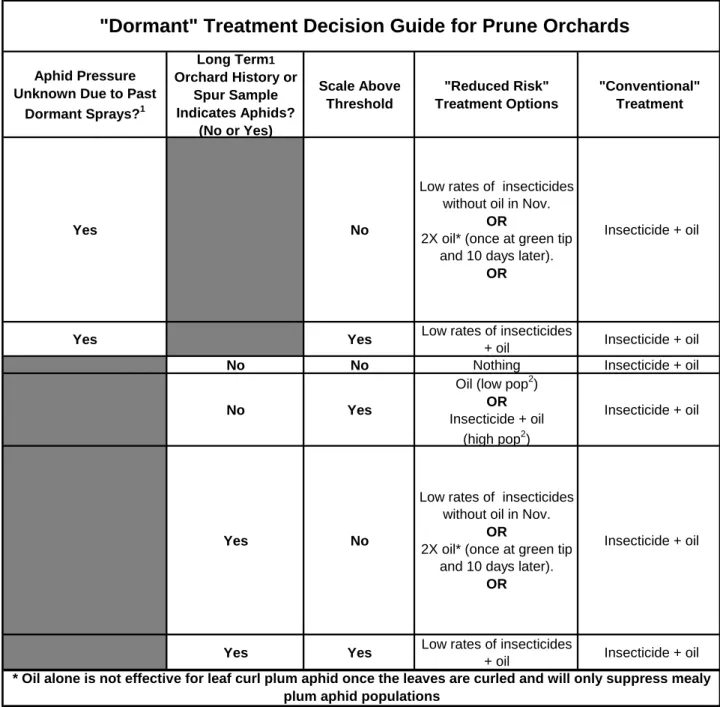
As a result of problems predicting aphid outbreaks and the success of the November spray trials with low rates of insecticides a revised guide for all orchards was developed and is presented in Table 3.
Table 3. The “Dormant Treatment Decision Guide” developed in 2004.
Aphid Pressure Unknown Due to Past
Dormant Sprays?1
Long Term1
Orchard History or Spur Sample
Indicates Aphids? (No or Yes)
Scale Above Threshold
"Reduced Risk" Treatment Options
"Conventional" Treatment
Yes No
Low rates of insecticides
without oil in Nov.
OR
2X oil* (once at green tip and 10 days later).
OR
Insecticide + oil
Yes Yes Low rates of insecticides
+ oil Insecticide + oil
No No Nothing Insecticide + oil
No Yes
Oil (low pop2)
OR
Insecticide + oil (high pop2)
Insecticide + oil
Yes No
Low rates of insecticides
without oil in Nov.
OR
2X oil* (once at green tip and 10 days later).
OR
Insecticide + oil
Yes Yes Low rates of insecticides
+ oil Insecticide + oil
"Dormant" Treatment Decision Guide for Prune Orchards
* Oil alone is not effective for leaf curl plum aphid once the leaves are curled and will only suppress mealy plum aphid populations
1
Long term is more than three years. To determine history of aphids in a dormant treated orchard:
1) Carefully observe trees throughout the orchard during growing season for the presence of any aphids. OR
2) Leave a few edge rows untreated and observe trees during the growing season for the presence of aphids.
2
Low scale populations are when 10 – 15 percent of the spurs have live scale. High scale population is when more than 15 percent of the spurs have live scale. 2. Pheromone Traps to Aid with Treatment Decisions
dried plum growers for treatment decisions. Pheromone traps are most commonly used to help determine treatment timing by calculating degree-days from a biofix and, in the case of SJS traps, are also used to assess the presence of beneficial insects. Rarely have they shown utility or have they been used to help determine if a treatment was needed. This information would be useful to dried plum growers who may need to treat for PTB, OBLR or SJS. This would also minimize un-needed OP sprays that may contaminate waterways.
A. San jose scale and beneficials
Evaluation: By monitoring SJS pheromone traps in spring, beneficial insects (Encarsia (Prospatella) and Aphytis melinus) and SJS males, were documented in each orchard each year of the IPFP project. For each “conventional”, “reduced risk” and “check” orchard one SJS scale trap was monitored and 1000 fruit were examined in July and near harvest for evidence of SJS crawlers.
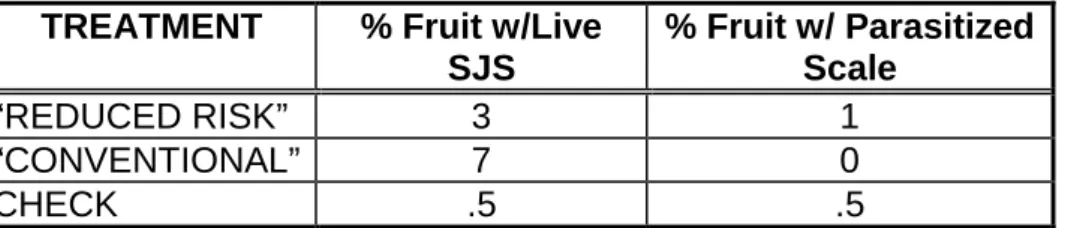
Results: Average numbers of male SJS and parasites caught in the “conventional”, “reduced risk” and “check” orchards during the course of this project are presented in Figure 3. No significant difference in pheromone trap catches was ever found for male SJS between the “conventional”, “reduced risk”, and “check” orchards. Significant differences in beneficial insects did occur in some years. Encarsia (Prospatella) was caught in significantly larger numbers in “reduced risk” and “check” orchards than in “conventional” orchards in 2000. No live or parasitized SJS were found on fruit during pre-harvest fruit evaluation in 2004, 2003, 2002 or 2001. However, a few live SJS were found on fruit in the 2000 and 1999 crops. The average number of live and parasitized SJS found on fruit during this project is shown in Table 4.
Figure 3. Mean number of male SJS and SJS parasitoids caught each year during the project.
Mean # of San Jose Scale and Scale Parasatoids Caught Per Trap Each Year
0 100 200 300 400 500 600 700
SJS Aphytis Encarsia
Reduced Risk Conventional Check
Table 4. Average number of live or parasitized SJS found on fruit each year of the project.
TREATMENT % Fruit w/Live SJS
% Fruit w/ Parasitized Scale
“REDUCED RISK” 3 1
“CONVENTIONAL” 7 0
CHECK .5 .5
Conclusion: Presence of more parasitoids in “reduced risk” and “check” orchards, where dormant insecticides had not been applied, indicates the dormant insecticide with oil treatment suppressed populations of these beneficial insects. Clearly, parasites can keep SJS in check after a few years of no dormant insecticide applications. The data also suggest that less than 150 male scales trapped during late winter-spring are low populations and should not require treatment since SJS crawler presence was not significant on the fruit. Although there were a few SJS on the fruit the first two years of the project, albeit of no economic consequence, in the last four years no SJS were found on the fruit. No SJS buildup was seen on the trees’ branches in any of the orchards during the course of this project.
Using SJS traps occasionally (not necessarily every year) can gave a good indication of SJS and scale parasite populations in the orchard and is a practice growers should follow. It appears however, from this project’s results, that SJS control is rarely required for dried plums.
B. Peach Twig Borer
Situation: Although research conducted during this project revealed a high correlation between total PTB trap catch in an orchard and damaged fruit at harvest, and a high correlation between live PTB larvae and PTB damage during the season, PCAs and growers said the monitoring techniques were too costly and time consuming. A new, less time consuming, PTB monitoring technique had to be discovered.
Currently PCAs and growers use PTB pheromone traps to obtain a biofix and then base their spray timing on degree-day accumulation. Project members took advantage of this and, over the past three years, developed and evaluated a one-time fruit monitoring technique that could tell the PCA if a PTB treatment was actually needed.
Evaluation: PTB pheromone traps were used to obtain a biofix and 400 degree-days after biofix, 1200 fruit were evaluated in each “conventional”, “reduced risk” and “check” orchard for presence of PTB larvae or PTB damage. Based on this fruit evaluation, a treatment decision was made based on a threshold of 1 percent of fruit having larvae and/or larvae damage. After the 2002 season, the threshold of 1 percent was found to be too conservative and was changed to 2 percent. This treatment, if needed, would lessen the chance of more worm or brown rot damage (associated with worms) later in the season. Alternatively, if the orchard history indicated that last year’s crop had significant worm damage then, two-bloom time
recommended. For each site, 1000 fruit were examined in July and near harvest for evidence of PTB larvae or damage in order to validate this monitoring technique.
Results: When the treatment threshold for PTB was set at one percent of the fruit with PTB larva and/or PTB damage at 400 degree-days from biofix, only one of the project orchards reached that level and was recommended for treatment. Of those orchards that did not reach the treatment thresholds only one orchard had any PTB larva and/or PTB fruit damage with 1.3 percent damage being detected in July. At harvest only one orchard, a different one, had any PTB larva and/or PTB fruit damage with 1.4 percent damage being detected. None of these orchards were treated and there was no significant difference in PTB damaged fruit between the “conventional” and “reduced risk” plots at harvest.
The one project orchard that was recommended for treatment had a previous history of over four percent fruit damage due to PTB larvae. The grower followed the projects recommendation of applying two bloom-time B.t. sprays (one at popcorn and again ten days later). Since the 400 degree-day fruit evaluation revealed 2.29 percent PTB damage in the “check” orchard, an additional PTB spray was recommended. This strategy was completely successful. The “conventional” and “reduced risk” plots had very low levels of PTB damage in the July and harvest evaluations while the “untreated check” had considerably more damage (Table 5). The Dried Fruit Associations grade sheet revealed no PTB damage in the “conventional” or reduced risk” orchards but the untreated “check” orchard had 1.3 percent PTB damage (Table 5). However statistically, there were no significant differences in the PTB damage between the three orchard programs.
Table 5. Control strategies and incidence of PTB damage in the only orchard during the course of this project that indicated a need for a 400 degree-day PTB treatment.
Evaluation Timing
"Reduced Risk"
Bt + Inseason Insecticide
"Conventional"D ormant Insecticide +
Inseason Insecticide
Untreated Check
400 Degree-Days 0.8 0.3 2.9
July Evaluation 0.2 0.0 1.8
Harvest Evaluation 0.7 1.4 2.3
DFA Disease/Insect
Offgrade 0 0 1.3
% Fruit with PTB Damage (Butte County Orchard) 2001
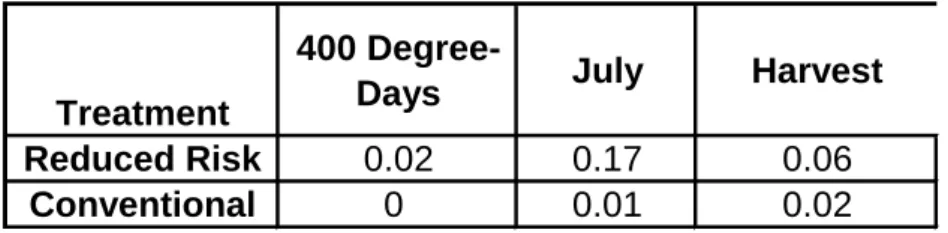
After the treatment threshold was changedto two percent of the fruit containing PTB larva and/or PTB damage at 400 degree-days from biofix, none of the orchards in this project needed to apply a growing season PTB treatment for dried fruit. The July and harvest samples found that no project orchards had PTB larva and/or damage over 1 percent. There was no significant difference between the “conventional” and “reduced risk” plots in the amount of PTB damaged fruit found at harvest in 2003 (Table 6). There was virtually no PTB damage in the “reduced risk” orchards in 2004 (data not shown).
Table 6. Mean percent fruit with PTB larvae and/or damage present (2003).
Treatment
400
Degree-Days July Harvest
Reduced Risk 0.02 0.17 0.06
Conventional 0 0.01 0.02
Conclusions:
o Fruit monitoring, 400 degree-days after PTB biofix, can be a useful tool in determining treatment necessity and timing.
o A 2 percent treatment threshold is very conservative because there was nearly no visible damage to the fruit at harvest in any year of the project.
o PTB is rarely an economic problem in dried plum orchards regardless of dormant treatment
C. Oblique Banded Leaf Roller (OBLR):
Situation: Prior to investigations undertaken in this project, it was unknown how OBLR pheromone traps and fruit monitoring might be used to determine need for an OBLR treatment.
Evaluation: Research, using OBLR trap catches and fruit monitoring, was conducted and evaluated each year like the PTB research described above. A one-time sample could not be used because exact degree-days for evaluating presence of OBLR or OBLR damage in dried plums were unknown. To determine best single evaluation timing for presence of OBLR larva and/or damage, 1200 fruit were monitored each week in each orchard for three weeks starting at 690 degree-days after biofix. OBLR were monitored for five weeks in 2003. At the best evaluation timing a treatment decision was made based on 1 percent (later raised to 2 percent) of fruit with OBLR larvae or OBLR larval damage. Alternatively, if the orchard history indicated that last year’s crop had significant worm damage (more than 2 percent) then, two-bloom time B.t. sprays (one pre-bloom at “popcorn” and again ten days later) were recommended. For each site, 1000 fruit were examined in July and near harvest for evidence of OBLR larvae and/or damage to validate this monitoring technique.
Results: When fruit were evaluated for three weeks, beginning at 690 degree-days after biofix, none of the project orchards reached the 1 percent treatment threshold so none needed to apply a growing season OBLR treatment. In the July sample, six orchards had OBLR larva and/or damage over 1 percent with 2.5 percent being the highest and at harvest five orchards had OBLR larva and/or damage of over 1 percent with 2.5 percent being the highest. However, there were no significant differences between “conventional”, “reduced risk” or “check” orchards in amount of OBLR damaged fruit found at harvest. Table 7 shows average percent of fruit with OBLR damage or larva present from all project orchards.
Table 7. Mean percent fruit with OBLR damage present (690 Degree-Days + 2 weeks, July and Harvest Final Evaluations).
Treatment
690
Degree-Days + 2
weeks
July OBLR
Damage
Harvest
OBLR
Damage
Reduced Risk
0.43
0.57
0.52
Conventional
0.31
0.32
0.42
CHECK
0.43
0.57
0.52
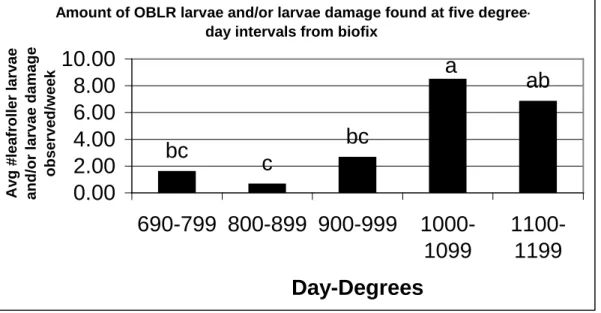
When fruit were evaluated for five weeks, beginning at 690 day-degrees after biofix, 900-999 day-degrees from biofix was found to be the best time to evaluate for presence of OBLR larvae and/or damage (see Figure 4). This timing was the beginning of the population rise.
Figure 4. Amount of OBLR larvae and/or larvae damage found at five degree-day intervals from biofix.
Amount of OBLR larvae and/or larvae damage found at five degree-day intervals from biofix
bc
c
bc
a
ab
0.00
2.00
4.00
6.00
8.00
10.00
690-799 800-899 900-999
1000-1099
1100-1199
Day-Degrees
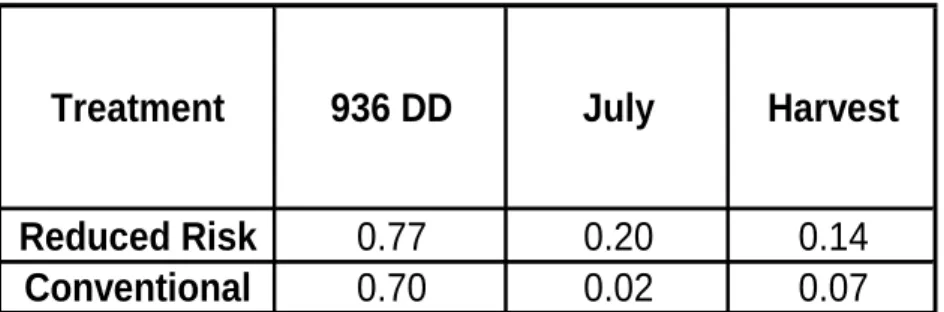
A vg #l eaf ro ll er l ar vae an d /o r l ar vae d am ag e o b ser ved /w eekUsing the 900-999 degree-day monitoring timing in 2003 and 2004, no treatments were recommended since no orchard exceeded 2 percent larvae and/or damage. The July and harvest samples found no orchards with OBLR larvae and/or damage over 1 percent. There were no significant differences between “conventional” and “reduced risk” orchards in the amount of OBLR damaged fruit found at harvest, July or at 900-999 DD (see Tables 8 and 9).
Treatment
936 DD
July
Harvest
Reduced Risk
0.77
0.20
0.14
Conventional
0.70
0.02
0.07
Table 9. Mean percent fruit with OBLR Larvae and/or damage present (2004).
Treatment
900-999
DD
July
Harvest
Reduced Risk
0.22
0.36
0
Conclusion:
o Fruit monitoring at 690 degree-days after biofix using pheromone traps is too early to get an accurate reading of OBLR damage. Fruit monitoring at 900-999 degree-days after biofix is the best time to evaluate for OBLR. This monitoring technique can be a useful tool in determining treatment necessity and timing.
o The 2 percent treatment threshold is considered conservative since worm damage at harvest was negligible.
o It appears OBLR is rarely an economic problem in dried plums. 3. Spring Prune Aphid Monitoring
Situation: Without a dormant insecticide and oil treatment it would be important to be able to assess MPA and LCPA populations’ during the growing season to determine if treatments would be needed.
Although it has been reported MPA causes fruit cracking, there is no documented evidence to support this. Knowing damage these aphids cause would be important in determining need for control measures.
Evaluation: Beginning in April, a random sample of 80 trees per project site was observed weekly to determine presence of LCPA and MPA. The treatment threshold was 10 percent or more of the trees having aphids in 2000 but in 2001, the treatment threshold was changed based on research done by Dr. Nick Mills to more than 20 percent of trees with “significant” aphid infestations. Significant was defined as trees with aphids covering 10 percent or more of the tree surface. Treatment recommendations ranged from an oil treatment to suppress MPA, to an insecticide treatment to eliminate MPA or LCPA.
A statistician developed a sequential observation technique for aphids from project data. Sequential observation allows for a small number of trees (20) to be observed. From this small sample if the treatment threshold was reached and a decision to treat was made, then sampling could stop. If MPA
and/or LCPA aphid levels were determined to be very low, sampling can also stop. If MPA and/or LCPA levels were moderate (more than very low, but not enough to call for a treatment) then additional trees (10) needed to be observed until a decision could be made or 80 trees had been observed. After a few years of using the sequential observation technique, it was discovered that project scouts and PCAs were taking too long to complete the sequential aphid sampling. To correct this, the sequential observation technique was improved in 2003 and 2004 by introducing a “timed” search. The initial search was for 10 minutes, the approximate amount of time it should take to monitor 40 trees. If a decision couldn’t be a made an additional five minutes would be spent looking at more trees. The total time allowed for monitoring was 20 minutes.
To determine to what extent MPA caused fruit cracking, 40 fruit (from up to 25 trees) were examined in August from trees infested by MPA, and 40 fruit (from up to 25 trees) from trees not infested by MPA. For example: if only 10 trees in the orchard had MPA, then only 10 trees not having MPA would be evaluated.
Results: During this project, eight orchards were correctly identified as having growing season aphid populations that exceeded the treatment threshold. Treatment recommendations were made in all eight orchards. However aphid control was varied due to the course of action that each grower took.One orchard, with LCPA, was being farmed “organically” and a new organically approved insecticide that was used did not work. Another orchard had a MPA problem and an oil treatment gave satisfactory control. An oil treatment failed to control LCPA in a third orchard. Five other orchards also exceeded the growing season treatment threshold for aphids; however these growers chose not to apply a treatment.
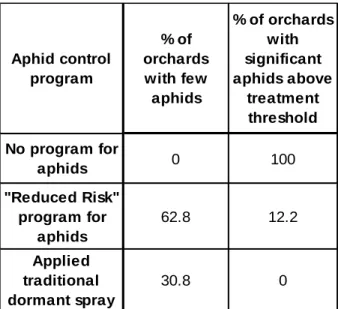
Average incidence of aphids among cooperators through the course of the project is shown in Table 10.
Table 10. Average incidence of aphids among cooperators.
The timed search aphid sampling technique was Aphid control
program
% of orchards with few aphids
% of orchards with significant aphids above
treatment threshold
No program for
aphids 0 100
"Reduced Risk" program for
aphids
62.8 12.2
Applied traditional dormant spray
compared to the sequential sampling method of looking at all 80 trees and produced the same results.
Although every year there was a numerical trend for more cracked fruit on trees that had aphids, 2000 was the only year that showed a statistically significant difference in the amount of fruit with side cracks and end cracks. Trees with MPA present had significantly higher levels of side cracks and end cracks than did trees without aphids (see Figure 5). That year also had the highest MPA populations at project sites.
Figure 5. Cracked fruit associated with aphids.
Mean % of Fruit with Side and End Cracks From Trees with and Without Aphids (2000)
3.68% A 3.6% A
1.92% B 2.2% B
0.00% 1.00% 2.00% 3.00% 4.00%
%
of
Fr
ui
t
Aphids Present No Aphids
Side Cracks End Cracks
Means not followed by a common letter are significantly different from each other at the 95 percent level of significance according to Duncan’s Multiple Range Test for Mean Separation.
Conclusion:
o The new sequential observation and timed search techniques for presence of aphids gave a good indication of aphid population levels and if a treatment was needed.
o All orchards that did not apply a dormant, delayed dormant or bloom treatment for aphids in 2003 and 2004, had a treatable level of aphids during the growing season. Of the orchards that used the original “Dormant Treatment Decision Guide,” 12.2 percent had a treatable level during the growing season. This prompted the 2004 revision of the “Dormant Treatment Decision Guide” as described earlier in this report (see page 14).
o The growing season treatment threshold (based on 20 percent significantly infested trees) appears to be fairly accurate.
o Even though there was not always a scientifically statistical difference, trees with MPA always had more cracked fruit than trees without MPA.
4. Quality and Harvest Evaluation:
were compared to sites farmed “conventionally” to see if there were any negative or positive effects.
Evaluation: In the project’s first year, quality data were obtained from growers’ P-1 grade sheets. However, these grade sheets were difficult to obtain from the grower, made harvesting more complicated, and processors began charging growers for delivering small lots of fruit. Additionally, it was impossible to separate disease and insect damage; it was combined on the P-1 grade sheets. In 2001 and 2002, the Dried Fruit Association of California (DFA) provided quality analyses of harvest samples submitted from each plot. This was an improvement but in 2003, DFA required a fee be paid for grading project samples. In 2003 and 2004, project scouts gathered fruit quality data at harvest by examining 1000 fruit per site and recording the number of fruit with scale (live or damage), cracks (side or end), and worm damage. Three 100-fruit samples were also taken from each site and evaluated for fresh to dry ratio, dry fruit count per pound, soluble solids and fresh fruit flesh pressure. Beginning in 2001 the only yield data gathered were average dry tons per acre production from the project orchards reported to project scouts by cooperating growers.
Results: Regardless of how fruit quality was evaluated, there were no significant differences between means of any treatments (“reduced risk”, “conventional”, and/or “check”) in soluble solids, fresh to dry ratio, fresh fruit flesh pressure, presence of worm damage, or presence of fruit cracks in any year of the project except 1999 where “reduced risk” plots averaged slightly larger dried fruit. Fruit quality data for 2004 and 2003 is shown in Tables 11 and 12.
Table 11. Average fruit quality from all “reduced risk” sites in 2004.
Soluble Solids Dry Away Ratio Pressure (PSI)
% of Fruit with Brown Rot % of Fruit with Worm Damage
% of Fruit with SJS Damage
% of Fruit with Cracks
Reduced Risk 23.95 2.90 4.22 0.44 0.44 0 0.28
Mean 2004 Dried Fruit Quality Data
Table 12. Average fruit quality from all “reduced risk” and “conventional” sites in 2003. Soluble Solids Dry Count/Lb Dry Away Ratio Pressure (PSI) % of Fruit with Brown Rot
% of Fruit with Worm Damage
% of Fruit with SJS Damage % of Fruit with Cracks Conventional 22.17 68.41 3.14 3.92 0.24 0.09 0 1.93
Reduced Risk 21.69 65.66 2.99 3.64 0.69 0.20 0 1.66
Mean 2003 Harvest and Quality Data
Conclusion: Based on the pest management data obtained throughout the course of this project no adverse fruit quality or yield affects have occurred using the “reduced risk” program.
5) Demonstrate a cover crop and hedgerow program
At the onset of IPFP, many dried plum farmers were experienced with cover crops. The CDPB was an initial sponsor of The Nature Conservancy’s (TNC) Biological Prune Systems (BPS) project that included cover crops and wildlife development. With the inclusion of the BPS project in the formation of the IPFP project through the SAREP BIFS Grant, ten of the initial growers were already using cover crops on their initial IPFP acres.
Starting in 1998 the USDA Natural Resources Conservation Service (NRCS) awarded the CDPB an Environmental Quality Incentives Program (EQIP) grant, the first of three. The three years of EQIP funding allowed IPFP to have a robust cover crop, filter strip, hedgerow, and wildlife friendly program statewide. During this time, these environmental practices were the primary feature at 28 meetings all of which were sponsored or cosponsored by the CDPB. These meetings drew in excess of 1,000 farmers, landowners, agencies, and reporters. In addition to the meetings, there was television coverage by Channel 12 News, multiple press releases announcing the meetings, 14 follow up articles in regional and statewide newspapers and magazines, including the front-page story by
California Farmer, January 2000.
A new chapter titled “Orchard floor Management” with a section called “Dried Plum Cover Crop Selection Guide” has been included in the third edition of the “Integrated Prune Farming Practices Decision Guide”
Cover Crop/Buffer Strip Program
A third of IPFP growers use cover crops (native or planted) on their IPFP orchards as part of a normal floor management program. Their reasons include: improving water infiltration, nitrogen fixation, beneficial insect habitat, weed suppression, and establishing a durable floor for orchard operations. In spite of low prices received for their crop, as a farm group, approximately 10 % of prune growers in the state have perennial or annual cover crops as a normal orchard floor practice.
The EQIP program was the ideal program for the CDPB to expand breadth of practices to include buffer strips and hedgerow plantings. EQIP selected eight farmers who allowed the IPFP project to plant 10 different demonstration cover crops at their prune orchards. These cover crop demonstration sites were then used as the focus of meetings over the next three years, allowing other growers to view them and the farmers who farmed them to evaluate how they performed under their management, irrigation, and soil type.
The following cover crops were demonstrated, with the first being planted outside the orchard and then the next four no tillage types being planted in order. The last five were covers that required disking and incorporation. By allowing us to plant these 10 covers, each participating grower had a mixture in their orchard that was difficult to manage and mow, and their contribution to the project was commendable.
1. Hard Fescue: Used as a filter strips and vegetated road. 2. ‘Beneficial Blend’: A filter strip and insectary reservoir. 3. N. Z. White Clover/Trefoil: A nitrogen fixing sod/insectary.
4. ‘Perennial Sod’: A durable, low maintenance orchard floor and water infiltration. 5. ‘NonTillage Clover’: A nitrogen fixing, mow able insectary floor.
6. ‘Plowdown Legumes’: A nitrogen fixing incorporated mixture of bell beans, peas and vetch.
7. ‘Max Organic Builder’: A soil improving incorporated mixture of oats, bell beans, peas and vetch.
8. Juan Triticale: A soil improving, weed suppressing grain. 9. Common Barley: A soil improving, weed suppressing grain.
10.Resident Vegetation: The comparison or check of what would be in the orchard. The CDPB partnered with one of this project’s “conventional” and “reduced risk” orchard sites at the California State University (CSU)-Chico Farm and with the EQIP grant, planted a long-term cover crop trial as a regional demonstration. Forty perennial and 60 annual cover crops were planted in 2000 and again in 2001. These 5 by 30 foot demonstration plots have been marked and are an open walking tour for any group that wishes to view, cover crops, filter strips, CA native grasses, insectaries, vetch, peas, annual clovers, fenoeugreek, brassicas, phacelia, erosion grasses, cereals, and mixtures. This planting has been the site of 5 walking tour meetings and was the site of a regional NRCS and RCD training workshop held April 25, 2002.
Insectary Hedgerows
The use of insectary hedgerows has been promoted by the IPFP at 6 different meetings. As part of the NRCS Cover Crop grant, a hedgerow project was also implemented with the cover crop cooperators. A total of 8 different dried plum ranches planted hedgerow habitat with signs for demonstration. Two particularly extensive plantings included a replicated planting at this project’s CSU-Chico dried plum site where permanent, laminated signs informed all visitors to CSU Farm tours about hedgerow species, insects attracted and pests controlled. The second planting at Billiou Ranches in Hamilton City (another original site of this project) is a 20 acre planting of hedgerow species; Coyote Brush, Coffee Berry, Yarrow, and Deergrass with the species placed in clumps in place of missing trees. Many groups have visited this innovative planting over the past four years as an insectary plantings interspersed in the orchard. During the first year of the NRCS grant, Mary Kimball, previously of the Yolo County RCD was the featured speaker at four of our meetings.
Wildlife Friendly Farming
The IPFP program has supported wildlife friendly farming through cover crop and hedgerow plantings. Four of our hedgerow plantings were specifically planted next to waterways including Deer Creek and Gilsizer Slough to provide diversity, cover, and food for bird species. As part of the BPS project, funding was also provided by the Point Reyes Bird Observatory (PRBO) to monitor bird species richness and diversity in a dried plum orchard in Sutter County. The results were presented at the 1999 CDPB Research Conference, Anne M. King; Avian Monitoring on the Heier Ranch: Progress Report of the 1999 Field Work.
In addition to field plantings and demonstrations, the CDPB’s IPFP program hosted, along with our cosponsors, The Nature Conservancy and the Colusa County NRCS, three ‘Wildlife Workshops’ at the Colusa Farm and Equipment Show in 1999, 2000, and 2001. The attendance at the 2000 show exceeded 100 participants including; farmers, wildlife biologists, and Future Farmer of America students.
Objective II. Demonstrate site management practices, in-season pest and cultural management that mitigate surface runoff from tree fruit orchards.
Here we include the “FINAL REPORT ON THE 2002-05 BMP EVALUATION STUDIES FOR THE CALIFORNIA DRIED PLUM BOARD 319(H) PROJECT IN BUTTE COUNTY”, prepared for the California Department of Pesticide Regulation by Dr. Frank Zalom, Department of Entomology U.C. Davis, Contract Agreement # 01-0223C
YEAR 1 STUDY
Introduction
This project was intended to develop a better understanding of the effectiveness of dormant spray management practices being considered for implementation in the Sacramento and San Joaquin River Watersheds. DPR is coordinating closely with the Sacramento River Watershed Program’s (SRWP) Organophosphate Focus Group (OPFG) in developing a list of management practices intended to reduce the runoff of diazinon from dormant spray-applied orchards. Specifically, DPR is interested in focusing on “edge-of-field” level monitoring that will allow the evaluation of the effectiveness of various management practices on a site-specific basis.
Within the proposed study area of this agreement, the California Dried Plum Board has received a 319h grant from the State Water Quality Control Board to demonstrate and promote management practices aimed at reducing winter runoff of organophosphates (OPs) from prune orchards. DPR intends to measure the effectiveness of some of these demonstrations in reducing OP levels in orchard runoff, particularly diazinon.
The objectives of the Year 1study were as follows:
1. To evaluate efficacy of different widths of buffering vegetation strips in reducing the concentration of diazinon in surface runoff from orchards dormant sprayed with diazinon. Vegetated filter strips are a proposed management practice for reducing off-site movement of pesticides.
2. To determine efficacy of post-spray sprinkler irrigation in reducing the concentration of diazinon in surface runoff from orchards dormant sprayed with diazinon. Irrigation is hypothesized to cause residual OP on soils to infiltrate into the soil and thereby reduce its availability to move off-site with rainfall runoff.
MATERIALS AND METHODS, YEAR 1 STUDY
The study design incorporated five treatments including a control treatment and four treatments that correlate with the two objectives stated above. Plots representing the five treatments were established in 4 non-randomized fully replicated blocks in a mature dormant prune orchard where trees are planted on berms 20 feet apart. A study site was identified and owner cooperation was secured within the Butte County CWA 319 Project area. The proposed study treatments included:
For each of the following five treatments, a typical dormant spray with diazinon (15.1 l active ingredient plus 363.4 l of water per acre) was simulated in order to control the size of the area sprayed and the total active ingredient and concentration applied within the replicated plots. Simulated spraying involved the use of a CO2-charged backpack sprayer to