Chapter 1500
Research Compliance
Table of Contents
¶1501 Introduction
Richard Seligman, Ed.D., Associate Vice President for Research Administration, California Institute of Technology
¶1505 Research Compliance
Stephen Erickson, Director, Research Compliance and Intellectual Property Management, Boston College and
Alice Tangredi-Hannon, University Research Compliance Officer, Yale University
¶1505.1 Why Research Compliance Is Important ¶1505.2 Statement of Principles
¶1505.3 Risks of Noncompliance
¶1505.4 Benefits of an Effective Compliance Program ¶1505.5 Compliance Program Considerations
¶1505.6 Research Compliance Program Development
¶1505.7 Ensuring Long-Term Success: Compliance Awareness Program ¶1505.8 Ensuring Long-Term Success: Compliance Assessment Process ¶1505.9 Conclusion
This material is reprinted from Sponsored Research Administration: A Guide to
Effective Strategies and Recommended Practices, co-published by the National
Council of University Research Administrators (NCURA) and Atlantic Information
Services, Inc. (AIS). For further information, visit www.AISEducation.com.
¶1501
Introduction
Richard Seligman, Ed.D.
Associate Vice President for Research Administration
California Institute of Technology
This chapter on research compliance addresses a particularly critical topic for re-search administration.
If the major issues and concerns of research administration in the 21st century had to be summarized in only one word, there is very little doubt that the word would be “compliance.” One needs only to read occasional headlines announcing yet another dramatic case of noncompliance or misconduct in connection with a research program at a college or university to appreciate this.
Stephen Erickson of Boston College and Alice Tangredi-Hannon of Yale Uni-versity have prepared an excellent overview of the research compliance topic. This chapter is not a catalogue of all of the subjects about which compliance require-ments exist. Rather, it is a very thoughtful discussion of what compliance means in the context of sponsored programs and how one might go about developing an effective program of research compliance.
Drawing on sources as diverse as the U. S. Sentencing Guidelines, the results of NIH compliance site visits, and the Council on Governmental Relations (COGR) publication, “Managing Externally Funded Research Programs,” Erickson and Tangredi-Hannon have collected and summarized the essential requirements for an effective research compliance program. They correctly identify the process of assess-ing compliance as one that is absolutely essential to an effective program. Assess-ment as a one-time effort will not produce the desired outcomes. Compliance assess-ment needs to become a regular ongoing activity within the institution. The authors have effectively conveyed the message that it is “all about integrity” and fostering a “culture of compliance.”
Clearly, the federal government is focused on monitoring regulatory and pro-grammatic compliance at colleges and universities. This chapter will continue to respond to the information needs of research administrators over time through the addition of new material. Future updates will contain revisions, additions, and en-hancements to ¶1505, as appropriate. Content added to other sections of the chapter will provide readers additional discussions of related topics (at ¶1520), practical tools (at ¶1530), case studies (¶1540), and relevant statistics and survey results (at ¶1560). A “knowledge check” containing Q&As and discussion topics is included at ¶1590.
¶1505
Research Compliance
Stephen Erickson
Director, Research Compliance and Intellectual Property Management
Boston College
Alice Tangredi-Hannon
University Research Compliance Officer
Yale University
This chapter provides an overview of why research compliance is important to an institution and will help guide an institution in developing a research compliance program and/or assessing the continued effectiveness of an existing program. The chapter discusses the importance of top-level institutional commitment and the ap-pointment of an office and/or individual to oversee research compliance. Further, the chapter outlines the process of developing a research compliance program and the importance of conducting ongoing assessments to determine compliance and mitigate risks.
¶1505.1
Why Research Compliance Is Important
For a scientist, integrity embodies above all the individual’s commit-ment to intellectual honesty and personal responsibility. It is an aspect of moral character and experience. For an institution, it is a commitment to creating an environment that promotes responsible conduct by embracing standards of excellence, trustworthiness, and lawfulness and then assessing whether researchers and administrators perceive that an
environment with high levels of integrity have been created.1
Universities in Society
As nonprofit institutions, universities have a public mission. The public depends on university research to be conducted in an objective and honest way. University research may form the basis of public policy. The creation of medical therapies, drugs, and devices depends on the basic and clinical research performed by universities and affiliated hospitals. The development of knowledge through research as well as contri-butions to the arts are additional ways universities fulfill, in part, their public mission. These are but a few examples of the social context of university research.
It is not enough, however, to simply create knowledge. The public mission requires that academic work must be disseminated through, for example, publications, public
performances or presentations,and the licensing of intellectual property. A key element
in the appropriate dissemination of knowledge is that the research must be performed ethically and honestly, in keeping with the accepted standards in the given academic
1 Institute of Medicine and National Research Council, Integrity in Scientific Research: Creating an
Environment That Promotes Responsible Conduct, National Academies Press, Washington, DC,
field. Furthermore, the reporting of research results whether to sponsors or via publica-tions must be done in an objective and honest manner.
Just as the conduct and reporting of research must be done in an honest manner, universities have a fiduciary responsibility to manage the funding of research projects appropriately regardless of the source of funding. Any perception that finances are mismanaged calls into question the integrity of the entire research program as well as the institution’s ability to satisfy its fiduciary responsibilities.
The research enterprise, to the greatest extent possible, also must be free of indi-vidual or institutional conflicts of interest. As noted by the Association of American Universities, “The partnership between research universities and their principal re-search sponsors — including the federal government — must be based on the
convic-tion that universities are accountable for the research they perform.”2 Great care must
be given to ensure the transparency of business relationships because even the percep-tion that a conflict exists can damage the public trust.
Preserving Public Trust in Research and Institution’s Fiduciary Role The public will support science only if it can trust the people and the institutions that conduct research. Major social institutions, including research institutions, are expected to be accountable to the public. Fostering an environment that promotes integrity in the conduct of
research is an important part of that accountability.3
Public trust in universities must be held by not just the general population, but also government agencies (at all levels), public and private research sponsors, alumni, donors, and the press. Some of the situations that jeopardize public trust in universities include the following:
(a) Misuse or mismanagement of sponsored funding (This occurs when proposal budgets are artificially inflated, when effort is not reported appropriately, and when funds are spent in conflict with sponsor policies.)
(b) Expenditure of funds in ways contrary to their intended purposes (c) Instances of research misconduct
(d) Real or perceived conflicts of interest (In the public’s eye, COI can easily lead to a perception, accurate or not, that research results are biased, or that universities are more concerned with private rather than public interests.)
Public support is essential to universities sustaining themselves as viable entities. Public distrust of university research or financial management would strike at the core of university existence. Trust is fragile and can be severely diminished by occurrences of financial mismanagement, poor audit findings, cases of research misconduct, and even the perception that research results are biased due to conflicts of interest.
2 Association of American Universities, Report on Individual and Institutional Financial Conflicts of
Interest, October 2001, p. ii.
Accepting Compliance Requirements
When an institution accepts sponsored funding, it is accepting and agreeing to comply with certain conditions in the areas outlined in Figure 1.
Even when the expectations are not explicitly stated, in order to maintain the integrity of the research and scholarly enterprise, the institution must understand that the topics listed in Figure 1 constitute fundamental aspects of all that an institution of higher education must satisfy as a part of maintaining the public trust.
What does acceptance of compliance requirements mean for an institution? It means the following:
◆ The highest levels of administration understand that compliance is important.
Figure 1
Note: The concept illustrated is an expansion of a slide presented in the NCURA Sponsored Projects Administration II program. NCURA publishes an excellent resource on compliance requirements: Regulation and Compliance: 2005, A Compendium of Regulations and Certifications Applicable to Sponsored Programs, National Council of University Research Administrators, www.ncura.edu.
R esearch Integr ity C onflict of interest M iscon du ct Intellectu al p roperty Data m anagem en t Export controls H um an p articipan ts An im al w elfare Techn ical reportin g
Biosafety Rad iation safety C hem ical safety F in an cial
S tew ar dsh ip C ost sh aring E ffort rep orting Accep ted accounting
practices Financial reportin g B usin ess Stew ard sh ip Pu rchasin g Property m gt . Su bcontracting Subrecipient m on itorin g Socio - econom ic Re s ea rc h C o m plia nc e
◆ Those responsible for performing the work under sponsored funding are aware of sponsor policies and what it takes to be in compliance.
◆ Universities must have policies and procedures that are consistent with compliance
requirements.
◆ Universities need to educate those who are responsible for various aspects of
compliance including faculty, administrative staff, and students, as appropriate to a given program. Education needs to include both the external and internal
environments, i.e., sponsor requirements as well as university policies and procedures.
◆ Compliance responsibilities must be clearly assigned and understood. The creation
of a “roles and responsibilities” document can take many forms, but it is essential. The exercise of creating a written document will assure that duplication of effort is avoided, that everyone understands who is responsible for what, and that all compliance aspects are covered.
◆ Compliance assessment must be an ongoing effort. Depending on institutional
culture, compliance assessment needs to cover policy and procedure development, as well as determine whether compliance with sponsor policies and internal policies and procedures is being achieved.
¶1505.2
Statement of Principles
It is not unusual for an institution to have a mission statement under which it operates. In order to fulfill that mission, principles are also defined and promoted. These prin-ciples further the mission and the success of the organization by articulating what the institution considers to be good practices and what its belief systems are. Similarly, when developing a sponsored projects compliance program, the expectations of the program need to be clearly understood by the senior officials promoting the compli-ance principles and the individuals working with them.
Example
The Trustees of the University of Pennsylvania have promulgated a statement of principles in regard to its sponsored projects compliance program. The following statement of principles articulates the university’s expectation of the community and provides information as to how the community will maintain an ethical and compliant environment: “In order to ensure the public trust in Penn’s considerable research enterprise, we must maintain the highest standards of integrity and expectations of ethical behavior. In maintaining this principle, Penn continues to encour-age and develop a highly ethical and compliant environment through education and training. The integrity with which we conduct sponsored programs is a community effort involving faculty, staff and students.”4
4 The Trustees of the University of Pennsylvania, Research Compliance Web site, accessed Dec.
When adopting or developing a statement of principles, institutions may further define the institution’s goals and include specific activities and/or good practices such as the following:
◆ Voluntarily commit to a culture of the highest ethical standards that encourages and
promotes an environment of compliance
◆ Uphold the institution’s commitment to internal and external sponsor policies,
regulations, laws, and award terms and conditions
◆ Seriously consider the value of sponsor guidance
◆ Commit to the mantra of “doing the right thing”
◆ Achieve the research goals of the sponsored project (May seem obvious but should
be stated so as to never lose perspective.)
¶1505.3
Risks of Noncompliance
Failure to successfully articulate and carry out an institution’s principles of operation may result in risks relating to noncompliance. The exposures associated with a determi-nation of noncompliance can vary significantly. Depending on the severity of the issue, an institution may experience the following:
◆ Costly fines and/or penalties
• Penalties under the False Claims Act include treble damages and fines of between $5,000 and $10,000 per false claim
◆ Reduced research funding either as a grantee or subrecipient
◆ Sponsor-imposed special award terms and conditions
◆ Loss of expanded or waiver of authorities
◆ Enhanced sponsor monitoring program
◆ Designation as an “exceptional” or “high-risk” institution
◆ Acquiescence to an Institutional Integrity Agreement
◆ Suspension/debarment from receiving federal funds
◆ Reduction in student enrollment
◆ Reduction in donations
◆ Compromise of the reputation of the following:
• Principal investigators • Research administrators • Trustees/governing boards • The overall institution
◆ Loss of public trust
Included in Figure 2 are some situations and associated fines that institutions have suffered and that could possibly damage their reputations and public trust.
Figure 2
Note: A similar graphic representation is presented in the NCURA Sponsored Projects Administration II workshop.
Noncompliance = Damages Financial and Reputation
University of Minnesota Misuse of Federal Grant Funds $32 million Stanford University Inflated Research Overhead Costs $1.2 million Harvard University/BIDMC Questioned Costs Self-Reported $3.25 million University of Chicago Research Fraud and
Abuse $650,000
University of Alabama Birmingham Resolve False Billing
Allegations $3.4 million
Can it happen to your institution? New York University
Medical Center Inflated Research Grant Costs $15.5 million Johns Hopkins University Effort Reporting Settlement $2.6 million Public Demand for Improved Control
¶1505.4
Benefits of an Effective Compliance Program
It should not be assumed that developing a sponsored projects compliance program is an inexpensive endeavor. Nevertheless, to not have a program in place can be very costly as evidenced by the penalties indicated in Figure 2. Avoiding such negative consequences is a reason in and of itself to have a program in place. In addition, an effective compliance program can help to accomplish the following:
◆ Protect the institution from liability by limiting the exposure of the following:
• Trustees • Senior officers
• Principal investigators • Key business administrators
◆ Mitigate risk of potential civil and criminal penalties of those considered to be
compliant
◆ Improve overall management of sponsored projects by ensuring good stewardship
of funds and thereby building the following: • Sponsor confidence
• Public confidence
◆ Provide for effective stewardship of institutional resources
¶1505.5
Compliance Program Considerations
In developing a sponsored projects compliance program, institutions have taken into consideration the following:
◆ Results of the National Institutes of Health (NIH) Office of Policy for Extramural
Research Administration (OPERA) compliance site visits
◆ Elements of the U.S. Sentencing Guidelines
◆ The November 2005 Department of Health and Human Services (HHS) Office of
Inspector General (OIG) draft guidance
◆ The Council on Governmental Relations (COGR) publication entitled Managing
Externally Funded Research Programs: A Guide to Effective Management Practices
Each of these is discussed separately below. OPERA Compliance Site Visits
In many cases OPERA’s compliance visits have been a wake-up call to grantees to start the process of self-assessment. The visits revealed core problems and reinforced NIH expectations of its grantees. For some grantees, these visits became the impetus to formalize a compliance program.
What exactly did OPERA discover during these visits? It found the following:
◆ Lack of institutional staff’s understanding of roles and responsibilities
◆ Inadequate staff training and education
◆ Outdated or nonexistent policies and procedures
◆ Inadequate management systems (e.g., effort reporting, financial management)
◆ Perception that internal control systems are not necessary
As a result of these findings, OPERA defined a set of fundamental principles for establishing a sponsored projects compliance program. OPERA’s recommendations to grantees were designed not only to correct the findings cited above but also to provide guidance on how an effective compliance program can be achieved. In presentations regarding the not-for-cause compliance site visits, OPERA describes what was learned, but more importantly what institutions should have in place as part of a sponsored projects compliance program.
As paraphrased from OPERA’s presentation, it recommends the following:
◆ An effective culture of compliance must be established from the “top” and be an
institutional expectation.
◆ A mechanism for concerns to be heard should be established.
◆ Personnel need to understand their responsibilities.
◆ Training and education are critical.
◆ Good communication throughout the institution is essential.
◆ Adequate systems must be in place to support an effective compliance program.
◆ It is important to take a proactive stand regarding compliance before, rather than
after, a catastrophe occurs.5
U.S. Sentencing Guidelines
The U.S. Sentencing Guidelines, including in particular the amendment to Chapter 8
(§8B2.1, Effective Compliance and Ethics Program), are not required to be adopted by
educational institutions. However, some institutions have embraced the basic tenets of the Guidelines and have built compliance programs using the tenets as their core principles. The purpose of the amendment to Chapter 8 is to assist organizations in mitigating civil or criminal penalties by possibly lowering the so-called “culpability scores” that a defendant would receive if convicted. The lowering of such “culpability scores” is accomplished in part by putting into place an effective compliance and ethics program.
The Guidelines contain seven steps viewed as the minimum necessary for an effective program of compliance and ethics. As paraphrased from the Guidelines, they include the following:
5 National Institutes of Health, Office of Policy for Extramural Research Administration, Division
of Grants Compliance and Oversight, A Federal Perspective on Compliance, accessed Dec., 20, 2005,
(1) The organization should establish standards and procedures to prevent and detect criminal conduct.
(2) The organization’s governing authority shall be knowledgeable about the content and operation of the compliance and ethics program and shall exercise reasonable oversight with respect to the implementation and effectiveness of the compliance and ethics program.
(a) High-level personnel of the organization shall ensure that the organization has an effective compliance and ethics program. Specific individual(s) within high-level personnel shall be assigned overall responsibility for the compliance and ethics program.
(b) Specific individual(s) within the organization shall be delegated day-to-day operational responsibility for the compliance and ethics program.
Individual(s) with operational responsibility shall report periodically to high-level personnel and, as appropriate, to the governing authority, or an appropriate subgroup of the governing authority, on the effectiveness of the compliance and ethics program. To carry out such operational responsibility, such individual(s) shall be given adequate resources [emphasis added],
appropriate authority, and direct access to the governing authority or an appropriate subgroup of the governing authority.
(3) The organization shall use reasonable efforts not to include within the substantial authority personnel of the organization any individual whom the organization knew, or should have known through the exercise of due diligence, has engaged in illegal activities or other conduct inconsistent with an effective compliance and ethics program.
(4) The organization shall take reasonable steps to communicate periodically and in a practical manner its standards and procedures, and other aspects of the compliance and ethics program, to the individuals referred to in (2)(b) by conducting effective training programs and otherwise disseminating information appropriate to such individuals’ respective roles and responsibilities.
(5) The individuals referred to in (2)(a) are the members of the governing authority, high-level personnel, substantial authority personnel, the organization’s employees, and, as appropriate, the organization’s agents.
(6) The organization shall take reasonable steps to
• ensure that the organization’s compliance and ethics program is followed, including monitoring and auditing to detect criminal conduct;
• evaluate periodically the effectiveness of the organization’s compliance and ethics program; and
• have and publicize a system, which may include mechanisms that allow for anonymity or confidentiality, whereby the organization’s employees and agents may report or seek guidance regarding potential or actual criminal conduct without fear of retaliation.
(7) The organization’s compliance and ethics program shall be promoted and enforced consistently throughout the organization through (a) appropriate incentives to perform in accordance with the compliance and ethics program; and (b) appropriate disciplinary measures for engaging in criminal conduct and for failing to take reasonable steps to prevent or detect criminal conduct.
After criminal conduct has been detected, the organization shall take reasonable steps to respond appropriately to the criminal conduct and to prevent further similar criminal conduct, including making any necessary modifications to the organization’s compliance and ethics program.6
OIG Draft Guidance on Compliance Programs
In November 2005, the Department of Health and Human Services (HHS) Office of Inspector General (OIG) published proposed guidance in the Federal Register for com-ment. In June 2006, HHS OIG announced that it would not be going forward with issuing final guidance. Instead, the Research Business Models Subcommittee of the National Science and Technology Council will be developing broader, voluntary compliance guidance. The proposed guidance is still valuable, however, in that it “sets forth its [OIG’s] general views on the value and fundamental principles of compliance programs for colleges and universities and other recipients of PHS awards for biomedi-cal and behavioral research and the specific elements that these award recipients should consider when developing and implementing an effective compliance pro-gram.”7
Reminder
Simply stated, institutions should consider
◆ establishing compliance standards and procedures;
◆ assigning high-level personnel to oversee compliance;
◆ ensuring that discretionary authority is not delegated to individuals with a propensity for illegal activities (e.g., through background screening);
◆ effectively communicating to employees about compliance standards and procedures (e.g., training);
◆ taking reasonable steps to ensure compliance with standards through monitoring, auditing, and reporting systems (e.g., a compliance hot line);
◆ adequately and consistently enforcing standards, including, as appropriate, discipline for offenders; and
◆ responding to infractions and taking steps to prevent subsequent re-occurrences.
6 U.S. Sentencing Guidelines Chapter 8 – Part B2.1, Remedying Harm from Criminal Conduct, and
Effective Compliance and Ethics Program, May 19, 2004, effective Nov. 1, 2004. See www.ussc.gov.
7 70 Fed. Reg. 71312, “Draft OIG Compliance Program Guidance for Recipients of PHS Research
Awards,” Nov. 28, 2005. For further information on activities of the Research Business Models Subcommittee, visit http://rbm.nih.gov. (See also ¶920.1.)
Specifically, the proposed HHS OIG guidance contains the following eight recom-mended elements of a successful compliance program:
(1) Implementing written policies and procedures
(2) Designating a compliance officer and compliance committee (3) Conducting effective training and education
(4) Developing effective lines of communication (5) Conducting internal monitoring and auditing
(6) Enforcing standards through well-publicized disciplinary guidelines
(7) Responding promptly to detected problems and undertaking corrective action (8) Defining roles and responsibilities and assigning oversight responsibility
Council on Governmental Relation’s Recommended Practices
A publication by the Council on Governmental Relations (COGR),Managing Externally
Funded Research Programs: A Guide to Effective Management Practices, provides “practices” valuable in the development of a compliance program that will assist in mitigating risk. COGR identifies eight practices that constitute an effective institutional compliance program:
(1) The institution has written policies and practices covering the programmatic conduct and the administrative and financial management of sponsored programs. (2) The institution has clearly established lines of responsibility, i.e., a delineation of the
roles and responsibilities, for all sponsored projects and administrative personnel involved in the conduct and management of sponsored programs.
(3) The institutional leadership is knowledgeable and supportive of an effective compliance program.
(4) An education program is in place for both externally mandated and institutionally determined compliance requirements.
(5) The institution has a program in place that creates a climate that encourages compliance including appropriate incentives and protections for employees who report noncompliance.
(6) The institution has systems designed to detect noncompliance with federal, state, and local regulations.
(7) When instances of noncompliance are determined, the institution implements corrective actions to minimize the re-occurrence of similar problems.
(8) The institution does ongoing risk assessment as an essential component of the design, implementation, and modification of its compliance program.8
8 Council on Governmental Relationships, Managing Externally Funded Research Programs: A
Guide to Effective Management Practices, accessed Dec. 20, 2005, www.cogr.edu/files/
It is not surprising that the sources discussed echo a similar theme, because they are based primarily on the U.S. Sentencing Guidelines. When viewed from another per-spective, one can see that they contain common elements because they are an articula-tion of common sense prerequisites for a compliance program.
Codes of Conduct
Many universities have in place compliance programs that incorporate the components outlined in the U.S. Sentencing Guidelines as well as the components of the HHS OIG proposed guidance. In the case of some institutions, their trustees or regents have required that a statement or code of conduct be developed to prevent and deter crimi-nal conduct.
Unfortunately, a statement or code of conduct alone does not establish an environ-ment of compliance. Rather, having an organizational culture that encourages ethical conduct and embraces an institution’s ethical value system is critical. Leadership in this regard must come from the “top,” i.e., governing board, president, and senior academic and administrative officials.
Institutions starting to design a compliance program that does not have in place either a “code of conduct” or “standards of ethical conduct” may want to engage representatives from the institutional community in its design. Faculty members in particular may take great interest in the development of such a code and may at times question its necessity. Senior officials need to be prepared to address the importance of such standards. The lack of expressed standards does not imply bad behavior, but the existence of such standards helps to articulate to the community the expectations under which the institution operates.
For many state institutions, a code or standards of conduct may in fact exist due to state statute. Although required by state law, the existence of a code or standards of conduct may not always be known to individuals within the institution. Periodic communications of the expectations can only enhance the institution’s commitment in encouraging an environment of compliance.
Example
In Effective Compliance Systems: A Practical Guide for Educational Institutions, the University of Texas (U.T.) System describes the process it employs in making employees aware of compliance, which starts at the highest levels: “An example of general messages to employees is the yearly statement of operating philosophy, which is sent to each U.T. System employee by their chief executive officer. This is a positive statement of the operating philosophy of the institution and includes heavy emphasis on ‘doing the right thing.’ Besides this annual reminder to all employees, the chief executive officer delivers a videotaped mes-sage to all new employees about the operating philosophy and compli-ance as a part of the New Employee Orientation. Finally, the chief
executive ensures the importance of the compliance program by commu-nicating to all employees the requirement for annual general compliance training.”9
Continued communication of expectations to employees from the executive leader-ship of the institution is paramount and enables the establishment of effective opera-tional compliance programs.
¶1505.6
Research Compliance Program Development
As noted earlier, in order to be effective, research compliance programs need support from the highest levels of an institution’s administration. The creation and develop-ment of the program requires such support. Furthermore, in order for the program to be viable, continued and clear commitment is critical.
There are many types of support that are required. Obviously, the program and its various components need sufficient budgetary support, adequate allocation of re-sources, and appropriate staffing levels. In addition, there should be a published statement that the institution is committed to research compliance.
The public statement at some institutions will come from the president, while at other institutions, it may emanate from the chief academic officer (i.e., provost or academic vice president). The level from which this public support comes should be consistent with institutional practice for other similar matters. The institutional officer articulating this statement should be high enough in the organization to ensure that the stated commitment will have the desired effect on the rest of the administration and the faculty. The individual should also be high enough in the administration to be able to ensure that the necessary resources are actually committed. If the latter is not the case, the statement of support will be regarded as an ideal, but one that lacks credibility.
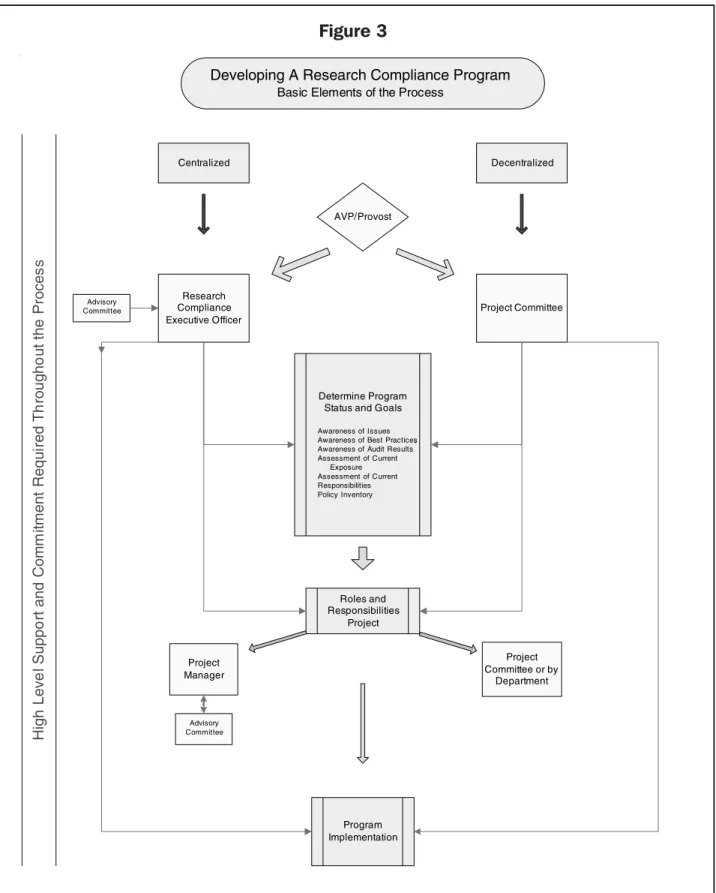
There is no single best way of developing a research compliance program. Pro-grams must be developed consistent with the institution’s culture. If an institution is governed in a centralized manner and decision making is “top down,” then the basic elements of the research compliance program should be designed to take that into account. On the other hand, if an institution is decentralized, creating a research com-pliance program founded on centralized decision making will very likely be unsuccess-ful.
Figure 3 (page 1505:14) illustrates that there are alternative ways of approaching the development of a research compliance program based on whether the institution is centralized or decentralized. The diagram is not comprehensive in that it only illus-trates the major steps. One could, for instance, also add a level of complexity if one were to add the variable of whether the institution is large or small, or whether it is public or private.
9 David B. Crawford, Charles G. Chaffin, and Scott Scarborough, Effective Compliance Systems: A
Practical Guide for Educational Institutions, The Institute of Internal Auditors Research
Figure 3
Centralized Decentralized Research Compliance Executive Officer Project Committee Determine Program Status and GoalsAwareness of Issues Awareness of Best Practices, Awareness of Audit Results Assessment of Current Exposure Assessment of Current Responsibilities Policy Inventory Roles and Responsibilities Project Project Manager Project Committee or by Department High Leve l S uppo rt and Com m itm ent Requi red T h rou gho ut the Pr oces s
Developing A Research Compliance Program Basic Elements of the Process
AVP/Provost Program Implementation Advisory Committee Advisory Committee
As noted previously, support from the upper levels of the university is absolutely essential to the success of a research compliance program. The bar along the left side of Figure 3 indicates how such support is a constant and must continue throughout the entire process, irrespective of other considerations, such as whether the institution is centralized or decentralized.
Research Compliance Executive Officer
As outlined in Figure 3, the first step in the process is to appoint an individual or entity that is responsible for leading the development of the program. This would be a single person — the Research Compliance Executive Officer — in the centralized model or a Project Committee in the decentralized model. Since even in the decentralized model there should be a point person, the person appointing the Project Committee (i.e., the Academic Vice President/Provost) would fill that role.
If the program development is to be done by an individual, that person cannot act in a vacuum. Input should be sought from an Advisory Committee that might be composed of the compliance-related offices and the chairs of the compliance commit-tee. If, on the other hand, the development of the program is to be accomplished by a Project Committee, it would be wise to have that committee composed of people having compliance-related responsibilities. While the composition of the Project Com-mittee is important, it is even more important that those involved in implementing the compliance program be consulted and their views taken seriously. While support for the development of the research compliance program from the highest level of the institution is essential, it is vital that the program have the “buy in” from those respon-sible for putting it into effect.
Program Status and Goals
Figure 1 (on page 1503:3) categorizes the various issues included in research compli-ance. In developing a research compliance program, however, an institution will give varying weight to these issues in terms of how much attention needs to be given to each. There are several criteria that should be used to make informed decisions con-cerning on which issues the institution must focus.
In order to make the appropriate decisions over research compliance program content, an objective and honest assessment of current status and future goals needs to be done in a number of areas:
◆Awareness of issues: What level of awareness of the various issues do the institution
and key players have? This includes awareness of the importance of the issues, the compliance requirements, and the risks of noncompliance.
◆Awareness of best practices: Research should be done on what other institutions have
done in terms of complying with the various issues, which approaches have been successful, and which approach(es) would fit best for an institution.
◆Awareness of external audit results: As noted above, the risks of noncompliance should
be known. Developing a compliance awareness can be furthered by making available the results of audits performed at other institutions. Reviewing these is helpful in determining actual risk. To be complete, however, the review should
include an awareness of which issues hold the most potential risk. One can gain some perspective on potential risk by reviewing such documents as the Work Plan published annually by the Department of Health and Human Services Office of the
Inspector General.10
◆Assessment of institution’s status on each issue: Once awareness of the various issues is
achieved, that knowledge should be applied to an assessment of how well the institution is doing in terms of basic compliance as well as best practices. To be effective, the assessment must be done as objectively as possible. The institution enters the assessment from the perspective that discovered problems are not an indication of failure as much as simply an indication that improvements must be made. Two main goals in this assessment will be to determine who is currently responsible for compliance on each issue and what exposures exist.
◆Conduct a policy inventory: It is very helpful to include as a part of the assessment
process, a comprehensive review of existing policies and procedures. This review could also include a review of the compliance-related forms. The purpose of the inventory is to determine that current policies and procedures are up to date. A review of other institutions’ policies as well as recognized best practices should be a part of this process as a means of ensuring that the institution has appropriate policies and procedures in all areas where needed.
One point needs to be emphasized: Assessments, to be effective, must be done objectively
and without fear of what might be found. While self-assessments performed by offices and
committees having compliance-related responsibilities may be convenient, heavy reliance on self-assessments at the development stage of the research compliance program is not the best way to ensure objectivity. Obviously these offices and commit-tees must be consulted, but the assessments are best done by others having no self-interest in the findings.
Program Involvement
Once the assessments are completed, and the current status and goals of the program are determined, the institution should engage in a “Roles and Responsibilities Project.” As a result of the assessments, the institution has documentation on who is currently involved in the various compliance issues. The institution also has vital information on where exposures exist as well as best practices. By combining this information, the institution can develop a matrix of compliance issues in which the issues are broken down into procedural components, and the responsible units or individuals are identi-fied.
This can be done in a number of different ways and formats. An abbreviated example of one format is provided in Figure 4.
Within each box in Figure 4, there should be an indication of who holds such responsibilities as implementation, review, and approval. The listed procedures should
10 The FY2006 Work Plan can be found at www.oig.hhs.gov/publications/docs/workplan/
be specific and narrowly defined. This will make the completion of the matrix much easier than if the procedures are stated broadly. Listed procedures should not include multiple functions since multiple individuals will be listed as having primary responsi-bility when, in fact, they may have responsiresponsi-bility for only part of what is listed.
As mentioned, the matrix found in Figure 4 is not a comprehensive example. To be complete the matrix should have such entities and individuals as the following:
◆ Sponsored Projects Office ◆ Principal Investigator ◆ Department Administrator ◆ Dean
◆ Department Chair
◆ Compliance Committee (each specified) ◆ Institutional Official (each specified)
◆ Compliance Offices (e.g., Environmental Health and Safety) ◆ Internal Audit
◆ Purchasing
◆ Human Resources11
The suggested matrix is not the only way to document roles and responsibilities. It can also be done in a document organized by unit, where each unit’s research-compli-ance responsibilities are listed and/or described in narrative fashion. Another model would be to outline each issue in narrative form and describe procedures and roles accorded to various offices and individuals.
Finally, once the roles and responsibilities are defined, it is often helpful to create organizational charts for research compliance issues. The purpose of these charts is to illustrate the interaction between and among offices. They are also a good way to make evident the lines of responsibility, authority, and institutional support.
x
i
r
t
a
M
e
c
n
a
il
p
m
o
C
e
l
p
m
a
S
:
4
e
r
u
g
i
F
s e u s s I e c n a il p m o C s l a u d i v i d n I/ s e c i f f O e l b i s n o p s e R I P Dept.Admin. OSP Compilance IRB IACUC Dean Dept.Chair t s e r e t n I f o t c il f n o C A e r u d e c o r P B e r u d e c o r P C e r u d e c o r P11 This list is drawn in part from a NCURA Sponsored Projects Administration II conference presentation.
¶1505.7
Ensuring Long-Term Success: Compliance Awareness Program
How does one even begin designing an effective sponsored projects compliance aware-ness program? Who is the audience? What should the program’s content include? How should the program be delivered: Should it be Web based or instructor led? Should an overall program be developed from the start or should it be done in “baby steps”? All excellent questions but in order to answer any of them, it is important to note that an institution must be flexible; no one approach fits all situations or all organizations.
By now it should be obvious that buy in from the “top” is essential in creating a compliance awareness program, as is the identification of a key individual (an execu-tive director of compliance or compliance officer) to oversee the program. A commit-ment of technical, human, and financial resources is imperative. These requirecommit-ments apply regardless if the program covers all regulatory requirements when designed or if the program is gradually built, addressing one requirement or set of requirements at a time.
Some institutions begin a compliance program based on the topic “du jour,” usu-ally determined by external influences and what is occurring on the national scene. In some cases, the genesis of a program may be the result of an audit. Regardless of the program’s origin, an opportunity exists with any assessment to enhance the environ-ment.
In the example below, a single area of compliance — effort reporting — is used to demonstrate how the compliance assessment process can occur. Though sponsored projects compliance is broader than a single regulatory issue, effort reporting was selected as the topic for the example as it has the attention of the federal government performing audits and institutions, whether or not the institutions are paying fines. In response to the effort-reporting concern, institutions should take stock and assess their current performance, which in turn can help determine if internal changes are neces-sary and the cost of those changes. Below is an abbreviated outline of some of the necessary steps an institution can take as part of such assessment.
Create a Work Plan
◆ It is important to develop a timetable or work plan identifying the steps in the
process and the anticipated roll-out date of a program. Assessment
◆ Determine if weaknesses exist with current effort-reporting process:
• Perform an assessment of the effectiveness of the existing process to better understand the contents of the effort-reporting program. Craft an inventory of federal and institution requirements against which the assessment would be measured. In general, the assessment includes
❚ the review of the policies/procedures of the institution and a
determination that the requirements of federal regulations are covered.
• Review recent A-133 audits, internal audits, or other external audits performed that included a sampling of effort reports. In addition, a sample audit may be performed to review the following issues:
❚ Is the community fulfilling the requirements of the existing
policies?
❚ Are the appropriate individuals signing the effort report?
❚ Did a “suitable” means of verification that the work was
performed exist for those forms requiring such documentation?
❚ Are forms dated?
❚ Are there arithmetic errors?
• Do percentages add up to 100 percent?
• Are sponsor-imposed salary caps calculated correctly?
❚ Are the forms completed in a timely fashion?
❚ Are cost sharing commitments accounted for?
❚ Is the minimum commitment to the sponsor fulfilled? If effort
is less than what was committed and if required, is there appropriate documentation supporting the change in commitment?
❚ Are research faculty charged 100 percent on sponsored
projects engaged in nonsponsored projects activities, e.g., writing new applications, serving on university committees?
❚ Are payroll controls in place to protect the integrity of the
payroll process?
❚ Do cost transfers of salary agree with certified effort reports
or vice versa?
❚ Does the Disclosure Statement (DS-2) require updating?
Analysis
◆ Analyze the results of the assessment, determining strengths, weaknesses, and the
need for change in policies, procedures, and manuals.
◆ Prepare a report identifying findings and recommendations for educational program
content, audience, process for identifying individuals post rollout, and method(s) of delivery.
◆ A cost analysis of program implementation may be an additional activity to
Seek Approval to Move Forward
◆ Approval must be sought from the individual(s) authorized to sanction new
programs and projects. Depending on the process of approval (including financial support) within the institution, an allowance for time must be built into the work plan.
Develop Educational Materials
◆ Begin revising policies, procedures, and sponsored projects handbook to address
perceived problems and findings.
• Make these materials easily accessible.
◆ Develop program content.
Communicate
◆ The “top” communicates the commitment and also announces the program, its
purpose, who is required to participate, anticipated completion date, and how individuals new to the organization will be identified. The communication should also identify the key individual taking the lead in rolling out the program.
• Communications may be done in multiple steps and in various venues with different audiences during this process. It is critical that the information is consistent, clear, and updated as needed without being overly burdensome.
Rollout
◆ During this entire process some institutions may employ the use of an advisory
committee to review content and discuss what delivery methodology would work best depending on the audience. If piloting an educational program such as effort-reporting principles, the content may vary depending on the audience, which may require different presentations.
¶1505.8
Ensuring Long-Term Success: Compliance Assessment Process
Research institutions should evaluate and enhance the integrity of their research environments using a process of self-assessment and external peer review in an ongoing process that provides input for their
continu-ous quality improvement.12
Once the research compliance program is established, it is critical that ongoing assessments be instituted. There are four key aspects to a research compliance assess-ment program:
◆ First, assessments are performed to determine which compliance activities are being
conducted and managed well, and which may need improvement.
◆ Second, assessments are useful tools in educating those responsible for aspects of research compliance regarding best practices.
◆ Third, the assessment program should evolve into an initiative that is ongoing and
self-sustaining.
◆ Fourth, an effective assessment program can help to significantly reduce negative
audit findings.
Key Aspects of the Assessment Process
The research compliance assessment process is similar to a compliance audit in that it reviews actual practices in compliance with laws, regulations, and policies. The process also reviews compliance with the institution’s policies and procedures.
The research compliance assessment process, however, is not a “snap-shot” process. Rather, a key characteristic of an effective assessment program is that it is ongoing and designed to be woven into the fabric of research compliance activities.
The assessment process should also be designed to create a working relationship between the research compliance office and the offices and committees having compli-ance-related responsibilities. One aspect of assessment that facilitates this relationship is that assessment findings are treated differently from audit findings. The results of formal internal audits are reported up the organizational line through the administra-tion and to the governing board. Generally, assessment findings are reported to the office or the committee whose activities are being assessed. Problems and remedies are discussed, and monitoring and follow-up procedures are agreed upon. Occasionally, assessment results will be referred to the institutional official having responsibilities for a given compliance activity. This would occur when significant noncompliance is discovered that should be or may have to be reported to an external entity (e.g., re-search sponsor). It might also occur if recommendations resulting from an assessment would require a commitment of additional institutional resources. Finally, the institu-tional official would be consulted if the office or committee being assessed is nonre-sponsive to recommendations and/or refuses to cooperate in the assessment process.
Another key element of the assessment process is to provide an educational and informational resource to compliance offices and committees. While this can be ad-dressed on an issue-by-issue basis, the research compliance office may become a central clearinghouse for research compliance materials. The research compliance Web site can be a valuable tool in establishing this clearinghouse of compliance materials with hyperlinks to online resources.
The assessment process should be designed to be a self-sustaining program. Creat-ing a self-sustainCreat-ing program could be done by educatCreat-ing offices and committees having research compliance responsibilities to perform self-assessments and to create a structure in which compliance awareness is built into everyday life.
A distinction was made earlier between audits and assessments. In one respect, however, the assessment process can be viewed as a “pre-audit” function. If successful, the assessment process will help offices and committees build their compliance aware-ness and create internal procedures and practices that enhance research compliance.
The natural result of this will not only be better-managed programs, but the exposure to negative audit findings will be lessened.
Self-Sustaining Assessment Program
Figure 5 illustrates the basic elements of how a research compliance program can be designed to be self-sustaining.
As shown in Figure 5, the Research Compliance Office has a dual assessment role: ◆ First, it conducts independent assessments of compliance-related programs. Though
the assessment is conducted collegially, it is absolutely essential that the Research Compliance Office preserve its ability to perform assessments objectively.
◆ Second, it assists offices and committees having compliance-related responsibilities to develop and perform self-assessments. At first, the Research Compliance Office will have an educational function in that it informs the offices and committees of best practices and procedures for creating and conducting effective self-assessments. The Research Compliance Office role then evolves into one of monitoring to ensure that self-assessments are conducted by offices and committees appropriately and in ways that will achieve meaningful results.
Once the self-assessment program is established, the need for independent assess-ments will be reduced. It cannot, however, be completely eliminated, and the Research Compliance Office should schedule periodic reviews of compliance-related programs. The frequency will depend on several factors, among which are the effectiveness of self-assessments and the history of compliance/noncompliance of given programs.
Figure 5
Provides Assistance to Offices and Committees
to Develop and Perform Self-Assessments
Reviews and Offers Comment on
Self-Assessments Independent Assessments
of Offices and Committees Having Compliance-Related
Responsibilities
Research Compliance Office Assessment Function
¶1505.9
Conclusion
The rollout of a comprehensive research compliance program is a great accomplish-ment. It is, however, the beginning of a continuing process. Once in place, required updating of information and content as well as periodic assessments of research com-pliance functions are necessary as is the identification of individuals new to the institu-tion or new to roles having a responsibility in this area. This is the compliance con-tinuum.
Figure 6 illustrates that sponsored projects compliance is a continuum. Neither the support from the top nor the subsequent activities should ever “end.” If embraced by the institution, the adoption of this circle of events will not only assist in mitigating risk but will become part of the culture of the institution.