ENCRYPTED DATA HIDING IN ENCRYPTED IMAGES
Dr. S. Kishore Reddy*
D Ravi Chandra**
R. Laxmi Kanth***
ABSTRACT
Data hiding is the process of secretly embedding information into data sources such as
image, video, or audio signals without changing the perceptual quality of the data. The
encryption is a general method for providing privacy protection such as confidentiality, data
integrity, entity authentication and data origin authentication. Data hiding scheme for
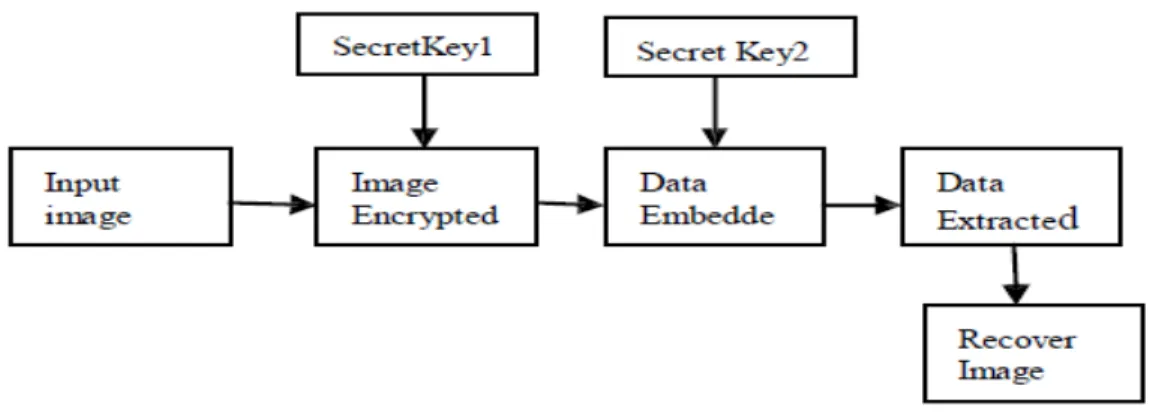
encrypted image is made of image encryption, data embedding and data extraction. The original
image and the data to be embedded are encrypted and the data is embedded into the encrypted
image. In the decryption side, the encrypted data is first extracted and decrypted using the
encryption key. Secondly, the encrypted image is decrypted for further analysis. The main
objective of this paper is to study the various encryption schemes to encrypt both image and data
and to propose a new encryption algorithm for both image and data hiding.
Keywords: Cryptography, Data hiding, Cat map transform.
*Associate Professor, ECE, SBCE, Khammam, AP, India
** Assistant Professor, ECE, DARE, Khammam, AP, India
I. INTRODUCTION
Cryptography is the science of writing a secret code (or) the study of mathematical techniques related to aspects of information security such as confidentiality, data integrity, entity
authentication and data origin authentication. The basic cryptographic schemes used are Symmetric (or) Secret key cryptography and Asymmetric (or) Public key cryptography. It employs complex computational algorithms for encryption and decryption. In order to reduce the complexity, Cryptography schemes can be used. The main need of cryptography is to hide the data with the secret key without knowing to the user.
The security of message transmission is very important in the modem computerized and interconnected world. Security problems, such as modification, forgery, duplication, and others, on the Internet have been focused on inevitably [1].Cryptography is concerned with construction of schemes that ensure the security services of confidentiality, authenticity and integrity of messages. Numerous encryption techniques are applied to different data streams, where different algorithms are performed to encrypt and decrypt confidential messages [3], [4], [5], [6], [7], [8],[9], [10]. Hiding significant data is the goal of encryption methods.The hidden message can be extracted to prove the ownership or to verify the message integrity or to secretly transmit the data in [10].
In recent years, some image encryption methods have been proposed [2],[5],[6],[7].Naveenkumar et al [1],proposed a distortion tolerant method. Tan Fei and Lia shaojun [4], proposed a method which is mainly based on RSA and the HSV characteristics of 24 bits BMP image.Sos Agaian and Yicong zhou [6], proposed an encryption method using image Steganography concept and PLIP model. These image encryption schemes have the advantage of the lossless recovery of the original message. However, due to the disturbances in
the transmission media, it makes harder to execute the decryption algorithm for the encrypted data with noise. In this paper, we propose a new encryption method to recover the original image without distortion.
simulated in matlab and their PSNR values are calculated.
The paper is organized as follows. In section II, Reversible data hiding method and Cat map transform are introduced i.e. how the original image is encrypted and decrypted. It also explains the security provided by the Steganography technique - watermarking and its properties. In section III the implementation of Steganography in encrypted images using cryptography
scheme is explained. Section IV, gives the simulation results and section V draws the conclusion.
II. PROPOSED SCHEME
A. Image Encryption
Due to the fast progression of data exchange in electronic way, information security is becoming more important in data storage and transmission. Because of widely using images in industrial process, it is important to protect the confidential image data from unauthorized access. Security is an important issue in communication and storage of images, and encryption is one of the ways to ensure security. Image encryption has applications in internet communication, multimedia systems, medical imaging, telemedicine, military communication, etc.
Images are different from text. Although we may use the traditional cryptosystems to encrypt images directly, it is not a good idea for two reasons. One is that the image size is almost always much greater than that of text. Therefore, the traditional cryptosystems need much time to directly encrypt the image data. The other problem is that the decrypted text must be equal to the original text. In order to transmit secret images to other people, a variety of image encryption schemes have been proposed.
B. Reversible Data Hiding Method
Several proposals have dealt with data hiding in image encryption implementations. The reversible data hiding scheme is used for encrypting the images. It is mainly used to embed
version. The detailed procedures are as follows:
Fig. 1. Sketch of proposed scheme
STEP 1: Consider a image, which is considered as a cover image. STEP 2: Convert the cover image to binary
STEP 3: Random bits are generated which act as the encryption key
STEP 4: XOR operation is performed between the random bits generated and cover image STEP 5: Convert the above binary image to grayscale image. Thus, encrypted image is obtained. C . LSB Method
This method is used to hide the data in encrypted images. In 8-bit gray scale images are selected as the cover media. These images are called cover-images. Cover-images with the secret messages embedded in them are called stego- images. For data hiding methods, the image quality refers to the quality of the stego-images.
One of the common techniques is based on manipulating the least-significant-bit (LSB) planes
by directly replacing the LSBs of the cover-image with the message bits. LSB methods typically achieve high capacity. This allows a person to hide information in the cover image and make
sure that no human could detect the change in the cover image. The LSB method usually does not increase the file size, but depending on the size of the information that is to be hidden inside the file, the file can become noticeably distorted. The detailed procedures as follows:
STEP 1: Consider an encrypted image (cover image).
STEP 2: Consider the message or data that should be hidden into the cover image.
cover image.
STEP 5: The original image along with the data is recovered with less distortion and the PSNR value is calculated.
D. Cat Map Transform
This is the transform which stretches an image that is composed of n by n pixels and effectively
wraps the stretched portions around to restore the original image. The proposed scheme is by using cat map transform and exclusive OR operation to produce scrambled images. The cat map transform is defined as
where (x, y) is the image pixel location of an N *N image.a,b are positive integers.(x ', y ') is the new pixel location, y, (x ', y ') 1, 2,...N .The cat map transform above can efficiently scramble the2D images. The user can choose the number of iterations for applying the cat map transform to the image in order to achieve a higher level of security. The parameters a, b and iteration times N can act as security keys for the image scrambling process. The same procedure is used for data hiding using LSB method.
III. RSA ENCRYPTION/DECRYPTION
RSA algorithm is currently accepted as the most mature and complete public key cryptosystem in both the theory and application. The first one can be used for both data encryption and digital signature, also, is the representative of public key cryptosystem. This paper applies the RSA algorithm in the pre-processing phase of information hiding to ensure the security of information.RSA algorithm is based on the theory of a special kind of reversible
arithmetic for modular and exponent. The steps for RSA algorithm is as follows: (1) Find two large primes p, q.
(2) n = p * q, z = (p - 1) * (q-1).
(3) Select a number e which is less than n and prime to z, so that e and z have no common factors.
(6) For a message m, if the cipher text is c, decryption and encryption process as follows: Encryption:
c = m ^ e mod n. Decryption: m = c ^ d mod n.
Thus, the image encryption is obtained.
Algorithm to hide the data in encrypted image using LSB
method:
STEP 1: Consider an encrypted image (cover image).
STEP 2: Consider the message or data that should be hidden into the cover image.
STEP 3: Convert all the pixel values of the encrypted image from grayscale to binary (8-bit). STEP 4: Embed the message or data into the cover image by hiding the data into the LSB bit of cover image.
STEP 5: The original image along with the data is recovered with less distortion and the PSNR value is calculated
IV. SIMULATION RESULTS
In this paper, we select the classical image of 256*256 cameraman.tif with 256 gray level as the original image and adopt the reversible data hiding method, Cat map transform and RSA algorithm for image encryption. We use MATLAB 2010 to simulate the experiment.
A. Reversible Data Hiding Method:
The test image Cameraman sized 256 *256 shown in Fig. 2(a) was used as the original cover in the experiment. After image encryption, the 8 encrypted bits of each pixel are converted into a gray value to generate an encrypted image shown in Fig. 2(b). Then, we embedded data into the encrypted image by using LSB method. The encrypted image with message is given as Fig.
Fig.2.(a)Original image,(b)its encrypted version,(c)Encrypted image with message and (d)
decrypted version
B. Cat map Transform
Fig.3.(a)Original image,(b)Scrambled images (33&21 times),(c) Encrypted images with
message (d) decrypted version..
D. RSA Encryption/Decryption
The test image Cameraman sized 256 *256 shown in Fig. 4(a) was used as the original cover in the experiment. Then, we embedded data into the encrypted image by using LSB method. The encrypted image with message is given Fig.4(c), is the encrypted file by public key. Fig. 4(d) shows the extracted information that was decrypted by the private key. The test
Fig.4.(a)Original image,(b)Scrambled image (c) Encrypted images with message (d)
decrypted version
IV. CONCLUSION AND DISCUSSION
In this paper, we demonstrate that the image encryption algorithm is efficient and highly secure. All parts of the proposed encryption system were simulated using MATLAB.The scheme can resist most known attacks, such as statistical analysis and brute-force attacks . All the
experimental analysis shows that the proposed encryption algorithm: (i) has high level of security with less computation. (ii) is highly robust towards cryptanalysis
REFERENCES
[1]V.Naveenkumar, Santosh Hariharan, Kumar Rajamani ‘Data hiding scheme for medical images using lossless code for mobile HIMS’, IEEE International conference on Communication system and networks, pp.1-4,2011.
[2] Min Wu, and B. Liu, ‘Data hiding in digital binary image,’IEEE transactions on multimedia, vol 6, no.4, 2004.
[3] Santosh Hariharan, V.Naveenkumar, Mrigank Rochan,‘An improved anti-counterfeiting technique for credit card transaction system’ IEEE International conference on communication system and networks,pp. 1-4,2011
[4] Tan Fei, Liao Shaojun,‘Research and implementation of information hiding based on RSA and HVS’, IEEE International conference on e-business and e-commerce,pp.1-4,2011.
on Wireless Communications, Networking and Mobile Computing,(pp1-4),2008.
[6] Sos Agaian, Yicong Zhou, ‘Image Encryption using the image steganography concept and PLIP model ’IEEE International conference on System Science and Engineering,pp 699-703.2011.