Vol. 2, No. 3, 2009, (401-425)
ISSN 1307-5543 – www.ejpam.com
Flocking of Multi-agents in Constrained Environments
Bibhya Sharma
∗, Jito Vanualailai and Utesh Chand
School of Computing, Information & Mathematical Sciences, University of the South
Pa-cific, Suva, FIJI
Abstract. Flocking, arguably one of the most fascinating concepts in nature, has in recent times established a growing stature within the field of robotics. In this paper, we control the
collective motion of a flock of nonholonomic car-like vehicles in a constrained environment. A
continuous centralized motion planner is proposed for split/rejoin maneuvers of the flock via
the Lyapunov-based control scheme to anchor avoidance of obstacles intersecting the paths
of flockmates. The control scheme inherently utilizes the artificial potential fields, within a
new leader-follower framework, to accomplish the desired formations and reformations of
the flock. The effectiveness of the proposed control laws are demonstrated through computer
simulations.
2000 Mathematics Subject Classifications: 34A30, 34D20, 70E60, 93C85, 93D15.
Key Words and Phrases: Multi-agents, Lyapunov-based control scheme, split/rejoin, cooper-ating, flocking.
∗Corresponding author.
Email address:sharma_busp.a.fj(B. Sharma)
1. Introduction
Flocking is a coordinate and cooperative behavior easily conspicuous in a large
number of beings, ranging from simple bacteria to mammals [8]. Prominent
exam-ples from nature include: schools of fishes, flocks of birds, and herds of animals, to
name a few. This salient behavior is predominantly based on the principle that there
is safety and strength in numbers [4, 5]. For example, a flock of birds invariably
demonstrates a larger entity and dissuades potential attackers. On the other hand,
if a flock is attacked the flockmates can scatter to confuse the predators, thus avoid
being captured, then regroup at a safer distance. Flocking behavior also contributes
to cooperative foraging, better opportunities for mating and safer long distance
mi-grations[6]. Flocks travelling in large dense groups are capable of smooth collision
and obstacle avoidance maneuvers even in the presence of external obstacles which
may be fixed or even moving.
In literature, the flocking models are built within a framework of three basic rules
of steering namely, separation, alignment, and cohesion, which describe how an
indi-vidual maneuvers based on the positions and velocities of its nearby flockmates[12].
Although the rules governing each member of a flock are seemingly basic, the
collec-tive motion is strikingly spectacular. The superposition of these rules results in the
flockmates moving in a particular formation, with a common heading whilst ensuring
all possible collision and obstacle avoidances[16].
Biologically inspired algorithms that mimic the flocking behavior are essential in
accomplishing the control objective of a group while also ensuring a collision-free
flightpath. Common objectives nowadays include formation flight control, satellite
clustering, exploration, surveillance, foraging and cooperative manipulation[1, 3, 8].
The applications of foraging could involve search-and-rescue teams at disaster sites.
accidents in minimal time, hence, saving further loss. All in all, team(s) of
homoge-nous (even heterogehomoge-nous) robots working towards a common objective can satisfy
stringent time, manpower and monetary demands, enhance performances and
ro-bustness, and harness desired multi-behaviors, each of which is extremely difficult if
not entirely impossible to obtain from single agents[5, 7, 9, 11].
A wide spectrum of approaches have appeared in literature in relation to
"forma-tion stiffness", a rule necessitating strict observance of the prescribed forma"forma-tion
dur-ing the motion of the flock[13, 15]. On one end we have thesplit/rejoinmaneuvers.
The applicability of the split/rejoin maneuvers can be immediately obvious in the field
of robotics, for example, reconnaissance, sampling, and surveillance. Populating the
other end of the spectrum are the tight-formationswhich can be required in
applica-tions that require cooperative payload transportation[3,9,13,15]. The main strength
of this paper lies on the emphasis placed upon the split/rejoin maneuvers, where a
group of robots in a specific formation splits and moves around the encountering
ob-stacle(s) and then returns to take its original position in the prescribed formation. A
new strategy is introduced in this paper to induce the split/rejoin maneuvers.
In recent times robotic applications with split/rejoin maneuvers have become
in-creasingly popular[3, 17, 18]. We will mention a few important ones here. Chang et
al. [3] used gyroscopic forces and scalar potential techniques to create swarming
behaviors for multiple agent systems. The governing decentralized control law
guar-anteed a group of robots accomplish specified control objectives while avoiding
inter-robot collisions and with unforeseen obstacles. [17, 18] provided design and
anal-ysis of distributed algorithms for large number of dynamic agents that enabled the
group to perform coordinated tasks. Free-flocking and flocking with obstacle
avoid-ance were considered with split/rejoin and squeezing maneuvers. Recently Sharma
et al. [14, 15] and Vanualailai et al. [19] developed algorithms that considered
workspace. Continuous acceleration-based control laws derived from the
Lyapunov-based control scheme were utilized in their studies. In brief, the Lyapunov-Lyapunov-based
control scheme is a new artificial potential field method which basically involves
at-taching attractive fields to the target and repulsive fields to each of the obstacles[10].
The total potential of the workspace is the sum of the attractive and repulsive fields
generated within the framework of the control scheme. The reader is referred to[13]
for a detailed account of the control scheme. Inspired, we adopt the control scheme to
control the flocking motion of a group of nonholonomic car-like vehicles. This paper
will demonstrate how the group can avoid collision with fixed obstacles by scattering,
and then regrouping after executing a successful avoidance maneuver. This
avoid-ance maneuver will be the split/rejoin maneuver, the coin of realm of the research.
In parallel, the control scheme utilizes Lyapunov’s Direct Method to analyze stability
of the vehicular system.
This paper is organized as follows: in Section 2 the robot model is defined; in
Sec-tion 3 moSec-tion planning is carried out, defining the targets, obstacles, and appropriate
attractive and avoidance functions; in Section 4 the Lyapunov-based control scheme
is executed to yield the controllers and to analyze the stability of the robot system; in
Section 5 we illustrate the effectiveness of the proposed controllers via simulations
in-volving the required split/rejoin maneuvers; and in Section 6 we conclude the paper
2. Boid Model
θi
xi,yi
υi φi
l1
ε1
l2
ε2
rv
x y
Figure1: Kinematimodelof ithboid.
Following the nomenclature of
Reynolds [12], we denote each
member of the flock as a boid. In
addition, each boid is assumed to
be a front-wheel steered car-like
vehicle, whereby engine power is
applied to the rear wheels.
With reference to Fig. 1, (xi,yi)
denotes the CoM of the ith boid,
θi gives its angle with respect to
the x-axis of the main frame, φi
gives the steering wheel’s angle with
respect to the ith boid’s longitudinal
axis. For simplicity, the dimensions
of the n boids are kept the same.
Therefore,l1is the distance between
the center of the rear and front
axles, while l2 is the length of each
axle.
The configuration of the ith boid is given by(xi,yi,θi,φi)∈R4, and its position
is given as the point(xi,yi)∈R2. The kinodynamic model of the ith boid, adopted
˙
xi=υicosθi−
l1
2ωisinθi , ˙
yi =υisinθi+ l1
2ωicosθi , ˙
θi=ωi , υ˙i =σi ,
˙
ωi=ηi , for i=1, . . . ,n,
(2.1)
whereυi andωi are, respectively, the instantaneous translational and rotational
velocities, whileσi andηi are the instantaneous translational and rotational
acceler-ations of theith boid. Without any loss of generality, we assumeφi =θi. The state of
ith boid is captured by the vector notation xi := (xi,yi,θi,υi,ωi)∈R5,i=1, 2, ...,n.
Fornboids, we define the vector x = (x1, ...,xn)∈R5×n. Given theclearance
param-eters ε1 and ε2, we can enclose each boid by a protective circular region (smallest
possible) centered at(xi,yi), with radiusrv=p(l1+2ε1)2+ (l
2+2ε2)2/2. The rep-resentation not only maximizes the free space available to the robots in the workspace
but it also ensures an easier construction of the potential field functions ([13],[14]).
3. Devising the problem
In this section we formulate the split/rejoin maneuver for a flock of n
nonholo-nomic boids, guided by a leader-follower strategy. In a split/rejoin maneuver a flock
maintained in a prescribed formation splits and moves around encountering
obsta-cle(s) and then returns to take its original position in the original formation.
The Lyapunov-based control scheme requires the design of target attractive
func-tionsand obstacle avoidance functions. On one hand, a attractive potential field
func-tion will be constructed from each target attractive funcfunc-tion. This will enable a boid
to move towards its designated targets whilst maintaining the overall formation. On
the other hand, a repulsive potential field function would be designed from each
ob-stacle avoidance function constructed. This will ensure a collision-free avoidance in
ap-propriately to form a Lyapunov function (total potentials) from which the controllers
would be generated.
3.1. Attractive Potential Field Functions
To formulate functions that instigate attraction of the boids towards their
desig-nated targets we, first and foremost, need to introduce a new leader-follower strategy.
This new strategy helps in establishing and maintaining prescribed formations.
bi
ai
(xi,yi)
(x1,y1) (x1−ai,y1−bi)
Leader
ith Boid
theith Boid Ghost Target of
Figure 2: Positioning of a mobile ghost target relativeto theposition oftheleader-boid.
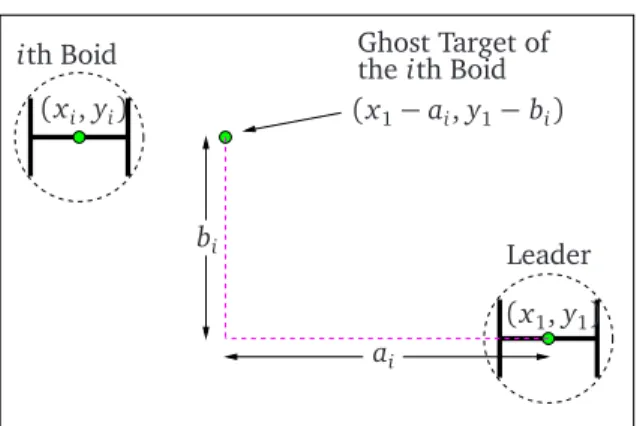
The new leader-follower strategy
summons the boids of the flock to
follow one particular boid which is
adopted as the leader-boid. This
strategy is advocated for the very first
time via mobile ghost targets. These
ghost targets are positioned relative
to the position of the leader-boid
with a user defined Euclidean
mea-sure (Figure 2).
We note here that each follower-robot
will have a different mobile ghost
tar-get designated to it.
While the mobile ghost targets move relative to the position of the leader-boid, the
follower-boids move towards the ghost targets designated to them, at every iteration
3.1.1. Attraction to Target/Ghost Target For theith boid, we designate a target
Ti ={(x,y)∈R2:(x−ti1)2+ (y−ti2)2 ≤r t2
i}
with center(ti1,ti2)and radiusr ti. The leader-boid (i=1) will move towards its target
with center(t11,t12). Now, with respect to the follower-boids, the mobile ghost targets
allocated to each will be positioned relative to the position of the leader (ai horizontal
units and bi vertical units, see Fig. 2) and whose center is given by(ti1,ti2) = (x1−
ai,y1−bi), fori =2 ton.
For attraction to the target/ghost target, we shall use an attractive function of the
form
HNi(x) = 1
2ln(Hi+1), where
Hi(x) = (xi−ti1)2+ (yi−ti2)2+υ2
i +ω
2
i , for i=1, . . . ,n. (3.1)
While the function is the measure of the distance between the ith boid and its
target Ti, it can also be treated as a measure of its convergence. In this case, the
particular form of HNi(x) is sufficient to be treated as a suitable attractive potential
function required to generate attractive fields around the targets. Figure 3(a) shows
the valleys created by the attractive forces in a continuous potential field. These
mo-bile valleys, associated to the momo-bile ghost targets of the follower-boids 1 and 2, are
positioned according to user-defined measurements in the leader-follower scheme.
Similarly, there would be a valley each for the remaining flockmates and the ultimate
goal is for each follower-boid to move to its designated valley. Figure 3(b) shows the
10 20 30 40 50 60 15
20 25
30 35 0
2 4 6 8 10 12 14 16
y position
Total Potential
Target of follower−boid 2
Target of follower−boid 1
FO1 FO2
x position
(a) 3D visualization
x position
y position
10 20 30 40 50 60
15 20 25 30 35
(b) Contour Plot
Figure 3: Total potential and the ontour plot generated using the attrative potential funtion for target attration and the repulsive potential funtion for avoidane of disk-shaped obstales.
3.1.2. Auxiliary Function
To ensure that the Lyapunov function candidate vanishes when all the boids converge
to their final target configuration we design a new attractive function whose role is
purely mathematical, and hence, auxiliary. We define this auxiliary function as
Gi(x) = 1 2
(xi−ti1)2+ (yi−ti2)2+ (θi−ti3)2
≥0 , for i=1, . . . ,n, (3.2)
whereti3is the desired orientation of theith boid. We will multiply the function to
each of the repulsive potential field function to be designed in the following section.
3.2. Repulsive Potential Field Functions
We desire the boids to avoid all fixed and moving obstacles intersecting their paths.
Therefore, we construct obstacle avoidance functions that basically measure the
avoidance, each of these functions will appear in the denominator of the repulsive
potential field function to generate the repulsive fields around the obstacles. The
numerators will be populated by tuning parameters which may be refined for safer,
shorter and smoother trajectories. The reader is referred to [13, 14, 19] for further
explanations. Now, we describe each obstacle appearing in the constrained workspace
and design the associated avoidance function.
3.2.1. Stationary Obstacles
LetOq,q∈ {1, . . . ,m}, represent a solid object fixed within the workspace. We provide
the following definition of the stationary obstacles
Definition 3.1. The kth stationary obstacle is a disk with center(ok1,ok2) and radius rok. Precisely, the kth stationary obstacle fixed in the workspace is the set
Ok={(z1,z2)∈R2:(z1−ok1)2+ (z2−ok2)2 ≤rok}.
For theith boid to avoid thekth stationary obstacle, we adopt the avoidance function
Wik(x) = 1 2
(xi−ok1)2+ (yi−ok2)2− rok+rv2
, fori=1, . . . ,n ; k=1, . . . ,m.
(3.3)
This positive function is the Euclidean measure of the distance between the ith boid
and thekth stationary obstacle. Now let us consider, for some constantαik>0
(clas-sified as a tuning parameter), fori=1 (leader-boid) andk=1 (a stationary obstacle
fixed in the workspace), the effect of the ratio α11
W11. According to the Lyapunov-based control scheme, this ratio is classified as a repulsive potential field function. If the
leader-boid approaches the stationary obstacle, then the value of the ratio will
in-crease. If it moves away from the stationary obstacle, the ratio will dein-crease.
Now, to provide the importance of the Lyapunov-based control scheme, we
artificial potential field function for system (2.1). Because, with respect to time t≥0,
one getsd L/d t ≤0 along a trajectory of (2.1), and Lis a positive definite function,L
cannot increase in t. Therefore any change in the value of the ratio could only
corre-spond to either an increase or decrease in|d L/d t|. Analogously,|d L/d t|is the rate of
dissipation of energy from the system in absolute value. If the stationary solid object
is being approached, thenW11gets smaller, and the ratio gets larger. Thus, the rate of
energy dissipation, in absolute value, gets larger. This, in turn, results in an increased
activity of the system. This increased activity could only be directed towards a stable
equilibrium point, away from the stationary solid object. In other words, a situation
whereW11=0 can never eventuate. Hence, if the ratio is a part of a Lyapunov
func-tion for system (2.1), then intuitively the ratio will act as a repulsive potential field
function, this is the very essence of the Lyapunov-based control scheme. An example
of the effect of the repulsive potential function designed from Equation (3.3) can be
seen in Figure 3(a). The cylindrical potential spikes are immediately evident.
Henceforth, all the obstacle avoidance functions will be appropriately coupled
with tuning parameters to design the repulsive potential field functions to generate
the collision and obstacle avoidance maneuvers.
3.2.2. Moving Obstacles
From a practical viewpoint, the control algorithms must generate feasible trajectories
based upon real-time perceptual information. In this paper, we will only consider
moving obstacles of which the system has complete and a priori knowledge. Here,
each boid itself becomes a moving obstacle for all the other boids. Therefore, for the
ith boid to avoid the jth moving boid, we consider
Vi j(x) = 1 2
(xi−xj)2+ (yi− yj)2− 2×rv2
This avoidance function is the measure of the Euclidean distance between theith
and the jth boid.
3.2.3. Dynamics Constraints
Again, in practice, the translational speed and the steering angle of the robots are
limited. However, in order to treat the dynamic constraints within the
Lyapunov-based control scheme we will have design anartificial obstaclecorresponding to each
dynamic constraint. Following on, we will design an appropriate obstacle avoidance
function for its avoidance.
If vma x > 0 is the maximum speed, and φma x is the maximum steering angle
satis-fying 0< φma x < π
2 then, as shown in [14], the constraints imposed on the transla-tional and the rotatransla-tional velocities are |υi|< υma x and υ2
i ≥ρ
2
minω
2
i . Whereρmin
known as theminimum turning radiusis given as ρmin =
l1
tanφma x. From above we get
|ωi| ≤ |υi|
|ρmin| <
υma x
|ρmin| .
Based on these constraints, the following artificial obstacles can be constructed:
AOi1={υi ∈R:υi≤ −υmax orυi≥υmax},
AOi2={ωi ∈R:ωi ≤ −υmax/|ρmin|orωi ≥υmax/|ρmin|},
For avoidance, the following obstacle avoidance functions will be included:
Ui1(x) = 1
2(υma x−υi)(υma x +υi), (3.5)
Ui2(x) = 1 2
υ ma x
|ρmin|−ωi
υma x
|ρmin|+ωi
, for i=1, . . . ,n. (3.6)
The repulsive potential functions generated from these obstacle avoidance functions
would guarantee the adherence to the limitations placed upon translational velocity
4. Lyapunov-based Control Scheme
Utilizing the Lyapunov-based control scheme we now design the nonlinear
con-trol laws and provide a mathematical proof that system (2.1) is indeed stable. The
control laws have been extracted from a Lyapunov function which appropriately sums
the attractive and repulsive potential field functions designed in the aforementioned
sections.
We begin with the following theorem:
Theorem 4.1. Consider a flock of nonholonomic boids, the motion of which is gov-erned by ODEs described by system (2.1). The objective is to, amongst considering other
integrated subtasks, establish and control a prescribed formation, facilitate split/rejoin
maneuvers of the boids within a constrained environment and reach the target
config-uration with the original formation. The subtasks include; restrictions placed on the
workspace, convergence to predefined targets, and consideration of kinematic and
dy-namic constraints. Utilizing the attractive and repulsive potential field functions the
following continuous time-invariant control laws can be generated for the ith boid that
per sestabilizes system (2.1) as well:
σi = −
δi1υi+ f1icosθi+ f2isinθi
/f4i , (4.1)
ηi = −
δi2ωi+
ll
2 −f1isinθi+f2icosθi
+ f3i
/f5i, (4.2)
for i = 1 to n where δi1,δi2 > 0 are constants commonly known as convergence
parameters.
Proof:
Introducing positive constants, denoted astuning parameters,αik>0,βi j >0 and
γis>0, fori,j,k,s∈N, we propose a Lyapunov function candidate for system (2.1):
L(x) = n X
i=1
HN
i(x) +Gi(x)
m X
k=1
αik
Wik(x)
+
2
X
s=1
γis
Uis(x)
+ n X
j=1,i6=j
βi j
Vi j(x)
Assumption 4.1. x∗ = (ti1,ti2,ti3, 0, 0, . . . ,tn1,tn2,tn3, 0, 0)∈R5n ∈D(L)is an
equi-librium point of system (2.1).
Remark 4.1. This is a reasonable assumption since ˙L(x∗) = 0 making x∗ a feasible
equilibrium point, at least, in a small neighborhood of the target configuration.
Then one can easily verify the following:
1. Lis continuous and positive on the domain Dgiven as
D(L) = {x ∈R5×n: Wik(x)>0 fori=1 ton, k=1 to m, Uis(x)>0 for
i=1 to n, s=1 to 2 and Vi j(x)>0 fori,j=1 to n, i6= j }.
2. L(x∗) =0, x∗∈D.
3. L(x)>0 ∀x ∈D,x 6=x∗ .
Now let us consider the time derivative of our Lyapunov function candidate L(x).
Along a particular trajectory of system (2.1), we have, upon collecting terms with vi
andωi separately
˙L(2.1)(x) = n X
j=1
f1icosθi+ f2isinθi+ f4iσi
υi
−
l
1
2f1isinθi− l1
2f2icosθi−f3i− f5iηi
ωi
,
where functions f1i to f5i are defined as (on suppressingx):
f11 = 1
H1+1+
m X
k=1
α1k
W1k + 2
X
s=1
γ1s
U1s +
n X
j=2
β1j V1j
!
(x1−t11)
−
n X
i=2
1 Hi+1+
m X
k=1
αik
Wik + 2
X
s=1
γis
Uis +
n X
j=1,i6=j
βi j
Vi j
(xi−ti1)
−G1
n X
j=2
β1j
V12j(x1−xj) +
n X
j=2
Gjβj1
Vj21(xj−x1)−G1
m X
k=1
α1k
f1i =
1 Hi+1+
m X
k=1
αik
Wik + 2
X
s=1
γis
Uis +
n X
j=1,i6=j
βi j
Vi j
(xi−ti1)
−Gi
n X
j=1,i6=j
βi j
Vi j2(xi−xj) +
n X
j=1,i6=j
Gjβji
Vji2(xj−xi)−Gi
m X
k=1
αik
Wik2(xi−ok1),
fori = 2 ton,
f21 = 1
H1+1+
m X
k=1
α1k
W1k + 2
X
s=1
γ1s
U1s +
n X
j=2
β1j
V1j
!
(y1−t12)
−
n X
i=2
1 Hi+1+
m X
k=1
αik Wik +
2
X
s=1
γis Uis +
n X
j=1,i6=j
βi j
Vi j
(yi−ti2)
−G1
n X
j=2
β1j
V12j(y1− yj) +
n X
j=2
Gjβj1
Vj21(yj− y1)−G1
m X
k=1
α1k
W12k(y1−ok2),
f2i =
1 Hi+1+
m X
k=1
αik
Wik + 2
X
s=1
γis
Uis +
n X
j=1,i6=j
βi j
Vi j
(yi−ti2)
−Gi
n X
j=1,i6=j
βi j
Vi j2(yi− yj) +
n X
j=1,i6=j
Gjβji
Vji2(yj− yi)−Gi
m X
k=1
αik
Wik2(yi−ok2),
fori = 2 ton, and
f3i =
m X
k=1
αik Wik +
2
X
s=1
γis Uis +
n X
j=1,i6=j
βi j Vi j
(θi−ti3),
f4i = 1
Hi+1+Gi γi1 U2
i1
, f5i = 1
Hi+1+Gi γi2 U2
i2
,
fori = 1 ton.
Substituting the controllers given in (4.1) - (4.2) and the governing ODEs for
system (2.1) we obtain a semi-negative definite function :
˙L(2.1)(x) =− n X
i=1
δi1υ2
i +δi2ω2i
We have thus provided a working proof of the fact that d td[L(x)]≤0 ∀x ∈D.
Finally, it can easily be verified that the first partials of L(2.1)(x)isC1 which makes
up the fifth and final prerequisite of a Lyapunov function.
Once L(x)successfully meets the five prerequisites discussed above, it is declared
a feasible Lyapunov function for system (2.1) and x∗ is at least a stable equilibrium
point in the sense of Lyapunov. In our case, this practical limitation is well within the
Lyapunov framework and there is no contradiction with Brockett’s result[2] because
we have proven only stability, and not asymptotic stability. Stability means that any
solution of system (2.1) starting close to x∗ remains near it at all times.
5. Results
In this section we illustrate the effectiveness of the Lyapunov-based control scheme
and the resulting nonlinear control laws, by simulating two interesting scenarios. We
present two different split/rejoin maneuvers for a flock of ten boids clustered at the
starting line. The boids in each scenario coalesce into a distinct prescribed formation
and move in the direction of their targets. When the formation encounters fixed
ob-stacles intersecting its path, the affected boids split and move around the obob-stacles
for a collision-free avoidance. Subsequently, the boids rejoin their coherent group and
the original formation gets re-enacted before the final target position is attained.
We consider two different formations in this paper: (i) arrowhead formation, and
(ii) circular formation. In the two formations, Boid 1, situated initially at (x1,y1) =
(8, 24) (see Fig. 4(b)and Fig. 6(b)), acts as the leader-boid. As the leader moves
towards its target, the follower-boids will move towards the moving ghost target
des-ignated to each. These ghost targets of the follower-boids are positioned relative to
the position of the leader in a specific pattern (the scheme is illustrated in Fig.2) that
5.1. Scenario 1: Arrowhead Formation
For this scenario, the prescribed formation is an arrowhead with the leader boid
positioned at the tip of the arrowhead. Assuming the units have been appropriately
taken care of, initial conditions pertaining the kinodynamic system and other
essen-tials of the simulation are provided in Table 1.
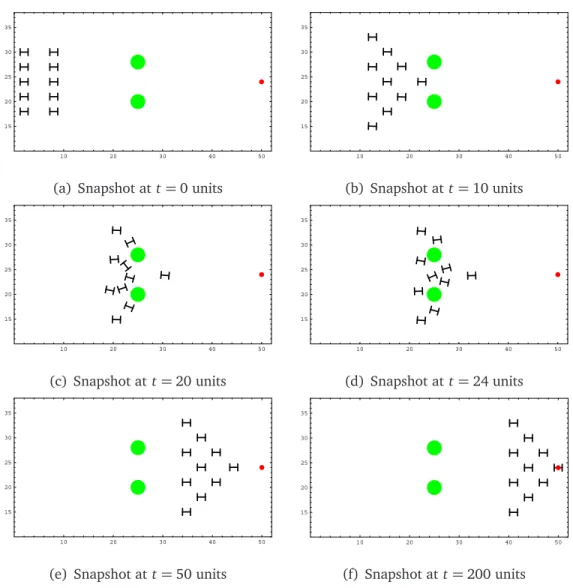
As the leader moves towards its target, the follower-boids move towards their
ghost targets positioned relative to the leader’s position, according to the coordinates
(ai,bi)given in Table 1. From the initial configuration the boids quickly coalesce into
a distinct arrowhead formation (Fig. 4(b)). The boids then split from their
forma-tion to avoid two obstacles in their path (as shown in Figures 4(c) and 4(d)). After
the avoidance, the boids rejoin the flock showing the same prescribed arrowhead
for-mation (Fig. 4(e)). The reforfor-mation takes place before the flock reaches the final
configuration (Fig. 4(f))
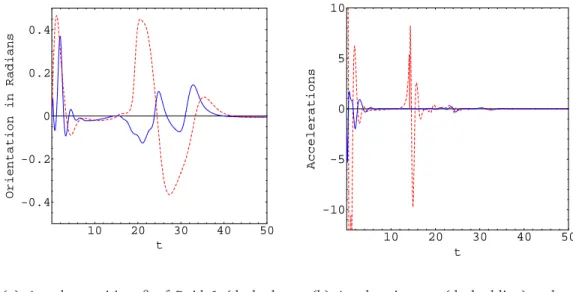
Figure 5(a) shows the evolution of the orientations of the first and the fourth
boids. The different headings can be noticed during the split of the flock,
how-ever, the pre-defined final orientations are achieved at the target configuration as
warranted in this research. Figure 5(b) shows the acceleration components for the
leader-boid. One can clearly notice the convergence of the variables at the final state
implying the effectiveness of the controllers. Similar trends were observed in the case
of the follower-boids. The profiles of the Lyapunov function along the system
trajec-tory show that the conditions of Theorem 1 have been satisfied and that the initial
Table1: Numerialvaluesof initialstates,onstraints andparametersof Senario1.
Initial Conditions
Rectangular positions (x1,y1) = (8, 24), (x2,y2) = (8, 27), (x3,y3) = (8, 21);
(x4,y4) = (8, 30), (x5,y5) = (2, 24), (x6,y6) = (8, 18);
(x7,y7) = (2, 30), (x8,y8) = (2, 27), (x9,y9) = (2, 21);
(x10,y10) = (2, 18)
Angular positions & velo. θi =0, υi =0.5, ωi =0.8, fori= 1 to 10
Constraints and Parameters Dimension of Boids l1 =1.6,l2=1.4
Target for leader (t11,t12) = (50, 24),r t1=0.5
Final orientations ti3=0, fori= 1 to 10
Position of ghost (a2,b2) = (3,−3), (a3,b3) = (3, 3), (a4,b4) = (6,−6);
targets relative to (a5,b5) = (6, 0), (a6,b6) = (6, 6), (a7,b7) = (9,−9);
leader boid (a8,b8) = (9,−3), (a9,b9) = (9, 3), (a10,b10) = (9, 9);
Fixed obstacles(ok1,ok2) (o11,o12) = (25, 28), (o21,o22) = (25, 20),ro1 =ro2=1.5
Max. translational speed υma x =3
Min. turning radius ρmin=0.14
Clearance parameter ε1=0.1,ε2=0.05
Control and Convergence Parameters Obstacle avoidance αik= 0.6, fori =1 to 10 andk =1 to 2
Boid avoidance βi j = 0.01, fori =1 to 10, j =1 to 10,i6= j
Dynamics constraints γis =0.0001, fori =1 to 10,s =1 to 2
10 20 30 40 50 15
20 25 30 35
(a) Snapshot att=0 units
10 20 30 40 50 15
20 25 30 35
(b) Snapshot att=10 units
10 20 30 40 50 15
20 25 30 35
(c) Snapshot att=20 units
10 20 30 40 50 15
20 25 30 35
(d) Snapshot at t=24 units
10 20 30 40 50 15
20 25 30 35
(e) Snapshot att=50 units
10 20 30 40 50 15
20 25 30 35
(f) Snapshot att=200 units
10 20 30 40 50 t
-0.4 -0.2 0 0.2 0.4
Orientation
in
Radians
(a) Angular position θ of Boid 1 (dashed
line) and Boid 4.
10 20 30 40 50 t
-10 -5 0 5 10
Accelerations
(b) Accelerations:σ(dashed line) andη.
Figure 5: Evolutionof theangularpositions andaeleration omponentsfor Senario1.
5.2. Scenario 2: Circular Formation
For this scenario, the prescribed formation is a circular arrangement with the
leader-boid positioned in the center of the formation. We retain the leader-follower
scheme although the virtual structures/centers could have been utilized for this
par-ticular formation. Table 5.2 provides the essentials for the simulation; however, only
those that are different from scenario 1.
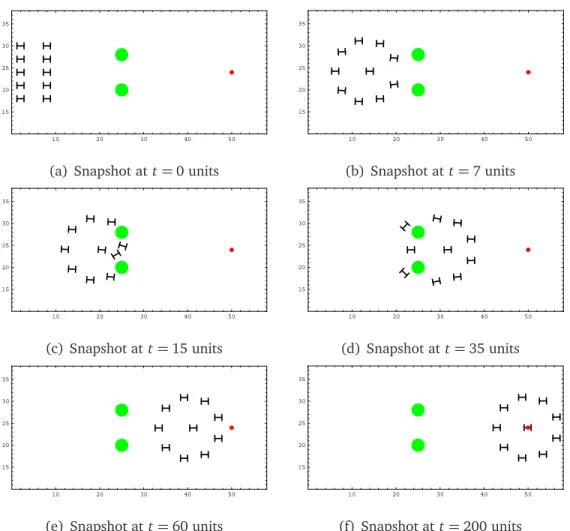
Figure 6 illustrate a similar split/rejoin maneuver as in scenario 1; however, with
a different constellation. The flock establishes the specified formation, carries out the
split/rejoin maneuver to avoid the obstacles, re-establishes the formation and finally
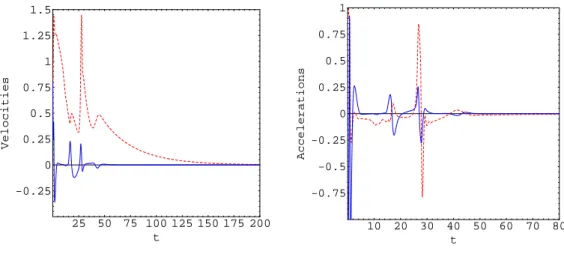
converges to the final configuration. Figure 7 shows the velocity and acceleration
components of Boid 4. Again the figures illustrate the convergent nature of the
Table2: Numerialvaluesof onstraints andparametersofSenario2.
Position of ghost (a2,b2) =κ(cos(π
9), sin(
π
9)),(a3,b3) =κ(cos( 17π
9 ), sin( 17π
9 ))
targets relative to (a4,b4) =κ(cos(π
3), sin(
π
3)),(a5,b5) =κ(cos(π), sin(π)) leader boid (a6,b6) =κ(cos(5π
3 ), sin( 5π
3 )),(a7,b7) =κ(cos( 5π
9 ), sin( 5π
9 ))
(a8,b8) =κ(cos(7π
9 ), sin( 7π
9 )),(a9,b9) =κ(cos( 11π
9 ), sin( 11π
9 ))
(a10,b10) =κ(cos(13π
9 ), sin( 13π
9 ))whereκ=7 Control and Convergence Parameters Obstacle avoidance αik =0.6, fori =1 to 10 and k=1 to 2
Boid avoidance βi j =0.01, fori =1 to 10, j= 1 to 10,i6= j
Dynamics constraints γis= 0.001, fori =1 to 10 ands =1 to 2
10 20 30 40 50 15
20 25 30 35
(a) Snapshot att=0 units
10 20 30 40 50 15
20 25 30 35
(b) Snapshot att=7 units
10 20 30 40 50 15
20 25 30 35
(c) Snapshot att=15 units
10 20 30 40 50 15
20 25 30 35
(d) Snapshot at t=35 units
10 20 30 40 50 15
20 25 30 35
(e) Snapshot att=60 units
10 20 30 40 50 15
20 25 30 35
(f) Snapshot att=200 units
25 50 75 100 125 150 175 200 t
-0.25 0 0.25 0.5 0.75 1 1.25 1.5
Velocities
(a) Velocities:υ(dashed line) andω.
10 20 30 40 50 60 70 80
t -0.75
-0.5 -0.25 0 0.25 0.5 0.75 1
Accelerations
(b) Accelerations:σ(dashed line) andη.
Figure7: Evolutionof theveloityandaeleration omponentsof Boid4for Senario2.
6. Conclusion
The Lyapunov-based control scheme was successfully utilized to create a new set
of continuous time-invariant control laws. We were able to generate a prescribed
for-mation, accomplish the required split/rejoin maneuvers and re-establish the original
formation of a flock of nonholonomic robots. By and large, the control scheme has
presented an excellent platform to yield split/rejoin maneuvers of a flock fixed in a
ar-bitrary formation. The new controllers (4.1) and (4.2) produced feasible trajectories
and ensured a nice convergence of the system to the equilibrium state, whilst
satis-fying all the constraints tagged on the system. Moreover, although computationally
intensive the control scheme will sufficiently encompass expansions to and scalability
of flocks.
The unique pattern of boids’ movement as a flock was possible by inclusion of
posi-tioned relative to the leader-boid. This specific positioning, however, restricted the
formation to a horizontal wayward motion only. Future research will address rotation
of formations and changing the leadership roles of the flockmates. The authors will
also utilize the concept of flocking via the Lyapunov-based control scheme on tunnel
passing and lane merging problems of intelligent vehicle systems.
References
[1] C. Belta and V. Kumar. Abstraction and control for groups of robots. InReprinted from
IEEE Transactions on Robotics and Automation, volume 4, pages 865–875, October 2004.
[2] R.W. Brockett. Differential Geometry Control Theory, chapter Asymptotic Stability and
Feedback Stabilisation, pages 181–191. Springer-Verlag, 1983.
[3] D. E. Chang, S. C. Shadden, J. E. Marsden, and R. Olfati-Saber. Collision avoidance for
multiple agent systems. In Procs. of the 42nd IEEE Conference on Decision and Control,
Maui, Hawaii USA, December 2003.
[4] D. Crombie. The examination and exploration of algorithms and complex behavior to
realistically control multiple mobile robots. Master’s thesis, Australian National
Univer-sity, 1997.
[5] P. ¨Ogren. Formations and obstacle avoidance in mobile robot control. Master’s thesis,
Royal Institute of Technology, Stockholm, Sweden, June 2003.
[6] L. Edelstein-Keshet. Mathematical models of swarming and social aggregation. In
Procs. 2001 International Symposium on Nonlinear Theory and Its Applications, pages
1–7, Miyagi, Japan, October-November 2001.
[7] G. H. Elkaim and R. J. Kelbley. A lightweight formation control methodology for a
swarm of non-holonomic vehicles. InIEEE Aerospace Conference, 2006.
[8] V. Gazi. Swarm aggregations using artificial potentials and sliding mode control. In
Procs. IEEE Conference on Decision and Control, pages 2041–2046, Maui, Hawaii,
[9] W. Kang, N. Xi, J. Tan, and Y. Wang. Formation control of multiple autonomous robots:
Theory and experimentation. Intelligent Automation and Soft Computing, 10(2):1–17,
2004.
[10] J-C. Latombe. Robot Motion Planning. Kluwer Academic Publishers, USA, 1991.
[11] M. Lindh´e. A flocking and obstacle avoidance algorithm for mobile robots. Master’s
thesis, KTH School of Electrical Engineering, Stockholm, Sweden, June 2004.
[12] C. W. Reynolds. Flocks, herds, and schools: A distributed behavioral model, in computer
graphics. InProcs. of the 14th annual conference on Computer graphics and interactive
techniques, pages 25–34, New York, USA, 1987.
[13] B. Sharma. New directions in the applications of the lyapunov-based control scheme to
the findpath problem. PhD Dissertation, July 2008.
[14] B. Sharma and J. Vanualailai. Lyapunov stability of a nonholonomic car-like robotic
system. Nonlinear Studies, 14(2):143–160, 2007.
[15] B. Sharma, J. Vanualailai, and A. Prasad. Formation control of a swarm of mobile
manipulators. Rocky Mountain Journal of Mathematics, To Appear.
[16] H. Tanner, A. Jadbabaie, and G. J. Pappas. Stable flocking of mobile agents, part i:
Fixed topology. In Procs. of the 42nd IEEE Conference on Decision and Control, pages
2010–2015, 2003.
[17] R. Olfati-Saber. Flocking for multi-agent dynamic systems: Algorithms and theory.IEEE
Transactions on Automatic Control, 51(3):401–420, 2006.
[18] R. Olfati-Saber and R. M. Murray. Flocking with obstacle avoidance: Cooperation with
limited information in mobile networks. InProcs. of the 42nd IEEE Conference on
Deci-sion and Control, volume 2, pages 2022–2028, Maui, Hawaii, December 2003.
[19] J. Vanualailai, B. Sharma, and A. Ali. Lyapunov-based kinematic path planning for a
3-link planar robot arm in a structured environment. Global Journal of Pure and Applied