Vol. 4, No. 1, 2011, 67-75
ISSN 1307-5543 – www.ejpam.com
The Numerical Solution Of Partial Differential-Algebraic
Equa-tions (PDAEs) By Multivariate Pade Approximation
Muhammed Yi˘
gider
2, Ercan Celik
1,∗1Department of Mathematics, Faculty of Science, Ataturk University, Erzurum, Turkey
2Department of Mathematics, Faculty of Art and Science, Erzincan University, Erzincan, Turkey
Abstract. In this paper, Numerical solution of Partial Diferential-Algebraic Equa- tions(PDAEs) is con-sidered by Multivariate Padè Approximations. We applied these method to one example. First Partial Diferential-Algebraic Equation(PDAE) has been converted to power series by two-dimensional difer-ential transformation,Then the numerical solution of equation was put into Multivariate Padè series form. Thus we obtained numerical solution of Partial Diferential-Algebraic Equa- tion(PDAE).
2000 Mathematics Subject Classifications: 35
Key Words and Phrases: Partial Differential-Algebraic Equation (PDAs), two-dimensional differential transformation, Multivariate Padè Approximation
1. Introduction
In this study, we consider Linear Partial Differential-Algebraic Equations(PDAEs) of the form
Aut(t,x) +Bux x(t,x) +Cu(t,x) = f(t,x) (1) Wheret∈(0,te)andx ∈(−l,l)⊂R,A,B,C ∈Rnxnare constant matrices,
u,f : 0,te
x[−l,l]→Rn. We are interested in cases where at least one of the matrices A andBis singular. The two special casesA=0 orB=0 lead to ordinary differential equations or DAEs which are not considered here. Therefore in this paper we assume that none of the matricesAorB is the zero matrix[6, 7].
Many important mathematical models can be expressed in terms of Partial Differential Alge-braic Equations(PDAEs). Such models arise in many areas of mathematics, engineering, the physical sciences and population growth. In resent years, much research has been focused on the numerical solution of Partial Differential-Algebraic Equations(PDAEs). Some numerical methods have been developed, using Runge-Kutta methods[8].
∗Corresponding author.
Email addresses:erelikatauni.edu.tr(E. Celik),myigidererzinan.edu.tr(M. Yigider)
M. Yi˘gider, E. Çelik Eur. J. Pure Appl. Math,4(2011), 67-75 68
The purpose of this paper is to consider the numerical solution of Partial Differential-Algebraic Equations(PDAEs) by using Multivariate Padé Approximations.
2. Two-Dimensional Differential Transformation
The basic definition of the two-dimensional differential transform is defined as follows
[9, 2, 3, 4, 1]:
W(k,h) = 1
k!h!
∂k+hw(x,y) ∂xk∂yh
0,0
(2)
wherew(x,y)is the original function andW(k,h)is the transformed function. The transfor-mation is calledT- function and lower case and upper case letters represent the original and transformed functions respectively. The differential inverse transform ofW(k,h)is defined as
w(x,y) =
∞ X
k=0
∞ X
h=0
W(k,h)xkyh (3)
and from Eqs.(2) and (3) can be concluded
w(x,y) =
∞ X
k=0
∞ X
h=0
1 k!h!
∂k+hw(x,y) ∂xk∂yh
0,0
xkyh. (4)
3. Multivariate Padé Approximations
Consider the bivariate function f(x,y)with Taylor series development
f(x,y) =
∞ X
i,j=0
ci jxiyj (5)
around the origin. We know that a solution of univariate Padé approximation problem for
f(x) =
∞ X
i=0
cixi (6)
is given by
p(x) =
Pm
i=0cixi x
Pm−1
i=0 cixi · · · xn
Pm−n i=0 cixi
cm+1 cm · · · cm+1−n
..
. ... ... ...
cm+n cm+n−1 · · · cm
(7)
and
q(x) =
1 x · · · xn
cm+1 cm · · · cm+1−n ..
. ... . .. ... cm+n cm+n−1 · · · cm
Let us now multiply jth row in p(x) andq(x) by xj+m−1 (j =2, . . . ,n+1) and afterwards divide jth column inp(x)andq(x)by xj−1(j=2, . . . ,n+1). This results in a multiplication of numerator and denominator byxmn. Having done so, we get
p(x)
q(x)=
Pm
i=0cixi
Pm−1
i=0 cixi · · ·
Pm−n
i=0 cixi
cm+1xm+1 cmxm · · · cm+1−nxm+1−n ..
. ... . .. ...
cm+nxm+n cm+n−1xm+n−1 · · · cmxm
1 1 · · · 1
cm+1xm+1 cmxm · · · cm+1−nxm+1−n
..
. ... . .. ...
cm+nxm+n cm+n−1xm+n−1 · · · cmxm
(9)
(D=detDm,n6=0).
This quotient of determinants can also immediately be written down for a bivariate function f(x,y). The sumPik=0cixishall be replacedkth partial sum of the Taylor series development
of f(x,y)and the expressionckxkby an expression that contains all the terms of degreekin f(x,y). Here a bivariate termci jxiyjis said to be of degreei+j.
If we define
p(x,y) =
Pm
i+j=0ci jxiyj
Pm−1
i+j=0ci jxiyj · · ·
Pm−n
i+j=0ci jxiyj
P
i+j=m+1ci jxiyj
P
i+j=mci jxiyj · · ·
P
i+j=m+1−nci jxiyj
..
. ... . .. ...
P
i+j=m+nci jxiyj
Pm
i+j=m+n−1ci jxiyj · · ·
Pm
i+j=mci jxiyj
(10) and
q(x,y) =
1 1 · · · 1
P
i+j=m+1ci jxiyj
P
i+j=mci jxiyj · · ·
P
i+j=m+1−nci jxiyj
..
. ... ... ...
P
i+j=m+nci jxiyj
Pm
i+j=m+n−1ci jxiyj · · ·
Pm
i+j=mci jxiyj
(11)
Then it is easy to see thatp(x,y)andq(x,y)are of the form
p(x,y) =Pimn+j+=mmnai jxiyj
q(x,y) =Pimn+j+=nmnbi jxiyj
(12)
We know that p(x,y) andq(x,y) are called Padé equations [5]. So the multivariate Padé approximant of order(m,n)for f(x,y)is defined as,
rm,n(x,y) =
p(x,y)
M. Yi˘gider, E. Çelik Eur. J. Pure Appl. Math,4(2011), 67-75 70
4. Numerical Example:
The test problem considers the following Partial Differential-Algebraic Equation(PDAE)
[8]:
0 1 0 0 0 1 0 0 0
ut+
0 0 −1
0 −1 −1
0 0 0
ux x+
−1 −1 −1
0 −1 0
0 0 1
u= f (14)
x ∈[−0.5, 0.5],t∈[0, 1]. Where
f1 = −x(x−1)(2 sint+cost)−(et+t5)(x2−x+2)
f2 = x(x−1)(et+5t4−cost)−2(et+t5+cost)
f3 = −x(x−1)(et+t5).
The exact solution is
u(x,t) =
x(x−1)sin(t)
x(x−1)cos(t)
x(x−1)(et+t5)
(15)
Equivalently, Equation (14) can be written as
0 1 0 0 0 1 0 0 0
u1t u2t u3t
+
0 0 −1
0 −1 −1
0 0 0
u1x x u2x x u3x x
+
−1 −1 −1
0 −1 0
0 0 1
u1 u2 u3 = f1 f2 f3 (16) u2t−u3x x−u1−u2−u3= f1
u3t−u2x x−u3x x−u2= f2 (17) −u3= f3
By using the basic definition of the two-dimensional differential transform and taking the transform of Equation (17) can obtain that
(k+1)U2(k+1,h)−(h+1)(h+2)U3(k,h+2)−U1(k,h)−U2(k,h)−U3(k,h) =F1(k,h) (k+1)U3(k+1,h)−(h+1)(h+2)U2(k,h+2)−(h+1)(h+2)U3(k,h+2)−U2(k,h) =F2(k,h)
−U3(k,h) =F3(k,h)
Consequently, by substituting the values ofUi. We have obtained
u1(x,t) =−x t+x2t+1
6x t
3−1
6x
2t3− 1
120x t
5+ 1
120x
2t5+ 1
5040x t
7
u2(x,t) =−x+x2+1
2x t
2−1
2x
2t2− 1
24x t
4+ 1
24x
2t4+ 1
720x t
6− 1
720x
2t6
u3(x,t) = −x−x t+x2−1 2x t
2+x2t−1
6x t
3+1
2x
2t2− 1
24x t
4+1
6x
2t3− 121
120x t
+ 1
24x
2t4− 1
720x t
6+121
120x
2t5− 1
5040x t
7+ 1
720x
2t6
The Power seriesu1(x,t),u2(x,t)andu3(x,t)can be transformed into multivariate Padé ap-proximation
m=3,n=2
p1(x,t) =
−x t+x2t −x t 0
1 6x t
3 x2t −x t 1
6x
2t3 1 6x t
3 x2t
= −0.1666666667x3t5+0.1666666667x4t5−x5t7+x6t7
q1(x,t) =
1 1 1
1 6x t
3 x2t −x t 1
6x 2t3 1
6x t 3 x2t
= x4t2+0.1666666667x2t4+0.02777777778x2t6+0.1666666667x4t4
r1(x,t) = p1(x,t)
q1(x,t)
= −0.1666666667x
3t5+0.1666666667x4t5−x5t7+x6t7
x4t2+0.1666666667x2t4+0.02777777778x2t6+0.1666666667x4t4
p2(x,t) =
−x+x2+1 2x t
2 −x+x2 −x
−1 2x
2t2 1
2x t
2 x2
−1 24x t
4 −1
2x 2t2 1
2x t 2
= −0.2500000000x3t4−0.5000000000x5t2+0.04166666667x4t4
+0.5000000000x6t2+0.1041666667x3t6+0.2083333333x5t4
q2(x,t) =
1 1 1
−1 2x
2t2 1 2x t
2 x2
−1 24x t
4 −1 2x
2t2 1 2x t
2
= 0.2500000000x4t4+0.5000000000x4t2+0.2500000000x4t4
+0.20833333333x3t4+0.0208333333x2t6
r2(x,t) =
p2(x,t)
M. Yi˘gider, E. Çelik Eur. J. Pure Appl. Math,4(2011), 67-75 72
=
−0.2500000000x3t4−0.5000000000x5t2+0.04166666667x4t4
+0.5000000000x6t2+0.1041666667x3t6+0.2083333333x5t4
−0.2500000000x3t4−0.5000000000x5t2+0.04166666667x4t4
+0.5000000000x6t2+0.1041666667x3t6+0.2083333333x5t4
p3(x,t) =
−x−x t+x2−12x t2+x2t −x−x t+x2 −x −1
6x t 3+1
2x
2t2 −1
2x t
2+x2t −x t+x2
−1 24x t
4+1 6x
2t3 −1
6x t 3+1
2x
2t2 −1 2x t
2+x2t
=0.0833333333x2t4−0.3333333333x3t3+0.50000000000x4t2+0.0694444444x2t6 −0.0416666667x3t5−0.0416666667x2t5+0.2083333333x3t4+0.083333333x4t4
−0.3333333333x4t3
r3(x,t) = p3(x,t)
q3(x,t)
=
0.2083333333x4t4−0.0833333333x3t4−0.5000000000x5t2+0.5000000000x6t2 −0.0694444444x3t6−0.1250000000x5t4+0.3333333333x4t3−0.0416666667x3t5
−0.5000000000x5t3+0.0416666667x4t5+0.1666666667x6t3
0.0833333333x2t4−0.3333333333x3t3+0.50000000000x4t2+0.0694444444x2t6 −0.0416666667x3t5−0.0416666667x2t5+0.2083333333x3t4+0.083333333x4t4
−0.3333333333x4t3
Table1: ComparisonoftheNumerialSolutionofu1(x,t)withExatSolutions(t=0.01)
x u1(x,t) r1(x,t)
u1(x,t)−r1(x,t) -0.5 0.007499875000 0.007499874999 1.10-12
-0.4 0.005599906667 0.005599006668 1.10-12 -0.3 0.003899935000 0.003899935000 0 -0.2 0.002399960000 0.002399960000 0 -0.1 0.001099981667 0.001099981668 1.10-12
Table2: Comparisonofthenumerialsolutionofu
2(x,t)withexatsolutions(t=0.01)
x u2(x,t) r2(x,t)
u2(x,t)−r2(x,t) -0.5 0.07499625003 0.07499625011 8.10-10
-0.4 0.5599720002 0.5599720006 4.10-10 -0.3 0. 3899805002 0. 3899805002 2.10-10 -0.2 0.2399880001 0.2399880002 1.10-10 -0.1 0.1099945000 0.1099945001 1.10-10 0.1 -0.08999550004 -0.08999550002 2.10-11 0.2 -0. 1599920001 -0. 1599929999 2.10-10 0.3 -0.2099895001 -0.2099895999 2.10-10 0.4 -0.2399880001 -0.2399889999 2.10-10 0.5 -0.2499875001 -0.2499874995 6.10-10
Table3: Comparisonofthenumerialsolutionofu
3(x,t)withexatsolutions(t=0.01)
x u3(x,t) r3(x,t) u 3(x,t)−r3(x,t) -0.5 0.7575376252 0.7575376251 1.10-10
-0.4 0.5656280935 0.5656280938 3.10-10 -0.3 0. 3939195651 0. 3939195651 0 -0.2 0.2424120401 0.2424120401 0 -0.1 0.1111055184 0.1111055184 0
0.1 -0.09090451503 -0.09090451504 1.10-11 0.2 -0. 1616080267 -0. 1616080267 0 0.3 -0.2121105351 -0.2121105350 1.10-10 0.4 -0.2424120401 -0.2424120401 0 0.5 -0.2525125418 -0.2525125415 3.10-10
Figure1: Valuesofu
1(x,t)andits r
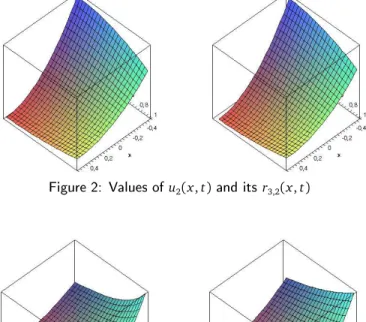
Figure2: Valuesofu
2(x,t)andits r
3,2(x,t)
Figure3: Valuesofu3(x,t)andits r3,2(x,t)
5. Conclusions
The method has proposed for solving partial differential-algebraic equations(PDAEs). The results of example showed that exactly the same solutions have been obtained with Multivarite Padé approximation. On the other hand the results are quite reliable. Therefore, this method can be applied to many complicated Partial Differential-Algebraic Equations(PDAEs).
References
[1] G Adomian. Convergent series solution of nonlinear equations, Journal of Computational and applied Mathematits, 11, 225-230,1984.
[2] F Ayaz. On the Two-Dimensional Differential Transform Method, Applied Mathematics and Computation, 143:361-374,2003.
[4] N Bildik, A Konuralp. Two-Dimensional Differential Transform Method,Adomian’s De-compostion Method and Variational Iteration Method for Partial Differential Equations, International Journal of Computer Mathematics ,Vol.83, 12:973-987,2006.
[5] A Cuyt, L Wuytack. Nonlinear Methods in Numerical Analysis, Amsterdam,1987.
[6] W Lucht, K Strehmel, C E Liebenow. Linear Partial Differential-Algebraic Equations, Part I, Reports of the Institute of Numerical Mathematics, Report No. 17,1997.
[7] W Lucht, K Strehmel, C E Liebenow. Linear Partial Differential-Algebraic Equations, Part II, Reports of the Institute of Numerical Mathematics, Report No. 18, 1997,
[8] K Strehmel, K Debrabant. Convergence of Runge-Kutta Methods Applied to Linear Partial Differential-Algebraic Equations, Applied Numerical Mathematics, 53:213-229, 2005,