Published online April 30, 2014 (http://www.sciencepublishinggroup.com/j/sjedu) doi: 10.11648/j.sjedu.20140202.13
Quality development of publication output in processes of
faculty evaluation
Kvetoslava Rešetová
Faculty of Materials Science and Technology in Trnava, Slovak Republic, Slovak University of Technology, Bratislava, Slovak Republic
Email address:
To cite this article:
Kvetoslava Rešetová. Quality Development of Publication output in Processes of Faculty Evaluation. Science Journal of Education. Vol. 2, No. 2, 2014, pp. 50-57. doi: 10.11648/j.sjedu.20140202.13
Abstract:
The contribution deals with the problematic of quality development of research activity in the form of publication output in the index reputable databases. Various evaluation processes and evaluation criteria determine significantly the impact of these results on the evaluation of a faculty as a complex unit. It is important to set up parallel evaluation processes, to eliminate differences in criteria and to continuously create motivation factors to achieve top-level and internationally accredited quality in publication activity. Therefore these results are distinguished for faculty classification into the highest category in the network of universities in the accreditation process of universities in the Slovak Republic. The evaluation process includes on-going evaluation of journal quality (proceedings and others), not only before their indexing in a database, but also during their classification. Research standards are always followed. Contributions and journals indexed in these databases are in the best categories of all types of the faculty evaluation. The same rules are valid also for feedback. Information management of the academic library has a significant proportion on evidence of publication activity and feedback. It is because the evidence of publication activity and feedback are an observed parameter of university activity.Keywords:
Evaluation of Publication Activity, Accreditation and Evaluation, Publication Categories, Journal Indexing, Information Management of Academic Library, Web of Science, Scopus1. Introduction
In the Slovak Republic evaluation of publication activity began in the middle of the 1990s. The beginnings of these activities, which should define criteria for evaluation processes, were connected with problematic of classifying publication activity (for example the project ProScientia). In 2000 there was an obligation to register a publication activity by academic libraries according to the Law on libraries No. 183 from 2000. Evidence of publication activity has become one of the observed parameters of university activity. The idea of the Central Register of publication activity and feedback was based from a need of efficient automation of document supplying for evaluation of public universities and the following control. The project of the Central Register of publication activity was created in the year 2007. The categories of publication activity are one of the methodological tools for distribution of financial resources for universities (15% of the university budget) (Trajtel- Kružlík, 2012), and for evaluation of processes of complex accreditation of universities, in processes of various
university rankings, and other processes. The best categories of publication activities follow strict rules of indexed journals of databases ISI Web of Knowledge, where bibliometric parameters are used for accreditation and evaluation of faculty documents (Impact Factor, Immediacy Index).
The evaluation of publication activity as one of the most notable and the most visible outputs of faculty employees’ creativity is one of the objective tools for complex faculty evaluation. Of course the complex evaluation process includes also other criteria and its mechanism is very complicated. To measure a contribution there are application possibilities of bibliometric methods by evaluation of influence of publication activity on acquisition of finances as an exact measurable result of faculty activity.
Bibliometric methods such as specialized
of mathematical-statistical methods in bibliographical practice (Krištofičová, 1997). Processing the results of publication activities requires a professional attitude towards document study from the perspective of library-information operations. Disorder of this information and their unprofessional distribution leads to:
• The loss of some information,
• No transparency in the creation of the publication activity base and their reactions,
• Lack of presentation to a reserach community
concentrated on a faculty platform.
2. Theoretical Outputs
There are approximately 100,000 science journals published in the world, with nearly two thirds (59%) being peer reviewed. Approximately half of them are published in a printed form and nearly half of them simultaneously publish also online, while approximately 7% of journals are published only in electronic version. There are 12,987 (13% of the total) freely available journals and 10,410 are assessed for their impact, which means that they are included in the database Journal Citation Reports (JCR) in the Web of Knowledge (WoK). A total of 98,874 journals include 69,696, which are published in the English language. In the Czech Republic there are 579 science journals published, and 451 of those are reviewed. One hundred and eleven from all are in the regime of open access, 26 have only an electronic form, and 43 are assessed for their impact factor (Burešová-Tomanová, 2013).
In the Slovak Republic today there are 56 titles registered in the databases WoS and Scopus (NISPEZ, 2011). The processes and criteria of journal selection to Web of Science highlight the essential selection factors (from qualitative ones to quantitative) and it is based on the quality of bibliographical databases.
In 2012 Scopus suggested that 2,820 of all titles register, less than half of which (1020) were moved to the tendering procedure (Vavříková, 2013), which does not mean that this number will become part of the database.
The mentioned facts show that domestic space for publishing the results of research activity are relatively limited. Not only the number limits it but especially by the diversity of domestic indexed sources for particular research areas. There is too high of a disproportion (representation of the Slovak research journals) from the area of social and natural sciences to technical sciences (a minimal amount). On the other side selection criteria of contributions in renowned foreign journals and proceedings are relatively strict, while precisely these outputs are decisive for faculty evaluation on various levels of evaluation processes.
3. Analysis of Publication Value
To determine a strategy for achieving a publication value for various evaluation goals it is necessary to know the criteria of particular evaluation commissions. The following
aspects cause problems:
• Modification of criteria over time,
• Unstable coefficients for measurement of efficiency,
• Diversity (disunity) of categories of publication
activity for particular evaluation processes,
• A low quotation influence on the field,
• Increasing requirements on information for research
management (requirement of transparency, visibility of research and other reasons).
3.1. Value of Publication for Grant Aims
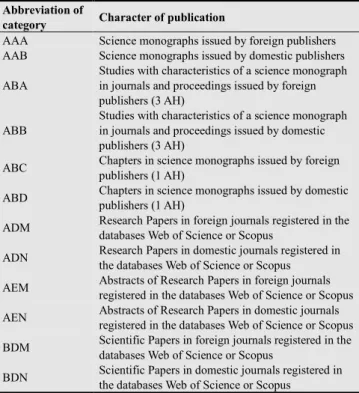
Category A 1 of publications (Table 1) is determined with the Methodology of a Grant Distribution from the state budget to public universities (categories of publications according to the Central Register of Publication Activity Evidence).
Table 1. List of publications classified into the group A 1 for grant purposes
Abbreviation of
category Character of publication
AAA Science monographs issued by foreign publishers AAB Science monographs issued by domestic publishers
ABA
Studies with characteristics of a science monograph in journals and proceedings issued by foreign publishers (3 AH)
ABB
Studies with characteristics of a science monograph in journals and proceedings issued by domestic publishers (3 AH)
ABC Chapters in science monographs issued by foreign publishers (1 AH)
ABD Chapters in science monographs issued by domestic publishers (1 AH)
ADM Research Papers in foreign journals registered in the databases Web of Science or Scopus
ADN Research Papers in domestic journals registered in the databases Web of Science or Scopus
AEM Abstracts of Research Papers in foreign journals registered in the databases Web of Science or Scopus
AEN Abstracts of Research Papers in domestic journals registered in the databases Web of Science or Scopus
BDM Scientific Papers in foreign journals registered in the databases Web of Science or Scopus
BDN Scientific Papers in domestic journals registered in the databases Web of Science or Scopus
The performance parameters are suggested in the same importance by distribution of finances in a grant:
• The volume of finance sources gained in the last two
years for foreign research grants,
• The volume of finance sources gained in the last two
years for research grants from the state budget and other domestic sources,
• The number of PhD graduates in the last two years,
• The number of internal PhD students after dissertation
exam,
• The performance of the university in publication
activity.
research and development. This means that reaching results in publication activities, for example in the category A1, presents the highest financial source. There are three additional categories beyond this one. Their financial impact is significantly lower. The proportion for the university is determined by the proportion average of the recalculated number of publications by particular universities in concrete categories. Scales consider performances in publication categories, for example: category A1 scale 2/9.
3.2. Value of Publication for Accreditation Purposes
Category A of publications for accreditation purposes is defined by the Detailed Rules of Evaluation which are followed by evaluation in concrete research areas (Criteria for evaluation of science, arts, developing areas and other creative activity as a part of the complex accreditation of university activities“ approved by the Ministry of Education on 28.2.2006 according to the §82 paragraph 7 Law No. 131/2002 Collection of law on universities and a change in accomplishment of some laws).
The STU Faculty of Materials Science and Technology (MTF STU) in Trnava was evaluated in four areas of research in the complex accreditation of activities. The research areas related to the faculty study programs are (Table 2):
Table 2. ResearchareaMTFSTU
Mechanical Engineering Evaluation - A Metallurgy and Materials Evaluation - A Information Sciences, Automation and
Telecommunication Evaluation - B Engineering and Technology Evaluation - B+
Everyresearch area has different evaluationcriteria for
faculty results of research activity in the form of
publications.Contemporarycriteriaarevalidforthesphere offacultyresearch(Table3):
Table 3. Criteriaforselectedresearchfieldsforaccreditationpurposes (Criteria,2006)
Research area Material Sciences
• Research Papers in journals (database WoS, or Scopus, IF≥ 0.7 IFM.
• Scientific monographs in foreign publishers as monothematic works of scientific-discovery character with original knowledge, which are result of author research (with concrete formal features of monograph in accordance with publisher norm).
• Verifiable processed patents.
Research area Engineering
• Research Papers registered in the databases WoS, Scopus and CCC with IF≥ 0.7 IFM.
• Scientific Monograph of significant influence in area of research or monograph published in world language by foreign
publisher.
• Accepted - published application or admitted patent or utility model.
Area of Information Sciences, Automation and Telecommunication
• Contribution in journal from the list Thomson Scientific Master Journal List with IF≥ 0.7 IFM.
• Research study in proceedings of world congress/ conference published with world famous research institutes on the level IFAC, IFIP, IEEE, ACM, IET, SPIE; or a renowned publisher such as Springer, Elsevier, John Wiley and others.
• Granted patent.
Area of Engineering and Technology
• Research studies in databases WoS, Scopus and CCC.
• Scientific monograph with importance for research, or monograph issued in a global language by a foreign publisher.
• Accepted/ published patented application or granted patent or utility model.
Fulfilment of accreditation criteria is decisive for
faculty/university. The results of the accreditation process moved thefaculty to thehighest category inthe university systemintheaccreditationprocessoftheSlovakuniversities. Theclassificationmeanspossibilitiesinareaofdevelopment, researchandinternationalcredibilityofthefaculty.
3.3. Value of Publications for Self-Evaluation
Publication activity isan important factor for obtaining
financial resources. The management of a faculty must
createamechanismsothementionedattributeisnotonlya motivationfactor,butitalsodevelopsandcreatesconditions
for development of publication activity. The academic
library has a transferred responsibility for evidence of
complexoutputs ofpublicationactivitiesofthe faculty.Its importanceintheareaofcentralevidenceandprocessingof publicationactivityandfeedback,aswellasmonitoringof
the environment for publications, is that it provides
documentsfor:
• evaluation of the faculty as a whole (evaluation,
accreditation),
• evaluation of organisation faculty units (institutes, departments),
• evaluation of criteria fulfilment for the increase of qualifications of employees,
• acquisition of grants,
• creation of a flexible part of wages,
• enrolment of applicants for pedagogical and research work at the faculty,
• support of presentation aims (transparency) of the
faculty at home and abroad.
Settingofself-evaluatingprocesses (publicationactivity isapartofit)dependsonthefacultymanagement,onprior aspectsforevaluationofresearchresults.Differentmodels
can be documented on a change of evaluation rules of
3.3.1. Calculation of Coefficient of Publication Activity and its Interpretation in Year 2002 at the Faculty
Interpretation of the method of point evaluation of
publicationactivityin2002wasbasedonaproportion:
• a number of publications of concrete type,
• a quality of concrete publication type (evaluated by points) in hierarchically organised system of publication type.
While a file of processed data (evaluated publication
outputs)wasrelativelyheterogeneousandstructuredinside,
a scale 0—100 was selected for the point evaluation in
accordancewiththehierarchyofdocumenttypology.
Evaluation criteria for the faculty departments:
• pedagogical activity (Kped.č.) – 50%
• grant international projects (Kgmp) – 15%
• grant projects of the Ministry of Education (Kgú) –
10%
• fulfilment ctivity (Kpod.č.) – 15%
• publication activity (Kpub.č.) – 10%
K= Kped.č. (0.50) + Kgmp(0.15) + Kgú (0.10) + Kpod.č.(0.15) + Kpub.č(0.10) = 1
The coeffcient evaluating outputs of publication activity was calculated according to the following relation:
BHPČH BHPČH č
Kpub. .=
where:
Kpub.č. coefficient of publication activity of workplace BHPČp the point value of publication activity of workplace for evaluated time calculated for one employee
BHPČo the point value of publication activity of organisation (faculty) for evaluated time calculated for one employee
The calculated coefficient of publication activity could reach a value:
• Kpub.č. < 1.00 when evaluated workplace gained on
average lower results of publication activity per one creative employee in comparison with results of organisation;
• Kpub.č. = 1.00 when evaluated workplace gained on
average the same results of publication activity per one creative employee than complete organisation;
• Kpub.č. > 1.00 when evaluated workplace gained on
average better results of publication activity per one creative employee than complete organisation. The calculated coefficient of publication activity (Kpub.č.) evaluated results of publication activity in all categories of publication activity together.
3.3.2. Calculation of the Coefficient of Publication Activity and its Interpretation in Year 2012.
Today’s value of the coefficient of publication activity is proportional to the ratio of achieving results in the total activity of the faculty in the proportion
• 30% for pedagogical activity
• 30% for grants and research activity
• 40% for publication activity.
Internal categorization (Table 4) of publication activity in the year 2012, which was approved for calculation purposes of above-tariff income part of researchers. Foreign, especially indexed publications are preferred.
Table 4. Internalcategorizationofpublicationactivity
Abbreviation Character of publication Number of points
M1 Scientific monograph (in
English language) 60
CC
Peer-reviewed journal (Thomson- Master Journal List)
55
J1
Indexed journal (ISI Web of Knowledge, Scopus, IEEE Xplore and other world established databases)
20
P1
Indexed publication in scientific proceedings of congresses or conferences (ISI Web of Knowledge, Scopus, IEEE Xplore and other world established databases)
15
M2 Scientific monograph
(domestic) 20
U1 University textbook 20
U2 Textbooks 10
J2
Non peer-reviewed and non-indexed journal (in English)
5
P2
Publication in scientific conference proceedings (in English)
4
3.4. Value of Quotations
Two important databases are in the foreground for evaluation of publications from the perspectives of accreditation, grant, or self-evaluation. These are: Web of Science and Scopus. The Ministry of Education and the faculty prefer these two databases because of their scientific credibility based on the complicated selection of publications by their evaluation process. The evaluation process presents a continuous consideration of quality of journals (proceedings and others) not only before their indexing in a database but also during their classification to follow a scientific standard. Contributions/ journals indexed in these databases belong to the highest categories in all types of evaluation at the faculty. The same rules are valid also for feedback. The regulation of the Ministry of Education, Science, Research and Sport SR on the central register of evidence of publication activity and the central evidence register of art activity classify the following quotations into the highest evaluated categories of feedback:
a) quotations in foreign publications registered in
quotation indexes of Web of Science and in the database Scopus,
quotation indexes of Web of Science and in the database Scopus.
In recent times we encounter various studies comparing quotation outputs also from other databases referring to needs of researchers. Google Scholar is getting to the first position besides Web of Science and Scopus. However, the study of Bergman comparing quotations from 2005 of the five most important journals from the field of social care in three mentioned databases has shown that quotation number in Google Scholar reached the highest number, but a high percentage were source documents such as dissertation theses, diploma theses, reports, non-published manuscripts and others. Source documents in the databases Web of Science and Scopus were especially scientific contributions and contributions from proceedings. A question about what should and should not be considered as a scientific source was formed in Google Scholar. Because the evidence of publication activity is exactly defined in the Slovak legislation we can agree with the opinion that online syllabi, presentations in Power Point and scientific blogs could be an indicator of influence of contribution used for quotations, but we cannot consider them as a scientific source. Because the databases Web of Science and Scopus place importance on quality evaluation, which is a condition of indexing, all three databases cannot be on one level because the question of quality evaluation is controversial or unclear with Google Scholar (Bergman, 2012).
3.5. Results of Analysis
It is definite that criteria of evaluation results of research activity have changed over time. Publication activity has become a significant factor for the final evaluation of faculty activity. Priority for acquiring point evaluation is typical for publications registered (indexed)
• in the world databases Web of Science and Scopus,
• as papers registered in journals from the list Master Journal List.
Togetclosertoaninternationalresearchspacemeansto acceptinternationalplatforms(andtheirevaluationcriteria)
for publishing research results. The accreditation
commission has determined the products of Thomson
Reutersastheseplatforms.Reachingresultsincategorizing
of contributions into observed databases is a very
demanding process and a sudden increase cannot be
expected. However, a change ofpriorities is continuously
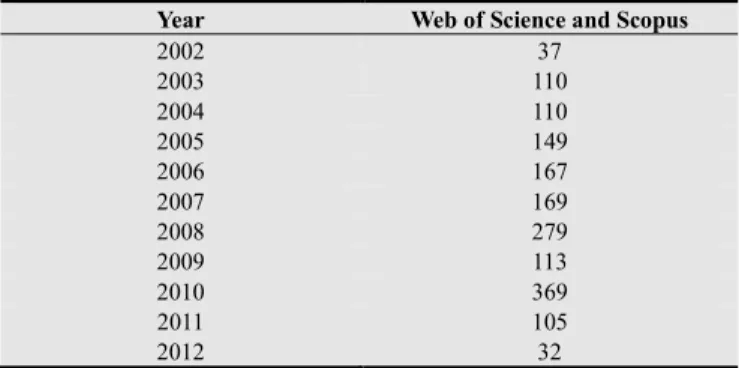
reflectedinstatisticalindicatorsofresults(inthenumberof registeredpublicationsorfeedback)(Tables5,6).
Table 5. NumberofpublicationsMTFSTUindexedindatabasesWebof ScienceandScopus2002–2012
Year Web of Science Scopus
2002 11 10
2003 12 14
2004 27 25
2005 20 17
2006 27 23
2007 30 23
2008 75 25
Year Web of Science Scopus
2009 72 33
2010 54 51
2011 59 66
2012 73 89
Note: Number of publications is without domestic publications indexed in databases (domestic publications are registered in concrete sources, but they are not the subject of classification into the highest class. Only foreign publications are admitted).
Table 6. Amount of author feedback at MTF STU in foreign publications registered in quotation indexes Web of Science and Scopus 2002 – 2012
Year Web of Science and Scopus
2002 37
2003 110
2004 110
2005 149
2006 167
2007 169
2008 279
2009 113
2010 369
2011 105
2012 32
Note: Regarding to the fact that process of indexing is a longer process, we can predict an increased number of quotations in the last two years.
Getting published in top-tier journals depends on
different factors. Ideally a manuscript’s quality and its
contributionsshould principally determinewhere it would
become published. Accordingly, journal editors and
reviewers are expected toconsider aspects relatedonlyto
the manuscript when making acceptance and rejection
decisions. This kind of universalistic publication system
wouldensurethateachmanuscriptisevaluatedinthesame
way andthat acceptance orrejection from a management
journal is based solely on the manuscript quality and
contribution(Amo,2012).
Financialgrantsdividedbythedeantoconcreteinstitutes tosupportoutputsofthetopinternationalqualityfollowtwo
elementaryaims:
1. to create favourable conditions for faculty success in the process of accreditation (meaning to gain a classification of the faculty into the A class)
2. to create a motivational tool to reach the top position of the faculty in the Slovak Republic (in the university network), it should be minimally in two accredited scientific research segments.
4. Methodology
The process for publication classification (of research outputs) of authors (the employees at the MTF STU) into the
categories “Top international quality” (A) and
“Internationally recognized quality” (B) was approved to evaluate objectively the publication activity (Resolution of dean, 2011).
evidence for every original output separate of the top international quality and internationally recognized quality (archived in the Academic library) is the content of criteria fulfillment, which determines continuity in publication classifying into the concrete category:
a) the main author of publication (or the first author from MTF STU) determines the research sphere in written form. The author can also suggest a classification of publication into the category A or B, which is labelled into an application, or the author documents it in another way (by e-mail, letter or other). The chief or the first author from the MTF STU determines also the recalculated output of a concrete publication for the MTF STU, as well as for the concrete institute MTF STU,
b) research assistants of the Academic library for the evidence of publication activity classify a publication on the basis of approved criteria for need of grant and accreditation,
c) a content classification is verified with the head of the Academic library (or the head of institute where the Academic Library belongs to),
d) a vice-dean for research activity considers the
suggested classification,
e) a final decision for evaluation of outputs of creative faculty employees is given by an evaluation commission.
The decision of the evaluation commission of Dean MTF STU accomplishes a classification process of publication (output) according to the accreditation. Authors can withdraw after decision to the Dean of faculty.
Processes of correct classification of publication of PhD students require creation of system mechanisms:
• Knowledge of publication value for evaluation
processes
• Access to electronic information sources of PhD
students research
• Support services of academic departments
• An efficient system for evidence of publication
activity.
Methodology of evidence and processing of publication activity of PhD students defines the ways to process by evaluation of output. It is important to select a relevant set of solution methods and a rational process of classification of publication activity into concrete categories to follow the defined aims. In accordance with a predicted process of problem solution a portfolio of methods can be defined:
• the general part of the classification method of
publication activity applies methods of induction and deduction – induction as a process from general to concrete (this method is used in summarizing all evaluation parameters, where a subject of evaluation is publication activity); deduction as a method of observing, which determines priorities of outputs in defined conditions;
• an analytical part uses the methods of causal analysis –
the method of recovering of causal relation phenomena,
which means the form of interactivity between processes, issues, systems and others (evaluation of output environment); methods of comparison - comparison methods present basic research methods, their importance is based in data division into various files with the aim of their comparison and finding – they present a base for generalization of analysis outputs; index method - the method for distinguishing categories to particular importance, it means indices are added to concrete publications;
• evaluation processes use methods of calculation, their
result is a determination of publication value for various evaluation purposes; methods of trend extrapolation – extrapolation as a process of evaluation, classification (or selecting) of values, they formulate trends of the next development of particular problematic, an alignment of publication activities and others; bibliometric methods such as specific
library-information methods enabling practical
application in decision processes by management of science and research with application in the field, for example a measurement of scientific productivity of authors.
A mechanism of method selection for evaluation processes is determined from the type of evaluation and the character of criteria, while a combination of more methods is expected to be used in concrete steps of classification process of publication.
5. Processes of Determination and
Securing of Quality
Evaluation of research includes the following attributes: a) research outputs (as “an attribute of outputs”),
b) a space for research (as “an attribute of environment”),
c) rewards associated with research results (as “an
attribute of award”).
The list is used as a sufficient criterion for the mutual differentiation of quality by top universities. If this list would include publication, which does not follow criteria for categorisation into “A”, the list will not be accepted as a unit. The outputs must follow the following criteria:
• date of output publishing is during the evaluated time,
• author of output or one of the authors is an academic
employee of a faculty from the particular research area, who worked for the faculty in time of issuing or studied the concrete study field in time of publishing. An important factor for its acceptance is, besides the name of the author, naming of a workplace title at the faculty or the faculty name. Output of one author is accepted only at one university. If the same output of one academic employee is provided by more universities, the evaluation will be D,
• when it is an output of more authors, the faculty is counting only the part which belongs to author(s) in accordance with affiliation to faculty,
• at least 40% of outputs must be from the second half of
evaluated time,
• the highest number of recalculated number of outputs
of one academic employee in evaluated time which can be added is 5,
• author or co-author of outputs presented in number derived from a number of academic employees in the function of professor is academic employee in the function of professor in time of issuing of output. Every admitted output must provide a sufficient number of information to determine exactly the type of output, if it is the work of one author or co-authors, the physical form of output and where it is located.
Quality profiles in particular attributes determine the total profile of quality of faculty research in evaluated area as a profile-weighted average of attributes, which are defined with the Accreditation Commission. The scale of output attributes must be at least 55%, the scale of environment attribute at least 15% and the scale of award attribute at least 20%. The total quality profile is defined with a complete evaluation of faculty research in evaluated area. There is mentioned an average number of academic employees in evaluated time when outputs were evaluated.
6. Future in Development
Evidence of publication activity in an academic area is made on various levels with different grades of details and standardization. Diversity is however not reflected only in the processing system. Logically, it seems academic libraries are the only place where publication activity is concentrated from the perspective of its registry, processing and storage. Employees of an academic library have to have professional skills in the processing of publication activity into complete bibliographical units and processing data from particular databases. At some faculties publication activity is concentrated in departments for science or it is the main activity of the vice-dean for science and research. The
academic library, with its special position in the organization structure, is a medium for information of a basic character and its position in the information management of the faculty should be dominant. It becomes a key element of university education system. Academic libraries are transformed under strong influences and basic changes in the global education and research communication system. To stay relevant for education and excellent research at universities they have to cause changes.
Mutual interaction of the organizational units of academic activities, for example the department for research, the academic library, and others, can be declared in various processes in the life of a faculty. The departments for research are focused on information for evaluation and accreditation of the faculty. The preparation of documents for evaluation commissions at faculties is mostly related to these departments. It is related to the fact that nearly 70% of information needed for the faculty evaluation is based on documents of departments for science and academic libraries. The academic library has a special role: it is a research-information, bibliographical, coordination and advisory workplace of the faculty (university), which guarantees evidence of publication activity and its feedback. If a faculty has a functioning information and
communication system connected with a library-
information system, it is able to integrate information from these parts into areas of:
• growth of qualifications,
• grant success,
• publication activity,
• feedback on publication activity to faculty employees.
The importance of information management at academic libraries is based on its integration function. The academic environment provides appropriate structures, rationalization patterns and information systems, which secure information that, will be “organized via management.”
All information dealing with activity of concrete faculty departments are considered as elements of integrated information system; it means that all components influence each other and information system enters as a unit into interactions with other subsystems of the faculty. To secure communicability of this information system it is needed:
• to analyse information needs (who and what type of information needs),
• to determine existing information sources,
• to secure a processing and communication of
information.
The features of information management at academic libraries determine its importance:
• it must be a support for the strategic and tactical aims
of the organisation (faculty),
• information must be identified with logical continuity
of the management process,
• it is a presumption for other processes of
decision-making and management,
• as part of a cycle of processes requiring identification
meaningful knowledge)
• it presents a regulated flow of information in the information system.
The information and communication system of the faculty becomes a group of particular programmes created and isolated under the pressure of daily problems, which is today absolutely unnecessary. Contemporary conditions require the existence of integrated information systems, these systems must enable maximal support of today’s and future faculty aims. In this way characterised information management of academic library can be a base of not only electronic but also functional connection of faculty workplaces and it can bring a significant increase of communication possibilities and access to a big domestic and foreign information amount for all members at the faculty.
Information management of an academic library is a subsystem of faculty management presenting a continual, repeating file of activities processed in a system of orientated information structure. Its aim is (using the most progressive information technologies) to secure the other components (subsystems) of organization management with requiring (optimal) amount of relevant, appropriately modified, actual information in a determined time so they can formulate concrete and clear decisions for managing of all organization components to fulfillment of organization aims. Simultaneously knowledge for continual evaluation of quality by activity and products must be defined. It has a meaning also for strategy formulation of management of repeating organization processes.
7. Conclusion
Monitoring and creation of conditions for publication of creative faculty employees is one of the prior tasks of the faculty to support publishing of research results. The possibility of transfer of these results in prestigious foreign spaces is in accordance with the concept intention of the faculty development. To regulate the value of publication in connection with expected economics is possible only with relatively quantified or an estimated complicated system. We can expect an income increase from achievement of publication outputs in top international quality journals, from an increase of grant success, and from an increased interest of students in study at the faculty. On the other side the faculty has to create mechanisms with contributions characterized by international credibility for creative employees:
• new foreign publication space for engaged employees
in foreign famous publishers,
• strengthening of top international quality,
• possible co-authorship with foreign partners and the possibility of creation of comparative research outputs,
• knowledge transfer and security of a quick transfer of
research results into education process,
• possibility of increased number and a quotation
proportion of the faculty authors.
The faculty management defined criteria to classify publications into categories and it created also conditions for publishing. They are not only internal sources for publication, supporting mechanisms but especially financial support of the faculty institutes to provide outputs of the top quality (conference fees on events where proceedings are indexed in studied databases; covering of fee to publish in top journals and others). A motivation factor is also the gaining of above-tariff income portions for outputs of top quality. To support and evaluate publications in observed databases Web of Science and Scopus, to regulate activities of creative employees (but also of supporting workplaces) to these sources means to support and improve quality.
References
[1] L.C. Amo, S. Ada and R. Sharman, “The Role of Scholar Status in the Academic Publication Process,” International Journal of Doctoral Studies,vol. 7, pp. 79-92, 2012.
[2] Burešová, H. Tomanová, “Journals issued with AV ČR in the World Citation Databases,” Inforum 2013: The 19th Conference on Professional Information Sources, Praha,
AlbertinaicomePraha, from
http://www.inforum.cz/cs/sbornik, ISSN 1801–2213. [3] Criteria for assessment of the level of research,
developmental, artistic and other creative activities as a part of complex accreditation of activities in higher education institution 2006.
[4] Dean’sRegulationNumber5/2011 from
http://www.mtf.stuba.sk/english/students/phd.-study. [5] Detailed Rules of Evaluation which are followed by
Evaluation in concrete Research Areas, 2011, from http://www.akredkom.sk/.
[6] E. Krištofičová, “Evaluation Tools of Library and Research-Information Processes,” Bratislava: CVTI SR, pp. 157, 1997, ISBN 80-85165-62-7.
[7] E. M. Lasda Bergman, “Finding Citations to Social Work Literature: The Relative Benefits of Using Web of Science, Scopus, or Google Scholar,” The Journal of Academic Librarianship, vol. 38, pp. 370-379, 2012.
[8] NISPEZ, 2011, from http://nispez.cvtisr.sk.
[9] E. Trajtel, P. Kružlík, “Evaluation of Publication Activity at the Slovak Universities,” Ikaros, vol.16, no. 6, 2012. [10] L. Vavříková, “Trends and Development of Science
Publishing,” Inforum 2013: The 19th Conference on Professional Information Sources, Praha,
AlbertinaicomePraha, from