African Journal of Reproductive Health March 2019; 23 (1):
46
REVIEW ARTICLE
Coping with the Supply-Side Effects of Free Maternal Healthcare
Policies in Seven sub-Saharan African Countries: A Systematic Review
DOI: 10.29063/ajrh2019/v23i1.5
Gordon Dugle
1* and Shannon Rutherford
2School of Business and Law, University for Development Studies, Box UPW 36, Wa Campus, Ghana1; School of Medicine, Gold Coast, Southport QLD 4215 Australia2
*For Correspondence: E-mail: [email protected]; Phone: +233200238294
Abstract
Free maternal healthcare policies (FMHP) result in enormous supply-side effects on care delivery in sub-Saharan Africa (SSA). This review synthesises the mechanisms adopted by supply-side actors to cope with the effects of FMHP and the results of coping mechanisms on policy objectives in seven SSA countries. We searched bibliographic databases for articles published in English for research that reported supply-side effects of FMHP, coping mechanisms, and effects of various coping mechanisms on attainment of reform objectives. Out of 215 studies identified, nine qualified for inclusion. Selected studies were exploratory in design and based on either mixed or qualitative methods. While local health system authorities and health facilities coping mechanisms that were intended to enhance implementation, facility managers and staff engaged in self-interest adaptation decisions and behaviours. Lack of explicit policy commitment to enhancing organisational and managerial capacity of local health authorities contribute to sustaining negative supply-side effects and adverse coping mechanisms. Without due consideration to governance and health system strengthening, FMHP are prone to perverse outcomes that undermine intended benefits. Context-specific empirical studies are needed to further conceptualise the supply-side effect – coping mechanism – consequential effect nexus of the policy. (Afr J Reprod Health 2019; 23[1]: 46-54).
Keywords: Free maternal healthcare policy, coping mechanisms, health management, health services organisation, health financing, sub-Saharan Africa
Résumé
Les politiques de santé maternelle gratuites (PSMG) ont d'énormes effets secondaires sur l'offre sur la prestation de soins en Afrique subsaharienne (ASS). Cette revue synthétise à la fois les mécanismes adaptés par les acteurs de l'offre pour faire face aux effets des PSMG et les résultats des mécanismes adaptés sur les objectifs politiques de sept pays d'ASS. Nous avons recherché dans des bases de données bibliographiques des articles publiés en anglais pour des études rapportant les effets de l'offre PSMG sur l'offre, les mécanismes adaptés par les acteurs pour y faire face et les effets des mécanismes d'adaptation sur la réalisation des objectifs de la réforme. Sur les 215 études identifiées, neuf ont pu être incluses. Les études sélectionnées étaient de conception exploratoire et reposaient sur des méthodes mixtes ou qualitatives. Tandis que les autorités du système de santé et les établissements de santé locaux ont adapté des mécanismes d'adaptation destinés à améliorer la mise en œuvre, les gestionnaires et le personnel des établissements se sont engagés dans des décisions et comportements d'adaptation pour leur propre intérêt. L'absence d'engagement explicite de la part des autorités locales de renforcer les capacités organisationnelles et de gestion des autorités de santé locales contribue à maintenir les effets négatifs sur l'offre et les mécanismes d'adaptation défavorables. Sans tenir dûment compte de la gouvernance et du renforcement du système de santé, PSMG est susceptible d‘obtenir des résultats pervers qui sapent les avantages escomptés de la politique. Des études ciblées et spécifiques au contexte sont nécessaires pour conceptualiser l'effet secondaire de l‘offre - mécanisme d'adaptation - lien indirect entre la politique et les conséquences. (Afr J Reprod Health 2019; 23[1]: 46-54).
Mots-clés: Politique de santé maternelle gratuite, mécanismes d'adaptation, gestion de la santé, organisation des services de santé, financement de la santé, Afrique subsaharienne
Introduction
Over the last three decades, maternal health user fee reforms, referred to as free maternal healthcare policies (FMHP) in sub-Saharan Africa (SSA) have been bedevilled with enormous supply-side effects1. FMHP officially remove or reduce user fees that were
African Journal of Reproductive Health March 2019; 23 (1):
47
In SSA, user charges serve as revenue to supplementgovernment subventions to public health facilities as well as cover internal operating costs5. While there is adequate evidence that FMHP results in increased attendance2, several reviews have reported its enormous effects on the supply-side of care delivery, including increased pressures on health workers6, reduced internal revenue and intense pressure on infrastructure and logistics1,6. Currently, it is unclear how health facilities in different settings respond to these pressures and how such responses can affect the intended goals of FMHP.
Since the introduction of FMHP in SSA in the 1990s, several reviews have presented evidence on its impact on access, particularly on rates of antenatal care (ANC), delivery and postnatal care (PNC) attendance, and subsequent maternal and neonatal mortality1. There have been reviews on implementation challenges, service quality and equity effects of the reforms7,8 but understanding of the decisions and actions that supply-side actors take to cope with the effects of the policy is limited. This review examines two primary questions: In SSA, what mechanisms have the supply-side of FMHP adopted to cope with extra supply-side effects of FMHP? How do coping strategies consequently impact on attainment of policy objectives?
Methods
This review was conducted in line with the Preferred Reporting Items for Systematic Reviews and Meta-Analysis (PRISMA) framework. Due to the diversity in research designs employed and countries studied, and the limited quantitative methods utilised, the review precluded meta-analysis.
Search strategy
First, a scoping review was conducted to help define the scope of the review and provide guidance on the search items in electronic databases. Search terms were pre-tested and revised using Google Scholar. The eventual key terms included the following: [‗Maternal healthcare‘ OR ‗Maternity care‘ OR ‗Maternal health services‘ OR ‗Pregnancy care‘ OR ‗Reproductive healthcare‘] AND [‗User fee reform‘ OR ‗User fee removal‘ OR ‗User fee exemption‘ OR ‗User fee policy‘] AND [‗Africa‘ OR ‗Sub-Sahara Africa‘ OR ‗Low-and middle-income countries‘ OR ‗Developing countries‘]. Google Scholar, Web of Science, Scopus, EmBase, PubMed, African Index
Medicus, Grey Literature Database, and WHO's Library Database were searched by two reviewers between October 25, 2017 and November 1, 2017. Also, the reviewers searched the reference lists of four previous reviews for relevant articles. The search was limited to publications in English and targeted primary studies of any design.
Study selection, screening and data extraction
Studies were only included if they specifically reported three variables: supply-side effects of FMHP, mechanisms for coping with the identified effects and impacts of the coping mechanisms on attainment of policy objectives. There was no restriction on publication dates. Studies on user fee policies covering the broader national health system or some specific disease burden (such as HIV or tuberculosis) or a population group that combined mothers and other beneficiaries (such as the aged) were excluded since they did not clearly reveal the maternal health component of the reform.
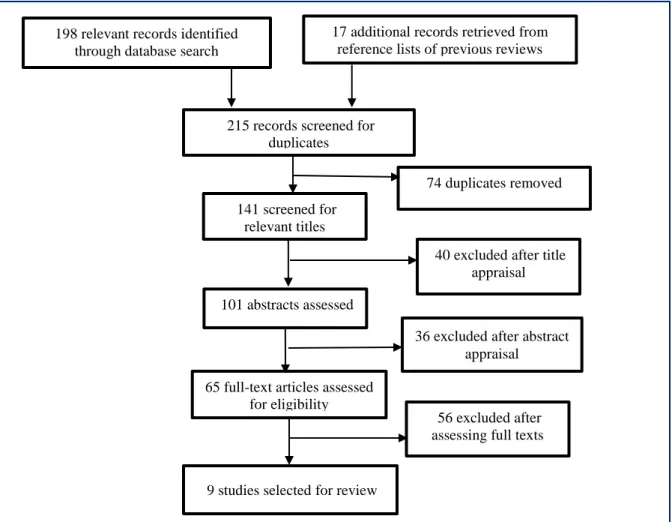
The initial list of identified studies was screened in four phases: removal of duplicates; appraisal of study titles; appraisal of abstracts; and generation of full articles for final selection (see Figure 1). The first and second reviewers independently read the full texts of the final list of included studies to ensure that they all met the inclusion criteria and did not contain duplicate data. Both reviewers made independent decisions on whether selected studies should be included or not. The independent reviews eventually identified the final list of included studies.
To ensure reliability, all identified studies were further screened by the first reviewer and reviewed by the second reviewer. Data from selected studies were extracted using a predefined form that included the studies‘ characteristics, supply-side effects, coping mechanisms and impacts of adapted mechanisms on policy objectives. To ensure consistency, all data were first extracted by the first reviewer and reviewed by the second reviewer.
Assessment of quality
African Journal of Reproductive Health March 2019; 23 (1):
48
Figure 1: Flowchart of systematic literature search and selection process
along a continuum of ≥20 for High quality, 10 – 19 for Moderate quality and ˂10 for Low quality. Two reviewers independently assessed the selected studies, and averages were used to finally grade them.
Results
Characteristics of selected studies
A total of 215 studies were identified, consisting of 198 from electronic databases and 17 additional records from the reference lists of four previous reviews. After the screening and quality assessment process, nine documents met the inclusion criteria. Generally, all nine studies were rated to be of high quality.
All except one of the selected studies were conducted on state-led FMHP. A single study in Niger was conducted on a German non-governmental
organisation‘s (HELP) intervention. One study covered multiple countries – including Benin,
Burkina Faso, Mali and Morocco10 but this review did not cover the Moroccan aspect of its findings. The remaining eight studies covered single countries. Two were conducted in Ghana11,12 and Burkina Faso13,14 and one in each of Senegal15, Mali16, Kenya17 and Niger18. In all, seven countries were covered in this review.
All studies were exploratory in design and based on either mixed (five) or qualitative methods (four). Responses from selected studies were drawn from perspectives of multiple key informants who had political, technical and administrative responsibility for the policy at national, regional, district and health facility levels. A summary of the characteristics of selected studies is presented in Table 1. Generally, selected studies provided adequate evidence on supply-side effects of the policy. However, there was limited evidence on coping mechanisms and the impact of adapted mechanisms on intended policy objectives.
198 relevant records identified through database search
65 full-text articles assessed for eligibility
74 duplicates removed
36 excluded after abstract appraisal 40 excluded after title
appraisal
9 studies selected for review
56 excluded after assessing full texts
141 screened for
relevant titles
215 records screened for duplicates
101 abstracts assessed
17 additional records retrieved from reference lists of previous reviews
African Journal of Reproductive Health March 2019; 23 (1):
49
Study Country Objective of study Method Policy and practice highlight
Witter et al (2014)10 Benin, Burkina
Faso and Mali
To develop research methodologies and tools that can enhance the study of and evidence on free maternal healthcare policies in Benin, Burkina Faso, Mali and Morocco
Mixed methods evaluation using a combination of 14 qualitative and quantitative research tools.
Reduction of financial barriers on their own do not change behaviour or give value for money unless they are linked with a positive shift in other barriers, including physical, cultural and systemic challenges HERA and Health Partners
Ghana (2013)11
Ghana To evaluate the impact of the Free Maternal Healthcare initiative in Ghana on utilisation of skilled assistance at delivery and on the quality of maternal health services
An exploratory mixed methods evaluation using document review, key informant interviews and community group discussion.
Sustainability of the initiative is dependent on the establishment and maintenance of several dedicated structures for administration and management across all levels of the health system
Witter et al (2007)12 Ghana To describe scheme to exempt all women from
delivery fees in Ghana
A qualitative study based on interviews with 65 key informants at national, regional, district and facility level
Although the scheme was well accepted and appropriate too, there were important problems to note – including challenges in disbursing and sustaining funding, budgeting and management, increased workloads on staff and maintenance of motivating levels of compensation
Ganaba et al (2016)13 Burkina Faso Examine effects of national subsidy scheme
for deliveries and emergency obstetric care in public facilities on utilisation, quality of care, equity, cost, sustainability and overall health system
A mixed methods case study, using national and district survey data, household interviews with women, data extraction from hospital and medical records, and key informant and health worker interviews
There is evidence of positive outcomes which suggest the need to maintain the subsidy policy, but critical attention is needed to ensure that vulnerable population benefit from the policy
Ridde et al (2011)14 Burkina Faso To document the process of Burkina Faso‘s
policy to subsidise deliveries and emergency obstetric care
Mixed methods design based on a health policy analytical framework
Despite strong administrative controls, health workers have discovered ways of taking advantage of the policy
Witter et al (2008)15 Senegal Provide understanding of fee exemption policy
and how it has been implemented at different levels of the health system in Senegal
Qualitative investigation based on semi-structured interviews with key informants with technical and
administrative or political
responsibility for the policy at national, regional, district and health post levels
Careful planning and communication and of simple and clear definition of ―free‖ in the package must be addressed before the policy is implemented
Touré (2015)16 Mali To enhance understanding of the role of health
systems in the success or failure of free maternal healthcare policies
Qualitative comparative study of the
implementation, provision,
functioning and outcomes of three free maternal healthcare policies
The state‘s inability to exercise its regulatory role and align policies with the health system creates dysfunctions that undermine effective implementation
Lang‘at & Mwanri (2015)17
Kenya Explore the perspectives of service providers and facility administrators on free maternal health service policy in Kenya
A qualitative study using semi-structured interviews with maternal health service providers and facility administrators in Malindi District
Free maternal healthcare is an innovative to improve
maternal health outcomes. However, many
organisational and managerial challenges hinder effective implementation
Ridde & Diarra (2009)18 Niger Evaluation of an NGO‘s intervention to
abolish user fees in Niger for pregnant women
A mixed-methods design using in-depth interviews, focus groups,
participant observation and
questionnaires
African Journal of Reproductive Health March 2019; 23 (1):
50
Mechanisms for coping with supply-side effects
of FMHP
Coping mechanisms were categorised under three themes: mechanisms initiated by local health authorities; health facility-instituted mechanisms; and health worker informally initiated mechanisms. Generally, studies did not report the existence of policy-embedded coping mechanisms or whether they had been adapted or not during implementation. An exception was HELP‘s intervention in Niger which made provision for a series of measures for ensuring effective implementation. Besides extensive communication of the policy to both demand and supply side actors, the NGO's intervention also anticipated adverse decisions and actions of policy implementers and provided appropriate adaptation measures ahead of implementation18. Benin‘s centralised model which connects policy managers directly with facilities without the local health system bureaucracies, also envisaged discrepancies and major delays in reimbursements to facilities, often resulting from long supply chains10.
Only studies on Burkina Faso, Ghana and Mali reported evidence of deliberate adaptation mechanisms initiated by local health authorities. In Burkina Faso, some District Health Management Teams (DHMTs) used their budgets to mitigate delays in reimbursements to health facilities14, others implemented stock control measures to check non-compliant practices13 and used subsidies to pay bonuses to health workers14. In Ghana, regional health authorities used internally generated funds (IGF) to compensate midwives for increased workload12, provided supplies on credit to hospitals to help ease pressures resulting from stock outs and delays in reimbursements and raised funds to cater for increased investment costs through partnerships with international donors11. In Mali, local health authorities conducted unannounced inspection of stock at facilities to curb abuses16.
At the health facility level, hospital managers in Burkina Faso paid part of their subsidy as bonuses to health workers to motivate them14. Some facilities pre-financed procurement of medical supplies to maintain service delivery and overcome delays in reimbursements in Burkina Faso. In Burkina Faso, facilities also developed control mechanisms on use of supplies to check non-compliant practices by workers13. Facilities in Ghana undertook tasks redesign schemes to ensure optimal allocation of work and compensation for extra load. Facilities also
contracted retired midwives to address increased workloads using IGF. Some hospitals in Ghana also relied on bank credits and overdrafts to enable them mitigate delays in reimbursements of user fees11. Some facilities in Ghana also engaged in referral of patients to facilities in other districts known to have adequate FMHP funding12. In Mali, some facilities hired volunteers to help manage the increased workload on regular staff16. In Mali, facilities also made early requests for stock to minimise stock outs16. In Senegal, health facilities coped with delayed and inadequate supply of kits by issuing directly from their stores and later replacing them upon receipt of supplies from the central policy management body. Some hospitals also increased tariffs for non-targeted services, while others solicited local government support15.
Negative coping strategies by facilities and health workers were also reported. In response to shortages of drugs and supplies, facilities improvised or asked patients to buy medical supplies for their treatment in all seven countries10-17. Due to delay and inadequacy of reimbursement of claims as well as stock outs, some hospitals reverted to charging user fees on maternal care in Ghana12. In Mali, when stocks were depleted or limited, some facilities restricted free care to certain working days and hours and others sold free care kits in order to compensate for additional workloads on staff16.
African Journal of Reproductive Health March 2019; 23 (1):
51
units to maternal care units in order to earn additionalincome through informal charges10.
Impact of coping mechanisms on attainment of
intended policy objectives
We found that across the seven countries, the main objectives of FMHP include: (1) reducing the costs of facility-based maternal care, especially for the worst-off; (2) increasing access to quality skilled delivery in health facilities; and (3) reducing adverse maternal health outcomes. Some coping mechanisms initiated by local health authorities and facilities had positive impacts on attainment of policy objectives. In Burkina Faso for instance, the use of DHMT‘s budget to minimise funding deficiencies helped to increase financial access for beneficiaries, especially those who could not bear the percentage of cost that was not covered by the free policy13. Financial incentives instituted by regional and district health authorities motivated midwives and controlled the practice where health workers sold supplies to clients in Ghana, Burkina Faso and Benin. The financial incentive mechanism also helped improve the availability, volume and quality of staff in these countries10,12. The use of volunteer staff by facilities kept services running and helped to reduce time spent by patients at facilities12,16. Stock control mechanisms helped sustain service provision13,14,18.
However, all nine studies noted negative impacts on policy objectives because of facility level and health worker-initiated adaptation strategies. The transfer of costs of care and/or supplies to clients affected utilisation. Informal charges resulted in gradual shrinking of the scope of the care package, significant local discrepancies leading to inequities in care delivery and a decline in the quality of services across all seven countries. In Kenya, the number of women seeking maternal care diminished over time17 due to informal charges at the facility level. In Burkina Faso, women continued to find it difficult to meet the costs associated with childbirth due to informal charges14. Costs of facility-based deliveries remained higher than programmed10-18. In Burkina Faso, informal charges by caregivers were sources of inequity in access as some women paid while others did not14. In Mali, the practice of gynaecologists abandoning their jobs to junior doctors in order to find additional money from private practice led to a number of women experiencing infections and complications after c- section16. Informal charges by health workers caused delays and affected the quality of care, leading
to increasing numbers of women resorting to home deliveries10,12,15,16.
Discussion
This review highlights two policy and practice issues that require attention: addressing gaps in the policy process and content to reflect local health system contexts; and building the organisational capacity of implementation authorities to enhance autonomy, oversight and control. These two helps to anticipate and address factors that hinder implementation and sustainability. Our review reveals the dearth of purposefully designed studies on coping mechanisms adapted by various levels of implementers in the FMHP chain. Although selected studies provided some evidence, generally, the link between these three policy elements is currently under-researched. Thus, rigorous evaluations of the policy in this context are encouraged. Lessons from our review suggest that studies on the supply-side effects – coping mechanism – consequential effect link should incorporate both qualitative and quantitative methodologies to establish comprehensive and contextual accounts.
While the review identified positive coping strategies by local health authorities and facilities, there are perverse facility level and health worker decisions and behaviours that directly or indirectly hinder effective implementation and sustainability of the reform. The difficulty in dealing with such perverse adaptation mechanisms at the health facility level is complex because of the involvement of facility management in the practice. The review also shows that policy conceived coping mechanisms as well as those initiated by local health authorities were not sustainable in overcoming the negative adaptation tactics at the facility level. Strong health systems are reported to play a critical role in addressing such perverse practices in the policy process19,20. Meanwhile, reports of persistently weak health systems in SSA21-23 raise questions about the ability of current governance structures to address the problem.
African Journal of Reproductive Health March 2019; 23 (1):
52
well-informed policy community (beneficiaries,community leaders and general stakeholder population) help to minimise the manipulating behaviour of health workers30,31.
Disturbing, but perhaps not surprising, this review found that a configuration of various supply-side effects and coping mechanisms served as hindrances to the attainment of the important objectives of a FMSP. The absence of a deliberate improved governance objective in policy design means that prevailing deficient health system management structures are relied on to deliver a ―new form‖ of maternal care. Clearly, the status quo is bound to prevail under such governance arrangements. Several studies have revealed the essential role of improved governance in achieving health policy objectives32-34. In Morocco, a dedicated objective on improved governance in the country‘s FMHP contributed to shaping oversight, control and adaptation strategies at the various levels of the policy10. It is important therefore that the design and management of financial access reforms consider the need for stronger governance capacity to overcome the status quo.
Although some local health system and health facility coping mechanisms were positive, the volume of supply-side effects reported raise questions about the sustainability of such mechanisms. Strategies such as bank credit and overdrafts, financial incentives to workers from internally generated funds and release of supplies on credit to facilities are all temporary measures that are difficult to sustain. As the supply-side effects of health policy are noted to persist in SSA1,35, sustainable coping mechanisms are critically needed.
The review was hindered by limited literature. Although the supply-side effect of FMHP is largely reported, the mechanisms used to cope with identified effects and the consequential impact of coping mechanisms on attainment of policy objectives are under-reported. Our focus on English language literature also has potential to exclude relevant literature. Despite these limitations, the national distribution of the studies included in the review provides enormous lessons for other settings. In addition, the combination of qualitative and quantitative approaches, significant depth and the wide range of perspectives across several levels of the healthcare system in the selected studies present reliable lessons on coping with the supply-side effects of FMHP.
Conclusion
In conclusion, there are diverse, complicated and persistent unintended effects originating from all levels of the supply-side chain that individually and collectively work to gradually erode the substance of ‗free‘ maternal care in SSA. Such effects may not necessarily be created by the supply-side actors, but their individual and collective responses to them could exacerbate the degree of effect. Thus, attention is needed to uncover tested response mechanisms that impede or promote effectiveness and sustainability of the policy. There are three levels of supply-side effects: gaps in the policy content and process affecting implementation; weak organisational capacity of the health system and health facilities to implement the policy; and managerial inability to control negative decisions and behaviours of the policy actors at the point of care delivery. In the absence of policy and governance attention to all three levels of adaptation, FMHP risks losing the very benefits it intended to achieve. At the policy level, adequate education of beneficiaries and communities on the process and content of the policy will not only increase utilisation and create demand-side support but will also minimise the extent to which front-line managers and staff engage in negative behaviours like imposing costs on patients for maternal care that should be free. As the advocacy for free maternal healthcare reforms intensifies, context-specific case studies and surveys are needed to contextualise the supply-side effect – coping mechanism – consequential effect nexus.
Conflict of interest
None
Contribution of Authors
GD conceived the study and both authors designed the review. Both authors independently searched for the studies, extracted and analysed the data. GD drafted the manuscript and SR made critical inputs to its revision. Both authors reviewed and approved the final manuscript.
Funding
African Journal of Reproductive Health March 2019; 23 (1):
53
References
1. Hatt LE, Makinen M, Madhavan S and Conlon CM. Effects of user fee exemptions on the provision and use of maternal health services: a review of literature. Journal of Health, Population, and Nutrition2013; 31(4 Suppl 2): 67-80.
2. Dzakpasu S, Powell-Jackson T and Campbell OM. Impact of user fees on maternal health service utilization and related health outcomes: a systematic review. Health Policy and Planning2013; 29(2): 137-150.
3. Witter S, Garshong B and Ridde V. An exploratory study of the policy process and early implementation of the free NHIS coverage for pregnant women in Ghana. International Journal for Equity in Health2013; 12(1): 16.
4. McKinnon B, Harper S, Kaufman JS and Bergevin Y. Removing user fees for facility-based delivery services: a difference-in-differences evaluation from ten sub-Saharan African countries. Health Policy and Planning 2015; 30(4): 432-441.
5. Robert E and Ridde V. Global health actors no longer in favor of user fees: a documentary study. Globalization and Health2013; 9(1): 29.
6. Bosu W, Bell J, Armar-Klemesu M and Tornui J. Effect of delivery care user fee exemption policy on institutional maternal deaths in the Central and Volta Regions of Ghana. Ghana medical journal2007; 41(3): 118-124. 7. Leone T, Cetorelli V, Neal S and Matthews Z. Financial
accessibility and user fee reforms for maternal healthcare in five sub-Saharan countries: a quasi-experimental analysis. BMJ Open2016;6(1): 1-8. 8. Manthalu G, Yi D, Farrar S and Nkhoma D. The effect of
user fee exemption on the utilization of maternal health care at mission health facilities in Malawi. Health Policy and Planning2016; 31(9): 1184-1192.
9. Center for Evidence-Based Management (CEBMa). CEBMa Guideline for Critically Appraised Topics in Management and Organizations. 2017; https://www.cebma.org/wp-content/uploads/CEBMa-CAT-Guidelines.pdf. Accessed August 15, 2017. 10. Witter S, Boukhalfa C and Filippi V. Cost and impact of
policies to remove fees for obstetric care in Benin, Burkina Faso, Mali and Morocco. Aberdeen: FEMHealth 2014.
11. HERA and Health Partners Ghana. Evaluation of the Free Maternal Health Care Initiative in Ghana. Accra, Ghana: Ministry of Health; 2013.
12. Witter S, Arhinful DK, Kusi A and Zakariah-Akoto S. The Experience of Ghana in Implementing a User Fee Exemption Policy to Provide Free Delivery Care. Reproductive Health Matters 2007; 15(30): 61-71. doi:https://doi.org/10.1016/S0968-8080(07)30325-X 13. Ganaba R, Ilboudo PG, Cresswell JA, Yaogo M, Diallo CO,
Richard F, Nadia C, Veronique F and Witter S. The obstetric care subsidy policy in Burkina Faso: what are the effects after five years of implementation? Findings of a complex evaluation. BMC Pregnancy and Childbirth2016; 16(1): 84.
14. Ridde V Richard F, Bicaba A, Queuille L, and Conombo G. The national subsidy for deliveries and emergency obstetric care in Burkina Faso. Health Policy and
Planning2011; 26(suppl_2): ii30-ii40.
15. Witter S and Diadhiou M. Key informant views of a free delivery and caesarean policy in Senegal. African Journal of Reproductive Health2008; 12(3): 93-111. 16. Touré L. User fee exemption policies in Mali: sustainability
jeopardized by the malfunctioning of the health system. BMC Health Services Research2015; 15(3): S8. 17. Lang‘at E and Mwanri L. Healthcare service providers‘ and
facility administrators‘ perspectives of the free maternal healthcare services policy in Malindi District, Kenya: a qualitative study. Reproductive Health2015; 12(1): 59. 18. Ridde V and Diarra A. A process evaluation of user fees
abolition for pregnant women and children under five years in two districts in Niger (West Africa). BMC Health Services Research2009; 9(1): 89.
19. Page A-L, Hustache S, Luquero FJ, Djibo A, Manzo ML and Grais RF. Health care seeking behavior for diarrhea in children under 5 in rural Niger: results of a cross-sectional survey. BMC Public Health2011; 11(1): 389. 20. Witter S, Khadka S, Nath H and Tiwari S. The national free
delivery policy in Nepal: early evidence of its effects on health facilities. Health Policy and Planning 2011; 26(suppl_2): ii84-ii91.
21. United Nations. The Millennium Development Goals Report 2015 summary. New York 2015.
22. World Health Organization. The world health report 2000. Health systems: improving performance: World Health Organization; 2000.
23. World Health Organization. World report on health policy and systems research. 2017.
24. Sood N, Burger N, Yoong J, Kopf D and Spreng C. Firm- level perspectives on public sector engagement with private healthcare providers: survey evidence from Ghana and Kenya. PLoS One2011; 6(11): e27194. 25. Peters DH, Adam T, Alonge O, Agyepong IA and Tran N.
Implementation research: what it is and how to do it. BMJ2013; 347: f6753.
26. Nabyonga-Orem J, Karamagi H, Atuyambe L, Bagenda F, Okuonzi SA and Walker O. Maintaining quality of health services after abolition of user fees: a Uganda case study. BMC Health Services Research2008; 8(1): 102.
27. Walker L and Gilson L. ‗We are bitter but we are satisfied‘: nurses as street-level bureaucrats in South Africa. Social Science & Medicine2004; 59(6): 1251-1261. 28. Agyepong IA and Adjei S. Public social policy development
and implementation: a case study of the Ghana National Health Insurance scheme. Health Policy and Planning 2008; 23(2): 150-160.
29. Ridde V and Morestin F. A scoping review of the literature on the abolition of user fees in health care services in Africa. Health Policy and Planning2010; 26(1): 1-11. 30. Sato M and Gilson L. Exploring health facilities‘
experiences in implementing the free health-care policy (FHCP) in Nepal: how did organizational factors influence the implementation of the user-fee abolition policy? Health Policy and Planning2015; 30(10): 1272-1288.
African Journal of Reproductive Health March 2019; 23 (1):
54
32. Fryatt R, Bennett S and Soucat A. Health sector governance: should we be investing more? BMJ Global Health 2017; 2(2): e000343.
33. Diarra A and Ousseini A. The coping strategies of front-line health workers in the context of user fee exemptions in Niger. BMC Health Services Research2015; 15(3): S1. 34. Kuhlmann E, Blank R, Bourgeault I and Wendt C. The
Palgrave international handbook of healthcare policy and governance: Springer; 2016.