Original Research Article
Gender difference in performance of undergraduate medical students
for subjective and objective evaluation in physiology
Meenakshi Sinha*, Jayshri Ghate, Dipali K. Chatur, Ramanjan Sinha
INTRODUCTION
In medical curriculum, methods of assessment have always held most important place in terms of quality of final outcome of medical graduates. For the assessment of cognitive, recall, interpretive and analytical abilities of medical students, the commonest written examination is long and short answer questions.1 However, with advancement of medical technology, these open ended
questions have been replaced with structured long or short answer questions bringing more objectivity to the evaluation by the examiners.2,3 Whereas, another most popular form of written assessment method is use of multiple choice questions (MCQs) which are considered to be both reliable and suitable due to its high objectivity and ease of administration.4,5 Balanced use of multiple tools of assessments are utilized to test various domains of learning as per Bloom's Taxonomy.6,7 There are
ABSTRACT
Background: Several studies have indicated gender differences in performance of undergraduate students in medical curriculum mainly in the clinical specialties which requires different set of skills as compared to pre and paraclinical subjects. Therefore, the study aim to investigate gender difference if any, on overall performance as well as on different modalities of assessment like multiple choice questions (MCQ) and structured long & short answer questions (LSQ) of medical students in physiology.
Methods: Performance of 238 first year MBBS students in overall theory (MCQ+LSQ) and separately in MCQ and LSQ were compared between male (n=139) & female (n=99). Further, they were sub-grouped on the basis of total marks in theory as low (<50%), medium (50-65%) and high achievers (>65%).
Results: Female students scored significantly more compared to male students in total (60.8±7.42% vs 56.81±8.78%) as well as individually in MCQ & LSQ. Also, overall failure rate was more for male (19%) as compared to female (7%). However, comparison of high achiever group revealed no significant difference in performance of both genders in all modalities of assessments. Whereas, female students of both medium and low achiever groups had significantly high scores in LSQ as compared to male, but no such difference was observed for MCQ.
Conclusions: Average and below average female students performed better relative to their male counterparts in subjective assessment (LSQ) as compared to assessment demanding more analytical/critical thinking (MCQ). However, performance of high achievers did not show any such gender difference. Therefore, different types of assessments bring out different abilities of students across genders depending on their grade of performance in a medical curriculum.
Keywords: Gender difference, Undergraduate assessment, MCQ, Long/short answer question, High achiever, Low achiever
Department of Physiology, AIIMS, Raipur, Chhattisgarh, India
Received: 11 January 2017
Accepted: 23 January 2017
*Correspondence:
Dr. Meenakshi Sinha
E-mail: [email protected]
Copyright: © the author(s), publisher and licensee Medip Academy. This is an open-access article distributed under the terms of the Creative Commons Attribution Non-Commercial License, which permits unrestricted non-commercial use, distribution, and reproduction in any medium, provided the original work is properly cited.
several reports comparing the outcome of such combinations of assessments in medical students.8,9 However, such multiple formats of assessments are bound to cause variation in the performance of students with different level of academic ability.10 Besides, many studies have also been reporting effect of gender on the overall performance of medical students, wherein, female students have been reported to perform better as compared to their male counterparts in paraclinical & clinical subjects.11-13 Whereas, others report no difference in performance of male & female students for preclinical subjects.14
So, the review of literature reveals that studies stratifying performance of male & female medical students across marks obtained in examinations has been rarely explored though several reports compare overall gender based performance of these students. Therefore, the present study was conducted to compare the performance of male and female medical students in preclinical subject i.e. physiology, in terms of their level of academic achievements for subjective (i.e. long & short answer questions) and objective (i.e. multiple choice question) type assessments during written examination.
METHODS
In this cross sectional retrospective study, pre-professional exam scores in physiology of the first year medical students (n=238) of batches 2012-2013, 2013- 2014 and 2014-15 were assessed and interpreted. Approval of the Institution Ethics Committee was obtained before initiation of the work. For the present study, we analyzed the marks obtained in theory examination in physiology. The theory examination was conducted for 3 hours duration which consisted of multiple choice questions (MCQ) and structured long & short answer question (LSQ). The weightage for MCQ was 20% and LSQ was 80% (with equal proportions of long and short answer questions). At department of physiology, AIIMS, Raipur, we administer 4 different types of MCQs during the formative examinations i.e. single response, multiple response, reason-assertion and problem based questions wherein students get 30 minutes time (1.5 min/question) for attempting 20 MCQs with 0.5 marks for correct and zero marks for incorrect answer with no negative marking.4 Thecourse content of MCQ and LSQ covered the core curriculum of first year undergraduate medical physiology.
Analysis of data
The marks obtained in total theory (both LSQ & MCQ), only LSQ and MCQ by all the students were first converted into % score and then divided into two groups i.e. male and female. Thereafter, we further divided each group into three sub-groups i.e. high (>65%), middle (50% to 65%) and low score (<50%), on the basis of their total percent marks obtained in theory examination (LSQ+MCQ) and labeled them as high, medium and low
achievers as reported by us earlier.4 The minimum total marks obtained by the students were 31.33% and maximum was 76.25%.
StatistiXL software version 1.7 was used to analyze the data. Student t-test was done to measure the significance of difference between male and female students for the % marks obtained in total theory, LSQ and MCQ examinations, whereas, Mann-Whitney U-test was done to compare the difference for high, middle and low achiever male & female students. To assess the correlation between total theory vs. LSQ and MCQ, as well as between LSQ & MCQ, Pearson’s correlation was performed for all the three groups of achievers, except for the low achiever female students where Spearman Rank Correlation test was performed as the number of students in this group was only 7. A p value of 0.05 or less was considered statistically significant.
RESULTS
Marks (%) obtained in theory (LSQ+MCQ) examination and also separately in LSQ and MCQ, by 238 1st year MBBS students during the pre-professional examination comprising of full course in physiology, were compared between male (n=141) and female (n=97) students after dividing them in three groups i.e. high (male n=23; female n=28), middle (male n=91; female n=62) and low (male n=27; female n=7) achievers on the basis of their performance in theory examination.
Comparison of performance across different assessment tools
Overall performance of the students in theory examination showed highly significant difference between MCQ & LSQ with better performance in LSQ as given in Table 1. Also, significant correlation existed between total theory vs LSQ (r = 0.82; p <0.001) & MCQ marks (r = 0.84; p <0.001) as well as LSQ vs. MCQ (r = 0.39; p <0.001).
Table 1: Comparison of % marks of total theory, LSQ & MCQ in all students and across genders.
Exam. format
Total
students Male Female
LSQ (%) 65.7±9.9 63.6±10.2 68.6±8.5***
MCQ (%) 51.23±10.4### 50±10.9### 53.1±9.5###
Total (LSQ+MCQ %)
58.5±8.4 56.8±8.7 60.8±7.4***
*Male vs. female; # LSQ vs. MCQ; ***/###p <0.001
Gender difference in performance of all students
MCQ marks, though more for female, was not found to be significantly different as shown in Table 1. Correlation between LSQ vs. MCQ was found to be highly significant (p <0.001) for both male & female students as
presented in Table 2. Also, percent of students failing (scoring less than 50% in theory) was more for male (19%) as compared to female (7%).
Table No. 2: Correlation of LSQ & MCQ in all students and in different achiever groups across genders.
Pearson's correlation
Total students High achiever Middle achiever Low achiever
Male Female Male Female Male Female Male Female LSQ vs. MCQ 0.37
(p<0.001)
0.36 (p<0.001)
0.07 (NS)
-0.10 (NS)
-0.26 (p<0.01)
-0.11 (NS)
-0.48 (p<0.01)
-0.35 (NS) (Correlation is expressed as 'r' value with significance in parentheses).
Gender difference in performance of students stratified as achiever groups
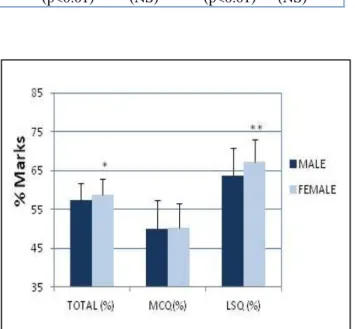
The male and female students in high achiever group performed similar in all types of assessment modalities (LSQ and MCQ) with no significant difference between them as shown in Figure 1. However, significantly high scores in LSQ (middle 67.35±5.63% & low achiever 56.93±6.59%) as well as in total theory (middle 58.76±3.96% & low achiever 46.73±4.52%) was obtained by the female students of both middle as given in Figure 2 and low as in Figure 3 achiever groups as compared to male (middle 64.6±7.19% & low achiever 51.12±10.22% in LSQ; and middle 57.29±4.45% & low achiever 44.25±4.7% in total theory), but no significant difference was observed for MCQ scores between them as presented in Figure 2 and 3.
Assessment of correlation between LSQ and MCQ revealed absence of any significant correlation for high achievers in both male and female students. Whereas, significant negative correlation was found to be present between LSQ and MCQ marks only for male students of middle and low achiever groups, but performance of female students did not hold any such correlation as given in Table 2.
Figure 1: % marks (Mean±SD) obtained in total theory, MCQ & long & short answer question (LSQ) by male and female students of High Achiever group. No significant difference was observed for any of these
parameters.
* p≤ 0.05; ** p≤0.01.
Figure 2: Depicts comparison of % marks (Mean ± SD) obtained by male and female students of middle achiever group in total theory, MCQ & long & short answer question (LSQ) which shows a significant
difference between total theory and LSQ marks.
* P ≤0.05
Figure 3: Displays comparison of male and female students from low achiever group. A significant difference was observed between total theory and long
DISCUSSION
The present study was an attempt to assess the performance of 1st year MBBS students in a preclinical subject (physiology) not only on the basis of gender difference but also from the angle of academic achievement level of students in terms of marks obtained. For this purpose, we divided male and female students as high, middle and low achievers based on their overall performance in theory examination. We also aimed to look into the performance of these student groups for different modalities of written examinations i.e. long and short answer questions (LSQ) and MCQ.
Overall performance of all the students (irrespective of gender) was more in LSQ as compared to MCQ, which indicates that generally students are better in representing the organized ideas and knowledge.15,16 As is known, MCQs are targeted for evaluating objectively the theory knowledge with emphasis on analytical/critical thinking as achieved by the use of reason-assertion or multiple response question.17,18 All the students, both male and females, received significantly lesser marks in MCQ as compared to theory examination (LSQ) irrespective of their level of achievements (high, middle or low), indicating thereby that in general MCQs may be more tricky and complicated for the students and its objectivity might not allow them to score easily.15,19 In our earlier study, we have already reported the impact of subtypes of MCQs eg. single response, multiple response, reason-assertion & problem based questions on the grade of performance of medical students.4
Studies have reported higher scores in long essay questions as compared to MCQ due to the fact of bias or more subjective marking schemes of different assessors compared with the more quantitative nature of MCQs.8,9 However, in our format of examination, LSQ consisted of properly structured long and short questions which minimizes the subjective bias of correction by the examiners and may be the reason for obtaining better scores by the students.
When gender difference was considered, we found that female students performed better as compared to males in both modalities of assessment formats. In contrast to our findings, some of the earlier studies had reported either better performance by male students20 or no difference in genders for assessment in preclinical subjects.14,21 However, better performance by female students have been reported for clinical subjects.22,23 In a more recent study, para-clinical subject like Pharmacology also reported better performance by female students as compared to male students.11 Better performance by female students have been attributed to the fact that they are inherently better at reading comprehension, perceptual speed and associative memory skills or because of their more sincere and greater efforts in medical courses.14,24 It may be further emphasized here that better performance by females in theory questions as
compared to MCQs also suggests better reasoning, depth of knowledge and conceptualization ability in them. We also found a high correlation between total theory and MCQ type questions as well as total theory marks vs LSQ for both the genders indicating that performance of students is independent of modality of testing. Also, it may be mentioned here that the failure rate (i.e. students getting less than 50% in total) of male students were much higher as compared to female students which was the reason for a very small number of female students in low achiever group.
However, stratification of performances of students into subgroups of high, middle and low achievers revealed interesting facts. Above average students in our study with marks above 65% (i.e. high achievers), irrespective of their genders, were found to have no difference in their performance in LSQ & MCQ suggesting thereby that students with higher academic abilities perform equally well irrespective of their genders. Also, high achiever male and female students showed no correlation between LSQ and MCQ performance. This finding was in accordance to the study of Dagogo et al, 2010,conducted on medical students of physiology.9 In this regard, our findings corroborate their interpretation that more competent students might have indiscriminate ability to handle either LSQ (with strong ability to organize and apply knowledge) or MCQ (with strong factual recall and analytical abilities) or both. We also observed lack of correlation between LSQ and MCQ marks for middle achiever female students as compared to males which again points towards better recall, cognitive and analytical abilities of average female students, therefore, possessing better competence in both the formats of assessment modules i.e. LSQ or MCQ.25 In this context, it is worth noting also that a significant negative correlation observed in case of male students of middle and low achiever groups. Such negative correlation was also observed for female students of low achiever group which was though not significant, had high "r" value (r=0.35) and this might be due to presence of very less number of female students (n=7) in this group, as very few female students had failed in overall performance. The negative correlation observed in these cases clearly points towards the fact that these students scored significantly less in MCQ suggesting therefore a poorer analytical/critical/recall abilities for highly objectivised questions (e.g. MCQ) as compared to LSQ.
than the performance obtained by using only one of the modalities.
However, further studies with bigger sample size are needed to substantiate this regard. Besides, comparison of performance on the basis of gender and achievement level at different levels of medical curriculum (i.e. pre, para and clinical) requiring altered levels of abilities for a medical graduate may give us better insight into the matter.
ACKNOWLEDGEMENTS
We wish to thank all the faculty members of the department of Physiology at AIIMS, Raipur for their contribution to the departmental question bank, which led us to this study.
Funding: No funding sources Conflict of interest: None declared
Ethical approval: The study was approved by the institutional ethics committee
REFERENCES
1. Walubo A, Burch V, Parmar P, Raidoo D, Cassimjee M, Onia R, Ofei F. A model for selecting assessment methods for evaluating medical students in African medical schools. Acad Med. 2003;78:899–906.
2. Sharma HS, Mutalik MM. Questions and Structured essay questions at III MBBS examination in Otorhinolaryngology in a Medical college in Mauritius. Int J Pharm Bio Sci. 2014;5(4):1195-202. 3. Reiner MC, Bothell TW, Sudweeks RR, Wood B. Preparing effective essay questions. A self directed workbook for educators. New Forum Press; 2002. 4. Ghate J, Sinha M, Sinha R. Correlation of MCQ
subtypes with grading of performance among undergraduate students in a preclinical discipline. Int J Res Med Sc. 2017;5(2):1-6.
5. Khan MZ, Aljarallah BM. MEQs and MCQ as a tool for assessing the cognitive skills of undergraduate medical students. Int J Heal Sci. 2011;5(1):45–50.
6. Beirer SB, Dannefer EF, Taylor C, Hall P, Hull A. Methods to assess students’ acquisition, application and integration of basic science knowledge in an innovative competency-based curriculum. Med Teach. 2008;30:171–7.
7. Sheader E, Gouldsborough I, Grady R. Staff and student perceptions of computer-assisted assessment for physiology practical classes. Adv Physiol Educ. 2006;30:174–80.
8. Moqattash S, Harris PF, Gumaa KA, Abu-Hijleh MF. Assessment of basic medical sciences in an integrated systems-based curriculum. Clin Anat. 1995;8:139–47.
9. Pepple DJ, Young LE, Carroll RG. A comparison of student performance in multiple-choice and long
essay questions in the MBBS stage I physiology examination at the University of the West Indies (Mona Campus).Adv Physiol Educ. 2010;34:86–9. 10. Shittu LA, Zachariah MP, Adesanya OA, Izegbu
MC, Ashiru OA. The differential impact of various assessment parameters on the medical students’ performance in the professional anatomy examination. Sci Res Essay. 2006;1(1):14-9. 11. Pai MRSM, Sanji N, Pai PG, Kotian S. Comparative
assessment in pharmacology multiple choice questions versus essay with focus on gender differences. J Clin Diagnostic Res. 2010;(4):2515-20.
12. Tyrer SP, Leung WC, Smalls J, Katona C. The relationship between medical school of training, age, gender and success in the MRCPsych examinations. Psych Bull. 2002;26:257263.
13. Krueger PM. Do women medical students outperform men in obstetrics and gynecology? Acad Med. 1998;73(1):101-2.
14. Deepak KK, Umran KU, Sheikh MH, Al-Rubaish A. The influence of gender on undergraduate performance in multiple choice testing in clinical disciplines at University of Dammam, Saudi Arabia. Al Ameen J Med Sci. 2011;4(2):123-30.
15. Kumar P, Ghildiya JP, Rajpoot RS, Kumar S. Comparison of performance in physiology subject assessed by short essay type questions and multiple choice questions of first year medical students. Asian J Med Sc. 2017;8(1):82-4.
16. Agu AU, Esom EA, Nto JN, Anyanwu GE, Ezugworie JO, Adiri CO, et al. Students preference for various types of assessments in anatomy examination. Intl J Develop Res. 2014;4(7):1377-9. 17. Palmer EJ, Devitt PG. Assessment of higher order cognitive skills in undergraduate education: modified essay or multiple choice questions? Research paper. BMC Med Edu. 2007;7:49. 18. Vyas R, Supe A. Multiple choice questions: A
literature review on the optimal number of options. Natl Med J India. 2008;21(3):130-3.
19. Bandaranayake RC. Setting and maintaining standards in multiple choice examinations: AMEE Guide no. 37. Med Teach. 2008;30:836–45.
20. El-Hazmi MAF, Tekian As, El-Mahdy S, Lambourne A. Performance of men and women medical students at King Saud University, Riyadh: a IO-year retrospective study. Med Edu. 1987;21(4):358-61.
21. Omigbodun OO, Omigbodun AO. Influence of gender on undergraduate performance in psychiatry at Ibadan, Nigeria. Med Edu. 2003;37(12):1091–3. 22. Haist SA, Witzke DB, Quinlivan S,
examination at University College Dublin. Med Educ. 2000;34:30-4.
24. Castagnetti C, Rosti L. Effort allocation in tournaments: The effect of gender on academic performance in Italian universities. Eco Edu Rev. 2008;28:357-79.
25. Anbar M. Comparing assessments of students’ knowledge by computerized open-ended and multiple choice tests. Acad Med. 1991;66:420–2.