VOLUME 18 ISSUE 2 (2020), Page 219 – 230
THE VARIANTS AND MEANINGS OF MALAY MOTIF ORNAMENTATION IN THE URBAN CONTEXT:
A CASE STUDY OF PUTRAJAYA
Zumahiran Kamarudin1, Puteri Shireen Jahn Kassim2, Alias Abdullah3
1,2,3Kulliyyah of Architecture and Environmental Design
INTERNATIONAL ISLAMIC UNIVERSITI MALAYSIA
Abstract
As Malaysia’s new satellite city, types of Malay motif and meanings inPutrajaya have been abstracted and used as design motifs and ornamentation for the quest of local identity. However, it is uncertain whether the placement of such components, which is sometimes difficult to comprehend, gives the premises a sense of identity. Therefore, this study aims to identify the variants, meanings and applications of these motifs in the ornamentation of public buildings in the urban context leading to its character and identity formation. The researchers had conducted on-site surveys and photographic documentation, and semi-structured interviews for data collection. Using Putrajaya as a case study, a visual descriptive and interpretative analyses was undertaken to analyse the underlying basis in terms of various plants from natural surrounding and transformations into the new depiction of motifs. The analyses revealed two distinctive types of Malay motifs depictions found in the building components with the tangible and intangible qualities that articulate their compositional order. The Malay urban character involves the depictions of abstract motifs incorporating local Malay cultural elements. Plant-based motifs dominate the ornamentation, which have its meaning and characteristics. The physical and practical nomenclatures of the motifs are indicators of continuity of tradition in the urban buildings. Further research is necessary to investigate the people’s perception of these abstracted
motifs as ornamentation in the interior and exterior spaces of the public buildings.
INTRODUCTION
Many urban public buildings, including educational, administrative, civic institutional, and commercial buildings in Peninsular Malaysia, showcase the ornamentation of abstract motifs to serve multiple purposes. The purposes of the embellishment depend upon the character of occupancy or the type of use. The understanding of such adornment and their meanings, especially by present-day designers, would inaugurate innovative possibilities for contemporary buildings and facilitate the design of buildings with local character to achieve a sense of authenticity while being aesthetically appealing. In recent years, considerable efforts have been invested in sustaining the revitalisation of cultural values, especially regarding architectural ornamentation. The focus of this quest for revival has predominantly centred on public buildings. However, it is uncertain whether the placement of such components, which is sometimes difficult to comprehend, gives the premises a sense of identity. McNaughton (2001) posits that the term ‘ornamentation’ specifically refers to its tangible and intangible roles that lead to building character and its identity formation. This paper discusses the integration of the decorative components in selected urban public buildings in Putrajaya with an emphasis on the manifestation of abstract Malay motifs in various forms of patterns and techniques. Many designers interpret the beauty of floral elements from natural surroundings into the innovated forms of motif and design. Thakkar (2004) postulates that a person develops his idea of ornament to beautify his surroundings. Nature and the socio-cultural environment have been the pivotal stimulus for beautification. Therefore, the objectives of this research are to analyse the types of abstract Malay motif and determine the meanings behind the design principles of the motifs as ornamentation reflecting local characteristics on public buildings in Putrajaya.
LITERATURE REVIEW
Defining Ornamentation and its Various Meanings
There is no universally-approved definition of ornamentation. The term has been defined in many ways. Likewise, many scholars have given their views on the meaning of ornamentation and its different purposes. As a working definition, especially in architecture, ornamentation is defined as something that beautifies or adorns a building or monument that becomes its essence. However, its presence is secondary to the architecture (Jones, 2001) while furnishing visual order to the thing with which it is associated (Grabar, 1992). Embellishment serves as an intermediary between art and structure. Its presence is to improve the appearance of functionally complete objects hence giving visual pleasure (Trilling, 2001). Baer (1998) posits that one of the primary functions of ornaments fitted on buildings or applied on portable objects of art is to embellish their surface. It expresses and communicates contemporary ideas of beauty and aesthetic concepts using forms, materials, and techniques fashionable at a specific time.
Ornamentation serves as a specific term embodying its intangible role that leads to building character and its identity formation. Ornaments, as addressed by McNaughton (2001), provide a way of incorporating added meaning into buildings, which supports the purpose for which it was built and further conveys the beliefs of the surrounding community. Their co-existence should be in harmony with the structural features of the architecture. Ornament is distinguished from decoration in that its primary purpose is to enhance its carrier by supplying visual order (Schafter, 2003). The decoration involves embellishing things by adding ornaments. Salama (2007) postulates that decoration is related to space beautification, which means to bring out the ability to spread the inner beauty so that the surrounding also becomes beautiful. Beauty is not only understood as aesthetical meaning; it is also associated with intangible purposes, including calmness, peacefulness, and pleasantness. Furthermore, the idea of ornamentation grew from the basic urge of an individual to embellish his surroundings wherein nature and the socio-cultural environment play a significant role (Thakkar, 2004; Spahic Omer, 2009). Three factors influence the mode of embellishment, namely the practical consideration, the need of display and the symbolic aspect of ornamentation.
the context of this study, the word embellishment is used to represent practices and ideas of building ornament, specifically those with abstract motifs.
Idiom of Compositional Principles and Visual Order in the Malay Motif The motif is used visually as part and parcel of various forms in arts and crafts. Therefore, multiple definitions for the word motif are found in the literature related to art and design. A motif means repeated shapes or thematic elements in a design or pattern (Wallschlaeger & Busic-Snyder, 1992). The most prominent and frequent decorative patterns found in arts and crafts are from floral elements. Motifs and patterns are interconnected and considered essential ingredients of aesthetic design. Motifs and patterns interact and become complementary elements in decoration, reflecting the skills and preferences of the maker and the taste of the intended viewer (Trilling, 2001). The visual attributes of the decorative components are an amalgam of tangible qualities and intangible traditions that enunciate its compositional order.The essence of the Malay motif, such as in woodcarvings, for example, illustrates its link with the natural elements like a growing plant. This element emerges from a source or a seed, which serves as its origin. Thus, a growing plant has been an important source for design patterns employed in the Malay wood carving (Farish & Eddin, 2003). The awan
larat (moving cloud), for example, represents the continual growth and
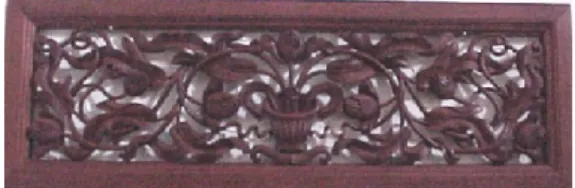
movement of life in a natural plant. The name awan larat originates from a moving cloud (Syed Ahmad Jamal, 1994). It represents the form of a spiral which is continuous but emanates from a core root, flower or seed with the outward flow in a progressive movement, as shown in Fig 1.
Figure 1: Awan larat with its associated elements
Awan larat consists of combined elements forming one complete carving that
larat that consists of these elements that are depicted as the theme of the composition. Meanwhile, Rosnawati Othman (2005) suggests that two poles determine the visual order of the awan larat: (1) the sense of rhythm innate in the natural order, and (2) the genius of composition. Rhythm and movement are interrelated, which determine good carvings. Apart from being complete in composition, awan larat also represents a philosophical meaning that pertains to the natural growth of real plants (Sulaiman Esa, 2001; Rosnawati Othman, 2005). The flows of plant elements in intertwining, interlacing, and overlapping characters represent the growth of a plant in a complete composition, as shown in Figure 1. In the intertwining composition, the overlapped form of linking lines between plant elements shows crosses above or below each other in a three-dimensional arrangement.
In short, the reviews of related researches and literatures yield to the interrelationship between principles of aesthetic, principles of awan larat, factors of ornamentation and its meaning.
METHODS OF RESEARCH
This study involves exploratory research, and a significant amount of primary data came from the on-site surveys and photographic documentation, and semi-structured interviews. The purpose of the on-site survey was to identify and determine the buildings that have ornamentation with Malay abstract motif and their visual attributes, including (1) types of Malay motif, 2) placement and orientation of ornamentation, and (3) components of the building ornamentation. The selected area of research was Putrajaya, the administrative capital and administration centre of the government. Putrajaya houses many late twentieth and early twenty-first-century prominent architecture including Putra Mosque and Perdana Putra. In this area, the researcher identified a total of seven buildings for the investigation, and they are as an amalgam of various styles of architecture. These buildings are the Palace of Justice (PoJ), Pullman Hotel and Resort (PHR), Mahkamah Putrajaya (MP), Putra Mosque (PM), Bangunan Hal Ehwal Undang-Undang (legal affairs building) (BHEU), Ministry of Tourism and Culture (MoTC) and Ministry of Higher Education (MoHE). Most of the buildings were constructed in the late 1990s and early 2000s.
placement, orientation and physical attributes of the building ornamentations. Visual data on the motifs and building components discovered during the survey are worth for pictorial analysis and documentation.
RESULTS, FINDINGS, AND DISCUSSION
Types of Abstract Malay Motif Used in the Urban Public Buildings
Two types of Malay motifs were identified from the on-site survey: 1) abstract floral design, and 2) plant-based motif. They are further categorised into two types of ornamental modes, namely integrated element and surface beautification. The survey of the buildings reveals that the two types of motifs are the archetype of the Malay motif. This motif archetype is prevalent in the different components of the buildings, namely, wall decorative components, perforated screen panels, gateway panels, window screen panels. Their presences are either for surface beautification or integrated elements for the different types of buildings. 6 out of 7 buildings, namely, Palace of Justice (PoJ), Pullman Hotel and Resort (PHR), Mahkamah Putrajaya (MP), Putra Mosque (PM), Bangunan Hal Ehwal Undang-Undang (BHEU), and Ministry of Tourism and Culture (MoTC) are adorned with wall decorative components for surface beautification. The results suggest that surface beautification becomes central mode of ornamentation for the buildings. In the context of the abstract Malay motif, the
craftsmen’s understanding of the Malay philosophy of awan larat determines the distinctive physical form of ornamentation. The beauty in the arrangement of the ornaments does not happen arbitrarily, but the specific idiom of compositional principles regulate its existence as evidence in the ornamentation of the buildings. There are many examples of ornamental motifs with the stylised pattern and semi-naturalistic style of awan larat, which dominate the exterior façades of the buildings as apparent in Palace of Justice (PoJ), Pullman Hotel and Resort (PHR), Mahkamah Putrajaya (MP), Bangunan Hal Ehwal Undang-Undang (BHEU), and Ministry of Tourism and Culture (MoTC). Many integrated elements in forms of perforated screen panels, decorative gateway panels and window screen panel with plant-based motifs dominate the facades of these buildings. Table 1 summarises the archetypes of the motifs found in the ornamental components of the buildings with regards to the types of motif, placement and orientation of ornamentation, and components of the building ornamentation.
Table 1: Archetypes of motifs in the ornamental components of the buildings
Source Ornamental modes
PoJ ✓ Surface beautification (decorative components on wall facade)
✓ Abstract floral design ✓ Plant-based
motif
Stylised pattern in repetitive placement
PHR ✓ Surface beautification (decorative components on wall façade)
✓ Integrated element (screen panel, window panel, gateway panels)
✓ Abstract floral design ✓ Plant-based
motif
Stylised pattern and semi-naturalistic in repetitive placement
MP ✓ Surface beautification (decorative components on wall facade)
✓ Abstract floral design ✓ Plant-based
motif
Stylised pattern and semi-naturalistic in repetitive placement
PM ✓ Surface beautification (decorative components on wall facade)
✓ Abstract floral design
Stylised pattern in repetitive placement of interior spaces
BHEU ✓ Surface beautification (decorative components on wall façade)
✓ Integrated element (perforated screen panel, gateway panels)
✓ Abstract floral design ✓ Plant-based
motif
Stylised pattern and semi-naturalistic in repetitive placement
MoTC ✓ Surface beautification (decorative components on wall façade)
✓ Integrated element (perforated window screen panel, gateway panel)
✓ Abstract floral design ✓ Plant-based
motif
Stylised pattern and semi-naturalistic in repetitive placement of exterior spaces
MoHE ✓ Integrated element (perforated window screen panel)
✓ Abstract floral
design Stylised pattern in repetitive placement
Ornamentation in the Pullman Hotel and Resort (PHR) in Precinct 5 and their visual composition and attributes suggest the awan larat archetype is used in its unifying pattern with other components, as shown in Fig 2A and Fig 2B. A range of integral elements gave attention to the front wall and windows and at the entrance gateway of the building. The decorative panels depicting the awan larat design with plant-based motifs was inspired by Pokok Bunga Tanjung
(Mimusops elengi). This luxury hotel, located in Precinct 5, demonstrates
A B
Figure 2: The architectural ornamentation of Pullman Hotel and Resort, Putrajaya
Bangunan Hal Ehwal Undang-Undang (BHEU) (legal affairs building), also known as the Legal Affairs Division, located in Precinct 3, showcases a wealth of perforated screens within its unique architecture. In these integral components, the concept of ibu (source) is visible within a composition of arches (Fig 3). Depiction of awan larat design with a plant-based motif is very dominant, consisting of combined plant elements in gentle character.
Figure 3: The architectural components of Bangunan Hal Ehwal Undang-Undang
The building artistically blends traditional design, modern form, and the use of the local concept of motif inspired by Ulam Raja (Cosmos caudatus), also known
as King’s salad. In harmony with its architectural style, the building feature is
suitable for Precinct 3, the core island, which is also known as the civic and cultural precinct of Putrajaya. The specific idiom of visual order regulates the
beauty of ornamentation and is in parallel with the building’s function. The
design of the building reflects the Neo-Raj palace in Jaipur Rajasthan, India, which shows clear Mughal influences on its Rajput architecture. As such, colonnades, porticos, archways, and screens of window openings with faced brick façades become dominant features. The multitude of fenestrations and ornate wall decorations found are suggestive of local Malaysian identity.
pure imagination or conception. Three approaches, influenced by Islamic principles of composition, namely unity in design, the contrast in characters, and the repetition of elements that appear in the arrangement of the components represent the aesthetic principle through visual beauty. This concept is further classified into two different aspects: micro composition (in the individual component) and macro composition (in the whole structure). The impacts of
cultural constructs, such as the notions of “ibu” as “identity” influence the
designs of the ornament. Awan larat has been the most pervasive design pattern in the decorative components, which are visible in many decorative components as seen in BHEU and the Pullman hotel. These qualities contribute to the meaning of beauty in their ornamentations. Therefore, beauty is one of the attributes that connote to the importance of ornamentation in both buildings.
Modes of Ornamentation and Principles in the Adornments of the Buildings The analysis of the buildings suggests five principles of building ornamentation: 1) integral part of construction, (2) surface beautification, 3) functionality, 4) unity, and 5) meaningfulness. These principles are visible in the embellishment of wall components. In the façades of Ministry of Higher Education (MoHE), Precinct 5 and Mahkamah Putrajaya (MP), Precinct 3, as in Figure 4A and Figure 4B, respectively, incorporated fundamentals are normally used by Malay craftsmen as structural guidelines.
Figure 4: The decorative components at the front façades of Ministry of Higher
Education (MoHE) and Mahkamah Putrajaya (MP)
The study shows that the public buildings and their ornamentations are
the collective manifestations of the craftsmen’s skilful interpretations that include tangible and intangible aspects behind the principles and meaning of each type of motif. Also, this achievement relates to their attitudes of making the embellishments visually comforting for the public in contemporary living. The
study suggests how they respond to the local people’s visual reference, but
balancing the visual principles and unity of design of the ornamentation to suit the contemporary living. Based on their visual attributes, the decorative components are excellent indicators of both continuity and innovation of traditional decoration in the modern based buildings designed by local architects, for example, the Pullman Hotel and Resort (PHR), designed by Raja Kamarul Bahrin Shah Raja Ahmad. Local Malay architects like him have set an example by documenting their perception of traditional worldviews on inorganic materials such as glass fibre reinforced concrete (GFRC), which enhance the sense of sustainability of local identity while simultaneously sustaining the old traditions. The inherent beauty also reflects their knowledge in the application of design principles for visual composition. The beauty in the arrangement of compositional elements in the embellishment does not happen arbitrarily. The specific idiom of compositional principles dictates and regulates its existence. The art of ornamentation has integrated meanings and contents that is aware of the ethnic environment. The floral motifs are derived from the inexhaustible nature of its surroundings. Other than Arabic calligraphy or geometry, the floral motif is the possible form of content that could express the spiritual ideal of
Islam, as found in many Putrajaya’s buildings.
Visibility of the heritage identity of the Malay motif in the embellishment of the present architecture reflects the sustainability of traditional idiom of compositional principles and visual order in the Malay theme. Owing to these, the reinterpretation of the heritage identity of the Malay motifs in the present modern buildings reflects several changes in its architectural features. The mode of embellishment gives a major impact on the buildings’ character,
decorative form, primarily via the use of floral design, helped it grow considerably more innovative and creative abstract decoration. This marks the rebirth of the abstract-based cultural items with converging values in the present architectural ornamental scheme. Both values deal basically with tradition and beauty.
CONCLUSION AND RECOMMENDATION
In this paper, the focus is on the integration of Malay motifs in the selected public buildings situated in Putrajaya. The results of the study show that abstract floral and plant-based design are the two types of motifs ornamenting public buildings. The study found two categories of ornamental modes, namely integrated element and surface beautification. The awan larat pattern becomes a dominant feature for the ornamentation. They form different placements for different types of buildings, namely administrative, commercial, and religious. The structures were heterogeneous in form, but most of the ornaments were in synchronised order, according to the building forms. One interesting finding was that plant-based motifs, although found in different shapes, are more common for various buildings. The use of abstraction is considered an effective approach in increasing the versatility of motifs for multiple typologies of architecture. Yet, underlying this heterogeneity is an underpinning of philosophical ethos of awan
larat as an abstract motif in the building ornamentation, which promotes regional
identity. These still resonate in modern buildings that eschew sentimental attachment to old ornaments and traditional values yet which are in favour of technological and architectural progress and change. The challenge is to continue encouraging interest in the production of local ornament while attempting to maintain its perception of authenticity among both locals and visitors. As such, there is a need for future research to investigate the perception of the application of abstract motifs as an embellishment in public buildings. Findings from this research would fill in the gap of knowledge regarding the existence of traditional Malay design in the architectural ornamentation of contemporary buildings, especially in discovering its meanings of placement concerning the visual forms and contents of the awan larat. Also, an introduction of a new motif from local plants into different types of ornaments would be part of the effort to promote traditional Malay design and ensure its sustainability.
ACKNOWLEDGEMENTS
REFERENCES
Abdul Halim Nasir (1987). Traditional Malay Woodcarving. Kuala Lumpur: Dewan Bahasa dan Pustaka.
Baer, A. (1998). Islamic Ornament. New York: New York University Press.
Farish A. Noor and Eddin Khoo (2003). Spirit of Wood the Art of Malay woodcarving. Singapore: Periplus Editions (HK) Ltd.
Grabar, O. (1992). The Mediation of Ornament. Princeton,NJ: Princeton University Press. Jones, O. (2001). The Grammar of Ornament. London: A Dorling Kindersley Book. McNaughton, M. E. (2001). A Cornhusker Hotel: A Case Study of the Meaning of the
Architectural Ornamentation. University of Minnesota, Minnesota.
Rosnawati Othman (2005). The Language of the Langkasuka Motif, Indonesia and the Malay World, 33(96), 97-111.
Trilling, J. (2001). The Language of Ornament. London: Thames & Hudson.
Salama, A., (2007). Mediterranean Visual Messages: The Conundrum of Identity, ISMS, and Meaning in Contemporary Egyptian Architecture. Archnet-IJAR, International Journal of Architectural Research. 1(1), 86-104.
Schafter, D. (2003). The Order of Ornament, The Structure of Style Theoretical Foundations of Modern Art and Architecture. United Kingdom: Cambridge University Press.
Spahic Omer (2009). The Philosophy of Decoration in Islamic Architecture. Kuala Lumpur: International Islamic University Malaysia.
Sulaiman Esa (2001). Islamic Roots of the Malay Philosophy of Beauty. In Niranjan Rajah. (Ed.) Insyirah the Art of Sulaiman Esa from 1980 to 2000. (pp. 65-81). Kuala Lumpur: Petronas.
Syed Ahmad Jamal (1994). Form & Soul. Kuala Lumpur: Dewan Bahasa dan Pustaka. Thakkar, J. (2004). Naqsh The Art of Wood Carving in Traditional Houses of Gujarat.
India: Research Cell.
Wallschlaeger, C. and Busic-Snyder, C. (1992). Basic Visual Concepts and Principles. New York: McGraw.Hill.