1
M O V I N G F R O M T H E T R A D I T I O N A L T O A
M O R E D I A G N O S T I C , P R E S C R I P T I V E , A N D
A U T H E N T I C M O D E L O F S T U D Y S K I L L S
D E V E L O P M E N T
MICHAEL S. HEARD, KENNESAW STATE UNIVERSITY
This article focuses on a five-step approach for moving from the traditional method of teaching study skills development to a more diagnostic, prescriptive, and authentic approach.
Like many professors who teach a first-year seminar, helping students develop good study skills to aid them in preparing for the rigors of university academics is a major objective of my seminar. Developing good study skills is one of the keys to achieving academic success. When one looks at the Summary of Results from National Surveys on First-Year Seminars (conducted by the National Resource Center for the First-Year Experience and Students in Transition, University of South Carolina) the importance of helping students develop good study skills is apparent. When respondents in these national surveys were asked to identify the most important course objective of their first-year seminar, the most frequently reported objective was the development/fostering of academic skills (56%, 2002; 64%, 2006; 54%, 2009).
The importance of developing good study skills was further supported on our campus by a survey conducted several years ago by members of our faculty. Near the end of the semester, we surveyed students enrolled in several of our first-year seminars by asking them to rank, in descending order, the most beneficial to least beneficial chapters of our textbook. “Learning Strategies for Academic Success” and “Time Management” were ranked as the two most beneficial chapters in the course. Additionally, anecdotal evidence from second-year students interviewing to be orientation leaders on campus further supports the importance of developing good study skills. When interviewees were asked, “What aspects of your first year of college did you find most challenging and/or demanding?” many of those being interviewed replied, “the new study and learning requirements, time management, and having to take more responsibility for their own academic and personal success was much more challenging and demanding than anticipated.” These were comments coming from some of our outstanding and top tier second-year students.
2 study skills strengths and weaknesses at the beginning of the semester allowed me to adapt instruction targeted at my students’ most significant needs.
To enhance student engagement and involvement in the learning process, I needed to develop an approach that was uniquely responsive to the specific study skill needs of the students enrolled in my class. I believe strongly that academic skills need to be developed and/or enhanced before there are signs of academic difficulty. This necessitates the need to be more proactive than reactive in developing/addressing study skills needs.
Unless students address their individual study and learning skill needs during their first year, the problems they face in subsequent years will be even more challenging. Additionally, there is a sizeable amount of research that demonstrates the important connection between study skills and academic performance outcomes (Robbins et al., 2002). Robbins and his colleagues (2004) point out that study skills are not only essential for college success, but may also result in student persistence.
Finally, the extensive meta-analysis conducted by Robbins et al. (2004) indicated that academic goals, academic self-efficacy, and academic-related skills were the strongest predictors of retention.
IMPORTANCE OF STUDY AND LEARNING SKILLS DEVELOPMENT
Study skills are approaches applied to learning. They are critical to success in school, essential for acquiring good grades, and are useful for learning throughout one's life. Study skills are distinct techniques that can be learned, usually in a short time, and applied to all or most fields of study. They are generally distinguished from discipline-specific strategies that are specific to a particular field of study, e.g., math or political science, and from abilities inherent in the student, such as aspects of intelligence or learning style.
Study skills are fundamental to academic competence. Effective study skills are associated with positive outcomes across multiple academic content areas and for diverse learners. Academic competence is associated with the knowledge and application of effective study skills. First-year students, regardless of their high-school academic history and/or preparation may experience academic difficulty during their first year of college, not because they lack ability, but because they lack good study skills. Although some students develop study skills independently, many go through school performing relatively well, without having acquired effective approaches for studying (Nicaise & Gettinger, 1995).
Many times, academic difficulties for first-year students has less to do with subject matter and more to do with the ability of the student to study and absorb information effectively. Learning anything requires discipline, practice, and commitment. The most successful first-year students are those who are able to concentrate, prioritize, and focus their minds on practicing good study and learning skills.
3
TRADITIONAL MODEL/APPROACH TO STUDY SKILLS INSTRUCTION AND
LEARNING
Traditional approaches to study skills instruction include an emphasis on:
Instruction and lectures.
Listening and observations in class. Memorization of basic facts.
One correct answer is sought, using one "standard" method. All students in a classroom are taught the same material.
Instructor selects a textbook with study skills topics to cover in class. Instructor develops a syllabus based on the textbook.
Students receive uniform instruction on each of the study skill topics, a “one-size-fits-all approach.”
Students study each study skill topic in a uniform manner.
Students receive grades based on their recall/test of study skill topics.
Limitations of this approach
:
Students assume what their individual study skill strengths and weaknesses are. Students have limited/quantifiable evidence to support these assumptions.
Instructors assume what the students study skill strengths and weaknesses are. Instructors have limited/quantifiable evidence to support these assumptions.
Instructor provides uniform study skill instruction, “one size fits all.”
Students and/or instructor have limited knowledge/quantifiable evidence as a basis for prioritizing the students’ study skill needs.
Instruction is teacher-centered.
Students are expected/assumed to apply subject matter content in general ways to their academic routines/needs.
Student grades are based on recall/recognition and indirect evidence of subject matter knowledge.
Student proficiency is often based on selecting a response.
AUTHENTIC MODEL OF STUDY SKILLS DEVELOPMENT
Authentic approaches to study skills instruction include an emphasis on:
Evaluation/Research of materials outside of lectures. Listening and observations outside the classroom. Real-life application of basic facts.
Alternative answers to a single question.
Student instruction is based on individual need and class-specific needs.
Instructor develops a syllabus based on individual and class-specific diagnosed needs. Study skill topics and time-on-task is based on student and class-specific needs.
4
APPROACH/METHOD
To address the individual and class-specific study skills needs of students within my seminar, we developed and implemented the following authentic-based approach:
1. Selected a range of specific study skills to address.
2. Administered a statistically valid study skills questionnaire associated with the selected study skill topics during the second class meeting.
3. Developed a study-skills syllabus section based on the individual, prioritized, and class-specific needs of the students.
4. Allowed instruction and class activities to be based on the identified and specific needs of the students as opposed to a predetermined set of objectives. This provides for a more student-structured approach to learning when compared to the traditional teacher-student-structured approach. 5. Required students to develop and implement Individualized Study and Learning Plans based on their
individual study skill profiles. The approach required students to perform real-life task associated with their individual needs. Students needed to provide direct evidence of their constructive application of research-based solutions.
6. Student grades are determined by how well a student can meaningfully apply solutions and research-based concepts to their study skill problems.
7. Post-tests are administered to assess and evaluate individual and class-specific progress.
THE FIVE –STEP APPROACH
STEP 1.
SELECT A
STATISTICALLY VALID AND RELIABLE TOOL FOR THE DIAGNOSIS OF
STUDY SKILLS THAT IS COMPATIBLE WITH YOUR STUDY SKILL SCALES (
DIAGNOSTIC
).
Most instructors begin each semester with limited knowledge of the individual or class-specific study skill needs of their students. Likewise, most of the students enrolled in first-year seminars have minimal to limited knowledge of their individual study skill needs (strengths and weaknesses). Determining what their specific study skills needs are and the varying levels associated with those needs is important if an instructor wants to provide customized instruction tailored to address those needs. Having this knowledge at the beginning of the semester allows both the instructor and the student an opportunity to apply effective solutions throughout the semester. It’s important to note that students at all levels of the academic spectrum benefit from improved study skill development.
Selecting a statistically valid and reliable tool that evaluates your selected study skill topics is extremely important. Questionnaires that evaluate skills not covered in your selected study skills topics will provide minimal value/support for your instructional efforts.
5 The LASSI provides standardized scores (percentile score equivalents) and national norms for ten different study skills scales (there is no total score since this is a diagnostic measure). The LASSI is both diagnostic and prescriptive. LASSI provides students with a diagnosis of their strengths and weaknesses, compared to other college students, in the areas covered by the 10 scales and it is prescriptive in that it provides feedback about areas where students may be weak and need to improve their knowledge, attitudes, beliefs, and skills.
I chose LASSI for several reasons:
It is easy to administer and understand;
It measured students’ strength and weaknesses; It can be done on-line and is not time-consuming; Results and feedback are instantaneous;
It is relatively inexpensive;
The scales of LASSI matched well with the subject-matter covered in our textbook. Student results based on the use of LASSI allowed me to:
(1) Personalize student learning. This principle reflects the importance of recognizing each student’s skills and learning styles.
(2) Develop instructional materials specific to the identified student needs and organizes course materials in an appropriate sequence.
(3) Revise course content and instruction based on student needs.
(4) Provide instructional activities which foster active involvement of students in the learning process. (5) Develop assignments that require students to engage in activities related to their individual and
identified needs.
(6) Select, develop, modify, and/or adapt instruction and assignments which support the varying needs of students.
(7) Provide instruction that maximizes student learning specifically relating to study skills.
(8) LASSI allowed me to be proactive and prioritize my approach to study skills instruction and development.
Considering each students reacts differently within the same academic environment, providing all students the same set of study skills concepts and principles, a “one-size-fits-all approach,” is not the most effective method of providing study skill instruction. Each student is different, requiring a unique combination/set of study skills to maximize their learning potential.
Because there are so many study skill possibilities, I limited my focus to the ten scales of the Learning and Study Strategies Inventory (LASSI): Attitude (ATT), Motivation (MOT), Time Management (TMT), Anxiety (ANX), Concentration (CON), Information Processing (INP), Selecting Main Ideas (SMI), Study Aids (STA), Self-Testing (SFT), and Test Strategies (TST).
STEP 2. IDENTIFY THE INDIVIDUAL AND CLASS-SPECIFIC NEEDS (BOTH STRENGTHS AND
WEAKNESSES) AT THE VERY BEGINNING OF THE SEMESTER
6 computer labs. Taking the LASSI assessment at the beginning of the semester maximizes their opportunity for implementing appropriate study skill strategies and practices.
The LASSI provides standardized scores (percentile score equivalents) and national norms for ten different scales (there is no total score since this is a diagnostic measure). The LASSI is both diagnostic and prescriptive. It provides students with a diagnosis of their strengths and weaknesses compared to other college students in the areas covered by the 10 scales and it is prescriptive in that it provides feedback about areas where students may be weak and need to improve their knowledge, attitudes, beliefs, and skills.
Before students took LASSI, they were assured that: LASSI is not an IQ test.
There are no right or wrong answers.
LASSI is designed to assist students at all levels of the GPA spectrum.
Students will not be differentiated, categorized, or grouped in class based on their LASSI scores. LASSI scores will have no effect on their final grade.
Prior to taking LASSI, students are told that LASSI is being used to:
Diagnose their individual study and learning skill strengths and weaknesses.
Assist them in designing a plan for enhancing their study skill strengths and improving their study skill weaknesses.
Assist them in prioritizing their study skill needs.
Assist them in developing a plan for improving their overall probability for academic success. Increase their self-awareness regarding their study skill profile.
Provide them empirical data to support their accurate or inaccurate perceptions of their study skill needs.
Provide them strategic assistance in the development of their Individual Study and Learning Plans (ISLP).
Assist me in developing targeted instruction to address their individual and class-specific study skill strengths and weaknesses.
RESULTS
Within hours of receiving all the student’s LASSI results, a class profile was developed that acted as the basis for subsequent study skills syllabus development. Evaluation of these profiles allows the teacher to develop targeted and tailored classroom instruction for the increased effectiveness and efficiency.
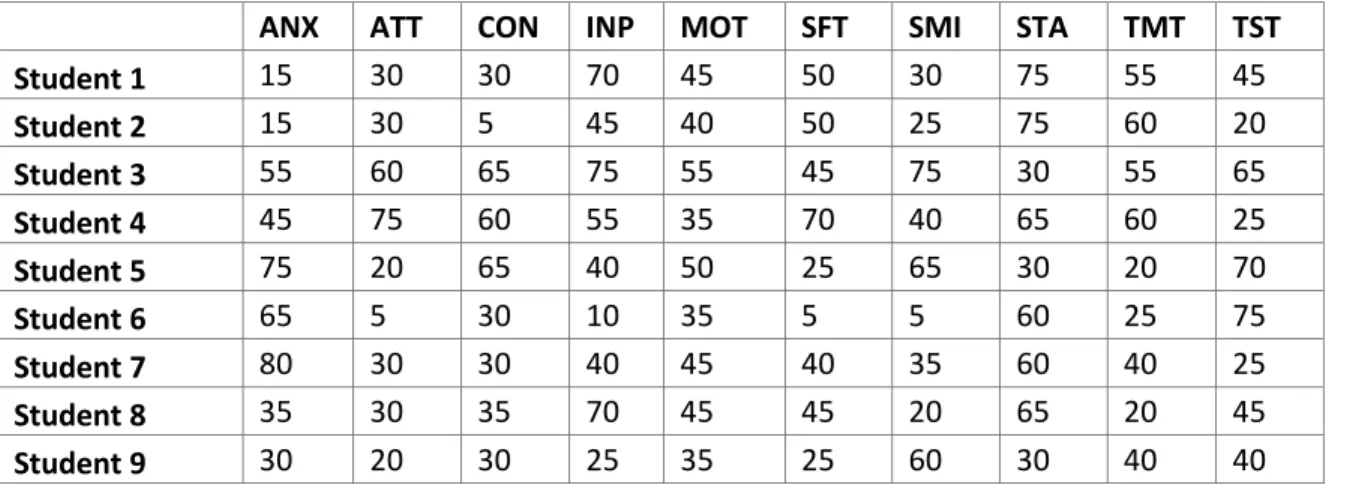
7 Figure 1. Example of Individual Student Scores/profiles
ANX ATT CON INP MOT SFT SMI STA TMT TST
Student 1 15 30 30 70 45 50 30 75 55 45
Student 2 15 30 5 45 40 50 25 75 60 20
Student 3 55 60 65 75 55 45 75 30 55 65
Student 4 45 75 60 55 35 70 40 65 60 25
Student 5 75 20 65 40 50 25 65 30 20 70
Student 6 65 5 30 10 35 5 5 60 25 75
Student 7 80 30 30 40 45 40 35 60 40 25
Student 8 35 30 35 70 45 45 20 65 20 45
Student 9 30 20 30 25 35 25 60 30 40 40
75-100 If you scored above the 75 percentile on any of the ten LASSI scales, you probably do not have to give a high priority to improving your strategies in those areas.
50 -75 If you scored between the 75 and 50 percentiles on any of the ten LASSI scales, you should consider improving your strategies in those areas.
0-50 If you scored below the 50 percentile on any of the ten LASSI scales, you need to improve your skills to avoid serious problems succeeding in college.
Attitude (ATT), Motivation (MOT), Time Management (TMT), Anxiety (ANX), Concentration (CON), Information Processing (INP), Selecting Main Ideas (SMI), Study Aids (STA), Self-Testing (SFT), and Test Strategies (TST).
Figure 2. Class profile based on first LASSI survey (2010)
8 75-100
If you scored above the 75 percentile on any of the ten LASSI scales, you probably do not have to give a high priority to improving your strategies in those areas.
50 -75 If you scored between the 75 and 50 percentiles on any of the ten LASSI scales, you should consider improving your strategies in those areas.
0-50 If you scored below the 50 percentile on any of the ten LASSI scales, you need to improve your skills to avoid serious problems succeeding in college.
Based on the class-average results, the class needed to improve (scored below fifty) their skills in eight areas: Attitude, Concentration, Information Processing, Motivation, Self-Testing, Study Aids, Time Management, and Test Strategies. The class should consider improving their skills (scored between 50 and seventy-five) in three areas (Anxiety, Selecting Main Ideas).
Due to time constraints, the four lowest areas (Attitude, Time Management, Test Strategies, and Concentration) were targeted and tailored for classroom instruction. Targeting these four areas did not mean the other areas (both strengths and weaknesses) were not covered, but these four areas received the primary focus (time-on-task) of classroom instruction. Additionally, putting individual and class-specific results in a graph allows for easier prioritization in terms of strengths and weaknesses.
STEP 3. DEVELOP/AMEND SYLLABUS AND CLASSROOM ACTIVITIES THAT TARGET
SPECIFIC STUDY SKILLS (
PRESCRIPTIVE
).
LASSI results allow you to develop/amend the study skills portion of your syllabus to address specific study skills. Having the ability to amend your syllabus at the beginning of the semester allow for a better match between student needs and instructional delivery. Allowing flexibility in your syllabus allows you the option/opportunity to address identified study skill needs rather than simply covering study skills in a generalized manner.
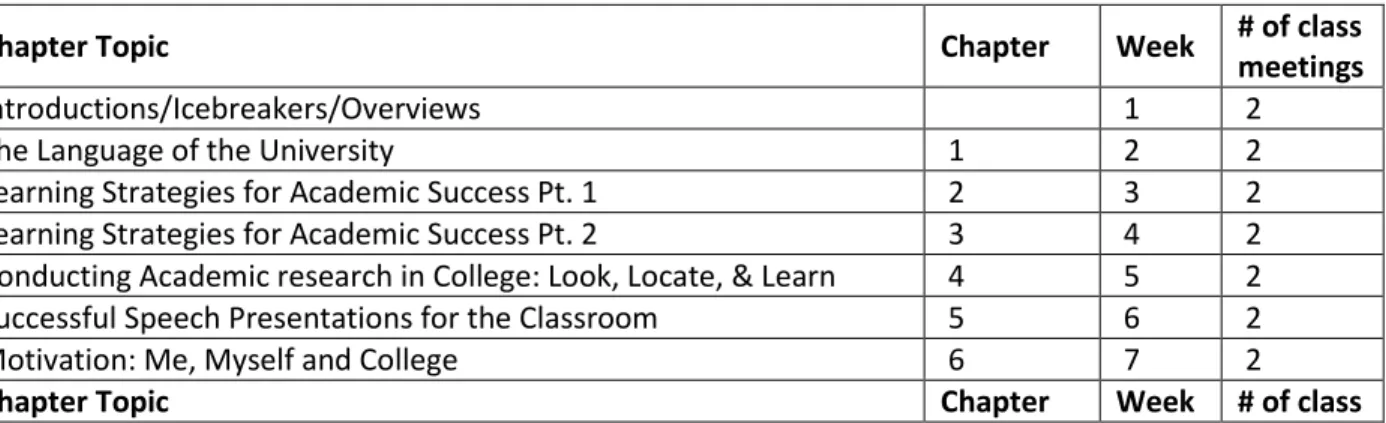
Figure 3. Textbook Layout 2010
Original Instructional Format and Time-on-Task
Table of Contents (Pre-LASSI) Syllabus Format
Chapter Topic Chapter Week # of class
meetings
Introductions/Icebreakers/Overviews 1 2
The Language of the University 1 2 2
Learning Strategies for Academic Success Pt. 1 2 3 2
Learning Strategies for Academic Success Pt. 2 3 4 2
Conducting Academic research in College: Look, Locate, & Learn 4 5 2 Successful Speech Presentations for the Classroom 5 6 2
Motivation: Me, Myself and College 6 7 2
9 meetings
Discover Yourself … Discover Your Career 9 10 2
Budget Your Way Through College Life 10 11 2
Your Global Community: Skillful Living in a Diverse World 11 12 2
Ethics, Leadership and Citizenship 12 13 2
Group Presentations 14 2
Group Presentations and Thanksgiving Break 15 1
Any make-ups and/or ISLP discussions and reviews 16 2
Total 31
Figure 4. Restructured Textbook Layout
Instructional Format and Time-on-Task
Table of Contents (Post-LASSI) Syllabus Format
Chapter Topic Chapter Week # of class
meetings
Introductions/Icebreakers/Overviews 1 1
Introductions/Icebreakers/Overviews students take LASSI 1 1
Motivation: Me, Myself and College *(ATT) Attitude 6 2 2
Time Management *(TMT) Time Management 7 3 2
Learning Strategies for Academic Success Pt. 1&2
*(TST) Test Strategies & *(CON) Concentration 2&3 4-6 6 Conducting Academic research in College: Look, Locate, & Learn 4 7 2
The Language of the University 1 8 2
Budget Your Way Through College Life 10 9 2
Becoming a Prepared Citizen: A Personal Responsibility 8 10 2
Discover Yourself … Discover Your Career 9 11 2
Your Global Community: Skillful Living in a Diverse World 11 12 2
Ethics, Leadership and Citizenship 12 13 2
Successful Speech Presentations for the Classroom 5 14 1
Group Presentations 14 1
Group Presentations and Thanksgiving Break 15 1
Group Presentations and/or ISLP discussions and reviews 16 2
Total 31
*Indicates Class-specific Weaknesses based on LASSI results
10
STEP 4. ASSIST STUDENTS IN DEVELOPING AN INDIVIDUAL STUDY AND LEARNING PLAN
BASED ON THEIR DIAGNOSTIC LASSI RESULTS (AUTHENTIC MODEL).
Characteristics of Authentic Tasks
Authentic assessment aims to evaluate students' abilities in 'real-world' contexts. In other words, students learn how to apply their skills to authentic tasks and projects. Authentic assessment does not encourage rote learning and passive test-taking. Instead, it focuses on students' analytical skills; ability to integrate what they learn. Performance assessment is a term that is commonly used in place of, or with, authentic assessment http://jfmueller.faculty.noctrl.edu/toolbox/tasks.htm. http://jfmueller.faculty.noctrl.edu/toolbox/tasks.htm - top
“Authentic assessment is commonly distinguished from traditional assessment is in terms of their defining attributes. Of course, traditional assessments as well as authentic assessments vary considerably in the forms they take. But, typically, along the continuums of attributes listed below, traditional assessments fall more towards the left end of each continuum and authentic assessments fall more towards the right end.” (Mueller, 2005)
Traditional Authentic
Selecting a Response Performing a Task
Contrived Real-life
Recall/Recognition Construction/Application Teacher-structured Student-structured Indirect Evidence Direct Evidence
Copied from, Jon Mueller (2005), "The Authentic Assessment Toolbox: Enhancing student learning
through online faculty development" -published in the Journal of Online Learning and Teaching (2005)
Outline for the Individual Study and Learning Plan
After discussing results of their individual and class-specific profiles, the reformatted class syllabus, and the process moving forward, I subsequently focused on the most important aspect of their study skills development, the formulation, implementation, and evaluation of their Individual Study and Learning Plans (ISLP). Based on their individual LASSI results (profile), each student was required to develop their own Individual Study and Learning Plan (ISLP).
The ISLP required students to analyze research, apply, reflect, evaluate, prioritize, and plan their individual approaches to study skills improvement. In developing their ISLP, each student is expected to set personal goals based upon his or her individual LASSI scores and then set forth a course of action to help them achieve the goals supported by information gained from their research and class lectures.
11 and apply their enhanced study skills within the domain-specific knowledge areas of their various classes.
The ISLP required each student to:
Examine how their strengths and weaknesses were manifested in their daily lives. Research solutions for enhancing their strengths and improving on their weaknesses.
Chart an appropriate course of action for implementing their findings based on their research. Develop a plan based on their individual needs and situations.
Set personal goals and objectives for addressing their weaknesses and enhancing their strengths.
Apply what they learned about themselves and apply appropriate behaviors to enhance their approach to studying and learning.
Perform a task based on individual and real-life situations.
Take more responsibility for their individual learning. As the Authentic Model might suggest, learning becomes less teacher-structured and instructor-dependent as students begin to take more responsibility for their individual learning. In this model, the teacher becomes more of a facilitator. Learning begins to move towards a more student-structured, student-directed model. The validation of correctness and legitimacy still rest primarily with the teacher. Considering LASSI is a statistically valid and objective measure of study skill strengths and weaknesses, using LASSI results as a guide for ISLP development should reduce subjective and often incorrect beliefs regarding one’s study skills profile.
Individual Study and Learning Plan (outline)
(1) What are your weaknesses? 3 pts
(2) What are your two strengths? 3 pts
(3) What skills do you need to think about improving 3 pts
(3) How are your weaknesses manifested in your daily actions? 15 pts
Give several examples.
(4) How are your strengths manifested in your daily actions?
Give several examples. 15 pts
(5) How does the research suggest you address your weaknesses? 15 pts
(6) How does the research suggest you address/enhance your strengths? 15 pts
(7) How do you plan to address your identified weaknesses in your
daily and weekly routines? (explain in detail) 15 pts
(8) How do you plan to enhance your identified strengths in your daily
and weekly routines? (explain in detail) 15 pts
(9) What has been the impact of your plan in terms of your study and
12 (10) How do you plan to maintain your study and learning skills in
subsequent semesters? (explain in detail) 30 pts
Total points = 150
Grading Rubric for Individual Study and Learning Plans
It is extremely important that each student provide a comprehensive report (typed paper) that addresses each question asked. In your written answers/responses, you must indicate/demonstrate that you have studied, researched, and critically thought about several perspectives and approaches to each question in your ISLP.
In your written reports, you must present a thoughtful, researched, and critical analysis of your study skill results. You must demonstrate that you’ve gone well beyond the few pages in the casebook in developing and writing your plans. You must make sure your answers/plans are supportable. I don’t have to agree on every aspect of your plan, but I do need to feel that you’ve made a strong case for your plan and that your plan is plausible and reasonable based on the evidence, research, and your personal perspectives. Your plan must be based on your individual activities and schedule. Your plans should not be based in the abstract, but on your personal strengths and weaknesses as applied to your daily routines.
1. Thoroughly discuss your strengths, weaknesses, and the skills you need to think about improving. Questions 1, 2, 3.
2. Thoroughly discuss how your strengths and weaknesses are manifested in your daily actions—not in the abstract, but specifically as they apply to your daily routines. Every student is different; therefore, no two discussions should be the same. This is not a group project. I’m looking for personalized discussions. Question 4.
3. Provide a personal and critical examination of the research as it applies to your strengths and weaknesses. There is ample information out there that addresses each skill. Review more than one article. You must demonstrate that you’ve gone well beyond the few pages of our textbook and one article in developing and written reports. Give supporting evidence. Strengthen your plans by referring directly to and citing outside materials. Don’t just recount what happened in the book, interpret it. Analyze the evidence to show how it supports your answers. Quoting phrases or single sentences is fine, but don’t include large chunks. And remember, don’t forget to give citations regarding all the information you use. I am more interested in how you plan to apply the research to you daily routines and lives. You must use your research to support the reasonableness of your plans. Questions 5 and 6.
4. Your plans to address your strengths and weaknesses must be thorough, well thought-out and reasoned. Your plans must demonstrate a personal development and application of the cited research. I’m more interested in the development and personal application of your plan more than the perceived rightness or wrongness of your plan. You must demonstrate that you’ve given serious thought and research in the development of your plan and that you’ve applied applicable and appropriate researched approaches. Questions 7 and 8.
13 study habits. Once again, your answers must be based on your individual approach. I will grade you on the clarity, comprehensiveness, deep understanding and thoroughness of your plan. As stated earlier, you must present a thoughtful, researched, and critical analysis of your study skills strengths and weaknesses. Questions 9 and 10.
STEP 5. ASSESS THE PROGRESS OF THE CLASS AND STUDENTS AT THE END OF THE
SEMESTER BASED ON LASSI RESULTS AND THEIR INDIVIDUAL STUDY AND LEARNING
PLANS.
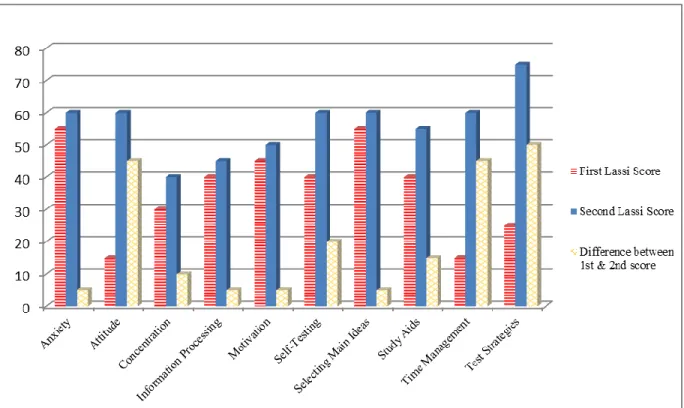
Students took LASSI for the second time at the end of the semester. This allowed them to evaluate and assess their progress, or in some cases, their regression within any given scale. Additionally, I developed a Post-LASSI (second class profile) to see where we stood as a class.
Figure 5. Second Class Profile Based on LASSI Results
Based on Appendix E conversions; LASSI 2nd Edition Scale Norms (Table 26). National Norms for the LASSI, 2nd Edition.
75-100 If you scored above the 75 percentile on any of the ten LASSI scales, you probably do not have to give a high priority to improving your strategies in those areas.
50 -75 If you scored between the 75 and 50 percentiles on any of the ten LASSI scales, you should consider improving your strategies in those areas.
0-50 If you scored below the 50 percentile on any of the ten LASSI scales, you need to improve your skills to avoid serious problems succeeding in college.
14 Figure 6. Class profile based on second LASSI survey (2010)
Based on Appendix E conversions; LASSI 2nd Edition Scale Norms (Table 26). National Norms for the LASSI, 2nd Edition
ANX ATT CON INP MOT SFT SMI STA TMT TST
Beginning 55 15 30 40 45 40 55 40 15 25
Ending 60 60 40 45 50 60 60 55 60 75
Difference 5 45 10 5 5 20 5 15 45 50
The four targeted areas Attitude, Concentration, Time Management, and Test Strategies all saw improved scores with concentration improving the least 10 points and Test Strategies showing the highest increase of 50 points.
Although most scales show an increase from the initial LASSI survey at the beginning of the semester to the second LASSI survey at the end of the semester, this is not always the case. The 2011 class-specific profile score in Anxiety dropped by 5 points from the first to the second class survey suggesting the students in that class developed more anxiety as the semester progressed.
15 Based on Appendix E conversions; LASSI 2nd Edition Scale Norms (Table 26). National Norms for the LASSI, 2nd Edition
ANX ATT CON INP MOT SFT SMI STA TMT TST
Beginning 65 30 45 55 50 25 60 25 35 60
Ending 60 60 65 75 60 60 65 45 65 70
Difference -5 30 20 20 10 35 5 20 30 10
.
CONCLUSION
LASSI in combination with the ISLP:
Provides students the opportunity to empirically identify, assess, and diagnose their individual study and learning skills.
Provides students a format by which they can research/investigate ways to enhance their study skill strengths and improve on their study skill weaknesses.
Allows students the ability to prioritize various approaches to address their study needs.
Allows instructors the opportunity to tailor and shape instructional delivery and curriculum that address individual and class-specific study skill needs
Allows the instructor the opportunity to move his/her seminar beyond the one-size-fits-all offerings.
Requires students to develop individual plans in writing that address their study needs.
Allow students the opportunity to develop behaviors/habits that address their individual and specific study skill competencies.
Requires students to perform various tasks based on their real-life situation. Requires construction/application on the part of the student.
Is student-structured.
16 This approach provides an alternative for addressing the individual and class-specific study and learning skills needs of students enrolled in a uniform content first-year seminar. This process assists students in developing more sophisticated approaches to study and learning. The ISLP offered students a valuable opportunity to reflect on their academic strengths and weaknesses and an opportunity to develop strategies to solve issues related to their individual study and learning needs.
This approach to study skills development was not used as a primary predicator of overall student academic performance. The degree to which LASSI and the ISLP will enhance academic performance depends on the degree to which students implement and stay committed to their ISLP. Customizing instruction for individual and class-specific needs should, however, increase the probability that students will maximize their study skill potential.
Considering the transitional and often complex needs of first-year students, it is imperative that schools do what they can to assist students in establishing good study and learning skills at the beginning of their postsecondary experiences. Irrespective of their academic preparation, all first-year students can benefit from the development and/or enhancement of their study and learning skills.
In the end, both the students (for having instructional and curricular activities tailored to meet their specific needs) and the instructor (for being able to prioritize instructional materials for the benefit of a specific seminar) learned from this process. When students are aware of their specific study skill strengths and weaknesses and develop plans of actions to address these findings, they are in a much better position to achieve their academic goals.
The degree to which students received higher grades based on this method requires a much more detailed and comprehensive study. Students made positive steps towards maximizing their academic potential because they have knowledge of their study skill strengths and weaknesses; they've put something in writing based on self-assessment, self-reflection, application, and research.
FINDINGS
1. Initial individual and class-specific LASSI scores generally ranked in the low percentiles.
2. Post-LASSI surveys indicated major enhancements/improvements in most of the targeted areas for individual and class-specific needs.
3. Students appreciated the focus on their individual strengths and weaknesses.
4. A large majority of these students took a serious look at their study skill competencies and indicated their desire/plan to be more proactive in future study skills development and application. 5. Most students indicated they would apply what they learned to future academic endeavors.
6. The activity in which there was a strong correlation with their final grade in the seminar was the grade they received on their individual learning and study plan (ISLP).
7. A large majority of students appreciated this exercise and the value-added benefits of performing this exercise (see student comments). Many went on to comment that development of these skills has helped them in other classes and they plan to continue using and further enhancing the use of these skills in their daily lives.
17 weaknesses and who were serious about effectively addressing them by changing their behaviors and attitudes, were more likely to maximize their academic potential when compared to students, similarly situated, who did not. This process may not demonstrate an immediate overall positive impact on a students’ GPA, but results do translate well for students wanting to maximize their transition from high school to postsecondary success. Satisfactory completion of this exercise also provides a foundation for future and sustained positive academic progression.
A few students did not agree with their overall study skills assessment using LASSI. For those one or two students who disagreed with one of their profile determinants, I allowed them to replace it with a scale/topic area they felt were more applicable. One student replaced anxiety with concentration and another student replaced time management with motivation. I allowed students limited discretion in modifying their study skills categories.
RECOMMENDATIONS FOR FUTURE FIRST-YEAR SEMINARS
1. Involve more first-year seminar (FYS) classes in a future study.
2. Develop specific FYS that focus/target one or more of the ten scales of LASSI or that focus on one of the three major components of LASSI (Skills, Will, or the Self-regulation Component of Strategic Learning) and have students enroll in themed seminars based on their LASSI scores. This would require using LASSI as a preregistration tool for seminar placement.
3. Offer first-year seminars based on pre-selected criteria or LASSl-based criteria, i.e., all students admitted in the bottom 20% of the first-year class would be enrolled in a seminar or learning community with a strong focused on study skills.
4. Group first-year students in selected seminars and/or learning communities based on their individual strengths or weaknesses/LASSI results.
5. Have first-year students take LASSI prior to class scheduling. Since LASSI can be taken on-line both students and instructors enroll in a seminar with specific knowledge about themselves.
6. Have students take an additional LASSI post-test halfway through the class to determine if they are on track with their Individual Study and Learning Plans which in turn will allow them an opportunity to modify plans as needed.
18
REFERENCES
Breslin, B. (2009). Article 17: Employing LASSI in a proactive, preventive model: Academic enhancement at the University of Kentucky. Retrieved January 16, 2012 from
http://www.hhpublishing.com/assessments/LASSI/2009_LASSI_in_Action_1/2009_article_17.ht ml
Cano, F. (2006). An in depth analysis of the learning and study strategies inventory (LASSI). Educational and Psychological Measurement, 66(6), 1023-1038.
Carrubba, C,W. & Dixon, L . (2009). Article 14: Multiple uses of LASSI at a 4-Year public institution. Retrieved January 16, 2012 from
http://www.hhpublishing.com/assessments/LASSI/2009_LASSI_in_Action_1/2009_article_14.ht ml
Cottrell, S. (2008). The Study Skills Handbook. (3rd ed.). New York: Palgrave Macmillan
Downing. S., (2009). On Course, Strategies for Creating Success in College and in Life. (6th ed.). Boston, MA: Wadsworth, Cengage Learning
Gahagan, J.S. (2000). A historical and theoretical framework for the first-year seminar, The 2000 national survey of first-year seminar programs: Continuing innovations in the collegiate curriculum (Monograph No. 35)(pp. 5-10). Columbia, SC: University of South Carolina, Author.
Goldfine, R.A., (2010), Foundations of Academic Inquiry (3rd ed.) and Braden, S. and Lynn. K.A., as editors (Kennesaw State University, Kennesaw, GA), Boston, MA., Pearsons Learning Solutions
Guskey, T.R. (2003). How classroom assessments improve learning. EDUCATIONAL LEADERSHIP, 60, 6-11.
Habley, W.R., & McClanahan, R. (2004). What works in student retention – All survey colleges? Iowa City, Iowa: ACT, Inc.
Hall, C., Smith, K. & Chia, R. (2008). Cognitive and Personality Factors in Relation to Timely Completion of a College Degree. College Student Journal, 42(4), 1087-1098.
Hunter, M.S. & Linder C.W. (2005). First-Year Seminars. In Challenging & Supporting The First-Year Student. Upcraft, M.L., Gardner, J. N., & Barefoot. B. San Francisco, CA: Jossey-Bass.
Learning and Study Strategies Inventory, (2012) http://www.hhpublishing.com/_assessments/LASSI/
Lipsky, S. A., (2007). College Study: The Essential Ingredients (2nd ed.). Upper Saddle River, New Jersey, Prentice Hall
Mueller, Jon., (2005), "The Authentic Assessment Toolbox: Enhancing student learning through online
faculty development" -- published in the Journal of Online Learning and Teaching (2005)
National Survey on First-Year Seminars (2009), National Resource Center for The First-Year Experience and Students in Transition, University of South Carolina.
Nicaise, M., & Gettinger, M. (1995). Fostering Reading Comprehension in College Students. Reading Psychology,16, 283-337.
Pauk, W., Owens. R.J. (2010). How to Study in College. (10th ed.). Boston, MA: Wadsworth, Cengage Learning
19 Phaneuf, R., (2009). Article 20: LASSI Saves the Day. Retrieved February 3, 2012 from
http://www.hhpublishing.com/assessments/LASSI/2009_LASSI_in_Action_1/2009_article_20.ht ml
Pure, T.S. (2009). Article 6: Identifying Learner Strengths and Weaknesses: Utilizing the LASSI as part of a retention strategy. Retrieved February 3, 2012 from
http://www.hhpublishing.com/_assessments/LASSI/2009_LASSI_in_Action_1/2009_article_6.ht ml
Robbins, S., Allen, J., Casillas, A., Peterson, C., & Le, H. (2006). Unraveling the Differential Effects of Motivational and Skills, Social, and Self-Management Measures from Traditional Predictors of College Outcomes. Journal of Educational Psychology, 98, 598-616.
Robbins, S., Davenport, M., Anderson, J., Kliewer, W., Ingram, K., & Smith, N. (2002). Motivational determinants and coping and academic behavior mediators of first year college adjustment: A prospective study. Manuscript submitted for publication.
Robbins, Steven B.; Lauver, Kristy; Le, Huy; Davis, Daniel; Langley, Ronelle; Carlstrom, Aaron. (2004). Do Psychological and Study Skill Factors Predict College Outcomes? A meta-analysis. Psychological Bulletin, Vol 130(2), Mar 2004, 261-288.
Stamoulis, L. (2009). Article 3: Relevance of study skills, attitudes and behaviors for first-year freshmen. Retrieved February 6 from
http://www.hhpublishing.com/_assessments/LASSI/2009_LASSI_in_Action_1/2009_ article_3.html
Tinnesz, C.G., Ahuna, K.H. & Kiener, M. (2006). Toward college success: Internalizing active and dynamic strategies. College Teaching, 54(4), 302-306.
Tinto, V. (1999). Taking retention seriously: Rethinking the first year of college. NACADA Journal, 19(2): 9.
Upcraft, M.L., Gardner, J.N., and Barefoot, B.O., (2005). Challenging & Supporting The First-Year Student. A Handbook for Improving the First Tear of College. San Francisco, CA. Jossey-Bass.
Van Blerkom.D.L.,(2012). College Study Skills: Becoming a Strategic Learner. (7th Edition). University of Pittsburgh, Johnstown
Weinstein, C.E. & Palmer, D.R. (2002). Learning and Study Strategies Inventory (LASSI): Users Manual (2nd ed.). Clearwater, FL: H & H Publishing.
Wong, L., (2009). Essential Study Skills. (6th ed.). Boston, MA: Wadsworth, Cengage Learning
20
APPENDIX: FIRST-YEAR SEMINAR SYLLABUS
COURSE DESCRIPTION
This globally focused version of the First-Year Seminar course is based on the Center for Strategic and International Studies’ research-based projections of what the world will look like in 25 years due to the influence of seven global issues. Those seven are population, resource management, technology, knowledge, economic integration, security, and governance. Students will analyze the impact of the “7 Revolutions” on their own lives as they transition to college.
REQUIRED TEXTS
1. Electronic access to selected chapters from
a. Outcasts United, by Warren St. John. (2009). Spiegel & Grau: New York. b. New York Times paid subscription [Purchase $5 subscription in Bookstore] 2. Various readings as assigned
COURSE LEARNING OUTCOMES
This course is designed to broaden your skills and knowledge in 4 major areas:
- life skills - connections to campus and community
- strategies for academic success - foundations for global learning
COURSE GOALS:
1.
Students will be introduced to various global, political, economic, social and behavioral systems and explore their impact on their college experience, career goals and daily lives.2.
Students can demonstrate the interconnectedness of the “7 Revolutions” and world events as well as their relevance to local, state and national communities.3.
Students will develop a better understanding of self that will facilitate their personal and professional success.4.
Students’ skills in research, critical thinking and communication will be enhanced.5.
Students will gain an increased awareness of international, national, regional, and local political and social issues and their ability to engage in those issues to promote change.VIEW/VISTA
21
POLICIES & PROCEDURES
STUDENT’S EMAIL
All students should quite often access their @student e-mails.
INSTRUCTION
Class sessions will consist primarily of lectures, class discussions, group assignments and presentations, quizzes, and exam. This course centers on the required texts, additional related readings, and individual and group assignments/projects.
ATTENDANCE
While attendance is not a component of the assessments for the course, it is mandatory. Here’s why: If you are not in the class and on-time, you cannot participate in class discussions, take pop quizzes (no make-ups), turn your work on time, or contribute to the course in a meaningful way.
If you must miss class, it is YOUR responsibility to find out what you missed. Please get the name and phone number of someone else in class to provide you with the information on what you missed. Realize as well that your grade may be impacted by losing in-class assignment points or missing the opportunity to turn in a homework assignment or give a presentation.
It is impossible for instructors to re-teach each absent student all of the course material. It is also a common courtesy to inform your instructor if you will miss class. You allowed three absences for the semester. Any absences over three the instructor will deduct 10 points from your overall grade PER absence
It is common courtesy to let your professor know if you are going to be absent from class. Please call my office or e-mail me prior to the beginning of class.
It is also a courtesy to others to turn off your cell phone (or place them on vibrate) during class. You should not answer your phone or utilize it during class. Only the instructor’s phone is on during an exam.
ACADEMIC INTEGRITY
Every student is responsible for upholding the provisions of the Student Code of Conduct, as published in the Undergraduate and Graduate Catalogs. Section II of the Student Code of
22
ACADEMIC HONESTY
The high quality of education at State University is reflected in the credits and degrees its students earn. The protection of these high standards is crucial since the validity and equity of the University’s grades and degrees depend upon it. Any student found guilty of an infraction of a regulation for academic honesty shall be suspended for at least one semester unless evidence is provided to the court that substantial mitigating circumstances existed in that student’s offense.
DISRUPTION OF CAMPUS LIFE STATEMENT
It is the purpose of the institution to provide a campus environment, which encourages academic accomplishment, personal growth and a spirit of understanding and cooperation. An important part of maintaining such an environment is the commitment to protect the health and safety of every member of the campus community. Belligerent, abusive, profane, threatening and/or inappropriate behavior on the part of students is a violation of the State University Student Conduct Regulations. Students who are found guilty of such misconduct may be subject to immediate dismissal from the institution. In addition, these violations of state law may also be subject to criminal action beyond the University disciplinary process.
Please respect your fellow students and instructors by turning all cell phones and pagers to silent during class. Also, be aware that whispering during lectures is distracting to classmates (and to the instructor). The instructor is not always aware of disruptions, so please inform them to assure a learning environment for all students. It is the purpose of the institution to provide a campus environment which encourages academic accomplishment, personal growth, and a spirit of understanding and cooperation. An important part of maintaining such an environment is the commitment to protect the health and safety of every member of the campus community.
Belligerent, abusive, profane, threatening and/or inappropriate behavior on the part of students is a violation of the Student Conduct Regulations and will be reported to the appropriate administrators and authority. Students who are found guilty of such conduct may be subject to immediate dismissal from the institution. In addition, these violations of state law may also be subject to criminal action beyond the University process. Computers and cell phones are not permitted in class (must be completely turned off) and if not will be considered a disruption. However, if you expect an emergency phone call, please notify the professor at the beginning of class.
PLAGIARISM AND CHEATING
No student shall receive, attempt to receive, knowingly give or attempt to give unauthorized assistance in the preparation of any work required to be submitted for credit as part of a course (including examinations, laboratory reports, essays, themes, term papers, etc.). When direct quotations are used, they should be indicated, and when the ideas, theories, data, figures, graphs, programs, electronic based information or illustrations of someone other than the student are incorporated into a paper or used in a project, they should be duly acknowledged
CLASSROOM RULES
Arrive on time and stay until dismissed.
23 If you use a laptop ensure that it is being used for this course’s purposes.
No sleeping or heads on the desk. Engage, be an active learner. No idle chit-chat
Do not do work for other classes during our class time. Laptops, iPods, etc. are to be used only for this day’s business in class.
IN THE CLASSROOM
Remember to stay A.L.E.R.T. so that you can be an engage, active learner.
A - Arrive on time and stay until dismissed.
L - Laptops cannot be used in this class.
E - Electronic devices should remain in the off position.
R - Rest and sleep after class, not during class.
T - Talking out of turn and idle chit-chat is distracting.
LATE ASSIGNMENTS
All work is due at the beginning of class, on the date due. It is your responsibility to insure you have observed the correct format for submission of a particular assignment.
Missed quizzes, written assignments, and exams due to absence or negligence will NOT be made up unless prior arrangements have been made with the instructor. All assignments are to be turned in on the due dates. Work turned in late (after it is taken up in class) may or may not be accepted, depending on the circumstances, but always with penalty. If you know in advance that you will miss class, you need to let your instructor know about your upcoming absence before you miss the class, not after. Your instructor reserves the right to determine whether or not an absence is excused.
No make-up assignments or quizzes are given.
CLASSROOM ENVIRONMENT
I'm looking forward to learning with you this semester. In order to best facilitate that learning I ask that you be respectful towards one another in both word and deed. As part of this classroom community, you are expected to honor and respect your instructor and your fellow classmates by acting in ways that are conducive to learning.
24
TARDY POLICY
It is a disruption to other students, as well as the instructor, to enter after the class has begun. If you enter class after the roll is called it will be counted as an unexcused absence. If you enter class after the roll is called it is your responsibility to make sure the professor includes you as having attended class that day.
OBSESSIVE TARDINESS
Obsessive tardiness on two or more occasions, will count as one (1) unexcused absence. Likewise, if you leave class early (must attend at least half the class) your leaving early on two or more classes, will count as one (1) unexcused absence. Please alert the instructor before class if you have an emergency requiring you to leave class early
DIVERSITY POLICY
Diversity is welcomed in this class. The more people we have from different countries, ages, races, lifestyles, and backgrounds, the richer we all become in knowledge and in experience. Because we will be working together on various activities and projects, you are expected to honor each other and are encouraged to invite respectful dialogue regarding each of your unique qualities. We all lose when we damage an individual member through jokes or destructive comments about ethnicity, race, gender, sexual orientation, etc. Such comments will not be tolerated in our class. Regardless of our differences, the one thing we have in common is a need to be valued and treated with respect.
COURSE ASSIGNMENTS
Be aware that midterm and final exams will consist of all assignments and will be cumulative for each specific half of the semester. The final may include some subject-matter covered during the first half of the semester. Additionally, midterm and finals will include information from all sources used during the semester that were covered in class
REFLECTION JOURNALS
Must be a minimum of one page and reflect upon the previous week’s assignments, life events, class projects, or other topics as assigned. Entries in the journal will continue throughout the entire semester. Always bring journals to class as they may be collected for review and evaluation. Please use your handwriting for these assignments.
WORDS OF THOUGHT AND WISDOM
25 from a personal perspective. You may have even learned the T&R se lessons during your short time on campus. Don’t be too personal or reflect upon someone in the class or someone easily identified. These stories should be should help your fellow students in their transition to college life.
Just a Reminder Students should keep all homework and assignments until the end of the semester. Students should record all grades when they are returned to them. Late work is generally not accepted. Please note that grades are on a point system, and there is no rounding up or down on grades; the points you earn is the grade you earn.
GRADES
Grades are earned through your performance and participation; they are not given. Please remember this throughout your college career.
Your final grade will be determined according to the following percentage scale:
1000-900 A
899-800 B
799-700 C
699-600 D
500 and below F
Please note that extra credit opportunities will NOT be given in this course. Your final grade will be determined by the total number of points you accumulate, which will be turned into a percentage (1000 points = 100%). Your assignments are worth the following maximum points:
Quizzes (2) 200
Global Village 150
Individual Study and Learning Plan 150
Mid-Term 150
Final Exam 200
Words of Wisdom 25
PSA 100
Reflective Journal 50
MANDATORY ACADEMIC ADVISING REQUIREMENT
State University has a mandatory academic advising requirement that all first-year students meet with an academic advisor two times during their first year. First-year students will be required to schedule an appointment and meet with an academic advisor in First-Year Advising or in their major department prior to registering for the second and third semester. The required academic advising meetings will be enforced by placement of the “FY-Advising required” hold on the student’s registration.
26
COMMON READER PROGRAM
The common reader program for all First-Year seminar students is designed to provide a shared intellectual experience. This year’s text, “Outcasts United,” was chosen because it promotes civic engagement and global understanding at the local, national and international level. Please note that this book contains some material that might be offensive to some readers.
CLASS SCHEDULE AND ASSIGNMENTS
CLASS 1- R
Class Introductions and greatest concerns;
Syllabus Overview; Learning Outcomes;
Differences between College and High School; College Success and Transition, Making the Adjustments
Chapter 13 Becoming a Globally Competent Citizen
CLASS 2 - T
Take the LASSI and In-Class surveys (please be on time)
Chapter 13 Becoming a Globally Competent Citizen
CLASS 3 – R
Chapter 13 Becoming a Globally Competent Citizen
* Class of 2014 Convocation & Induction Ceremony for New Students
Location:
Date:
Time:
Description: First Year Convocation is for new students with less than 30 hours. Students, families, and friends are invited to the event.
First Year Convocation Website
CLASS 4 – T
Chapter 2 Learning Strategies for Academic Success, Part 1
CLASS 5 – R
27 CLASS 6 –T
Chapter 7 Time Management
CLASS 7 – R
Chapter 7 Time Management
CLASS 8 – T
Chapter 11 Successful Skills for Diversity: An Open Mind
CLASS 9 – R
Chapter 12 Ethics, Leadership, and Citizenship
CLASS 10 – T Revolution 1 Population
READINGS
(1) The New Population Bomb
CLASS 11 – R Revolution 1 Population
Readings:
(2) The Earth Is Full, false. Friedman, Thomas L, New York Times, 08 June 2011: .23.
CLASS 12 – T
Revolution 2 Resource Management (see KSU 1111 readings list)
Readings:
CLASS 13 – R
Revolution 2 Resource Management
Readings:
CLASS 14 – T
Revolution 3 Technology (see readings list)
Readings:
(2) The World is Flat, After All
28 Readings:
CLASS 16 – T Midterm
CLASS 17 – R Speaker
CLASS 18 – T
Revolution 4 Information (see readings list)
Readings:
CLASS 19 – R Revolution 4 Information
Readings:
CLASS 20 – T
Revolution 5 Economic Integration (see readings list)
Readings:
(3) GDP Now Matters More Than Force
CLASS 21 – R
Revolution 5
Economic Integration Readings:CLASS 22 – T
Revolution 6 Security/Conflict (see readings list)
Readings:
CLASS 23 – R
Revolution 6 Security/Conflict
Readings:
CLASS 24 - T
Revolution 7 Governance (see readings list)
Readings:
29 CLASS 25 – R
Revolution 7 Governance
Readings:
CLASS 26 – T
Global Village Reports
CLASS 27 – R
Global Village Reports
CLASS 28 – T PSA’s
R11/ 24 Thanksgiving
CLASS 29 – T LASSI 2nd questionnaire
CLASS 30 – R
READINGS LIST FROM ELECTRONIC LIBRARY RESERVE
REVOLUTION ONE – POPULATION:
Global Tends 2025: a Transformed World, Futurist, U.S. National Intelligence Council The New Population Bomb” Foreign Affairs
A World of Ten Billion
Immigration Reform Creates Divide Return of the Population Bomb
The Ideology of Development, Foreign Policy, William Easterly
REVOLUTION TWO – RESOURCE MANAGEMENT:
The New Geopolitics of Food.”
The Economist: Part of a Special Report on Climate Change
“The Green Slump”
Good Policy and Bad”
“Vampires on a Diet”
“Cap and Tirade”
The New geopolitics of Food
30 Builders Offer Green Tract Homes
Climate Change, Foreign Policy, McKibben
The Earth is Full, Thomas Friedman
The Economist - A Special Report - Getting Warmer - Part 2Who Cares? A Long Game; Closing
the Gaps; What Needs to Change; Unpacking the Problem
REVOLUTION THREE - TECHNOLOGY
The Economist: Part of a Special Report on Social Networking
“Global Swap Shop”
“Twitter Transmitters”
“Profiting from Friendship”
“Yammering Away at the Office”
“Towards a Socialiased State”
It’s a Flat World.er All
Why the World is Not Flat
Technology Could Help Achieve the MDG’s
Can Nanotechnology Save Lives
Technology in Georgia, 2011 Report: Technology Overview
Handling the Cornucopia, The Economist, Anonymous
REVOLUTION FOUR – INFORMATION AND KNOWLEDGE:
The Economist: Part of a Special Report on Information
Data, Data Everywhere”
“New Rules for Big Data”
Too Much Information
Parting with Privacy with a Quick Click
Tomorrow’s College, The Chronicle of Higher Education, Marc Perry
31
REVOLUTION FIVE – ECONOMICS:
Don’t Hold Your Breath. Time Magazine
GDP Matters More Than Force
Globalization and Its Contents
The Ideology of Development
Can Extreme Poverty be Eliminated
Can Microfinance Make it in America
A World Enslaved
Supply and Demand
The Future Still Belongs to America The Wall Street Journal
REVOLUTION SIX – SECURITY:
Success Without Victory
Other readings TBA
REVOLUTION SEVEN – GOVERNANCE:
GDP Now Matters More Than Force.” Foreign Affairs
Global Corporate Citizenship. Foreign Affairs
Can Extreme Poverty Be Eliminated? Scientific America.
Global Corporate Citizenship
Demystifying the Arab Spring
GA Redistricting Maps May Land in Court First
7 REVOLUTIONS/OUTCASTS UNITED “GLOBAL VILLAGER” PROJECT
The purpose of the “capstone” 1111 project is to blend our work with 7 Revolutions and Outcasts United.
Step 1: Working in teams of 4 (teams used for the PSA project) create a “persona” or a “role” from one of the countries represented in “Outcasts United.” You may create an individual - young or old, male or female, alive or deceased. NOTE: Your team should complete and sign-off on a Task Responsibility Sheet (TRS) detailing the work that you invest in this project
32
Afghanistan Kosovo
Bosnia Gambia
Burundi Liberia
Congo Ethiopia
Sudan Iraq (or an Iraqi Kurd)
Republic of South Sudan Jordan
Step3: After identifying your country, begin by researching/creating each of the following demographic variables:
Name, age, sex, city or region, ethnicity, religion, life expectancy, language, annual income, occupation or family occupations…thoroughly describe the individual. To begin your research you might start with the Times Topic page for your country as well as other credible resources and research the current state of affairs in your country. Look for information that helps to predict what life may be like for your villager in the next 20-25 years. Working as a team, select 10-15 references (books, articles, CIA Factbook, State Department information, white papers from NGOs, United Nations materials, and more) that help you understand the population, resources, technology, information dissemination, economics, security/conflict issues, and basic governmental structures of your country. Now create your proposal listing: group members, roles, country, character and concept (what’s going to happen with the character). This should be an approximately a one- page paper. It is due 9/20. Your Global Village Form is also due.
Step 4: Write an annotated bibliography analyzing and summarizing those references. Due: 10/27
Step 5: Create a tri-fold poster that shows where your villagers live while creatively detailing what life is like today for this individual in his/her country and situation. Due: 11/17. As your schedule allows, attend the Global Village Poster Presentation and show off all you know about the country you selected and the villager you’ve created. There will be free refreshments and the opportunity to interact with top-level administrators, faculty, staff, and students from across the campus. ** Mark your calendar now for Thursday, Nov. 17th from 3:30 – 5 p.m. in the University Rooms.
Step 6: Produce an 8-10 minute video “presentation” or vignette (PowerPoint is discouraged - Prezi is fine) detailing what life is like today for this individual in his/her country and situation. Moving forward toward over the next 25 - 30 years, based on your research, describe the likely changes that this individual can expect based on at least 4 of the 7 revolutions. I suggest you select those most impactful. IMPORTANT – weave the events of this characters life into a storyline. DO NOT simply describe the individual separate of the revolutions you choose.
Step 6: Turn in both your video presentation and TRS no later than 11/29.
I look forward to seeing your work and welcome any questions that you might have. Review these websites for 7 Revolutions
http://csis.org/program/seven-revolutions
review all sidebars
33
Global Villager Video Project Evaluation
Criteria 0 4-5 7-8 9-10 Total
1. Non-verbal skills (10)
body language – use the whole body-physically eye contact
gestures/hands
professionalism/polish-rehearsed facial expressions-varied
2. Verbal Skills (10)
speaks clearly – enunciation Volume
inflection-change in pitch Tone
pace-too fast or too slow
2 way with the audience-do you connect does not interrupt-coordination w/partner does not read
3. Character/Implications Development (10) background - all demographic aspects Family/structure/lifestyle- detailed-thorough character's response/perspective- reasonable
4. Revolutions Described (10)
causes and drivers-have you explained context is it reasonably research grounded
5. Creativity (10)
(unique/engaging/clever)
6. Technically well done: proficiency (10) Overall Total (out of 60 points)
Public Service Announcement/ Short Subject Video Group Project