Farsad Zamani Boroujeni and Doryaneh Hossien Afshari
Department of Computer Engineering, Khorasgan (Isfahan) Branch, Islamic Azad University, Isfahan, Iran
An Efficient Rule-Hiding Method
For Privacy Preserving in
Transactional Databases
One of the obstacles in using data mining techniques such as association rules is the risk of leakage of sensi-tive data after the data is released to the public. There-fore, a trade-off between the data privacy and data mining is of a great importance and must be managed carefully. In this study, an efficient algorithm is intro-duced for preserving the privacy of association rules according to distortion-based method, in which the sensitive association rules are hidden through deletion and reinsertion of items in the database. In this algo-rithm, in order to reduce the side effects on non-sensi-tive rules, the item correlation between sensinon-sensi-tive and non-sensitive rules is calculated and the item with the minimum influence in non-sensitive rules is selected as the victim item. To reduce the degree of data distor-tion and preservadistor-tion of data quality, transacdistor-tions with highest number of sensitive items are selected for mod-ification. The results show that the proposed algorithm has better performance in real non-dense databases as well as less side effects and less data loss compared to its performance in real dense databases. Further, more improvements are achieved for synthetic databases in comparison with real databases.
ACM CCS (2012) Classification: Information systems
→ Information systems applications → Data mining
→ Association rules
Security and privacy → Database and storage security
→ Data anonymization and sanitization
Security and privacy → Software and application se-curity → Domain-specific security and privacy archi-tectures
Keywords: association rules hiding, sensitive rule, dis-tortion-based method
1. Introduction
Today, to enhance decision making, many com-panies and organizations use data mining in
order to extract useful and desirable patterns from their repositories and databases. Contrary to owners' desire, this can lead to disclosure of sensitive information contained in the da-tabase which is a risk to them. Among many techniques, extracting the association rules is one of the widely-used data mining techniques showing hidden relations and dependencies be-tween itemsets in the database. The extracted rules may include some sensitive information such that its public release can be extremely destructive. As an example in medical data-bases, sharing information about a disease will be useful for the progress of medical science. Yet, releasing the information of patients must be avoided. Therefore, to maintain the database security and to prevent the extraction of the sensitive patterns, a new discipline of data min-ing was introduced called Privacy Preservmin-ing Data Mining (PPDM). Most of the PPDM algo-rithms aim to apply changes in database so that sensitive information cannot be extracted even after applying well-known rule extraction tech-niques. These rule hiding algorithms mainly rely on minimal modifications of data items, either by replacing new values or removing/ inserting items in a set of selected transactions to decrease the rules' interestingness measures, e.g. support and confidence.
it suffers from some limitations like high level of hiding failure and inability to hide the rules with multiple LHS. items. This study presents a heuristic algorithm which aims at overcoming the limitations of RRLR algorithm. In contrast to its counterparts, the proposed algorithm does not require removing and inserting all LHS items to the transactions. To hide the sensitive rules, it only removes and reinserts a limited number of appropriate items leading to minimal side effects and maintaining the data quality. The remainder of this paper is organized as follows: Section 2 presents an overview of the existing approaches and some theoretical back-ground. Section 3 describes the proposed al-gorithm in detail and gives an example which illustrates how the proposed algorithm works. Section 4 is dedicated to performance evalua-tion of the proposed algorithm. Finally, the re-sults of comparative performance experiments are presented in Section 5. Conclusions and fu-ture works are described in the last section.
2. Background and Related Works
Hiding sensitive association rules is the process of applying changes to the original database and converting it to a sanitized one. So that, ex-cept sensitive rules, all of the useful association rules can be extracted from the sanitized data-base. The problem of association rule hiding can be defined as follows:
The inputs of the algorithm include an original database D which is supposed to be released to the public, a minimum support threshold (MST), a minimum confidence threshold (MCT), a set of sensitive association rules Rs ⊆ R to be hid-den from the association rule extraction algo-rithms. The outputs include a sanitized database D′ from which the non-sensitive rules R ‒ Rs can be extracted as much as possible [2].
In the rule hiding algorithms, the sensitive rules are hidden by altering their support and/or confidence through insertion or deletion of the items in the original database. These operations may result in the appearance of four important side effects which are defined and measured by the following quality metrics [3]:
1. Hiding Failure (hiding rate) which is used to measure the percentage of sensitive as-sociation rules that remain disclosed
possi-bly due to the process of hiding some other sensitive rules;
2. Misses Cost (lost rules) which reflects the percentage of non-sensitive rules that are hidden inadvertently by the rule hiding al-gorithm;
3. Artificial Patterns (ghost rules) that mea-sures the percentage of false association rules that can be extracted from the san-itized database among all of the rules whose confidence is below the pre-defined minimum confidence threshold;
4. Dissimilarity (altered rate) measures the percentage of altered transactions among the entire database.
Most of the association rule hiding algorithms aim at producing their output with minimal side effects such that:
1. Sensitive rules are hidden and are not ex-tracted from the sanitized database (hiding failure reaches zero).
2. There is no lost rule; all non-sensitive and useful rules should be extracted from sani-tized database.
3. Ghost rules should not be produced; in other words, non-existing rules in the main database cannot be produced from the san-itized database.
4. The lower rate of database modifications is performed. When more transactions are modified, more processing time would be required [3].
Let I = {I1,…,In} be a set of items existing in
database D. Each association rule is denoted as X → Y, where X and Y are LHS and RHS itemsets respectively such that X,Y ⊂ I and X ∩ Y = ∅. The interestingness of an associ-ation rule is measured by its support and con-fidence which are calculated by equations (1) and (2) [4].
(
)
X Y Support X Y
D
∪ → =
(1)
(
)
X Y Confidence X Y
X
∪ → =
(2)
blocking technique to hide the sensitive rules. Although they do not distort values, they insert many unknown values into the database. The problem with this technique is that the transac-tions that contain items with unknown values can be used as cues to find sensitive informa-tion. In fact, all the rules that their generating itemsets contain question marks and their max-imum confidence is above the MCT could be the sensitive rules that we want to hide from the adversary. The latter refers to a common ap-proach in which a set of selected items is either removed from or inserted to the transactions with the aim of increasing or decreasing the support and confidence of the sensitive rules. Due to their undesirable side effects, the heuris-tic approaches are unable to provide an optimal method.
The subject of association rules hiding was first suggested by Attallah et al. [20] who developed an association rule hiding technique with rea-sonable time complexity in which a lattice-like graph has been utilized for concealment. Very-kios et al. [21] have presented five different al-gorithms, namely 1.a, 1.b, 2.a, 2.b and 2.c; two of which use the support reduction strategy and the other three algorithms use reduction of con-fidence for hiding the sensitive rules. Although some of the algorithms mentioned above, e.g. 2.c and 2.b, produce minimal side effects, al-most all of them can hide only one sensitive rule at a time, which limits the applicability of these algorithms. Oliveira and Zaïane [9] pro-posed the first generation of algorithms that hide multiple rules, e.g. Naïve, MinFIA, Max-FIA and IGA. Their idea was to hide sensitive rules based on their conflict level at the cost of high execution time. Another multiple rule hiding algorithm is DSRRC which effectively hides the sensitive association rules by means of clustering and use of a sensitivity measure [22]. However, its limitation in hiding sensitive rules with multiple RHS and LHS items makes it in-appropriate for real-world applications. Later, the same research group developed a modified version of DSRRC, called MDSRRC algorithm [23], to prevail the limitations associated with DSRRC algorithm
In another study, Hong et al. [24] conducted a research in which the reduction of support tech-nique is used for hiding association rules. Gen-erating low amount of ghost rules is the main Here, the support reflects the frequency of the
rule and the confidence refers to the strength of the rule within the transactional database. In both equations, |X ∪ Y| denotes the num-ber of transactions that contain both itemsets X and Y. |D| is the whole number of the existing transactions in database and |X| is the number of transactions of database that include itemset X. Along with these measures, two threshold quantities named minimum support thresh-old (MST) and minimum confidence threshold (MCT) are frequently used as gauges to assess the interestingness of the rules.
Approaches to hide association rules are com-monly categorized as heuristic approaches [5] ‒ [9], border based approaches [10] ‒ [12], exact approaches [13] ‒ [15] and reconstruction based approaches [16]. Heuristic techniques try to find a near-optimal solution for hiding as many sensitive rules as possible while minimizing the possible side effects. Since it is almost im-possible to minimize all side effects simultane-ously, they rely on optimizing certain sub-goals in the hiding process, while they do not guaran-tee optimality. The border based approach uses the theory of borders [17] to hide sensitive as-sociation rules. The idea is to define the borders by identifying itemsets which are at the position of the borderline separating the frequent and infrequent itemsets. The borders are greedily revised to hide association rules with minimal side effects. The third category involves exact and non-heuristic algorithms, which formulates the hiding process as an optimization problem which is solved by integer programming. The exact approaches guarantee the optimality, but may fail to provide a solution for all situations. The algorithms that follow the exact approach suffer from high computational burden required for searching a large state space. The fourth cat-egory involves reconstruction based algorithms that are used to accurately estimate the distri-bution of original data values. Using the esti-mated distributions, the goal of the algorithm is to build a classifier for distortion of values in the database.
it suffers from some limitations like high level of hiding failure and inability to hide the rules with multiple LHS. items. This study presents a heuristic algorithm which aims at overcoming the limitations of RRLR algorithm. In contrast to its counterparts, the proposed algorithm does not require removing and inserting all LHS items to the transactions. To hide the sensitive rules, it only removes and reinserts a limited number of appropriate items leading to minimal side effects and maintaining the data quality. The remainder of this paper is organized as follows: Section 2 presents an overview of the existing approaches and some theoretical back-ground. Section 3 describes the proposed al-gorithm in detail and gives an example which illustrates how the proposed algorithm works. Section 4 is dedicated to performance evalua-tion of the proposed algorithm. Finally, the re-sults of comparative performance experiments are presented in Section 5. Conclusions and fu-ture works are described in the last section.
2. Background and Related Works
Hiding sensitive association rules is the process of applying changes to the original database and converting it to a sanitized one. So that, ex-cept sensitive rules, all of the useful association rules can be extracted from the sanitized data-base. The problem of association rule hiding can be defined as follows:
The inputs of the algorithm include an original database D which is supposed to be released to the public, a minimum support threshold (MST), a minimum confidence threshold (MCT), a set of sensitive association rules Rs ⊆ R to be hid-den from the association rule extraction algo-rithms. The outputs include a sanitized database D′ from which the non-sensitive rules R ‒ Rs can be extracted as much as possible [2].
In the rule hiding algorithms, the sensitive rules are hidden by altering their support and/or confidence through insertion or deletion of the items in the original database. These operations may result in the appearance of four important side effects which are defined and measured by the following quality metrics [3]:
1. Hiding Failure (hiding rate) which is used to measure the percentage of sensitive as-sociation rules that remain disclosed
possi-bly due to the process of hiding some other sensitive rules;
2. Misses Cost (lost rules) which reflects the percentage of non-sensitive rules that are hidden inadvertently by the rule hiding al-gorithm;
3. Artificial Patterns (ghost rules) that mea-sures the percentage of false association rules that can be extracted from the san-itized database among all of the rules whose confidence is below the pre-defined minimum confidence threshold;
4. Dissimilarity (altered rate) measures the percentage of altered transactions among the entire database.
Most of the association rule hiding algorithms aim at producing their output with minimal side effects such that:
1. Sensitive rules are hidden and are not ex-tracted from the sanitized database (hiding failure reaches zero).
2. There is no lost rule; all non-sensitive and useful rules should be extracted from sani-tized database.
3. Ghost rules should not be produced; in other words, non-existing rules in the main database cannot be produced from the san-itized database.
4. The lower rate of database modifications is performed. When more transactions are modified, more processing time would be required [3].
Let I = {I1,…,In} be a set of items existing in
database D. Each association rule is denoted as X → Y, where X and Y are LHS and RHS itemsets respectively such that X,Y ⊂ I and X ∩ Y = ∅. The interestingness of an associ-ation rule is measured by its support and con-fidence which are calculated by equations (1) and (2) [4].
(
)
X Y Support X Y
D
∪ → =
(1)
(
)
X Y Confidence X Y
X
∪ → =
(2)
blocking technique to hide the sensitive rules. Although they do not distort values, they insert many unknown values into the database. The problem with this technique is that the transac-tions that contain items with unknown values can be used as cues to find sensitive informa-tion. In fact, all the rules that their generating itemsets contain question marks and their max-imum confidence is above the MCT could be the sensitive rules that we want to hide from the adversary. The latter refers to a common ap-proach in which a set of selected items is either removed from or inserted to the transactions with the aim of increasing or decreasing the support and confidence of the sensitive rules. Due to their undesirable side effects, the heuris-tic approaches are unable to provide an optimal method.
The subject of association rules hiding was first suggested by Attallah et al. [20] who developed an association rule hiding technique with rea-sonable time complexity in which a lattice-like graph has been utilized for concealment. Very-kios et al. [21] have presented five different al-gorithms, namely 1.a, 1.b, 2.a, 2.b and 2.c; two of which use the support reduction strategy and the other three algorithms use reduction of con-fidence for hiding the sensitive rules. Although some of the algorithms mentioned above, e.g. 2.c and 2.b, produce minimal side effects, al-most all of them can hide only one sensitive rule at a time, which limits the applicability of these algorithms. Oliveira and Zaïane [9] pro-posed the first generation of algorithms that hide multiple rules, e.g. Naïve, MinFIA, Max-FIA and IGA. Their idea was to hide sensitive rules based on their conflict level at the cost of high execution time. Another multiple rule hiding algorithm is DSRRC which effectively hides the sensitive association rules by means of clustering and use of a sensitivity measure [22]. However, its limitation in hiding sensitive rules with multiple RHS and LHS items makes it in-appropriate for real-world applications. Later, the same research group developed a modified version of DSRRC, called MDSRRC algorithm [23], to prevail the limitations associated with DSRRC algorithm
In another study, Hong et al. [24] conducted a research in which the reduction of support tech-nique is used for hiding association rules. Gen-erating low amount of ghost rules is the main Here, the support reflects the frequency of the
rule and the confidence refers to the strength of the rule within the transactional database. In both equations, |X ∪ Y| denotes the num-ber of transactions that contain both itemsets X and Y. |D| is the whole number of the existing transactions in database and |X| is the number of transactions of database that include itemset X. Along with these measures, two threshold quantities named minimum support thresh-old (MST) and minimum confidence threshold (MCT) are frequently used as gauges to assess the interestingness of the rules.
Approaches to hide association rules are com-monly categorized as heuristic approaches [5] ‒ [9], border based approaches [10] ‒ [12], exact approaches [13] ‒ [15] and reconstruction based approaches [16]. Heuristic techniques try to find a near-optimal solution for hiding as many sensitive rules as possible while minimizing the possible side effects. Since it is almost im-possible to minimize all side effects simultane-ously, they rely on optimizing certain sub-goals in the hiding process, while they do not guaran-tee optimality. The border based approach uses the theory of borders [17] to hide sensitive as-sociation rules. The idea is to define the borders by identifying itemsets which are at the position of the borderline separating the frequent and infrequent itemsets. The borders are greedily revised to hide association rules with minimal side effects. The third category involves exact and non-heuristic algorithms, which formulates the hiding process as an optimization problem which is solved by integer programming. The exact approaches guarantee the optimality, but may fail to provide a solution for all situations. The algorithms that follow the exact approach suffer from high computational burden required for searching a large state space. The fourth cat-egory involves reconstruction based algorithms that are used to accurately estimate the distri-bution of original data values. Using the esti-mated distributions, the goal of the algorithm is to build a classifier for distortion of values in the database.
advantage of this method, but requires high computation time that makes it unsuitable for practical applications. Later, Cheng et al. [25] tried to use a greedy approach for reduction of rules' support through removing right hand side items. The main drawback of this method is high number of database scans. It also requires large number of database modifications which results in low quality of the sanitized database. Recently, two algorithms ADSRRC and RRLR were presented in [1] to overcome the other limitations of DSRRC algorithm. The first lim-itation is related to the dependency of DSRRC algorithm on the ordering of transactions, which is absolutely necessary in order to remove items from the database. Further, it requires to sort all the transactions in the database each time an item is removed from a transaction, which highly degrades the performance of the algo-rithm. These two issues have been addressed in ADSRRC algorithm. The ADSRRC algo-rithm tries to conceal sensitive association rules through reducing support and confidence of the rules using a clustering method. This technique requires two times scan of the database and has proved to be remarkably efficient in terms of low hiding failure. Conversely, it suffers from high rate of lost rules and high computational complexity. Another limitation of the DSRRC algorithm is that it does not have the ability to hide rules with multiple RHS items. To over-come this problem, the RRLR algorithm is sug-gested instead. The RRLR algorithm reduces the support and confidence of the rules to hide the sensitive ones, but is unable to hide the rules with multiple LHS items. This paper aims at tackling this problem by proposing an effi-cient algorithm called ARRLR which can hide the sensitive rules with multiple RHS and LHS items. In the next section, the technical details of ARRLR are presented.
3. The Proposed Algorithm
This section provides a brief overview of the underlying concepts to better understand the multiple-item rule hiding algorithms. Gen-erally, hiding sensitive rules in the form of M → N, can be performed by decreasing either the confidence or support of the rules to below the MST and MCT. In fact, the support of the
rule M → N can be decreased by reducing the occurrences of itemset MN. Similarly, the con-fidence of the rules can be reduced by one of the following techniques:
1. Increasing the support of the antecedent of the rule, i.e. LHS part, in transactions in which the consequence of rule is not pres-ent.
2. Decreasing the support of rule's conse-quence, i.e. RHS part, in transactions in-cluding both parts of the rule [21].
The proposed method aims at hiding sensitive rules with multiple items in LHS and multiple items in RHS. This type of rule is represented in the form of aM → bN where a,b ∈ I and M,N ⊂ I. Here, 'a' and 'b' are single items se-lected by the algorithm to be inserted into or removed from LHS or RHS of the rule, respec-tively. The idea behind the proposed algorithm is to decrease both support and confidence mea-sures to hide the sensitive rules. The support of the rules that are in the form of aM → bN can be decreased by reducing the support of the item-set aMbN. Also, to decrease the support of the large itemset aMbN, a suitable item is selected and removed from the LHS items of the sen-sitive rule; and to decrease confidence of the sensitive rule, a selected item is inserted in the suitable transaction. To this end, the algorithm identifies a list of suitable transactions for mod-ification that are called victim transactions. To identify a set of items to remove from the victim transactions, two objective parameters, namely α and β, are calculated for items that exist in the sensitive rules. They are also used to calculate the total sensitivity of the victim transactions. These parameters are defined as follows:
1. Parameter α: The number of occurrence for LHS items of the sensitive rules in the whole set of non-sensitive rules. This pa-rameter is used to construct the list Lα in which LHS items of the sensitive rules are sorted in ascending order, according to the value of α.
2. Parameter β: The frequency of an item in the set of sensitive rules, which is used to compute the sensitivity of each transaction. 3. Sensitivity of transaction: The sensitivity
of a transaction is calculated as the sum of β values of all sensitive items included in that transaction.
In the first step, association rules are mined from the original database by using the Apri-ori algApri-orithm. Then, sensitive rules are selected from the mined rules (Rs) and are sorted in de-scending order, according to their confidence value. To make sure that all sensitive rules are hidden, a Boolean variable named ''State'' is de-fined to maintain the hiding status of each sen-sitive rule. The states of all sensen-sitive rules are initially set to false. Now, parameters α, β and sensitivity of transaction are computed by the algorithm and the transactions are arranged in descending order, based on their sensitivity and length. Next, Lα is computed by the algorithm and the process of hiding sensitive rules starts from the first sensitive rule.
Among the LHS items of the first sensitive rule, an item with the least value of α (according to list Lα) is selected to be removed. Then, the se-lected item is removed from the first transac-tion that has the highest sensitivity and length. After removing, the selected item is inserted in the transactions which do not have the item (i.e. the large itemsets that partially support LHS of the rule and partially support, or do not support RHS of the rule). If the suitable transaction for the selected item is not found, the insertion will not be done. During the process of hiding, the sensitivity of transactions will not be updated. After each removal and insertion, support and confidence of the sensitive rules existing in Rs will be updated. If they reach below the MST and MCT, the false state of the sensitive rule is changed to true, without being removed from the list Rs. The rule state is changed from true to false, if a sensitive rule becomes disclosed because of inserting an item. In this situation, there will be no insertion and the rule is hidden just by removing a suitable item of the left side ones. As shown in Figure 1, a Boolean variable, called Disclosed, is used for identifying dis-closed rules and preventing the algorithm from calling item insertion process. The hiding goes on until the state values of all sensitive rules become true.
Finally, the transactions in the original database are modified and constitute a new database that is a sanitized version of the original database D. This preserves the privacy of the sensitive data and keeps data quality. The main steps of the proposed algorithm named ARRLR (Advanced Remove and Reinsert LHS of Rule) are shown in Figure 1.
Input: Original database D, (MCT), (MST).
Output: The sanitized database D′.
Use Apriori, extract association Rules. Select a set of sensitive rules Rsensitive(Rs)
Set the State and Disclosed variable of all sensitive rules to false
Sort Rs in decreasing order based on their Confidence. Calculate α, β and sensitivity of transactions.
Create Lα by sorting LHS items of the sensitive rules in ascending order based on their α value
Arrange transactions in decreasing order of their sensi-tivity and length.
while (states of all Rsensitive are not true)
{
Find the first rule Rk from Rsensitive such that Rk. State is false
Select item I from LHS of rule Rk according to Lα
//Antecedent Deletion Process
form = 1 to no. of transactions in database {
if (Tm supports both parts of rule Rk) Remove selected antecedent item I from transaction Tm
if (Rk. Disclosed is false)
{
// Antecedent Insertion Process
for n = m to no. of transactions in database
{
if (Tn does not include item I and partially supports rule Rk)
Insert selected LHS item I in transaction Tn
} }
for each rule R in RS {
Recalculate Support & Confidence for R
if (R.Support < MST or R.Confidence < MCT) Set R.State to true.
else
{
If (R.State is true) Set R.Disclosed to true
Set R.State to false.
Figure 1. Pseudo code of algorithm ARRLR (Advance Remove and Reinsert Left hand side Rule). }
advantage of this method, but requires high computation time that makes it unsuitable for practical applications. Later, Cheng et al. [25] tried to use a greedy approach for reduction of rules' support through removing right hand side items. The main drawback of this method is high number of database scans. It also requires large number of database modifications which results in low quality of the sanitized database. Recently, two algorithms ADSRRC and RRLR were presented in [1] to overcome the other limitations of DSRRC algorithm. The first lim-itation is related to the dependency of DSRRC algorithm on the ordering of transactions, which is absolutely necessary in order to remove items from the database. Further, it requires to sort all the transactions in the database each time an item is removed from a transaction, which highly degrades the performance of the algo-rithm. These two issues have been addressed in ADSRRC algorithm. The ADSRRC algo-rithm tries to conceal sensitive association rules through reducing support and confidence of the rules using a clustering method. This technique requires two times scan of the database and has proved to be remarkably efficient in terms of low hiding failure. Conversely, it suffers from high rate of lost rules and high computational complexity. Another limitation of the DSRRC algorithm is that it does not have the ability to hide rules with multiple RHS items. To over-come this problem, the RRLR algorithm is sug-gested instead. The RRLR algorithm reduces the support and confidence of the rules to hide the sensitive ones, but is unable to hide the rules with multiple LHS items. This paper aims at tackling this problem by proposing an effi-cient algorithm called ARRLR which can hide the sensitive rules with multiple RHS and LHS items. In the next section, the technical details of ARRLR are presented.
3. The Proposed Algorithm
This section provides a brief overview of the underlying concepts to better understand the multiple-item rule hiding algorithms. Gen-erally, hiding sensitive rules in the form of M → N, can be performed by decreasing either the confidence or support of the rules to below the MST and MCT. In fact, the support of the
rule M → N can be decreased by reducing the occurrences of itemset MN. Similarly, the con-fidence of the rules can be reduced by one of the following techniques:
1. Increasing the support of the antecedent of the rule, i.e. LHS part, in transactions in which the consequence of rule is not pres-ent.
2. Decreasing the support of rule's conse-quence, i.e. RHS part, in transactions in-cluding both parts of the rule [21].
The proposed method aims at hiding sensitive rules with multiple items in LHS and multiple items in RHS. This type of rule is represented in the form of aM → bN where a,b ∈ I and M,N ⊂ I. Here, 'a' and 'b' are single items se-lected by the algorithm to be inserted into or removed from LHS or RHS of the rule, respec-tively. The idea behind the proposed algorithm is to decrease both support and confidence mea-sures to hide the sensitive rules. The support of the rules that are in the form of aM → bN can be decreased by reducing the support of the item-set aMbN. Also, to decrease the support of the large itemset aMbN, a suitable item is selected and removed from the LHS items of the sen-sitive rule; and to decrease confidence of the sensitive rule, a selected item is inserted in the suitable transaction. To this end, the algorithm identifies a list of suitable transactions for mod-ification that are called victim transactions. To identify a set of items to remove from the victim transactions, two objective parameters, namely α and β, are calculated for items that exist in the sensitive rules. They are also used to calculate the total sensitivity of the victim transactions. These parameters are defined as follows:
1. Parameter α: The number of occurrence for LHS items of the sensitive rules in the whole set of non-sensitive rules. This pa-rameter is used to construct the list Lα in which LHS items of the sensitive rules are sorted in ascending order, according to the value of α.
2. Parameter β: The frequency of an item in the set of sensitive rules, which is used to compute the sensitivity of each transaction. 3. Sensitivity of transaction: The sensitivity
of a transaction is calculated as the sum of β values of all sensitive items included in that transaction.
In the first step, association rules are mined from the original database by using the Apri-ori algApri-orithm. Then, sensitive rules are selected from the mined rules (Rs) and are sorted in de-scending order, according to their confidence value. To make sure that all sensitive rules are hidden, a Boolean variable named ''State'' is de-fined to maintain the hiding status of each sen-sitive rule. The states of all sensen-sitive rules are initially set to false. Now, parameters α, β and sensitivity of transaction are computed by the algorithm and the transactions are arranged in descending order, based on their sensitivity and length. Next, Lα is computed by the algorithm and the process of hiding sensitive rules starts from the first sensitive rule.
Among the LHS items of the first sensitive rule, an item with the least value of α (according to list Lα) is selected to be removed. Then, the se-lected item is removed from the first transac-tion that has the highest sensitivity and length. After removing, the selected item is inserted in the transactions which do not have the item (i.e. the large itemsets that partially support LHS of the rule and partially support, or do not support RHS of the rule). If the suitable transaction for the selected item is not found, the insertion will not be done. During the process of hiding, the sensitivity of transactions will not be updated. After each removal and insertion, support and confidence of the sensitive rules existing in Rs will be updated. If they reach below the MST and MCT, the false state of the sensitive rule is changed to true, without being removed from the list Rs. The rule state is changed from true to false, if a sensitive rule becomes disclosed because of inserting an item. In this situation, there will be no insertion and the rule is hidden just by removing a suitable item of the left side ones. As shown in Figure 1, a Boolean variable, called Disclosed, is used for identifying dis-closed rules and preventing the algorithm from calling item insertion process. The hiding goes on until the state values of all sensitive rules become true.
Finally, the transactions in the original database are modified and constitute a new database that is a sanitized version of the original database D. This preserves the privacy of the sensitive data and keeps data quality. The main steps of the proposed algorithm named ARRLR (Advanced Remove and Reinsert LHS of Rule) are shown in Figure 1.
Input: Original database D, (MCT), (MST).
Output: The sanitized database D′.
Use Apriori, extract association Rules. Select a set of sensitive rules Rsensitive(Rs)
Set the State and Disclosed variable of all sensitive rules to false
Sort Rs in decreasing order based on their Confidence. Calculate α, β and sensitivity of transactions.
Create Lα by sorting LHS items of the sensitive rules in ascending order based on their α value
Arrange transactions in decreasing order of their sensi-tivity and length.
while (states of all Rsensitive are not true)
{
Find the first rule Rk from Rsensitive such that Rk. State is false
Select item I from LHS of rule Rk according to Lα
//Antecedent Deletion Process
form = 1 to no. of transactions in database {
if (Tm supports both parts of rule Rk) Remove selected antecedent item I from transaction Tm
if (Rk. Disclosed is false)
{
// Antecedent Insertion Process
for n = m to no. of transactions in database
{
if (Tn does not include item I and partially supports rule Rk)
Insert selected LHS item I in transaction Tn
} }
for each rule R in RS {
Recalculate Support & Confidence for R
if (R.Support < MST or R.Confidence < MCT) Set R.State to true.
else
{
If (R.State is true) Set R.Disclosed to true
Set R.State to false.
Figure 1. Pseudo code of algorithm ARRLR (Advance Remove and Reinsert Left hand side Rule). }
3.1. Case Study
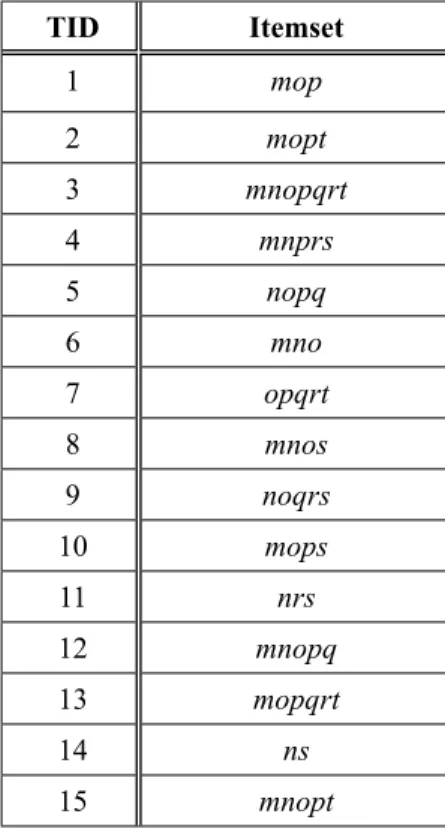
In this section the function of ARRLR algo-rithm is explained by an example. Considering the transactional database D shown in Table 1, the rules that are shown in Table 2 are achieved after employing the Apriori algorithm on data-base D with MST = 30% and MCT = 70%.
Assume that three sensitive rules 5, 13 and 22 are sorted based on their confidence with con-fidence values of 100%, 83.33%, and 71.43% respectively. Since item "o" is included in all sensitive rules, its β sensitivity is 3. Accord-ingly, the β sensitivity of m, n, p are calculated as 2, 2 and 1. Next, the algorithm calculates the number of occurrences for each item that ex-ists in LHS of sensitive rules, in all non-sen-sitive rules (α value), arranging those items in increasing order of their α value. Therefore, Lα = {n = 2, t = 4, m = 9, p = 16, o = 17}. To compute the transaction sensitivity, the sum of sensitivity values (β sensitivity) of itemset that exists in that transaction is calculated. Table 3 shows item sensitivity values of α and β as well as transaction sensitivity sorted in decreasing
order of sensitivity and length. Then the algo-rithm selects a sensitive rule with highest con-fidence for hiding. In this example pt → o is selected as first rule for hiding. According to Lα and rule pt → o, item "t" is selected for deletion. Now, the algorithm selects a transaction with highest sensitivity (in this example, transaction TID = 3 is the most sensitive transaction) and deletes item "t" from that transaction. Thus, the support of large itemset "opt" is decreased. Af-ter deletion, LHS item should be inserted in the most appropriate transaction selected from the list of sorted transactions, as shown in Table 3. The most appropriate transaction is a candidate transaction that satisfies the following criteria:
1. If the sensitive rule has only one LHS item, the candidate transaction should have all items of sensitive rule except the LHS item that is considered for insertion.
2. If the sensitive rule has more than one LHS items, the candidate transaction should partially support them, i.e. it should con-tain all the LHS items of the sensitive rule except for the LHS item that is considered for insertion.
Furthermore, the candidate transaction should not have all the RHS items of the sensitive rule. In other words, the candidate transaction should lack one or more RHS items of the sensitive
rule. In this example, item "t" is inserted in the candidate transaction with TID = 4.
So, the confidence of the selected rule is de-creased due to the increase in support of LHS itemset. If such a candidate transaction is not found, the algorithm ignores the insertion of the LHS item. For example, for rule mn → o, item "n" is removed from transaction with TID = 3, but not inserted. After deletion and insertion, confidence and support of all sensitive rules are updated. If they reach below the MST and MCT, the false state of the rule is changed to True without being removed from the list Rs. The hiding goes on till the state values of all sensitive rules become true. The sanitized data-base is also shown in Table 3.
4. Performance Evaluation
We conducted two groups of experiments, both on real and synthetic datasets. The real dataset is collected from the website (fimi.ua.ac.be/ data) [26]. All of the experiments were con-ducted on a PC with core-i5 2.40 GHz CPU and 4 GB memory, running under Windows 7 64-bit operating system. The characteristics of the dataset are shown in Table 4.
4.1. Performance Measures
Performance measures reflect the quality of hiding in terms of hidden effects, side effects and database effects. The measures include Hiding Failure, Misses Cost, Artificial Patterns and Dissimilarity which are defined as follows [4]:
Hiding Failure (HF): Hiding Failure indicates
the number of sensitive rules which can still be explored by the rule extraction algorithm. It is calculated by the relation between the number of sensitive rules in sanitized database and the number of sensitive rules in the original data-base. This measure is calculated by the follow-ing equation [4]:
( )
( )
ss
R D' HF
R D
=
(3)
Table 3. Item sensitivity, sorted transactions and final sanitized database.
Item
sensitivity Sorted Transactions
Sanitized Data-base TID Itemset Sensitivities Length TID Itemset
β α 3 mnopqrt 9 7 1 mop
m = 2 m = 9 15 mnopt 9 5 2 mopt
n = 2 n = 2 12 mnopq 8 5 3 mopqr
o = 3 o = 17 13 mopqrt 7 6 4 mnprst
p = 1 p = 16 2 mopt 7 4 5 nopq
t = 1 t = 4 8 mnos 7 4 6 mno
6 mno 7 3 7 opqrt
5 nopq 6 4 8 mnos
10 mops 6 4 9 noqrs
1 mop 6 3 10 mops
7 opqrt 5 5 11 nrs
4 mnprs 5 5 12 mnopq
9 noqrs 5 5 13 mopqrt
11 nrs 2 3 14 ns
14 ns 2 2 15 mnopt
Table 1. Sample database.
TID Itemset
1 mop
2 mopt
3 mnopqrt
4 mnprs
5 nopq
6 mno
7 opqrt
8 mnos
9 noqrs
10 mops
11 nrs
12 mnopq
13 mopqrt
14 ns
15 mnopt
Table 2. Mined association rules.
Extract association rules from sample Database
1. q → o 2. t → o
3. t → p 4. pq → o
5. pt → o 6. ot → p
7. t → op 8. m → o
9. p → o 10. mp → o
11. s → n 12. q → p
13. mn → o 14. oq → p
15. q → op 16. p → m
17. m → p 18. op → m
19. mo → p 20. o → m
21. o → p 22. no → m
23. n → o 24. p → mo
25. m → op
Table 4. Database characteristics.
Database TransactionsNo. of LengthAvg. of No. of Items
Mushroom 8.128 23 119
Chess 3.196 37 75
3.1. Case Study
In this section the function of ARRLR algo-rithm is explained by an example. Considering the transactional database D shown in Table 1, the rules that are shown in Table 2 are achieved after employing the Apriori algorithm on data-base D with MST = 30% and MCT = 70%.
Assume that three sensitive rules 5, 13 and 22 are sorted based on their confidence with con-fidence values of 100%, 83.33%, and 71.43% respectively. Since item "o" is included in all sensitive rules, its β sensitivity is 3. Accord-ingly, the β sensitivity of m, n, p are calculated as 2, 2 and 1. Next, the algorithm calculates the number of occurrences for each item that ex-ists in LHS of sensitive rules, in all non-sen-sitive rules (α value), arranging those items in increasing order of their α value. Therefore, Lα = {n = 2, t = 4, m = 9, p = 16, o = 17}. To compute the transaction sensitivity, the sum of sensitivity values (β sensitivity) of itemset that exists in that transaction is calculated. Table 3 shows item sensitivity values of α and β as well as transaction sensitivity sorted in decreasing
order of sensitivity and length. Then the algo-rithm selects a sensitive rule with highest con-fidence for hiding. In this example pt → o is selected as first rule for hiding. According to Lα and rule pt → o, item "t" is selected for deletion. Now, the algorithm selects a transaction with highest sensitivity (in this example, transaction TID = 3 is the most sensitive transaction) and deletes item "t" from that transaction. Thus, the support of large itemset "opt" is decreased. Af-ter deletion, LHS item should be inserted in the most appropriate transaction selected from the list of sorted transactions, as shown in Table 3. The most appropriate transaction is a candidate transaction that satisfies the following criteria:
1. If the sensitive rule has only one LHS item, the candidate transaction should have all items of sensitive rule except the LHS item that is considered for insertion.
2. If the sensitive rule has more than one LHS items, the candidate transaction should partially support them, i.e. it should con-tain all the LHS items of the sensitive rule except for the LHS item that is considered for insertion.
Furthermore, the candidate transaction should not have all the RHS items of the sensitive rule. In other words, the candidate transaction should lack one or more RHS items of the sensitive
rule. In this example, item "t" is inserted in the candidate transaction with TID = 4.
So, the confidence of the selected rule is de-creased due to the increase in support of LHS itemset. If such a candidate transaction is not found, the algorithm ignores the insertion of the LHS item. For example, for rule mn → o, item "n" is removed from transaction with TID = 3, but not inserted. After deletion and insertion, confidence and support of all sensitive rules are updated. If they reach below the MST and MCT, the false state of the rule is changed to True without being removed from the list Rs. The hiding goes on till the state values of all sensitive rules become true. The sanitized data-base is also shown in Table 3.
4. Performance Evaluation
We conducted two groups of experiments, both on real and synthetic datasets. The real dataset is collected from the website (fimi.ua.ac.be/ data) [26]. All of the experiments were con-ducted on a PC with core-i5 2.40 GHz CPU and 4 GB memory, running under Windows 7 64-bit operating system. The characteristics of the dataset are shown in Table 4.
4.1. Performance Measures
Performance measures reflect the quality of hiding in terms of hidden effects, side effects and database effects. The measures include Hiding Failure, Misses Cost, Artificial Patterns and Dissimilarity which are defined as follows [4]:
Hiding Failure (HF): Hiding Failure indicates
the number of sensitive rules which can still be explored by the rule extraction algorithm. It is calculated by the relation between the number of sensitive rules in sanitized database and the number of sensitive rules in the original data-base. This measure is calculated by the follow-ing equation [4]:
( )
( )
ss
R D' HF
R D
=
(3)
Table 3. Item sensitivity, sorted transactions and final sanitized database.
Item
sensitivity Sorted Transactions
Sanitized Data-base TID Itemset Sensitivities Length TID Itemset
β α 3 mnopqrt 9 7 1 mop
m = 2 m = 9 15 mnopt 9 5 2 mopt
n = 2 n = 2 12 mnopq 8 5 3 mopqr
o = 3 o = 17 13 mopqrt 7 6 4 mnprst
p = 1 p = 16 2 mopt 7 4 5 nopq
t = 1 t = 4 8 mnos 7 4 6 mno
6 mno 7 3 7 opqrt
5 nopq 6 4 8 mnos
10 mops 6 4 9 noqrs
1 mop 6 3 10 mops
7 opqrt 5 5 11 nrs
4 mnprs 5 5 12 mnopq
9 noqrs 5 5 13 mopqrt
11 nrs 2 3 14 ns
14 ns 2 2 15 mnopt
Table 1. Sample database.
TID Itemset
1 mop
2 mopt
3 mnopqrt
4 mnprs
5 nopq
6 mno
7 opqrt
8 mnos
9 noqrs
10 mops
11 nrs
12 mnopq
13 mopqrt
14 ns
15 mnopt
Table 2. Mined association rules.
Extract association rules from sample Database
1. q → o 2. t → o
3. t → p 4. pq → o
5. pt → o 6. ot → p
7. t → op 8. m → o
9. p → o 10. mp → o
11. s → n 12. q → p
13. mn → o 14. oq → p
15. q → op 16. p → m
17. m → p 18. op → m
19. mo → p 20. o → m
21. o → p 22. no → m
23. n → o 24. p → mo
25. m → op
Table 4. Database characteristics.
Database TransactionsNo. of LengthAvg. of No. of Items
Mushroom 8.128 23 119
Chess 3.196 37 75
Where, |Rs(D')| and |Rs(D)|are the number of sensitive rules extracted from modified data-base D' and the original database D, respec-tively.
Misses Cost (MC): This performance measure
is used to show the percentage of the non-sensi-tive rules that are hidden as a side-effect of the sanitization process. The misses cost is calcu-lated as follows [4]:
( )
( )
( )
s s
s
R D R D'
MC
R D
π − =
(4)
Where ~ Rs(D) denotes the numbers of non-sensitive rules discovered from the original da-tabase D, and ~ Rs(D') denotes the number of non-sensitive rules discovered from modified database (D').
Dissimilarity (Diss): the dissimilarity measure
is calculated according to the formula suggested by [4]:
(
)
( )
( )
( )
1
1
, n n D D'
i n D
i
Diss D D' f i f i
f i = =
= ×
∑
− ∑
(5) Where fD(i) denotes repetition of the i-th item in the database D, and n is the number of differ-ent items in the initial database D.
Artificial Patterns (AP): This performance
factor is used to measure the percentage of the extracted rules that are ghost. It is calculated as follows [4]:
R' R R' AP
R'
− ∩ =
(6) Where, |R'| and |R| are the numbers of rules ex-tracted from D' and D, respectively.
4.2. Results and Discussion
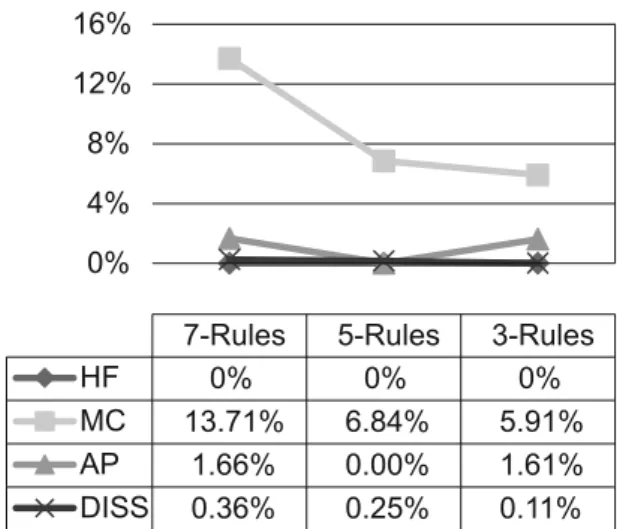
The side effect evaluations for our proposed algorithm are shown in Figures 2‒4. To assess the performance of the proposed algorithm, we established three sets of association rules for each of the three datasets shown in Table 4. These sets include 3 and 5 and 7 rules that are randomly selected from the whole set of rules mined from each dataset.
Three different datasets including Chess dataset with 88% support and 90% confidence, Mush-room dataset with 40% support and 60% confi-dence and synthetic dataset T1K with 2% sup-port and 7% confidence are chosen to extract the rules using the Apriori algorithm. Our algo-rithm tries to hide the sensitive rules through de-letion and re-insertion of an item from the LHS items. Accordingly, two types of side effects occur: Misses Cost and Artificial Pattern. Fig-ures 2‒4 show that no sensitive rules have been extracted from the sanitized databases; in other words, hiding failure has not happened for none of the three datasets. Our algorithm has more misses cost for dense Chess dataset than syn-thetic dataset T1K and non-dense Mushroom dataset because of more difficulty in finding a suitable transaction in dense datasets for re-in-serting an item. Since re-inre-in-serting an item in this dataset takes place infrequently, more removals are required by the algorithm to hide a sensi-tive rule and, consequently, more misses cost is produced. On the other hand, as can be seen in Figure 2, reduction of insertions or failure to insert items in Chess dataset, results in less pro-duction of artificial patterns. As can be seen in Figure 3, a suitable transaction in a non-dense dataset (Mushroom) can be found more easily for inserting an item than other datasets. As a result, sensitive rules are hidden with fewer removals and better results are achieved. Dis-similarity equals to zero if there are possibilities for removing or re-inserting items in a dataset. It can be inferred from Figures 2–4 that less probability of finding suitable transactions for inserting items will lead to some dissimilarity.
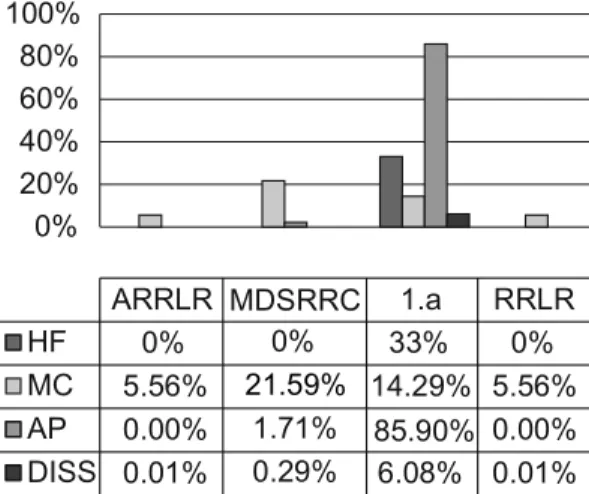
Six experiments, in two categories, are per-formed to compare the performance of algo-rithms 1a, MDSRRC and basic RRLR with the proposed one on three database setups shown in Table 4. The first category of the experiments is done with the aim of hiding a set of 3 rules that have a single item in their LHS and the second category is conducted with a set of 7 rules hav-ing multiple RHS and LHS items. The results of the first category are shown in Figures 5, 7 and 9. In this category, the results of the pro-posed algorithm and RRLR are similar. So they are not discussed except for Figure 5 in which a synthetic dataset is used and the hiding failure of RRLR is higher than that of the proposed al-gorithm.
Figure 5 and Figure 6 show the experiments on synthetic dataset T1K. This dataset is dense, but the lengths of transactions are different and an item can be inserted. It is worth noting that, in Figure 5, the RRLR has a high rate of hid-ing failure. This is due to the fact that RRLR removes the rules that are hidden by the algo-rithm from the list of sensitive ones. Therefore, inserting an item to hide the next sensitive rule may lead to disclosure of the previous one and, consequently, a hiding failure will occur.
The result of the second category of exper-iments are presented in Figures 6, 8 and 10. Since RRLR is not able to hide the sensitive rules with multiple LHS items, it is not in-cluded in the second category of experiments and is not shown in the corresponding figures.
Figure 2. Evaluation of the proposed algorithm on Chess dataset.
Figure 4. Evaluation of the proposed algorithm on
Synthetic dataset. Figure 5. Comparative evaluation of algorithms with 3-rules on T1k dataset.
Figure 6. Comprative evaluation with 7-rules on T1k dataset.
Where, |Rs(D')| and |Rs(D)|are the number of sensitive rules extracted from modified data-base D' and the original database D, respec-tively.
Misses Cost (MC): This performance measure
is used to show the percentage of the non-sensi-tive rules that are hidden as a side-effect of the sanitization process. The misses cost is calcu-lated as follows [4]:
( )
( )
( )
s s
s
R D R D'
MC
R D
π − =
(4)
Where ~ Rs(D) denotes the numbers of non-sensitive rules discovered from the original da-tabase D, and ~ Rs(D') denotes the number of non-sensitive rules discovered from modified database (D').
Dissimilarity (Diss): the dissimilarity measure
is calculated according to the formula suggested by [4]:
(
)
( )
( )
( )
1
1
, n n D D'
i n D
i
Diss D D' f i f i
f i = =
= ×
∑
− ∑
(5) Where fD(i) denotes repetition of the i-th item in the database D, and n is the number of differ-ent items in the initial database D.
Artificial Patterns (AP): This performance
factor is used to measure the percentage of the extracted rules that are ghost. It is calculated as follows [4]:
R' R R' AP
R'
− ∩ =
(6) Where, |R'| and |R| are the numbers of rules ex-tracted from D' and D, respectively.
4.2. Results and Discussion
The side effect evaluations for our proposed algorithm are shown in Figures 2‒4. To assess the performance of the proposed algorithm, we established three sets of association rules for each of the three datasets shown in Table 4. These sets include 3 and 5 and 7 rules that are randomly selected from the whole set of rules mined from each dataset.
Three different datasets including Chess dataset with 88% support and 90% confidence, Mush-room dataset with 40% support and 60% confi-dence and synthetic dataset T1K with 2% sup-port and 7% confidence are chosen to extract the rules using the Apriori algorithm. Our algo-rithm tries to hide the sensitive rules through de-letion and re-insertion of an item from the LHS items. Accordingly, two types of side effects occur: Misses Cost and Artificial Pattern. Fig-ures 2‒4 show that no sensitive rules have been extracted from the sanitized databases; in other words, hiding failure has not happened for none of the three datasets. Our algorithm has more misses cost for dense Chess dataset than syn-thetic dataset T1K and non-dense Mushroom dataset because of more difficulty in finding a suitable transaction in dense datasets for re-in-serting an item. Since re-inre-in-serting an item in this dataset takes place infrequently, more removals are required by the algorithm to hide a sensi-tive rule and, consequently, more misses cost is produced. On the other hand, as can be seen in Figure 2, reduction of insertions or failure to insert items in Chess dataset, results in less pro-duction of artificial patterns. As can be seen in Figure 3, a suitable transaction in a non-dense dataset (Mushroom) can be found more easily for inserting an item than other datasets. As a result, sensitive rules are hidden with fewer removals and better results are achieved. Dis-similarity equals to zero if there are possibilities for removing or re-inserting items in a dataset. It can be inferred from Figures 2–4 that less probability of finding suitable transactions for inserting items will lead to some dissimilarity.
Six experiments, in two categories, are per-formed to compare the performance of algo-rithms 1a, MDSRRC and basic RRLR with the proposed one on three database setups shown in Table 4. The first category of the experiments is done with the aim of hiding a set of 3 rules that have a single item in their LHS and the second category is conducted with a set of 7 rules hav-ing multiple RHS and LHS items. The results of the first category are shown in Figures 5, 7 and 9. In this category, the results of the pro-posed algorithm and RRLR are similar. So they are not discussed except for Figure 5 in which a synthetic dataset is used and the hiding failure of RRLR is higher than that of the proposed al-gorithm.
Figure 5 and Figure 6 show the experiments on synthetic dataset T1K. This dataset is dense, but the lengths of transactions are different and an item can be inserted. It is worth noting that, in Figure 5, the RRLR has a high rate of hid-ing failure. This is due to the fact that RRLR removes the rules that are hidden by the algo-rithm from the list of sensitive ones. Therefore, inserting an item to hide the next sensitive rule may lead to disclosure of the previous one and, consequently, a hiding failure will occur.
The result of the second category of exper-iments are presented in Figures 6, 8 and 10. Since RRLR is not able to hide the sensitive rules with multiple LHS items, it is not in-cluded in the second category of experiments and is not shown in the corresponding figures.
Figure 2. Evaluation of the proposed algorithm on Chess dataset.
Figure 4. Evaluation of the proposed algorithm on
Synthetic dataset. Figure 5. Comparative evaluation of algorithms with 3-rules on T1k dataset.
Figure 6. Comprative evaluation with 7-rules on T1k dataset.
In all experiments performed on three datasets, no failure is reported using the proposed al-gorithm. Accordingly, in some cases, fewer number of artificial patterns are produced by MDSRRC, but misses cost of our algorithm is less than MDSRRC's.
Comparing the results on Mushroom dataset shown in Figure 7 and Figure 8 indicates that misses cost and artificial pattern of the proposed algorithm are less than those of MDSRRC. This is because the proposed algorithm removes an item with the least frequency from the LHS items of the sensitive rules, and re-inserts it, if possible. On the other hand, removing an item with highest frequency by MDSRRC will re-sult in an increase of misses cost and artificial pattern. The strategy of removing and
re-insert-ing a LHS item, in order to hide sensitive rules, makes the proposed algorithm have better dis-similarity for all cases when compared with the others.
According to Figure 9 and Figure 10, the pro-posed algorithm has less Misses Cost than MDSRRC. However, its Misses Cost is in-creased relative to the previous experiments. The reason is that more removals are required to hide the sensitive rules due to the dataset's nature and inability to insert an item. In all ex-periments, the 1.a algorithm produces a large number of artificial patterns and is not able to hide the whole sensitive rules since it uses the strategy of inserting LHS. item. It should be noted that the number of Misses cost, in this al-gorithm, is not affected by the number of sensi-tive rules and database size. Low rate of Misses
cost is not considered as an advantage for 1.a, because it suffers from high rate of hiding fail-ure.
Finally, it should be mentioned that the time used by the proposed algorithm to hide the sensitive rules is less than that of its counterparts. This is due to the fact that MDSRRC re-computes the sensitivity of transactions, as well as items, after each deletion. It also performs re-order-ing of transactions. Moreover, for each case and each rule, 1.a finds and re-orders the transac-tions that partially support LHS of a sensitive rule. For MDSRRC and 1.a, these procedures lead to more computational time when facing with more sensitive rules. As mentioned before, at the initial step of the proposed algorithm, the transactions are ordered based on the sensitivity of the items. However, the algorithm does not update the sensitivity of items and transactions during the hiding process and, consequently, no re-ordering is required.
5. Conclusion
This paper presents a heuristic algorithm named ARRLR which is developed to over-come the limitations of RRLR algorithm. The proposed algorithm is rule-oriented and enables us to hide the sensitive association rules with multiple RHS and LHS items. This approach was compared with MDSRRC, 1.a, RRLR al-gorithms. We used MDSRRC and 1.a and the proposed algorithm (ARRLR) to hide the three and seven sensitive rules on three databases. The experimental results are analyzed based on the following performance factors [4]: Hid-ing Failure (HF), Misses Cost (MC), Artificial Patterns (AP), and Dissimilarity (DISS). The results show that our algorithm outperforms MDSRRC, 1.a and RRLR in terms of the above performance factors. For future works, ARRLR algorithm can be improved to reduce its side ef-fects on dense databases.
References
[1] K. Shah et al., "Association Rule Hiding by Heu-ristic Approach to Reduce Side Effects and Hide Multiple R. H. S. Items", International Journal of Computer Applications, vol. 45, no. 1, pp. 1‒7,
2012.
[2] M. N. Dehkordi et al., "A Novel Method for Privacy Preserving in Association Rule Mining Based on Genetic Algorithms", Journal of Soft-ware, vol. 4, no. 6, pp. 555‒562, 2009.
http://dx.doi.org/10.4304/jsw.4.6.555-562
[3] H. Wang, "Quality Measurements for Association Rules Hiding", in 2013 AASRI Conference on Parallel and Distributed Computing and Systems,
Elsevier, 2013, vol. 5, pp. 228‒234.
http://dx.doi.org/10.1016/j.aasri.2013.10.083 [4] V. S. Verykios and A. Gkoulalas-Divanis, "A
Survey of Association Rule Hiding Methods for Privacy", in Privacy-Preserving Data Mining,
Springer, 2008, pp. 267‒289.
http://dx.doi.org/10.1007/978-0-387-70992-5_11 [5] A. Amiri, "Dare to Share: Protecting Sensitive
Knowledge with Data Sanitization", Decision Support Systems, vol. 43, no. 1, pp. 181‒191,
2007.
http://dx.doi.org/10.1016/j.dss.2006.08.007 [6] S. R. Oliveira and O. R. Zaiane, "A Unified
Framework for Protecting Sensitive Association Rules in Business Collaboration", International Journal of Business Intelligence and Data Min-ing, vol. 1, no. 3, pp. 247‒287, 2006.
http://dx.doi.org/10.1504/IJBIDM.2006.009135 [7] S. R. Oliveira and O. R. Zaiane, "Protecting
Sen-sitive Knowledge by Data Sanitization", in Data Mining, (ICDM 2003) 3rd IEEE Int. Conf., 2003,
pp. 613‒616.
http://dx.doi.org/10.1109/ICDM.2003.1250990 [8] S. R. Oliveira and O. R. Zaiane, "Algorithms for
Balancing Privacy and Knowledge Discovery in Association Rule Mining", in Database Engi-neering and Applications Symp., 2003. Proc. of the 7th Int. Conf., 2003, pp. 54‒63.
http://dx.doi.org/10.1109/IDEAS.2003.1214911 [9] S. R. Oliveira and O. R. Zaiane, "Privacy
Preserv-ing Frequent Itemset MinPreserv-ing", in Proc. of IEEE Int. Conf. Privacy, Security and Data Mining, 2002, Australian Computer Society, Inc., vol. 14,
pp. 43‒54.
[10] G. V. Moustakides and V. S. Verykios, "A Max-Min Approach for Hiding Frequent Itemsets",
Data & Knowledge Engineering, vol. 65, no. 1,
pp. 75‒89, 2008.
http://dx.doi.org/10.1016/j.datak.2007.06.012 [11] X. Sun and S. Y. Philip, "Hiding Sensitive
Fre-quent Itemsets by a Border-Based Approach'',
Journal of Computing Science and Engineering,
vol. 1, no. 1, pp. 74‒94, 2007.
http://dx.doi.org/10.5626/JCSE.2007.1.1.074 [12] X. Sun and P. S. Yu, "A Border-Based Approach
for Hiding Sensitive Frequent Itemsets", in Data Mining, 5th IEEE Int. Conf. 2005, pp. 74‒82.
http://dx.doi.org/10.1109/ICDM.2005.2
[13] A. Gkoulalas-Divanis and V. S. Verykios, "act Knowledge Hiding Through Database
Ex-Figure 7. Comparative evaluation with 3-rules on Mushroom dataset.
Figure 8. Comprative evaluation with 7-rules on Mushroom dataset.
Figure 9. Comparative evaluation with 3-rules on Chess dataset.