DESIGN AND DEVELOPMENT OF A SPATIAL IMMERSIVE TRACK
CYCLING SIMULATOR
Yap, H. J.1*, Tan, C. H.1, Taha, Z.2, Chang, S.W.3, Sivadas, C.S.1,4, and Wan W.L.1
1Department of Mechanical Engineering, Faculty of Engineering,
University of Malaya, Malaysia
2Innovative Manufacturing, Mechatronics & Sports Laboratory (iMAMS), Faculty of
Manufacturing Engineering, Universiti Malaysia Pahang, Malaysia 3Bioinformatics Programme, Institute of Biological Sciences, Faculty of Science,
University of Malaya, Malaysia
4Aerospace Malaysia Innovation Centre (AMIC), German Malaysian Institute, Malaysia
*Email: [email protected]
(Received 28 December 2017; accepted 29 May 2018; published online 3 July 2018)
To cite this article: Yap, H. J., Tan, C. H., Taha, Z., Chang, S.W., Sivadas, C.S., & Wan W.L. (2018). Design and development of a spatial immersive track cycling simulator Malaysian Journal of Movement, Health & Exercise, 7(2), 39-52. https://doi.org/10.15282/mohe.v7i2.217
Link to this article: https://doi.org/10.15282/mohe.v7i2.217
Abstract
(HMD) to visualize the VR environment. An actual bike will be mounted on the 6-DOF motion platform, which the platform will synchronize with the VR environment to simulate the track condition for the training purposes. An encoder is placed at the bicycle wheel to feedback the moving speed and synchronize the visualize feedback to the HMD.
Keywords: Virtual reality, track cycling, simulation, 6-DOF platform, training
Introduction
Virtual environment
Fully immersive visualization facilities are still a relatively novel technology, but they are in fact the key subject of many research and industrial projects. Head mounted displays (HMDs) are commonly used in immersive virtual environment systems. HMDs are designed to present two separate views of the virtual environment to the user. One view is for the user’s right eye and the other view is for the left eye. These two stereo views are fused by the viewer’s perceptual system in the same way as right and left eye views of natural scenes. HMD system must also compute the synthetic views, track the viewer’s location and viewing orientation in the virtual world to create the correct right and left eye views. The latest technologies allow the development of better and cost effective spatially immersive visualization systems. Helen et al. (2012) listed the basic input technologies, tracking technologies, grounded display technologies, wireless display technologies, stereoscopic technologies and other output technologies used to present virtual environment in 25 academic papers relating to sports virtual reality Helen et al. (2012).
Stewart Platform
vehicle simulator as well [5]. The motion of the bicycle in virtual environment can be simulated using the Stewart Platform mechanism. It enables the user to feel the motion sensation in the virtual world. However, this might cause dizziness in certain individuals. Forward kinematics can be used to predict kinematics and also dynamic behavior. However, the forward kinematics of the Stewart Platform is extremely complicated because of its structure and its mechanical stiffness (El-Badawy & Youssef, 2013). Many researchers have presented single polynomial of direct kinematics, which might be time consuming and cause heavy computational loads [6].
Virtual Reality
Track cycling
In track cycling, facilities and infrastructure are very costly. For example, and indoor velodrome facility built in Aigle, Switzerland cost 11 million dollars US and the 200-meter board track, fully homologated and Union Cycliste Internationale (UCI) certified track cost around 400 thousand dollars, which includes the track, electronic timing, lighting, sound system, computerized scoreboard, access tunnel and UCI certification. The remaining 10.6 million dollars was the land, building, and architect’s fees. Velodrome Rakyat located in Ipoh was the first velodrome built in Malaysia. It cost around RM44 million at the time it was built. The cost of building a proper Velodrome is huge. Once a Velodrome is built, maintenance and cleaning work must be carried out from time to time. In Malaysia, the government used to send the national track cyclists to train abroad. The cost incurred for sending a team to overseas is another huge amount of money. While VR systems keep improving, VR track cycling simulator can provide a real-time visualization on Velodrome track, giving the rider the same sensational as riding on the real bicycle. No matter the time or the weather, a virtual bike training system lets the athletes get out and ride. Athletes can reap the benefits of a full workout paired with the excitement of riding a virtual bike trainer along a real Velodrome as the system tracks the training data. Track cycling can be very dangerous if someone in the field thinks that he has enough experience to race aggressively. Accidents may happen anytime when a person cycling on a Velodrome track, especially for the beginner. This is because the track cycling is much different than normal road cycling in term of the slope of the track, track path, bicycle type, and bicycle brake system. In order for top athletes and sport organizations to focus on improving physical performance without suffering injuries, immersive virtual reality combined with real time motion analysis is becoming a primary training tool. Gait analysis and training can be used for sport related research and therapy. The VR technology is invaluable for injury prevention and rehabilitation, research and human gait analysis. These systems are ideal for creating and implementing new training programs in premiere sports centers. Virtual reality scenarios coupled with real time presence and interaction offers great potential for enhancing sports performance in track cycling. VR simulations can be tailored for any track cycling event. Those simulations reveal the information of useful mental strategies and improve one’s performance in the actual sport. Such VR track cycling simulations may use the virtual reality concepts to physically immerse an individual into a simulated competition as well.
Related previous research
back wheel of the bicycle. The actuation unit consists of a damper and a servomotor. The simulator can be displayed with stereoscopic effect and with sound effect playing at the background. Kim et al. [12] developed a VR bicycle simulator as well, specifically for rehabilitation training of postural balance. They have conducted a series of experiments on the VR bicycle simulator in three conditions (without visual feedback, with visual feedback of weight shift and with visual feedback of the center of pressure). Their experiments suggested that the visual feedback of weight shift is most effective for increasing the effect of the balance training. Chen et al. [13] had proposed an interactive bike simulator of 2 DOF platform. The platform is controlled by adjusting the cable tied to the platform and is presented in VR. They proposed numerical methods to calculate the bike motion equations and road conditions in virtual bike riding. Yap et al. [14] designed a 6 DOF system for virtual bicycle simulator prototype. The kinematics equation of the 6 DOF system has been formulated with accuracy tested. The authors commented there are still many further improvements required. They successfully created a design feasibility programming to verify the design of a 6 DOF platform before actually building one. The authors suggested the addition of a display of the virtual environment to complete an immersive virtual bicycle simulator.
The objectives of this study are:
To simulate Velodrome track cycling in a virtual environment
To synchronize the 6 degree of freedom (DOF) mechanism with the VR environment
Section II of this paper concerns the methodology of the integration of the hardware, control system and the virtual environment design of the spatial immersive track cycling simulator. Next, in section III, results and discussions on the questionnaire survey are provided based on the 50 university students who had tried the simulator. Conclusions and future work are discussed in section IV.
Methodology
Figure 1: Spatial immersive track cycling simulator elements
6 DOF platform’s design and Ardruino control system
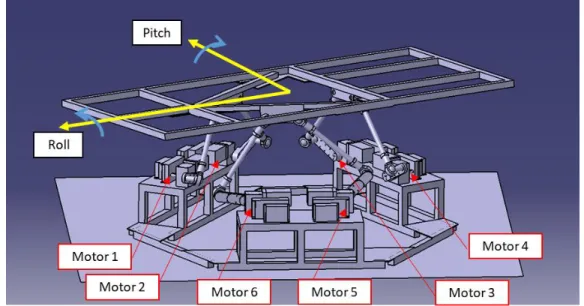
The orientation of the virtual bicycle is tracked in the virtual environment. The roll, yaw and pitch orientation of the virtual bicycle represent the roll, yaw and pitch orientation of the 6 DOF platform. To control the platform’s orientation, the 6 servomotors have to be rotated to the designated step and direction. The communication between the virtual environment and the Ardruino board is wired using an USB cable. The orientation of the virtual bicycle is identified in roll axis and pitch axis, table 1 shows the rotation direction of the 6 motors to achieve positive or negative value of roll angle and pitch angle of the bicycle. Figure 2 shows the 6 DOF platform arrangement.
Table 1: Bicycle orientation vs 6 motors orientation
Bicycle orientation 6 DOF platform motor orientation
Motor 1 Motor 2 Motor 3 Motor 4 Motor 5 Motor 6
Roll +ve CCW CW CCW CCW CW CCW
-ve CW CCW CW CW CCW CW
Pitch +ve CW CCW CCW CW CW CCW
-ve CCW CW CW CCW CCW CW
CW: Clockwise
Figure 2: 6 DOF platform arrangement
Wiimote setup and virtual bicycle speed calculation
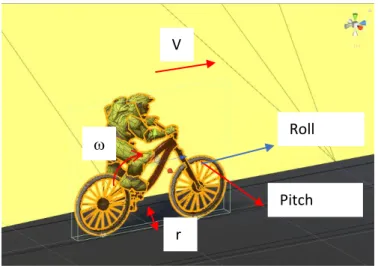
A Wiimote is attached at the back wheel of the bicycle and is used to track the speed of the actual bicycle and send the data to the virtual environment for controlling the virtual bicycle. Figure 3 shows the setup of Wiimote in spatial immersive track cycling system. The Wiimote API calculates the angular speed of the Wiimote (roll, yaw and pitch) in degree per second. To convert the angular speed from degree per second to radian per second, the data need to be multiplied by 0.01745. The yaw angular speed of the Wiimote represents the angular speed of the bicycle wheel. The velocity of the bicycle is the product of the Wiimote’s angular speed in yaw and the radius of the back wheel. In this research, the radius of the back wheel is 0.66 m. Figure 4 provides an explanation of the virtual bicycle velocity calculation and roll, pitch angle of the virtual bicycle.
V = * r
Where,
Figure 3: Placement of Wiimote
Figure 4: Virtual bicycle velocity and orientation view
Virtual environment of the track cycling simulator design
Based on Cycle Sports Facilities Design Guide from Sport England, the standard dimension of various Velodrome track is given. According to Webb [9], the tracks are constructed according to the metric distance of cycling events:
250m track is 4 laps = 1km 333.333m track is 3 laps = 1km 500m track is 2 laps = 1km
Table 2 below shows the length and width of the track.
Table 2: Velodrome track dimension
Track (m) Length (m) Width (m)
250 116 78
333.333 138 97
400 181 104
Roll angle
Pitch angle r
V
There are also smaller Velodrome tracks for indoor events and the dimensions of the track are as below:
166.666m (6 laps = 1km) 200m (5 laps = 1km)
The highest banking angle of the 250 m track is up to 45° while for the 333.333 m track, the highest banking angle is 28°. The 333.333m track has a higher radius of curvature of 48.5m. The detailed dimensions for the 333.333m Velodrome track are as in table 3.
Table 3: The 333.333m Velodrome track dimension
Parameter Dimension
Concourse circumference 436m
Track circumference 333.333m
Track perimeter 373.5m
Track width 7m
Highest angle 28º
Lowest angle 5.5º
Length 138m
Width 97m
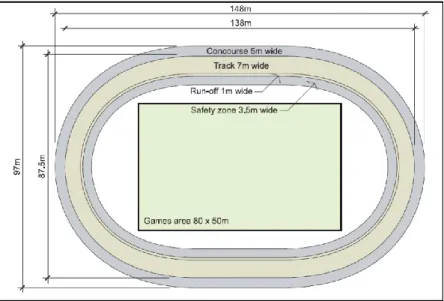
The track with size of 3 laps = 1km, 333.333m Velodrome track is recommended as a good solution to the need for general cycling activities from beginner to elite level. It provides a central arena area to accommodate a wide variety of sports. Figure 5 shows a standard 333.333m Velodrome track dimension.
Figure 5: The 333.333m Velodrome Track Dimension
and rendered according to the real Velodrome sample to allow the user to have a realistic feel in the virtual environment. Figure 6 shows a screenshot of the Velodrome model in Unity software.
Figure 6: Velodrome model in Unity software
Prototype of the spatial immersive track cycling simulator
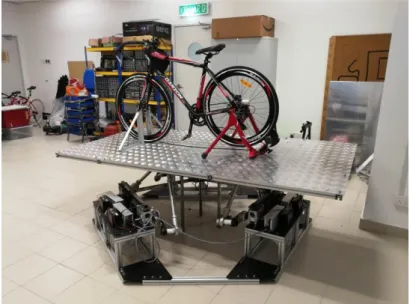
A prototype of the spatial immersive track cycling simulator is built. A 6 DOF platform is built with an Ardruino board as the controller to control 6 servomotors. The 6 servomotors are connected to 6 independent linkage connected to a flat metal surface. The platform moves and rotates when the servomotors rotate. A bicycle complying with UCI standards is mounted on the platform. The bicycle is modified with the back wheel freely rotates when force is applied on the pedals. A Wiimote is attached at the back wheel to check its angular speed. Figure 7 shows the setup of the hardware. Figure 8 shows a student wearing the HMD and trying the spatial immersive track cycling simulator.
Figure 8: User testing the spatial immersive track cycling simulator
Results and discussion
50 students from Faculty of Engineering, University of Malaya were selected to try the developed spatial immersive track cycling simulator. They were then asked to complete a questionnaire survey regarding the spatial immersive track cycling simulator. The questionnaire can be summarized as below:
i. The easiness of VR track cycling simulator ii. User interface realistic level
iii. The usefulness of the VR track cycling simulator iv. The usefulness of the VR simulation applications
v. Adoption of the VR track cycling simulation as training tool vi. Recommendations from users
The results of the questionnaire analysis are discussed below.
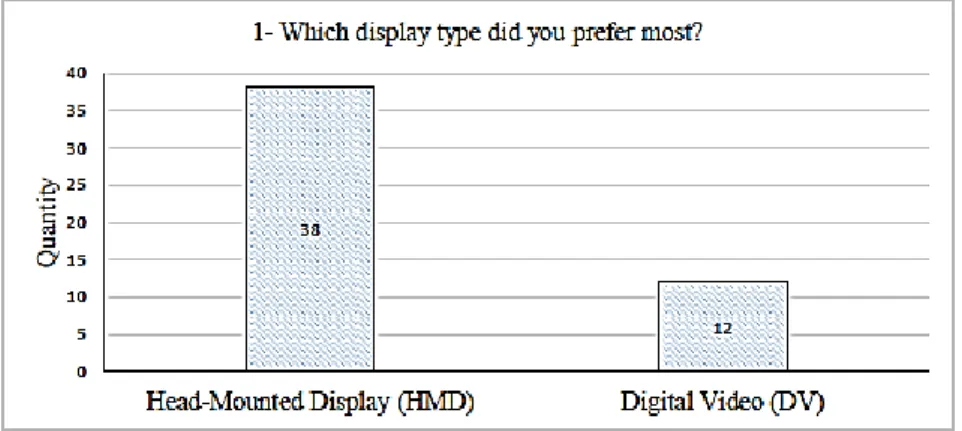
38/50 of the students preferred to display the simulation in HMD as compared to normal projector. In their opinion, HMD can provide an immersive feeling in the simulation. 90% of the students preferred to use VR simulator for training purpose as compared to static bicycle trainer. This is because the view in the VR simulator is interactive and the users had more fun in VR simulator.
6 students claimed that the system is not user friendly while the rest thought the system is good. 8 students feedback that the orientation of the virtual bicycle does not tally with the simulator, while 24 thought that it does tally while the rest thought it is acceptable. 20% of the students feel that the simulator speed is not tally to the actual pedal moving speed, while 38% of the student thought that the speed is correct and the rest 42% thought that it is acceptable. 45 students saw the virtual environment as real scale while the other 5 students thought that the design and dimensions are not according to a real-life scale.
94% of the students reported that this VR track cycling simulator could improve real track cycling skills. 46 students suggested that track cyclists should try VR track cycling simulator before exposed to the real training, while four students did not agree. 78% of the students think that the training cost can be reduced by having this VR track cycling simulator while the rest think this VR track cycling is costly and cannot reduce the training cost. 41 of 50 students thought that the playback function is necessary for them to review their performance and strive to improve in future training. All of the students suggested adding an instant computer aided instruction and full cycling technique guidance in the simulation to provide them instant correction on bicycle handle orientation, cycling speed, proper cycling posture and technique.
Figure 9: Chart analysis on student’s display preference when using simulator
Conclusion and future work
The development of the spatial immersive track cycling simulator will help in training cyclist athletes. It will definitely save the cost and space for training facilities. However, the effectiveness of this simulator in raising the performance of the athletes is uncertain. Hence, a review of the simulator with professions in track cycling is suggested for future work. Based on the questionnaire results, a majority of the students have accepted the current prototype of spatial immersive track cycling simulator as training tool. To further improve the system, the performance of the user in the simulator can be shown on the screen follows with suggestion for improvement. Video playback to show the user performance at the end of the training session would add merit to the simulator.
Acknowledgements
The authors would like to thank the Department of Mechanical Engineering, Faculty of Engineering, University of Malaya, for providing the necessary facilities to support this study. The authors would like to acknowledge the Ministry of Higher Education of Malaysia (MOHE) for the financial support under Grant No: GA012-2014.
References
Helen C. M., Serban R. P., Simon J. W., Gavin P. L. & Nigel W. J. (2012), A review of virtual environments for training in ball sports. Computer & Graphics, 36(2), 714-726.
Stewart, D. (1965), A platform with six degrees of freedom. Proceedings of the Institution of Mechanical Engineers, 180, 371-386.
Patel, Y. D. (2012), Parallel Manipulators Applications – A Survey. Modern Mechanical Engineering, 02(03), 57-64.
Ferrazzin, D., Barbagli, F., Avizzano, C. A., Di Pietro, G., & Bergamasco, M. (2003), Designing new commercial motorcycles through a highly reconfigurable virtual reality-based simulator. Advanced Robotics, 17(4), 293-318.
Mohamad K. (2010), Design and Development of 6 DOF Motion Platform for Vehicle
Driving Simulator. Retrieved from website:
http://fkm.utm.my/~kasim/content/motionbase.pdf
El-Badawy, A., & Youssef, K. (2013), On Modeling and Simulation of 6 Degrees of Freedom Stewart Platform Mechanism Using Multibody Dynamics Approach. ECCOMAS Multibody Dynamics 2013, 751-760.
Han C., Ma L., Luying G. (2011), The Research on Application of Information Technology in sports Stadiums. Physics Procedia, 22, 604-609.
Webb, R. (2003), Cycle racing tracks and velodromes. Cycle Sports Facilities - Design Guide. Sport England and British Cycling, 2-17.
Ramirez, A. R. G., Reis, A. A., Haase, A. & Cordeiro Neto, A. A. (2012), Automation of Flight Simulator Platform in Immersive Virtual Reality. Human Factors, v. 1, 1- 6.
Yuk-Ming T., Matthew T., Daniel F., Pauline L., Kin-Chuen H.., Kai-Ming, C.(2007), The Development of a Virtual Cycling Simulator. Technologies for E-Learning and Digital Entertainment. Berlin: Springer, 162-170.
Kim N. G., Kim Y. Y., and Kwon T. K., (2006), Development of a Virtual Reality Bicycle Simulator for Rehabilitation Training of Postural Balance. Computational Science and Its Applications - ICCSA 2006, pp.241-250
Chen, C.-K., Chen, F.-J., Huang, J.-T., & Huang, C.-J. (2007), Study of interactive bike simulator in application of virtual reality. Journal of the Chinese Society of Mechanical Engineers, 28(6), 633-640.