VOLUME 16 ISSUE 2 (2018), Page 39 - 49
DESIGN ANALYSIS TO ACHIEVE GREEN/ECO SCHOOL BUILDING DESIGN TYPOLOGY FOR MALAYSIA
Zuraini Denan1, Muhammad Afiq Helmi Mazlan2, Noor Hanita Abdul
Majid3, & Nur Aliyah Zafirah Sanusi4
1,2,3,4Kulliyyah of Architecture and Environmental Design
INTERNATIONAL ISLAMIC UNIVERSITY MALAYSIA
Abstract
Ever since the first establishment of the public school (primary and secondary school) in Malaysia, the building design for most of the schools is almost the same until now. Public school for primary and secondary education is based on a standard layout designed by the Malaysian Public Works Department. Evolution of varieties education system employed by the schools does not affect the physical design of school. The emergence of awareness on sustainability and promotion towards green way of life has made it crucial for designer to rethink the best design for school in enhancing its environment that could be the “third teacher” to the pupils. The research attempt to explore design criteria of green school in Malaysia based on the critical elements of green initiatives. Recommendation of green/eco school design will be presented based on site and building planning, climate and green technology application
INTRODUCTION
The education system in Malaysia has changed occasionally, yet the physical form of the school remains almost the same. More schools (primary and secondary) were built to fulfill the needs of the children education in Malaysia. A total of 10,117 number of school buildings; excluding the number of pre-school, was recorded in Malaysia (Roslizar, Alghoul, Bakhtyar, Asim, & Sopian, 2014). The same prototype school building design was repeated all over Malaysia.
The space planning of standard school building design are based on the syllabus of the latest curriculum for primary and secondary schools (Kurikulum Baru Sekolah Rendah and Kurikulum Baru Sekolah Menengah) governed by the Ministry of Education. Number of courses or subjects required determine the number of classes and type of classroom (i.e: music room, laboratories, halls or outdoor space/areas, etc).
Commonly, layout of standard schools is arranged in linear spatial organization with one sided corridor. Two blocks of three or up to five stories block are facing each other with a courts in a middle. Two blocks that faced each other are connected with a bridge where shared staircases are designed in the middle or merely just a bridge for connectivity. Fire staircases are located either in the middle or at the end of the block, while toilets are always located at the end of the block. Other blocks for halls, laboratories, workshop, canteen, musholla are another separated physical building form. These are basic architectural form and spaces which are required by a school to accommodate subjects such as science, mathematics, geography, history and religion. Gardens are used more like yards or working compound for specific subjects such as science or vocational landscape or co-curriculum activities. The existence of green surrounding is not emphasizing as maintenance to keep it clean, manageable and safe for the children can increase maintenance budget for the school.
The environment and the physical surrounding of public schools do not really encourage the learning through nature or school as ‘third teacher’ or a laboratory for the green and sustainable living experience.
ISSUES AND PROBLEM
and staff. Study have shown that the environment of teaching and learning has tremendous effect on academic performances. Environmental factors has affected 73% of the score in student scores (“School Design, Classroom Layout”, 2013).
AIM AND OBJECTIVES
The study attempts to propose a suitable design of school physical form and space in order to use school as the living laboratory in motivating green initiatives in school. The proposed design evaluated based on the optimum recommendation of of the school will be based on the site and building planning, climate, and green technology application.
METHODOLOGY
A design thesis proposal (Mazlan, 2016) is presented as an experimental process in searching for the suitable green school form and space layout. The analysis is focussed on creating a comfortable environment due to climate and placing green technology application.
GREEN SCHOOL CRITERIA
Teaching and learning environment has tremendous effects on students’ performance (Higgins, Hall, Wall, Woolner, & McCaughey, 2016; Schneider, 2002). The world has realized that by establishing a green school or eco school program, the teaching and learning environment which are based on nature will change the future education paradigm. Eco or green school is an international programme that lead to sustainable development. Study shows that green school program can reduce absenteeism and increase test score (US EPA), 2017).
GREEN SCHOOL DESIGN CONSIDERATION
Site Planning
In searching for a conducive and comfortable learning and teaching environment, passive design concept is emphasized. Not only site planning focus on accessibility, security and maximization of space on site, but building orientation is also considered due to avoid over exposure to heat and sun. Figure 1 shows the site planning process in searching the best orientation based on program distribution (academic, administration and services), exterior frontage, green pocket areas, assembly area and vehicular and pedestrian access.
Figure 1(a): Site Planning and Design process
Figure 1(b): Site planning with green pocket and middle spine for connectivity in between blocks.
Passive Design
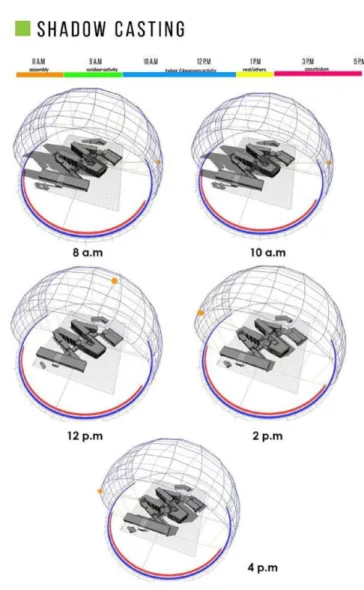
Passive design feature is one of the strategy to achieve green and sustainable design. Orientated the longest façade building facing the south and north, the building has less exposure area toward direct sunlight. It will reduce the heat absorb to the building. Besides that, creating a proper positioning of the building based on the sun orientation will create a shadow in the area where pupils mostly have their assembly. Shadow, solar radiation and day lighting analysis are among suitable evaluation to determine design components that response to the climate, in this case the humidity of Malaysia. The evaluation will also influence the installation of green technology such as solar photovoltaic panel and rain water harvesting.
Shadow Casting Analysis
Figure 2: Shadow casting Analysis
Source: Mazlan (2016)
Solar Radiation Analysis
was getting less heat from direct sunlight. The result also showed the suitable spot to place photovoltaic solar is on the roof.
Figure 3: Solar radiation analysis of the building
Daylighting Analysis
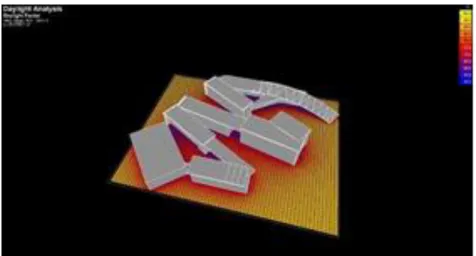
The result showed that the area between the block receiving almost 70% of natural lighting in the area. It was proved that the area had ample natural lighting for reading and not required artificial lighting in the area. The garden between the block would received enough natural daylight for the plants and trees. However, spine of the building only received 60% of daylighting. It was still good enough to have an activity in the area because they were more shaded than the landscape or the garden area. Therefore, the area surrounding the building had ample daylighting to hold activities outside the classroom.
Green Technology
Photovoltaic (PV) Solar Panel
The proposed design responded to the sun orientation. The roof of each block is facing more toward south to gain more exposure hours of the sun. There are no obstacle that prevent direct sunlight to the PV panel. Figure 5 shows the most suitable roof location after taking into consideration of the angle and azimuth in order to gain more exposure hours of direct sunlight to generate more electricity energy. The area only at Academic 1 block, administration block, hall, and the spin roof.
Figure 5: The area of PV panel location. The red one is for the commercial use while the yellow one is for the educational purposes.
Source: Mazlan (2016)
Rainwater Harvesting
Figure 6: The diagram of rainwater harvesting system for the garden roof and its location in the school building.
Source: Mazlan (2016)
Details on Classroom Design
The dimension of typical classroom was adjusted. The typical classroom dimension is 7500mm x 9000mm which is equivalent to 68 sqm. A dimension of green classroom is 8000mm x 12000mm equivalent to 90 sqm. The classroom floor plate was designed bigger but thinner in order to allow more air flow ventilated through the classroom. Besides that, the green classroom was to create more room for the student in order to make the classroom 1:35 or 1:40 ratio rather than 1:30. However the size of the classroom could be adjusted depends on the size and no of occupant of the school but maintaining the ratio of classroom dimension. Figure 7 below show the eco classroom concept and its simulation.
Figure 7: Classroom design with green corridor.
RESULTS AND FINDINGS
Figure 8: Elevation of the whole school block showing the image of green school
CONCLUSION
The design shows that a comfortable teaching and learning environment that is based on climatic analysis and recommended green strategies proposal have high potential to be adopted as an option to a refreshing and stimulating teaching and learning environment for public school in Malaysia. No extreme design is proposed as to keep the maintenance low and safety of the children are under control.
REFERENCES
Denan, Z
.,
Awang, A. H., Mazlan, M. A. H., Majid, N. H. A., Rahim, Z. A., & Sanusi, N. A. Z. (2017). The implementation of environmental education and green programs in schools to achieve sustainability. Advance Science Letter, 23(7), 6261-6265.Higgins, S., Hall, E., Wall, K., Woolner, P., & McCaughey, C. (2005). The impact of school environments: A literature review. University of Newcastle.
Mazlan, M. A. H. (2016). Proposed eco school, Desa Park City (Unpublished Thesis). IIUM, Malaysia.
Roslizar, A., Alghoul, M. A., Bakhtyar, B., Asim, N., & Sopian, K. (2014). Annual energy usage reduction and cost savings of a school: End-use energy analysis. The Scientific World Journal, 1-8. http://doi.org/10.1155/2014/310539
Schneider, M. (2002). Do school facilities affect academic outcomes. Washington USA: National Clearinghouse for Educational Facilities.
School Design, Classroom Layout Can Heavily Affect Student Grades, Learning: Study
(2013, March 1). Retrieved from
https://www.huffingtonpost.com/2013/01/03/school-design-student-grades_n_2404289.html