FERMAT’S LAST THEOREM USING OF TRIGONOMETRY AND ITS INTEGRATED APPLICATIONS: AN ANALYSIS
Manisha Garg1, Dr. Sudesh Kumar2
Department of Mathematics
1,2
OPJS University, Churu (Rajasthan) – India
Abstract
In this article we demonstrate an elective point of view on Fermat's Last Theorem using ideas of traditional geometry, trigonometry, reductio promotion absurdum, and basic however non-evident mathematical traps. Fermat's conjecture was propelled definitely when he was finding out about how to discover Pythagorean triples solutions to the quadratic Diophantine equations
x2+y2=z2, and this is the motivation behind why we examine a conceivable proof of this theorem
from another viewpoint. Specifically, we show how the theorem can be diminished to three conceivable geometric situations. After a cautious investigation of each case, we touch base to contradictions which appear to show a conceivable course towards another method for examining the legitimacy of the theorem
1. OVERVIEW
In number theory Fermat's Last Theorem (once in a while called Fermat's conjecture, especially in more established writings) states that no three positive integers a, b, and c fulfill the equation
an + bn = cn for any integer estimation of n more prominent than 2. The cases n = 1 and n = 2
have been known since relic to have an infinite number of solutions.
The proposition was first conjectured by Pierre de Fermat in 1637 in the edge of a duplicate of Arithmetica; Fermat included that he had a proof that was too huge to even consider fitting in the edge. Nonetheless, there were first questions about it since the distribution was finished by his child without his assent, after Fermat's demise. Following 358 years of exertion by mathematicians, the primary effective proof was discharged in 1994 by Andrew Wiles, and formally distributed in 1995; it was depicted as a "shocking development" in the reference for Wiles' Abel Prize honor in 2016. It likewise demonstrated a significant part of the modularity theorem and opened up whole new approaches to various different issues and mathematically powerful modularity lifting methods.
the "most troublesome mathematical issue" to some extent on the grounds that the theorem has the biggest number of ineffective proofs.
2 SIMPLE PROOF OF FERMAT’S LAST THEOREM BY TRIGONOMETRY
Practically all mathematicians have fairly enthusiasm for Fermat's last theorem coming up short on the proof since Fermat's statement in 1637 until the arrangement of the proof by Andrew Wiles in 1995. I attempted my best to be very short and as basic as could be expected under the circumstances. Since Fermat was an expert legal counselor yet an amateur mathematician presumably, he likewise had his very basic proof for his theorem. Indeed, even a moderate secondary school understudy can understand my proof all around effectively in extremely brief time.
(Proof of Fermat’s Last Equation)
Fermat’s last theorem (FLT) is one of the most celebrated and intriguing theorems of mathematics. The original statement by Fermat was:
"It is difficult to isolate a block into two 3D squares, or a fourth power into two fourth powers, or by and large, any power higher than the second, into two like powers."
aggregate of two squares, that is, the means by which to discover Pythagorean triples that are solutions of the quadratic Diophantine equations x2+y2=z2. Consequently, it looks conceivable at any rate on a basic level that the theorem can likewise be examined from an alternate point of view, closer to what Fermat had presumably as a main priority initially, either right or off-base. In this paper we demonstrate an elective point of view on FLT dependent on established geometry and trigonometry. As we will appear, using a number of (basic yet non-self-evident) deceives it is conceivable to decrease the theorem to a number of cases which, whenever broke down in detail and cautiously enough, may show a conceivable course towards another method for demonstrating the legitimacy of the theorem.
Statement of FLT
As is well-known, using modern notation, FLT can be stated as follows:
The equation has not integer solutions (non-trivial) for n equal to 3, has not integer
solutions (non-trivial) for n equal to 4, and generally, has not integer solutions (non-trivial) for n greater than 2.
and z ∈ Z other than the trivial solution such that for any
Or what is the same:
FLT1: and z ∈ Z other than the trivial solution and n ∈ N n> 2 such that
But the most popular is the equivalent statement:
FLT2: and z ∈ N other than the trivial solution and n ∈ N n> 2 such that
Statements FLT1 and FLT2 are indeed equivalent. This is the case because, if n is even, then
with independence of x, y, z being positive or negative, then we have and z n>
And if n is odd, then we have:
The remaining two cases x > 0, y > 0, z < 0 and x < 0, y < 0, z > 0 do not make sense, because we get a positive number equal to a negative number in the first case, and a negative number equal to a positive number in the second case.
In this work we use this last equivalent statement, i.e., what we call FLT2. As a remark, notice
that (obviously) x must be different to y, because if x is equal to y, then we have and
since is an irrational number, then z is not a natural number.
As stated in the previous section, x must be different to y, because otherwise z is not a natural
number. Dividing by zneverywhere, we get:
∃x, y and z ∈ N different to the trivial solution and n ∈ N n> 2 such that
Notice that if then it means that . Therefore, x/z ∈ (0, 1)
and y z ∈ (0, 1). Moreover, since the sine function is continuous and sin x ∈ [−1, 1], we then
have:
such that
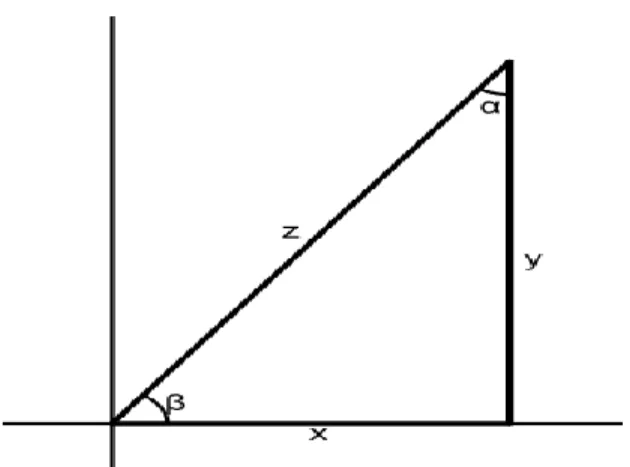
At this point it is important to realize that, if x and y are two natural numbers, then we can always represent them as two perpendicular segments in the Cartesian plane as in Fig.(1).
Figure 1: Representation of x and y as two perpendicular segments in the Cartesian plane.
Therefore, using the usual definition of sine and cosine in a right-triangle, we have three possible situations:
First situation: the hypotenuse of the correct triangle formed by the portions x and y is
only the estimation of z.
Second situation: the hypotenuse of the correct triangle formed by the sections x and y
isn't the estimation of z, yet the estimation of z is more noteworthy than the hypotenuse
Third situation: the hypotenuse of the correct triangle formed by the portions x and y isn't
Let us consider in what follows those three situations in detail.
Analysis of the first situation
We have that with the end goal that sin α = x/z and sin β = y/z . In this
way, taking into account how we can speak to x and y in the Cartesian plane and the definition of sine and cosine functions in the correct triangles, we would now be able to draw a triangle as appeared in Fig.(2).
Figure 2: Right triangle with legs x and y where the hypotenuse is precisely z.
Notice that the triangle shows the angles α and β, and that the angles satisfy the following:
Then, given that ∃x, y and z ∈ N different to the trivial solution and n ∈ N n> 2 such that
we have:
∃n ∈ N n> 2 such that
Given that α ∈ (0, π/2 ) then sin2 α > 0 and cos2 α > 0, the above equality will be true if and only
if sinn α − 1 = 0 and cosn α − 1 = 0. But importantly,
Hence, sinn α = 1 and cosn α = 1 ⇔ n = 0, and consequently we touch base to a contradiction
since we were expecting that it was valid for a natural number n more prominent or equivalent to 1. This situation is, therefore, incomprehensible. Truth be told, this situation is incomprehensible notwithstanding for x, y, z genuine.
Analysis of the second situation
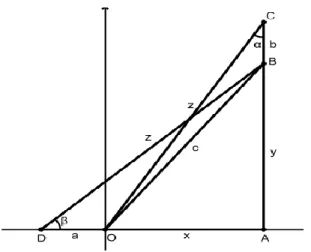
If z is greater than the hypothenuse c, we can make a drawing such as the one in Fig.(3).
Figure 3: Right triangle with legs x and y where z is greater than the hypotenuse c
Then, given that ∃x, y and z ∈ N different to the trivial solution and n ∈ N n> 2 such that
we have that:
∃n ∈ N n> 2 such that sinn α + sinn β = 1.
Again, let us now study the above equality for this case. We find the following chain of equations:
Presently, on the off chance that we examine the last one of the equations above, we see that the correct hand side is constantly negative on the grounds that sin2 α > 0, sin2 β > 0, (sinn α − 1) < 0 and (sinn β − 1) < 0. Thusly, with the goal for it to be valid, it is fundamental for the left-hand side to be likewise negative. Be that as it may, studying the indication of the left-hand side we have:
And given that c is less than z then:
i.e., it is positive.
The attention is on number theory, polynomials, and commutative rings. Group theory is presented close to the finish of the content to clarify why generalizations of the quadratic formula don't exist for polynomials of high degree, enabling the peruser to welcome the broader work of Galois and Abel on roots of polynomials. Results and proofs are propelled with explicit examples at whatever point conceivable, so deliberations rise up out of solid experience. Applications go from the theory of rehashing decimals to the utilization of nonexistent quadratic fields to build issues with rational solutions. While such applications are incorporated all through.
5. CONCLUSION
In this article we have considered Fermat’s Last Theorem,
and z ∈ Z other than the trivial solution and n ∈ N n> 2 such that using
the equivalent statement
and z ∈ N other than the trivial solution and n ∈ N n> 2 such that
We have shown an alternative approach to the study of this theorem using classical geometry and reductio ad absurdum. By assuming the opposite, i.e.,
∃x, y and z ∈ N different to the trivial solution and n ∈ N n> 2 such that
We discover three potential situations portrayed in Figs. After a cautious examination, we touched base to a contradiction in every last one of these situations. Due to reductio advertisement absurdum, this infers the theorem is substantial. An expression of alert is all together. Obviously, we are impeccably mindful of the complexities in the historical backdrop of FLT and its potential proofs. Supposedly, the proposition displayed in this paper presents a few (basic however non-self-evident) mathematical traps that have not been completely misused before in this unique circumstance. All things considered, this new point of view has an incentive all alone and has the right to be investigated further. With respect to the legitimacy of our approach with regards to FLT, we couldn't locate any conspicuous missteps, and this is the reason, as we would like to think, the outcome displayed here ought to be painstakingly considered.
would see it the easiest and the clearest proof is the most important. I trust that any individual who knows moderate variable-based math and trigonometry can understand my proof.
REFERENCES
[1].Wiles, Andrew (1995). Modular elliptic curves and Fermat's last theorem, Annals of
Mathematics141 (3), 443-551
[2]. Diophantus of Alexandria (1621). Arithmetica of Diophantus.
[3].Christophe Breuil, Brian Conrad, Fred Diamond, Richard Taylor (2001). On the
modularity of elliptic curves over Q: Wild 3-adic exercises. Journal of the American Mathematical Society 14: 843–939.
[4].Singh, Simon. “Fermat’s Enigma: The Epic Quest to Solve the World’s Greatest