The Effect of Filler Loading and Silane Coupling Agent on Properties of Rice Husk Powder Filled Natural Rubber Compounds
Razif Nordin C. S. Said
H. Ismail
The effect of silane coupling agent, bis(triethoxysilyl propyl) tetrasulphide, Si69 on cure characteristics and mechanical properties of rice husk powder, RHP filled natural rubber, NR compounds were studied. Scorch time t2 and cure time t90 of the
compounds decrease with increasing filler loading and with presence of a silane coupling agent, Si69. However, minimum torque increases with increasing filler loading but at a similar filler loading shows lower value with the presence of Si69. The mechanical properties of compounds viz tensile strength, tensile modulus and hardness were also increased while resilience decreases with additional of Si69.
Introduction
These days various polymers combined with various fillers from different sources are being prepared so as to enhance material properties and or to save cost. Recently, utilization of agricultural waste as fillers has been the subject of various studies (Dai, 2003 and Ismail, Rosnah & Rozman, 1997). These natural fillers are especially being sought since the production of composites using natural substance as reinforcing filler is not only inexpensive but is also able to minimize the environmental pollution caused by their characteristic biodegradability (Joseph et al., 2002).
The need for biodegradable and compostable products, especially those made from the disposable lignocellulocis materials is necessary due to lack of resources (crude oil) and increasing level of environmental pollution. The most important aspect of lignocellulocis reinforced composites is to attainment of good adhesion between the fibres and matrix. Several attempts have been made to overcome these problems. These include grafting surface modifying groups onto the fibres, adding various coupling agent or bonding agents or pretreatment of the fibres with suitable chemicals (Geethamma, Joseph & Thomas, 1995 and Ismail, Edyham & Wirjosentono, 2002).
In the present study, a new type of composite material viz. rice husk powder (RHP) reinforced natural rubber compounds was developed. RHP was used as the reinforcement because rice husk is an abundantly available in Asia including Malaysia (IRRI, 2004). The effect of filler loading and silane coupling agents on the curing characteristics, and mechanical properties of RHP filled natural rubber composites will be reported. Scanning electron microscopy (SEM) studies were carried out to determine the failure mechanism of the composites.
Experimental
acid, N-cyclohexyl-2-benzothiazole sulfenamide, 2,2-methylene-bis(4-methyl-6-tertbutylphenol) and silane coupling agent, bis(triethoxysilyl propyl) tetrasulphide, Si69 were all purchased from Bayer (M) Ltd.
Cure characteristics were studied using a Monsanto Moving Die Rheometer (MDR 2000) according to ASTM D 224. Compounds were compression moulded using hot press with a pressure of 10 MPa into 3 mm thick sheets at 150 °C, according to respective cure time t90 determined with MDR 2000.
Dumbbell shaped samples were cut from the moulded sheets according to ASTM D 3182. Tensile tests were performed at a crosshead speed of 500 mm/min using Testometric Tensometer M500 according to ASTM D 412. Hardness measurements of samples were done according to ASTM D 1415 using a Wallace dead load, with hardness ranging from 30 to 85 IRHD (International Rubber Hardness Degree). Resilience was studied by using a Wallace Dunlop Tripsometer according to ASTM D 1054.
The fracture surface of respective compounds was investigated with a Leica Cambridge S-360 scanning electron microscope. The objectives are to get some information regarding the quality of filler-matrix adhesion and to detect the presence of any microdefect.
Table 1 Formulation for rice husk powder reinforced natural rubber compounds
Ingredients Phr
Natural Rubber 100 100 100 100 100 100 100 100 100
Rice husk powder 0 10 20 30 50 10 20 30 50
Silane coupling agent Si69 - - - 2.5 2.5 2.5 2.5 Zinc Oxide = 5.0 phr; Stearic Acid = 2.5 phr; Sulphur = 1.5phr;
2,2–methylene–bis-(4-methyl-6-tert-butylphenol)=2.0 phr; N-cyclohexyl-2-benzothiazole sulfenamide = 2.0 phr.
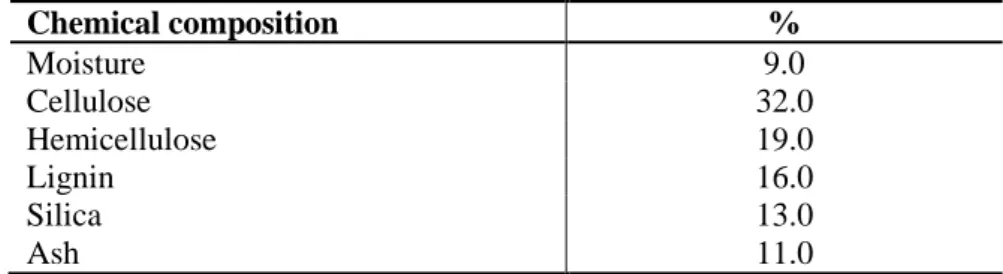
Table 2 Chemical composition of rice husk powder
Chemical composition %
Moisture 9.0
Cellulose 32.0
Hemicellulose 19.0
Lignin 16.0
Silica 13.0
Ash 11.0
Results and Discussion
Cure Characteristics
Si69 had a shorter t2, and t90 than compounds without a Si69 (control). Debasish et al reported (2004) that, the cure time and scorch time enhancement is due to improvement in filler dispersion in a rubber matrix by silane coupling agent. Wagner (1976) reported that, the mercaptosilane generally reduced the cure and scorch time to a certain degree depending on the types of accelerator system and elastomer. This effect is due to the presence of a thiol group in silane (γ-mercaptopropyltrimethyoxl) which is known to exert a catalytic effect on accelerating the curing process of NR compounds (Pot & Ng, 1998).
The effect of filler loading and a silane coupling agent on minimum torque, ML is shown in Table 3. It can be seen that, the ML of both NR compounds with or without silane coupling agent increases with increasing filler loading. This indicates that the presence of filler in the rubber matrix has reduced the mobility of the macromolecular chains of the rubber. However at a similar filler loading, compounds with a silane coupling agent Si69 have lower ML than the similar compounds without Si69. Debasish et al (2004) also reported, the reduction of ML is due to improvement in filler dispersion in a rubber matrix by silane coupling agent. According to Wolff et al (1993), in presence of silane coupling agent, the compounds Mooney viscosity and minimum torque of silica containing compounds were reduced.
The effect of RHP loading on torque difference (maximum torque – minimum torque), MH – ML of NR compounds with and without silane coupling agent are shown in Table 3. It can be seen that torque difference of NR compounds with or without silane coupling agent increase with increasing RHP loading. This could be due to appreciable improvement in crosslink density. At a similar filler loading, however, NR compounds with silane coupling agent exhibit higher torque difference than NR compounds without silane coupling agent. This is consistent with the finding by Krysztafkiewicz and Domka (1986) who reported that the incorporation of silane coupling agent increases the amount of sulphur linked to rubber through the formation of polysulphidic link during the vulcanization process and consequently, increases the crosslinking density.
Mechanical Properties
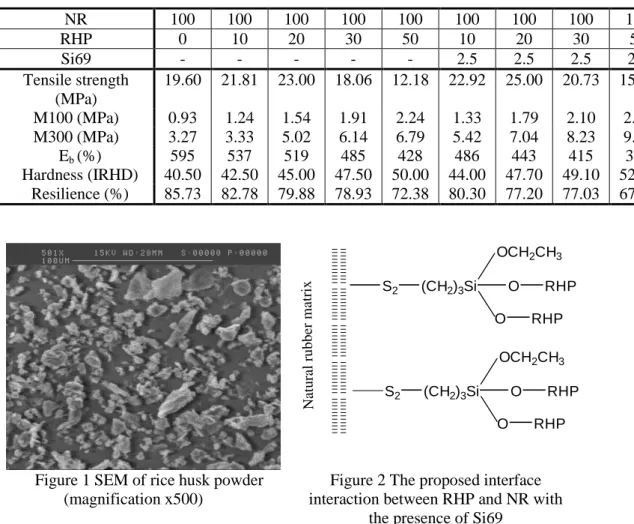
of the polymer. Fig. 2 shows the proposed mechanism occurred between NR compounds and RHP with the presence of Si69.
Table 3 Cure characteristics of RHP filled NR compounds
NR 100 100 100 100 100 100 100 100 100
RHP 0 10 20 30 50 10 20 30 50
Si69 - - - 2.5 2.5 2.5 2.5
Cure time, t90 (min) 11.15 8.42 7.14 6.42 6.20 7.17 5.52 5.26 4.40 Scorch time, ts2
(min)
6.20 4.72 4.04 3.50 3.12 3.88 3.28 3.11 2.93
ML (dNm) 0.06 0.09 0.11 0.14 0.16 0.08 0.11 0.13 0.14 MH – ML (dNm) 6.60 6.90 7.43 7.97 8.98 7.49 7.97 8.17 9.38
Table 4 Mechanical properties of Rice Husk Powder/Natural Rubber compounds
NR 100 100 100 100 100 100 100 100 100
RHP 0 10 20 30 50 10 20 30 50
Si69 - - - 2.5 2.5 2.5 2.5
Tensile strength (MPa)
19.60 21.81 23.00 18.06 12.18 22.92 25.00 20.73 15.00
M100 (MPa) 0.93 1.24 1.54 1.91 2.24 1.33 1.79 2.10 2.80 M300 (MPa) 3.27 3.33 5.02 6.14 6.79 5.42 7.04 8.23 9.09 Eb (%) 595 537 519 485 428 486 443 415 345 Hardness (IRHD) 40.50 42.50 45.00 47.50 50.00 44.00 47.70 49.10 52.74
Resilience (%) 85.73 82.78 79.88 78.93 72.38 80.30 77.20 77.03 67.90
N
at
u
ra
l
ru
b
b
er
m
at
ri
x
S2 (CH2)3Si
OCH2CH3
O RHP
O RHP
S2 (CH2)3Si
OCH2CH3
O RHP
O RHP
Figure 1 SEM of rice husk powder (magnification x500)
Figure 2 The proposed interface interaction between RHP and NR with
the presence of Si69
higher tensile modulus and hardness than the similar compounds but without a Si69. Hence incorporation of Si69 results in an increase in rubber-bound sulphur and gives the vulcanizates increased strength (Pot & Ng, 1998).
The effect of RHP on elongation at break, Eb and resilience of NR compounds with and without Si69 is shown in Table 4. It can be seen that both properties, decreases with increasing filler loading for both compounds. As filler loading increases, eventually, a reduction of the deformability of a rigid interface between filler and rubber matrix is expected. In other words, the addition of more RHP tends to impose extra resistance to flow and lead to lower value of Eb and resilience. However, it is observed that the Eb and resilience for NR compounds without Si69 is higher than NR compounds with Si69. As discussed before, Si69 is able to improve the functionality of RHP and subsequently enables RHP to bond chemically to the rubber matrix.
Figure 3 SEM tensile fracture of RHP filled NR compounds at 20 phr of filler and without a Si69 at magnification x300.
Figure 4 SEM tensile fracture of RHP filled NR compounds at 50 phr of filler and without a Si69 at magnification x300.
Figure 5 SEM tensile fracture of RHP filled NR compounds at 20 phr of filler
and with a Si69 at magnification x300
Figure 6 SEM tensile fracture of RHP filled NR compounds at 50 phr of filler
and with a Si69 at magnification x300.
respectively. It can be seen that from both figures that there are many holes formation after RHP were pulled out from the rubber matrix and unwetted filler on the surface particularly Fig. 4. However, for a similar compounds but with the presence of Si69 (Figs. 5 and 6), a better adhesion between RHP and rubber matrix can be seen. RHP well wetted by the rubber matrix and the pulled out of filler from rubber matrix is minimum. Figs. 5 and 6 also show that the surface has many tear lines with branching. This type of failure indicates strong adhesion between filler and rubber matrix.
Conclusions
Based on the above studies, the following conclusion can be drawn
1. Incorporation of silane coupling agent has improved the cure rate and minimum torque of RHP filled NR compounds. At a similar filler loading, NR compounds with silane coupling agent exhibited shorter cure time and scorch time; and lower minimum torque than NR compounds without silane coupling agent.
2. The mechanical properties viz. tensile strength, tensile modulus and hardness, were enhanced by incorporation the silane coupling agent. This improvement in properties was due to the ability of silane coupling agent in enhancing the crosslink density, and improving RHP dispersion and rubber-filler interaction in NR compounds.
Acknowledgements
The authors would like to thank the Universiti Teknologi MARA for sponsoring this work under project IRPA (vote 100-CHS: IRDC 9/19/22). The authors would also to thank Mr. Megat Rosli and Mr Nurazminudin, from the Bernas Perdana Sdn. Bhd. Penang, Malaysia, for preparing rice husk powder sample.
References
Dai W.L., (2003). Blendability and processing methodology of an environmental material rice husk/PVA composite, Materials Letter, 57, 3128 – 3136
Debasish D, Debapriya D, and Adhikari B., (2004). The effect of grass fiber filler on curing characteristics and mechanical properties of natural rubber, Polym. Advanced Technol., 15, 708 – 715
Geethamma V.G., Joseph R., and Thomas S., (1995). Short coir fiber-reinforced natural rubber composites: Effects of fiber length, orientation, and alkali treatment J Appl. Polym. Sci., 55, 583 - 594
IRRI 2004; www.irri.org
Ismail H., Edyham M.R., and Wirjosentono B., (2002). Bamboo fibre filled natural rubber composites: the effects of filler loading and bonding agent, Poly. Testing, 21, 139 – 144
Ismail H., Rosnah N., and Rozman H.D., (1997). Curing characteristics and mechanical properties of short oil palm fibre reinforced rubber composites, Polym., 36 (16), 4056 -4064
Joseph S., Sreekala M.S., Oommen Z., Koshy P., and Thomas S., (2002). A comparison of the mechanical properties phenol formaldehyde composites reinforced with banana fibres and glass fibres. Composites Sci. Technol. 62, 1857 – 1868
Krysztafkiewicz A., and Domka L., (1986). Effect of silane coupling in filled rubber vulcanizates. Plast. Rubb. Process. Appl., 55, 197 – 203
Pot B.T., and Ng C.C., (1998). Effect of silane coupling agents on the Mooney scorch time of silica-filled natural rubber compound. Eur. Polym., 34, 975 – 979
Poh B.T. and Wong K.W., (1998) “Effect of blend ratio on Mooney scorch time of rubber blends,” J. App. Polym. Sci., 69, 1301-1310
Wagner M.P., (1976). Reinforcing silicas and silicates, Rubb. Chem. Technol., 49, 703 – 774
Wolff S., Gorl U., Wang M.J., and Wolff W., (1993). Silica-based compounds: background and performance, presented at Tyretech ’93. Basel, Switzerland, October 1993.
RAZIF NORDIN, Faculty of Applied Science, Universiti Teknologi MARA Perlis, 02600 Arau, Perlis
C. S. SAID, Faculty of Applied Science, Universiti Teknologi MARA Malaysia, 40450 Shah Alam, Selangor