Aliso: A Journal of Systematic and Evolutionary Botany
Volume 13 | Issue 1
Article 6
1991
Distribution and Evolution of Forms and Types of
Sieve-element Plastids in the Dicotyledons
Dietmar Behnke
Universität Heidelberg
Follow this and additional works at:
http://scholarship.claremont.edu/aliso
Part of the
Botany Commons
Recommended Citation
Behnke, Dietmar (1991) "Distribution and Evolution of Forms and Types of Sieve-element Plastids in the Dicotyledons,"Aliso: A Journal of Systematic and Evolutionary Botany: Vol. 13: Iss. 1, Article 6.
ALISO 13(1), 1991, pp. 167-182
DISTRIBUTION AND EVOLUTION OF FORMS AND TYPES OF SIEVE-ELEMENT PLASTIDS IN THE DICOTYLEDONSI.2
H.-DIETMAR BEHNKE
Zel/enlehre der Universitiit Heidelberg Im Neuenheimer Feld 230
D-6900 Heidelberg, FRG
ABSTRACT
Sieve-element plastids may contain any combination of protein crystals (c), protein filaments (f), and starch grains (s), or none of these. All structurally distinct combinations (=forms) possible (s, cs, cfs, c, cf, fs, f, o) are recorded among the 2100 dicotyledons investigated so far with the transmission electron microscope (representing 381 of more than 460 families described). The six forms that include c and/or f define the P-type and are found in some 620 species, mainly confined to Magnolianae, Caryophyllanae, Vitanae, and Rutanae (Fabales, Linales, Rhizophorales). A detailed family-by-family analysis and quantitative form-by-form comparison suggests that form-Ss plastids give rise to all other forms. Based on a logic model connecting all forms via one-step-alterations (loss or gain of starch, protein crystals, or filaments), the distribution of P-type plastids within dicotyledons, their intercon-nection, and their relationships to the S-type taxa are discussed. Due to the diversity of sieve-element plastids found within one taxon, the Magnolianae (P- and S-type) are held to be a center of P-type evolution and more primitive than Caryophyllanae (P-type, only) or other superorders. The significance of sieve-element plastid data to the shaping of some of the higher dicotyledon taxa is discussed.
Key words: sieve-element plastids, P-type plastids, distribution, evolution, dicotyledons.
INTRODUCfiON
Studies of sieve-element plastids involve the description of the different forms and a recording of their distributions. These studies have, over the last two decades, contributed increasingly to data used in the characterization of higher taxa from the class level down to the subfamily level. For the monocotyledons, the P2-subtype of sieve-element plastids was found to be homogeneously present (Behnke 1969, 1981a) but several subtypes and forms ofP- and S-type plastids were described in the dicotyledons (Behnke 1972, 1981b). Within the dicots, the majority of superorders seem to represent pure S-type taxa, while others contain both P-type and S-type plastids and only two, Caryophyllanae and Vitanae, are unique in that they contain only P-type plastids (this paper follows the superordinal and ordinal classification of Dahlgren [1989]).
Dicotyledon sieve-element plastids were classified into a great number of dif-ferent subtypes and forms (Behnke 1981b), often distinguished only by minor morphological criteria. However, in some higher taxa (e.g., Magnolianae) the different forms of sieve-element plastids were difficult to classify under one sub-type, while identical forms were recorded in other taxa which have not been considered related.
168 ALISO
at the rank of family and their applicability to Dahlgren's (1989) system of the dicotyledons.
MATERIALS AND METHODS
Living material-fresh or shipped within a few days under special care-is a prerequisite for fixation of sieve elements and the eventual investigation of their plastids with the transmission electron microscope. Thin hand sections were made with a razor blade from herbaceous shoots or end parts of tree branches. The sections w~re immediately immersed into a fixing solution containing parafor-maldehyde and glutaraldehyde (Kamovsky 1965), kept therein for 3 to 24 h, washed with 0.1 M sodium cacodylate buffer (1 h, several changes), postfixed for 1 h with buffered 1% Os04 , dehydrated in acetone, embedded and polymerized
in an Epon-Araldite mixture, and processed according to standard methods for ultrathin sectioning and eventual photographing with a transmission electron microscope.
The samples of the some 2100 dicotyledon species investigated were collected from natural habitat (some 20% of the species) or at botanical gardens all over the world.
While complete lists of the species, their origin, collectors, and deposit of vouch-ers have already been given for some higher taxa (e.g., Fabales [Behnke and Pop 1981]; Myrtanae [Behnke 1984]; Magnolianae [Behnke 1988a]; parts ofRosanae and Rutanae [Behnke 1988b]; parts ofMalvanae and Rosanae ["Hamamelidae"] [Behnke 1989]), a summary of the sieve-element plastid data at the family level is given in Table 1.
RESULTS AND DISCUSSION
Development, Peculiarities, and Stability of the Plastids in Dicotyledon Sieve Elements
Sieve elements derive from procambial or cambial initials but undergo drastic structural changes before turning into functionally mature symplastic conduits for long-distance transport of assimilates. The translocating sieve element is enucleate and evacuolate. It has lost its major cytoplasmic contents, but remains delimited against the apoplast by the plasma membrane and thus stays alive for about one growing season (Behnke 1990; Evert 1990).
Plastids are among the few organelles that are present throughout the entire life span of a sieve element but they also undergo equally fundamental structural changes.
Initially there are proplastids, characterized by a dense matrix and a few thy-lakoids. Often an early accumulation of ergastic material (proteins or starch) is the first indication that their differentiation has been initiated. Increased quantities of ergastic products, loss of thylakoids, gradual depletion of the matrix, and a change from elongate-amoeboid to spherical shapes are further steps that even-tually lead to the typical sieve-element plastid (Behnke 1990).
Sieve-element starch stains reddish with iodine, contains less amylose and more amylopectins than ordinary amyloplast starch, and is specifically digested after treatment with enzymes cleaving a-1,6 bonds (Palevitz and Newcomb 1970). Proteins accumulate in sieve-element plastids in various morphological forms
VOL
and hov. plas;
A
ont• in e T
pla~
c
tegr
pla~
con 10-
mo-(:
of 1
aut
me
(_
det an<: ext ar( an•
COl
fer on eel the; Sh tid fo1 co:
Eh
cr:
di pc
m.
iti ar pr
ALISO
1
system of theecial care-is a
~gation of their
ions were made branches. The :aining
parafor-1 for 3 to 24 h,
,.), postfixed for nd polymerized
~rd methods for lission electron
I
~ were collected
~rdens all over
~posit
ofvouch-!Jehnke and Pop
~rts of Rosanae
~amamelidae"]
lthe family level
undergo drastic conduits for
VOLUME 13, NUMBER 1 169
and are digested after treatment with different proteases (Behnke 1975). In vivo, however, a digestion or synthesis of any of the contents of mature sieve-element plastids has never been observed.
According to our present knowledge, sieve-element plastids, as soon as their ontogenetic differentiation is terminated, become functionless and do not change in either size or content.
The stability-and thus reliability as a taxonomic character-of sieve-element
plastids is shown by the following evidence:
(1) Sieve-element plastids do not break down before the sieve element disin-tegrates: if artifacts of preparation and fixation are minimized, intact sieve-element plastids, i.e., surrounded by a double envelope and incorporating their usual contents, can still be found in old sieve elements, e.g., those at the base of an over 10-m-long monocotyledon vine of Dioscorea (Behnke, unpubl. data) or even in more than 5-yr-old palm sieve elements (Parthasarathy 1980).
(2) All sieve elements of a plant-primary or secondary-contain only one kind of plastid: Dioscorea, Saruma, and Pisum have been studied extensively in the author's laboratory, while indirect evidence derives from many papers docu-menting sieve-element studies from different parts of plants of a single species.
(3) The species-specific composition of sieve-element plastids is genetically determined and begins to be expressed as soon as a meristematic cell is determined and directed toward the differentiation of a sieve element. This also applies to extreme situations. If, after interruption of the stele (e.g., by wounding or grafting), a restitution of the vascular tissue is required to secure the continuity of nutrition-and hence survival-of a plant, new sieve elements will be formed from, e.g., cortical parenchyma. Sieve-element plastids have been helpful in identifying dif-ferent grafting partners (Kollmann and Glockmann 1990); it has also been dem-onstrated that, during wound restitution, amy lop lasts of an ordinary parenchyma cell transformed into species-specific sieve-element plastids that elaborated both the peculiar sieve-element starch and protein inclusions (Behnke and Schulz 1983; Shulz 1990). Undoubtedly, the specificity ofthe inclusions of sieve-element plas-tids is part of a genetic program that is expressed whenever a sieve element is formed. Therefore, the early development of the specific plastid contents will continue to be helpful in identifYing very young sieve elements (Behnke 1990; Eleftheriou 1990).
So far, it has not been shown that the types or amounts of sieve element inclusions are changed by environmental factors.
Types, Subtypes, and Forms of Sieve-Element Plastids
Sieve-element plastids are characterized by their ergastic inclusions, i.e., protein crystals (c), protein filaments (f), and starch grains (s). Different combinations and different quantities of these inclusions determine the specific sieve-element plastid possessed by a taxon. Consequently, if sieve-element plastids of an arbitrary number of species are screened, definite criteria are necessary to explain similar-ities or dissimilarsimilar-ities, to establish different categories of sieve-element plastids, and to eventually support or disprove the putative systematic position of a taxon proposed by considering other characters.
Early in the investigation of sieve-element plastids the presence or absence of protein inclusions was used as a criterion to make a major distinction between
. \'
170 ALISO
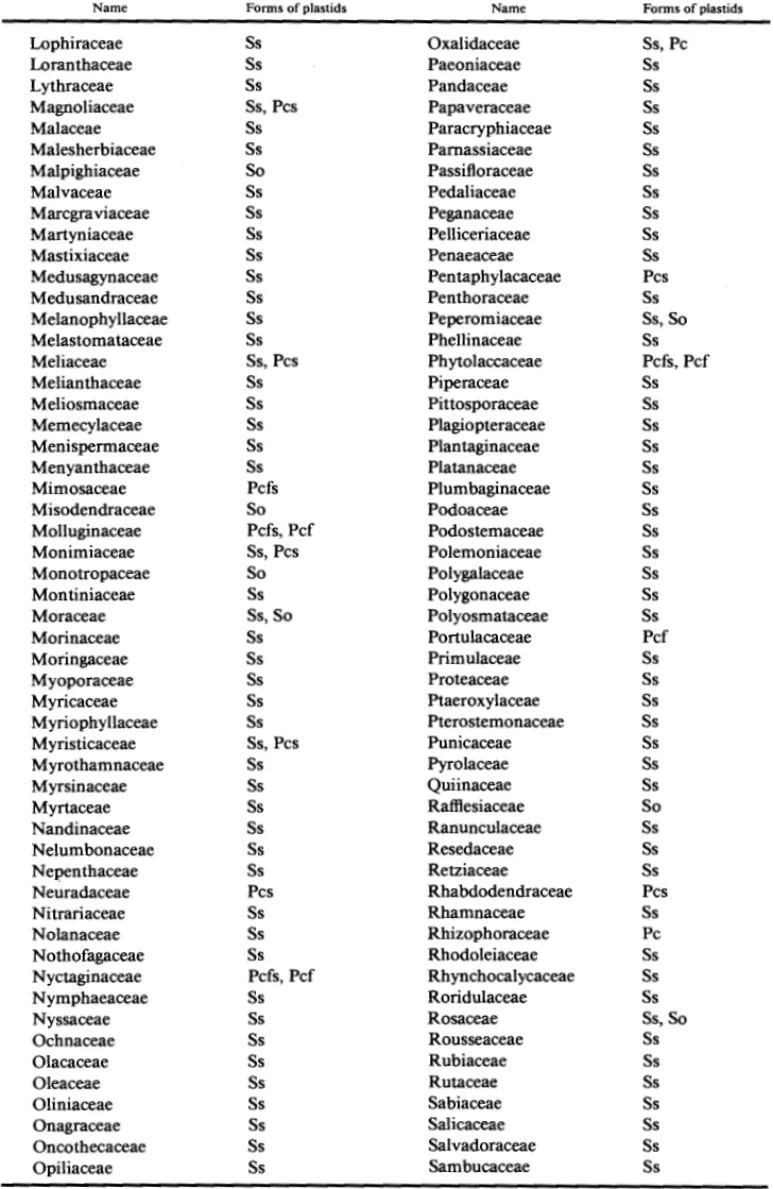
Table 1. Alphabetical list of dicotyledon families and the sieve-element plastid forms they possess. All families are recognized in either Cronquist's (1981), Thorne's (1983), Takhtajan's (1987), or Dahlgren's (1989) systems. A few additional families, which have distinctive plastids, have been considered.
Name Forms of plastids Name Forms of plastids
Acanthaceae Ss, Pes, Pc Bonnetiaceae Ss
Aceraceae Ss Boraginaceae Ss
Achariaceae Ss Brassicaceae Ss
Achatocarpaceae Pcf Bretschneideraceae Ss
Actinidiaceae Ss Brexiaceae Ss
Adoxaceae Ss Brunelliaceae Ss
Aegicerataceae Ss Bruniaceae Ss
Aextoxicaceae Ss Brunoniaceae Ss
Agdestidaceae Pcf Buddlejaceae Ss
Aizoaceae Pcf Burseraceae Ss
Akaniaceae Ss Buxaceae Pes, Pc
Alangiaceae Ss Byblidaceae Ss
Alseuosmiaceae Ss Cabombaceae Ss
Altingiaceae Ss Cactaceae Pcf
Amaranthaceae Pfs, Pf Caesalpiniaceae Pes
Amborellaceae Ss Callitrichaceae Ss
Amygdalaceae Ss Calycanthaceae Pcfs
Anacardiaceae Ss Calyceraceae Ss
Ancistrocladaceae Ss Campanulaceae Ss
Anisophylleaceae Ss Canellaceae Pes, Pcfs, Pfs
Annonaceae Pes, Pcfs Cannabaceae Ss
Apiaceae Ss Capparaceae Ss
Apocynaceae Ss Caprifoliaceae Ss
Aquifoliaceae Ss Caricaceae Ss
Araliaceae Ss Caryocaraceae Ss
Argophyllaceae Ss Caryophyllaceae Pcf
Aristolochiaceae Ss, Pes, Pcfs, Casuarinaceae Ss
Pc Cecropiaceae Ss,So
Asclepiadaceae Ss Celastraceae Ss
Asteraceae Ss Cephalotaceae Ss
Asteropeiaceae Ss Ceratophyllaceae Ss
Atherospermataceae Pcfs Cercidiphyllaceae Ss
Aucubaceae Ss Chenopodiaceae Pf
Austrobaileyaceae Ss Chloranthaceae Ss
A verrhoaceae Pcfs Chrysobalanaceae Ss
Balanitaceae Ss Cistaceae Ss
Balanopaceae Ss Clethraceae Ss
Balanophoraceae Ss Cneoraceae Ss
Balsaminaceae Ss Cobaeaceae Ss
Barbeyaceae Ss Cochlospermaceae Ss
Basellaceae Pcf Combretaceae Ss
Bataceae Ss Connaraceae Pes, Pcfs
Baueraceae Ss Convolvulaceae Ss
Begoniaceae Ss Cordiaceae Ss
Berberidaceae Ss Coriariaceae So
Berberidopsidaceae Ss Coridaceae Ss
Betulaceae Ss Cornaceae Ss, So, Pes
Bignoniaceae Ss Corylaceae Ss
Bischofiaceae Pes Corynocarpaceae Ss
Bixaceae Ss Crassulaceae So
ALISO VOLUME 13, NUMBER 1 171
~s they possess. Table 1. Continued.
~an's (1987), or
itids, have been Name Forms of plastids Name Forms of plastids
Crypteroniaceae Ss Goupiaeeae Ss
'orms of plastids Cueurbitaeeae Ss Greyiaeeae Ss
Cunoniaeeae Ss Grise1iniaeeae Ss
~ Curtisiaeeae Pes Grossu1ariaeeae Ss
Is Cyrillaeeae Pef Gunneraeeae Pes
Is Cytinaeeae So Gyroearpaeeae Pes
Is Daphniphyllaeeae Ss Gyrostemonaeeae Ss
Is Datiseaeeae Ss Halophytaeeae Pef
Is Davidiaeeae Ss Haloragaeeae Ss
Is Davidsoniaeeae Ss Hamamelidaeeae Ss
Is Degeneriaeeae Pes Heetorellaeeae Pef
Is Desfontainiaeeae Ss Helwingiaeeae Ss
Is Diapensiaeeae Ss Hemandiaeeae Pes
~es, Pe Diehapetalaeeae Ss Himantandraceae Ss
Is Didiereaeeae Pef Hippoeastanaeeae Ss
Is Dilleniaeeae Ss Hippoerateaeeae Ss
~ef Dioneophyllaeeae Ss Hippuridaeeae Ss
~es Dipsaeaeeae Ss Hoplestigmataeeae Ss
Is Dipteroearpaeeae Ss Hugoniaeeae Ss
~efs Donatiaeeae Ss H umiriaeeae Pes
Is Droseraeeae Ss Hydnoraeeae So
Is Duabangaeeae Ss Hydrangeaeeae Ss
•es, Pefs, Pfs Ebenaeeae Ss Hydrastidaeeae Ss
~s Ehretiaeeae Ss Hydrophyllaeeae Ss
~s Elaeagnaceae So Hypeeoaeeae Ss
Elaeoearpaeeae Ss Hyperieaeeae Ss
Elatinaeeae So Hypseoeharitaeeae Ss
Empetraeeae Ss Ieacinaeeae Ss
Epaeridaeeae Ss Idiospermaceae Pefs
Erieaeeae Ss Illieiaeeae Ss
Erythroxylaeeae Pe lteaeeae Ss
Esealloniaeeae Ss Ixonanthaeeae Ss
Eueommiaeeae Ss Juglandaeeae Ss
Eueryphiaeeae Pe J ulianiaeeae Ss
Euphorbiaeeae Ss Kiggelariaeeae Ss
Eupomatiaeeae Pes Kirkiaeeae Ss
Eupteleaeeae Ss Krameriaceae Ss
Fabaeeae Ss, Pes, Pe Laetoridaeeae Ss
Fagaceae Ss Lamiaeeae Ss
Flaeourtiaeeae Ss Lardizabalaeeae Ss
Fouquieriaeeae Ss Lauraeeae Pes
Franeoaeeae Ss Leeythidaeeae Ss
Frankeniaceae Ss Ledoearpaeeae Ss
Fumariaeeae Ss Leeaceae Pes
Pefs Garryaeeae Ss Leitneriaceae Ss
Gentianaeeae Ss LennoaC<tae Ss
Geraniaeeae Ss Lentibulariaeeae Ss
Gesneriaeeae Ss Lepidobotryaeeae Ss
Gisekiaeeae Pef Limnanthaeeae Ss
Glaucidiaeeae Ss Limoniaeeae Ss
Globulariaeeae Ss Linaeeae Ss
Gomortegaeeae Pefs Loasaeeae Ss
Gonystylidaeeae Ss Lobeliaeeae Ss
172 ALISO vo:
Table 1. Continued. T
Name Forms of plastids Name Forms of plastids
Lophiraceae Ss Oxalidaceae Ss, Pc
Loranthaceae Ss Paeoniaceae Ss
Lythraceae Ss Pandaceae Ss
Magnoliaceae Ss, Pes Papaveraceae Ss
Malaceae Ss Paracryphiaceae Ss
Malesherbiaceae Ss Pamassiaceae Ss
Malpighiaceae So Passifloraceae Ss
Malvaceae Ss Pedaliaceae Ss
Marcgraviaceae Ss Peganaceae Ss
Martyniaceae Ss Pelliceriaceae Ss
Mastixiaceae Ss Penaeaceae Ss
Medusagynaceae Ss Pentaphylacaceae Pes
Medusandraceae Ss Penthoraceae Ss
Melanophyllaceae Ss Peperomiaceae Ss, So
Melastomataceae Ss Phellinaceae Ss
Meliaceae Ss, Pes Phytolaccaceae Pcfs, Pcf
Melianthaceae Ss Piperaceae Ss
Meliosmaceae Ss Pittosporaceae Ss
Memecylaceae Ss Plagiopteraceae Ss
Menispermaceae Ss Plantaginaceae Ss
Menyanthaceae Ss Platanaceae Ss
Mimosaceae Pcfs Plumbaginaceae Ss
Misodendraceae So Podoaceae Ss
Molluginaceae Pcfs, Pcf Podostemaceae Ss
Monimiaceae Ss, Pes Polemoniaceae Ss
Monotropaceae So Polygalaceae Ss
Montiniaceae Ss Polygonaceae Ss
Moraceae Ss, So Polyosmataceae Ss
Morinaceae Ss Portulacaceae Pcf
Moringaceae Ss Primulaceae Ss
Myoporaceae Ss Proteaceae Ss
Myricaceae Ss Ptaeroxylaceae Ss
Myriophyllaceae Ss Pterostemonaceae Ss
Myristicaceae Ss, Pes Punicaceae Ss
Myrothamnaceae Ss Pyrolaceae Ss
Myrsinaceae Ss Quiinaceae Ss tw
Myrtaceae Ss Raffiesiaceae So p);
Nandinaceae Ss Ranunculaceae Ss
Nelumbonaceae Ss Resedaceae Ss
Nepenthaceae Ss Retziaceae Ss wi
Neuradaceae Pes Rhabdodendraceae Pes pt
Ni trariaceae Ss Rhamnaceae Ss hi
Nolanaceae Ss Rhizophoraceae Pc
of
N othofagaceae Ss Rhodoleiaceae Ss
Nyctaginaceae Pcfs, Pcf Rhynchocalycaceae Ss gr
Nymphaeaceae Ss Roridulaceae Ss m
Nyssaceae Ss Rosaceae Ss, So in
Ochnaceae Ss Rousseaceae Ss ar
Olacaceae Ss Rubiaceae Ss
Oleaceae Ss Rutaceae Ss
Oliniaceae Ss Sabiaceae Ss ca
Onagraceae Ss Salicaceae Ss
el
Oncothecaceae Ss Salvadoraceae Ss re
ALISO
1 Forms of plastids
Ss, Pc Ss 'Ss Ss Ss Ss Ss Ss Ss Ss Ss Pes Ss
1 Ss, So Ss Pcfs, Pcf Ss Ss Ss Ss Ss Ss Ss Ss Ss Ss Ss Ss Pcf Ss Ss Ss Ss Ss Ss Ss So Ss Ss Ss Pes Ss Pc Ss Ss Ss Ss, So Ss Ss Ss Ss Ss Ss Ss
VOLUME 13, NUMBER 1 173
Table l. Continued.
Name Forms of plastids Name Forms of plastids
Santalaceae Ss Tetracarpaeaceae Ss
Sapindaceae Ss Tetracentraceae Ss
Sapotaceae Ss Tetragoniaceae Pcf
Sarcolaenaceae Ss Theaceae Ss
Sargentodoxaceae Ss Theligonaceae Ss
Sarraceniaceae Ss Theophrastaceae Ss
Saururaceae Ss Thunbergiaceae Ss
Sauvagesiaceae Ss Thymelaeaceae Ss
Saxifragaceae Ss Ticodendraceae Ss
Schisandraceae Ss Tiliaceae Ss
Scrophulariaceae Ss Tovariaceae Ss
Scyphostegiaceae Ss Trapaceae Ss
Scytopetalaceae Ss Tremandraceae Ss
Simaroubaceae Ss Trigoniaceae Ss
Simmondsiaceae Ss Trimeniaceae Ss
Siparunaceae Pes Trochodendraceae Ss
Siphonodontaceae Ss Tropaeolaceae Ss
Solanaceae Ss Tumeraceae Ss
Sonneratiaceae Ss Ulmaceae Ss, So, Pc
Sphaerosepalaceae Ss Urticaceae Ss, So
Stachyuraceae Ss Vahliaceae Ss
Stackhousiaceae Ss Valerianaceae Ss
Staphyleaceae Ss V erbenaceae Ss
Stegnospermataceae Pcf Vibumaceae Ss
Sterculiaceae Ss Violaceae Ss
Strasburgeriaceae Ss Viscaceae Ss
Stylidiaceae Ss Vitaceae Pes
Stylobasiaceae Ss Vivianiaceae Ss
Styracaceae Ss Vochysiaceae Ss
Surianaceae Ss Winteraceae Ss, Pes
Symplocaceae Ss Xanthophyllaceae Ss
Tamaricaceae Ss Zygophyllaceae Ss, Pes
two types of sieve-element plastids, named P-type and S-type (sieve-element)
plastids, respectively (Behnke 1971 ).
The category subtypes of sieve-element plastids was introduced (Behnke 1975,
with slight modifications in 1977) to allow emphasis of similarities in the mor-phology of protein inclusions present within sieve-element plastids of related higher taxa and at the same time provide a simple reference to, and identification of, sieve-element plastids of species that belong to the appropriate taxonomic group. Subtype identification was indicated by numerals (previously roman nu-merals, e.g., Pill, now arabic ones, e.g., P3). Prominent examples of subtypes
include the cuneate crystals of the monocotyledons (P2) and the protein filaments arranged in a peripheral ring in plastids of the Caryophyllanae (P3).
The form of a sieve-element plastid is the basic unit in the hierarchy of plastid
categories. Forms were originally used to subdivide subtypes and to refer to "sieve-element plastids which are typical of some families or family groups within the respective higher taxon" (Behnke 1977). While their labelling was changed from alphabetized to nmemonic symbols, forms always represented "the realized
por-
ALISO 174
YO
tiOJ cry
I
nm
anc
red cor wit Of the
19~
Al of:
I
int1 Of{ fan dia pia thi: cas
trw [Be
kin 191
~
ne2 cia:
1
sie'
the
lS 2
tha
Fi 12 ( filan
noli;
by l
Tieg
do/a Can thur
Pf: 1
ALISO VOLUME 13, NUMBER 1 175
tions of a potential free combination of the different plastid contents, viz. (protein) crystals, (protein) filaments, and starch" (Behnke 1981 b).
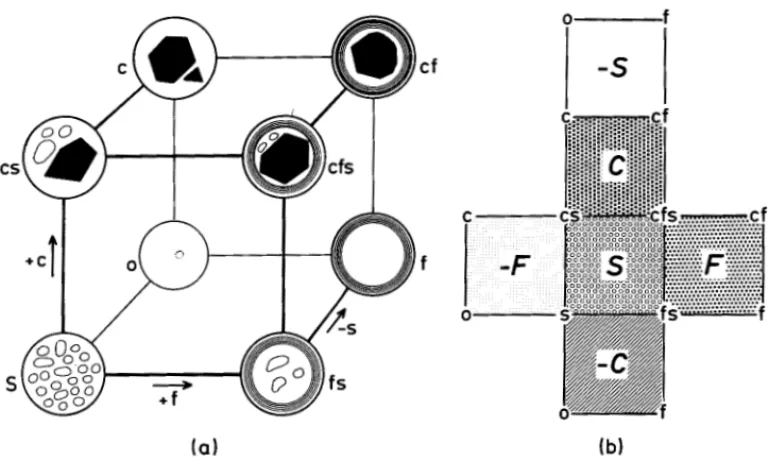
If one refrains from morphological or quantitative differences (e.g., shape or number of crystals) and only records the presence or absence of crystals, filaments, and starch, the great apparent diversity of forms of sieve-element plastids is reduced to only eight qualitatively distinct combinations (Fig. 1); one form in-corporating all characters (cfs), three forms with any two (cf, cs, fs), three forms with only one character (c, f, s), and one form that is devoid of any inclusion (o). Of these eight forms six (cfs, cf, cs, fs, c, f) belong to the P-type and two (s, o) to the S-type (form-So plastids were earlier classified as the So-subtype [Behnke
1977, 1981b]).
A New Model of the Interrelationships Between Forms of Sieve-Element Plastids
In 1981, 26 morphologically different forms of sieve-element plastids, grouped into six subtypes, were recognized in angiosperm families investigated by the use of plastid data. A first attempt to show the possible interrelationships among these families resulted in a two-dimensional coordinate system and a semicladistic diagram (Behnke 1981 b: Figs. 5 and 1 0). However, the affiliation of sieve-element plastids forms to a distinct subtype turned out to be one of the weak points of this classification. The subtype characteristics were not distinct enough, in all cases, to definitely assign several forms to only one P-subtype (this is especially true for the P1- and P4-subtypes of which the cfs-forms looked very similar [Behnke 1981b]). Also, some subtypes were not likely to be correlated with any kind of common evolution of the taxa represented (e.g., PS-subtype, Behnke
1982a).
Since then, the duplication of the number of investigated species, as well as the near completion of the family survey in the dicotyledons has led to a modified classification of sieve-element plastids.
The revised classification emphasizes the eight qualitatively distinct forms of sieve-element plastids (Fig. 1) and, with the exception ofthe Caryophyllanae (and the Monocotyledons), disregards their grouping into subtypes. If, in addition, it is assumed that during evolution all forms are interchangeable, a logical model that demonstrates their interrelationships is a cube (Fig. 2).
Fig. 1. Different forms and types of sieve-element plastids represented in the dicotyledons. The 12 p1astids depicted show all the combinations between starch (s), protein crystals (c), and protein filaments (f) possible and found within dicotyledons. The examples are taken mainly from the Mag-nolianae and Caryophyllanae. From top left to base right the different plastid forms are represented by the following species. S: Aconitum napellus L. (Ranunculaceae), Psc: Belliolum crassifolium Van Tiegh. (Winteraceae), Pcfs: Daphnandra repandula F. Muell. (Atherospermataceae), So: Peperomia
176 ALISO
s
-+f
(a)
0 f
cf
-S
c
--F
o
-(b)
Fig. 2. Cubical model of the interconnections between the eight forms of sieve-element plastids.-2a. Forms of plastids are located in the comers of the cube. A transition of any form into any other alongside the edges is accompanied by a gain or loss of only one character (c = protein crystals, f = protein filaments, s = starch).-2b. An unfolding of the six faces ofthe cube enables the demonstration of their genuine features, i.e., presence or absence of one character (e.g., the S -face is bordered by all forms of sieve-element plastids containing starch grains, the -S-face by all forms lacking starch).
Within the cube the eight forms are placed in the eight comers, which are connected by the twelve edges of the cube. Any form of a sieve-element plastid is altered by one character (loss or gain) if a change is made from one comer along one edge to any neighboring comer (such one-step-alterations did possibly prevail during the evolution of plastid forms). The orientation of the cube in Figure 2a demonstrates the acquisition of protein crystals from base to top, of protein filaments from left to right, and the loss of starch from front to back.
A cube has six faces; those of the "sieve-element plastid cube" are specifically bordered by four different plastid forms. Although each plastid form consequently serves as a cornerstone for three different faces, each face is recognized by the presence or absence of only one character (C, F, S, and -C, -F, -S-face, respec-tively). In order to better demonstrate the morphological distinctness of the faces, the cube has been unfolded and reproduced as a square grid in Figure 2b.
The S-face (front in Fig. 2a, marked by open circles in Fig. 2b) is bordered by the four plastid forms containing starch, the C-face (top in Fig. 2a, squares in Fig. 2b) is edged by the four crystal-containing forms, and the F-face (right in Fig. 2a, heavy dots in Fig. 2b) is framed by all of the forms that contain protein filaments. An absence of protein filaments characterizes the -F-face (left in Fig. 2a, small dots in Fig. 2b), an absence of protein crystals distinguishes the -C-face (bottom in Fig. 2a, hatching in Fig. 2b), and an absence of starch grains denotes the -S-face (back plain in Fig. 2a, blank in Fig. 2b).
The way the cube is drawn in Figure 2a (i.e., sitting on the -C-face and having the S-face in front) corresponds to the quantitative distribution ofS-type plastids
vc
an re
14:_;
pc Tl ar
sic
2a
ar of in th yl·
4:;;
re-m
st-fa
1)
h~
of ti<: di tb
pl
al
of
(P
1n
m
of cc
s-(e: is
ALISO VOLUME 13, NUMBER I 177
and their importance in the development of the other plastid forms. Independent results from several taxa (e.g., Acanthaceae [Behnke 1986a]; Magnolianae [Behnke 1988a]; "Hamamelidae" [Behnke 1989]) recently led to a rediscussion of the possible evolutionary succession ofthe forms and types of sieve-element plastids. This resulted in a reorientation of the putative evolutionary trend: form-Ss plastids are now thought to represent the starting point from which all other forms of sieve-element plastids are derived, according to the cube edges drawn in Figure 2a (for an earlier view see Behnke 1981b).
Forms of Sieve-Element Plastids: Their General Distribution, Their Distribution Among Extant Dicotyledons, and
Their Putative Evolutionary Succession
The 2100 dicotyledonous species for which the forms of sieve-element plastids are recorded are distributed evenly over all major taxa and represent at least 1% of all extant dicotyledons. Exactly 381 ofthe 460 dicotyledon families recognized in at least one of the major present-day angiosperm systems are represented in the sieve-element plastid studies (Table 1 ). This includes 282 of the 318 dicot-yledon families in Cronquist (1981), 274 ofthe 296 in Thome (1983), 355 ofthe 429 in Takhtajan (1987), and 332 of the 373 dicotyledon families recognized in "The Last Dahlgrenogram" (Dahlgren 1989).
The 381 families represent 99% ofthe total of about 176,000 dicotyledons. The remaining 77 families, of which fresh samples have not yet become available, are monotypic or monogeneric or contain only a few genera. Of the 382 families studied, 13 families had both P-type and S-type sieve-element plastids, while 48 families had only P-type plastids and 320 had exclusively S-type plastids (Table 1). A total of620 ofthe 2100 species contain P-type plastids, while 1480 species haveS-type plastids in their sieve elements. Therefore, according to the number of investigated species, about 30% of all dicotyledons would contain P-type plas-tids. An almost equally high percentage (about 25%) of the total number of extant dicotyledons is obtained if the calculation is based on the proportional sizes of the families or subfamilies covered.
If one considers the quantitative distribution of the eight forms of sieve-element plastids, form-Ss plastids, found in about 67% (1400) of the species, far outnumber all others. Form-Pes plastids are the second most numerous, found in 15% (306) ofthe species, followed by form-Pcf(7% [140]). All other forms rank far behind (Pc: 4% [75]; Pcfs: 3% [60]; Pf: 2% [35]; So: 4% [78]); form-Pfs has been found in only four species.
The frequencies of the different plastid forms, and the occurrence of two or more forms in a single higher taxon, suggest the following evolutionary trends.
(1) The edge between sand cs (Fig. 2a) represents the major line of alteration of forms: Almost all taxa that have heterogeneous sieve-element plastid types contain at least the Ss and Pes forms.
(2) Other frequent transformations are required along the es-c, cs-cfs, and s-o edges: Forms Pes, Pcfs and/or Pc are often found to occur in the same taxon (e.g., Fabales, Laurales, Aristolochiaceae, Acanthaceae; see also Table 1); the same is true with respect to the So and Ss forms (e.g., Moraceae, Peperomiaceae, Ro-saceae).
NVM I
I
\
I
\
I
\. I' \ \---.
---.
PHO AEALES "-/ ·,,""""'"'
WINTERALES PIPERALES / / _/· URTICALES2~
:n
T
I
' '~~----~~
I I '
---\
'
I I
EUPHORBIALES " '
"''~""
'
\
ASTERALES \S§
s~~~ ~g~g ~~~o~~ s~~~o ~fr.fr.~~~ t:r ,... rl"' •• r-t \C 'T'1 I'T'1 IV'o r-t ~ M ... r'T' 'T'1 ,::· lJ!la
"Q ...,.._ t:r ""' 0 ""' ~ ... ~ <"I 1:::1 r'" fl' 'T'1 """ ~~ ~ 0 '<~t:r P..~'[i;' (j"'qo
oq" ,--, ~ ~ Sl!-_, 00
~
~ALISO VOLUME 13, NUMBER l 179
(see Fig. 2) are observed more often than between different faces, and, with the exception of the Aristolochiaceae, no family is known to express forms on two different faces.
(4) Faces of the sieve-element plastid cube, once exclusively established for a higher taxon, are comparatively stable and of additional taxonomic significance; e.g., F-face for Caryophyllanae, -F-face for Urticales, and C-face for the Monocot-yledoneae.
The Distribution of Types and Forms of Sieve-Element Plastids Among the Higher Taxa of Dicotyledons
The distribution of sieve-element plastid types among the families, orders, and superorders of dicotyledons is quantitatively plotted in "The Last Dahlgreno-gram" (Dahlgren 1989), where white areas mark S-type and shading denotes P-type plastids (Fig. 3). The amount of shading corresponds to the extent of the different families (see Dahlgren's figure 2). An alphabetically arranged list of dicotyledon families investigated for their sieve-element plastids is given in Ta-ble 1.
More than 90% of the dicotyledons containing P-type plastids were found in Dahlgren's (1989) four superorders: Magnolianae (about 60% of its species in 12 of its 23 families); Caryophyllanae (all species); Vitanae (all species); and Rutanae (nearly all Fabales, 70% of Linales, 20% of Rhizophorales, and Connaraceae of Sapindales). Less than 10% were distributed over 12 different families from five other superorders.
Although the Magnolianae, Caryophyllanae, Vitanae, and Rutanae certainly represent their strongholds, the total distribution ofP-type sieve-element plastids among the current dicotyledon systems does not readily suggest any simple phy-logenetic line. P-type plastids are found in 10 of Dahlgren's (1989) 25 superorders (Fig. 3), in all of Cronquist's (1981) six subclasses, in nine ofThome's (1983) 19 superorders, and in 14 of Takhtajan's (1987) 37 superorders (from six of eight subclasses).
Therefore, a detailed family-by-family analysis and qualitative form-by-form comparison (supplemented by quantitative characters, such as diameter of sieve-element plastids and amount of starch vs. protein content) were initiated to find out where the center of evolution for P-type plastids might have been (Behnke 1988a, b, 1989).
Results from the Magnolianae (Behnke 1988a) led to the conclusion that this superorder reflected not only a transition of S-type into P-type plastids, but rep-resents the major center for the evolution of the P-type. The extreme heterogeneity of the sieve-element plastids found within Magnolianae, and the interrelationships to specific P-subtypes present in other taxa, are in favor of this concept.
Six different plastid forms (Ss, So, Pes, Pc, Pcfs, Pfs; i.e., all forms of the
S-and -F-faces) are recorded in the Magnolianae, a number not reached by any other superorder. Four different forms from the same two cube faces are even
180 ALISO
found in the Aristolochiaceae; no other family is recorded to have more than three forms (Table 1). Five families contain both S-type and P-type plastids; three of these have only the "Ss" and "Pes" forms. In a few genera, sieve-element plastid forms were found that would favor their affiliation with another superorder, although there is little doubt on their placement within the Magnolianae. The aristolochiacean genera Asarum and Saruma contain form-Pc plastids identical
to the subtype-P2 plastids of the Monocotyledoneae (Behnke 1981 a, b). The form-Pfs plastids of Canella (Canellaceae) are very similar to subtype-P3 plastids,
otherwise known only in the Caryophyllanae.
All other superorders are either monotypic (see Caryophyllanae, Vitanae, and those superorders left entir€t1y white in Fig. 3) or contain only two or three plastid forms, none of which are particularly related to subtypes P2 or P3.
Caryophyllanae are the most homogeneous dicotyledon superorder, both with respect to the taxa included in the different modem systems and to their sieve-element plastids. No other higher taxon of comparable size demonstrates such harmony between Cronquist's (1981), Thome's (1983), Takhtajan's (1987) and Dahlgren's (1989) recent treatments. The results from our sieve-element plastid studies have largely influenced this accordance (see Eckardt 1976 for a review of earlier systems). The 180 investigated species of the Caryophyllanae contain P-type plastids, the forms of which are exclusively located in the F-face and belong to the P3-subtype.
The presence of P-type sieve-element plastids in some taxa and the presence
Of
S-type plastids in others has corroborated conclusions drawn independently using other characters or has repeatedly initiated reconsiderations of their posi-tioning within different systems; e.g., Vitales/Rhamnales (Johnston 197 4; Behnke1974; Behnke and Dahlgren 1975; Dahlgren 1980, 1989; Takhtajan 1987); Gun-nerales/Haloragales(Behnke 1981b, 1986b; Dahlgren 1980, 1989; Takhtajan 1987); Buxaceae/Simmondsiaceae (Behnke 198 2b ); Rhizophoraceae/ Anisophylleaceae (Cronquist 1981; Behnke 1984, 1988b; Dahlgren 1989).
ACKNOWLEDGMENTS
The ultrastructural investigations of the sieve-element plastids were supported by grants from the Deutsche Forschungsgemeinschaft.
LITERATURE CITED
Behnke, H.-D. 1969. Die Siebrohren-Plastiden der Monokotyledonen. Vergleichende Untersuchung-en iiber Feinbau und Verbreitung eines charakteristischUntersuchung-en PlastidUntersuchung-entyps. Planta 84:17 4-184. - - . 1971. Sieve-tube plastids ofMagnol!idae and Ranunculidae in relation to systematics. Taxon
20:723-730.
- - . 1972. Sieve-tube plastids in relation to angiosperm systematics-an attempt towards a classification by ultrastructural analysis. Bot. Rev. (Lancaster) 38:155-197.
- - . 1974. P- und S-Typ Siebelement-Plastiden bei Rhamnales. Beitr. Bioi. Pflanzen 50:457-464. (appeared 1975)
- - . 197 5. P-type sieve-element plastids: a correlated ultrastructural and ultrahistochemical study on the diversity and uniformity of a new reliable character in seed plant systematics. Protoplasma 83:91-101.
- - . 1977. Transmission electron microscopy and systematics of flowering plants. Pl. Syst. Evol., Suppl. 1:155-178.
- - . 1981a. Siebelement-Plastiden, Phloem-Protein und Evolution der Bliitenpflanzen: II. Mono-kotyledonen. Ber. Dtsch. Bot. Ges. 94:647-662.
VOLl
Crono
Dahl1
DahlJ
EckaJ
Eieftl
Even
John:
Kam
Kollr
Pale-..
Partt
ALISO
18-Ve more than
~ plastids; three
~ sieve-element
~er superorder,
~olianae. The lastids identical
(l, b). The
form-rpe-P3 plastids,
~e, Vitanae, and
i or three plastid
~3.
the presence independently of their posi-1974; Behnke
1987);
Gun-..,._.,, ... J·~· 198 7);
were supported
lenJpftanzen:· II.
Mono-VOLUME 13, NUMBER 1 181
- - - . 198lb. Sieve-element characters. Nord. J. Bot. 1:381-400.
- - - . 1982a. Sieve-element plastids of Cyrillaceae, Erythroxylaceae and Rhizophoraceae: descrip-tion and significance of subtype PV plastids. Pl. Syst. Evol. 141:31-39.
- - - . 1982b. Sieve-element plastids, exine sculpturing and the systematic affinities of the Buxaceae. Pl. Syst. Evol. 139:257-266.
- - - . 1984. Ultrastructure of sieve-element plastids of Myrtales and allied groups. Ann. Missouri Bot. Gard. 71:824-831.
- - - . 1986a. Contributions to the knowledge ofP-type sieve-element plastids in dicotyledons. IV. Acanthaceae. Bot. Jahrb. Syst. 106:499-510.
- - - . 1986b. Contributions to the knowledge of sieve-element plastids in Gunnaraceae and allied families. Pl. Syst. Evol. 151:215-222.
- - - . 1988a. Sieve-element plastids, phloem protein and evolution of flowering plants: III. Mag-noliidae. Taxon 37:699-732.
- - - . 1988b. Sieve-element plastids and systematic relationships of Rhizophoraceae, Anisophyl-leaceae and allied groups. Ann. Missouri Bot. Gard. 75:1387-1409.
- - - . 1989. Sieve-element plastids, phloem proteins and the evolution of flowering plants. IV. Hamamelidae, pp. 105-128. In P.R. Crane and S. Blackmore [eds.], Evolution, systematics,
and fossil history of the Hamamelidae. Systematics Association Special Volume 40A, Oxford Univ. Press, Oxford.
- - - . 1990. Siebelemente. Kernlose Spezialisten fUr den Stoffiransport in Pflanzen. Naturwissen-schaften 77: 1-11.
- - - , and R. Dahlgren. 1975. The distribution of characters within an angiosperm system. 2. Sieve-element plastids. Bot. Not. 129:287-295.
- - - , and L. Pop. 1981. Sieve-element plastids and crystalline P(hloem)-protein in Leguminosae: micromorphological characters as an aid to the circumscription of the family and subfamilies, pp. 707-715. InR. M. PolhillandP. H. Raven [eds.],Advancesinlegumesystematics.Academic
Press, London.
- - - , and A. Schulz. 1983. The development of specific sieve-element plastids in wound phloem of Coleus blumei (S-type) and Pisum sativum (P-type), regenerated from amyloplast-containing
parenchyma cells. Protoplasma 114: 125-132.
Cronquist, A. 1981. An integrated system of classification of flowering plants. Columbia Univ. Press, New York .
Dahlgren, G. 1989. The last Dahlgrenogram -system of classification of the Dicotyledons, pp. 249-260. InK. Tan [ed.], The Davis and Hedge Festschrift. Edinburgh University Press, Edinburgh.
Dahlgren, R. M. T. 1980. A revised system of classification of the angiosperms. J. Linn Soc., Bot. 80:91-124.
Eckardt, T. 1976. Classical morphological features of centrospermous families. Pl. Syst. Evol. 126: 5-25.
Eleftheriou, E. P. 1990. Monocotyledons, pp. 139-159. In H.-D. Behnke and R. D. Sjolund [eds.],
Sieve elements. Comparative structure, induction and development. Springer-Verlag, Berlin-Heidelberg-New York.
Evert, R. F. 1990. Dicotyledons, pp. 103-137. In H.-D. Behnke and R. D. Sjolund [eds.], Sieve
elements. Comparative structure, induction and development. Springer-Verlag, Berlin-Heidel-berg-New York.
Johnston, M. C. 1974. Rhamnales, pp. 794-796. In Encyclopaedia Britannica, 15th ed., vol. 15.
Chicago.
Karnovsky, M. J. 1965. A formaldehyde-glutaraldehyde fixative of high osmolality for use in electron microscopy. J. Cell Bioi. 27:137A-138A.
Kollmann, R., and C. Glockmann. 1990. Sieve elements of graft unions, pp. 219-237. In H.-D.
Behnke and R. D. Sjolund [eds.], Sieve elements. Comparative structure, induction and de-velopment. Springer-Verlag, Berlin-Heidelberg-New York.
Palevitz, B. A., and E. H. Newcomb. 1970. A study of sieve element starch using sequential enzymatic digestion and electron microscopy. J. Cell Bioi. 45:383-398.
Parthasarathy, M. V. 1980. Mature phloem of perennial monocotyledons. Ber. Dtsch. Bot. Ges. 93: 57-70.
Schulz, A. 1990. Wound-sieve elements, pp. 199-217. In H.-D. Behnke and R. D. Sjolund [eds.],
ALISO 182
Takhtajan, A. 1987. Systema Magnoliophytorum. Nauka, Leningrad. 440 p. (in Russian). Thome, R. F. 1983. Proposed new realignments in the angiosperms. Nord. J. Bot. 3:85-117.
FOOTNOTES
1 This paper is dedicated to the memory of Rolf Dahlgren who always took a great interest in the
sieve-element plastid data.
2 Based on a presentation given at the XIV International Botanical Congress in Berlin, 1 August
1987, as part of the Rolf Dahlgren Memorial Symposium entitled "Steps toward the natural system of the dicotyledons," chaired by R. F. Thome and H. Huber.
'I p ti